Adding Semantics to Data-Driven Paraphrasing
Ellie Pavlick1 Johan Bos2 Malvina Nissim2 Charley Beller3 Benjamin Van Durme4 Chris Callison-Burch1
1Computer and Information Science Department, University of Pennsylvania 2Center for Language and Cognition Groningen, University of Groningen 4Human Language Technology Center of Excellence, Johns Hopkins University
3IBM Watson Group
Abstract
We add an interpretable semantics to the paraphrase database (PPDB). To date, the relationship between phrase pairs in the database has been weakly de-fined as approximately equivalent. We show that these pairs represent a vari-ety of relations, including directed entail-ment (little girl/girl) and exclusion ( no-body/someone). We automatically assign semantic entailment relations to entries in PPDB using features derived from past work on discovering inference rules from text and semantic taxonomy induction. We demonstrate that our model assigns these relations with high accuracy. In a down-stream RTE task, our labels rival relations from WordNet and improve the coverage of a proof-based RTE system by 17%.
1 Motivation
A basic precursor to language understanding is the ability to recognize when two expressions mean the same thing. Different expressions of the same information is the central problem addressed by paraphrasing and the closely related task of rec-ognizing textual entailment (RTE). In RTE, a sys-tem is given two pieces of text, often called the text (T) and the hypothesis(H), and asked to de-termine whether T entails H, T contradicts H, or T and H are unrelatable (Figure 1). In contrast, data-driving paraphrasing typically sidesteps de-veloping a clear definition of “meaning the same thing” and instead “assume[s] paraphrasing is a coherent notion and concentrate[s] on devices that can produce paraphrases” (Barzilay, 2003). Re-cent work on paraphrase extraction has resulted in enormous paraphrase collections (Lin and Pan-tel, 2001; Dolan et al., 2004; Ganitkevitch et al., 2013), but the usefulness of these collections
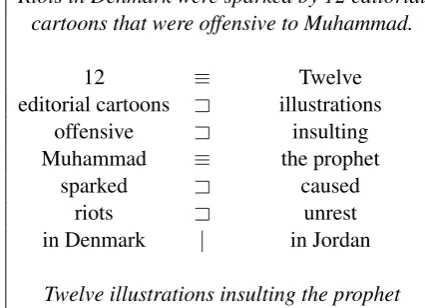
Riots in Denmark were sparked by 12 editorial cartoons that were offensive to Muhammad.
12 ⌘ Twelve
editorial cartoons A illustrations offensive A insulting Muhammad ⌘ the prophet
sparked A caused
riots A unrest
in Denmark | in Jordan
[image:1.595.305.518.213.367.2]Twelve illustrations insulting the prophet caused unrest in Jordan.
Figure 1: An example sentence pair for the RTE task. In order for a system to conclude that the premise (top) does not entail the hypothesis (bottom), it should recognize thatsparked im-pliescausedbut thatin Denmarkprecludesin Jordan. These phrase-level entailment relationships are modeled by natural logic.
is limited by the fast-and-loose treatment of the meaning of paraphrases. One concrete defini-tion that is sometimes used for paraphrases re-quires that they be bidirectionally entailing (An-droutsopoulos and Malakasiotis, 2010). That is, in terms of RTE, it is assumed that if P is a para-phrase of Q, then P entails Q and Q entails P. In reality, paraphrases are often more nuanced (Bha-gat and Hovy, 2013), and the entries in most para-phrase resources certainly do not match this def-inition. For instance, Lin and Pantel (2001) ex-tracted 12 million “inference rules” from mono-lingual text by exploiting shared dependency con-texts. Their method learns paraphrases that are truly meaning equivalent, but it just as readily learns contradictory pairs such ashX rises,X fallsi. Ganitkevitch et al. (2013) extract over 150 mil-lion paraphrase rules by pivoting through foreign translations. This bilingual method often learns hypernym/hyponym pairs, e.g. due to variation in the discourse structure of translations
Equivalent Entailment Exclusion Other relation Unrelated
look at/watch little girl/girl close/open swim/water girl/play
a person/someone kuwait/country minimal/significant husband/marry to found/party
clean/cleanse tower/building boy/young girl oil/oil price profit/year
away/out the cia/agency nobody/someone country/patriotic man/talk
distant/remote sneaker/footwear blue/green drive/vehicle car/family
the phone/the telephone heroin/drug france/germany family/home holiday/series
last autumn/last fall doe/deer least three/least two basketball/court green/tennis
illegal entry/smuggling typhoon/storm child/mother playing/toy sunday/tour
[image:2.595.75.554.61.175.2]approve/to ratify seriously injure/injure in front/on the side islamic/jihad city/south alliance of/coalition between sunglasses/glasses oppose/support delay/time back/view
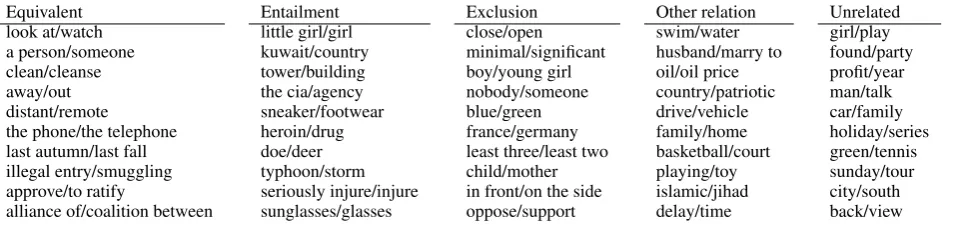
Table 1: Examples of different types of entailment relations appearing in PPDB.
Burch, 2007), and unrelated pairs, e.g. due to mis-alignments or polysemy in the foreign language.
The unclear semantics severely limits the ap-plicability of paraphrase resources to natural lan-guage understanding (NLU) tasks. Some efforts have been made to identify directionality of para-phrases (Bhagat et al., 2007; Kotlerman et al., 2010), but tasks like RTE require even richer se-mantic information. For example, in the T/H pair shown in Figure 1, a system needs information not only about equivalent words (12/twelve) and asymmetric entailments (riots/unrest), but also se-mantic exclusion (Denmark/Jordan). Such lexical entailment relations are captured bynatural logic, a formalism which views natural language itself as a meaning representation, eschewing external representations such as First Order Logic (FOL). This is a great fit for automatically extracted para-phrases, since the phrase pairs themselves can be used as the semantic representation with minimal additional annotation. But as is, paraphrase re-sources lack such annotation.
As a result, NLU systems rely on manually built resources like WordNet, which are limited in cov-erage and often lead to incorrect inferences (Ka-plan and Schubert, 2001). In fact, in the most recent RTE challenge, over half of the submitted systems used WordNet (Pontiki et al., 2014). Even the NatLog system (MacCartney and Manning, 2007), which popularized natural logic for RTE, relied on WordNet and did not solve the problem of assigning natural logic relations at scale.
The main contributions of this paper are: • We add a concrete, interpretable semantics
to the Paraphrase Database (PPDB) (Ganitke-vitch et al., 2013), the largest paraphrase re-source currently available. We give each try in the database a label describing the en-tailment relationship between the phrases. • We develop a statistical model to predict
these relations. The enormous size of PPDB– over 77 million phrase pairs!– makes it im-possible to perform this task manually. Our wide range of monolingual and bilingual fea-tures results in high intrinsic accuracy. • We demonstrate improvements to a
proof-based RTE system, showing that our auto-matic labels increase the number of proofs that it is able to find by 17%, while maintain-ing the same accuracy as when usmaintain-ing gold-standard, manual labels.
2 Related Work
Lexical entailment resources Approaches to paraphrase identification have exploited signal from distributional contexts (Lin and Pantel, 2001; Szpektor et al., 2004), comparable corpora (Dolan et al., 2004; Xu et al., 2014), and graph structures (Berant et al., 2011; Brockett et al., 2013). These approaches are scalable, but they often assume that all relations are equivalence relations (Madnani and Dorr, 2010). Several efforts have attempted to build or augment lexical ontologies automati-cally, to discover other types of lexical relations like hypernyms. Most of these approaches rely on lexico-syntactic patterns. Hearst (1992) searched for hand-written patterns (e.g. “an X is a Y”) in a large corpus in order to learn taxonomic relations between nouns. Snow et al. (2006) used depen-dency parses to automatically learn such patterns, which they used to augment WordNet with new hypernym relations. Similar monolingual signals have been used to learn fine-grained relationships between verbs, such asenablement and happens-before(Chklovski and Pantel, 2004; Hashimoto et al., 2009).
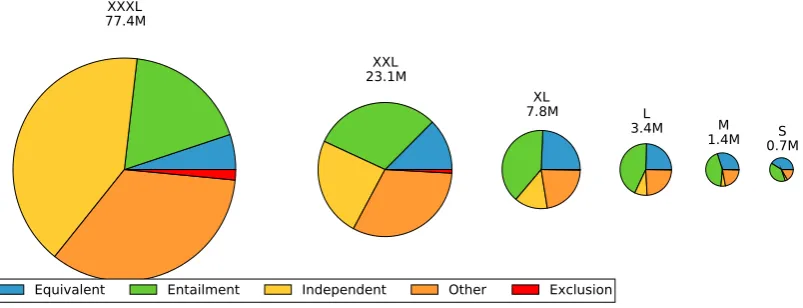
Figure 2: Distribution of entailment relations in different sizes of PPDB. Distributions are estimated from our manual annota-tions of randomly sampled pairs. PPDB-XXXL contains over 77MM paraphrase pairs (where the majority type is independent), compared to only 700K in PPDB-S (where the majority type is equivalent).
using data motivated by the applications to infor-mation retrieval, inforinfor-mation extraction, summa-rization, machine translation evaluation, and more recently, question answering (Giampiccolo et al., 2007) and essay grading (Clark et al., 2013). RTE systems vary considerably in their choice of rep-resentation and inference procedure. In the most recent shared task on RTE, some systems used deep logical representations of text, allowing them to invoke theorem provers (Bjerva et al., 2014) or Markov Logic Networks (Beltagy et al., 2014) to perform the inference, while others used shal-lower representations, relying on machine learn-ing to perform inference (Lai and Hockenmaier, 2014; Zhao et al., 2014). Systems based on natural logic (MacCartney and Manning, 2007) use natu-ral language as a representation, but still perform inference using a structured algebra rather than a statistical model. Regardless of the inference pro-cedure, improvements to external lexical resources can improve RTE systems across the board (Clark et al., 2007).
3 The Paraphrase Database (PPDB)
PPDB is currently the largest available collection of paraphrases. Compared to other paraphrase resources such as the DIRT database (12 mil-lion rules) (Lin and Pantel, 2001) and the MSR paraphrase phrase table (13 million) (Dolan et al., 2004), PPDB contains over 150 million para-phrase rules covering three parapara-phrase types– lex-ical (single word), phrasal (multiword), and syn-tactic restructuring rules. We focus on lexical and phrasal paraphrases, of which there are over 77 million rules. Of these, a large fraction are true
paraphrases– either equivalent (distant/remote) or asymmetric entailment (girl/little girl)– but many are not. PPDB contains some pairs which are related by semantic exclusion (nobody/someone), some of which are related by something other than entailment (swim/water), and some which are sim-ply unrelated (car/family). Table 1 gives examples of pairs in PPDB falling into each of these cate-gories.
PPDB is released in six sizes (S, M, L, XL, XXL and XXXL), which fall roughly on a con-tinuum from highest precision and lowest recall to lowest average precision and highest recall. Fig-ure 2 shows how the distribution of entailment re-lations differs across the sizes of PPDB.1Our goal is to make these relations explicit, by providing annotations for each phrase pair. Because of the enormous scale of PPDB, this annotation must be done automatically.
4 Selection of Paraphrases
In this paper we focus on paraphrases pairs from PPDB that occur in RTE data. We use the recent SICK dataset from in the 2014 SemEval RTE chal-lenge (Marelli et al., 2014) for our experiments. The data consists of 10K sentences split roughly evenly into training and testing sets. The sen-tence pairs are labeled using a 3-way entailment classification:ENTAILMENT, (29%)CONTRADIC -TION (15%), or NEUTRAL (56%). We consider
all phrase pairs from PPDB hp1, p2i up to three
words in length such that there is some T/H sen-tence pair in whichp1appears in T andp2appears
Lexical We use the lemmas, POS tags, and phrase lengths ofp1andp2, the substrings shared byp1 andp2, and the Levenstein, Jaccard, and Hamming distances betweenp1andp2.
Distributional Given a dependency context vectors forp1andp2, we compute the number of shared contexts, and the Jaccard, Cosine, Lin1998, Weeds2004, Clarke2009, and Szpektor2008 similarities between the vectors.
Paraphrase We include 33 paraphrase features distributed with PPDB, which include the paraphrase probabilities as computed in Bannard and Burch (2005). We refer the reader to Ganitkevitch and Callison-Burch (2014) for a complete description of all of the features included with PPDB.
Translation We include the number of foreign language “pivots” (translations) shared byp1andp2for each of 24 languages used in the construction of PPDB, as a fraction of the total number of translations observed for each ofp1andp2.
Path We include a sparse vector of all lexico-syntactic patterns (paths through a dependency parse) which are observed betweenp1andp2in the Annotated Gigaword corpus (Napoles et al., 2012).
[image:4.595.310.524.379.473.2]WordNet We include binary features indicating whether WordNet classifiesp1andp2according to any of the following relations: synonym, hypernym, hyponym, antonym, holonym, meronym, cause, entailment, derivationally-related, similar-to, also-see, or attribute.
Figure 3: Summary of features extracted for each phrase pairhp1, p2i. Full descriptions of the features used are given in the supplementary material.
in H. Roughly 55% of the word types and 5% of the phrase (bigram and trigram) types in the SICK data appear in PPDB. This gives us a list of 9,600 pairs, half from the training sentences, which we use for development in Section 6, and half from the test sentences, which we use for evaluation in Section 7.
The SICK data has a relatively small vocabu-lary, with 86% of words types and <1% of the phrase types covered by WordNet. Still, over half of the words in SICK which are covered by PPDB do not appear in WordNet. In general, PPDB cov-ers a much larger vocabulary (1.6MM words) than does WordNet (155K words), and we expect the potential benefit of using PPDB in addition to or in place of WordNet to be larger on datasets with richer vocabularies.
5 Entailment Relations
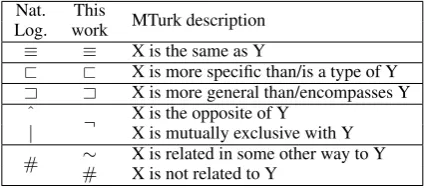
We use the relations from Bill MacCartney’s thesis on natural language inference as the basis for our categorization of relations (MacCartney, 2009). He outlines 7 basic entailment relation-ships:2
Equivalence (P⌘Q):8x[P(x)$Q(x)]
Forward Entailment (P@Q):8x[P(x)!Q(x)] Reverse Entailment (PAQ):8x[Q(x)!P(x)] Negation (PˆQ):8x [P(x)$ ¬Q(x)]
Alternation (P|Q):8x¬[P(x)^Q(x)] Cover (P^Q):8x[P(x)_Q(x)] Independence (P#Q): All other cases.
2To further clarify the definitions here: “negation” is XOR (exclusive disjunction), “alternation” is NAND, and “cover” is OR (inclusive disjunction)
These relations are based on the theory of natu-ral logic, meaning they are defined between pairs of natural language expressions rather than requir-ing an external formal representation. This makes them an ideal fit for the phrase pairs in in PPDB and similar automatically-constructed paraphrase resources.
Nat. This MTurk description Log. work
⌘ ⌘ X is the same as Y
@ @ X is more specific than/is a type of Y
A A X is more general than/encompasses Y
ˆ ¬ X is the opposite of Y | X is mutually exclusive with Y
# ⇠# X is related in some other way to YX is not related to Y
Table 2: Column 1 gives the semantics of each label under MacCartney’s Natural Logic. Column 2 gives the notation we use throughout the remainder of this paper. Column 3 gives the description that was shown to Turkers.
moder-Cosine Similarity Monolingual (symmetric) Monolingual (asymmetric) Bilingual
A shades/the shade ¬ large/small A boy/little boy ⌘ dad/father
A yard/backyard ⌘ few/several A man/two men A some kid/child
# each other/man ¬ different/same A child/three children ⌘ a lot of/many
A picture/drawing ¬ other/same ⌘ is playing/play ⌘ female/woman
[image:5.595.75.527.62.124.2]⇠ practice/target ¬ put/take A side/both sides ⌘ male/man
Table 3: Top scoring pairs (x/y) according to various similarity measures, along with their manually classified entailment labels. Column 1 is cosine similarity based on dependency contexts. Column 2 is based on Lin (1998), column 3 on Weeds (2004), and column 4 is a novel feature. Precise definitions of each metric are given in the supplementary material.
ate levels of agreement (Fleiss’s= 0.56) (Landis and Koch, 1977). For a fuller discussion of the annotation, refer to the supplementary material.
6 Automatic Classification
We aim to build a classifier to automatically assign entailment types to entries in the PPDB, and to demonstrate that it performs well both intrinsically and extrinsically. We fix the direction of the@and
Arelations to create a single class and train a lo-gistic regression classifier to distinguish between the 5 classes{#,⌘,A,¬,⇠}. We compute vari-ety of basic lexical features and WordNet features (summarized in Figure 3). We categorize the re-maining features into two broad groups: monolin-gual features, which are based on observed usage in the Annotated Gigaword corpus (Napoles et al., 2012), and bilingual features, which are based on translation probabilities observed in bilingual par-allel corpora. Full descriptions of all the features used are provided in the supplementary material. 6.1 Monolingual features
Path features Snow et al. (2004) used lexico-syntactic patterns to mine taxonomic relations (hypernyms and hyponyms) between noun pairs. They were able to verify the earlier work of Hearst (1992) which found that certain patterns, e.g. X and other Y, are strong indicators of hypernymy. Using similar path features, we learn new patterns to differentiate between more subtle relations. For example, we learn the patternseparate X from Yis highly indicative of the¬relation. We learn that the patternX including Y suggestsAmore than it suggests⌘whereas the patternX known as Y sug-gests⌘more thanA. Table 4 gives examples of some of the paths most indicative of the¬relation. Distributional features Lin and Pantel (2001) attempted to mine inference rules from text by finding paths in a dependency tree which connect the same nouns. The intuition is that good para-phrases should tend to modify and be modified by
in X and in Y in foods and in beverages
separate X from Y separate the old from the young
to X and/or to Y to the left or to the right
from X to Y from 7 a.m. to 10 p.m.
more/less X than Y more harm than good
Table 4: Top paths associated with the¬class.
the same words. Given context vectors, Lin and Pantel (2001) used a symmetric similarity met-ric (Lin, 1998) to find candidate paraphrases. We build dependency context vectors for each word in our data and compute both symmetric as well as more recently proposed asymmetric similarity measures (Weeds et al., 2004; Szpektor and Da-gan, 2008; Clarke, 2009), which are potentially better suited for identifying A paraphrases. Ta-ble 3 gives a comparison of the pairs which are considered “most similar” according to several of these metrics.
6.2 Bilingual features
We explore a variety of bilingual features, which we expect to provide complimentary signal to the monolingual features. Each pair in PPDB is asso-ciated with several paraphrase probabilities, which are based on the probabilities of aligning each word to the foreign “pivot” phrase (a foreign trans-lation shared by the two phrases), computed as described in Bannard and Callison-Burch (2005). We also compute the total number of shared for-eign translations for each phrase pair. Table 3 shows the highest ranked pairs by this bilingual similarity score, in comparison to several of the monolingual scores.
6.3 Analysis
Table 1
mono Predicted label (using monolingual features)
Predicted label (using bilingual features)
Predicted label (using all features)
ind syn hyp exl oth
≣
⊐
¬ # ~
≣
⊐
¬ # ~
≣
⊐
¬ # ~
syn 1 3 1 0 0 4
≣
58% 20% 4% 15% 3% 62% 21% 5% 4% 8% 83% 10% 0% 2% 4%hyp 2 3 7 0 1 13
⊐
20% 51% 3% 18% 7% 27% 5% 7% 7% 54% 6% 76% 2% 7% 8%exl 1 1 1 1 0 4
¬
26% 14% 37% 17% 6% 6% 14% 30% 36% 14% 2% 8% 73% 13% 3%ind 14 2 2 0 1 20
#
8% 13% 2% 71% 6% 1% 7% 6% 78% 8% 1% 4% 2% 88% 6%oth 3 1 2 0 2 10
~
15% 21% 5% 36% 23% 8% 19% 9% 30% 35% 5% 10% 3% 18% 64%bi
ind syn hyp exl oth
syn 0 3 1 0 0 4
hyp 2 7 1 2 13 24
exl 1 0 1 1 1 4
ind 15 0 1 1 2 20
oth 3 1 2 1 3 10
both
ind syn hyp exl oth
syn 9 368 46 1 19 443
hyp 97 83 1004 29 108 1321
exl 49 9 29 275 13 375
ind 1730 15 82 35 114 1976
oth 169 48 97 33 609 956
T
ru
e
la
b
e
[image:6.595.71.290.265.338.2]l
Figure 4: Confusion matrices for classifier trained using only monolingual features (distributional and path) versus bilingual features (paraphrase and translation). True labels are shown along rows, predicted along columns. The matrix is normalized along rows, so that the predictions for each (true) class sum to 100%. The confusion matrices reflect classifier’s performance on held-out phrase pairs from the SICK test set.
F1 when excluding
All Lex. Dist. Path Para. Tran. WN
# 79 -2.0 -0.2 -1.2 -1.7 -0.2 -0.1
⌘ 57 -3.5 +0.2 -0.7 -2.4 -3.7 +0.5
[image:6.595.308.535.328.451.2]A 68 -4.6 -0.3 -0.8 -0.8 -0.7 -1.6 ¬ 49 -4.0 -0.8 -2.9 +0.3 -0.0 -2.2 ⇠ 51 -4.9 -0.5 -0.7 -1.2 -0.9 -0.3 Table 5: F1 measure (⇥100) achieved by entailment classifier using 10-fold cross validation on the training data.
Table 3 shines some light onto the differences between monolingual and bilingual similarities. While the monolingual asymmetric metrics are good for identifyingApairs, the symmetric met-rics consistently identify ¬ pairs; none of the monolingual scores we explored were effective in making the subtle distinction between⌘ pairs and the other types of paraphrase. In contrast, the bilingual similarity metric is fairly precise for identifying ⌘ pairs, but provides less infor-mation for distinguishing between types of non-equivalent paraphrase. These differences are fur-ther exhibited in the confusion matrices shown in Figure 4; when the classifier is trained using only monolingual features, it misclassifies 26% of ¬ pairs as ⌘, whereas the bilingual features make this error only 6% of the time. On the other hand, the bilingual features completely fail to predict the
Aclass, calling over 80% of such pairs⌘or⇠.
7 Evaluation
7.1 Intrinsic Evaluation
We test the performance of our classifier intrinsi-cally, through its ability to reproduce the human labels for the phrase pairs from the SICK test sen-tences. Table 7 shows the precision and recall achieved by the classifier for each of our 5
en-tailment classes. The classifier is able to achieve an overall 79% accuracy, reaching >70% preci-sion while maintaining good levels of recall on all classes.
True Pred. N Example misclassifications ⇠ # 169 boy/little, an empy/the air
# ⇠ 114 little/toy, color/hair
A ⇠ 108 drink/juice, ocean/surf
A # 97 in front of/the face of, vehicle/horse
A ⌘ 83 cat/kitten, pavement/sidewalk ⌘ A 46 big/grand, a girl/a young lady
A ¬ 29 kid/teenager, no small/a large ¬ A 29 old man/young man, a car/a window
# ⌘ 15 a person/one, a crowd/a large ⌘ # 9 he is/man is, photo/still
⌘ ¬ 1 girl is/she is
Table 6: Example misclassifications from some of the most frequent and most interesting error categories.
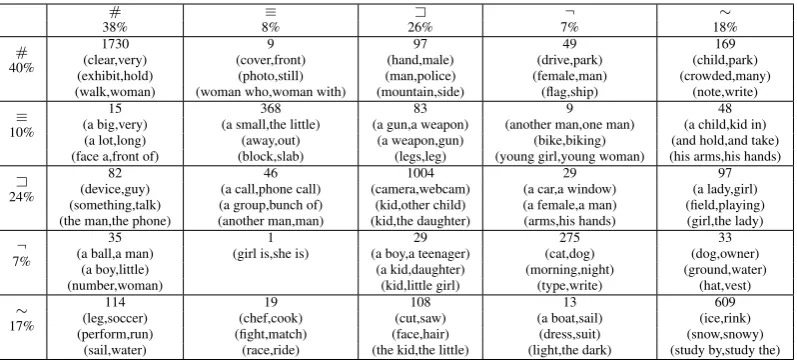
Figure 4 shows the classifier’s confusion ma-trix and Table 6 shows some examples of common and interesting error cases. The majority of errors (26%) come from confusing the⇠class with the #class. This mistake is not too concerning from an RTE perspective since ⇠ can be treated as a special case of#(Section 5). There are very few cases in which the classifier makes extreme errors, e.g. confusing⌘with¬or with#; some interest-ing examples of such errors arise when the phrases contain pronouns (e.g. girl ⌘ she) or when the relation uses a highly infrequent word sense (e.g. photo⌘still).
7.2 The Nutcracker RTE System
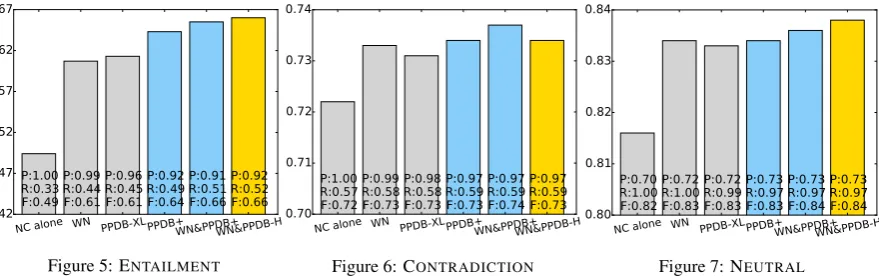
Figure 5: ENTAILMENT Figure 6: CONTRADICTION Figure 7: NEUTRAL
Figure 8: F1 measures achieved by Nutcracker on SICK test data when using various KBs. Baselines are in gray, this work in blue, human references in gold. PPDB-XL refers to a run in which every pair which appears in PPDB is assumed to be equivalent. PPDB-H refers to a run in which manual labels were used to generate axioms. PPDB+refers to runs in which the automatic classifications were used to generate axioms. In some cases, better proof coverage causes NC to find incorrect proofs, illustrated by the decreased performance onCONTRADICTIONwhen using PPDB-H. For example, using PPDB-H, NC finds an inconsistency for the pairSomeone is not playing piano./A person is playing a keyboard. Using the PPDB+, in which
piano/keyboardis falsely classified as#, NC fails to find a proof and so correctly guessesNEUTRAL.
Freq. Precision Recall F score # 39% 84.22 87.55 85.85 ⌘ 8% 70.36 83.07 76.19
[image:7.595.81.283.300.383.2]A 26% 79.81 76.00 77.85 ¬ 7% 73.73 73.33 73.53 ⇠ 19% 70.57 63.70 66.96
Table 7: F1 measure (⇥100) achieved by entailment classifier on the held out phrase pairs from the sentences in SICK test.
In the SemEval 2014 RTE challenge, this system performed in the top 5 out of the more than 20 par-ticipating systems (Marelli et al., 2014).
Given a text/hypothesis (T/H) pair, Nutcracker (NC) uses the Boxer parser (Bos, 2008) to produce a formal semantic representation of both T and H, which it translates into standard first-order logic. The logical formulae are passed to an off-the-shelf theorem prover, which searches for a logical en-tailment, and to a model builder, which attempts to find a logical contradiction. By default, when the system fails to find a proof for either entailment or inconsistency, it predicts the most frequent class (in our case, NEUTRAL). Therefore, NC relies
heavily on lexical entailment resources in order to improve the recall of the theorem prover and model builder.
Baselines The most frequent class baseline is achieved by labeling every sentence pair asNEU -TRAL, and results in an accuracy of 56%. A
stronger baseline is obtained by running NC alone, without any external axioms; in this case, words are only equivalent if they are lemma-identical.
As an additional baseline, we generate a “basic”
Acc. # Proofs Coverage
MFC 56.4 0 0%
NC alone 74.3 878 17.8%
+ WN 77.5 1,051 21.3%
+ PPDB-XL 77.5 1,091 22.1%
+ PPDB+ 78.0 1,197 24.3%
+ WN, PPDB+ 78.4 1,230 25.0%
+ WN, PPDB-H 78.6 1,232 25.0%
Table 8: Nutcracker’s overall system accuracy and proof cov-erage when using different sources of axioms. Covcov-erage is measured as the percent of sentence pairs for which NC’s theorem prover or model builder is able to find a complete logical proof of either entailment or contradiction. When NC fails to find either type of proof, it guesses the most frequent class,NEUTRAL. NC alone uses no axioms. PPDB+ refers to the axioms generated automatically using the classifier de-scribed in this paper. PPDB-H refers axioms generated using the human labels on which the classifier was trained.
PPDB-XL3knowledge base (KB), which consists exclusively of axioms expressing synonym rela-tionships. I.e. for every pair of phraseshp1, p2iin
PPDB-XL, the PPDB-XL KB contains the equiv-alence axiom syn(p1, p2). We also generate the
WordNet (WN) KB, which is the default used by NC. This KB consists of axioms for all synonyms, antonyms, and hypernyms in WN, which generate syn,isnota, andisaaxioms, respectively. PPDB+ We convert our classifier’s predictions into a set of axioms for NC. When our classifier predicts⌘we generate ansynaxiom, when it pre-dicts A we generate an isa axiom, and when it predicts¬we generate an isnotaaxiom. #and ⇠do not generate any axioms. To handle the di-rectionality of theArelation, we run the classifier
True PPDB+ WN Text/Hypothesis pair
ENTAIL. ENTAIL. NEUTRAL Abridein a white dress is running/Agirlin a white dress is running. ENTAIL. NEUTRAL ENTAIL. Alemuris biting a person’s finger./Ananimalis biting a person’s finger. CONTRA. CONTRA. NEUTRAL Someoneis playing a piano./There isno oneplaying a piano.
CONTRA. NEUTRAL CONTRA. There isno manpouring oil into apan./A manis pouring oil into askillet. Table 9: Examples of T/H pairs for which the system’s prediction differed when using PPDB+vs. WN.
over every pair in both directions, and we choose whichever direction and relation receives the high-est confidence score to be the final prediction. We refer to this set of automatically-predicted axioms as PPDB+.
To calibrate our improvements, we also gener-ate a KB using the human labels collected from MTurk, which we refer to as PPDB-Human or PPDB-H.
Results Table 8 reports NC’s overall prediction accuracy and the number of proofs found when us-ing each of the described KBs. Figure 8 shows the performance in terms of the precision and recall achieved for each of the three entailment classes:
ENTAILMENT, CONTRADICTION, andNEUTRAL.
Table 9 provides some examples of T/H pairs on which predictions differed using the PPDB+ com-pared to the WN KB, and Figure 9 shows some illustrative misclassifications.
Our automatic labels result in a 4% improve-ment in accuracy over the baseline of using NC alone (Figure 8), and a 15 point improvement in F1 measure for the entailment class (Table 8). By all performance measures, PPDB+also outperforms WordNet as a source of axioms for NC. More-over, adding PPDB+to WordNet gives a 17% rel-ative increase in the number of proofs found com-pared to using WordNet alone (Table 8). These additional proofs lead NC to make a greater num-ber of correct predictions for the “right reasons” (i.e. finding a proof/contradiction) rather than by lucky guessing (recall NC guesses the most fre-quent class when it cannot find a proof).
For comparison, we run the same experiments using a KB of oracle human labels in place of the predicted labels in PPDB+. Using PPDB+, NC comes very close to the performance achieved when using PPDB-Human, demonstrating that the automatically generated PPDB+ provides as much utility to the end-to-end system as does a gold-standard resource.
8 Data Release
Upon publication, we are releasing a new PPDB fully annotated with semantic relations. We are also releasing the set of 14K manually labeled phrase pairs occurring in RTE data, and our soft-ware for extracting features and running the clas-sifier, so that researchers can apply our model to their own paraphrase collections. This will consti-tute the largest lexical entailment resources avail-able, while also offering new fine-grained anno-tation necessary for challenging NLU tasks. An evaluation of the predicted relations appearing in the entire Paraphrase Database (not just those oc-curring in RTE data) is given in the supplementary material.
9 Conclusion
We argue that a significant failing of recent work on data-driven paraphrasing is the weak definition of paraphrases as being more-or-less equivalent. In this paper, we show how a clear concept of se-mantics can be applied to large-scale paraphrase resources. In particular, the entailment relations given by natural logic are a great fit for paraphrase resources, since natural logic operates on pairs of natural language expressions (like the entries in PPDB). By classifying paraphrase entries with en-tailment relations, we provide them with an inter-pretable semantics. Our classifier uses extensive feature sets to scale natural logic to the enormous number of phrase pairs in PPDB. We rigorously evaluate our model, demonstrating high accuracy on an intrinsic task. On an extrinsic RTE task, our model’s predictions allow an RTE system to find 17% more proofs and achieve a higher overall ac-curacy than when using WordNet’s manual rela-tions. Our new release of PPDB, annotated with semantic entailments, will dramatically improve PPDB’s utility for NLU tasks.
# ⌘ A ¬ ⇠
38% 8% 26% 7% 18%
# 1730 9 97 49 169
40% (exhibit,hold)(clear,very) (cover,front)(photo,still) (man,police)(hand,male) (female,man)(drive,park) (crowded,many)(child,park) (walk,woman) (woman who,woman with) (mountain,side) (flag,ship) (note,write)
⌘ 15 368 83 9 48
10% (a big,very)(a lot,long) (a small,the little)(away,out) (a gun,a weapon)(a weapon,gun) (another man,one man)(bike,biking) (and hold,and take)(a child,kid in) (face a,front of) (block,slab) (legs,leg) (young girl,young woman) (his arms,his hands)
A 82 46 1004 29 97
24% (something,talk)(device,guy) (a group,bunch of)(a call,phone call) (camera,webcam)(kid,other child) (a car,a window)(a female,a man) (field,playing)(a lady,girl) (the man,the phone) (another man,man) (kid,the daughter) (arms,his hands) (girl,the lady)
¬ 35 1 29 275 33
7% (a ball,a man)(a boy,little) (girl is,she is) (a boy,a teenager)(a kid,daughter) (morning,night)(cat,dog) (ground,water)(dog,owner)
(number,woman) (kid,little girl) (type,write) (hat,vest)
⇠ 114 19 108 13 609
[image:9.595.101.500.61.241.2]17% (perform,run)(leg,soccer) (fight,match)(chef,cook) (face,hair)(cut,saw) (a boat,sail)(dress,suit) (snow,snowy)(ice,rink) (sail,water) (race,ride) (the kid,the little) (light,the dark) (study by,study the)
Figure 9: Confusion matrix for classifier (with all features) on SICK test set. True labels and their distribution are shown along the columns, predicted along the rows.
Facebook. This material is based in part on re-search sponsored by the NSF under grant IIS-1249516 and DARPA under agreement number FA8750-13-2-0017 (the DEFT program). The U.S. Government is authorized to reproduce and distribute reprints for Governmental purposes. The views and conclusions contained in this pub-lication are those of the authors and should not be interpreted as representing official policies or en-dorsements of DARPA or the U.S. Government.
The authors would like to thank Peter Clark, Bill MacCartney, Patrick Pantel and the anony-mous reviews for their thoughtful suggestions.
References
Ion Androutsopoulos and Prodromos Malakasiotis. 2010. A survey of paraphrasing and textual entail-ment methods. Journal of Artificial Intelligence Re-search, 38.
Colin Bannard and Chris Callison-Burch. 2005. Para-phrasing with bilingual parallel corpora. In Pro-ceedings of the 43rd Annual Meeting on Association for Computational Linguistics, pages 597–604. Regina Barzilay. 2003. Information fusion for
multi-document summarization: paraphrasing and gener-ation. Ph.D. thesis, Columbia University.
Islam Beltagy, Stephen Roller, Gemma Boleda, Ka-trin Erk, and Raymond J Mooney. 2014. UTexas: Natural language semantics using distributional se-mantics and probabilistic logic. SemEval 2014, page 796.
Jonathan Berant, Ido Dagan, and Jacob Goldberger. 2011. Global learning of typed entailment rules. In Proceedings of the 49th Annual Meeting of the Association for Computational Linguistics: Human
Language Technologies - Volume 1, HLT ’11, pages 610–619.
Rahul Bhagat and Eduard Hovy. 2013. What is a para-phrase? Computational Linguistics, 39.
Rahul Bhagat, Patrick Pantel, Eduard H Hovy, and Marina Rey. 2007. Ledir: An unsupervised algo-rithm for learning directionality of inference rules. InEMNLP-CoNLL, pages 161–170. Citeseer.
Johannes Bjerva, Johan Bos, Rob van der Goot, and Malvina Nissim. 2014. The meaning factory: For-mal semantics for recognizing textual entailment and determining semantic similarity. SemEval 2014, page 642.
Johan Bos. 2008. Wide-coverage semantic analy-sis with boxer. In Johan Bos and Rodolfo Del-monte, editors,Semantics in Text Processing. STEP 2008 Conference Proceedings, Research in Compu-tational Semantics, pages 277–286. College Publi-cations.
Christopher John Brockett, Stanley Kok, and Dengy-ong Zhou. 2013. Locating paraphrases through uti-lization of a multipartite graph, July 9. US Patent 8,484,016.
Chris Callison-Burch. 2007. Paraphrasing and Trans-lation. Ph.D. thesis, University of Edinburgh, Edin-burgh, Scotland.
Timothy Chklovski and Patrick Pantel. 2004. VerbO-cean: Mining the web for fine-grained semantic verb relations. InEMNLP, volume 2004, pages 33–40.
Peter Clark, Myroslava O Dzikovska, Rodney D Nielsen, Chris Brew, Claudia Leacock, Danilo Gi-ampiccolo, Luisa Bentivogli, Ido Dagan, and Hoa T Dang. 2013. Semeval-2013 task 7: The joint stu-dent response analysis and 8th recognizing textual entailment challenge.
Daoud Clarke. 2009. Context-theoretic semantics for natural language: an overview. In Proceedings of the Workshop on Geometrical Models of Natural Language Semantics, pages 112–119.
Ido Dagan, Oren Glickman, and Bernardo Magnini. 2006. The pascal recognising textual entailment challenge. InMachine Learning Challenges. Eval-uating Predictive Uncertainty, Visual Object Classi-fication, and Recognising Tectual Entailment, pages 177–190. Springer.
Bill Dolan, Chris Quirk, and Chris Brockett. 2004. Unsupervised construction of large paraphrase cor-pora: Exploiting massively parallel news sources. In Proceedings of the 20th international conference on Computational Linguistics, page 350.
Juri Ganitkevitch and Chris Callison-Burch. 2014. The multilingual paraphrase database. InThe 9th edition of the Language Resources and Evaluation Confer-ence, Reykjavik, Iceland, May. European Language Resources Association.
Juri Ganitkevitch, Benjamin Van Durme, and Chris Callison-Burch. 2013. PPDB: The paraphrase database. In Proceedings of NAACL-HLT, pages 758–764, Atlanta, Georgia, June. Association for Computational Linguistics.
Danilo Giampiccolo, Bernardo Magnini, Ido Dagan, and Bill Dolan. 2007. The third PASCAL recog-nizing textual entailment challenge. InProceedings of the ACL-PASCAL workshop on textual entailment and paraphrasing, pages 1–9.
Chikara Hashimoto, Kentaro Torisawa, Kow Kuroda, Stijn De Saeger, Masaki Murata, and Jun’ichi Kazama. 2009. Large-scale verb entailment acqui-sition from the web. In Proceedings of the 2009 Conference on Empirical Methods in Natural Lan-guage Processing: Volume 3-Volume 3, pages 1172– 1181. Association for Computational Linguistics. Marti A. Hearst. 1992. Automatic acquisition of
hy-ponyms from large text corpora. InProceedings of the 14th Conference on Computational Linguistics -Volume 2, COLING ’92, pages 539–545.
Aaron N Kaplan and Lenhart K Schubert. 2001. Measuring and improving the quality of world knowledge extracted from wordnet. University of Rochester, Rochester, NY.
Lili Kotlerman, Ido Dagan, Idan Szpektor, and Maayan Zhitomirsky-Geffet. 2010. Directional distribu-tional similarity for lexical inference. Natural Lan-guage Engineering, 16(4):359–389.
Alice Lai and Julia Hockenmaier. 2014. Illinois-LH: A denotational and distributional approach to seman-tics. SemEval 2014, page 329.
J Richard Landis and Gary G Koch. 1977. The mea-surement of observer agreement for categorical data. biometrics, pages 159–174.
Dekang Lin and Patrick Pantel. 2001. DIRT – Dis-covery of Inference Rules from Text. In Proceed-ings of the seventh ACM SIGKDD international con-ference on Knowledge discovery and data mining, pages 323–328. ACM.
Dekang Lin. 1998. Automatic retrieval and clustering of similar words. InProceedings of the 17th inter-national conference on Computational linguistics-Volume 2, pages 768–774.
Bill MacCartney and Christopher D. Manning. 2007. Natural logic for textual inference. InProceedings of the ACL-PASCAL Workshop on Textual Entail-ment and Paraphrasing, RTE ’07, pages 193–200. Bill MacCartney. 2009. Natural language inference.
Ph.D. thesis, Citeseer.
Nitin Madnani and Bonnie J. Dorr. 2010. Generating phrasal and sentential paraphrases: A survey of data-driven methods.Computational Linguistics, 36. Marco Marelli, Luisa Bentivogli, Marco Baroni,
Raf-faella Bernardi, Stefano Menini, and Roberto Zam-parelli. 2014. Semeval-2014 task 1: Evaluation of compositional distributional semantic models on full sentences through semantic relatedness and textual entailment.SemEval-2014.
Courtney Napoles, Matthew Gormley, and Benjamin Van Durme. 2012. Annotated gigaword. In Pro-ceedings of the Joint Workshop on Automatic Knowl-edge Base Construction and Web-scale KnowlKnowl-edge Extraction, pages 95–100.
Maria Pontiki, Haris Papageorgiou, Dimitrios Galanis, Ion Androutsopoulos, John Pavlopoulos, and Suresh Manandhar. 2014. Semeval-2014 task 4: Aspect based sentiment analysis. Proceedings of SemEval, Dublin, Ireland.
Rion Snow, Daniel Jurafsky, and Andrew Y Ng. 2004. Learning syntactic patterns for automatic hypernym discovery. InNIPS, volume 17, pages 1297–1304. Rion Snow, Daniel Jurafsky, and Andrew Y. Ng. 2006.
Semantic taxonomy induction from heterogenous evidence. In Proceedings of the 21st International Conference on Computational Linguistics and the 44th Annual Meeting of the Association for Compu-tational Linguistics, ACL-44, pages 801–808. Idan Szpektor and Ido Dagan. 2008. Learning
Idan Szpektor, Hristo Tanev, Dr Dagan, Bonaventura Coppola, et al. 2004. Scaling web-based acquisition of entailment relations.
Julie Weeds, David Weir, and Diana McCarthy. 2004. Characterising measures of lexical distributional similarity. InProceedings of the 20th International Conference on Computational Linguistics, COLING ’04.
Wei Xu, Alan Ritter, Chris Callison-Burch, William B. Dolan, and Yangfeng Ji. 2014. Extracting lexically divergent paraphrases from Twitter. Transactions of the Association for Computational Linguistics, 2. Jiang Zhao, Tian Tian Zhu, and Man Lan. 2014. Ecnu: