A Computational Study of the Gas-Solid Suspension
Flow through a Supersonic Nozzle
Jian Guo Sun1,2, Heuy Dong Kim2*, Jin Ouk Park2, Ying Zi Jin1
1College of Mechanical Engineering & Automation, Zhejiang Sci-Tech University, Hangzhou, China 2School of Mechanical Engineering, Andong National University, Andong, South Korea
Email: *[email protected]
Received September 13, 2012; revised October 25, 2012; accepted November 4,2012
ABSTRACT
The present study focuses on numerical simulation of the gas-solid suspension flow in a supersonic nozzle. The Euler- Lagrange approach using a Discrete Phase Model (DPM) has been used to solve the compressible Navier-Stokes equa- tions. A fully implicit finite volume scheme has been employed to discretize the governing equations. Based upon the present CFD results, the particle loading effect on gas-solid suspension flow was investigated. The results show that the presence of particles has a big influence on the gas phase behavior. The structure of shock train, the separation point, and the vortex of the backflow are all related to particle loading. As the particle loading increases the flow characteris- tics behave differently such as 1) the strength of shock train decreases, 2) the separation point moves toward the nozzle exit, 3) the number and strength of vortex increase, 4) the strength of first shock also increases while the other pseudo shocks decreases. The change of gas flow behavior in turn affects the particle distribution. The particles are concen- trated at the shear layers separated from the upper wall surface.
Keywords: Gas-Solid Suspension Flow; Supersonic Nozzle; Flow Choking; Internal Flow; Shock Wave
1. Introduction
High-velocity gas flows including very fine solid parti- cles are often encountered in many diverse fields of en- gineering applications, such as solid rocket engines, pneumatic conveying systems, powdered drug delivery devices, thermal spray coating systems, etc. [1]. Such gas-solid suspension flows can be obtained in supersonic nozzles in which fine particles with several to several 10 μm in diameter are flowing suspended with the high ve- locity gas stream. The detailed flow physics in such two phase flows are extremely complex and difficult to un- derstand [2]. The flow complexities mainly arise from particle-mean stream interactions, particle-flow turbu- lence interactions, inter-particle collisions, particle-wall interactions, particle-shock wave interactions, etc. [3].
A considerable deal of work has been made to get an insight into the gas-solid two phase flows and to specify the particle motion and its influence on the gas flow field. It has been comparatively well known that the suspend- sion flow is governed by Reynolds number as well as Stokes number [4]. Many other parameters associated with the particle practically affect the two-phase flow characteristics. The flow of a gas-solid mixture can be categorized according to the significance of particle col-
lisions on particle motion [5]. A flow in which particle motion is controlled by inter-particle collision is referred to as a “dense flow”. In this kind of flow, the particle- particle collision cannot be neglected. A flow in which particle motion is controlled by the aerodynamic forces on the particle is a “dilute flow” [6]. The researchers usually ignore the particle-particle collision when they study the dilute flow. In dilute flow, the phase interaction will be the one of the main characteristics. Since there is no fluid pressure appear in the dispersed particle phase, all the characteristics of particle are show by the fluid phase. The dispersed phase phenomena are related to turbulent fluctuations in the gas phase. Until now, the turbulent diffusion phenomena have not yet been satis- factorily explained [7].
Okuda and Choi [8] have done the analytical and ex- perimental study gas-particle mixture flow in various types of convergent-divergent nozzle. They found the velocity of particle was influenced by particle size, parti-cle density, nozzle geometry, and operating conditions, etc. Rumpf [9] used the formulation of particle velocity based on the experiment to predict the velocity of the particle. Kaushal [10] has used a CFD model to study the pipeline flow of fine particles at high concentration. However, very less people studied the micro-sized parti- cle effect on supersonic two phase flow, mainly because
of the extreme difficulty in experimentally measuring motion of micron-sized particle and the particle-turbulent interaction. The cost of the experiment also is very high. However, the numerical simulation can offer a conven- ient way to solve those problems, and it also can give the further details about the suspension internal flow.
The present study is the mainly to investigate the gas- solid suspension flow through a convergent-divergent supersonic nozzle. According to the previous analytical work carried out by the authors, the two-phase flow is significantly different from the single-phase gas flow. The flow behavior depends on the particle loading as well as its diameter. Present study will investigate parti- cle loading effect on supersonic suspension flow through a convergent-divergent nozzle. Four kinds of particle loading are used in simulation: 0.01, 0.03, 0.05, and 0.1, respectively. The discrete particle phase (DPM) from FLUNT was employed to calculate the particle motions, and the two way turbulence coupling method was used to monitor the particle-turbulent interactions.
2. Numerical Analysis
Computational Flow Model
For the CFD software, ANSYS Fluent 14.0 was chosen to simulate internal nozzle flows. Ideal gas was used as the primary fluid phase in all cases. A finite volume scheme and density-based solver with coupled scheme were applied in the computational process. Standard k-ω turbulent model, implicit formulations were used consid- ering the accuracy and stability. Second-order upwind scheme was used for turbulent kinetic energy as well as spatial discretization.
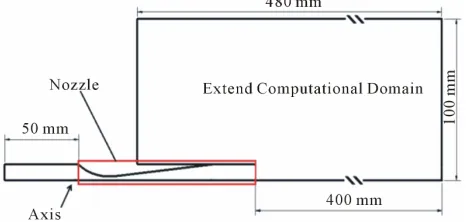
[image:2.595.311.537.538.718.2]The computational domain is shown in Figure 1. The nozzle part is highlighted using a red box. The axial- symmetric CFD model has been used for the present study. In order to get stable solution, the computational domain was extended up to the region of 5D (D is di- ameter of nozzle exit.) upstream of the nozzle inlet and up to the region of 20D downstream of nozzle exit. The diameter of nozzle throat, inlet, and outlet is 5.8 mm, 22 mm, 20 mm. respectively. The geometry was discretized into structured quadrilateral cells using commercial
Figure 1. Flow geometry and calculation domain.
software GAMBIT. Boundary layer effects were consid- ered by making finer grid clustered towards the walls.
Four different grid systems were simulated using the same boundary conditions. The mesh independence study is shown in Figure 2, which shows the velocity distribu- tion along the axis for four different mesh systems. The simulation with a grid system of 260,000 was chosen for all further studies as it shows lesser deviation in results when compared to it preceding cases with different meshes. For the present simulation, the inlet total pres- sure is 493,591 pa and back pressure is 101,325 pa, re- spectively. The inlet total temperature is 300 K.
Currently there are two approaches for the numerical calculation of multiphase flows: the Euler-Lagrange ap- proach and the Euler-Euler approach. The Lagrangian discrete phase model in ANSYS FLUENT follows the Euler-Lagrange approach. The fluid phase is treated as a continuum by solving the N-S equations, while the dis- persed phase is solved by tracking a large number of par- ticles through the calculated flow field. The dispersed phase can exchange momentum, mass, and energy with the fluid phase. This approach is made considerably sim- pler when particle-particle interactions can be neglected, and this requires that the dispersed second phase occu- pies a low volume fraction, even though high mass load- ing is acceptable. The particle trajectory is computed individually at specified intervals during the fluid phase calculation.
Particle Force Balance equation is shown below:
d d
p p
D p
p
g u
F u u
t
(1)
FD is gas drag force which is calculated by:
2
3 R
4
D D
e
p p
C F
d
(2)
[image:2.595.56.289.608.719.2]Re is particle Reynolds number which is calculated by:
Re d up p u
(3)
CD is drag coefficient which is fellows spherical drag
law:
3 2 1 Re Re2
D
a a
C a (4)
where: a1, a2, a3 are constants.
The trajectory equations, and any auxiliary equations describing heat or mass transfer to/from the particle, are solved by stepwise integration over discrete time steps. Integration of time in Equation (1) yields the velocity of the particle at each point along the trajectory, with the trajectory itself predicted by
d
d p
x u
t (5)
For the particle velocity at the new location n1
p
u we
get
1 e p
t
n n n
p
u u u u
n
p (6)
The new location n1
p
x can be computed from a simi-
lar relationship:
1 1 e p
t
n n n n
p p p p
n
x x u t u u
(7)
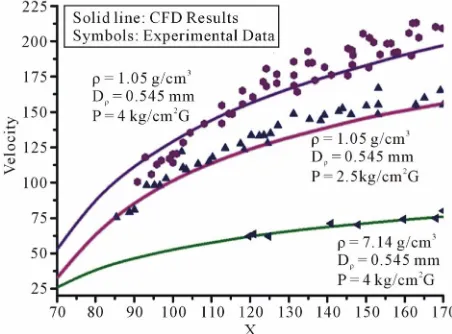
[image:3.595.310.537.112.211.2]At the beginning of the study, in order to test the ac- curacy of DPM method, 3 cases from Ref. [8] have been chosen to simulate in Fluent. The results were compared with experimental data. The Figure 3 shows the particle mean velocity along the axis. It can be seen that the nu- merical results are in good agreement with the experi- mental data.
Table 1 shows the different cases used for the present
Figure 3. Validation with experimental data (Solid lines are the present CFD results).
Table 1. Simulation conditions for different particle load- ing.
No. Particle density(g/cm3) diameter (mm) Particle Particle loading Total pressure (pa)
1 1.05 g/cm3 0.001 0.01 490332.5
2 1.05 g/cm3 0.001 0.03 490332.5
3 1.05 g/cm3 0.001 0.05 490332.5
4 1.05 g/cm3 0.001 0.1 490332.5
study. All the parameters are same except the particle loading.
3. Results and Discussion
Figure 4 shows the particle propagation through the C-D nozzle at different time intervals. At the initial stage the particle flow is uniform and is aligned perpendicular to the axis of the nozzle. When the flow reaches near to the convergent part which shown in Figure 4(d), the particle head trajectory will no longer obeys planar structure, but behaves in a parabolic structure. As the particle flow past the convergent section the particle inertia increases and some particles collides with the wall, but most of parti- cles follow the gas flow trajectories. From the previous study, the flow chocking was observed at the throat sec- tion. The flow will change to supersonic speed after it passes the throat section. The shock cell formation in the divergent section leads to flow separation and a shear layer will be formed due to the high velocity gradient exiting between the core flow and the reverse flow in the boundary layer region. The shear layer formation after the oblique shock front causes the concentration of parti- cles near to the shear layer, which can be observed from
[image:3.595.58.284.539.706.2]Figure 4(e). As the flow reaches the end plane of the nozzle, the particles becomes more evenly dispersed in the main gas flow.
(a)
(b)
(c)
(d)
(e)
[image:4.595.57.289.84.325.2](f)
Figure 4. Particle distributions with time. (a) t = 1.0 × 10⁻⁴ s; (b) t = 2.0 × 10⁻³ s; (c) t = 3.0 × 10⁻³ s; (d) t = 3.2 × 10⁻³ s; (e) t = 3.6 × 10⁻³ s; (f) t = 4.0 × 10⁻³ s.
Figure 5. Static pressure variations along the nozzle wall for different particle loading cases at t = 5 × 10⁻³ s.
[image:4.595.308.540.301.439.2] [image:4.595.59.283.376.564.2]more the pressure fluctuations. This phenomenon is be- cause as the particle loading increase the particle-turbu- lence interaction also becomes strong.
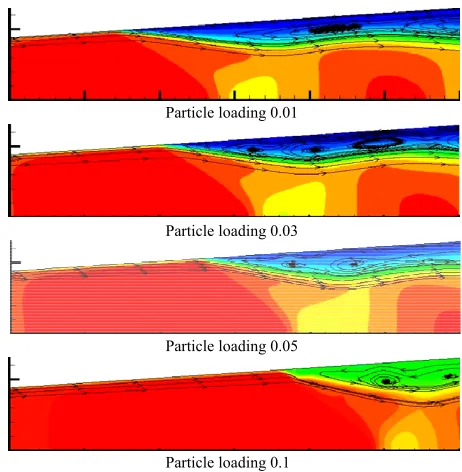
Figure 6 shows the static pressure contours of the gas phase in the divergent section at time equals to 0.005 s. The contours show that after the flow pass through the nozzle throat, the static pressure keeps on decreasing. When the shock is strong enough to separate the bound- ary layer, the shock is bifurcated and more shocks appear downstream of the bifurcated shock. The shock train is always followed by an adverse pressure gradient region.
In present study, the particle loading leads to the change in static pressure structure as shown in Figure 6. It can be seen that as the particle loading increase, the numbers and strength of shock decreases.
Figure 7 shows the stream line and Mach number con- tours of the gas flow. It can be noticed that the separation point moves downstream of the nozzle as the particle loading increase. The location of the separation point is related to many factors, like the nozzle shape, the pres- sure ratio, etc. In present work, the main reason for the separation point movement is because of the turbulence intensity changes. As the particle loading increases, the more numbers of particles are involved in the flow. So the particle-turbulence interaction will be enlarged. The increase in turbulence strength leads the boundary layer to adhere more to nozzle wall. The movement of the separation point also causes the first shock cell to move
Particle loading 0.01
Particle loading 0.03
Particle loading 0.05
[image:4.595.306.537.473.709.2]Particle loading 0.1
Figure 6. Static pressure contours of the four cases for dif- ferent particle loading at t = 5 × 10⁻³ s.
Particle loading 0.01
Particle loading 0.03
Particle loading 0.05
Particle loading 0.1
downstream and the vortex structure changes. From Fig- ure 7, it can be seen that the vortex location and intensity are different.
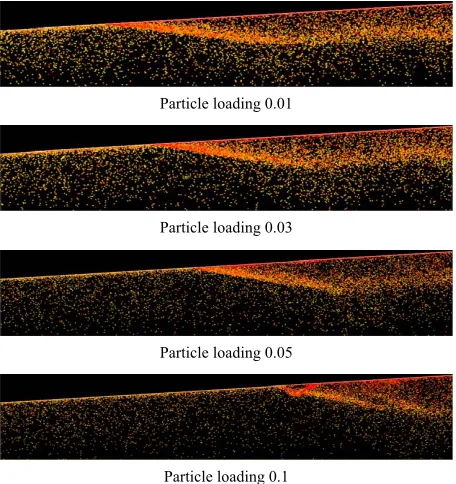
[image:5.595.59.287.253.495.2]The movement in separation point affects the particle distribution also. This can be clearly observed from Fig- ure 8. Most of particles are concentrated at the shear layer. The shear flow layer was created mainly because of the interaction between the high speed and low speed flow regimes.
Figure 9 shows the Mach number distribution along the axis. It can be seen that although the first shock posi- tion moves downstream, but the maximum Mach num- bers for the all cases are almost constant. As the particle
Particle loading 0.01
Particle loading 0.03
Particle loading 0.05
[image:5.595.310.539.322.496.2]Particle loading 0.1
Figure 8. Spatial distributions of particles with different particle loading at t = 5 × 10⁻³ s.
Figure 9. Mach number distributions along nozzle center- line for different particle loading at t = 5 × 10⁻³ s.
[image:5.595.59.285.534.706.2]loading increases, the Mach number at the exit decreases.
Figure 10 shows the static pressure alone the axis for the five cases (included only gas phase flow). From the figure it is clearly observable that the particle loading significantly influences the gas flow. The strength of the first shock is stronger in suspension flow compared to single phase gas flow. The more the particle loading, the higher will be the first shock cell strength. But for the rest pseudo shocks, the situation is opposite, and it can be visualized from Figure 10 that the case with higher parti- cle loading has less pseudo shocks. The static pressure is almost same at the nozzle outlet.
Figure 11 shows the particle velocity at the nozzle exit. It can be seen that the particle velocity have minor dif- ferences even though the particle loading changes.
4. Conclusions
[image:5.595.311.537.535.706.2]The presence of particles has a big influence on the gas
Figure 10. Static pressure distributions along nozzle center- line for different particle loading at t = 5 × 10⁻³ s.
[4] M. A. F. Kendall, “The Delivery of Particulate Vaccines and Drugs to Human Skin with A Practical Hand-Held Shock Tube-based System,” Shock Waves, Vol. 12, No. 1,
2002, pp. 23-30. doi:10.1007/s001930200126 phase behavior. Particle loading is an important parame-
ter for the suspension flow. The structure of shock train, the separation point, and the vortex of the backflow are all related to particle loading.
[5] M. V. Protasov, A. Yu. Varaksin, T. F. Ivanov and A. F. Polyakov, “Experimental Study of Downward Turbulent Gas-solid Flow in Narrow Pipe,” 4th International sym-posium on Turbulence, Heat and Mass Transfer, Antalya,
12-17 October 2003, 13 pp.
As the particle loading increases: 1) The strength of shock train decreases;
2) The separation point moves toward the nozzle exit; 3) The number and strength of vortex increase; 4) The strength of first shock also increases while the
other pseudo shocks decreases; [6] Y.-M. Lee and R. A. Berry, “Analysis of the Two-Phase Flow in a De Laval Spray Nozzle and Exit Plume,” Jour-nal of Thermal Spray Technology, Vol. 3, No. 2, 1994, pp. 179-183. doi:10.1007/BF02648275
5) The gas mass flow rate decreases, but total mass flow rate is increases.
The change of gas flow behavior in turn to affects the particle distribution. The particles are concentrated at the shear layers separated from the upper wall surface.
[7] M. B. Stakić, G. S. Živković and M. A. Sijerčić, “Nu-merical Analysis of Discrete Phase Induced Effects on a Gas Flow in a Turbulent Two-Phase Free Jet,” Interna-tional Journal of Heat and Mass Transfer, Vol. 54, No. 11-12, 2011, pp. 2262-2269.
doi:10.1016/j.ijheatmasstransfer.2011.02.039
5. Acknowledgements
This work was supported by the National Research Foundation of Korea (NRF) grant funded by the Korea government (MEST) (2011-0017506).
[8] S. Okuda and W. S. Choi, “Gas-Particle Mixture Flow in Various Types of Convergent-Divergent Nozzle,” Journal of Chemical Engineering of Japan, Vol. 11, No. 6, 1978, pp. 432-438. doi:10.1252/jcej.11.432
[9] R. Gr. Maev and V. Leshchynsky, “Introduction to Low Pressure Gas Dynamic Spray,” John Wiley & Sons, Ho-boken, 2009.
REFERENCES
[1] J. H. Geng and H. Groenig, “Dust Suspensions Acceler-ated by Shock Waves,” Experiments in Fluids, Vol. 28, No. 4, 2000, pp. 360-367. doi:10.1007/s003480050395
[10] D. R. Kaushal, T. Thinglas, Y. Tomita, S. Kuchii and H. Tsukamoto, “CFD Modeling for Pipeline Flow of Fine Particles at High Concentration,” International Journal of Multiphase Flow, Vol. 43, 2012, pp. 85-100.
doi:10.1016/j.ijmultiphaseflow.2012.03.005 [2] L.-S. Fan and C. Zhu, “Principles of Gas-Solid Flows,”
Cambridge University Press, Cambridge, 1998.
[3] C. T. Crowe, D. F. Elger and J. A. Roberson, “Engineer-ing Fluid Mechanics,” Wiley, Hoboken, 2000.
Nomenclature
nu The gas velocity at old location (m/s)
Density of gas
1, ,2 3
a a a The constants
p
Density of particle
CD Drag coefficient p
d Particle diameter (mm) p Particle relaxation time
t
Time step
D
F Drag force (N)
g Gravity (m/s2) t Time
x Distance (m)
u Gas velocity (m/s) n1
p
x The new location of particle (m)
n p
x
p
u
1
n
Particle velocity (m/s) The old location of particle (m) Re
p
u The particle velocity at new location (m/s)
n p
u The particle velocity at old location (m/s) Particle Reynolds number