Munich Personal RePEc Archive
How (Not) to Foster Innovations in
Public Infrastructure Projects
Hoppe, Eva I. and Schmitz, Patrick W.
2019
How (Not) to Foster Innovations in Public Infrastructure
Projects*
Eva I. Hoppe
University of Bonn, DE-53113 Bonn, Germany
Patrick W. Schmitz
University of Cologne, DE-50923 Cologne, Germany
Abstract
The government wants an infrastructure-based public service to be provided. First,
the infrastructure has to be built; subsequently, it has to be operated. Should the
government bundle the building and operating tasks in a public-private partnership? Or
should it choose traditional procurement, i.e. delegate the tasks to di¤erent …rms? Each
task entails unobservable investments to come up with innovations. It turns out that
depending on the nature of the innovations, bundling may either stimulate or discourage
investments. Moreover, we …nd that if renegotiation cannot be prevented,
public-private partnerships may lead the government to deliberately opt for technologically
inferior projects.
Keywords: Contract theory; procurement; public-private partnerships; moral hazard;
renegotiation
JEL classi…cation: D86;L33;H11;H54;H57
I.
Introduction
Providing infrastructure-based public services is one of the main tasks of government.
On average, public procurement accounts for around 12% of GDP in OECD countries
(see OECD, 2017). Thus, the amounts at stake are certainly signi…cant. While the
public procurement system should strive to achieve the best possible performance in
terms of cost and service, examples of ine¢ciencies are reported regularly in the daily
news.1 How to best organize the provision of public goods and services is therefore a
highly relevant policy question that is of broad interest.
In particular, public infrastructure such as highways, bridges, airports, and
hospi-tals …rst has to be built and subsequently it has to be operated. Traditionally, when
the government wanted to procure an infrastructure-based service, the two tasks of
…rst building and then operating the infrastructure were separated. Speci…cally, the
construction of a project was contracted out to a private company. This …rm built
the project, received the agreed payment, and then the contract was completed.
Af-terwards, another party took charge of operating and maintaining the facility. Yet,
around the early 1990s, public-private partnerships have emerged as a new
organiza-tional form and they have become increasingly popular since then. A key property of
a public-private partnership is the fact that facility construction and service provision
are bundled (see e.g. Hart, 2003); i.e., the tasks of …rst building and then operating
the infrastructure are assigned to a single private company.2
In the present paper, our goal is to provide a new perspective on the pros and cons
of public-private partnerships compared to traditional procurement. Speci…cally, we
consider a contract-theoretic model with two stages, a building stage and an operating
stage. We investigate whether the two tasks of building and operating the infrastructure
should be delegated to two di¤erent …rms or whether it is better to bundle these two
1Infrastructure projects plagued by delays, cost overruns, environmental issues, and quality
short-falls attract much attention in the media. Recent examples include the Berlin Brandenburg Airport
in Germany (cf. Hammer, 2015), the Honolulu Rail Transit Project in Hawaii (cf. Nagourney, 2016),
or the Alaskan Way Viaduct replacement tunnel in Seattle (cf. Anderson, 2017). See Flyvbjerg et
al. (2003) for discussions of many other examples.
2Grimsey and Lewis (2004) and Yescombe (2007) also emphasize that in practice a de…ning
char-acteristic of a public-private partnership is that design and construction as well as operation and
tasks and assign them to a single company, a consortium. Advocates of public-private
partnerships often argue that bundling fosters innovation incentives (see e.g. HM
Trea-sury, 2012). In this context, innovations can be de…ned in a very broad sense as “any
positive e¢ciency gains achieved through productive investments” (cf. Roumboutsos
and Saussier, 2014, p. 359). However, now that public-private partnerships have been
in place for more than twenty years, the empirical evidence regarding the success of
public-private partnerships in stimulating innovations is mixed.3
On the one hand, there are case studies which document that public-private
part-nerships have indeed spurred innovations. For example, in the transportation sector,
public-private partnerships were successful in substantially reducing construction time
and in developing innovative solutions for congestion management by introducing
time-varying tolls.4 On the other hand, there is evidence which suggests that bundling may
sti‡e innovations. For example, in the health care sector it has been reported that
consortia in charge of hospital projects faced strategic incentives not to come up with
innovations facilitating the adaptability of the hospital design, because it would
en-able them to “achieve additional income through alterations needed in the future”.5
Hence, when the same party is in charge of building and operating, innovations in the
building stage might actually be discouraged, since they may reduce rents that could
be obtained in the operating stage.
Our formal model provides an explanation for the empirical …nding that bundling
the building and operating tasks in a public-private partnership can boost innovation
incentives in some situations, while it may sti‡e incentives to innovate under di¤erent
circumstances. Speci…cally, we consider an extension of Tirole’s (1999) “R&D game”
to two stages. We assume that …rms in charge of building and/or operating the public
3See e.g. Leiringer (2006), Russell et al. (2006), Javed et al. (2013), Liu and Liu (2017), Himmel
and Siemiatycki (2017), Saeed et al. (2018), Singh (2018), and the recent survey by Carbonara and
Pellegrino (2018) for empirical studies investigating whether or not public-private partnerships are
conducive to fostering innovations.
4For instance, it was a private consortium that took the initiative to introduce variable pricing for
California’s State Route 91 express lanes, which works well to eliminate tra¢c congestion during peak
periods. In France, a private …rm resolved a 30-year impasse over how to complete the missing link of
the A86 Paris ring road, using a deep-bore tunnel under the Versailles palace. See Gilroy et al. (2007)
and Small (2010) for further details.
infrastructure are protected by limited liability. In the building stage as well as in the
operating stage, unobservable e¤ort can be exerted to come up with an innovation.
In each stage, the outcome (i.e., whether or not there was a successful innovation) is
veri…able.6 Since e¤ort is a hidden action, the government can incentivize e¤ort only
with the help of outcome-contingent contracts.
In particular, consider the operating stage. In the presence of uncertainty, the
outcome is only a noisy signal of the chosen e¤ort level. Hence, if the government
wants to induce the …rm in charge of operating to exert high e¤ort, it must leave a
rent to the …rm (see e.g. La¤ont and Martimort, 2002). In case of a public-private
partnership, the expected rents in the operating stage are taken into account by the
consortium when it decides on how much e¤ort to spend in the building stage. Bundling
can thus create positive or negative incentive spillover e¤ects which are absent in case
of traditional procurement.
Suppose …rst that a successful innovation in the building stage increases the
govern-ment’s value of an innovation in the operating stage. Hence, a success in the building
stage and a success in the operating stage are complements. For example, an
innov-ative design of an airport which makes it possible to deal with a signi…cantly larger
number of passengers would also make subsequent service improvements in the
oper-ating stage more valuable, since more passengers would bene…t. The government will
then implement a relatively large second-stage e¤ort level after a …rst-stage success,
while it implements a relatively small second-stage e¤ort level after a …rst-stage
fail-ure. Thus, in case of a public-private partnership the consortium will be able to earn
a larger rent in the operating stage if it was already successful in the building stage.
As a consequence, it becomes cheaper for the government to provide incentives in the
building stage, which gives a public-private partnership an advantage over traditional
procurement.
Now suppose that a successful innovation in the building stage reduces the
govern-ment’s additional value that can be generated by an innovation in the operating stage.
Thus, a success in the building stage and a success in the operating stage are
substi-tutes. For instance, suppose there is an exogenously given upper limit on the bene…ts
6Note that these assumption are in line with Tirole’s (1999, p. 745) one-shot model, which in turn
that can potentially be generated by a particular project such as a highway. An
inno-vative solution in the building stage (say, a tunnel that avoids tra¢c congestion) may
already bring us close to the maximum bene…t, so in this case the additional value
that can be generated by further innovations in the operating stage (say, implementing
variable tolls to reduce tra¢c congestion) is rather small. A consortium may then
pre-fernot to exert innovation e¤ort in the building stage, in order to obtain a larger rent
in the operating stage. As a result, it can become very expensive for the government
to induce high e¤ort in the building stage, such that traditional procurement may be
preferred.
Therefore, in our model the pros and cons of bundling the building and operating
tasks in a public-private partnership can be traced back to the same source, namely the
e¤ect of expected second-stage rents on …rst-stage incentives. An important take-home
message of our analysis is that public-private partnerships are desirable in situations in
which successful outcomes in the two stages can be expected to be of a complementary
nature, while traditional procurement may be preferred when successful outcomes in
the two stages are rather of a substitutive nature.
When the government has full commitment power, then the second-stage e¤ort
level that it implements after a …rst-stage success will be larger under a public-private
partnership than under traditional procurement. In this way, the government further
increases the consortium’s incentives to exert e¤ort in the building stage. In contrast,
after a …rst-stage failure the government implements a smaller second-stage e¤ort level
under a public-private partnership than under traditional procurement, so the
consor-tium is punished for not developing an innovation in the building stage.
Yet, practitioners emphasize that in reality the government often cannot commit
not to renege on its contract with the consortium.7 When mutually bene…cial
renegotia-tion cannot be prevented, the government loses the possibility to punish the consortium
for a …rst-stage failure by implementing a smaller second-stage e¤ort level than under
traditional procurement.8 As a consequence, the possibility of renegotiations reduces
7The fact that in practice renegotiations cannot be prevented has often been emphasized in the
empirical literature on public-private partnerships, see e.g. Guasch (2004), Engel et al. (2014, ch. 7),
and Beuve et al. (2014).
8However, we will show that optimal contracts remain to be history-dependent even when
the advantages of a public-private partnership compared to traditional procurement
and may have important implications for the initial choice of a public infrastructure
project. In particular, we …nd that if under a public-private partnership renegotiation
cannot be ruled out, then the government may prefer to choose a technologically
infe-rior project. Intuitively, the reason is that the choice of such a project may reduce the
scope for renegotiations. In contrast, under a public-private partnership with full
com-mitment as well as under traditional procurement the government would never choose
a technologically inferior project.
Related literature. The theoretical literature analyzing the pros and cons of bundling
tasks in public-private partnerships was initiated by Hart (2003), who applies the
in-complete contracting approach.9 Hart (2003) considers two di¤erent kinds of
invest-ments which both can be made in the building stage in order to reduce costs in the
operating stage. One kind of investment is desirable, while the other kind of investment
is undesirable, since it leads to a strong reduction in service quality. A public-private
partnership results in too much undesirable investment, while under traditional
pro-curement there are weaker incentives to make the desirable investment. In line with
Hart (2003), we focus on the bundling decision and do not study the choice between
public and private ownership.10 In contrast, Bennett and Iossa (2006) explore the
interaction of the bundling decision with the choice between di¤erent ownership
struc-tures.11 However, in models combining agency problems and property rights, Iossa and
Martimort (2015, p. 23) conclude that “the important issue is not who owns the asset
but instead whether tasks are bundled or not.” Following Hart (2003), these authors
assume that e¤ort invested in the building stage has adirect external e¤ect on the costs
incurred in the operating stage. In contrast, in our model an innovation in the building
9See also Bös and De Fraja’s (2002) earlier incomplete contracting model on bundling in the health
care sector. The incomplete contracting paradigm was developed by Grossman and Hart (1986), Hart
and Moore (1990), and Hart (1995). See Maskin and Tirole (1999) and Tirole (1999) for critical
discussions of the foundations of the incomplete contracting methodology.
10Hart (2003, p. C71) points out that he ignores ownership issues and that he takes bundling to
be the key property of a public-private partnership. On the decision between public and private
ownership, see Hart et al. (1997) and the subsequent literature, e.g. Besley and Ghatak (2001), King
and Pitchford (2008), Hoppe and Schmitz (2010), De Brux and Desrieux (2014), and Hamada (2017).
stage can make an innovation in the operating stage either more or less valuable for
the government, so from the consortium’s perspective an external e¤ect is createdonly
if the government conditions payments in the operating stage on the outcome of the
building stage.12
Our contribution is based on agency problems due to moral hazard.13 Early
contri-butions to the literature on moral hazard models were based on the trade-o¤ between
incentives and insurance when agents are risk-averse.14 In particular, Rogerson (1985)
considers a repeated moral hazard problem and shows that the optimal second-period
incentives depend on the …rst-period outcome (i.e., the contract exhibits memory),
even though the periods are technologically independent. His result is driven by the
consumption-smoothing motive of the risk-averse agent. More recently, several authors
such as Ohlendorf and Schmitz (2012), Kräkel and Schöttner (2016), and Schöttner
(2017) have studied repeated moral hazard problems where agents are risk-neutral but
protected by limited liability.15 Yet, these papers do not study the di¤erences between
bundling and unbundling, which is the focus of the present paper.16
Recently, Martimort and Straub (2016) have also studied public-private
partner-ships in a two-stage moral hazard model with risk-neutral …rms that are protected by
12In particular, the e¤ort costs and the success probability for a given e¤ort level in the second stage
donotdepend on what happened in the …rst stage. Thus, for a …xed second-stage incentive scheme the
agent’s second-stage behavior depends neither on the …rst-stage e¤ort nor on the …rst-stage outcome.
Our model thus di¤ers from the sequential agency problems studied by Baliga and Sjöström (1998),
Schmitz (2005), and Pi (2018).
13In contrast, Hoppe and Schmitz (2013) discuss the costs and bene…ts of public-private partnerships
in an adverse selection model, where the consortium may strategically gather information about future
costs to adapt the service provision to changing circumstances. The role of adverse selection in the
context of public-private partnerships has recently also been studied by Buso (2018).
14See Holmström and Milgrom (1991) and Itoh (1991) for studies in the multi-task agency literature
focused on the e¤ort-substitution problem when tasks are simultaneously performed.
15For static moral hazard models with risk-neutral agents and limited liability, see the earlier work
by Innes (1990) and Pitchford (1998).
16For instance, Ohlendorf and Schmitz (2012) study a single-agent …nancial contracting problem in
which the principal must make an investment to continue a project. Potential second-stage returns are
independent of the outcome of the …rst stage. In line with Rogerson (1985), they …nd that the optimal
contract exhibits memory. They do not study the two-agents case, since in their setup unbundling
limited liability. However, there are important di¤erences. In particular, Martimort
and Straub (2016) assume that the e¤ort level exerted in the second stage must always
be larger than …rst-stage e¤ort, and they exogenously rule out second-stage payments
that depend on the outcome of the …rst stage. Their focus is on the e¤ects of an
uncer-tain productivity shock after the …rst stage. Our model is complementary to Martimort
and Straub’s (2016) setup, since we do not impose any intertemporal restrictions on the
e¤ort levels and since history-dependent payments play a central role in our analysis.
To the best of our knowledge, the di¤erent implications of public-private partnerships
and traditional procurement for the initial choice of a public project have not yet been
explored in the literature so far.
Finally, it should be noted that in practice policy makers may be tempted to favor
public-private partnerships for the wrong reasons, since they are often not included in
the …scal balance sheets.17 From an economic perspective, public-private partnerships
should be given the same treatment in budgetary accounting as traditional
procure-ment, so the choice between the organizational forms should be based on e¢ciency
considerations (see Hart, 2003, p. C75). Hence, in the present contribution we abstract
from …nancing issues and instead focus on the di¤erent incentive structures that prevail
in public-private partnerships and traditional procurement.
Organization of the paper. The remainder of the paper is organized as follows. In
Section II, we introduce the model. The case of traditional procurement is analyzed in
Section III, while the organizational form of a public-private partnership is investigated
in Section IV. In Section V, we compare the two modes of provision. In Section VI,
we analyze a scenario where renegotiations cannot be ruled out and we explore the
implications for project choice. Concluding remarks follow in Section VII. All formal
proofs have been relegated to the Appendix.
II.
The Model
Suppose the government (the principal) wants two sequential tasks to be performed in
order to provide a public good or service. First, an infrastructure has to be designed
17See e.g. Vining and Boardman (2008, p. 153), Engel et al. (2013, 2014), Iossa and Martimort
and built (stage 1); subsequently, it has to be maintained and operated (stage 2).
Before the …rst stage begins, the government has the choice between two di¤erent
governance structures, traditional procurement (TP) and a public-private partnership
(PPP). In the case of traditional procurement, the government contracts with one agent
(the builder) in charge of stage 1 and with another agent (the operator) in charge of
stage 2. In the case of a public-private partnership, the two tasks are bundled; i.e.,
the government contracts with only one agent (a consortium) that is in charge of both
stages. We assume that all parties are risk-neutral, the agents are protected by limited
liability, and their reservation utilities are zero.18
In the …rst stage, the agent in charge of designing and building the infrastructure
can choose an unobservable e¤ort levelE 2 f0;1gin order to come up with innovative
ideas to improve the social value of the infrastructure. The veri…able outcome of the
building stage is a success (x= 1) with probabilitypE and a failure (x= 0) otherwise,
where0< p <1. Let the agent’s disutility of e¤ort be given by E, where >0.19
In the second stage, the agent in charge of operating and maintaining the
infrastruc-ture exerts unobservable e¤orte2[0;1], incurring a disutility of e¤ort given by(1=2)e2
.
The second-stage e¤ort aims at innovations to further increase the social value of
pro-viding the public good or service. The veri…able outcome of the operating stage is a
success (y= 1) with probabilitye and a failure (y= 0) otherwise. Note that the e¤ort
levele(x) chosen in the second stage can depend on the outcome xof the …rst stage.
The social bene…ts generated by the public good or service are given by Bx+ybx.
The bene…ts are net of the monetary and veri…able costs of building and operating
18The assumption that the reservation utilities are zero is made for expositional simplicity only.
The results still hold if the reservation utilities are strictly positive but su¢ciently small. Similar
assumptions are often made in the related literature, see e.g. the recent work by Martimort and
Straub (2016).
19It should be noted that the assumptionE 2 f0;1gis made only to simplify the exposition. The
results still hold whenE2[0;1], since a corner solution is always optimal due to linearity. One could
alternatively consider strictly convex e¤ort costs, so that the government would have to leave a rent
to the agent in charge of the building stage in order to motivate him to exert e¤ort. However, we
do not want to obfuscate the analysis by introducing …rst-stage rents. Instead, our focus will be on
the implications of second-stage rents. The reason is that …rst-stage rents are simply sunk in the
second stage, whereas anticipated second-stage rents can have economically interesting e¤ects on the
the infrastructure, which are always reimbursed by the government. We assume that
a successful innovation always increases the social value. Speci…cally,B1 > B0 >0, so
the bene…ts are larger when an innovative infrastructure was built in the …rst stage.
Similarly,b0 >0and b1 >0, so a second-stage innovation always increases the bene…ts
from service provision. Note that the magnitude of the increase may depend on whether
or not there was an innovation in the building stage. Moreover, we make the technical
assumptions that b0 1 and b1 1. This normalization allows us to follow the
usual convention that e¤ort e can be directly interpreted as a success probability.20
Furthermore, in order to focus the analysis on the economically most interesting case,
we assume throughout that >(1=2)pb2
1, i.e. the …rst-stage e¤ort costs are su¢ciently
large.21 For simplicity, we assume throughout that there is no discounting.22
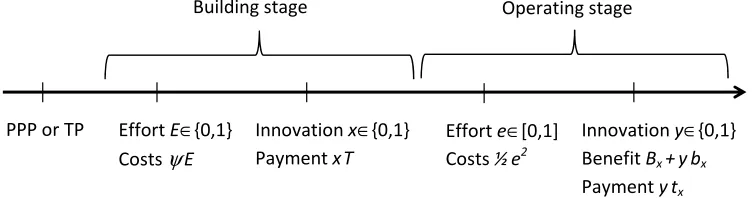
The sequence of events is illustrated in Figure 1. At the outset, the government
chooses the organizational mode (traditional procurement or a public-private
partner-ship). In the building stage, the agent who is in charge can exert unobservable e¤ort
E. Since the outcome is veri…able, it is feasible to contractually specify a payment T
that the government must make to the agent whenever there was a success (x = 1).
In the operating stage, the agent who is in charge can exert unobservable e¤ort e.
The outcome is again veri…able, so it is possible to contractually specify a paymenttx
that has to be made from the government to the agent whenever there was a success
(y = 1). Note that the amount to be paid for a second-stage innovation can depend
on whether or not there was a …rst-stage innovation. Under traditional procurement,
the government o¤ers a contract (specifying T) to the builder at the outset, while it
o¤ers a contract (specifying tx) to the operator at the beginning of the second stage.
Under a public-private partnership, the government o¤ers a contract (T; t0; t1) to the
20At the expense of a more involved notation, we could drop the normalization and instead assume
that the success probability in the second stage is given by a strictly increasing and concave function
q(e)that lies between zero and one.
21In particular, the assumption ensures that the …rst-stage e¤ort costs are not so trivially small
that in case of a public-private partnership the consortium could be willing to exert high …rst-stage
e¤ort even in the absence of a direct reward for a …rst-stage innovation, just in order to increase
the second-stage rent. Dragging this case along would complicate the exposition without yielding
additional insights.
22This assumption is made in most papers on public-private partnerships, cf. the literature surveyed
consortium at the outset.23 We will study the case in which the government has full
commitment power as well as the case in which it cannot commit not to renege on the
contract at the beginning of the operating stage.
PPP or TP Effort E∈{0,1}
Costs ψ E
Innovation x∈{0,1} Payment x T
Effort e∈[0,1] Costs ½ e2
Innovation y∈{0,1} Benefit Bx + y bx
Payment y tx
[image:12.612.124.502.127.226.2]Building stage Operating stage
Figure 1. The sequence of events.
The …rst-best benchmark. Consider for a moment a …rst-best world in which the
e¤ort decisions are veri…able. The …rst-best e¤ort level in the operating stage maximizes
ebx (1=2)e
2
. Hence, the marginal e¤ort costs must be equal to the marginal bene…t,
eF B
(x) = bx. In the building stage, it is …rst-best to choose high e¤ort (E = 1)
whenever
p[B1+
1 2b
2
1] + (1 p)[B0+
1 2b
2
0] B0+
1 2b
2
0: (1)
The left-hand side is the expected total bene…t net of e¤ort costs given high e¤ort in
the building stage, while the right-hand side is the corresponding expression given low
e¤ort in the building stage. Hence, there is a cuto¤ value
F B
:=p[B1 B0+
1 2b
2 1
1 2b
2
0] (2)
such thatEF B
= 1 if F B
and EF B
= 0 otherwise.
23Note that we can con…ne our attention to contracts specifying non-negative payments T,t
0, t1.
Under traditional procurement, it is straightforward to see that it would never be optimal to make
a strictly positive payment to an agent who was not successful. Moreover, nothing could be gained
by making the builder’s payment dependent on whether or not the operator is successful. Under a
public-private partnership, in general we could allow for payments (x; y) 0made to the consortium
at the end of the operating stage. It is easy to see that (0;0) = 0 is optimal. Moreover, we can
denote (1;0) by T and (0;1) by t0. Hence, by assuming that (1;1) = T +t1 and t1 0, our
only additional restriction on (x; y)is that (1;1) (1;0). It is straightforward to show that this
constraint is never binding; i.e., given a …rst-period success the government never wants to specify a
If the e¤ort levels were veri…able, the government would implement the …rst-best
e¤ort choices with a simple forcing contract that would in each stage reimburse the
agent in charge for his e¤ort costs. Thus, the government would be indi¤erent with
regard to the bundling decision. Yet, in the remainder of the paper we assume that
the e¤ort choices are hidden actions. As a consequence, when we …nd that one of the
two organizational forms is strictly preferred by the government, then this result must
be due to incentive considerations only.
III.
Traditional Procurement
We now investigate the incentive structure under traditional procurement. Consider
…rst the operating stage, so the outcome of the building stage x 2 f0;1g has already
been realized. In the operating stage, given the contractually speci…ed rewardtx 1for
a second-stage innovation,24 the operator maximizes his expected payo¤ et
x (1=2)e
2
.
Thus, the operator choosese(x) = tx.
Anticipating the operator’s e¤ort choice, at the beginning of the second stage the
government sets the rewardtx in order to maximize its expected payo¤e(x)[bx tx] =
tx[bx tx]. Thus, the government will specify the payment t T P
x = (1=2)bx. Observe
that the operator’s expected rent (1=2)t2
x = (1=8)b
2
x is increasing in the additional
bene…t generated by a second-stage innovation. Moreover, note that the government’s
second-stage payo¤ is(1=4)b2
x.
Next, consider the building stage. Given that the rewardT was contractually
spec-i…ed for a …rst-stage innovation, the builder will choose high e¤ort (E = 1) whenever
the incentive compatibility constraintpT 0 is satis…ed. Hence, the government
setsTT P
= =p if it wants to induce high e¤ort in the …rst stage, while it sets T = 0
otherwise.
It is optimal for the government to implement high e¤ort in the …rst stage whenever
p[B1+
1 4b
2
1 =p] + (1 p)[B0+
1 4b
2
0] B0+
1 4b
2
0, (3)
i.e., whenever the expected social bene…ts net of the payments to the agents are larger
in the case of high …rst-stage e¤ort than in the case of low …rst-stage e¤ort. Rewriting
24It is straightforward to verify that the government will never o¤er a reward larger than one, since
the condition we …nd that the government implements E = 1 whenever T P
,
where
T P
:=p[B1 B0+
1 4b
2 1
1 4b
2
0]: (4)
The preceding discussion can thus be summarized as follows.
Proposition 1 Consider traditional procurement.
(i) If T P, it is optimal for the government to set tT P
0 = (1=2)b0, t
T P
1 = (1=2)b1,
and TT P
= =p. Then the builder will choose ET P
= 1 and the operator will choose
eT P
(1) = (1=2)b1, e
T P
(0) = (1=2)b0.
(ii) If > T P, it is optimal for the government to set tT P
0 = (1=2)b0, t
T P
1 = (1=2)b1,
and TT P
= 0. Then the builder will choose ET P
= 0 and the operator will choose
eT P
(0) = (1=2)b0.
Note that when the government implements low e¤ort in the building stage, there
will be no …rst-stage success, so on the equilibrium path the payment t1 is irrelevant
if > T P. Furthermore, observe that T P is smaller than F B whenever b0 < b1.
Hence, the following result holds.
Corollary 1 Consider traditional procurement. (i) In the building stage,ET P
EF B
if b0 < b1, while E
T P
EF B
if b0 > b1.
(ii) In the operating stage, eT P
(x)< eF B
(x) for x2 f0;1g.
Compared to the benchmark case in which e¤orts are veri…able, unobservability
of e¤orts leads to a smaller e¤ort level in the second stage, since in this way the
expected rent that must be left to the operator is reduced. In the building stage, there
may be e¤ort cost parameters such that high e¤ort would be chosen when e¤orts
were veri…able, while only low e¤ort is induced when e¤orts are hidden actions. This
happens when b0 < b1, because in this case the second-stage rent is larger following
a …rst-stage success, so from the government’s perspective the value of a …rst-stage
innovation is reduced. In contrast, if b0 > b1, there are cost parameters such that
low e¤ort would be preferred when e¤ort was veri…able, while high e¤ort is induced
when e¤ort is unobservable. The reason is that in this case a larger second-stage rent
must be paid following a …rst-stage failure, which from the government’s perspective
IV.
Public-Private Partnership
Let us now analyze the incentive structure in case of a public-private partnership,
assuming that the government can commit not to renege on the contractually speci…ed
payments. Suppose that the payments t0 1 and t1 1 have been contractually
agreed upon.25 In the second stage, following the …rst-stage outcome x 2 f0;1g, the consortium chooses the e¤ort level e that maximizes its expected payo¤ etx
(1=2)e2
. Thus, the consortium will exert e¤orte(x) = tx. Observe that the consortium’s
expected second-stage rent is(1=2)t2
x. Applying backward induction, we can now study
the consortium’s e¤ort decision in the …rst stage. Given that the payment T was
speci…ed in the contract, the consortium prefers to exert high e¤ort (E = 1) whenever
p[T + 1 2t
2
1] + (1 p)
1 2t
2 0
1 2t
2
0; (5)
i.e., whenever the consortium’s expected payo¤ over the whole life of the project is larger
if it exerts high instead of low e¤ort in the building stage. This incentive compatibility
constraint can be rewritten as
T =p 1
2t
2 1+
1 2t
2
0: (6)
Anticipating the consortium’s behavior, at the outset the government o¤ers a
con-tract (T; t0; t1) that maximizes the expected social bene…ts net of the payments made
to the consortium,
pE[B1+t1(b1 t1) T] + (1 pE)[B0+t0(b0 t0)]: (7)
In order to characterize the solution to the government’s problem, let us de…ne a
threshold level of the …rst-stage e¤ort costs,
P P P
:=p[B1 B0+
1 2b
2 1
1 4
3 2p
2 p b
2
0]: (8)
Then the solution under a public-private partnership can be summarized as follows.
Proposition 2 Consider a public-private partnership and suppose the government has full commitment power.
25It is again straightforward to verify that the government will never o¤er payments larger than
(i) If P P P
, it is optimal for the government to set tP P P
0 = (1 p)b0=(2 p),
tP P P
1 =b1, andT
P P P
= =p (1=2)b2 1+
1
2((1 p)b0=(2 p)) 2
. Then the consortium will
choose EP P P
= 1 in the building stage and eP P P
(1) =b1,e
P P P
(0) = (1 p)b0=(2 p)
in the operating stage.
(ii) If > P P P, it is optimal for the government to set tP P P
0 = (1=2)b0, t
P P P
1 =
(1=2)b1, and T
P P P
= 0. Then the consortium will choose EP P P
= 0 in the building
stage and eP P P
(0) = (1=2)b0 in the operating stage.
Proof. See the Appendix.
When the same agent is in charge of both stages, the government can make use
of incentive spillovers from the second to the …rst stage. In the building stage, the
consortium’s e¤ort decision will not only depend on the payment T for a …rst-stage
success, but also on the expected rents that it may get in the second stage. Suppose
the government wants to implement high …rst-stage e¤ort. The government can
indi-rectly reward the consortium for a …rst-stage success by implementing a relatively large
second-stage e¤ort (and thus a large rent) followingx= 1, while it can punish the
con-sortium for a …rst-stage failure by implementing a relatively small second-stage e¤ort
(and thus a small rent) following x = 0. Observe that according to Proposition 2(i),
following a …rst-stage success the government implements the …rst-best e¤ort level in
the operating stage. While the expected rent could be further increased by specifying
an even larger second-stage e¤ort level, this would be an ine¢cient way to reward the
consortium; i.e., it would be cheaper for the government to increase the direct reward
T for a …rst-stage success.
Furthermore, note that P P P
> F B
, so there are …rst-stage e¤ort cost parameters
such that in the building stage low e¤ort would be chosen when e¤orts were
veri-…able, while high e¤ort is chosen when they are unobservable. Intuitively, since the
government must leave a rent to the consortium in order to induce second-stage e¤ort,
it would like to extract this rent from the consortium by an up-front payment. Yet,
since negative payments are ruled out due to limited liability, utility may instead be
transferred from the consortium to the government in an ine¢cient way only, namely
by implementing an ine¢ciently large …rst-stage e¤ort level.
Corollary 2 Consider a public-private partnership and suppose the government has full commitment power.
(i) In the building stage,EP P P
EF B
.
(ii) In the operating stage, eP P P
(1) = eF B
(1) and eP P P
(0) < eF B
(0) if P P P
,
whileeP P P
(0)< eF B
(0) if > P P P.
V.
Public-Private Partnership Versus Traditional
Procurement
We can now analyze the government’s choice between the two organizational modes.
Propositions 1 and 2 immediately reveal that if the government implements low e¤ort in
the building stage, the second-stage e¤ort level does not depend on the organizational
form; i.e., in this case the government is indi¤erent between traditional procurement
and a public-private partnership. However, when the government wants to implement
high e¤ort in the building stage, the two modes of provision lead to di¤erent agency
costs.
Speci…cally, suppose that b1 is larger than b0, so under traditional procurement
higher second-stage rents are earned by the operator after a …rst-stage success than
after a …rst-stage failure. In this case it is clearly better to bundle the two tasks,
because then the payment that is necessary to directly reward a …rst-stage success can
be reduced. The reason is that in the building stage, the consortium already has an
indirect incentive to exert e¤ort, since a …rst-stage success leads to a larger rent in the
second-stage.
In contrast, if b1 is smaller than b0, then under traditional procurement a larger
second-stage rent is earned after a …rst-stage failure. At …rst glance, one might guess
that in this case bundling would be undesirable, since the consortium would have an
indirect incentive not to exert e¤ort in the building stage, in order to avoid a
…rst-stage success. However, this intuition is correct only if b1 is much smaller than b0.
Otherwise, a public-private partnership can still outperform traditional procurement.
To see this, observe that if the government implements high e¤ort in the building
stage, then compared to traditional procurement, under a public-private partnership
the second-stage e¤ort is larger in case of a …rst-stage success,eP P P
(1) > eT P
it is smaller in case of a …rst-stage failure, eP P P
(0) < eT P
(0). Hence, when the same
agent is in charge of both stages, the government can commit to second-stage e¤ort
levels that are di¤erent from the ones implemented under traditional procurement in
order to indirectly reward a …rst-stage success and punish a …rst-stage failure.
Let us now take a closer look at the government’s expected payo¤s under the two
organizational modes. Under traditional procurement, Proposition 1 implies that high
e¤ort (E = 1) is implemented in the building stage whenever T P
. In this case,
the government’s expected payo¤ is
GT P
H =p[B1+
1 4b
2
1] + (1 p)[B0+
1 4b
2
0] : (9)
Under a public-private partnership, Proposition 2 implies that high e¤ort is
imple-mented in the building stage whenever P P P
. In this case, the government’s
expected payo¤ reads
GP P P
H =p[B1+
1 2b
2
1] + (1 p)[B0+
1 2
1 p
2 pb
2
0] : (10)
Furthermore, under both modes of provision the government’s expected payo¤ is given
by
GL=B0+
1 4b
2
0 (11)
when low e¤ort is implemented in the building stage.
Ψ TP
Ψ PPP Ψ
G H PPP
G H TP
G L
Ψ PPP
Ψ TP Ψ
G H TP
G H PPP
[image:18.612.106.509.476.617.2]G L
Figure 2. The government’s expected payo¤ depending on the …rst-stage e¤ort
costs. In the left panel, b2
1>(1 p)b 2
0=(2 p). In the right panel, b 2 1<(1
p)b2
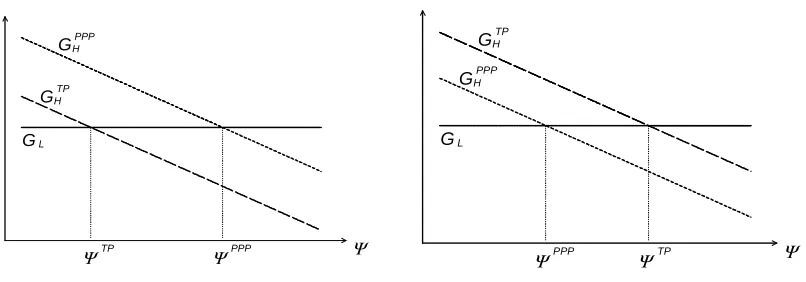
Figure 2 depicts the government’s expected payo¤ depending on the …rst-stage
e¤ort costs . In the left panel, the conditionb2
1 >(1 p)b 2
0=(2 p)is satis…ed.26 This
condition implies that P P P
> T P
and GP P P H > G
T P
H must hold. The government will
implement high e¤ort in the building stage whenever the e¤ort costs are smaller than
P P P
and in this case the government strictly prefers a public-private partnership.
In the right panel, the condition b2
1 < (1 p)b 2
0=(2 p) holds (i.e., a
second-stage success is su¢ciently more valuable when there was a …rst-second-stage failure). This
condition implies P P P < T P and GP P P
H < G
T P
H , so whenever is smaller than T P
the government implements high e¤ort in the building stage and strictly prefers
traditional procurement.
Taken together, the following result holds.
Proposition 3 Suppose the government has full commitment power. (i) If b2
1 > (1 p)b 2
0=(2 p) and <
P P P
, the government strictly prefers a
public-private partnership.
(ii) If b2
1 <(1 p)b 2
0=(2 p) and <
T P
, the government strictly prefers traditional
procurement.
(iii) Otherwise, the government is indi¤erent between the two modes of provision.
VI.
Renegotiation
Public-Private Partnership Versus Traditional Procurement Reconsidered
So far, we have assumed that the government can commit not to renege on the
con-tractually speci…ed payments.27 We now relax this assumption and explore what will
26Note that this condition always holds when b
1 > b0; i.e., when a second-stage success is more
valuable in case of a …rst-stage success.
27It should be noted that renegotiation has often been studied in traditional moral hazard models
with a risk-averse agent. In such a framework, renegotiation is an important issue even in a one-shot
problem, because after the agent has chosen the e¤ort level, there is no need to expose the agent
to further risk. Fudenberg and Tirole (1990), Ma (1994), and Matthews (1995) demonstrate that it
depends on the details of the renegotiation game whether or not e¤ort incentives are reduced when
renegotiation cannot be ruled out. In contrast, in a framework with risk-neutral agents, there is scope
happen if mutually bene…cial renegotiation at the beginning of the operating stage
cannot be prevented.28 In the case of traditional procurement the analysis remains
unchanged, since two di¤erent parties are in charge of the two stages and hence the
government has no reason to ex ante commit to a second-stage contract that it would
want to renege on after the building stage is …nished. However, in case of a
public-private partnership, ex ante the government wants to commit to second-stage payments
that a¤ect the consortium’s second-stage incentives as well as its …rst-stage incentives.
Once it is known whether or not there was a success in the building stage, the
govern-ment is interested only in the consortium’s incentives in the operating stage and thus
the government might want to renege on the original contract.
Speci…cally, consider a public-private partnership and suppose that P P P, so
that the government would implement high …rst-stage e¤ort (E = 1) if renegotiation
could be ruled out. According to Proposition 2, under full commitment the contract
speci…es tP P P
1 = b1, so that following a …rst-stage innovation the second-stage e¤ort
level iseP P P
(1) =b1. Yet, when there was a …rst-stage success, then at the beginning
of the second stage the government would prefer to implement only e(1) = 1 2b1 in
order to reduce the expected second-stage rent, as we have seen in the analysis of
the operating stage under traditional procurement. However, if the government tried
to renege on the agreed-upon contract by reducing the payment for a second-stage
innovation, the consortium would not give in. The consortium would insist on the
original contract, since otherwise its expected rent would be reduced. Hence, there is
no scope for mutually bene…cial renegotiation when there was a …rst-stage success.
Now suppose that there was no innovation in the building stage. According to
Proposition 2, for this case the contract under full commitment speci…es tP P P
0 = (1
p)b0=(2 p). As a consequence, the consortium would choose the second-stage e¤ort
level eP P P
(0) = (1 p)b0=(2 p), while at the beginning of the operating stage the
government would prefer to implement the e¤ort levele(0) = (1=2)b0, as we know from
the analysis of traditional procurement. Clearly, when the government o¤ers to increase
the payment for a second stage innovation to t0 = (1=2)b0, the consortium will accept
28Several authors have pointed out that renegotiation is an important problem in the context of
public-private partnerships, see e.g. the recent contributions by Henckel and McKibbin (2017) and
the o¤er, since then its expected rent will be larger. Therefore, the outcome described
in Proposition 2 is no longer sustainable when mutually bene…cial renegotiation cannot
be prevented.
To characterize the solution to the government’s problem when renegotiation cannot
be ruled out, let us de…ne a new threshold level of the …rst-stage e¤ort costs,
^P P P :=p[B1 B0+1 2b
2 1
3 8b
2
0]: (12)
Applying the renegotiation-proofness principle, we can without loss of generality focus
on contracts that are not renegotiated in equilibrium.29 We thus obtain the following result.
Proposition 4 Consider a public-private partnership and suppose that mutually ben-e…cial renegotiation cannot be prevented.
(i) If ^P P P, it is optimal for the government to set tP P P
0 = (1=2)b0, t
P P P
1 = b1,
and TP P P
= =p (1=2)b2
1 + (1=8)b 2
0. Then the consortium will choose E
P P P
= 1 in
the building stage and eP P P
(1) =b1, e
P P P
(0) = (1=2)b0 in the operating stage.
(ii) If > ^P P P, it is optimal for the government to set tP P P
0 = (1=2)b0, t
P P P
1 =
(1=2)b1, and T
P P P
= 0. Then the consortium will choose EP P P
= 0 in the building
stage and eP P P
(0) = (1=2)b0 in the operating stage.
Proof. See the Appendix.
Observe that the government still rewards the consortium for a …rst-stage success
by implementing a larger second-stage e¤ort level in this case than it would do
un-der traditional procurement. However, when renegotiation cannot be ruled out the
government loses its possibility to punish the consortium for a …rst-stage failure by
implementing a smaller second-stage e¤ort level than under traditional procurement.
As a consequence, given that high …rst-stage e¤ort is implemented, the government’s
expected payo¤ is smaller when renegotiation cannot be prevented than in the case of
full commitment.30
29See Hart and Tirole (1988) for more on the renegotiation-proofness principle. Intuitively, the
allocation that would result from renegotiation can already be speci…ed in the original contract, so
there is no need to consider contracts that are renegotiated on the equilibrium path.
The new threshold value ^P P P satis…es F B < ^P P P < P P P. High e¤ort in
the building stage is now implemented for a smaller range of …rst-stage e¤ort costs
compared to the case of a public-private partnership where the government has full
commitment power. Yet, the impossibility to prevent renegotiation does not
qualita-tively change the comparison with the …rst-best benchmark where e¤orts are veri…able.
Corollary 3 Consider a public-private partnership and suppose that mutually bene…-cial renegotiation cannot be prevented.
(i) In the building stage,EP P P
EF B
.
(ii) In the operating stage, eP P P
(1) = eF B
(1) and eP P P
(0) < eF B
(0) if ^P P P,
whileeP P P
(0)< eF B
(0) if > ^P P P.
Let us now turn to the comparison between the two organizational modes. When
renegotiation cannot be ruled out, Proposition 4 implies that under a public-private
partnership high e¤ort is implemented in the building stage whenever ^P P P. In
this case, the government’s expected payo¤ reads
^ GP P P
H =p[B1+
1 2b
2
1] + (1 p)[B0+
1 8
2 3p
1 pb
2
0] ; (13)
which is smaller than GP P P
H . Otherwise, the government’s expected payo¤s remain
unchanged.
Suppose now that the condition b2
1 > (1=2)b 2
0 holds, which is always the case if a
second-stage innovation is more valuable when there also was a …rst-stage innovation.
Then ^P P P > T P
and G^P P P H > G
T P
H hold. Hence, the government implements high
…rst-stage e¤ort whenever the e¤ort costs are smaller than ^P P P and in this case
the government strictly prefers a public-private partnership. Next, suppose that the
condition b2
1 < (1=2)b 2
0 is satis…ed, so a second-stage innovation is su¢ciently more
valuable when there was no …rst-stage innovation. Then^P P P < T P andG^P P P H < G
T P H
hold. Thus, whenever is smaller than T P
, the government implements high
…rst-stage e¤ort and strictly prefers traditional procurement.
Taken together, the parameter range where a public-private partnership is optimal
is now smaller than in the case of full commitment.
use of history-dependent contracts. Hence, our model illustrates that limited commitment power
does not invalidate the insight of the repeated moral hazard literature that optimal contracts exhibit
Proposition 5 Suppose that mutually bene…cial renegotiation cannot be prevented. (i) If b2
1 > (1=2)b 2
0 and < ^
P P P
, the government strictly prefers a public-private
partnership.
(ii) If b2
1 <(1=2)b 2
0 and <
T P
, the government strictly prefers traditional
procure-ment.
(iii) Otherwise, the government is indi¤erent between the two modes of provision.
Project Choice
We now investigate implications that the impossibility to rule out renegotiation in
case of a public-private partnership may have with regard to the initial choice of a
public project. Suppose that at the outset, the government has the choice between
two di¤erent projects I and II. In what follows, we assume that bI
0 > bII0 , while the
projects are identical otherwise. Hence, the two projects di¤er only in the value of a
second-stage innovation when there was no …rst-stage success. This value is larger in
case of projectI, which means that project I is the technologically superior project.31
If the government implements low …rst-stage e¤ort (so that the organizational mode
does not matter) or if the government opts for traditional procurement, it is obvious
that it will never choose the technologically inferior project II. To see this formally,
observe that GL and G T P
H are increasing in b0. Moreover, in case of a public-private
partnership the government always prefers project I when it has full commitment
power, since alsoGP P P
H is increasing inb0.
Now consider a public-private partnership and suppose that renegotiation cannot
be prevented. Recall that when high …rst-stage e¤ort is implemented, the government’s
expected payo¤ as a function ofb0 is given by
^ GP P P
H (b0) =p[B1+
1 2b
2
1] + (1 p)[B0+
1 8
2 3p
1 p b
2
0] : (14)
Observe that when the probability of a …rst-stage success given high …rst-stage e¤ort is
relatively large, then the government’s expected payo¤ is decreasing inb0. Speci…cally,
^ GP P P
H (bII0 )>G^
P P P
H (bI0)whenever p > 2=3.
31We focus on two projects that di¤er only with regard to b
0 in order to clearly isolate the reason
why an inferior project may be chosen by the government. Yet, by continuity it is straightforward
to verify that the inferior projectII may be chosen even if in addition to bI
0 > bII0 also B1I > B1II,
BI
Ψ PPP
(b0) Ψ Ψ PPP
(b0)
I II
^ _ ^ Ψ
G H PPP(b0)
^ II
G H PPP(b0)
^ I
G L(b0)
G L(b0) I
[image:24.612.196.426.50.202.2]II
Figure 3. Choice between projectsI and II withb0I > bII0 , when p >2=3.
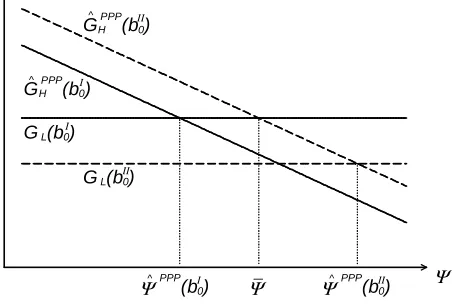
As an illustration consider Figure 3, which depicts the government’s expected
pay-o¤ from a given project depending on the …rst-stage e¤ort costs. The solid curves refer
to the technologically superior projectI, while the dashed curves refer to the
techno-logically inferior projectII. Recall that when low …rst-stage e¤ort is implemented, the
government’s expected payo¤ as a function of b0 is given by GL(b0) = B0 + (1=4)b 2 0.
In each project, high …rst-stage e¤ort is implemented when the …rst-stage e¤ort costs
are su¢ciently small, ^P P P(b0) = p[B1 B0 + (1=2)b 2
1 (3=8)b 2
0]. Note that
^P P P
(bI 0)< ^
P P P
(bII
0 )must hold. When low …rst-stage e¤ort is implemented, the
gov-ernment prefers projectI, sinceGL(bI0)is larger thanGL(bII0 ). Yet, when high …rst-stage
e¤ort is implemented, the government prefers project II, given that p >2=3. Hence,
there exits a threshold value such that the government chooses the technologically
inferior project whenever the …rst-stage e¤ort costs are smaller than .
Proposition 6 Consider a public-private partnership and suppose that mutually ben-e…cial renegotiation cannot be prevented.
(i) If p <2=3, the government chooses the technologically superior project I.
(ii) If p > 2=3, there exists a cuto¤-value 2 (^P P P(bI 0);^
P P P
(bII
0)) such that the
government chooses project I if > , while it chooses the technologically inferior
project II if < .
Proof. See the Appendix.
Intuitively, the government may prefer the technologically inferior project II
renegotiation cannot be prevented the government loses its ability to punish the
con-sortium for a …rst-stage failure by implementing a very small second-stage e¤ort. This
is less of a problem whenb0 is small, since then the second-stage e¤ort (and hence the
consortium’s expected second-stage rent) following a …rst-stage failure will be small
anyway; i.e., renegotiation has less bite. However, choosing the technologically inferior
project can be optimal only if the probability p is relatively large, so the probability
that b0 will actually become relevant on the equilibrium path is relatively small.
Finally, regarding the choice between a public-private partnership and traditional
procurement, it should be noted that the preceding …ndings imply that the availability
of a technologically inferior project can increase the parameter range for which the
government prefers a public-private partnership. In particular, the following result
holds.
Corollary 4 Suppose that mutually bene…cial renegotiation cannot be prevented, p > 2=3, and < .
(i) If only project I is available, the government strictly prefers a public-private
part-nership over traditional procurement wheneverb2
1 >(1=2)(bI0) 2
.
(ii) If in addition the technologically inferior project II becomes available, the
govern-ment chooses project II and strictly prefers a public-private partnership over traditional
procurement whenever b2
1 >((1 p)=p)(bI0) 2
+ ((3p 2)=(2p))(bII 0)
2
.
Proof. See the Appendix.
VII.
Concluding Remarks
The relatively new organizational form of public-private partnerships was promoted to
foster incentives to innovate, such that increased quality would be achieved at lower
costs. However, after more than 20 years of experience we observe mixed evidence
re-garding innovation incentives within public-private partnerships. Our model explains
in a uni…ed framework that compared to traditional procurement, a public-private
part-nership may indeed either foster or sti‡e innovation incentives, depending on whether
successes in the two stages are of a complementary or of a substitutive nature.
In contrast to earlier contributions to the literature on public-private partnerships
success probability in the operating stage) are technologically independent of the e¤ort
invested in the building stage.32 Instead, in our moral hazard setting future expected
rents in the operating stage can increase or decrease incentives to innovate in the
build-ing stage. Thus, from the consortium’s perspective an externality between the stages
is endogenously created only if the government conditions payments in the operating
stage on the outcome of the building stage.33 Therefore, in our model there is a single
force working in two ways. The costs and bene…ts of bundling the building and
oper-ating tasks in a public-private partnership are two sides of the same coin, since in each
case they stem from the intricate e¤ects that expected rents have on the prevailing
incentive structure.
Speci…cally, it turns out that if a …rst-stage innovation increases the social value of a
second-stage innovation (i.e., successful outcomes of the two stages are complements),
then bundling the tasks in a public-private partnership reduces the agency costs. In
contrast, if a …rst-stage innovation reduces the social value of a second-stage innovation
(i.e., successful outcomes of the two stages are substitutes), then in a public-private
partnership the consortium may face strategic reasonsnot to exert e¤ort in the
build-ing stage, in order to extract a larger rent in the provision stage. Moreover, we …nd
that the impossibility to rule out mutually bene…cial renegotiations reduces the
advan-tages of bundling and that in this case a public-private partnership may even lead the
government to opt for a technologicallyinferior project.34
We hope that the insights gained by our analysis will help to spur further empirical
research on the important topic of innovations in public infrastructure projects.35 In
32We have not introduced such externalities into our model since their e¤ects have already been
studied in the literature and in order to make clear that we identify a separate force that may also be
relevant when comparing public-private partnerships to traditional procurement.
33Note that our setup is thus di¤erent from and complementary to Martimort and Straub’s (2016)
recent work on moral hazard in public-private partnerships, since they rule out second-stage payments
that depend on the …rst-stage outcome.
34Note that this result identi…es a potential selection bias that should be taken care of in the
empir-ical literature, since it could a¤ect the assessment of the performance of public-private partnerships
compared to traditional procurement.
35As has been pointed out by Iossa and Martimort (2015, p. 40), in spite of the policy relevance,
still relatively little research has been carried out on public-private partnerships. In particular, the
particular, a testable implication of our analysis is that the complementary or
substitu-tive nature of successful outcomes of the building and operating stages should have an
impact on the choice of the organizational form. Moreover, from a contract-theoretic
perspective, our model could be extended in several directions. For example, following
most of the theoretical literature on public-private partnerships, we have abstracted
from agency problems within the consortium and we have focused our analysis on the
relationship between the government and a given consortium. Exploring the
interac-tions of internal agency problems and of the award procedure with the incentive e¤ects
identi…ed in the present paper might be interesting avenues for future research.36
so much more work needs to be done on that front.
36Regarding agency problems within consortia, see Greco (2015) for an analysis of imperfect
bundling in an incomplete contracting model based on Hart (2003) and Bennett and Iossa (2006).
With regard to award procedures, see Li et al. (2015) who study the bundling of tasks in procurement
Appendix
Proof of Proposition 2. The government o¤ers a contract (T; t0; t1) to the consortium
in order to maximize its expected payo¤
pE[B1+t1(b1 t1) T] + (1 pE)[B0 +t0(b0 t0)] (A1)
subject to the constraint that in the building stage the consortium will choose high
e¤ort (E = 1) ifT =p (1=2)t2
1+ (1=2)t 2
0, while it will choose low e¤ort otherwise.
If the government wants to implement high e¤ort in the building stage, it sets
T = =p (1=2)t2
1+ (1=2)t 2
0 and chooses the paymentst0 and t1 that maximize
p[B1+t1b1
1 2t 2 1 1 2t 2
0] + (1 p)[B0+t0(b0 t0)] : (A2)
Hence, in this case the optimal contract is given bytP P P
1 =b1,t
P P P
0 = (1 p)b0=(2 p),
andTP P P
= =p (1=2)b2 1+
1
2((1 p)b0=(2 p)) 2
. Observe that under our assumption
>(1=2)pb2
1 the limited liability constraint T
P P P
0is satis…ed.
If the government wants to implement low e¤ort in the building stage, it setsT = 0
and chooses the payment t0 that maximizes B0 +t0(b0 t0). Thus, in this case the
optimal contract must satisfy tP P P
0 = (1=2)b0 and T
P P P
= 0. Note that in order to
satisfy the constraint T < =p (1=2)t2
1 + (1=2)t 2
0, the government can specify any
t1 such that (1=2)t 2
1 < =p+ (1=8)b 2
0. Under the assumption that > (1=2)pb 2 1, the
government can thus settP P P
1 = (1=2)b1, which would be the optimal payment o¤ the
equilibrium path.
Comparing the two cases, we see that the government prefers to induce high e¤ort
in the building stage whenever
p[B1+
1 2b
2
1] + (1 p)[B0+
1 2
1 p
2 pb
2
0] B0+
1 4b
2
0 (A3)
holds. This condition can be rewritten as
p[B1 B0+
1 2b 2 1 1 4
3 2p
2 p b
2
0]; (A4)
which completes the proof of the proposition.
Proof of Proposition 4. Given that the payments t0 1and t1 1have been
stage-2 payo¤ etx (1=2)e
2
and thus exert e¤ort e(x) =tx. Recall from our analysis
of traditional procurement that at the beginning of the operating stage, the
govern-ment would like to set tx = (1=2)bx. Due to concavity of the government’s payo¤,
at the beginning of the operating stage the government would like to reduce tx when
in the original contract it was larger than (1=2)bx, while the government would like
to increase tx when in the original contract it was smaller than (1=2)bx. Since the
consortium’s expected second-stage rent(1=2)t2
x is increasing intx, the consortium will
accept a renegotiation o¤er at the beginning of the operating stage whenever the
pay-ment is larger than in the original contract. Hence, the original contract must satisfy
tx (1=2)bx to be renegotiation-proof. In the building stage, given that the payment
T was speci…ed in the contract, the consortium exerts high e¤ort (E = 1) whenever
p[T + (1=2)t2
1] + (1 p)(1=2)t 2
0 (1=2)t 2 0.
Thus, if the government wants to implementE = 1, it proposes a contract(T; t0; t1)
to the consortium in order to maximize its expected payo¤
p[B1+t1(b1 t1) T] + (1 p)[B0+t0(b0 t0)] (A5)
subject to the incentive-compatibility constraint T =p (1=2)t2
1 + (1=2)t 2 0 and
the renegotiation-proofness constraints t0 (1=2)b0 and t1 (1=2)b1. Applying the
Kuhn-Tucker Theorem (see e.g. Dixit, 1990), the solution to the government’s problem
maximizes the Lagrangian
p[B1+t1(b1 t1) T] + (1 p)[B0+t0(b0 t0)]
+ 0(t0
1
2b0) + 1(t1 1
2b1) + 2(T =p+ 1 2t
2 1
1 2t
2
0); (A6)
where 0 0, 1 0, and 2 0. Hence, p(b1 2t1) + 1 + 2t1 = 0, (1 p)[b0
2t0] + 0 2t0 = 0, and p+ 2 = 0 must hold. Moreover, the complementary
slackness conditions 0(t0 (1=2)b0) = 0, 1(t1 (1=2)b1) = 0, and 2(T =p+
(1=2)t2
1 (1=2)t 2
0) = 0 must be satis…ed. Observe that 2 = p > 0 implies that
T = =p (1=2)t2
1 + (1=2)t 2
0. Next, suppose that 0 = 0 would hold. Then (1
p)[b0 2t0] + 0 2t0 = 0 and 2 =pwould implyt0 = (1 p)b0=(2 p), which would
violate the constraintt0 (1=2)b0. Therefore the constraint is binding; i.e., 0 >0and
tP P P
0 = (1=2)b0 must hold. Moreover, observe that 1 > 0 would imply t1 = (1=2)b1,
and tP P P
1 =b1 must hold. Finally, observe that under our assumption >(1=2)pb 2 1 it
is ensured that TP P P
= =p (1=2)b2
1+ (1=8)b 2
0 is positive.
If the government wants to implementE = 0, it setsTP P P
= 0andtP P P
0 = (1=2)b0,
which maximizesB0+t0(b0 t0). To satisfy the constraintT < =p (1=2)t 2
1+ (1=2)t 2 0,
under our assumption >(1=2)pb2
1 the government can specifyt
P P P
1 = (1=2)b1. Note
that the contract is renegotiation-proof.
A comparison of the government’s expected payo¤s implies that the government
implementsE = 1 whenever
p[B1+
1 2b
2
1] + (1 p)[B0+
1 8
2 3p
1 p b
2
0] B0+
1 4b
2
0 (A7)
is satis…ed. Thus, the government implements high e¤ort in the building stage whenever
p[B1 B0+
1 2b 2 1 3 8b 2
0]; (A8)
so the proposition must hold.
Proof of Proposition 6.Recall thatbI
0 > bII0 impliesGL(b0I)> GL(bII0 ). Hence, part (i) of
the proposition immediately follows from the fact thatG^P P P
H (bI0)>G^
P P P
H (bII0 )whenp <
2=3. Now consider part (ii) of the proposition. Recall thatp > 2=3impliesG^P P P
H (bII0 )>
^ GP P P
H (bI0). Hence, while the government prefers project I when it implements low
…rst-stage e¤ort, it prefers project II when it implements high …rst-stage e¤ort. The
government thus implements high …rst-stage e¤ort wheneverG^P P P
H (bII0 ) GL(bI0). This
condition can be rewritten as , where
:=p[B1 B0+
1 2b
2 1
3p 2
8p (b
II 0 )
2 1
4p(b
I 0)
2
]: (A9)
It is straightforward to verify that the cuto¤-value satis…es the condition ^P P P(bI 0)<
< ^P P P(bII 0 ).
Proof of Corollary 4. Part (i) of the corollary follows immediately from Propositions 5
and 6. Now consider part (ii) of the corollary. We already know that the government
prefers projectI in case of traditional procurement. Given a public-private partnership,
prefers projectI otherwise. Hence, the government chooses the technologically inferior
projectII and a public-private partnership if
^ GP P P
H (b
II 0 )> G
T P H (b
I
0) =p[B1+
1 4b
2
1] + (1 p)[B0+
1 4(b
I 0)
2
] (A10)
and G^P P P
H (bII0 )> GL(bI0). The latter condition is satis…ed since by assumption < .
The former condition can be rewritten as
b2 1 >
1 p
p (b
I 0)
2
+3p 2
2p (b
II 0 )
2
: (A11)
Observe thatp >2=3 implies
1 p
p (b
I 0)
2
+3p 2
2p (b
II 0 )
2
< 1 2(b
I 0)
2
; (A12)
so a public-private partnership is preferred for a larger parameter range when project