Original Article
Quality of life among postoperative patients with
disorders of sex development: a long-term perspective
Xiaoyan Tang, Ning Zhang, Jingxin Ding, Keqin Hua
Department of Gynecology, Obstetrics and Gynecology Hospital, Fudan University, Shanghai 200011, People’s Republic of China
Received September 4, 2016; Accepted February 2, 2017; Epub September 15, 2017; Published September 30, 2017
Abstract: Objective: Quality of life (QOL) among patients with disorders of sex development (DSD) is important as-pect of their care. In our study, we evaluated the long-term QOL of postoperative DSD patients compared with the
control. Design: A cross-sectional study utilizing a standardized questionnaire. Patients and Methods: Thirty-five
patients with DSD (seven with congenital adrenal hyperplasia, six with 46,XY gonadal dysgenesis, and twenty-two with androgen insensitivity syndrome) participated in this study. They all underwent different surgical treatments. A long-term follow up was carried out after surgeries including postoperative QOL and sexual life quality, which were assessed through SF-12 questionnaire and Chinese version of Female Sexual Function Index (CVFSFI) for patients with DSD and 35 controls matched for sex, age, and education level etc. Results: The mean follow-up time was 3.98
(0.3-11.2) years. Compared to the 46,XX healthy women, patients with DSD reported significantly lower mental health scores (P<0.05) while other domains were not significantly different (P>0.05). And two patients received psychotherapy after surgery. There were no significant differences (P>0.05) regarding the eight domains between patients with different types of DSD (P>0.05). We observed no differences in QOL between patients with androgen insensitivity syndrome (AIS) who underwent gonadectomy in adolescence or adulthood (P>0.05). Among all pa -tients, only 8women (22.8%) reported sexual activity with lower orgasm and total FSFI scores (P<0.05). Conclusion: A skilled multidisciplinary team is necessary and especially more attention should be paid to the treatment of psy-chological and sexual problems experienced by patients with DSD to improve their QOL.
Keywords: Quality of life, disorders of sex development, surgical treatment, sexual dysfunction
Introduction
The term “disorder of sex development” (DSD)
is defined as a congenital condition in which
the development of chromosomal, gonadal, or anatomical sex is atypical according to the international consensus established in Chicago in 2005. The term includes a heterogeneous group of conditions and can be divided into sex chromosome DSD, 46,XY DSD, and 46,XX DSD according to the consensus [1]. DSDs are rare, and the incidence is approximately 1:4,500-5,000 [2, 3]. The rarity of DSD limits the rele-vance of the literature when conducting a medi-um to long-term follow-up study of affected patients.
Quality of life (QOL) is a term utilized to describe an individual’s perception of their position in life in the context of the culture and value sys-tems in which they live and in relation to their
according to the Quality of Life Group of the
World Health Organization [4]. QOL is indeed
crucial to outcome studies involving patients with DSD. QOL measurements provide an over-view of multiple dimensions regarding patient
well-being and influence patient management.
Although a few articles have assessed QOL for patients with DSD during the last decade, DSD is a heterogeneous condition that can be quite variable [5-7].
In our study utilizing the SF-12 survey, we evalu-ated the QOL of Chinese patients with DSD who underwent surgical treatments compared to normal individuals matched for sex, age, and education level etc.
Material and methods
Patients and comparison group
invited 58 DSD patients from different regions of China who received surgical treatments in our hospital between February 2005 and Nove- mber 2015 to participate this study. Among the 58 patients, 35 (60%) agreed to participate. These patients were well informed and signed consent forms. For 5 (9%) patients, their par-ents rejected the invitation because they had not informed their children about their diagno-sis and considered them too young to under-stand their condition. The remaining 18 (31%) patients did not reply to our invitation.
All 35 patients had definite diagnosis following
comprehensive examinations, including physi-cal examinations, laboratory tests, ultrasonog-raphy and pathological results following sur-gery. Despite of their diagnosis, all patients or
their parents chose female as the final social
sex. The mean follow-up time for these patients
was 3.98 years (0.3-11.2 years). We collected
data regarding age, clinical diagnosis, educa-tion level, marriage, employment, the age at
operation, the scores of the SF-12 question-naire and all treatments they received including surgery, medicine and psychological therapy. The control group was recruited from women who came to the health examination center at our hospital and several girls from nearby schools with complete medical records indicat-ing no past or present illness. The controls were matched for sex, age (n=35, age: 22.97±4.94, range: 15-33 years), education level, marriage, employment and were informed about the nature of our study.
Methods
The SF-12 questionnaire is a reasonable alter-native to SF-36. The Chinese version is avail-able athttp://www.qualitymetric.com, and fur-ther information can be obtained from the International Quality of Life Assessment Project [8]. The SF-12 questionnaire consists of 12 questions that measure health in 8 domains: physical functioning, physical roles, bodily pain, general health, vitality, social functioning, emo-tional roles, and mental health. The scale scores are calculated by summing the respons-es across scale items and then transforming the raw scores to a 0-100 scale (higher scores indicate better health) [9]. Such questionnaires have been widely utilized to assess the impact of a variety of diseases or interventions on gen-eral health [10, 11].
Statistical analysis
The data were analyzed using PASW Statistics for Windows, Version 19.0 (SPSS Inc., Chicago,
IL, USA). The continuous data are presented as means ± standard deviations, and the categori-cal data are presented as counts and percent-ages. Independent sample t tests were used to compare the differences between patient and control groups. A one-way ANOVA was used to compare differences based on age and diagno-sis. A P value of less than 0.5 was considered
significant.
Results
Thirty-five patients with DSD and thirty-five
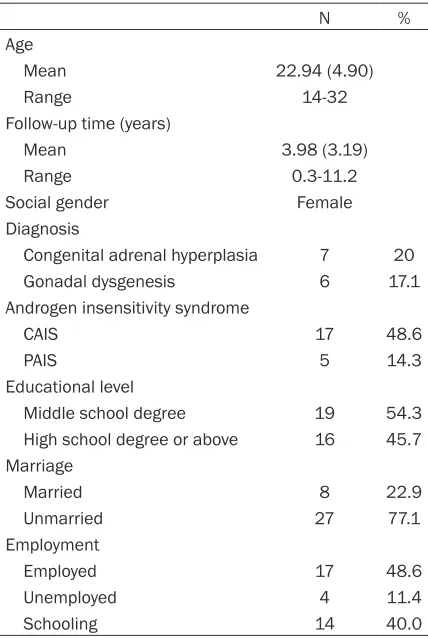
[image:2.612.90.304.95.414.2]healthy women (control group) were recruited to participate in this study. Among the patients with DSD, 7 had congenital adrenal hyper- plasia, 6 had 46,XY gonadal dysgenesis, and 22 had androgen insensitivity syndrome. All Table 1. Basic characteristics of patients with
DSD
N %
Age
Mean 22.94 (4.90)
Range 14-32
Follow-up time (years)
Mean 3.98 (3.19)
Range 0.3-11.2
Social gender Female
Diagnosis
Congenital adrenal hyperplasia 7 20
Gonadal dysgenesis 6 17.1
Androgen insensitivity syndrome
CAIS 17 48.6
PAIS 5 14.3
Educational level
Middle school degree 19 54.3
High school degree or above 16 45.7
Marriage
Married 8 22.9
Unmarried 27 77.1
Employment
Employed 17 48.6
Unemployed 4 11.4
Schooling 14 40.0
patients were reared as female. The mean pa- tient age was 22.94 years (SD 4.90, range: 14-32 years). The mean follow-up time was 3.98 years (range: 0.3-11.2 years). In total, 19 patients (54.3%) had achieved a middle school degree, and the other patients had achieved high school degree or above. Seven- teen patients (48.6%) are employed, four pa- tients (11.4%) are unemployed and others are schooling. Seven patients (22.7%) are married. The basic characteristics of the patients are presented in Table 1.
The scores from the SF-12, including 8 domains (physical functioning, physical role, bodily pain, general health, vitality, social functioning, emo-tional role, and mental health) were calculated for the patients with DSD and controls. The scores were transformed to a 1-100 scale. Compared to the 46,XX healthy women, pa-
scores for mental health (P<0.05) but not the
[image:3.612.91.522.84.143.2]other domains (P>0.05) (Table 2). As shown in Table 3, the data were analyzed via a one-way ANOVA. Regarding the eight domains, we ob-
served no significant differences between the
different DSD subgroups. Among all patients, 8 women (22.8%) were sexually active and the ratio is lower than the control group in which
the ratio is 40% (14/35). We also evaluated
their sexual life quality using the Chinese ver-sion of the Female Sex Life Index (CVFSFI). In contrast with the control group, patients with
DSD reported significantly lower orgasm and
total FSFI score (P<0.05) (Table 4).
All thirty-five patients had undergone different
surgical treatments, including gonadectomy, clitoroplasty, vaginoplasty and constructive ge- nital surgery in accordance with their
condi-tions. We compared the QOL among patients
diagnosed with androgen insensitivity syndro- Table 2. SF-12 scores for patients with different types of DSD versus the control group
Groups General health Physical function physicalRole Mental health emotionalRole Bodily pain Vitality functionSocial
[image:3.612.92.525.179.257.2]DSD (n=35) 66.71±19.33 97.86±7.10 82.86±29.56 68.29±17.06 72.86±30.54 82.86±16.90 65.14±21.33 78.57±17.30 Control (n=35) 57.14±23.17 97.14±8.07 75.71±32.93 73.43±12.59 68.57±29.92 85.00±18.39 65.14±16.34 87.86±12.68 P 0.368 0.433 0.207 0.047 0.729 0.409 0.067 0.587
Table 3. Comparison of SF-12 scores for DSD subgroups
Subgroups General health Physical function physicalRole Mental health emotionalRole Bodily pain Vitality functionSocial
CAH (n=7) 69.29±22.81 100.00±0.00 78.57±26.73 70.00±19.15 78.57±39.34 89.29±13.36 74.29±19.02 85.71±19.67 46XY GD (n=6) 62.50±22.08 95.83±10.21 83.33±40.83 68.33±21.37 91.67±20.41 87.50±13.69 66.67±24.22 83.33±12.91 AIS (n=22) 67.05±18.24 97.73±7.36 84.09±28.40 67.73±16.02 65.91±28.40 79.55±18.32 61.82±21.30 75.00±17.25 F 0.198 0.551 0.166 0.044 1.930 1.166 0.921 1.316 P 0.821 0.582 0.848 0.957 0.162 0.324 0.408 0.282
[image:3.612.90.525.302.358.2]CAH: Congenital adrenal hyperplasia; 46XY GD: 46,XY gonadal dysgenesis; AIS: Androgen insensitivity syndrome.
Table 4. CVFSFI scores for patients with DSD and the control group
Group Desire Arousal Lubrication Satisfaction Orgasm Sexual pain Total
DSD (n=8) 3.38±0.71 4.08±1.37 4.84±0.91 4.05±1.16 3.10±1.51 4.75±0.84 24.20±5.30
Control (n=14) 3.69±0.57 4.24±0.86 5.04±0.66 4.37±0.85 3.91±0.74 4.46±0.35 25.71±2.81
P 0.393 0.053 0.421 0.232 0.017 0.233 0.048
[image:3.612.91.522.402.461.2]CVFSFI: Chinese version of the Female Sex Life Index.
Table 5. Comparison of SF-12 scores for AIS groups based on the age at operation Age at
operation General health Physical function physicalRole Mental health emotionalRole Bodily pain Vitality functionSocial
<18 (n=14) 62.06±23.98 97.06±8.30 73.53±35.87 61.76±20.38 58.82±31.80 82.35±17.15 60.00±25.50 73.53±16.47
adolescence or adulthood. We observed no dif -ferences between these two groups (Table 5). Discussion
Our study is a cross-sectional investigation of the QOL of patients with DSD. In agreement with other studies reported previously [12-14], DSD does not affect some aspects of life, such as general health, physical function and bodily pain according to our results. The general health scores for patients with DSD were even higher than the scores for healthy women (but
not significant). The patients may feel that they
are better followed and medically protected because of the necessity of long-term follow-up in clinical settings. Other hypotheses may also account for these differences. Perhaps expo-sure to prenatal androgen positively affects a woman’s physical well-being. Additionally, wo- men with DSD are not exposed to the immen-
se hormonal fluctuations that other women
experience during “normal” female pubertal changes [14]. Further studies are needed to better understand these results. Patients with CAH and 46,XX and 46,XY-virilized DSD report-ed a poorer QOL according to a case-control study [15]. However, we did not observe any dif-ferences among the three different DSD sub-groups in our study. This inconsistency may be due to different patient groups, cultural envi-ronments, or questionnaires.
Patients with DSD scored significantly lower
on the mental health domain compared to healthy women. And only two patients recei- ved psychotherapy. This result raises concern. Franco et al. [16] investigated the QOL and psychological adjustment of 34 Italian females with 46,XY DSD. These women were more likely to be depressed and anxious, showing more withdrawal and aggressive behaviors and hav-ing more thought and attention problems than the women in the comparison group. Accord-
ingly, the ESPE/LWPES guidelines emphasized
the importance of a clinical psychologist as a key member of the multidisciplinary team to provide proper management for patients with DSD patients and their families [17].
The timing of surgical interventions, especially gonadectomy for patients with 46,XY DSD is controversial. Currently, the common practice is to remove the testes of patients diagnosed with AIS after their feminization is complete.
Feminization occurs when peripheral androgen is converted to estrogen. The malignancy risk associated with AIS gonads is relatively low [18, 19]. However, some doctors still recommend that gonadectomy should be performed soon after diagnosis due to the potential for malig-nant transformation [20]. Among all 22 AIS patients in our study, only 1 (4.54%) patient
had dysgerminoma. This patient was first diag
-nosed with CAIS and underwent gonadectomy
at the age of 22. We evaluated the QOL of
patients diagnosed with AIS who had under-gone gonadectomy during adolescence or adulthood and found no difference between these two groups. The removal of the gonads in AIS patients can be deferred until adolescence due to the low malignancy rate and unaffected QOL. Moreover, better awareness of one’s med-ical condition during adolescence may contrib-ute to better psychological adjustment [21]. In this study, we also evaluated the sexual life quality of patients with DSD using the Chinese version of FSFI (CVFSFI) which has been previ-ously validated [22]. However, only 8 women (22.8%) reported any lifetime sexual activity while 14 (40.0%) women had sexual activity in control group. The low ratio may be due to the young age and conservative traditional beliefs of the patient population. Moreover, a higher degree of sexual and social anxieties for patients with DSD (e.g., fear of sexual contact) may delay or decrease sexual activity com-pared to the healthy women [12, 23, 24]. In contrast with the control group, patients with
DSD had significantly lower orgasm and total
FSFI scores and the scores of other domains
were also lower but not significant. Based on
the cut-off scores of the CVFSFI established by Jiehua Ma et al. [25], 4 patients (50%) were
sexually dysfunctional (total score ≤23.5); 2
(22.2%) patients had low desire; 2 (22.2%) patients had an arousal disorder; 2 (22.2%) patients had a lubrication disorder; 6 (66.7%) patients had an orgasm disorder, and 1 (11.1%)
patient had sexual pain. These findings agree
cautiously. (1) The study response rate was only 60%, and it is possible that the most ill or distressed patients did not participate. Hence, the sample size of our study is small. (2) Our study may have a selection bias. The data were collected in a gynecological hospital, and all of the patients were reared as female. Not all DSD types were represented in our study. (3) Because our follow-up study was cross-sec-tional in regards to QOL, we could not investi-gate how the QOL of the patients had evolved
over time. We also could not investigate the
impact of other potentially adverse life events. Conclusion
In conclusion, a skilled multidisciplinary team is necessary to care for patients with DSD, especially regarding their psychological and psychosexual counseling and education, to re- duce the degree of psychological and sexual problems and improve patient QOL by better understanding their condition and best treat-ment options.
Disclosure of conflict of interest
None.
Address correspondence to: Dr. Keqin Hua, De- partment of Gynecology, Obstetrics and Gyneco- logy Hospital, Fudan University, 419 Fang-Xie Road, Shanghai 200011, People’s Republic of China. Tel: +86-21-63455050*8261; Fax: +86-21-6345- 5090; E-mail: [email protected]
References
[1] Hughes IA. Disorders of sex development: a
new definition and classification. Best Pract
Res Clin Endocrinol Metab 2008; 22: 119-134.
[2] Dreger AD. “Ambiguous sex”-or ambivalent medicine? Ethical issues in the treatment of intersexuality. Hastings Cent Rep 1998; 28: 24-35.
[3] Low Y, Hutson JM; Murdoch Childrens Research Institute Sex Study Group. Rules for clinical diagnosis in babies with ambiguous genitalia. J Paediatr Child Health 2003; 39: 406-413.
[4] The World Health Organization Quality of Life assessment (WHOQOL): position paper from the World Health Organization. Soc Sci Med
1995; 41: 1403-1409.
[5] Cassia Amaral R, Inacio M, Brito VN, Bachega TA, Oliveira AA Jr, Domenice S, Denes FT, Sircili
MH, Arnhold IJ, Madureira G, Gomes L, Costa EMF and Mendonca BB. Quality of life in a large cohort of adult Brazilian patients with 46,XX and 46,XY disorders of sex development from a single tertiary centre. Clin Endocrinol (Oxf) 2015; 82: 274-279.
[6] Amaral RC, Inacio M, Brito VN, Bachega TA, Domenice S, Arnhold IJ, Madureira G, Gomes L, Costa EM and Mendonca BB. Quality of life of patients with 46,XX and 46,XY disorders of sex development. Clin Endocrinol (Oxf) 2015; 82: 159-164.
[7] Zhu D, Hu L, Wan X, Li H, You Q, Gao L and
Feng J. Quality of life evaluation in juveniles with disorders of sexual development. Pediatr Surg Int 2012; 28: 1119-1123.
[8] Ware JE Jr, Kosinski M and Keller SD. A
12-item short-form health survey-Construction of scales and preliminary tests of reliability and validity. Med Care 1996; 34: 220-233. [9] Busija L, Pausenberger E, Haines TP, Haymes
S, Buchbinder R and Osborne RH. Adult mea-sures of general health and health-related quality of life: medical outcomes study short form 36-item (SF-36) and short form 12-item (SF-12) health surveys, nottingham health
pro-file (NHP), sickness impact propro-file (SIP), medi -cal outcomes study short form 6D (SF-6D), health utilities index mark 3 (HUI3), quality of
well-being scale (QWB), and assessment of
quality of life (AQoL). Arthritis Care Res (Ho- boken) 2011; 63 Suppl 11: S383-412.
[10] Carmona L, Ballina J, Gabriel R, Laffon A; EPISER Study Group. The burden of musculo-skeletal diseases in the general population of Spain: results from a national survey. Ann Rheum Dis 2001; 60: 1040-1045.
[11] Foley A, Halbert J, Hewitt T and Crotty M. Does hydrotherapy improve strength and physical function in patients with osteoarthritis-a ran-domised controlled trial comparing a gym based and a hydrotherapy based strengthen-ing programme. Ann Rheum Dis 2003; 62: 1162-1167.
[12] Warne GL. Long-term outcome of disorders of
sex development. Sex Dev 2008; 2: 268-277. [13] Mazur T, Sandberg DE, Perrin MA, Gallagher
JA and MacGillivray MH. Male pseudoher-maphroditism: Long-term quality of life
out-come in five 46,XY individuals reared female. J
Pediatr Endocrinol Metab 2004; 17: 809-823. [14] Kleinemeier E, Jürgensen M, Lux A, Widenka
PM, Thyen U; Disorders of Sex Development
Network Working Group. Psychological adjust -ment and sexual develop-ment of adolescents with disorders of sex development. J Adolesc Health 2010; 47: 463-471.
dis-orders of sex development. Eur J Endocrinol 2006; 155: 877-885.
[16] D’Alberton F, Assante MT, Foresti M, Balsamo A, Bertelloni S, Dati E, Nardi L, Bacchi ML and Mazzanti L. Quality of life and psychological ad-justment of women living with 46,XY differenc-es of sex development. J Sex Med 2015; 12: 1440-1449.
[17] Hughes IA, Nihoul-Fékété C, Thomas B and Cohen-Kettenis PT. Consequences of the
ESPE/LWPES guidelines for diagnosis and
treatment of disorders of sex development. Best Pract Res Clin Endocrinol Metab 2007; 21: 351-365.
[18] Cheikhelard A, Morel Y, Thibaud E, Lortat-Jacob S, Jaubert F, Polak M and Nihoul-Fekete C. Long-term followup and comparison be-tween genotype and phenotype in 29 cases of complete androgen insensitivity syndrome. J Urol 2008; 180: 1496-1501.
[19] Oakes MB, Eyvazzadeh AD, Quint E and Smith YR. Complete androgen insensitivity syndrome-a review. J Pedisyndrome-atr Adolesc Gynecol 2008; 21: 305-310.
[20] Matsumoto F, Shimada K and Ida S. Tumors of bilateral streak gonads in patients with disor-ders of sex development containing y chromo-some material. Clin Pediatr Endocrinol 2014; 23: 93-97.
[21] Sandberg D, Gardner M and Cohen-Kettenis PT. Psychological aspects of the treatment of patients with disorders of sex development. Semin Reprod Med 2012; 30: 443-452.
[22] Sun X, Li C, Jin L, Fan Y and Wang D.
Deve-lopment and validation of Chinese version of female sexual function index in a Chinese population-a pilot study. J Sex Med 2011; 8: 1101-1111.
[23] Schmidt G, Klusmann D, Zeitzschel U and Lange C. Changes in adolescents’ sexuality
be-tween 1970 and 1990 in West-Germany. Arch
Sex Behav 1994; 23: 489-513.
[24] Boyle ME, Smith S and Liao LM. Adult genital surgery for intersex: a solution to what prob-lem? J Health Psychol 2005; 10: 573-584. [25] Ma J, Pan L, Lei Y, Zhang A and Kan Y. Preva-
lence of female sexual dysfunction in urban Chinese women based on cutoff scores of the Chinese version of the female sexual function index: a preliminary study. J Sex Med 2014; 11: 909-919.
[26] Schönbucher V, Schweizer K, Rustige L, Schützmann K, Brunner F and Richter Appelt H. Sexual Quality of Life of Individuals with 46,XY Disorders of Sex Development. J Sex Med 2012; 9: 3154-3170.
[27] Kohler B, Kleinemeier E, Lux A, Hiort O, Gruters
A, Thyen U; DSD Network Working Group.