Developing Universal Dependencies for Wolof
Cheikh Bamba Dione
University of Bergen / Sydnesplassen 7, 5007 Bergen [email protected]
Abstract
This paper presents work on the creation of a Universal Dependency (UD) treebank for Wolof as the first UD treebank within the Northern Atlantic branch of the Niger-Congo languages. The paper reports on various issues related to word segmentation for tokenization and the mapping of PoS tags, morphological features and dependency relations to existing conventions for annotating Wolof. It also outlines some specific constructions as a starting point for discussing several more general UD annotation guidelines, in particular for noun class marking, deixis encoding, and focus marking.
1 Introduction
Wolof (ISO code: 693-3) is a Niger-Congo language mainly spoken in Senegal and Gambia.1 Until
re-cently, not many natural language processing (NLP) tools or resources were available for this language. Dione (2012a) developed a finite-state morphological analyzer. Dione (2014) reported on the creation of a deep computational grammar for Wolof based on the Lexical Functional Grammar (LFG) framework. That grammar has been used to create the first treebank for this language, making an important contribution to the development of the LFG parallel treebank (Sulger et al., 2013).
Treebanks play an increasingly important role in computational and arguably also theoretical linguistics. A treebank can be defined as a collection of sentences that typically contain various kinds of morphological and syntactic annotations (Abeillé, 2003). In recent years, different language processing applications (e.g. question answering, machine translation, information extraction) require high-quality parsers. Reliable and robust parsing models can be trained and induced from treebanks (Manning and Schütze, 1999).
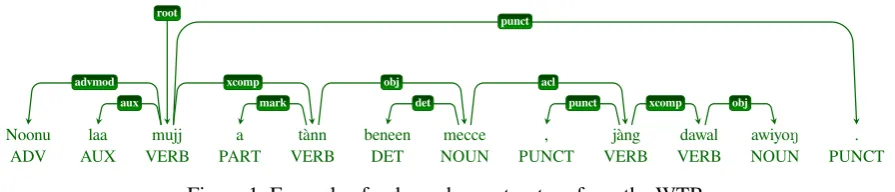
The basic assumption in dependency grammar is that syntactic structure consists of lexical elements linked by binary asymmetrical relations calleddependencies (Tesnière, 1959). The arguments to these relations consist of a head and a dependent. The head word of a constituent is the central organizing word of that constituent. The remaining words in the constituent are considered to be dependents of their head. Figure 1 shows an example of dependency structure from the WTB for the sentence2given in (1).
(1) Noonu
ADV laa1SG.NSFOCmujjfinally.doatotànnchooseanotherbeneen mecce,professionjànglearndawalpilot awiyoairplaneN. ‘So then I chose another profession, and learned to pilot airplanes.’
Noonu laa mujj a tànn beneen mecce , jàng dawal awiyoN .
ADV AUX VERB PART VERB DET NOUN PUNCT VERB VERB NOUN PUNCT
advmod aux
punct
xcomp mark
obj det
acl
[image:1.595.76.524.633.729.2]punct xcomp obj root
Figure 1: Example of a dependency structure from the WTB
1Seehttp://www.ethnologue.com/language/WOL.
This paper presents work on the development of a Universal Dependency (UD) treebank for Wolof (henceforth WTB). It is the first effort in building dependency structures for Wolof in particular, and for the Northern Atlantic branch of the Niger-Congo languages in general. The annotations contained in the Wolof LFG treebank (henceforth WolGramBank) served as a basis for the creation of a scheme for the WTB. Note, however, that the WTB is not an automatic conversion from the LFG treebank, but was rather created manually (from scratch). This is mainly because such an automatic conversion (which is planed as future work) involves non-trivial mapping issues between LFG and UD. One of the most significant challenges is to determine which syntactic level of representation– constituency structure or functional structure– is the most natural basis for constructing dependency representations. Other crucial issues include e.g. the procedure of selecting the true head of syntactic constituents, the mapping from LFG to UD relations, the treatment of copula, coordination and punctuation (Meurer, 2017; Przepiórkowski and Patejuk, 2019).
The paper is structured as follows. Section 2 gives a brief overview of some salient features of the Wolof language. Section 3 describes the data collection process and the composition of the corpus. Section 4 discusses issues of word segmentation for tokenization. Section 5 describes the annotation processes for parts of speech (PoS), morphological features and syntactic relations. Section 6 concludes the discussion.
2 Background on Wolof
Before we take up the issue of the creation of a treebank for Wolof, we need to provide the reader with a general understanding of some salient features of that language.
2.1 Nouns, noun classes and determiners
Like the other Atlantic languages, Wolof has a noun class (NC) system (Greenberg, 1963; Sapir, 1971; McLaughlin, 1997) that consists of approximatively 13 noun classes:38 singular, 2 plural, 2 locative, and 1
manner noun classes. Like in Bantu languages, the Wolof noun class system also encodesNumber. However, class membership is not marked on the noun itself, but rather on the noun dependents like determiners (e.g. articles, demonstratives), but also on (indefinite, interrogative and relative) pronouns and adverbs (locatives, manner). The noun classes are identified by their index (b,g,j, k,l,m,s,w for singular NCs andy, and
ñ for plural NCs). The index “appears in the form of a single consonant on nominal dependents such as determiners and relative particles” (McLaughlin, 1997, p. 2).
Wolof determiners agree in noun class with the head noun. Determiners for different noun classes are distinguished by a consonant that is final (i.e. as a suffix) in the indefinite article (2c) and word-initial (i.e. as a prefix) in all other determiners. In addition, definite determiners encode information about proximity and distance with respect to the noun reference. As shown in (2), the definite article is constructed by suffixing a spatial deictic,-ifor the proximal (2a) or-afor the distal (2b), to the consonantal class marker.4
(2) a. xaj
dogb-iNC-DFP ‘the dog (proximal)’
b. xaj
dogb-aNC-DFD ‘the dog (distal)’
c. a-b
INDF-NCxajdog ‘a dog’
Wolof has a rich system of demonstratives (Robert, 2016). These combine indications of the distance and reference point with respect to the speaker or addressee. For instance, for thebnoun class, the four most commonly used forms are (bii,bale,boobale, andboobu), as exemplified in (3) with the nounxaj“dog”.
(3) a. xaj bii‘this dog’ (close to me, wherever you may be)
b. xaj bale‘that dog’ (far away from me, wherever you may be)
c. xaj boobale‘that dog’ (far away from both of us, but closer to you than to me) d. xaj boobu‘that dog’ (close to you and far away from me)
3The number of noun classes may vary according to dialects (Tamba et al., 2012).
4Abbreviations in the glosses: ADV: adverb; COP: copula; DEM: demonstrative; DET: determiner; DFP: definite proximal;
In Wolof, noun class membership is determined by a number of factors, including phonological, semantic and morphological criteria (McLaughlin, 1997; Tamba et al., 2012). For instance, many nouns that begin with[w]are in thew-class. Concerning morphology, nouns derived with certain derivational suffixes (e.g.-in) are assigned a specific class (e.g. thew-class). Finally, regarding semantics, trees typically are in theg-class, while most fruits are in theb-class. Also, the singular human noun class is thek-class, while the default plural human noun class is theñ-class. However, the aforementioned factors just point to few tendencies found in the language. In fact, for each class, there are several words that do not follow these factors. The Wolof noun class system lacks semantic coherence (McLaughlin, 1997). The same can be said for the phonological and the morphological criteria. None of these factors are systematic indicators of noun classes in Wolof.
Furthermore, Wolof nouns are typically not inflected except for the genitive and the possessive case. Wolof genitives (4) are head-initial and show affinities with the Semitic construct state (Kihm, 2000). Such constructions involve a possessed entity described as the head and a possessor as its complement. The genitive relationship is overtly marked on the head noun by means of the-usuffix (e.g.kër-u) which precedes its complement (buur“king”). This suffix may also appear in other constructions like (5), which, unlike (4), do not denote possession, but rather seems to be just a normal compound, despite the similarity between these two constructions. In many other compounds like (6), the genitive marker does not appear at all.
(4) kër-u
house-GENbuurking ‘king’s house’
(5) ndox-u water-GENtawrain ‘rain water’
(6) téere
bookxam-xamknowledge ‘knowledge book’
2.2 Adjectives
Wolof has no category for adjectives (Church, 1981; McLaughlin, 2004). The ‘adjectival’ concepts in Indo-European languages are typically expressed by stative verbs in Wolof. Adjectival constructions are realized as relative clause structures with the “adjective” being inflected like verbs.
2.3 Verbal system
In Wolof, a verb constituent has two components (Robert, 1991; Robert, 2000). The first component is the verb which is typically an invariant (unless derived) lexical stem. The second component is an inflectional marker that conveys the grammatical specifications of the verb, including person, number, tense, aspect, and mood features as well as the information structure of the sentence (focus). The inflectional marker can be preposed, postposed, or suffixed to the lexical stem, resulting in ten different paradigms or conjugations (Robert, 2010). Among these paradigms, we can distinguish non-focused conjugations from focused ones. Non-focus conjugations include perfective (7-8) and imperfective (9) constructions.
(7) Xaj
dogb-iNC-DFPlekkeat na.3SG ‘The dog has eaten.’
(8) Lekk eat na.3SG
‘She/he/it has eaten.’
(9) Xaj
dogb-iNC-DFPdi-naIPFV-3SGlekk.eat ‘The dog will eat.’
Like Arabic (Attia, 2007) and many other languages, Wolof is a pro-language. This means that the subject can be explicitly stated as an NP or implicitly understood as a pro-drop. The pro-drop nature of the language is illustrated in the affirmative perfective examples given in (7-8). While (7) has an explicit subject, (8) does not. Nevertheless both sentences are grammatical. In (8), there is no overt subject, because the language freely allows the omission of such an argument. In examples (7-8),na is an agreement marker. It carries information about number, and person, which enables the reconstruction of the missing subject in (8).
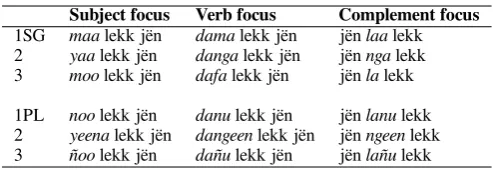
Wolof has three focus conjugations: subject focus, verb focus, and complement focus. As these names imply, these constructions vary according to the syntactic function of the focused constituent: subject, verb, or complement. The latter has a wide meaning and refers in general to any constituent which is neither subject nor main verb. Table 1 illustrates the inflections for the verblekk‘to eat’ and the objectjën‘fish’ in the three focus types. As can be seen, focus is marked morphosyntactically.
Subject focus Verb focus Complement focus 1SG maalekk jën damalekk jën jënlaalekk 2 yaalekk jën dangalekk jën jënngalekk 3 moolekk jën dafalekk jën jënlalekk
1PL noolekk jën danulekk jën jënlanulekk 2 yeenalekk jën dangeenlekk jën jënngeenlekk 3 ñoolekk jën dañulekk jën jënlañulekk
Table 1: Subject, verb and complement focus in Wolof.
(10) Faatu
Faatumoo3SG.SFOClekkeat jën.fish ‘It’s Faatu who ate fish.’
(11) Faatu
Faatudafa3SG.VFOClekkeat jën.fish ‘What Faatu did is eat fish.’
(12) Jën
fishla3SG.NSFOCFaatuFaatulekk.eat ‘It’s fish that Faatu ate.’
Morphologically, one can reconstruct the origins of the subject, verb and non-subject focus markers as
-a,da- and la-, respectively. An evidence for such a reconstruction can be seen in examples where the focus marker amalgamates with a noun or a proper name, as shown in (13a). Here, the formFaatoo is a phonological contraction and can be decomposed inFaatu + a, as illustrated in (13b). The main difference between (10) and (13a) is that in the former the constituent Faatu is dislocated, while in the latter that constituent bears the subject function. Indeed, (10) could be translated as “Faatu, it’s her who ate the fish”.
(13) a. Faatoo Faatu.SFOC
lekk eat
jën. fish ‘It’s Faatu who ate fish.’
b. Faatu Faatu a SFOC
lekk eat
jën. fish ‘It’s Faatu who ate fish.’
3 Data collection
The basis for the development of the WTB is a corpus of natural text data selected from the following sources: OSAD,5Wolof Online,6 Wolof Wikipedia,7and Xibaaryi.com.8Table 2 lists the sources of the
corpora used for creating the Wolof UD treebank.
[image:4.595.174.421.60.145.2]Source Genres # Docs # Tokens # Sentences OSAD didactic, expository 6 6269 265 Wolof Online informative, narrative 18 12988 673 Wolof Wikipedia encyclopedic 12 9232 500 Xibaaryi informative 17 15095 669
Table 2: Texts and genres in WTB.
The selection of texts for the WTB was meant to satisfy the following criteria. First, the data should be freely available as far as possible. Second, the text types should be chosen which are interesting to typical UD users. The data selected from Wikipedia is freely available under a Creative Commons license, facili-tating its annotation and distribution. Also, users interested in computational linguistics, corpus linguistics and language typology may prefer texts which resemble other treebank texts or are even available in other languages, such as Wikipedia. Third, a range of different genres should be covered. Accordingly, we include texts from other sources than Wikipedia. For those sources, it was necessary to first clarify copyright issues.
4 Tokenization and word segmentation
Syntactic analysis in UD is based on a lexicalist view of syntax (i.e. dependency relations hold between words). According to De Marneffe (2014), practical computational models gain from this approach. Fol-lowing this, the basic units of annotation are syntactic (not phonological or orthographic) words. Therefore, clitics attached to orthographic words need to be systematically segmented for proper syntactic analysis.
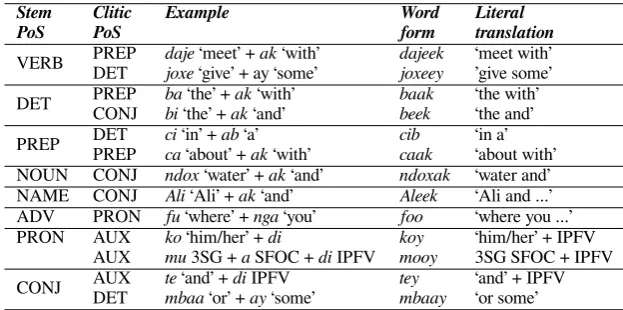
Word segmentation for tokenization in Wolof is a non-trivial task due to an extensive use of cliticization (Dione, 2017). As in Arabic (Attia, 2007), function words such as prepositions, conjunctions, auxiliaries and determiners can attach to other function or content words. Like Amharic (Seyoum et al., 2018), clitics in Wolof may undergo phonological changes. They may assimilate with word stems and with each other, making it difficult to recognize and handle them properly. The phonological change is also exhibited in the written form where clitics are attached to their host. For proper segmentation, then, we need to recover the underlying form first. For example, the wordcib‘in a’, can be segmented into the prepositionci‘in’ and the indefinite articleab‘a’. However, if we simply segment the first charactersci, the remaining form,bwill not have meaning. Furthermore, a non-trivial issue is ambiguity of clitics. For instance, a form likebeekcan be split intobi‘the’ andakwhereakcan actuallly be interpreted as a conjunction ‘and’ or a preposition ‘with’. Table 3 provides examples of full form words consisting of stems with clitics. The first row of the table is to be read as follows: the preposition ak‘with’ may encliticize to the verbal stem daje‘meet’, yielding the surface formdajeek.9 The other surface forms involve different grammatical categories (determiners,
conjunctions, pronouns, auxiliaries, etc.) and occur in a similar manner.
Stem Clitic Example Word Literal
PoS PoS form translation
VERB PREPDET dajejoxe‘meet’ +‘give’ + ay ‘some’ak‘with’ dajeekjoxeey ‘meet with’’give some’
DET PREPCONJ babi‘the’ +‘the’ +akak‘and’‘with’ baakbeek ‘the with’‘the and’
PREP DETPREP cica‘in’ +‘about’ +ab‘a’ak‘with’ cibcaak ‘in a’‘about with’ NOUN CONJ ndox‘water’ +ak‘and’ ndoxak ‘water and’ NAME CONJ Ali‘Ali’ +ak‘and’ Aleek ‘Ali and ...’ ADV PRON fu‘where’ +nga‘you’ foo ‘where you ...’ PRON AUX ko‘him/her’ +di koy ‘him/her’ + IPFV
[image:5.595.140.452.261.416.2]AUX mu3SG +aSFOC +diIPFV mooy 3SG SFOC + IPFV CONJ AUXDET tembaa‘and’ +‘or’ +diayIPFV‘some’ teymbaay ‘and’ + IPFV‘or some’
Table 3: Examples of cliticization in Wolof
A crucial segmentation issue concerns the focus markers discussed in section 2.3. In accordance with the UD guidelines, we split the focus markers into a pronoun and a focus morpheme. Thus, contracted forms like third singular subject focus markermoowere decomposed intomu(3SG) anda(subject focus marker). The same applies fordafa which becomesda(verb focus marker) + fa(3SG), thoughfais an irregular form. In contrast,ladoes not combine with a pronoun. The direct consequence of splitting focus elements likemoois that, as shown in (14b), the proper nounFaatuoccurs in a dislocated position before the clause, and is resumed within the clause by the co-referential pronounmu, the subject of the verblekk‘eat’.
(14) a. Faatu
Faatumoo3SG.SFOClekkeat jën.fish ‘It’s Faatu who ate fish.’
b. Faatu
Faatumu3SGaSFOClekkeat jën.fish ‘Faatu, it’s her who ate fish.’
Tokenization and word segmentation were done semi-automatically using the Wolof finite-state tokenizer (Dione, 2017). This tool includes a clitic transducer that can detect and demarcate contracted morphemes, handling these as separate words. For some cases, a manual revision was necessary.
5 Annotation
There are a number of existing interfaces in use that allow for manual annotation of UD treebanks. These include BRAT (Stenetorp et al., 2012), Arborator (Gerdes, 2013) and Tred.10In this work, manual
anno-tation was done using UD Annotatrix (Tyers et al., 2018). Unlike the aforementioned tools, UD Annotatrix is designed specifically for Universal Dependencies. It can be used in online and in fully-offline mode. The tool is freely-available under the GNU GPL licence.
5.1 Parts of speech annotation
The PoS tag set used in the UD scheme is based on the Universal PoS tag set (Petrov et al., 2012) and contains 17 tags. Because we wanted to use existing PoS tag annotation for Wolof as starting point, a mapping between the tagset in the Wolof LFG and the UD PoS tagset was necessary. At the coarse-grained level, the Wolof LFG tag set contains 24 tags. Thus, the conversion of the parts of speech information in LFG treebank to the UD PoS tag set required some considerations. Since UD does not allow sub-typing of PoS tags or language-specific tags, we adhere to this restriction. Below we discuss issues in adapting the UD annotation scheme to the existing Wolof tagset.
5.1.1 Nouns
WolGramBank makes a distinction between proper nouns and other noun types. One main reason for this is that proper nouns generally do not appear with determiners (while common nouns and indefinite pronouns for instance do). This distinction starts at early preprocessing steps (during tokenization and morphological analysis). The functional information about the syntactic type as a proper noun and the semantic type as a name are respectively provided by the morphological tags+PropNounand+PropTypeName. Proper nouns are assigned theNAME tag, making the mapping to the corresponding UD tagPROPNstraightforward.
Concerning the other noun types, WolGramBank distinguishes three categories: NOUN, NGEN and
NPOSS. The first category includes nouns without any inflection (e.g.kër“house”). The second and third categories refer to nouns inflected in the genitive (e.g.kër-u“house of”) or in the possessive case (e.g.kër-am
“his/her house”), respectively (see section 2.1).
In the WTB, all the three categories (common nouns, nouns inflected for genitive and those inflected for possessive) are mapped into the PoS categoryNoun. In terms of syntactic annotation, nouns with an apparent genitive marker are assigned thenmod11relation and are treated differently from those which do
not show such an inflection, e.g.téere‘book’ in (6). Nouns in the latter category are marked ascompound. Using the UD features (FEATS), it was possible to further categorize the different forms, e.g.Case=Gen
for the genitive andPoss=Yesfor the possessive.
5.1.2 Determiners
In the WTB, determiners and quantifiers are assigned theDETcategory. A distinction between these cate-gories can be made using features, e.g.NumType=Cardfor quantifiers, as it is done in some UD treebanks.
5.1.3 Adverbs
WolGramBank distinguishes between various types of adverbs, depending on whether an adverb modifies a verb, a clause, or introduces negation (e.g. negative particles). In the WTB, however, we define ADV for any kind of adverbs, and use thePolarityandPronTypefeatures (e.g. for relative/interrogative adverbs) to describe the type of adverb where necessary (the morphological features are discussed in section 5.2).
5.1.4 Verbs and auxiliaries
As discussed in section 2.3, Wolof verbs typically do not themselves carry inflectional markers. Instead, inflection is in many cases carried by so called inflectional elements that appear as separate words. The inflectional markers express a bunch of subject-related and clause-related features, including subject agree-ment, but also tense-aspect mood (TAM), polarity, and the focus in the sentence.
In the Wolof LFG Grammar, the inflectional markers are grouped under the categoryINFL. This category subdivides into four subcategories corresponding to the information whether the marker expresses subject focus, non-subject focus, verb focus and progressive. TheAUX(for auxiliaries) tag is used mainly for thedi
imperfective marker (including its past tense inflected forms, e.g.doon). Furthermore, the tagCOPis used for copula verbs and inflectional markers found in predicative constructions. This choice was motivated by the idea to provide a uniform analysis for both simple copula and clefts in Wolof, as both instantiate the same forms (Dione, 2012b).12
However, the UD tagset scheme contains noINFLorCOPtag. Still, it provides a general definition that allows for grouping these tags under theAUX category. UD defines an auxiliary as a function word that expresses grammatical distinctions not carried by the lexical verb, such as person, number, tense, mood, aspect. This is also the category provided for nonverbalTAMEmarkers found in many languages. Thus, this is the category that fits theINFLtag from the Wolof LFG grammar. However, to keep the relevant informa-tion regarding the encoded informainforma-tion structure and copulae, it was necessary to introduce a new feature calledFocusType. Such a feature is used to distinguish auxiliaries marking focus from other auxiliaries.
The UD guidelines state that the AUX category also includes copulas (in the narrow sense of pure linking words for nonverbal predication). Following this, theCOP category from the LFG treebank was mapped toAUX in the Wolof UD treebank. This mapping, however, raised a small issue: in the UD schemeAUX
cannot have a dependent, while in the existing annotation scheme for Wolof it is sometimes necessary for
COPto have a dependent. An example is illustrated in (15) where the past tense particlewoonhas to be a dependent of the copulala. Following the UD practices, both the copular verb (e.g.la) and the tense particle (e.g.woon) have to be attached as siblings to the nonverbal predicate, as shown below.
(15) Amari Amari
xale child
la COP.3SG
woon. PAST ‘Amari was a child.’
Amari xale la woon .
PROPN NOUN AUX AUX PUNCT
nsubj cop aux
punct
5.1.5 PRON
In WolGramBank, object and locative clitics (OLCs) are tagged asCLfor clitics (Dione, 2013). A particular motivation for this was to distinguish these elements from subject pronouns, which are tagged asPRON. While subject pronouns have a predictable position in the sentence, OLCs have a quite special distribution, i.e. are special clitics according to Zwicky’s definition (Zwicky, 1977).13First, they have a phrase structure
position which is distinct from that of their non-clitic counterparts. While the latter typically follow the verb, the former usually precede it. Furthermore, OLCs have a set order amongst themselves. That is, if there is more than one clitic, they form a cluster. Considering these properties, OLCs are tagged as CL
in WolGramBank. However, for UD compatibility reasons, both subject pronouns and object clitics are assigned the category PRON for pronouns. The relevant distinction is then made by using features, i.e.
Case=Nomfor subject clitics, andCase=Accfor object clitics. In contrast, locative clitics are assigned the
ADVtag. Example (16) shows an instance of subject (mu), object (ko), and locative (fa) clitics.
(16) Mu
3SG.SUBJlekkeat ko3SG.OBJfa.LOC ‘So she/he/it eats it there.’
In addition, possessive, reflexive, relative, interrogative, demonstrative, and indefinite pronouns are also grouped under thePRONclass. Like personal pronouns, possessive and reflexive pronouns have person and number features. Pronouns also include information about the noun class (where appropriate).
5.1.6 Adpositions
Wolof has only prepositions (no postpositions or circumpositions). The WolGramBank distinguishes be-tween simple, partitive, and possessive prepositions. However, the UD convention does not further catego-rize prepositions, nor does it make a distinction between prepositions and postpositions. It rather recom-mends the category adposition (ADP) which is the cover term for both categories. Accordingly, in the WTB we useADPwithout any subtype and that category actually only includes prepositions.
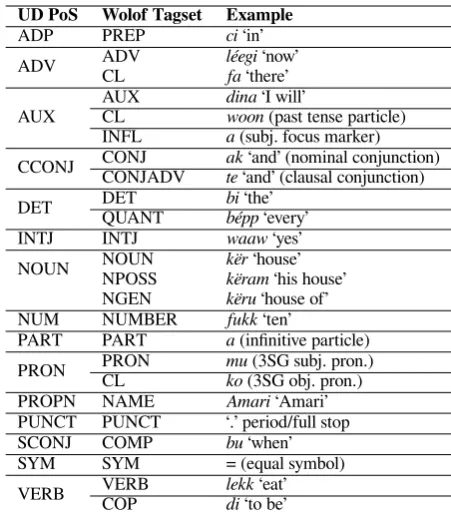
Table 4 shows the mapping between UD vs. WolGramBank PoS tags. It is a many-to-one (i.e. multiple WolGramBank tags mapping to one UD tag) rather than a many-to-many mapping, thus validating both annotation schemes. The WTB does not use the categoryADJ, as the language has no adjectives.
UD PoS Wolof Tagset Example ADP PREP ci‘in’ ADV ADVCL léegifa‘there’‘now’
AUX AUXCL dinawoon‘I will’(past tense particle) INFL a(subj. focus marker) CCONJ CONJCONJADV akte‘and’ (clausal conjunction)‘and’ (nominal conjunction)
DET DETQUANT bibépp‘the’‘every’ INTJ INTJ waaw‘yes’ NOUN NOUNNPOSS kërkëram‘house’‘his house’
NGEN këru‘house of’ NUM NUMBER fukk‘ten’
[image:8.595.183.409.60.318.2]PART PART a(infinitive particle) PRON PRONCL muko(3SG obj. pron.)(3SG subj. pron.) PROPN NAME Amari‘Amari’ PUNCT PUNCT ‘.’ period/full stop SCONJ COMP bu‘when’ SYM SYM = (equal symbol) VERB VERBCOP lekkdi‘to be’‘eat’
Table 4: Mapping between the Wolof LFG and the UD PoS tagset
5.2 Morphological annotation
The UD annotation scheme defines a set of 23 morphological features across languages. These are divided into lexical vs. inflectional features. Lexical features such asPronType (pronoun type) and Poss (posses-sive) are attributes of lexemes or lemmas. Inflectional features are mostly features of individual word forms and are further subdivided into nominal features (e.g.Gender,Case,Definite) vs. verbal features (e.g. Per-son, Number,Tenseand Mood). In contrast to the universal PoS tagset, the language specification allows treebanks to extend this set of universal features and add language-specific features when necessary.
One feature that is currently missing in the universal list of features and quite relevant for Wolof is Fo-cusType. To capture the main distinction between the different focus constructions, we introduceFocusType
as a new feature. This attribute can take three values:subj,verb,compldepending on the syntactic function of the constituent in focus. Another feature that needed to be updated wasNounClass.14Although that
fea-ture is described in the UD guidelines, it was not used in any UD treebank so far, since UD currently does not contain any Bantu language. The description ofNounClassindicates that the set of values of that feature is specific for a language family or group. The idea is to identify, within a language group, classes that have similar meaning across languages. However, one has to decide where the boundary of the group is.
The UD guidelines illustrate the use of the NounClassfeature based on the system found in the Bantu language group. Following this, the feature has values that range from 1 to 20 noun classes calledBantu1
toBantu20. The class numbering system is accepted by scholars of the various Bantu languages and UD recommends the creation of similar numbering systems for the other families that have noun classes.
Because Wolof is not a Bantu language, and the Bantu classes were not extensible to Wolof, it was necessary to create a different set of classes (that could eventually be shared with some other related non-Bantu Niger-Congo languages). However, as mentioned above, one main difficulty with such an endeavour is the lack of semantic coherence in the Wolof noun class system. In most cases, and unlike in Bantu languages, there is no clear semantics, phonology or morphology that can explain the classification in Wolof.
The approach we adopted to tackle these issues was to create a set of classes for Wolof that follows a schema similar to the one proposed for Bantu languages. This means that the values of the feature had to be in a certain range (e.g. Wol1 - Wol13). It was also necessary to order the values in a way that would be comparable to the Bantu classes where possible.
To illustrate the numbering system in the Bantu languages, the UD guidelines listed 18 noun classes for Swahili. Some of these show a similarity with the Wolof noun classes, as illustrated in Table 5. For instance, the classes number 1 and 2 refer to singular and plural persons, respectively. It is easy to see that the Wolof equivalents of these two classes are thekandñclass, respectively. Likewise, the classes number 7 and 8 have the typical meaning of singular and plural things, respectively. Their Wolof counterparts would belandy, respectively. Thus, for these classes, it was not problematic to propose a comparable numbering system.
Swahili Wolof
Class number Prefix Affix Typical Meaning
1 m-, mw-, mu- k singular: persons
2 wa-, w- ñ plural: persons (a plural counterpart of class 1)
7 ki-, ch- l singular: things
[image:9.595.126.466.157.222.2]8 vi-, vy- y plural: things (a plural counterpart of class 7)
Table 5: Noun system numbering for compatible classes between Bantu and Wolof.
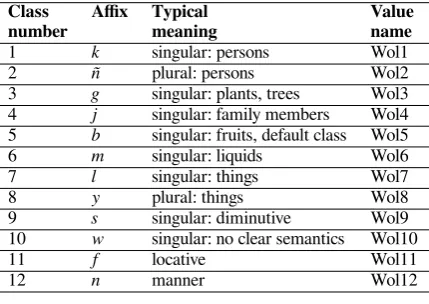
However, for the remaining Wolof classes, a numbering system different from those found in Bantu was necessary. This is because the typical meaning of these Wolof classes did not match the semantics conveyed by the Bantu classes. Table 6 gives the numbering system proposed for Wolof (and eventually non-Bantu Niger-Congo languages). Also, as stated above, it is crucial to mention that the examples of typical meaning provided in this table are not meant to be reliable or systematic indicators of noun classes in Wolof. For each class, there are several words that do not follow these patterns. Also note that currently nouns are not marked with theNounClassfeature. This is particularly motivated by the fact that nouns in Wolof (i) lack a class marker on the noun itself and (ii) may belong to several classes.
Class Affix Typical Value
number meaning name
1 k singular: persons Wol1
2 ñ plural: persons Wol2
3 g singular: plants, trees Wol3 4 j singular: family members Wol4 5 b singular: fruits, default class Wol5 6 m singular: liquids Wol6 7 l singular: things Wol7
8 y plural: things Wol8
9 s singular: diminutive Wol9 10 w singular: no clear semantics Wol10
11 f locative Wol11
12 n manner Wol12
Table 6: Noun class numbering for Wolof
As discussed in section 2.1, Wolof demonstratives encode information about deixis, including reference to the speaker and/or addressee. As with theNounClass feature, the Deixis feature is described in Uni-morph (Sylak-Glassman, 2016), but not currently used by any UD treebank. So, to properly capture this information, the WTB introduced two features:Deixis andDeixisRef, which respectively represent deixis subdimensions corresponding to “Distance” and “Reference Point”. The distance distinction is a three-way contrast between proximate (Prox), medial (Med), and remote (Remt). Reference point is used to determine the relationship of the speaker, addressee, and referent of the pronoun. The latter dimension often overlaps with distance distinctions, but is sometimes explicitly separated. In the WTB, the two primary features for reference point are speaker as reference point (ref1), and addressee as reference point (ref2). Thus, the information contained in the Wolof demonstratives given in example (3) can be modeled as follows:
• close to me, wherever you may be ... Deixis=Prox|DeixisRef=1
• far from me, wherever you may be ... Deixis=Remt|DeixisRef=1
• far from both, closer to you ... Deixis=Med|DeixisRef=2
[image:9.595.191.406.369.521.2]Table 7 summarizes the morphological features used in the WTB. PoS tags that do not have additional fea-tures, e.g. coordinating conjunctions (CCONJ), subordinating conjunctions (SCONJ), interjections (INTJ), particles (PART), proper names (PROPN), punctuations (PUNCT) and symbols (SYM), are not displayed.
UD PoS Description Morphological Features
ADP Adpositions Number=Sing,Plur; NounClass=Wol1,Wol2,..,Wol13; ADV Adverbs Polarity=Neg,Pos; PronType=Rel,Int
AUX Auxiliaries Aspect=Hab,Imp,Perf,Prog; Focus=Subj,Verb,Compl; Mood=Cnd,Imp,Ind,Opt; Number=Sing,Plur;Person=0,1,2,3; Polarity=Neg,Pos; Tense=Fut,Past,Pres; VerbForm=Fin,Inf NOUN Nouns Case=Gen; Poss=Yes
DET Determiners Definite=Def,Ind; Deixis=Prox, Med,Remt; DeixisRef=1,2; NounClass=Wol1,Wol2,..,Wol13;Number=Sing,Plur; Poss=Yes; PronType=Art,Dem,Int,Neg,Prs,Rel,Tot NUM Numerals NumType=Card,Ord
PRON Pronouns Definite=Def,Ind; Deixis=Prox, Med,Remt; DeixisRef=1,2; NounClass=Wol1,Wol2,..,Wol13;Number=Sing,Plur; Poss=Yes; PronType=Art,Dem,Int,Neg,Prs,Rel,Tot
[image:10.595.70.546.112.249.2]VERB Non-auxiliaryverbs Aspect=Hab; Mood=Cnd,Imp,Ind; Number=Sing,Plur; Person=0,1,2,3; Polarity=Neg,Pos;Tense=Past,Pres; VerbForm=Fin,Inf
Table 7: Morphological features in the WTB
5.3 Syntactic annotation
The WTB uses most of the UD relations, apart fromamod,clf,dep,goeswith, andreparandum. The two first relations are not relevant for Wolof, which lacks adjectival modifier15and classifier. Likewise,goeswith
andreparandumare not used as the WTB data do not contain dysfluencies/orthographic errors. Finally,dep
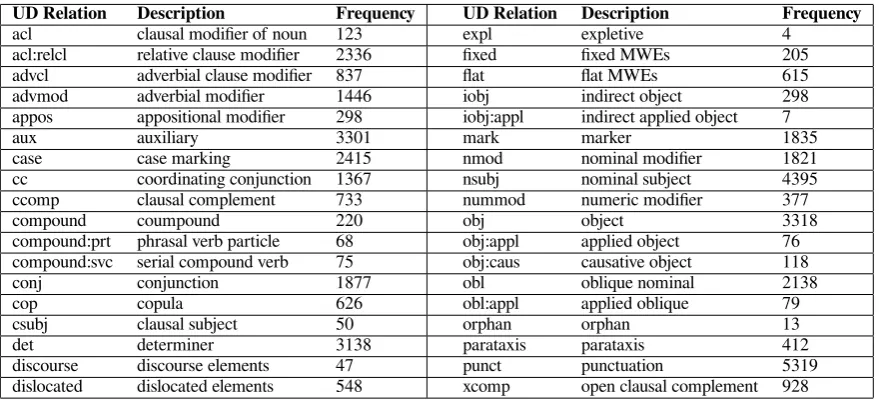
was irrelevant as it was always possible to determine a more precise relation. Table 8 lists the frequency of UD relations used in the WTB.
UD Relation Description Frequency UD Relation Description Frequency acl clausal modifier of noun 123 expl expletive 4
acl:relcl relative clause modifier 2336 fixed fixed MWEs 205 advcl adverbial clause modifier 837 flat flat MWEs 615 advmod adverbial modifier 1446 iobj indirect object 298 appos appositional modifier 298 iobj:appl indirect applied object 7
aux auxiliary 3301 mark marker 1835
case case marking 2415 nmod nominal modifier 1821 cc coordinating conjunction 1367 nsubj nominal subject 4395 ccomp clausal complement 733 nummod numeric modifier 377
compound coumpound 220 obj object 3318
compound:prt phrasal verb particle 68 obj:appl applied object 76 compound:svc serial compound verb 75 obj:caus causative object 118
conj conjunction 1877 obl oblique nominal 2138
cop copula 626 obl:appl applied oblique 79
csubj clausal subject 50 orphan orphan 13
det determiner 3138 parataxis parataxis 412
[image:10.595.79.519.371.573.2]discourse discourse elements 47 punct punctuation 5319 dislocated dislocated elements 548 xcomp open clausal complement 928
Table 8: Universal dependency relations in WTB
6 Conclusion
This paper has presented the process of creating a Universal Dependency treebank for Wolof, the first UD treebank from the North Atlantic languages. Wolof is also the second Atlantic-Congo language (after Yoruba) that has a UD treebank. Adopting UD to existing conventions for annotating Wolof required several decisions to be made. We have discussed issues related to tokenization pointing out the challenge of clitic segmentation. We indicated that Wolof orthographic words may carry morphological information as well as other function elements of syntactic relations. The discussion has also shown that there are a number of challenges in adapting the UD scheme for Wolof. In particular we advocate the introduction of missing features for focus marking and deixis information, and the redefinition of the existing noun class feature for non-Bantu languages. In future, we plan to address the issue of automatic conversion of WolGramBank.
Acknowledgements
I would like to thank the UD community, in particular Dan Zeman for many fruitful discussions. I also want to thank the anonymous reviewers for valuable comments and suggestions.
References
Anne Abeillé, editor. 2003.Treebanks: Building and Using Parsed Corpora. Kluwer.
Mohammed A Attia. 2007. Arabic Tokenization System. InProceedings of the 2007 workshop on computational approaches to semitic languages: Common issues and resources, pages 65–72. Association for Computational Lin-guistics.
Eric D. Church. 1981.Le système verbal du wolof. Faculté des Lettres et Sciences Humaines (FLSH), Université de Dakar.
Marie-Catherine De Marneffe, Timothy Dozat, Natalia Silveira, Katri Haverinen, Filip Ginter, Joakim Nivre, and Christopher D Manning. 2014. Universal stanford dependencies: A cross-linguistic typology. InLREC, volume 14, pages 4585–4592.
Cheikh M. Bamba Dione. 2012a. A Morphological Analyzer For Wolof Using Finite-State Techniques. In Pro-ceedings of the Eigth International Conference on Language Resources and Evaluation (LREC’12), Istanbul, Turkey, may. ELRA.
Cheikh M. Bamba Dione. 2012b. An LFG Approach to Wolof Cleft Constructions. In Miriam Butt and Tracy Hol-loway King, editors,The Proceedings of the LFG ’12 Conference, Stanford, CA. CSLI Publications.
Cheikh M. Bamba Dione. 2013. Handling Wolof Clitics in LFG. In Christine Meklenborg Salvesen and Hans Petter Helland, editors,Challenging Clitics, Amsterdam. John Benjamins Publishing Company.
Cheikh M Bamba Dione. 2014. LFG parse disambiguation for Wolof.Journal of Language Modelling, 2(1):105–165.
Cheikh M. Bamba Dione. 2017. Finite-state tokenization for a deep wolof lfg grammar. Bergen Language and Linguistics Studies, 8(1).
Kim Gerdes. 2013. Collaborative dependency annotation. InProceedings of the second international conference on dependency linguistics (DepLing 2013), pages 88–97.
Joseph H Greenberg. 1963. Some universals of grammar with particular reference to the order of meaningful ele-ments.Universals of language, 2:73–113.
Alain Kihm. 2000. Wolof Genitive Constructions and the Construct State. In J. Lowenstamm & U. Shlonsky Lecarme, J., editor,Research in Afro-Asiatic grammar: papers from the third conference on Afroasiatic languages, pages 150–181. Amsterdam & Philadelphia : John Benjamins Publishing Co.
Christopher D Manning and Hinrich Schütze. 1999. Foundations of Statistical Natural Language Processing. MIT Press, Cambridge, MA.
Fiona McLaughlin. 1997. Noun classification in Wolof: When affixes are not renewed.Studies in African Linguistics, 26(1).
Fiona McLaughlin. 2004. Is there an adjective class in Wolof? In R.M.W. Dixon and Alexandra Y. Aikhenvald, editors,Adjective classes. A crosslinguistic typology., pages 242–262. Oxford University Press.
Paul Meurer. 2017. From LFG structures to dependency relations.Bergen Language and Linguistics Studies, 8(1).
Slav Petrov, Dipanjan Das, and Ryan McDonald. 2012. A universal part-of-speech tagset. In Nicoletta Calzo-lari (Conference Chair), Khalid Choukri, Thierry Declerck, Mehmet Uğur Doğan, Bente Maegaard, Joseph Mari-ani, Asuncion Moreno, Jan Odijk, and Stelios Piperidis, editors,Proceedings of the Eight International Conference on Language Resources and Evaluation (LREC’12), Istanbul, Turkey, may. European Language Resources Associ-ation (ELRA).
Adam Przepiórkowski and Agnieszka Patejuk. 2019. From lexical functional grammar to enhanced universal depen-dencies. Language Resources and Evaluation, Feb.
Stéphane Robert. 2000. Le verbe wolof ou la grammaticalisation du focus. Louvain: Peeters, Coll. Afrique et Langage, 229-267. Version non corrigée.
Stéphane Robert. 2010. Clause chaining and conjugations in wolof. Clause Linking and Clause Hierarchy: Syntax and Pragmatics, 121:469–498.
Stéphane Robert. 2016. Content question words and noun class markers in wolof: reconstructing a puzzle.Frankfurt African Studies Bulletin, 23:123–146.
Antoine de Saint-Exupéry. 1971. Le petit prince. 1943.Paris: Harvest.
David J. Sapir. 1971. West Atlantic: an inventory of the languages, their noun class systems and consonant alternation. Current Trends in Linguistics, 7(1):43–112.
Binyam Ephrem Seyoum, Yusuke Miyao, and Baye Yimam Mekonnen. 2018. Universal dependencies for amharic. InLREC.
Pontus Stenetorp, Sampo Pyysalo, Goran Topić, Tomoko Ohta, Sophia Ananiadou, and Jun’ichi Tsujii. 2012. Brat: a web-based tool for nlp-assisted text annotation. InProceedings of the Demonstrations at the 13th Conference of the European Chapter of the Association for Computational Linguistics, pages 102–107. Association for Computational Linguistics.
Sebastian Sulger, Miriam Butt, Tracy Holloway King, Paul Meurer, Tibor Laczkó, György Rákosi, Cheikh Bamba Dione, Helge Dyvik, Victoria Rosén, Koenraad De Smedt, Agnieszka Patejuk, Özlem Çetinoǧlu, I Wayan Arka, and Meladel Mistica. 2013. ParGramBank: The ParGram Parallel Treebank. InProceedings of the 51th Annual Meeting of the Association for Computational Linguistics (ACL 2013), pages 759–767, Sofia, Bulgaria.
John Sylak-Glassman. 2016. The composition and use of the universal morphological feature schema (unimorph schema). Technical report, Technical report, Department of Computer Science, Johns Hopkins University.
Khady Tamba, Harold Torrence, and Malte Zimmermann. 2012. Wolof quantifiers. InHandbook of Quantifiers in Natural Language, pages 891–939. Springer.
Lucien Tesnière. 1959. Eléments de syntaxe structurale. Klincksieck, Paris.
Francis M Tyers, Mariya Sheyanova, and Jonathan North Washington. 2018. UD Annotatrix: An annotation tool for universal dependencies. InProceedings of the 16th Conference on Treebanks and Linguistic Theories.
Anne Zribi-Hertz and Lamine Diagne. 2002. Clitic placement after syntax: evidence from Wolof person and locative markers. Natural Language & Linguistic Theory, 20(4):823–884.