Mark my Word:
A Sequence-to-Sequence Approach to Definition Modeling
Timothee Mickus Universit´e de Lorraine
CNRS, ATILF [email protected]
Denis Paperno Utrecht University [email protected]
Mathieu Constant Universit´e de Lorraine
CNRS, ATILF [email protected]
Abstract
Defining words in a textual context is a useful task both for practical purposes and for gaining insight into distributed word representations. Building on the distribu-tional hypothesis, we argue here that the most natural formalization of definition modeling is to treat it as a sequence-to-sequence task, rather than a word-to-sequence task: given an input word-to-sequence with a highlighted word, generate a con-textually appropriate definition for it. We implement this approach in a Transformer-based sequence-to-sequence model. Our proposal allows to train contextualization and definition generation in an end-to-end fashion, which is a conceptual improve-ment over earlier works. We achieve state-of-the-art results both in contextual and non-contextual definition modeling.
1 Introduction
The task of definition modeling, introduced by Noraset et al. (2017), consists in generating the dictionary definition of a specific word: for in-stance, given the word “monotreme” as input, the system would need to produce a definition such as “any of an order (Monotremata) of egg-laying mammals comprising the platypuses and echid-nas”.1 Following the tradition set by lexicogra-phers, we call the word being defined a definien-dum(pl.definienda), whereas a word occurring in its definition is called adefiniens(pl.definientia).
Definition modeling can prove useful in a vari-ety of applications. Systems trained for the task may generate dictionaries for low resource lan-guages, or extend the coverage of existing lexico-graphic resources where needed, e.g. of domain-specific vocabulary. Such systems may also be
1Definition from Merriam-Webster.
able to provide reading help by giving definitions for words in the text.
A major intended application of definition mod-eling is the explication and evaluation of dis-tributed lexical representations, also known as word embeddings (Noraset et al., 2017). This eval-uation procedure is based on the postulate that the meaning of a word, as is captured by its embed-ding, should be convertible into a human-readable dictionary definition. How well the meaning is captured must impact the ability of the model to reproduce the definition, and therefore embed-ding architectures can be compared accorembed-ding to their downstream performance on definition mod-eling. This intended usage motivates the require-ment that definition modeling architectures take as input the embedding of the definiendum and not retrain it.
From a theoretical point of view, usage of word embeddings as representations of meaning (cf. Lenci, 2018; Boleda, 2019, for an overview) is motivated by the distributional hypothesis (Harris, 1954). This framework holds that meaning can be inferred from the linguistic context of the word, usually seen as co-occurrence data. The context of usage is even more crucial for characterizing meanings of ambiguous or polysemous words: a definition that does not take disambiguating con-text into account will be of limited use (Gadetsky et al., 2018).
2 Related Work
In their seminal work on definition modeling, No-raset et al. (2017) likened systems generating def-initions to language models, which can naturally be used to generate arbitrary text. They built a sequential LSTM seeded with the embedding of thedefiniendum; its output at each time-step was mixed through a gating mechanism with a feature vector derived from thedefiniendum.
Gadetsky et al. (2018) stressed that a definien-dum outside of its specific usage context is am-biguous between all of its possible definitions. They proposed to first compute the AdaGram vec-tor (Bartunov et al., 2016) for the definiendum, to then disambiguate it using a gating mechanism learned over contextual information, and finally to run a language model over the sequence of definientiaembeddings prepended with the disam-biguateddefiniendumembedding.
In an attempt to produce a more interpretable model, Chang et al. (2018) map thedefiniendum to a sparse vector representation. Their architec-ture comprises four modules. The first encodes the context in a sentence embedding, the second con-verts thedefinienduminto a sparse vector, the third combines the context embedding and the sparse representation, passing them on to the last module which generates the definition.
Related to these works, Yang et al. (2019) specifically tackle definition modeling in the con-text of Chinese—whereas all previous works on definition modeling studied English. In a Transformer-based architecture, they incorporate “sememes” as part of the representation of the definiendumto generate definitions.
On a more abstract level, definition modeling is related to research on the analysis and evalu-ation of word embeddings (Levy and Goldberg, 2014a,b; Arora et al., 2018; Batchkarov et al., 2016; Swinger et al., 2018, e.g.). It also relates to other works associating definitions and em-beddings, like the “reverse dictionary task” (Hill et al., 2016)—retrieving thedefiniendumknowing its definition, which can be argued to be the oppo-site of definition modeling—or works that derive embeddings from definitions (Wang et al., 2015; Tissier et al., 2017; Bosc and Vincent, 2018).
3 Definition modeling as a sequence-to-sequence task
Gadetsky et al. (2018) remarked that words are
often ambiguous or polysemous, and thus gener-ating a correct definition requires that we either use sense-level representations, or that we disam-biguate the word embedding of the definiendum. The disambiguation that Gadetsky et al. (2018) proposed was based on a contextual cue—ie. a short text fragment. As Chang et al. (2018) notes, the cues in Gadetsky et al.’s (2018) dataset do not necessarily contain thedefiniendumor even an in-flected variant thereof. For instance, one train-ing example disambiguated the word “fool” using the cue “enough horsing around—let’s get back to work!”.
Though the remark thatdefiniendamust be dis-ambiguated is pertinent, the more natural formula-tion of such a setup would be to disambiguate the definiendumusing its actual context of occurrence. In that respect, thedefiniendumand the contextual cue would form a linguistically coherent sequence, and thus it would make sense to encode the con-text together with thedefiniendum, rather than to merely rectify thedefiniendumembedding using a contextual cue. Therefore, definition modeling is by its nature a sequence-to-sequence task: map-ping contexts of occurrence ofdefiniendato defi-nitions.
This remark can be linked to the distributional hypothesis (Harris, 1954). The distributional hy-pothesis suggests that a word’s meaning can be inferred from its context of usage; or, more suc-cinctly, that “you shall know a word by the com-pany it keeps” (Firth, 1957). When applied to def-inition modeling, the hypothesis can be rephrased as follows: the correct definition of a word can only be given when knowing in what linguistic context(s) it occurs. Though different kinds of linguistic contexts have been suggested through-out the literature, we remark here that senten-tial context may sometimes suffice to guess the meaning of a word that we don’t know (Lazaridou et al., 2017). Quoting from the example above, the context “enough around—let’s get back to work!” sufficiently characterizes the meaning of the omitted verb to allow for an approximate def-inition for it even if the blank is not filled (Taylor, 1953; Devlin et al., 2018).
sequence-to-sequence architectures. Concretely, a specific en-coding procedure was applied to thedefiniendum, so that it could be used as a feature vector during generation. In the simplest case, vector encoding of thedefiniendumconsists in looking up its vector in a vocabulary embedding matrix.
We argue that the whole context of a word’s us-age should be accessible to the generation algo-rithm rather than a single vector. To take a more specific case of verb definitions, we observe that context explicitly represents argument structure, which is obviously useful when defining the verb. There is no guarantee that a single embedding, even if it be contextualized, would preserve this wealth of information—that is to say, that you can cram all the information pertaining to the syntactic context into a single vector.
Despite some key differences, all of the previ-ously proposed architectures we are aware of (No-raset et al., 2017; Gadetsky et al., 2018; Chang et al., 2018; Yang et al., 2019) followed a pattern similar to sequence-to-sequence models. They all implicitly or explicitly used distinct submodules to encode thedefiniendumand to generate the defini-entia. In the case of Noraset et al. (2017), the en-coding was the concatenation of the embedding of the definiendum, a vector representation of its sequence of characters derived from a character-levelCNN, and its “hypernym embedding”.
Gadet-sky et al. (2018) used a sigmoid-based gating mod-ule to tweak thedefiniendumembedding. The ar-chitecture proposed by Chang et al. (2018) is com-prised of four modules, only one of which is used as a decoder: the remaining three are meant to convert the definiendum as a sparse embedding, select some of the sparse components of its mean-ing based on a provided context, and encode it into a representation adequate for the decoder.
Aside from theoretical implications, there is an-other clear gain in considering definition modeling as a sequence-to-sequence task. Recent advances in embedding designs have introduced contextual embeddings (McCann et al., 2017; Peters et al., 2018; Devlin et al., 2018); and these share the par-ticularity that they are a “function of the entire sen-tence” (Peters et al., 2018): in other words, vector representations are assigned to tokens rather than to word types, and moreover semantic information about a token can be distributed over other token representations. To extend definition modeling to contextual embeddings therefore requires that we
devise architectures able to encode a word in its context; in that respect sequence-to-sequence ar-chitectures are a natural choice.
A related point is that not all definienda are comprised of a single word: multi-word expres-sions include multiple tokens, yet receive a single definition. Word embedding architectures gener-ally require a pre-processing step to detect these expressions and merge them into a single token. However, as they come with varying degrees of se-mantic opacity (Cordeiro et al., 2016), a definition modeling system would benefit from directly ac-cessing the tokens they are made up from. There-fore, if we are to address the entirety of the lan-guage and the entirety of existing embedding ar-chitectures in future studies, reformulating defini-tion modeling as a sequence-to-sequence task be-comes a necessity.
4 Formalization
A sequence-to-sequence formulation of definition modeling can formally be seen as a mapping be-tween contexts of occurrence of definienda and their corresponding definitions. It moreover re-quires that the definiendum be formally distin-guished from the remaining context: otherwise the definition could not be linked to any particular word of the contextual sequence, and thus would need to be equally valid for any word of the con-textual sequence.
We formalize definition modeling as mapping to sequences ofdefinientia from sequences of pairs hw1, i1i, . . . , hwn, ini, wherewkis thekthword
in the input andik ∈ {0,1}indicates whether the
kth token is to be defined. As only one element of the sequence should be highlighted, we expect the set of all indicators to contain only two ele-ments: the one,id = 1, to mark thedefiniendum,
the other,ic = 0, to mark the context; this entails
that we encode this marking using one bit only.2 To treat definition modeling as a sequence-to-sequence task, the information from each pair hwk, iki has to be integrated into a single
repre-2
Multiple instances of the samedefiniendumwithin a sin-gle context should all share a sinsin-gle definition, and therefore could theoretically all be marked using thedefiniendum indi-catorid= 1. Likewise the words that make up a multi-word
expression should all be marked with thisidindicator. In this
sentationmarked~ k:
~
markedk=mark(ik, ~wk) (1)
This marking function can theoretically take any form. Considering that definition modeling uses the embedding of the definiendumw~d=e(wd), in
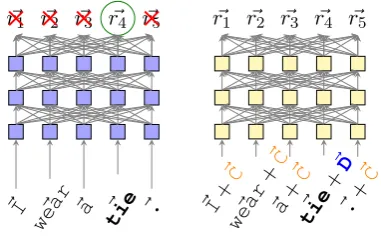
this work we study a multiplicative and an additive mechanism, as they are conceptually the simplest form this marking can take in a vector space. They are given schematically in Figure 1, and formally defined as:
~
marked×k =ik×w~k (2)
~
marked+k =e(ik) +w~k (3)
The last point to take into account is where to set the marking. Two natural choices are to set it either before or after encoded representations were obtained. We can formalize this using either of the following equation, withEthe model’s encoder:
~
markedkafter=mark(ik,E(w~k))
~
markedkbefore=E(mark(ik, ~wk)) (4)
4.1 Multiplicative marking: SELECT
The first option we consider is to use scalar multi-plication to distinguish the word to define. In such a scenario, the marked token encoding is
~
marked×k =ik×w~k (2)
As we use bit information as indicators, this form of marking entails that only the representa-tion of the definiendum be preserved and that all other contextual representations are set to ~0 = (0, · · · , 0): thus multiplicative marking amounts to selecting just the definiendum embedding and discarding other token embeddings. The contex-tualized definiendum encoding bears the trace of its context, but detailed information is irreparably lost. Hence, we refer to such an integration mech-anism as a SELECTmarking of thedefiniendum.
When to apply marking, as introduced by eq. 4, is crucial when using the multiplicative marking scheme SELECT. Should we mark thedefiniendum before encoding, then only the definiendum em-bedding is passed into the encoder: the resulting system provides out-of-context definitions, like in Noraset et al. (2017) where the definition is not linked to the context of a word but to its definien-dum only. For context to be taken into account
~
r1 r~2 r~3 r~4 r~5
~I ~
wear ~a tie~ ~.
(a) SELECT: Select-ing from encoded items. Items are contextualized and the definiendum is singled out from them.
~
r1 r~2 r~3 r~4 r~5
~I+
~C
~
wear
+~C ~
a+
~C ~
tie
+~D ~
.+
~C
[image:4.595.321.512.72.190.2](b) ADD: Additive mark-ing in encoder. Context items anddefiniendumare marked by adding dedicated embed-dings.
Figure 1: Additive vs. multiplicative integration
under the multiplicative strategy, tokenswkmust
be encoded and contextualized before integration with the indicatorik.
Figure 1a presents the contextual SELECT
mechanism visually. It consists in coercing the decoder to attend only to the contextualized rep-resentation for thedefiniendum. To do so, we code the full context and then select only the en-coded representation of thedefiniendum, dropping the rest of the context, before running the decoder. In the case of the Transformer architecture, this is equivalent to using a multiplicative marking on the encoded representations: vectors that have been zeroed out are ignored during attention and thus cannot influence the behavior of the decoder.
This SELECTapproach may seem intuitive and naturally interpretable, as it directly controls what information is passed to the decoder—we care-fully select only the contextualized definiendum, thus the only remaining zone of uncertainty would be how exactly contextualization is performed. It also seems to provide a strong and reasonable bias for training the definition generation system. Such an approach, however, is not guaranteed to excel: forcibly omitted context could contain important information that might not be easily incorporated in thedefiniendumembedding.
Being simple and natural, the SELECTapproach
4.2 Additive marking: ADD
We also study an additive mechanism shown in Figure 1b (henceforth ADD). It concretely
con-sists in embedding the wordwk and its indicator
bitikin the same vector space and adding the
cor-responding vectors:
~
marked+k =e(ik) +w~k (3)
In other words, under ADD we distinguish the
definiendumby adding a vector~Dto the definien-dum embedding, and another vector~C to the re-maining context token embeddings; both markers ~
Dand~Care learned during training. In our imple-mentation, markers are added to the input of the encoder, so that the encoder has access to this formation; we leave the question of whether to in-tegrate indicators and words at other points of the encoding process, as suggested in eq. 4, to future work.
Additive marking of substantive features has its precedents. For example, BERTembeddings (De-vlin et al., 2018) are trained using two sentences at once as input; sentences are distinguished with added markers called “segment encodings”. To-kens from the first sentence are all marked with an added vectorseg~ A, whereas tokens from sec-ond sentences are all marked with an added vector
~
segB. The main difference here is that we only mark one item with the markerD~, while all others are marked withC~.
This ADDmarking is more expressive than the SELECT architecture. Sequence-to-sequence de-coders typically employ an attention to the input source (Bahdanau et al., 2014), which corresponds to a re-weighting of the encoded input sequence based on a similarity between the current state of the decoder (the ‘query’) and each member of the input sequence (the ‘keys’). This re-weighting is normalized with a softmax function, produc-ing a probability distribution over keys. However, both non-contextual definition modeling and the SELECT approach produce singleton encoded
se-quences: in such scenarios the attention mecha-nism assigns a single weight of 1 and thus de-volves into a simple linear transformation of the value and makes the attention mechanism useless. Using an additive marker, rather than a selective mechanism, will prevent this behavior.
5 Evaluation
We implement several sequence to sequence mod-els with the Transformer architecture (Vaswani et al., 2017), building on the OpenNMT library
(Klein et al., 2017) with adaptations and modifi-cations when necessary.3 Throughout this work, we use GloVe vectors (Pennington et al., 2014) and freeze weights of all embeddings for a fairer comparison with previous models; words not in GloVe but observed in train or validation data and missingdefiniendain our test sets were randomly initialized with components drawn from a normal distributionN(0,1).
We train a distinct model for each dataset. We batch examples by 8,192, using gradient accumu-lation to circumvent GPU limitations. We opti-mize the network using Adam with β1 = 0.99, β2 = 0.998, a learning rate of 2, label smooth-ing of 0.1, Noam exponential decay with 2000 warmup steps, and dropout rate of 0.4. The pa-rameters are initialized using Xavier. Models were trained for up to 120,000 steps with checkpoints at each 1000 steps; we stopped training if perplexity on the validation dataset stopped improving. We report results from checkpoints performing best on validation.
5.1 Implementation of the Non-contextual Definition Modeling System
In non-contextual definition modeling,definienda are mapped directly to definitions. As the source corresponds only to the definiendum, we conjec-ture that few parameters are required for the en-coder. We use 1 layer for the encoder, 6 for the de-coder, 300 dimensions per hidden representations and 6 heads for multi-head attention. We do not share vocabularies between the encoder and the decoder: therefore output tokens can only corre-spond to words attested asdefinientia.4
The dropout rate and warmup steps number were set using a hyperparameter search on the dataset from Noraset et al. (2017), during which encoder and decoder vocabulary were merged for computational simplicity and models stopped af-ter 12,000 steps. We first fixed dropout to 0.1 and tested warmup step values between 1000 and
3Code & data are available at the following
URL: https://github.com/TimotheeMickus/onmt-selectrans.
4In our case, not sharing vocabularies prevents the model
10,000 by increments of 1000, then focused on the most promising span (1000–4000 steps) and ex-haustively tested dropout rates from 0.2 to 0.8 by increments of 0.1.
5.2 Implementation of Contextualized Definition Modeling Systems
To compare the effects of the two integration strategies that we discussed in section 4, we imple-ment both the additive marking approach (ADD, cf. section 4.2) and the alternative ‘encode and select’ approach (SELECT, cf. section 4.1). To match with the complex input source, we de-fine encoders with 6 layers; we reemploy the set of hyperparameters previously found for the non-contextual system. Other implementation de-tails, initialization strategies and optimization al-gorithms are kept the same as described above for the non-contextual version of the model.
We stress that the two approaches we compare for contextualizing the definiendum are applicable to almost any sequence-to-sequence neural archi-tecture with an attention mechanism to the input source.5 Here we chose to rely on a Transformer-based architecture (Vaswani et al., 2017), which has set the state of the art in a wide range of tasks, from language modeling (Dai et al., 2019) to machine translation (Ott et al., 2018). It is therefore expected that the Transformer architec-ture will also improve performances for definition modeling, if our arguments for treating it as a se-quence to sese-quence task are on the right track.
5.3 Datasets
We train our models on three distinct datasets, which are all borrowed or adapted from previous works on definition modeling. As a consequence, our experiments focus on the English language. The dataset of Noraset et al. (2017) (henceforth DNor) maps definienda to their respective
defini-entia, as well as additional information not used here. In the dataset of Gadetsky et al. (2018) (henceforth DGad), each example consists of a
definiendum, the definientia for one of its mean-ings and a contextual cue sentence. DNorcontains on average shorter definitions thanDGad. Defini-tions inDNorhave a mean length of6.6and a stan-dard deviation of5.78, whereas those inDGadhave a mean length of11.01and a standard deviation of 6.96.
5For best results, the S
ELECTmechanism should require a bi-directional encoding mechanism.
Chang et al. (2018) stress that the datasetDGad includes many examples where the definiendum is absent from the associated cue. About half of these cues doe not contain an exact match for the corresponding definiendum, but up to 80% con-tains either an exact match or an inflected form of thedefiniendumaccording to lemmatization by the
NLTKtoolkit (Loper and Bird, 2002). To cope with this problematic characteristic, we converted the dataset into the word-in-context format assumed by our model by concatenating the definiendum with the cue. To illustrate this, consider the ac-tual input from DGad comprised of the definien-dum “fool” and its associated cue “enough hors-ing around—let’s get back to work!”: to convert this into a single sequence, we simply prepend the definiendum to the cue, which results in the sequence “fool enough horsing around—let’s get back to work!”. Hence the input sequences of DGad do not constitute linguistically coherent
se-quences, but it does guarantee that our sequence-to-sequence variants have access to the same input as previous models; therefore the inclusion of this dataset in our experiments is intended mainly for comparison with previous architectures. We also note that this conversion procedure entails that our examples have a very regular structure: the word marked as a definiendumis always the first word in the input sequence.
Our second strategy was to restrict the dataset by selecting only cues where thedefiniendum(or its inflected form) is present. The curated dataset (henceforth DCtx) contains 78,717 training
take up these challenges; for example, the output “monotremes: plural of monotreme”6 would not have been self-contained, necessitating a second query for “monotreme”.
5.4 Results
We use perplexity, a standard metric in definition modeling, to evaluate and compare our models. Informally, perplexity assesses the model’s confi-dence in producing the ground-truth output when presented the source input. It is formally defined as the exponentiation of cross-entropy. We do not reportBLEUorROUGEscores due to the fact that an important number of ground-truth definitions are comprised of a single word, in particular in DNor (≈ 25%). Single word outputs can either be assessed as entirely correct or entirely wrong using BLEUorROUGE. However consider for in-stance the word “elation”: that it be defined either as “mirth” or “joy” should only influence our met-ric slightly, and not be discounted as a completely wrong prediction.
DNor DGad DCtx Noraset et al. 48.168 45.620 – Gadetsky et al. – 43.540 – Non-contextual 42.199 39.428 48.266 ADD – 33.678 43.695
SELECT – 33.998 62.039
Table 1: Results (perplexity)
Table 1 describes our main results in terms of perplexity. We do not compare with Chang et al. (2018), as they did not report the perplexity of their system and focused on a different dataset; likewise, Yang et al. (2019) consider only the Chi-nese variant of the task. Perplexity measures for Noraset et al. (2017) and Gadetsky et al. (2018) are taken from the authors’ respective publications.
All our models perform better than previous proposals, by a margin of 4 to 10 points, for a relative improvement of 11–23%. Part of this im-provement may be due to our use of Transformer-based architectures (Vaswani et al., 2017), which is known to perform well on semantic tasks (Radford, 2018; Cer et al., 2018; Devlin et al., 2018; Radford et al., 2019, eg.). Like Gadet-sky et al. (2018), we conclude that disambiguat-ing the definiendum, when done correctly, im-proves performances: our best performing
contex-6Definition from Wiktionary.
tual model outranks the non-contextual variant by 5 to 6 points. The marking of the definiendum out of its context (ADDvs. SELECT) also impacts results. Note also that we do not rely on task-specific external resources (unlike Noraset et al., 2017; Yang et al., 2019) or on pre-training (unlike Gadetsky et al., 2018).
Our contextual systems trained on the DGad dataset used the concatenation of thedefiniendum and the contextual cue as inputs. The definien-dum was always at the start of the training exam-ple. This regular structure has shown to be use-ful for the models’ performance: all models per-form significantly worse on the more realistic data of DCtx than on DGad. The DCtx dataset is in-trinsically harder for other reasons as well: it re-quires some form of lemmatization in every three out of eight training examples, and contains less data than other datasets, only half as many exam-ples asDNor, and 20% less thanDGad.
The surprisingly poor results of SELECTon the DCtx dataset may be partially blamed on the ab-sence of a regular structure inDCtx. UnlikeDGad, where the model must only learn to contextual-ize the first element of the sequence, inDCtx the model has to single out the definiendum which may appear anywhere in the sentence. Any infor-mation stored only in representations of contextual tokens will be lost to the decoders. The SELECT
model therefore suffers of a bottleneck, which is highly regular in DGad and that it may therefore learn to cope with; however predicting where in the input sequence the bottleneck will appear is far from trivial in the DCtx dataset. We also at-tempted to retrain this model with various settings of hyperparameters, modifying dropout rate, num-ber of warmup steps, and numnum-ber of layers in the encoder—but to no avail. An alternative explana-tion may be that in the case of theDGaddataset, the regular structure of the input entails that the first positional encoding is used as an additive marking device: onlydefiniendaare marked with the posi-tional encodingpos~(1), and thus the architecture does not purely embrace a selective approach but a mixed one.
In any event, even on the DGad dataset where the margin is very small, the perplexity of the ad-ditive marking approach ADD is better than that
better treated with sequence methods. The stabil-ity of the performance improvement over the non-contextual variant in both non-contextual datasets also highlights that our proposed additive marking is fairly robust, and functions equally well when con-fronted to somewhat artificial inputs, as inDGad, or to linguistically coherent sequences, as inDCtx.
6 Qualitative Analysis
filch to seize
grammar the science of language
implosion a sudden and violent collapse
(a) Handpicked sample
sediment to percolate
deputation the act of inciting
ancestry lineage
(b) Random sample
Table 2: Examples of production (non-contextual model trained onDNor)
A manual analysis of definitions produced by our system reveals issues similar to those dis-cussed by Noraset et al. (2017), namely self-reference,7 POS-mismatches, over- and under-specificity, antonymy, and incoherence. Annotat-ing distinct productions from the validation set, for the non-contextual model trained on DNor, we counted 9.9% of self-references, 11.6% POS -mismatches, and 1.3% of words defined as their antonyms. We countedPOS-mismatches whenever the definition seemed to fit another part-of-speech than that of thedefiniendum, regardless of both of their meanings; cf. Table 2 for examples.
For comparison, we annotated the first 1000 productions of the validation set from our ADD
model trained on DCtx. We counted 18.4% POS
mismatches and 4.4% of self-referring definitions; examples are shown in Table 3. The higher rate of
POS-mismatch may be due to the model’s hardship
in finding which word is to be defined since the model is not presented with thedefiniendumalone: access to the full context may confuse it. On the other hand, the lower number of self-referring def-initions may also be linked to this richer, more var-ied input: this would allow the model not to fall
7Self-referring definitions are those where a
definiendum is used as adefiniensfor itself. Dictionaries are expected to be exempt of such definitions: as readers are assumed not to know the meaning of thedefiniendumwhen looking it up.
back on simply reusing thedefiniendumas its own definiens. Self-referring definitions highlight that our models equate the meaning of thedefiniendum to the composed meaning of itsdefinientia. Sim-ply masking the corresponding output embedding might suffice to prevent this specific problem; pre-liminary experiments in that direction suggest that this may also help decrease perplexity further.
As for POS-mismatches, we do note that the work of Noraset et al. (2017) had a much lower rate of 4.29%: we suggest that this may be due to the fact that they employ a learned character-level convolutional network, which arguably would be able to capture orthography and rudiments of mor-phology. Adding such a sub-module to our pro-posed architecture might diminish the number of mistagged definienda. Another possibility would be to pre-train the model, as was done by Gadetsky et al. (2018): in our case in particular, the encoder could be trained forPOS-tagging or lemmatization. Lastly, one important kind of mistakes we ob-served is hallucinations. Consider for instance this production by the ADD model trained on DCtx, for the word “beta”: “the twentieth letter of the Greek alphabet (κ), transliterated as ‘o’.”. Nearly everything it contains is factually wrong, though the general semantics are close enough to deceive an unaware reader.8 We conjecture that filtering out hallucinatory productions will be a main chal-lenge for future definition modeling architectures, for two main reasons: firstly, the tools and met-rics necessary to assess and handle such hallucina-tions have yet to be developed; secondly, the input given to the system being word embeddings, re-search will be faced with the problem of ground-ing these distributional representations—how can we ensure that “beta” is correctly defined as “the second letter of the Greek alphabet, transliterated as ‘b’”, if we only have access to a representa-tion derived from its contexts of usage? Integra-tion of word embeddings with structured knowl-edge bases might be needed for accurate treatment of such cases.
8
Error type Context(definiendumin bold) Production
POS-mismatch hermajoris linguistics most important or important Self-reference he wrote a letter ofapologyto the hostess a formal expression of apology
Table 3: Examples of common errors (ADDmodel trained onDNor)
7 Conclusion
We introduced an approach to generating word definitions that allows the model to access rich contextual information about the word token to be defined. Building on the distributional hypothe-sis, we naturally treat definition generation as a sequence-to-sequence task of mapping the word’s context of usage (input sequence) into the context-appropriate definition (output sequence).
We showed that our approach is competitive against a more naive ‘contextualize and select’ pipeline. This was demonstrated by compari-son both to the previous contextualized model by Gadetsky et al. (2018) and to the Transformer-based SELECTvariation of our model, which dif-fers from the proposed architecture only in the context encoding pipeline. While our results are encouraging, given the existing benchmarks we were limited to perplexity measurements in our quantitative evaluation. A more nuanced seman-tically driven methodology might be useful in the future to better assess the merits of our system in comparison to alternatives.
Our model opens several avenues of future ex-plorations. One could straightforwardly extend it to generate definitions of multiword expressions or phrases, or to analyze vector compositionality models by generating paraphrases for vector repre-sentations produced by these algorithms. Another strength of our approach is that it can provide the basis for a standardized benchmark for contextual-ized and non-contextual embeddings alike: down-stream evaluation tasks for embeddings systems in general either apply to non-contextual embed-dings (Gladkova et al., 2016, eg.) or to contextual embeddings (Wang et al., 2019, eg.) exclusively, redefining definition modeling as a sequence-to-sequence task will allow in future works to com-pare models using contextual and non-contextual embeddings in a unified fashion. Lastly, we also intend to experiment on languages other than En-glish, especially considering that the required re-sources for our model only amount to a set of pre-trained embeddings and a dataset of definitions, ei-ther of which are generally simple to obtain.
While there is a potential for local improve-ments, our approach has demonstrated its abil-ity to account for contextualized word meaning in a principled way, while training contextualized token encoding and definition generation end-to-end. Our implementation is efficient and fast, building on free open source libraries for deep learning, and shows good empirical results. Our code, trained models, and data will be made avail-able to the community.
Acknowledgments
We thank Quentin Gliosca for his many remarks throughout all stages of this project. We also thanks Kees van Deemter, as well as anonymous reviewers, for their thoughtful criticism of this work. The work was supported by a public grant overseen by the French National Research Agency (ANR) as part of the “Investissements d’Avenir” program: Idex Lorraine Universit´e d’Excellence (reference: ANR-15-IDEX-0004).
References
Sanjeev Arora, Yuanzhi Li, Yingyu Liang, Tengyu Ma, and Andrej Risteski. 2018. Linear algebraic struc-ture of word senses, with applications to polysemy.
Transactions of the Association for Computational Linguistics, 6:483–495.
Dzmitry Bahdanau, Kyunghyun Cho, and Yoshua Bengio. 2014. Neural machine translation by jointly learning to align and translate. CoRR, abs/1409.0473.
Sergey Bartunov, Dmitry Kondrashkin, Anton Osokin, and Dmitry P. Vetrov. 2016. Breaking sticks and am-biguities with adaptive skip-gram. InProceedings of the 19th International Conference on Artificial Intel-ligence and Statistics, AISTATS 2016, Cadiz, Spain, May 9-11, 2016, pages 130–138.
Gemma Boleda. 2019. Distributional semantics and linguistic theory. CoRR, abs/1905.01896.
Tolga Bolukbasi, Kai-Wei Chang, James Y Zou, Venkatesh Saligrama, and Adam T Kalai. 2016. Man is to computer programmer as woman is to homemaker? debiasing word embeddings. In D. D. Lee, M. Sugiyama, U. V. Luxburg, I. Guyon, and R. Garnett, editors,Advances in Neural Information Processing Systems 29, pages 4349–4357. Curran Associates, Inc.
Tom Bosc and Pascal Vincent. 2018. Auto-encoding dictionary definitions into consistent word embed-dings. In Proceedings of the 2018 Conference on Empirical Methods in Natural Language Process-ing, pages 1522–1532. Association for Computa-tional Linguistics.
Daniel Cer, Yinfei Yang, Sheng-yi Kong, Nan Hua, Nicole Limtiaco, Rhomni St. John, Noah Constant, Mario Guajardo-Cespedes, Steve Yuan, Chris Tar, Yun-Hsuan Sung, Brian Strope, and Ray Kurzweil.
2018. Universal sentence encoder. CoRR,
abs/1803.11175.
Ting-Yun Chang, Ta-Chung Chi, Shang-Chi Tsai, and Yun-Nung Chen. 2018. xsense: Learning sense-separated sparse representations and textual defini-tions for explainable word sense networks. CoRR, abs/1809.03348.
Silvio Cordeiro, Carlos Ramisch, Marco Idiart, and Aline Villavicencio. 2016. Predicting the com-positionality of nominal compounds: Giving word embeddings a hard time. In Proceedings of the 54th Annual Meeting of the Association for Computational Linguistics (Volume 1: Long Pa-pers), pages 1986–1997, Berlin, Germany. ACL.
CORE2018 rank: A*. https://aclweb.org/
anthology/P16-1187.
Zihang Dai, Zhilin Yang, Yiming Yang, Jaime G. Carbonell, Quoc V. Le, and Ruslan Salakhutdi-nov. 2019. Transformer-xl: Attentive language models beyond a fixed-length context. CoRR, abs/1901.02860.
Jacob Devlin, Ming-Wei Chang, Kenton Lee, and Kristina Toutanova. 2018. BERT: pre-training of deep bidirectional transformers for language under-standing. CoRR, abs/1810.04805.
J.R. Firth. 1957.Papers in linguistics, 1934-1951. Ox-ford University Press.
Artyom Gadetsky, Ilya Yakubovskiy, and Dmitry Vetrov. 2018. Conditional generators of words def-initions. In Proceedings of the 56th Annual Meet-ing of the Association for Computational LMeet-inguistics (Volume 2: Short Papers), pages 266–271. Associa-tion for ComputaAssocia-tional Linguistics.
Anna Gladkova, Aleksandr Drozd, and Satoshi Mat-suoka. 2016. Analogy-based detection of morpho-logical and semantic relations with word embed-dings: what works and what doesn’t. In SRWHLT-NAACL.
Zellig Harris. 1954. Distributional structure. Word, 10(23):146–162.
Felix Hill, Kyunghyun Cho, and Anna Korhonen. 2016. Learning distributed representations of sentences from unlabelled data. CoRR, abs/1602.03483.
G. Klein, Y. Kim, Y. Deng, J. Senellart, and A. M. Rush. 2017. OpenNMT: Open-Source Toolkit for Neural Machine Translation.ArXiv e-prints.
Angeliki Lazaridou, Marco Arturo Marelli, and Marco Baroni. 2017. Multimodal word meaning induction from minimal exposure to natural text. Cognitive science, 41 Suppl 4:677–705.
Alessandro Lenci. 2018. Distributional models of word meaning. Annual review of Linguistics, 4:151–171.
Omer Levy and Yoav Goldberg. 2014a. Linguistic regularities in sparse and explicit word representa-tions. In Proceedings of the Eighteenth Confer-ence on Computational Natural Language Learning, pages 171–180. Association for Computational Lin-guistics.
Omer Levy and Yoav Goldberg. 2014b. Neural
word embedding as implicit matrix factorization. In Z. Ghahramani, M. Welling, C. Cortes, N. D. Lawrence, and K. Q. Weinberger, editors,Advances in Neural Information Processing Systems 27, pages 2177–2185. Curran Associates, Inc.
Edward Loper and Steven Bird. 2002. Nltk: The nat-ural language toolkit. InIn Proceedings of the ACL Workshop on Effective Tools and Methodologies for Teaching Natural Language Processing and Compu-tational Linguistics. Philadelphia: Association for Computational Linguistics.
Bryan McCann, James Bradbury, Caiming Xiong, and Richard Socher. 2017. Learned in translation: Con-textualized word vectors. CoRR, abs/1708.00107.
Thanapon Noraset, Chen Liang, Lawrence Birnbaum, and Doug Downey. 2017. Definition modeling: Learning to define word embeddings in natural lan-guage. InAAAI.
Myle Ott, Sergey Edunov, David Grangier, and Michael Auli. 2018. Scaling neural machine trans-lation.CoRR, abs/1806.00187.
Matthew E. Peters, Mark Neumann, Mohit Iyyer, Matt Gardner, Christopher Clark, Kenton Lee, and Luke Zettlemoyer. 2018. Deep contextualized word rep-resentations. InProc. of NAACL.
Alec Radford. 2018. Improving language understand-ing by generative pre-trainunderstand-ing.
Alec Radford, Jeff Wu, Rewon Child, David Luan, Dario Amodei, and Ilya Sutskever. 2019. Language models are unsupervised multitask learners.
Nathaniel Swinger, Maria De-Arteaga, Neil
Thomas Heffernan IV, Mark D. M. Leiserson, and Adam Tauman Kalai. 2018. What are the biases in my word embedding? CoRR, abs/1812.08769.
Wilson Taylor. 1953. Cloze procedure: A new tool for measuring readability. Journalism Quarterly, 30:415–433.
Julien Tissier, Christophe Gravier, and Amaury Habrard. 2017. Dict2vec : Learning word embed-dings using lexical dictionaries. InEMNLP.
Ashish Vaswani, Noam Shazeer, Niki Parmar, Jakob Uszkoreit, Llion Jones, Aidan N Gomez, Ł ukasz Kaiser, and Illia Polosukhin. 2017. Attention is all you need. In I. Guyon, U. V. Luxburg, S. Bengio, H. Wallach, R. Fergus, S. Vishwanathan, and R. Gar-nett, editors, Advances in Neural Information Pro-cessing Systems 30, pages 5998–6008. Curran As-sociates, Inc.
Alex Wang, Amanpreet Singh, Julian Michael, Felix Hill, Omer Levy, and Samuel R. Bowman. 2019. GLUE: A multi-task benchmark and analysis plat-form for natural language understanding. In the Pro-ceedings of ICLR.
Tong Wang, Abdelrahman Mohamed, and Graeme Hirst. 2015. Learning lexical embeddings with syn-tactic and lexicographic knowledge. InProceedings of the 53rd Annual Meeting of the Association for Computational Linguistics and the 7th International Joint Conference on Natural Language Processing (Volume 2: Short Papers), pages 458–463. Associa-tion for ComputaAssocia-tional Linguistics.