A Participant-based Approach for Event Summarization Using
Twitter Streams
Chao Shen1, Fei Liu2, Fuliang Weng2, Tao Li1
1School of Computing and Information Sciences, Florida International University
Miami, Florida 33199, USA
2Research and Technology Center, Robert Bosch LLC
Palo Alto, California 94304, USA
{cshen001, taoli}@cs.fiu.edu {fei.liu, fuliang.weng}@us.bosch.com
Abstract
Twitter offers an unprecedented advantage on live reporting of the events happening around the world. However, summarizing the Twit-ter event has been a challenging task that was not fully explored in the past. In this paper, we propose a participant-based event summa-rization approach that “zooms-in” the Twit-ter event streams to the participant level, de-tects the important sub-events associated with each participant using a novel mixture model that combines the “burstiness” and “cohesive-ness” properties of the event tweets, and gen-erates the event summaries progressively. We evaluate the proposed approach on different event types. Results show that the participant-based approach can effectively capture the sub-events that have otherwise been shadowed by the long-tail of other dominant sub-events, yielding summaries with considerably better coverage than the state-of-the-art.
1 Introduction
Twitter has increasingly become a critical source of information. People report the events they are ex-periencing or publish comments on a wide variety of events happening around the world, ranging from the unexpected natural disasters, regional riots, to many scheduled events, such as sports games, po-litical debates, local festivals, and even academic conferences. The Twitter data streams thus cover a broad range of events and broadcast these in-formation in a live manner. Event summarization in this paper aims to generate a representative and concise textual description of the scheduled events
that are being lively reported on Twitter, providing people with an alternative means of observing the world beyond the traditional journalism. Specifi-cally, we investigate scheduled events of different types, including six of the NBA (National Basket-ball Association) sports games and a representative conference event, namely the Apple CEO’s keynote speech in the Apple Worldwide Developers Confer-ence (WWDC 2012)1. All these events have excited great discussion among the Twitter community.
Summarizing the Twitter event is a challenging task that has yet been fully explored in the past. Most previous summarization studies focus on the well-formatted news documents, as driven by the annual DUC2 and TAC3 evaluations. In contrast, the Twitter messages (a.k.a., tweets) are very short and noisy, containing nonstandard terms such as ab-breviations, acronyms, emoticons, etc. (Liu et al., 2011b; Liu et al., 2012; Eisenstein, 2013). The noisy contents also cause great difficulties to the tra-ditional NLP tools such as NER and dependency parser (Ritter et al., 2011; Foster et al., 2011), lim-iting the possibility of applying finer-grained event analysis tools. In nature, the event tweets are closely associated with the timeline and are drastically dif-ferent from a static collection of news documents. The tweets converge into text streams that pulse along the timeline and cluster around the important moments or sub-events. These “sub-events” are of crucial importance since they represent a surge of in-terest from the Twitter audience and the
correspond-1
https://developer.apple.com/wwdc/
2
http://duc.nist.gov/
3
http://www.nist.gov/tac/
Figure 1: Example Twitter event stream (upper) and par-ticipant stream (lower). Event stream contains tweets related to an NBA basketball game (Spurs vs Thunder) scheduled on May 31, 2012; participant stream contains tweets corresponding to the player Russell Westbrook in team Thunder. X-axis denotes the timeline and y-axis represents the number of tweets per 10-second interval.
ing key information must be reflected in the event summary. As such, event summarization research has been focusing on developing accurate sub-event detection systems and generating text descriptions that can best summarize the sub-events in a progres-sive manner (Chakrabarti and Punera, 2011; Nichols et al., 2012; Zubiaga et al., 2012).
In Figure 1, we show an example Twitter event stream and one of its “participant” streams. The event stream contains all the tweets related to an NBA basketball game Spurs vs Thunder; while the participant stream contains only tweets corre-sponding to the player Russell Westbrook in this game. Previous research on event summarization focuses on identifying the important moments from the coarse-level event stream. This may yield sev-eral side effects: first, the spike patterns are not clearly identifiable from the overall event stream, though they are more clearly seen if we “zoom-in” to the participant level; second, it is arguable whether the important sub-events can be accurately detected based solely on the tweet volume change; third, a popular participant or sub-event can elicit huge vol-ume of tweets which dominant the event discussion and shield less prominent sub-events. For example, in the NBA games, discussions about the key players (e.g., “LeBron James”, “Kobe Bryant”) can heavily shadow other important participants or sub-events, resulting in an event summary with repetitive de-scriptions about the dominant players.
In this work, we propose a novel participant-based event summarization approach, which dynam-ically identifies the participants from data streams, then “zooms-in” the event stream to participant level, detects the important sub-events related to each participant using a novel time-content mixture model, and generates the event summary progres-sively by concatenating the descriptions of the im-portant sub-events. Results show that the mixture model-based sub-event detection approach can effi-ciently incorporate the “burstiness” and “cohesive-ness” of the participant streams, and the participant-based event summarization can effectively capture the sub-events that have otherwise been shadowed by the long-tail of other dominant sub-events, yield-ing summaries with considerably better coverage than the state-of-the-art approach.
2 Related Work
Mining Twitter for event information has received increasing attention in recent years. Many research studies focus on identifying the trending events from Twitter and providing a concise and dynamic visual-ization of the information. The identified events are often represented using a set of keywords. (Petro-vic et al., 2010) proposed an algorithm based on locality-sensitive hashing for detecting new events from a stream of Twitter posts. (O’Connor et al., 2010; Becker et al., 2011b; Becker et al., 2011a; Weng et al., 2011) proposed demo systems to dis-play the event-related themes and popular tweets, allowing the users to navigate through their topic of interest. (Zhao et al., 2011) described an effort to perform data collection and event recognition de-spite various limits to the free access of Twitter data. (Diao et al., 2012) integrated both temporal infor-mation and users’ personal interests for bursty topic detection from the microblogs. (Ritter et al., 2012) described an open-domain event-extraction and cat-egorization system, which extracts an open-domain calendar of significant events from Twitter.
develop adaptations to fit these methods to a col-lection of event tweets. (Sharifi et al., 2010b) pro-posed a graph-based phrase reinforcement algorithm to build a one-sentence summary from a collection of topic tweets. (Sharifi et al., 2010a; Inouye and Kalita, 2011) presented a hybrid TF-IDF approach to extract one- or multiple-sentence summary for each topic. (Liu et al., 2011a) proposed to use the concept-based ILP framework for summarizing the Twitter trending topics, using both tweets and the webpages linked from the tweets as input text sources. (Harabagiu and Hickl, 2011) introduced a generative framework that incorporates event struc-ture and user behavior information in summarizing multiple microblog posts related to the same topic.
Regarding summarizing the data streams, (Mar-cus et al., 2011) introduced a “TwitInfo” system to visually summarize and track the events on Twit-ter. They proposed an automatic peak detection and labeling algorithm for the social streams. (Taka-mura et al., 2011) proposed a summarization model based on the facility location problem, which gener-ates summary for a stream of short documents along the timeline. (Chakrabarti and Punera, 2011) pro-posed an event summarization algorithm based on learning an underlying hidden state representation of the event via hidden Markov models. (Louis and Newman, 2012) presented a method for summariz-ing a collection of tweets related to a business. The proposed procedure aggregates tweets into subtopic clusters which are then ranked and summarized by a few representative tweets from each cluster. (Nichols et al., 2012; Zubiaga et al., 2012) focused on real-time event summarization, which detects the sub-events by identifying those moments where the tweet volume has increases sharply, then uses var-ious weighting schemes to perform tweet selection and finally generates the event summary.
Our work is different from the above research studies in three folds: first, we propose to “zoom-in” the Twitter event streams to the participant level, which allows us to clearly identify the im-portant sub-events associated with each participant and generate a balanced event summary with com-prehensive coverage of all the important sub-events; second, we propose a novel time-content mixture model approach for sub-event detection, which ef-fectively leverages the “burstiness” and
“cohesive-ness” of the event tweets and accurately detects the participant-level sub-events. Third, we evalu-ate the participant-based event summarization sys-tem on different event types and demonstrate that the proposed approach outperforms the state-of-the-art method by a considerable margin.
3 Participant-based Event Summarization
We propose a novel participant-centered event sum-marization approach that consists of three key com-ponents: (1) “Participant Detection” dynamically identifies the event participants and divides the entire event stream into a number of participant streams (Section 3.1); (2) “Sub-event Detection” in-troduces a novel time-content mixture model ap-proach to identify the important sub-events associ-ated with each participant; these “participant-level sub-events” are then merged along the timeline to form a set of “global sub-events”4, which capture all the important moments in the event stream (Sec-tion 3.2); (3) “Summary Tweet Extrac(Sec-tion” extracts the representative tweets from the global sub-events and forms a comprehensive coverage of the event progress (Section 3.3).
3.1 Participant Detection
We define event participants as the entities that play a significant role in shaping the event progress. “Par-ticipant” is a general concept to denote the event participating persons, organizations, product lines, etc., each of which can be captured by a set of correlated proper nouns. For example, the NBA player “LeBron Raymone James” can be represented by {LeBron James, LeBron, LBJ, King James, L. James}, where each proper noun represents a unique mention of the participant. In this work, we automat-ically identify the proper nouns from tweet streams, filter out the infrequent ones using a threshold ψ, and cluster them into individual event participants. This process allows us to dynamically identify the key participating entities and provide a full-coverage for these participants in the event summary.
4
We formulate the participant detection in a hier-archical agglomerative clustering framework. The CMU TweetNLP tool (Gimpel et al., 2011) was used for proper noun tagging. The proper nouns (a.k.a., mentions) are grouped into clusters in a bottom-up fashion. Two mentions are considered similar if they share (1) lexical resemblance, and (2) contextual similarity. For example, in the following two tweets “Gotta respect Anthony Davis, still rocking the uni-brow”, “Anthony gotta do something about that uni-brow”, the two mentions Anthony Davis and An-thonyare referring to the same participant and they share both character overlap (“anthony”) and con-text words (“unibrow”, “gotta”). We usesim(ci, cj)
to represent the similarity between two mentionsci
andcj, defined as:
sim(ci, cj) =lex sim(ci, cj)×cont sim(ci, cj)
where the lexical similarity (lex sim(·)) is defined as a binary function representing whether a mention ci is an abbreviation, acronym, or part of another
mentioncj, or if the character edit distance between
the two mentions is less than a thresholdθ5:
lex sim(ci, cj)=
1 ci(cj) is part of cj(ci)
1 EditDist(ci, cj)< θ
0 Otherwise
We define the context similarity (cont sim(·)) of two mentions as the cosine similarity between their context vectors ~vi and~vj. Note that on the tweet
stream, two temporally distant tweets can be very different even though they are lexically similar, e.g., two slam dunk shots performed by the same player at different time points are different. We there-fore restrain the context to a segment of the tweet stream|Sk|and then take the weighted average of
the segment-based similarity as the final context similarity. To build the context vector, we use term frequency (TF) as the term weight and remove all the stopwords. We use|D|to represent the total tweets in the event stream.
cont sim|Sk|(ci, cj) = cos(~vi, ~vj)
cont sim(ci, cj) =
X
k
|Sk|
|D| ×cont sim|Sk|(ci, cj)
5θ
was empirically set as0.2×min{|ci|,|cj|}
t w
W z
π
|D|
[image:4.612.363.491.55.145.2]μ σ θ K θ' B
Figure 2: Plate notation of the mixture model.
Similarity between two clusters of mentions are de-fined as the maximum possible similarity between a pair of mentions, each from one cluster:
sim(Ci, Cj) = max ci∈Ci,cj∈Cj
sim(ci, cj)
We perform bottom-up agglomerative clustering on the mentions until a stopping thresholdδ has been reached forsim(Ci, Cj). The clustering approach
naturally groups the frequent proper nouns into par-ticipants. Theparticipant streamsare then formed by gathering the tweets that contain one or more mentions in the participant cluster.
3.2 Mixture Model-based Sub-event Detection
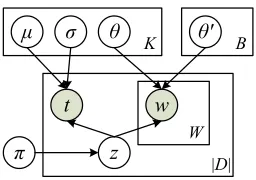
A sub-event corresponds to a topic that emerges from the data stream, being intensively discussed during a short period, and then gradually fades away. The tweets corresponding to a sub-event thus de-mand not only “temporal burstiness” but also a cer-tain degree of “lexical cohesiveness”. To incorporate both the time and content aspects of the sub-events, we propose a mixture model approach for sub-event detection. Figure 2 shows the plate notation.
In the proposed model, each tweet din the data streamDis generated from a topicz, weighted by πz. Each topic is characterized by both its content
event evolvement process and do not present the de-sired “burstiness” property. We use a uniform dis-tributionU(tb, te)to model the time aspect of these
“background” topics, withtb andtebeing the event
beginning and end time points. The content aspect of a background topic is modeled by similar multi-nomial distribution, parameterized byθ0. We use the maximum likelihood parameter estimation. The data likelihood can be represented as:
L(D) = Y
d∈D
X
z
{πzpz(td)
Y
w∈d
pz(w)}
wherepz(td)models the timestamp of tweetdunder
the topicz;pz(w)corresponds to the word
distribu-tion in topicz. They are defined as:
pz(td) =
N(td;µz, σz) ifzis a sub-event topic
U(tb, te) ifzis background topic
pz(w) =
p(w;θz) ifzis a sub-event topic
p(w;θ0z) ifzis background topic
where both p(w;θz) and p(w;θz0) are multinomial
distributions over the words. Initially, we assume there areKsub-event topics andBbackground top-ics and use the EM algorithm for model fitting. The EM equations are listed below:
E-step:
p(zd=j)∝
πjN(d;µj, σj) Q w∈d
p(w;θj) ifj <=K
πjU(tb, te) Q w∈d
p(w;θj0) else
M-step:
πj ∝
X
d
p(zd=j)
p(w;θj)∝
X
d
p(zd=j)×c(w, d)
p(w;θ0j)∝
X
d
p(zd=j)×c(w, d)
µj=
P
dp(zd=j)×td
PK
j=1 P
dp(zd=j)
σj2=
P
dp(zd=j)×(td−µj)2
PK
j=1 P
dp(zd=j)
To process the data streamD, we divide the data into 10-second bins and process each bin at a time.
The peak time of a sub-event was determined as the bin that has the most tweets related to this event. During EM initialization, the number of sub-event topicsKwas empirically decided by scanning through the data stream and examine tweets in ev-ery 3-minute stream segment. If there was a spike6, we add a new sub-event to the model and use the tweets in this segment to initialize the value of µ, σ, andθ. Initially, we use a fixed number of back-ground topics withB = 4. A topic re-adjustment was performed after the EM process. We merge two sub-events in a data stream if they (1) locate closely in the timeline, with peaks times within a 2-minute window; and (2) share similar word distributions: among the top-10 words with highest probability in the word distributions, there are over 5 words over-lap. We also convert the sub-event topics to back-ground topics if their σ values are greater than a thresholdβ7. We then re-run the EM to obtain the updated parameters. The topic re-adjustment pro-cess continues until the number of sub-events and background topics do not change further.
We obtain the “participant sub-events” by ap-plying this sub-event detection approach to each of the participant streams. The “global sub-events” are obtained by merging the participant sub-events along the timeline. We merge two participant sub-events into a global sub-event if (1) their peaks are within a 2-minute window, and (2) the Jaccard simi-larity (Lee, 1999) between their associated tweets is greater than a threshold (set to 0.1 empirically). The tweets associated with each global sub-event are the ones withp(z|d)greater than a thresholdγ, wherez is one of the participant sub-events andγ was set to 0.7 empirically. After the sub-event detection pro-cess, we obtain a set of global sub-events and their associated event tweets.8
3.3 Summary Tweet Extraction
We extract a representative tweet from each of the global sub-events and concatenate them to form an informative event summary. Note that our goal in this work is to identify all the important moments
6
We use the algorithm described in (Marcus et al., 2011) as a baseline and ad hoc spike detection algorithm.
7
βwas set to 5 minutes in our experiments.
8
Event Date Duration #Tweets Lakers vs Okc 05/19/2012 3h10m 218,313 N Celtics vs 76ers 05/23/2012 3h30m 245,734 B Celtics vs Heat 05/30/2012 3h30m 345,335 A Spurs vs Okc 05/31/2012 3h 254,670 Heat vs Okc (1) 06/12/2012 3h30m 331,498 Heat vs Okc (2) 06/21/2012 3h30m 332,223 Apple’s WWDC’12 Conf. 06/11/2012 3h30m 163,775
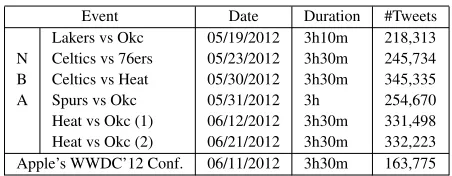
Table 1: Statistics of the data set, including six NBA bas-ketball games and the WWDC 2012 conference event.
for event summarization, but not on proposing new methods for tweet selection. We thus use the Hybrid TF-IDF approach (Sharifi et al., 2010a; Liu et al., 2011a) to extract the representative sentences from a collection of tweets. In this approach, each tweet was considered as a sentence. The sentences were ranked according to the average TF-IDF score of the consisting words; top weighted sentences were it-eratively extracted, while excluding those that have high cosine similarity with the existing summary sentences. (Inouye and Kalita, 2011) showed the Hybrid TF-IDF approach performs constantly better than the phrase reinforcement algorithm and other traditional summarization systems.
4 Data Corpus
We evaluate the proposed event summarization ap-proach on six NBA basketball games and a repre-sentative conference event, namely the Apple CEO’s keynote speech in the Apple Worldwide Develop-ers Conference (WWDC 2012)9. We use the het-erogeneous event types to verify that the proposed approach can robustly and efficiently produce sum-maries on different event streams. The tweet streams corresponding to these events are collected using the Twitter Streaming API10 with pre-defined key-word set. For NBA games, we use the team names, first name and last name of the players and head coaches as keywords for retrieving the event tweets; for the WWDC conference, the keyword set contains about 20 terms related to the Apple event, such as “wwdc”, “apple”, “mac”, etc. We crawl the tweets in real-time when these scheduled events are taking place; nevertheless, certain non-event tweets could be mis-included due to the broad coverage of the used keywords. During preprocessing, we filter out
9
https://developer.apple.com/wwdc/
10
https://dev.twitter.com/docs/streaming-apis
Time Action (Sub-event) Score 9:22 Chris Bosh misses 10-foot two point shot 7-2 9:22 Serge Ibaka defensive rebound 7-2 9:11 Kevin Durant makes 15-foot two point shot 9-2 8:55 Serge Ibaka shooting foul (Shane Battier draws 9-2
the foul)
8:55 Shane Battier misses free throw 1 of 2 9-2 8:55 Miami offensive team rebound 9-2 8:55 Shane Battier makes free throw 2 of 2 9-3
Table 2: An example clip of the play-by-play live cov-erage of an NBA game (Heat vs Okc). “Time” corre-sponds to the minutes left in the current quarter of the game; “Score” shows the score between the two teams.
the tweets containing URLs, non-English tweets, and retweets since they are less likely containing new information regarding the event progress. Ta-ble 1 shows statistics of the event tweets after the filtering process. In total, there are over 1.8 million tweets used in the event summarization experiments. We use the play-by-play live coverage collected from the ESPN11and MacRumors12websites as ref-erence, which provide detailed descriptions of the NBA and WWDC events as they unfold. Table 2 shows an example clip of the play-by-play descrip-tions of an NBA game. Ideally, each item in the live coverage descriptions may correspond to a sub-event in the tweet streams, but in reality, not all actions would attract enough attention from the Twitter au-dience. We use a human annotator to manually filter out the actions that did not lead to any spike in the corresponding participant stream. The rest items are projected to the participant and event streams as the goldstandard sub-events. The projection was man-ually performed since the “game clock” associated with the goldstandard (first column in Table 2) does not align well with the “wall clock” due to the game rules such as timeout and halftime rest. To evalu-ate the participant detection performance, we ask the annotator to manually group the proper noun men-tions into clusters, each cluster corresponds to a par-ticipant. The mentions that do not correspond to any participant are discarded. The goldstandard event summaries are generated by manually selecting one representative tweet from each of the groundtruth global sub-events. We choose not to use the play-by-play descriptions as reference summaries since their vocabulary is rather limited and do not overlap with the tweet language.
11
http://espn.go.com/nba/scoreboard
12
[image:6.612.315.540.55.145.2]Example Participants - NBA game westbrook, russell westbrook
stephen jackson, steven jackson, jackson james, james harden, harden
ibaka, serge ibaka
oklahoma city thunder, oklahoma gregg popovich, greg popovich, popovich kevin durant, kd, durant
thunder, okc, #okc, okc thunder, #thunder Example Participants - WWDC Conference macbooks, mbp, macbook pro, macbook air,... google maps, google, apple maps
wwdc, apple wwdc, #wwdc os, mountain, os x mountain, os x iphone 4s, iphone 3gs, iphone
Table 3: Example participants automatically detected from the NBA game Spurs vs Okc (2012-5-31) and the WWDC’12 conference.
5 Experimental Results
We evaluate the participant-based event summariza-tion in a cascaded fashion and present results for each of the three components, including the par-ticipant detection (Section 5.1), sub-event detection (Section 5.2), and quantitative and qualitative evalu-ation of example event summaries (Section 5.3).
5.1 Participant Detection Results
In Table 3, we show example participants that were automatically detected by the proposed hierarchical agglomerative clustering approach. We note that the clusters include various mentions of the same event participant, e.g., “gregg popovich”, “greg popovich”, and “popovich” are both referring to the head coach of the team Spurs; “macbooks”, “macbook pro”, “mbp” are referring to a line of products from Apple. Quantitatively, we evaluate the participant detection results on both participant- and mention-level. As-sume the system-detected and the goldstandard par-ticipant clusters areTsandTg respectively. We
de-fine acorrect participantas a system detected par-ticipant with more than half of its associated men-tions are included in a goldstandard participant (re-ferred to as the hit participant). As a result, we can define the participant-level precision and recall as below:
participant-prec= #correct-participants/|Ts|
participant-recall= #hit-participants/|Tg|
Note that a correct participant may include incor-rect mentions, and that more than one corincor-rect
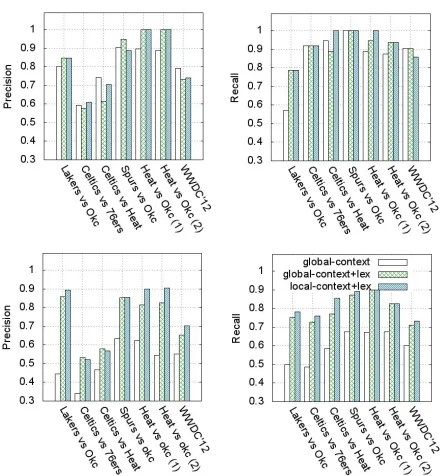
par-Figure 3: Participant detection performance. The upper figures represent the participant-level precision and re-call scores; while the lower figures represent the mention-level precision and recall. X-axis corresponds to the six NBA games and the WWDC conference.
ticipants may correspond to the same hit participant, both of which are undesired. In the latter case, we userepresentative participantto refer to the cor-rect participant which contains the most mentions in the hit participant. In this way, we build a 1-to-1 mapping from the detected participants to the groundtruth participants. Next, we define correct mentionsas the union of the overlapping mentions between all pairs of representative and hit partici-pants. Then we calculate the mention-level precision and recall as the number of correct mentions divided by the total mentions in the system or goldstandard participant clusters.
Figure 3 shows the participant- and mention-level precision and recall scores. We experimented with different similarity measures for the agglomerative clustering approach13. The “global context” means that the context vectors are created from the entire data stream; this may not perform well since dif-ferent participants can share similar global context. E.g., the terms “shot”, “dunk”, “rebound” can ap-pear in the context of any NBA players and are not
13The stopping threshold δ was set to 0.15, local context
[image:7.612.316.536.53.291.2] [image:7.612.104.268.55.205.2]Participant-level Sub-event Detection Global Sub-event Detection
Event
#P #S Spike MM #S Spike Participant + Spike Participant + MM
R P F R P F R P F R P F R P F
Lakers vs Okc 9 65 0.75 0.31 0.44 0.71 0.39 0.50 48 0.67 0.38 0.48 0.94 0.19 0.32 0.88 0.40 0.55
Celtics vs 76ers 10 88 0.52 0.39 0.45 0.53 0.43 0.47 60 0.65 0.51 0.57 0.72 0.18 0.29 0.78 0.39 0.52
Celtics vs Heat 14 152 0.53 0.29 0.37 0.50 0.38 0.43 67 0.57 0.41 0.48 0.97 0.21 0.35 0.91 0.28 0.43
Spurs vs Okc 12 98 0.78 0.46 0.58 0.84 0.57 0.68 81 0.41 0.42 0.41 0.88 0.35 0.50 0.91 0.54 0.68
Heat vs Okc (1) 15 123 0.75 0.27 0.40 0.72 0.35 0.47 85 0.41 0.47 0.44 0.94 0.20 0.33 0.96 0.34 0.50
Heat vs okc (2) 13 153 0.74 0.36 0.48 0.76 0.43 0.55 92 0.41 0.33 0.37 0.88 0.21 0.34 0.87 0.38 0.53
[image:8.612.75.540.57.170.2]WWDC’12 10 56 0.64 0.14 0.23 0.59 0.33 0.42 43 0.53 0.26 0.35 0.77 0.14 0.24 0.70 0.31 0.43 Average 12 105 0.67 0.32 0.42 0.66 0.41 0.50 68 0.52 0.40 0.44 0.87 0.21 0.34 0.86 0.38 0.52
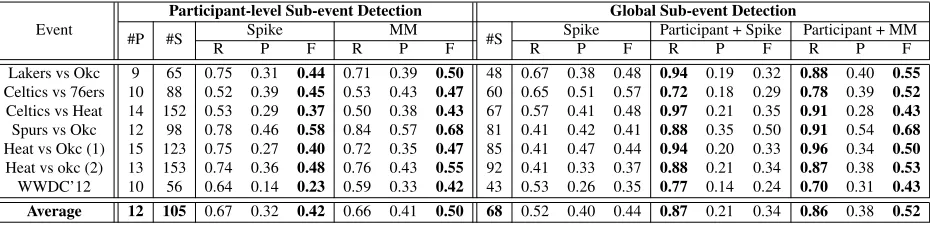
Table 4: Sub-event detection results on both participant and the event streams. “Spike” corresponds to the spike detection algorithm proposed in (Marcus et al., 2011); “MM” represents our proposed time-content mixture model approach. “#P” and “#S” list the number of participants and sub-events in each event stream.
discriminative enough. We found that adding the lexical similarity measure greatly boosted the clus-tering performance, especially on the mention-level, and that combining the lexical similarity with the lo-cal context is even more helpful for some events. We notice that two events (celtics vs 76ers and celtics vs heat) yield relatively low precision on both participant- and mention-level. Taking a close look at the data, we found that these two events acciden-tally co-occurred with other popular events, namely the TV program “American Idol” finale and the NBA Draft. The keyword based data crawler thus includes many noisy tweets in the event streams, leading to some false participants being detected.
5.2 Sub-event Detection Results
We compare our proposed time-content mixture model (noted as “MM”) against the spike detection algorithm proposed in (Marcus et al., 2011) (noted as “Spike”) . The spike algorithm is based on the tweet volume change. It uses 10 seconds as a time unit, calculates the tweet arrival rate in each unit, and identifies the rates that are significantly higher than the mean tweet rate. For these rate spikes, the algorithm finds the local maximum of tweet rate and identify a window surrounding the local maximum. We tune the parameter of the “Spike” approach (set τ = 4) so that it yields similar recall values as the mixture model approach. We then apply the “MM” and “Spike” approaches to both the participant and event streams and evaluate the sub-event detection performance. Results are shown in Table 4. A sys-tem detected sub-event is considered to match the goldstandard sub-event if its peak time is within a 2-minute window of the goldstandard.
We first apply the “Spike” and “MM” approach to
the participant streams. The participant streams on which we cannot detect any meaningful sub-events have been excluded, the resulting number of partic-ipants are listed in Table 4 and denoted as “#P”. In general, we found the “MM” approach can per-form better since it inherently incorporates both the “burstiness” and “lexical cohesiveness” of the event tweets, while the “Spike” approach relies solely on the “burstiness” property. Note that although we di-vide the entire event stream into participant streams, some key participants still own huge amount of dis-cussion and the spike patterns are not always clearly identifiable. The time-content mixture model gains advantages in these cases.
+ Spike” yields slightly worse precision, since it is very sensitive to the spikes on the participant-level, leading to the rise of false alarms. The “Participant + MM” approach is much better in precision, which is consistent to our findings on the participant streams.
5.3 Summarization Results
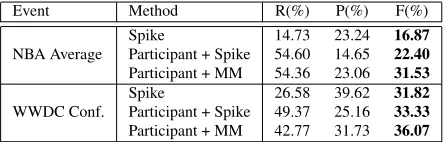
Summarization evaluation has been a longstanding issue in the literature (Nenkova and Mckeown, 2011; Liu and Liu, 2010). There are even less studies fo-cusing on evaluating the event summaries generated from data streams. Since the summary annotation takes quite some effort, we sample a 10-minute seg-ment from each of the seven event streams and ask a human annotator to select representative tweets for each segment. We then compare the system summaries against the manual summaries using the ROUGE-1 (Lin, 2004) metric. The quantitative re-sults and qualitative analysis are presented in Table 5 and Table 6 respectively. Note that the ROUGE scores are based solely on the n-gram overlap be-tween the system and reference summaries, which may not be the most appropriate measure for eval-uating the Twitter event summaries. However, we do notice that the accurate sub-event detection per-formance can successfully translate into a gain of the ROUGE scores. Qualitatively, the participant-based event summarization approach focus more on extracting tweets associated with the targeted partic-ipants, which could lead to better text coherence.
6 Conclusion and Future Work
In this work, we made an initial attempt to gen-erate event summaries using Twitter data streams. We proposed a participant-based event summariza-tion approach which “zooms-in” the Twitter event streams to the participant level, detects the impor-tant sub-events associated with each participant us-ing a novel mixture model that incorporates both the “burstiness” and “cohesiveness” of tweets, and gen-erates the event summaries progressively. Results show that the proposed approach can effectively cap-ture the sub-events that have otherwise been shad-owed by the long-tail of other dominant sub-events, yielding summaries with considerably better cover-age. Without loss of generality, we report results on the entire event streams, though the proposed ap-proach can well be applied in an online fashion.
Event Method R(%) P(%) F(%)
NBA Average
Spike 14.73 23.24 16.87
Participant + Spike 54.60 14.65 22.40
Participant + MM 54.36 23.06 31.53
WWDC Conf.
Spike 26.58 39.62 31.82
Participant + Spike 49.37 25.16 33.33
[image:9.612.316.538.57.128.2]Participant + MM 42.77 31.73 36.07
Table 5: ROUGE-1 scores of summarization
Method Summary
Manual
Good drive fordurant
Pretty shot byDuncan
Good 3 pointtony parker
Nice movewestbrook
Good shotWestbrook
Spike Game 3. Spurs vs. OKCOkc and spurs game.
Participant + Spike
OKLAHOMA CITY THUNDER vs san antonio spurs!! YA
I hope okc win the series. Ill hate too see the heat play San Antonio
we aint in San Antonio anymore. NBA: SA 0 OKC 8, 9:11 1st.#TeamOkc San antonio spurs for 21 consecutive win? #nba Somebody Should StopTim Duncan.
Pass the damn ballWestbrook
Good 3 pointertony parker!
Participant + MM
Tim Duncanshot is so precise
Tim Duncanis gettin started Good 3 pointertony parker!
Sefalosa guardingtony parker. Good fucking move coach brooks
Westbrook= 2 Fast 2 Furious
Niggas steady lettingTim Duncanshoot
[image:9.612.313.541.158.424.2]Westbrookmid range shot is automatic
Table 6: Example summaries for an event segment. Par-ticipants are marked usingitalicizedtext.
There are many challenges left in this line of re-search. Having a standardized evaluation metric for event summaries is one of them. In the current work, we employed ROUGE-1 for summary evaluation, since it has been shown to correlate well with the hu-man judgements on noisy text genres (Liu and Liu, 2010). We would like to explore other evaluation metrics (e.g., ROUGE-2, -SU4, Pyramid (Nenkova et al., 2007)) and the human evaluation in future. We will also explore better ways of integrating the sub-event detection and summarization approaches.
Acknowledgments
References
James Allan. 2002. Topic detection and tracking: Event-based information organization. Kluwer Academic
Publishers Norwell, MA, USA.
Hila Becker, Feiyang Chen, Dan Iter, Mor Naaman, and Luis Gravano. 2011a. Automatic identification and presentation of twitter content for planned events. In
Proceedings of the Fifth International AAAI
Confer-ence on Weblogs and Social Media (ICWSM), pages
655–656.
Hila Becker, Mor Naaman, and Luis Gravano. 2011b. Beyond trending topics: Real-world event identifica-tion on twitter. In Proceedings of the Fifth Interna-tional AAAI Conference on Weblogs and Social Media
(ICWSM), pages 438–441.
Deepayan Chakrabarti and Kunal Punera. 2011. Event summarization using tweets. In Proceedings of the Fifth International AAAI Conference on Weblogs and
Social Media (ICWSM), pages 66–73.
Qiming Diao, Jing Jiang, Feida Zhu, and Ee-Peng Lim. 2012. Finding bursty topics from microblogs. In Pro-ceedings of the 50th Annual Meeting of the Association
for Computational Linguistics (ACL), pages 536–544.
Jacob Eisenstein. 2013. What to do about bad language on the internet. InProceedings of the 2013 Confer-ence of the North American Chapter of the Associa-tion for ComputaAssocia-tional Linguistics: Human Language
Technologies (NAACL/HLT).
Jennifer Foster, Ozlem Cetinoglu, Joachim Wagner, Joseph Le Roux, Stephen Hogan, Joakim Nivre, Deirdre Hogan, and Josef van Genabith. 2011. #hard-toparse: POS tagging and parsing the twitterverse. In
Proceedings of the AAAI Workshop on Analyzing
Mi-crotext, pages 20–25.
Kevin Gimpel, Nathan Schneider, Brendan O’Connor, Dipanjan Das, Daniel Mills, Jacob Eisenstein, Michael Heilman, Dani Yogatama, Jeffrey Flanigan, and Noah A. Smith. 2011. Part-of-speech tagging for twit-ter: Annotation, features, and experiments. In Pro-ceedings of the 49th Annual Meeting of the Associa-tion for ComputaAssocia-tional Linguistics: Human Language
Technologies (ACL-HLT), pages 42–47.
Aria Haghighi and Lucy Vanderwende. 2009. Explor-ing content models for multi-Document summariza-tion. InProceedings of Human Language Technolo-gies: The 2009 Annual Conference of the North Ameri-can Chapter of the Association for Computational
Lin-guistics (NAACL), pages 362–370.
Sanda Harabagiu and Andrew Hickl. 2011. Relevance modeling for microblog summarization. In Proceed-ings of the Fifth International AAAI Conference on
We-blogs and Social Media (ICWSM), pages 514–517.
Thomas Hofmann. 1999. Probabilistic latent semantic analysis. In Proceedings of Uncertainty in Artificial
Intelligence (UAI).
David Inouye and Jugal K. Kalita. 2011. Compar-ing twitter summarization algorithms for multiple post summaries. InProceedings of 2011 IEEE Third
Inter-national Conference on Social Computing, pages 290–
306.
Lillian Lee. 1999. Measures of distributional similarity.
InProceedings of the 37th Annual Meeting of the
As-sociation for Computational Linguistics (ACL), pages
25–32.
Chin-Yew Lin. 2004. ROUGE: A package for automatic evaluation of summaries. InWorkshop on Text
Sum-marization Branches Out.
Feifan Liu and Yang Liu. 2010. Exploring correlation between ROUGE and human evaluation on meeting summaries. IEEE Transactions on Audio, Speech, and
Language Processing, 18(1):187–196.
Fei Liu, Yang Liu, and Fuliang Weng. 2011a. Why is ”SXSW” trending? Exploring multiple text sources for twitter topic summarization. InProceedings of the
ACL Workshop on Language in Social Media (LSM),
pages 66–75.
Fei Liu, Fuliang Weng, Bingqing Wang, and Yang Liu. 2011b. Insertion, deletion, or substitution? Normal-izing text messages without pre-categorization nor su-pervision. InProceedings of the 49th Annual Meet-ing of the Association for Computational LMeet-inguistics
(ACL), pages 71–76.
Fei Liu, Fuliang Weng, and Xiao Jiang. 2012. A broad-coverage normalization system for social media lan-guage. InProceedings of the 50th Annual Meeting of
the Association for Computational Linguistics (ACL),
pages 1035–1044.
Annie Louis and Todd Newman. 2012. Summarization of business-related tweets: A concept-based approach.
In Proceedings of the 24th International Conference
on Computational Linguistics (COLING).
Adam Marcus, Michael S. Bernstein, Osama Badar, David R. Karger, Samuel Madden, and Robert C. Miller. 2011. Twitinfo: Aggregating and visualizing microblogs for event exploration. In Proceedings of the SIGCHI Conference on Human Factors in
Com-puting Systems, pages 227–236.
Ani Nenkova and Kathleen Mckeown. 2011. Automatic summarization. Foundations and Trends in
Informa-tion Retrieval, 5(2–3):103–233.
Ani Nenkova, Rebecca Passonneau, and Kathleen Mcke-own. 2007. The pyramid method: Incorporating hu-man content selection variation in summarization eval-uation. ACM Transactions on Speech and Language
Jeffrey Nichols, Jalal Mahmud, and Clemens Drews. 2012. Summarizing sporting events using twitter. In
Proceedings of the 2012 ACM Interntional Conference
on Intelligent User Interfaces (IUI), pages 189–198.
Brendan O’Connor, Michel Krieger, and David Ahn. 2010. TweetMotif: Exploratory search and topic sum-marization for twitter. In Proceedings of the Fourth International AAAI Conference on Weblogs and Social
Media (ICWSM), pages 384–385.
Sasa Petrovic, Miles Osborne, and Victor Lavrenko. 2010. Streaming first story detection with application to twitter. In Proceedings of the 2010 Annual Con-ference of the North American Chapter of the
Associ-ation for ComputAssoci-ational Linguistics (NAACL), pages
181–189.
Alan Ritter, Sam Clark, Mausam, and Oren Etzioni. 2011. Named entity recognition in tweets: An exper-imental study. In Proceedings of the Conference on Empirical Methods in Natural Language Processing
(EMNLP), pages 1524–1534.
Alan Ritter, Mausam, Oren Etzioni, and Sam Clark. 2012. Open domain event extraction from twitter. In
Proceedings of the 18th ACM SIGKDD International Conference on Knowledge Discovery and Data Min-ing, pages 1104–1112.
Beaux Sharifi, Mark-Anthony Hutton, and Jugal K. Kalita. 2010a. Experiments in microblog summariza-tion. InProceedings of the 2010 IEEE Second
Interna-tional Conference on Social Computing, pages 49–56.
Beaux Sharifi, Mark-Anthony Hutton, and Jugal K. Kalita. 2010b. Summarizing microblogs automati-cally. InProceedings of the 2010 Annual Conference of the North American Chapter of the Association for
Computational Linguistics (NAACL), pages 685–688.
Hiroya Takamura, Hikaru Yokono, and Manabu Oku-mura. 2011. Summarizing a document stream. In
Proceedings of the 33rd European Conference on
Ad-vances in Information Retrieval (ECIR), pages 177–
188.
Jui-Yu Weng, Cheng-Lun Yang, Bo-Nian Chen, Yen-Kai Wang, and Shou-De Lin. 2011. Imass: An intelli-gent microblog analysis and summarization system. In
Proceedings of the 49th Annual Meeting of the Asso-ciation for Computational Linguistics: Human
Lan-guage Technologies (ACL-HLT), pages 133–138.
Siqi Zhao, Lin Zhong, Jehan Wickramasuriya, and Venu Vasudevan. 2011. Human as real-time sensors of so-cial and physical events: A case study of twitter and sports games. Technical Report TR0620-2011, Rice
University and Motorola Labs.
Arkaitz Zubiaga, Damiano Spina, Enrique Amig´o, and Julio Gonzalo. 2012. Towards real-time summariza-tion of scheduled events from twitter streams. In
Pro-ceedings of the 23rd ACM Conference on Hypertext