Towards Robust Semantic Role Labeling
Sameer Pradhan BBN Technologies Cambridge, MA 02138
Wayne Ward, James H. Martin University of Colorado
Boulder, CO 80303 {whw,martin}@colorado.edu
Abstract
Most research on semantic role labeling (SRL) has been focused on training and evaluating on the same corpus in order to develop the technology. This strategy, while appropriate for initiating research, can lead to over-training to the particular corpus. The work presented in this pa-per focuses on analyzing the robustness of an SRL system when trained on one genre of data and used to label a different genre. Our state-of-the-art semantic role labeling system, while performing well on WSJ test data, shows significant perfor-mance degradation when applied to data from the Brown corpus. We present a se-ries of experiments designed to investigate the source of this lack of portability. These experiments are based on comparisons of performance using PropBanked WSJ data and PropBanked Brown corpus data. Our results indicate that while syntactic parses and argument identification port relatively well to a new genre, argument classifica-tion does not. Our analysis of the reasons for this is presented and generally point to the nature of the more lexical/semantic features dominating the classification task and general structural features dominating the argument identification task.
1 Introduction
Automatic, accurate and wide-coverage techniques that can annotate naturally occurring text with se-mantic argument structure play a key role in NLP applications such as Information Extraction (Sur-deanu et al., 2003; Harabagiu et al., 2005), Question Answering (Narayanan and Harabagiu, 2004) and Machine Translation (Boas, 2002; Chen and Fung, 2004). Semantic Role Labeling (SRL) is the pro-cess of producing such a markup. When presented with a sentence, a parser should, for each predicate in the sentence, identify and label the predicate’s se-mantic arguments. In recent work, a number of re-searchers have cast this problem as a tagging prob-lem and have applied various supervised machine learning techniques to it. On the Wall Street Jour-nal (WSJ) data, using correct syntactic parses, it is possible to achieve accuracies rivaling human inter-annotator agreement. However, the performance gap widens when information derived from automatic syntactic parses is used.
So far, most of the work on SRL systems has been focused on improving the labeling performance on a test set belonging to the same genre of text as the training set. Both the Treebank on which the syntac-tic parser is trained and the PropBank on which the SRL systems are trained represent articles from the year 1989 of the WSJ. While all these systems per-form quite well on the WSJ test data, they show sig-nificant performance degradation (approximately 10 point drop in F-score) when applied to label test data that is different than the genre that WSJ represents (Pradhan et al., 2004; Carreras and M`arquez, 2005).
Surprisingly, it does not matter much whether the data is from another newswire, or a completely dif-ferent type of text – as in the Brown corpus. These results indicate that the systems are being over-fit to the specific genre of text. Many performance im-provements on the WSJ PropBank corpus may re-flect tuning to the corpus. For the technology to be widely accepted and useful, it must be robust to change in genre of the data. Until recently, data tagged with similar semantic argument structure was not available for multiple genres of text. Recently, Palmer et al., (2005), have PropBanked a significant portion of the Treebanked Brown corpus which en-ables us to perform experiments to analyze the rea-sons behind the performance degradation, and sug-gest potential solutions.
2 Semantic Annotation and Corpora
In the PropBank1corpus (Palmer et al., 2005), pred-icate argument relations are marked for the verbs in the text. PropBank was constructed by assign-ing semantic arguments to constituents of the hand-corrected Treebank parses. The arguments of a verb are labeled ARG0 to ARG5, where ARG0 is the
PROTO-AGENT (usually the subject of a transitive verb) ARG1 is the PROTO-PATIENT(usually its di-rect object), etc. In addition to these COREARGU -MENTS, 16 additional ADJUNCTIVE ARGUMENTS, referred to as ARGMs are also marked.
More recently the PropBanking effort has been extended to encompass multiple corpora. In this study we use PropBanked versions of the Wall Street Journal (WSJ) part of the Penn Treebank (Marcus et al., 1994) and part of the Brown portion of the Penn Treebank.
The WSJ PropBank data comprise 24 sections of the WSJ, each section representing about 100 documents. PropBank release 1.0 contains about 114,000 predicates instantiating about 250,000 argu-ments and covering about 3,200 verb lemmas. Sec-tion 23, which is a standard test set and a test set in some of our experiments, comprises 5,400 predi-cates instantiating about 12,000 arguments.
The Brown corpus is a Standard Corpus of Ameri-can English that consists of about one million words of English text printed in the calendar year 1961
1
http://www.cis.upenn.edu/˜ace/
(Kuˇcera and Francis, 1967). The corpus contains about 500 samples of 2000+ words each. The idea behind creating this corpus was to create a hetero-geneous sample of English text so that it would be useful for comparative language studies.
The Release 3 of the Penn Treebank contains the hand parsed syntactic trees of a subset of the Brown Corpus – sections F, G, K, L, M, N, P and R. Palmer et al., (2005) have recently PropBanked a signifi-cant portion of this Treebanked Brown corpus. In all, about 17,500 predicates are tagged with their se-mantic arguments. For these experiments we used a limited release of PropBank dated September 2005. A small portion of the predicates – about 8,000 have also been tagged with frame sense information.
3 SRL System Description
We formulate the labeling task as a classification problem as initiated by Gildea and Jurafsky (2002) and use Support Vector Machine (SVM) classi-fiers (2005). We use TinySVM2 along with Yam-Cha3(Kudo and Matsumoto, 2000) (Kudo and Mat-sumoto, 2001) as the SVM training and classifica-tion software. The system uses a polynomial kernel with degree 2; the cost per unit violation of the mar-gin,C=1; and, tolerance of the termination criterion, e=0.001. More details of this system can be found
in Pradhan et al., (2005). The performance of this system on section 23 of the WSJ when trained on sections 02-21 is shown in Table 1
ALLARGs Task P R F A (%) (%) (%) TREEBANK Id. 97.5 96.1 96.8
Class. - - - 93.0 Id. + Class. 91.8 90.5 91.2 AUTOMATIC Id. 86.9 84.2 85.5
Class. - - - 92.0 Id. + Class. 82.1 77.9 79.9
Table 1: Performance of the SRL system on WSJ
The performance of the SRL system is reported on three different tasks, all of which are with respect to a particular predicate: i) argument identification (ID), is the task of identifying the set of words (here, parse constituents) that represent a semantic role; ii)
argument classification (Class.), is the task of
clas-sifying parse constituents known to represent some
2
http://cl.aist-nara.ac.jp/˜talus-Au/software/TinySVM/
3
semantic role into one of the many semantic role types; and iii) argument identification and
classifi-cation (ID + Class.), which involves both the
iden-tification of the parse constituents that represent se-mantic roles of the predicate and their classification into the respective semantic roles. As usual, argu-ment classification is measured as percent accuracy (A), whereas ID and ID + Class. are measured in terms of precision (P), recall (R) and F-score (F) – the harmonic mean of P and R. The first three rows of Table 1 report performance for the system that uses hand-corrected Treebank parses, and the next three report performance for the SRL system that uses automatically generated – Charniak parser – parses, both during training and testing.
4 Robustness Experiments
This section describes experiments that we per-formed using the PropBanked Brown corpus in an attempt to analyze the factors affecting the portabil-ity of SRL systems.
4.1 How does the SRL system trained on WSJ perform on Brown?
In order to test the robustness of the SRL system, we used a system trained on the PropBanked WSJ corpus to label data from the Brown corpus. We use the entire PropBanked Brown corpus (about 17,500 predicates) as a test set for this experiment and use the SRL system trained on WSJ sections 02-21 to tag its arguments.
Table 2 shows the performance for training and testing on WSJ, and for training on WSJ and testing on Brown. There is a significant reduction in per-formance when the system trained on WSJ is used to label data from the Brown corpus. The degrada-tion in the Identificadegrada-tion task is small compared to that of the combined Identification and Classifica-tion task. A number of factors could be responsible for the loss of performance. It is possible that the SRL models are tuned to the particular vocabulary and sense structure associated with the training data. Also, since the syntactic parser that is used for gen-erating the syntax parse trees (Charniak) is heavily lexicalized and is trained on WSJ, it could have de-creased accuracy on the Brown data resulting in re-duced accuracy for Semantic Role Labeling. Since
the SRL algorithm walks the syntax tree classifying each node, if no constituent node is present that cor-responds to the correct argument, the system cannot produce a correct labeling for the argument.
Train Test Id. Id. + Class
F F
[image:3.612.354.500.121.165.2]WSJ WSJ 85.5 79.9 WSJ Brown 82.4 65.1
Table 2: Performance of the SRL system on Brown.
In order to check the extent to which constituent nodes representing semantic arguments were deleted from the syntax tree due to parser error, we gener-ated the performance numbers which are shown in Table 3. These numbers are for top one parse for the Charniak parser, and represent not all parser errors, but deletion of argument bearing constituent nodes.
[image:3.612.354.496.300.330.2]Total Misses % PropBank 12000 800 6.7 Brown 45880 3692 8.1
Table 3: Constituent deletions in WSJ and Brown.
The parser misses 6.7% of the argument-bearing nodes in the PropBank test set and about 8.1% in the Brown corpus. This indicates that the errors in syntactic parsing account for a fairly small amount of the argument deletions and probably do not con-tributing significantly to the increased SRL error rate. Obviously, just the presence of a argument-bearing constituent does not necessarily guarantee the correctness of the structural connections be-tween itself and the predicate.
4.2 Identification vs Classification Performance
SRL SRL Task P R F A
Train Test (%) (%) (%)
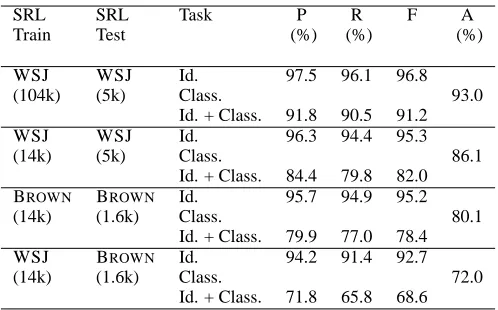
WSJ WSJ Id. 97.5 96.1 96.8 (104k) (5k) Class. 93.0
Id. + Class. 91.8 90.5 91.2 WSJ WSJ Id. 96.3 94.4 95.3
(14k) (5k) Class. 86.1
Id. + Class. 84.4 79.8 82.0 BROWN BROWN Id. 95.7 94.9 95.2 (14k) (1.6k) Class. 80.1
Id. + Class. 79.9 77.0 78.4 WSJ BROWN Id. 94.2 91.4 92.7 (14k) (1.6k) Class. 72.0
[image:4.612.182.431.55.210.2]Id. + Class. 71.8 65.8 68.6
Table 4: Performance of the SRL system using correct Treebank parses.
test sets, we used stratified sampling, which is often used by the syntactic parsing community (Gildea, 2001). The test set was generated by selecting ev-ery 10th sentence in the Brown Corpus. We also held out the development set used by Bacchiani et al., (2006) to tune system parameters in the future. This procedure resulted in a training set of approxi-mately 14,000 predicates and a test set of about 1600 predicates. We did not perform any parameter tun-ing for any of the followtun-ing experiments, and used the parameter settings from the best performing ver-sion of the SRL system as reported in Table1. We compare the performance on this test set with that obtained when the SRL system is trained using WSJ sections 02-21 and use section 23 for testing. For a more balanced comparison, we retrained the SRL system on the same amount of data as used for train-ing on Brown, and tested it on section 23. As usual, trace information, and function tag information from the Treebank is stripped out.
Table 4 shows the results. There is a fairly small difference in argument Identification performance when the SRL system is trained on 14,000 predi-cates vs 104,000 predipredi-cates from the WSJ (F-score 95.3 vs 96.8). However, there is a considerable drop in Classification accuracy (86.1% vs 93.0%). When the SRL system is trained and tested on Brown data, the argument Identification performance is not sig-nificantly different than that for the system trained and tested on WSJ data (F-score 95.2 vs 95.3). The drop in argument Classification accuracy is much more severe (86.1% vs 80.1%).
This same trend between ID and Classification is even more pronounced when training on WSJ and
testing on Brown. For a system trained on WSJ, there is a fairly small drop in performance of the ID task when tested on Brown vs tested on WSJ (F-score 92.7 vs 95.3). However, in this same condi-tion, the Classification task has a very large drop in performance (72.0% vs 86.1%).
So argument ID is not very sensitive to amount of training data in a corpus, or to the genre of the corpus, and ports well from WSJ to Brown. This ex-periment supports the belief that there is no signifi-cant drop in the task of identifying the right syntactic constituents that are arguments – and this is intuitive since previous experiments have shown that the task of argument identification is more dependent on the structural features – one such feature being the path in the syntax tree.
Argument Classification seems to be the problem. It requires more training data within the WSJ corpus, does not perform as well when trained and tested on Brown as it does for WSJ and does not port well from WSJ to Brown. This suggests that the features it uses are being over-fit to the training data and are more idiosyncratic to a given dataset. In particular, the predicate whose arguments are being identified, and the head word of the syntactic constituent being classified are both important features in the task of argument classification.
training and testing on WSJ (with comparable train-ing set size). It is probably the case that the predi-cates and head words in a homogeneous corpus such as the WSJ are used more consistently, and tend to have single dominant word senses. The Brown cor-pus probably has much more variety in its lexical usage and word senses.
4.3 How sensitive is semantic argument prediction to the syntactic correctness across genre?
This experiment examines the same cross-genre ef-fects as the last experiment, but uses automatically generated syntactic parses rather than gold standard ones.
For this experiment, we used the same amount of training data from WSJ as available in the Brown training set – that is about 14,000 predicates. The examples from WSJ were selected randomly. The Brown test set is the same as used in the previous experiment, and the WSJ test set is the entire section 23.
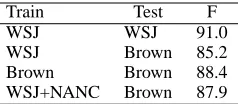
Recently there have been some improvements to the Charniak parser, use n-best ranking as re-ported in (Charniak and Johnson, 2005) and self-training and re-ranking using data from the North American News corpus (NANC) and adapts much better to the Brown corpus (McClosky et al., 2006a; McClosky et al., 2006b). The performance of these parsers as reported in the respective literature are shown in Table 6 shows the performance (as re-ported in the literature) of the Charniak parser: when trained and tested on WSJ, when trained on WSJ and tested on Brown, When trained and tested on Brown, and when trained on WSJ and adapted with NANC.
[image:5.612.127.246.546.598.2]Train Test F WSJ WSJ 91.0 WSJ Brown 85.2 Brown Brown 88.4 WSJ+NANC Brown 87.9
Table 6: Charniak parser performance.
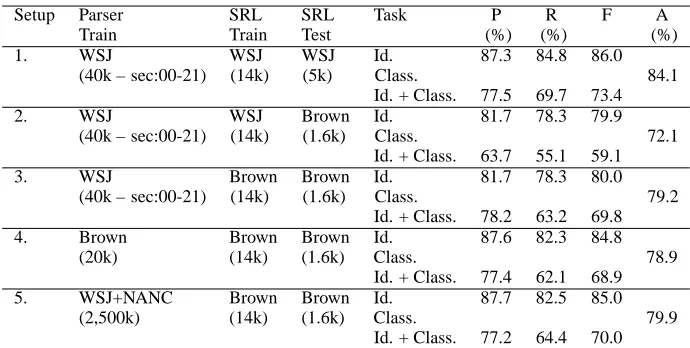
We describe the results of Semantic Role Label-ing under the followLabel-ing five conditions:
1. The SRL system is trained on features ex-tracted from automatically generated parses of the PropBanked WSJ sentences. The syntactic
parser – Charniak parser – is itself trained on the WSJ training sections of the Treebank. This is used for Semantic Role Labeling of section-23 of WSJ.
2. The SRL system is trained on features ex-tracted from automatically generated parses of the PropBanked WSJ sentences. The syntac-tic parser – Charniak parser – is itself trained on the WSJ training sections of the Treebank. This is used to classify the Brown test set. 3. The SRL system is trained on features
ex-tracted from automatically generated parses of the PropBanked Brown corpus sentences. The syntactic parser is trained using the WSJ por-tion of the Treebank. This is used to classify the Brown test set.
4. The SRL system is trained on features ex-tracted from automatically generated parses of the PropBanked Brown corpus sentences. The syntactic parser is trained using the Brown training portion of the Treebank. This is used to classify the Brown test set.
5. The SRL system is trained on features ex-tracted from automatically generated parses of the PropBanked Brown corpus sentences. The syntactic parser is the version that is self-trained using 2,500,000 sentences from NANC, and where the starting version is trained only on WSJ data (McClosky et al., 2006b). This is used to classify the Brown test set.
Setup Parser SRL SRL Task P R F A
Train Train Test (%) (%) (%)
1. WSJ WSJ WSJ Id. 87.3 84.8 86.0 (40k – sec:00-21) (14k) (5k) Class. 84.1
Id. + Class. 77.5 69.7 73.4 2. WSJ WSJ Brown Id. 81.7 78.3 79.9
(40k – sec:00-21) (14k) (1.6k) Class. 72.1 Id. + Class. 63.7 55.1 59.1 3. WSJ Brown Brown Id. 81.7 78.3 80.0
(40k – sec:00-21) (14k) (1.6k) Class. 79.2 Id. + Class. 78.2 63.2 69.8 4. Brown Brown Brown Id. 87.6 82.3 84.8
(20k) (14k) (1.6k) Class. 78.9 Id. + Class. 77.4 62.1 68.9 5. WSJ+NANC Brown Brown Id. 87.7 82.5 85.0
[image:6.612.133.478.55.229.2](2,500k) (14k) (1.6k) Class. 79.9 Id. + Class. 77.2 64.4 70.0
Table 5: Performance on WSJ and Brown using automatic syntactic parses
trained on WSJ to test Brown sentences give a 12 point drop in F-score (84.1 vs 72.1). Using the SRL system trained on Brown using WSJ trained syntac-tic parser shows a drop in accuracy by about 5 F-score points (84.1 to 79.2). When the SRL system is trained on Brown using syntactic parser also trained on Brown, we get a quite similar classification per-formance, which is again about 5 points lower than what we get using all WSJ data. This shows lexical semantic features might be very important to get a better argument classification on Brown corpus.
4.4 How much data is required to adapt to a new genre?
We would like to know how much data from a new genre we need to annotate and add to the training data of an existing corpus to adapt the system such that it gives the same level of performance as when it is trained on the new genre.
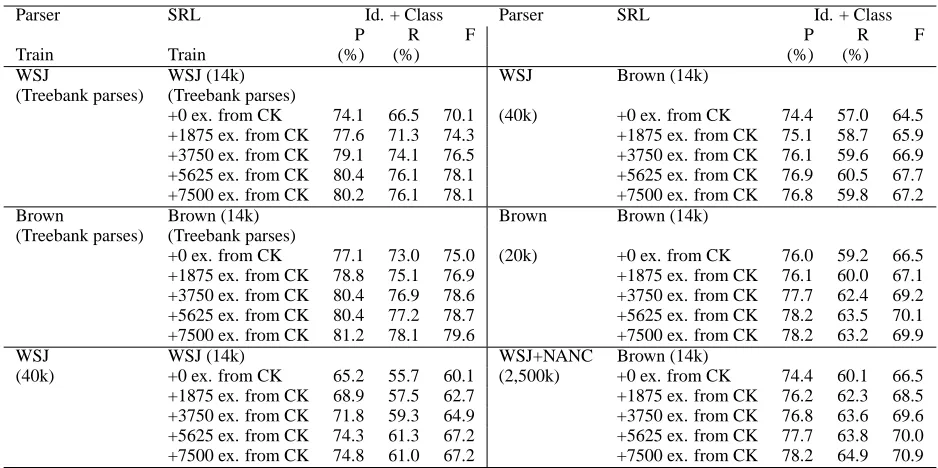
One section of the Brown corpus – section CK has about 8,200 predicates annotated. We use six different conditions – two in which we use correct Treebank parses, and the four others in which we use automatically generated parses using the varia-tions described before. All training sets start with the same number of examples as in the Brown train-ing set. The part of this section used as a test set for the CoNLL 2005 shared task is used as the test set here. It contains a total of about 800 predicates.
Table 7 shows a comparison of these conditions. In all the six conditions, the performance on the task of Identification and Classification improves
gradu-ally until about 5625 examples of section CK which is about 75% of the total added, above which they improve very little. In fact, even 50% of the new data accounts for 90% of the performance differ-ence. Even when the syntactic parser is trained on WSJ and the SRL is trained on WSJ, adding 7,500 instances of the new genres allows it to achieve al-most the same performance as when all three are from the same genre (67.2 vs 69.9). Numbers for ar-gument identification aren’t shown because adding more data does not have any statistically signifi-cant impact on its performance. The system that uses self-trained syntactic parser seems to perform slightly better than the rest of the versions that use automatically generated syntactic parses. The preci-sion numbers are almost unaffected – except when the labeler is trained on WSJ PropBank data.
4.5 How much does verb sense information contribute?
In order to find out how important the verb sense information is in the process of genre transfer, we used the subset of PropBanked Brown corpus that was tagged with verb sense information, ran an ex-periment similar to that of Exex-periment 1. We used the oracle sense information and correct syntactic in-formation for this experiment.
distribu-Parser SRL Id. + Class Parser SRL Id. + Class
P R F P R F
Train Train (%) (%) (%) (%)
WSJ WSJ (14k) WSJ Brown (14k)
(Treebank parses) (Treebank parses)
+0 ex. from CK 74.1 66.5 70.1 (40k) +0 ex. from CK 74.4 57.0 64.5 +1875 ex. from CK 77.6 71.3 74.3 +1875 ex. from CK 75.1 58.7 65.9 +3750 ex. from CK 79.1 74.1 76.5 +3750 ex. from CK 76.1 59.6 66.9 +5625 ex. from CK 80.4 76.1 78.1 +5625 ex. from CK 76.9 60.5 67.7 +7500 ex. from CK 80.2 76.1 78.1 +7500 ex. from CK 76.8 59.8 67.2 Brown Brown (14k) Brown Brown (14k)
(Treebank parses) (Treebank parses)
+0 ex. from CK 77.1 73.0 75.0 (20k) +0 ex. from CK 76.0 59.2 66.5 +1875 ex. from CK 78.8 75.1 76.9 +1875 ex. from CK 76.1 60.0 67.1 +3750 ex. from CK 80.4 76.9 78.6 +3750 ex. from CK 77.7 62.4 69.2 +5625 ex. from CK 80.4 77.2 78.7 +5625 ex. from CK 78.2 63.5 70.1 +7500 ex. from CK 81.2 78.1 79.6 +7500 ex. from CK 78.2 63.2 69.9 WSJ WSJ (14k) WSJ+NANC Brown (14k)
[image:7.612.71.540.55.289.2](40k) +0 ex. from CK 65.2 55.7 60.1 (2,500k) +0 ex. from CK 74.4 60.1 66.5 +1875 ex. from CK 68.9 57.5 62.7 +1875 ex. from CK 76.2 62.3 68.5 +3750 ex. from CK 71.8 59.3 64.9 +3750 ex. from CK 76.8 63.6 69.6 +5625 ex. from CK 74.3 61.3 67.2 +5625 ex. from CK 77.7 63.8 70.0 +7500 ex. from CK 74.8 61.0 67.2 +7500 ex. from CK 78.2 64.9 70.9
Table 7: Effect of incrementally adding data from a new genre
Train Test Without Sense With Sense Id. Id.
F F
WSJ Brown (All) 69.1 69.9 WSJ Brown (predicate: go) 46.9 48.9
Table 8: Influence of verb sense feature.
tion was different. One such predicate is “go”. The improvement on classifying the arguments of this predicate was about 2 points (46.9 to 48.9), which suggests that verb sense is more important when the sense structure of the test corpus is more ambiguous and is different from the training. Here we used ora-cle verb sense information, but one can train a clas-sifier as done by Girju et al., (2005) which achieves a disambiguation accuracy in the 80s for within the WSJ corpus.
5 Conclusions
Our experimental results on robustness to change in genre can be summarized as follows:
• There is a significant drop in performance when training and testing on different corpora – for both Treebank and Charniak parses
• In this process the classification task is more disrupted than the identification task.
• There is a performance drop in classification
even when training and testing on Brown (com-pared to training and testing on WSJ)
• The syntactic parser error is not a large part of the degradation for the case of automatically generated parses.
An error analysis leads us to believe that some reasons for this behavior could be: i) lexical us-ages that are specific to WSJ, ii) variation in sub-categorization across corpora, iii) variation in word sense distribution and iv) changes in topics and enti-ties. Training and testing on the same corpora tends to give a high weight to very specific semantic fea-tures. Two possibilities remedies could be: i) using less homogeneous corpora and ii) less specific fea-tures, for eg., proper names are replaced with the name entities that they represent. This way the sys-tem could be forced to use the more general features. Both of these manipulations would most likely re-duce performance on the training set, and on test sets of the same genre as the training data. But they would be likely to generalize better.
6 Acknowledgments
version of the Brown training data for the various models reported in his work reported at HLT 2006.
This research was partially supported by the ARDA AQUAINT program via contract OCG4423B and by the NSF via grants IS-9978025 and ITR/HCI 0086132.
References
Michiel Bacchiani, Michael Riley, Brian Roark, and Richard Sproat. 2006. MAP adaptation of stochas-tic grammars. Computer Speech and Language, 20(1):41–68.
Hans Boas. 2002. Bilingual framenet dictionaries for machine translation. In Proceedings of LREC-2002.
Xavier Carreras and Llu´ıs M`arquez. 2005. Introduction to the CoNLL-2005 shared task: Semantic role label-ing. In Proceedings of CoNLL-2005, pages 152–164, Ann Arbor, MI.
Eugene Charniak and Mark Johnson. 2005. Coarse-to-fine n-best parsing and maxent discriminative rerank-ing. In Proceedings of ACL-2005, pages 173–180, Ann Arbor, MI.
Benfeng Chen and Pascale Fung. 2004. Automatic con-struction of an english-chinese bilingual framenet. In Proceedings of the HLT/NAACL-2004, Boston, MA.
Daniel Gildea and Daniel Jurafsky. 2002. Automatic la-beling of semantic roles. Computational Linguistics, 28(3):245–288.
Daniel Gildea. 2001. Corpus variation and parser perfor-mance. In In Proceedings of EMNLP-2001.
R. Girju, D. Roth, and M. Sammons. 2005. Token-level disambiguation of verbnet classes. In Proceed-ings of the Interdisciplinary Workshop on the Identifi-cation and Representation of Verb Features and Verb Classes, K. Erk, A. Melinger, and S. Schulte im Walde (eds.).
Sanda Harabagiu, Cosmin Adrian Bejan, and
Paul Morarescu. 2005. Shallow semantics for relation extraction. In IJCAI-2005, pages 1061–1067, Edin-burgh, Scotland.
Henry Kuˇcera and W. Nelson Francis. 1967. Com-putational analysis of present-day American English. Brown University Press, Providence, RI.
Taku Kudo and Yuji Matsumoto. 2000. Use of support vector learning for chunk identification. In Proceed-ings of CoNLL-2000 and LLL-2000, pages 142–144.
Taku Kudo and Yuji Matsumoto. 2001. Chunking with support vector machines. In Proceedings of the NAACL-2001.
Mitchell Marcus, Grace Kim, Mary Ann Marcinkiewicz, Robert MacIntyre, Ann Bies, Mark Ferguson, Karen Katz, and Britta Schasberger. 1994. The Penn Tree-bank: Annotating predicate argument structure.
David McClosky, Eugene Charniak, and Mark Johnson. 2006a. Effective self-training for parsing. In Proceed-ings of HLT/NAACL-2006, pages 152–159, New York City, USA. Association for Computational Linguistics.
David McClosky, Eugene Charniak, and Mark Johnson. 2006b. Rerankinng and self-training for parser adapta-tion. In Proceedings of COLING/ACL-2006, Sydney, Australia.
Srini Narayanan and Sanda Harabagiu. 2004. Question answering based on semantic structures. In Proceed-ings of COLING-2004), Geneva, Switzerland.
Martha Palmer, Daniel Gildea, and Paul Kingsbury. 2005. The proposition bank: An annotated corpus of semantic roles. Computational Linguistics, 31(1):71– 106.
Sameer Pradhan, Wayne Ward, Kadri Hacioglu, James Martin, and Dan Jurafsky. 2004. Shallow semantic parsing using support vector machines. In Proceed-ings of HLT/NAACL-2004, Boston, MA.
Sameer Pradhan, Wayne Ward, Kadri Hacioglu, James Martin, and Dan Jurafsky. 2005. Semantic role label-ing uslabel-ing different syntactic views. In Proceedlabel-ings of ACL-2005, Ann Arbor, MI.