Universal Dependencies for Arabic
Dima Taji, Nizar Habash and Daniel Zeman†
Computational Approaches to Modeling Language (CAMeL) Lab, New York University Abu Dhabi
†Faculty of Mathematics and Physics, Charles University
{dima.taji,nizar.habash}@nyu.edu,[email protected]
Abstract
We describe the process of creating NUDAR, a Universal Dependency treebank for Arabic. We present the conversion from the Penn Arabic Tree-bank to the Universal Dependency syntactic repre-sentation through an intermediate dependency rep-resentation. We discuss the challenges faced in the conversion of the trees, the decisions we made to solve them, and the validation of our conversion. We also present initial parsing results on NUDAR.
1 Introduction
Parsers have been used in many Natural Lan-guage Processing (NLP) applications, such as au-tomatic summarization, question answering, and
machine translation. This motivates the
cre-ation of treebanks on which these parsers can be trained. Treebanks have two main different syn-tactic representations. On one hand, there are phrase structure (constituency) treebanks such as the Penn Treebank (Marcus et al., 1993), and its sister treebanks such as the Penn Arabic Treebank (PATB) (Maamouri et al., 2004) and the Penn Chi-nese Treebank (Xue et al., 2005). On the other hand, there are dependency treebanks, such as Columbia Arabic Treebank (CATiB) (Habash and Roth, 2009), and the Prague Dependency Tree-bank (PDT) (Hajiˇc et al., 2001). Other treeTree-banks that followed the style of PDT are the Slovene (Džeroski et al., 2006) and the Croatian (Berovi´c et al., 2012) treebanks, as well as the Prague Ara-bic Dependency Treebank (PADT) (Smrž et al., 2002; Hajiˇc et al., 2004; Smrž et al., 2008).
Having these different syntactic representations makes it difficult to compare treebanks, and pars-ing results (Nilsson et al., 2007). This moti-vated the creation of the Universal Dependency
(UD) syntactic representation, that aims to create cross-linguistically consistent annotation guide-lines that facilitate the creation of treebanks that are built with the same label sets and structural basis (Nivre, 2014; Pyysalo et al., 2015). In this
paper, we present the New York University Abu
Dhabi Universal Dependency Arabic Treebank, a
UD treebank for Arabic, which we dub NUDAR.1
2 Related Work
In this section we present the Universal Depen-dency syntactic representation, as well as some of the most prominent previous efforts on Modern Standard Arabic (MSA) treebanks.
2.1 Universal Dependencies
UD is an open community effort. It builds on the existing treebank structure of the Stanford depen-dencies (De Marneffe et al., 2006; De Marneffe and Manning, 2008; De Marneffe et al., 2014), as well as the universal Google dependency scheme (McDonald et al., 2013). In addition, it makes use of the Google Universal Parts-of-Speech (POS) Tagset (Petrov et al., 2011), and the
morphosyn-tactic tag set of the interset interlingua (Zeman,
2008).
The aim of UD is to facilitate the creation of treebanks in different languages that are consis-tent in their syntactic representation, while still allowing the extension of the relations to accom-modate for language-specific constructs. The tar-get of UD is to facilitate the development of mul-tilingual learning systems, and mulmul-tilingual NLP, as well as allow for comparative linguistic studies and evaluation (Nivre et al., 2016).
In its last release of version 1.4, the UD tree-bank collection contained 64 different treetree-banks,
1The noun Nudar
PA
nuDAris Arabic for ‘pure gold’.with over 10 other treebanks scheduled for re-lease in the upcoming version 2.0. The treebanks are in 47 languages, including Swedish (Nivre, 2014), Danish (Johannsen et al., 2015), Finnish (Pyysalo et al., 2015), Estonian (Muischnek et al., 2014), Norwegian (Øvrelid and Hohle, 2016), Croatian (Agi´c and Ljubeši´c, 2015), Persian (Ser-aji et al., 2016), Bulgarian (Osenova and Simov, 2015), Catalan and Spanish (Alonso and Zeman, 2016), as well as the Prague Arabic Universal De-pendency Treebank (PAUDT), among others.
2.2 Arabic Treebanks
A number of treebanks exist for MSA. These tree-banks vary in terms of their syntactic representa-tion (constituency vs. dependency), richness of annotation, and source of data. We discuss next four treebanks that are relevant to this paper.
PATB: The Penn Arabic Treebank (Maamouri et al., 2004; Maamouri et al., 2009) is a Lin-guistic Data Consortium (LDC) project, for which there are currently 12 parts for MSA. PATB con-sists of constituency trees, the sources of which are newswire articles from a variety of news sources.
CATiB: Columbia Arabic Treebank (Habash and Roth, 2009) is a dependency treebank effort that allows for faster annotation and uses "intu-itive dependency structure representation and re-lational labels inspired by traditional Arabic gram-mar" (Habash, 2010). The basic CATiB treebank uses six POS tags, and eight relational labels. It contains 273K tokens that have been annotated di-rectly in the CATiB representation, as well as the entire PATB parts 1, 2, and 3 that were automati-cally converted into CATiB representation.
PADT and PAUDT: The Prague Arabic Depen-dency Tree 1.0 (Smrž et al., 2008) was published in the LDC in 2004 (Hajiˇc et al., 2004) and con-sisted of about 114K tokens. The data in PADT comes from part of the PATB parts 1 and 2, and the Arabic Gigaword (Graff et al., 2006). Vari-ants of that dataset were released for the CoNLL 2006 (60K tokens) and CoNLL 2007 (116K to-kens, improved morphology) shared tasks. An ex-tended dataset (282K tokens) was incorporated in the HamleDT collection, where 30 treebanks were first harmonized in the Prague annotation style, later in Stanford dependencies (Rosa et al., 2014). Finally, this dataset was converted to Universal
Dependencies and it has been part of UD releases
since UD 1.2, labeled simply “UD Arabic”.2
The annotation guidelines of PADT 1.0 were derived from the Prague Dependency Treebank (Czech), with some necessary adjustments to ac-count for the differences between Arabic and Czech. The original morphological and syntactic disambiguation was done manually but the subse-quent conversion steps were automatic.
Word forms in PADT are fully diacritized; in PAUDT we preserve the diacritized as a useful ex-tra attribute, but the main form is undiacritized, to provide more natural training material for parsers. Morphological tags were converted to the UD tags and features, dependency relation types were translated to the UD label set. Occasionally the translation of labels relied on other sources such as part of speech or even lemma. For example,
the PADT relationAuxM(modifying expression)is
used for prepositions (which are attached ascase
or mark in PAUDT), for negative particles lA,
lam, lan3(which ended up asnegin UD v1 and as
advmodin UD v2), for future particlessa, sawfa
(which areaux dependents in PAUDT) and also
for the negative copulalaysa(copin PAUDT).
Unlike UD, the Prague treebanks do not dis-tinguish whether the dependent is a nominal or a
clause (nsubjvs. csubj,objvs. ccompetc.)
Heuristics have to be used here. At present, only phrases headed by verbs are considered clausal; clauses with non-verbal predicates without a cop-ula are attached as if they were bare nominals. On the other hand, when a copula is involved, we re-attach it as a dependent of the non-verbal predi-cate (in PADT, if the copula is present, it heads the clause). Similarly, prepositions head prepositional phrases in the Prague style but they are attached as modifiers of their nouns in PAUDT.
Finally, coordination in the Prague style is
al-2In this paper we use UD to refer to the general shared concept of Universal Dependency representation. For lan-guage specific decision and treebanks we will use the name of the treebanks, i.e. PAUDT or NUDAR.
3All Arabic transliterations are provided in the Habash-Soudi-Buckwalter transliteration scheme (Habash et al., 2007b). This scheme extends Buckwalter’s transliteration scheme (Buckwalter, 2002) to increase its readability while maintaining the 1-to-1 correspondence with Arabic orthogra-phy as represented in standard encodings of Arabic, i.e., Uni-code, CP-1256, etc. The following are the only differences from Buckwalter’s scheme (which is indicated in parenthe-ses): ¯A
@
(|), Â@
(>), ˆwð'
(&), ˇA@
(<), ˆyø'
(}),¯hè
(p),ways headed either by a conjunction, or, if no con-junction is present, by a punctuation symbol. All conjuncts are at the same tree level. In PAUDT these structures are transformed so that the first conjunct is the head and all subsequent conjuncts are attached to it.
Why Another Arabic Universal Dependency Treebank? PAUDT is based on PADT, which is a small treebank, compared to the existing PATB treebank. Our aim is to make use of the automatic conversion of PATB, parts 1, 2, and 3, into a richer version of CATiB, and use it to create NUDAR. This would allow us in the future to convert the remaining parts of PATB, both in MSA and di-alectal Arabic (such as Egyptian (Maamouri et al., 2012)), as well as extend the existing CATiB tree-bank that has no parallel in PATB’s constituency representation.
3 NUDAR: NYUAD Universal Dependency Arabic Treebank
In this section we describe the creation of NUDAR, starting with the PATB. The conversion strategy we adopt is to transform the constituency PATB trees into the rich CATiB++ dependency representation (Section 3.2). We then apply mor-phological and syntactic transformations on these trees – Section 3.3, and Section 3.4 respectively.
3.1 A Note on Tokenization and Datasets
The datasets that are currently included in NUDAR are the PATB part 1, v4.1 (Maamouri et al., 2010a), part 2, v3.1 (Maamouri et al., 2011), and part 3, v3.2 (Maamouri et al., 2010b). The tokenization followed in NUDAR is the same to-kenization scheme followed in PATB, which tok-enizes all the clitics, with the exception of the
def-inite article +
È@
Al+‘the’ (Pasha et al., 2014). Thetreebank contains 19K sentences, containing 738K tokens. For our parsing experiment, we followed the guidelines detailed by Diab et al. (2013), to
split the treebanks into TRAIN, DEV, and TEST.
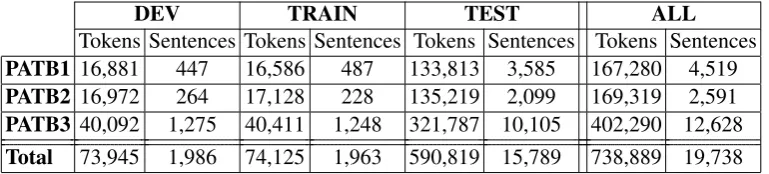
The details of the sizes of the different datasets are shown in Table 1.
3.2 From Constituency to Dependency
Our conversion pipeline starts from PATB, con-verting it to a richer version of the Columbia Ara-bic Treebank which we refer to as CATiB++. We use the Columbia Arabic Conversion Tool v0.7
(Habash and Roth, 2009),4 that converts PATB
trees to the CATiB representation, with the ad-dition of the semantic dashtags and the PATB complete morphological tags (BW) (Buckwalter, 2004). We supplement the trees with additional feature-value pairs representation in the style used in the MADAMIRA morphological analyzer and disambiguator (Pasha et al., 2014).
We chose to convert the treebanks through this methodology to allow for the conversion of the existing CATiB treebank that has no parallel in PATB’s constituency representation. In the future, we envision enriching the CATiB treebank with the morphosyntactic features it lacks, using tech-niques described by Alkuhlani et al. (2013).
3.3 Morphological Transformation
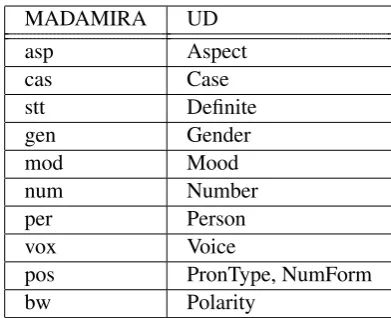
The mapping of the morphological features from CATiB++ to NUDAR includes mapping the NUDAR POS tag, as well as the set of features that appear with each token. The mapping of POS tags is done through a lookup that takes the CATiB POS tag and the gold BW tag of the token stem, and maps them to the equivalent NUDAR POS tag. The lookup map is shown in Table 2. The mapping of the morphological features uses an-other lookup map, that is shown in Table 3.
3.4 Syntactic Transformation
UD and CATiB representations share a number of similarities, both being dependency representa-tions. However there are differences between them that primarily arise from the basic focus on what a dependency is, and affect the structure of the trees. CATiB tries to represent a structure closer to tradi-tional Arabic grammar analysis, which is more
in-terested in modeling the assignment ofcase. This
results in function words tending to head their phrase structures more. In contrast, UD tends to get closer to the meaning, and minimize differ-ences between different languages that have dif-ferent morphosyntactic structures (Nivre, 2016).
The CATiB and NUDAR representations use a different set of labels that refer to very similar concepts, although they use different forms. This results in having a number of similar constructs where we only need to map the labels without modifying the structure.
DEV TRAIN TEST ALL
Tokens Sentences Tokens Sentences Tokens Sentences Tokens Sentences
PATB1 16,881 447 16,586 487 133,813 3,585 167,280 4,519
PATB2 16,972 264 17,128 228 135,219 2,099 169,319 2,591
PATB3 40,092 1,275 40,411 1,248 321,787 10,105 402,290 12,628
[image:4.595.108.493.62.149.2]Total 73,945 1,986 74,125 1,963 590,819 15,789 738,889 19,738
Table 1: The tokens and sentences in the current NUDAR Treebank, based on PATB parts 1, 2, and 3
3.4.1 Verbal Constructs
Verbal constructs representation in CATiB and NUDAR are the same, except for the choice of label. The verb heads the optional subject, zero or more objects, and other modifiers. The label used for the attachment between the subject and
the verb isSBJin CATiB, andnsubjin NUDAR.
Any object is attached to the verb using theOBJ
relation in CATiB. In NUDAR, the first object
takes the labelobj, and any other objects take the
labeliobj. An example of a verbal sentence is
demonstrated in Figure 1.
In the case of passive verbs, the subject of
the passive verb takes the relationnsubj:pass.
CATiB marks passive verbs using the POS tag
VRB-PASS, and uses the relationSBJfor the sub-ject.
CATiB
—————-VRB
I.J»ktb ‘(he-)wrote’
SBJ
NOM
ÈAg.QË@AlrjAl ‘the-men’
OBJ
NOM
H.AJºË@AlktAb ‘the-book’
NUDAR
—————-VERB
I.J»ktb ‘(he-)wrote’
NSUBJ
NOUN
ÈAg.QË@AlrjAl ‘the-men’
OBJ
NOUN
H.AJºË@AlktAb ‘the-book’
H.AJºË@ ÈAg.QË@ I.J»
kataba AlrijAlu AlkitAba
‘the men wrote the book’
Figure 1: Verb-Subject-Object Construct
3.4.2 Adjectival Constructs
A noun followed by an adjectival modifier main-tains the same structure in both CATiB and NUDAR, with the noun heading the adjectival modifier. The label that this relation takes in
NUDAR isamod, as in the example in Figure 2.
3.4.3 Idafa Constructs
TheIdafaconstruct can be used to mark the gen-itive possessor, objects of preposition-like nom-inal adverbs, and some quantification constructs (Habash et al., 2009). Each of these cases is
CATiB
—————-NOM
H.AJ»ktAb ‘book’
MOD
NOM
ÑêÓmhm ‘important’
NUDAR
—————-NOUN
H.AJ»ktAb ‘book’
AMOD
ADJ
ÑêÓmhm ‘important’
ÑêÓ H.AJ»
kitAb˜u muhim∼˜u
[image:4.595.354.477.186.295.2]‘improtant book’
Figure 2: Adjectival Modifier Construct
treated differently. For the case of possessive con-structs, such as in Figure 3, we extend the
ex-isting nmod UD label to the language-specific
nmod:posslabel.
CATiB
—————-NOM
H.AK.bAb ‘door’
IDF
NOM
IJ.Ë@Albyt ‘the-house’
NUDAR
—————-NOUN
H.AK.bAb ‘door’
NMOD:POSS
NOUN
IJ.Ë@Albyt ‘the-house’
IJ.Ë@ H.AK.
bAbu Albayti
[image:4.595.97.266.435.548.2]the door of the house
Figure 3:IdafaConstruct: the genitive possessor
Nominal adverbs (e.g.,
ÐAÓ@
AmAm‘front’,Ê g
xlf ‘behind’) are connected to their parents with
an Idafa relation (IDF) in CATiB. Since these
nominal-adverbs are tagged with the ADV POS
tag in NUDAR, this relation gets directly mapped toadvmod, as demonstracted in Figure 4.
The case of Idafa in quantification constructs
(Figure 6) will be discussed next with the other number constructs.
3.4.4 Number Constructs
Number constructs take different relational labels
in the CATiB representation. A number5heads the
ad-CATiB POS BW’ POS UD POS
NOM *SUFF_DO PRON
NOM ABBREV NOUN
NOM ADJ ADJ
NOM ADJ_COMP ADJ
NOM ADJ_NUM ADJ
NOM ADV ADV
NOM DEM_PRON DET
NOM DIALECT X
NOM FOREIGN X
NOM INTERJ INTJ
NOM INTERROG_ADV ADV
NOM INTERROG_PRON PRON
NOM LATIN X
NOM NOUN ADV ifnom-prep
NOM NOUN NOUN if notnom-prep
NOM NOUN_NUM NUM
NOM NOUN_PROP PROPN
NOM NOUN_QUANT NOUN
NOM POSS_PRON PRON
NOM PRON PRON
NOM REL_ADV ADV
NOM REL_PRON PRON
NOM TYPO X
PROP !! PROPN
PNX NUMERIC_COMMA PUNCT
PNX PUNC PUNCT
PRT CONJ CCONJ
PRT CONNEC_PART PART
PRT DET DET
PRT FOCUS_PART PART
PRT FUT_PART AUX
PRT INTERJ INTJ
PRT INTERROG_PART PART
PRT JUS_PART PART
PRT NEG_PART PART
PRT PART PART
PRT PREP ADP
PRT PSEUDO_VERB CCONJ
PRT RC_PART PART
PRT RESTRIC_PART PART
PRT SUB_CONJ SCONJ
PRT VERB_PART AUX
PRT VOC_PART PART
UNK DIALECT X
UNK LATIN X
UNK TYPO X
VRB !! VERB
VRB-PASS !! VERB
Table 2: Part-of-Speech mapping from CATiB POS and BW POS to NUDAR. BW’ denotes the complete or partial match of the full BW tag set.
Entries marked with!!under BW’ POS means that
the relevant information is taken from the CATiB POS tag only. Entries starting with * under the BW means that there are multiple tags the contain this partial tag, and that they all map to the same
UD POS.nom-prep is a function that determines
if the word falls under the list of nominal adverbs, which are specified words that are tagged as nomi-nals in CATiB and PATB, but behave like adverbs.
MADAMIRA UD
asp Aspect
cas Case
stt Definite
gen Gender
mod Mood
num Number
per Person
vox Voice
pos PronType, NumForm
[image:5.595.317.513.60.219.2]bw Polarity
Table 3: Morphological features mapping from CATiB to NUDAR
CATiB
—————-NOM
ÐAÓ@AmAm ‘front’
IDF
NOM
IJ.Ë@Albyt ‘the-house’
NUDAR
—————-NOUN
IJ.Ë@Albyt ‘the-house’
ADVMOD
ADV
ÐAÓ@AmAm ‘front’
IJ.Ë@ ÐAÓ@
AmAma Albayti
in front of the house
Figure 4: Idafa Construct: the object of a
preposition-like nominal adverb
word it modifies. The relation between the
num-ber and the noun is eitherTamyiz- if the number
is between 11 and 99, as in Figure 5 orIdafa
oth-erwise, as in Figure 6. In NUDAR the noun heads
the number, and the relation is nummodin both
cases.
CATiB
—————-NOM
àñªK.P@Ârbςwn ‘forty’
TMZ
NOM
AJK.baytA ‘house’
NUDAR
—————-NOUN
AJK.baytA ‘house’
NUMMOD
NUM
àñªK.P@Ârbςwn ‘forty’
AJK. àñªK.P@
Ârbaςuwna baytAã
[image:5.595.74.289.64.586.2]forty houses
Figure 5:TamyizConsrtuct: the numeral modifier
of numbers between 11 and 99
The relations between numbers in compound number structures in CATiB are similar to the
[image:5.595.355.480.522.635.2]CATiB
—————-NOM
éÔ gxmsh¯
‘five’ IDF
NOM
HñJK.bywt ‘houses’
NUDAR
—————-NOUN
HñJK.bywt ‘houses’
NUMMOD
NUM
éÔ gxms¯h
‘five’
HñJK. éÔ g
[image:6.595.124.240.57.169.2]xamsa¯hu buyuwt˜ı five houses
Figure 6:IdafaConstruct: the numeral modifier
relations between numbers and the nouns they modify. In this example, as shown in Figure 7,
Ë@
Alf ‘thousand’ would be headed byàñªK.P@
Ârbςwn‘forty’ with theTamyizrelation (TMZ) in
CATiB. However, in NUDAR, the subtree would
be headed byAlf, and Ârbςwn would be attached
to it with acompoundrelation.
CATiB
—————-NOM
àñªK.P@Ârbςwn ‘forty’
TMZ
NOM
Ë@Alf ‘thousand’
IDF
NOM
IK.byt ‘house’ MOD
NOM
QJ.»kbyr ‘big’
NUDAR
—————-NOUN
IK.byt ‘house’
NUMMOD
NUM
Ë@Alf ‘thousand’
COMPOUND
NUM
àñªK.P@Ârbςwn ‘forty’
AMOD
ADJ
QJ.»kbyr ‘big’
QJ.» IK. Ë@ àñªK.P@
Ârbaςwuna Alfa bayt˜ı kabiyr˜ı
forty thousand big houses
Figure 7: Compound Number Construct
3.4.5 Coordination Constructs
In CATiB, the coordinating conjunction heads the sub-tree of the following phrase in a cascading structure. In NUDAR, however, the construct is flat, with all the coordinating conjunctions and conjuncts being headed by the first conjunct of the coordination construct. The coordinating
conjunc-tions take the relationcc, and the conjuncts take
the relationconj. The difference between the two
tree structures in illustrated in Figure 8.
It is also common for the coordinating con-junctions in Arabic to be sentence-initial discourse connectives (
éJ ¯A JJ@ ð@ð
/éJK@YJK.@ ð@ð
) orinterrup-tives (
éJ @Q«@ ð@ð
) (Habash et al., 2009). In thesecases, the coordinating conjunctions are depen-dent on the root predicate of the sentence with the relationcc.
CATiB
—————-NOM
H.AJºË@AlktAb ‘the-book’
MOD
NOM
QÔgB@AlÂHmr ‘the-red’
MOD
PRT +ðw+
‘and’ OBJ
NOM
ÕήË@Alqlm ‘the-pen’
MOD
NOM
XñB@AlÂswd ‘the-black’
NUDAR
—————-NOUN
H.AJºË@AlktAb ‘the-book’
AMOD
ADJ
QÔgB@AlÂHmr ‘the-red’
CC
CCONJ +ðw+ ‘and’
CONJ
NOUN
ÕήË@Alqlm ‘the-pen’
AMOD
ADJ
XñB@AlÂswd ‘the-black’
XñB@ ÕήË@ð QÔgB@ H.AJºË@
AlkitAbu AlÂaHmaru waAlqalamu AlÂaswadu
[image:6.595.319.510.118.316.2]‘the red book and the black pen’
Figure 8: Coordination Construct
3.4.6 Proper Name Constructs
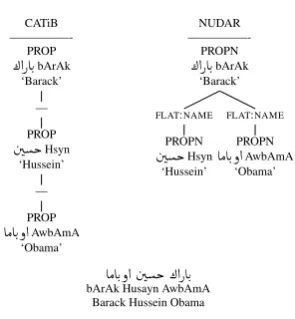
Proper nouns having two or more nominal elements have these elements linked using
the language-specific relation flat:name in
NUDAR. If a proper noun has more than two nom-inal elements, they all are headed by the first el-ement of the proper name, unlike CATiB, where each element is headed by the one that precedes it, as seen in Figure 9.
CATiB
—————-PROP
¼@PAK.bArAk ‘Barack’
— PROP
ákHsyn ‘Hussein’
— PROP
AÓAK.ð@AwbAmA ‘Obama’
NUDAR
—————-PROPN
¼@PAK.bArAk ‘Barack’
FLAT:NAME
PROPN
ákHsyn ‘Hussein’
FLAT:NAME
PROPN
AÓAK.ð@AwbAmA ‘Obama’
AÓAK.ð@ ák ¼@PAK.
bArAk Husayn AwbAmA Barack Hussein Obama
Figure 9: Proper Name Construct
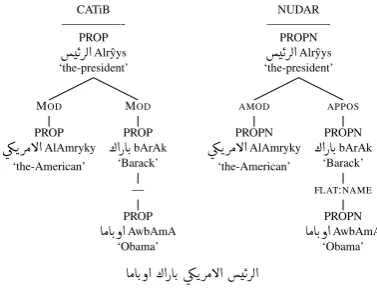
Apposition is marked by the relationapposin
NUDAR, as in Figure 10, opposed to theMOD
[image:6.595.113.251.322.515.2] [image:6.595.342.490.522.682.2]CATiB —————-PROP KQË@Alrˆyys ‘the-president’ MOD PROP ú¾KQÓB@AlAmryky ‘the-American’ MOD PROP ¼@PAK.bArAk ‘Barack’ — PROP AÓAK.ð@AwbAmA ‘Obama’ NUDAR —————-PROPN KQË@Alrˆyys ‘the-president’ AMOD PROPN ú¾KQÓB@AlAmryky ‘the-American’ APPOS PROPN ¼@PAK.bArAk ‘Barack’
FLAT:NAME
PROPN
AÓAK.ð@AwbAmA ‘Obama’
AÓAK.ð@ ¼@PAK. ú¾KQÓB@ KQË@
[image:7.595.85.274.61.205.2]Alraˆyiysu AlÂamriykiyu bArAk AwbAmA The American President, Barack Obama
Figure 10: Apposition Construct
3.4.7 Preposition Constructs
Prepositions in NUDAR are case-marking ele-ments that are dependent on the element they in-troduce. They attach low, unlike the CATiB
struc-ture. The label this relation takes iscase, as can
be seen in Figure 11.
CATiB —————-VRB I.J»ktb ‘(he-)wrote’ SBJ NOM Ég.QË@Alrjl ‘the-man’ OBJ NOM AK.AJ»ktAbA ‘a-book’ MOD PRT
ú ¯fy ‘in’
OBJ
PROP
á¢Ê ¯flsTyn ‘Palestine’ NUDAR —————-VERB I.J»ktb ‘(he-)wrote’ NSUBJ NOUN Ég.QË@Alrjl ‘the-man’ OBJ NOUN AK.AJ»ktAbA ‘a-book’ NMOD PROPN
á¢Ê ¯flsTyn ‘Palestine’
CASE
ADP
ú ¯fy ‘in’
á¢Ê ¯ ú ¯ AK.AJ» Ég.QË@ I.J»
kataba Alrajulu kitAbAã fiy filasTiyna
‘the man wrote a book in Palestine’
Figure 11: Prepositional Construct
3.4.8 Copular Constructs
The basic copular construct in Arabic does not in-clude copular verbs. It has the same tree structure in both CATiB and NUDAR. The predicate heads the relation, and the subject attaches to it with the
label SBJ in CATiB and nsubj in NUDAR, as
seen in Figure 12.
Some so-called incomplete verbs in Arabic,
such as
àA¿
kAn ‘to be’, and verb-like particles,such as
à@
ˇAn ‘indeed/verily’ act like the copulaverbbein English. Since copula verbs cannot be
the heads of clauses, they attach to their
[image:7.595.339.494.205.316.2]predi-cates with the relation cop, like the example in
Figure 13. CATiB —————-NOM ÑêÓmhm ‘important’ SBJ NOM H.AJºË@AlktAb ‘the-book’ NUDAR —————-ADJ ÑêÓmhm ‘important’ NSUBJ NOUN H.AJºË@AlktAb ‘the-book’ AÒêÓ H.AJºË@
AlkitAbu muhim∼˜u
‘the-book (is) improtant’
Figure 12: Basic Copular Construct
CATiB —————-VRB àA¿kAn ‘(it-)was’ SBJ NOM H.AJºË@AlktAb ‘the-book’ PRD NOM AÒêÓmhmA ‘important’ NUDAR —————-ADJ AÒêÓmhmA ‘important’ NSUBJ NOUN H.AJºË@AlktAb ‘the-book’ COP VERB àA¿kAn ‘(it-)was’
AÒêÓ H.AJºË@ àA¿
kAna AlkitAbu muhim∼Aã
[image:7.595.80.283.359.516.2]‘the-book was improtant’
Figure 13: Copular Construct with Copular Verb
3.4.9 Subordinating Conjunction Constructs
Subordinating conjunctions introduce a finite clause that is subordinate to another clause. As with copula, they cannot head a clause. The sub-ordinating clause’s predicate becomes the parent of the subordinating conjunction, as shown in Fig-ure 14.
CATiB
—————-VRB
IªÖÞ smςt ‘I-heard’ OBJ PRT à@Ân ‘that’ SBJ NOM
¼+ +k ‘you’
PRD
VRB
HQ ¯AsAfrt ‘you-traveled
NUDAR
—————-VERB
IªÖÞ smςt ‘I-heard’
CCOMP
VERB
HQ ¯AsAfrt ‘you-traveled
NSUBJ
PRON
¼+ +k ‘you’
MARK
SCONJ
à@Ân ‘that’
HQ ¯A ½ K@ IªÖÞ
samiςtu Âan∼aka sAfarta
[image:7.595.353.482.472.623.2]‘I heard that you traveled’
Figure 14: Subordinating Conjunction Construct
3.4.10 Clausal Complement Constructs
Clauses that are a core argument of a verb are
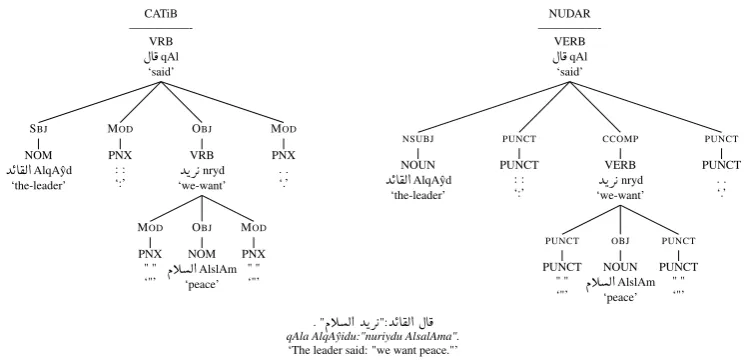
at-tached to that verb with a ccomp or an xcomp
relation. Theccomprelation is used for clauses
that have their own subject, while xcomp refers
subject of the verb that heads them. An example
of a clause attaching with accomprelation is in
Figure 15.
3.5 Validation
During our conversion process, we selected a ran-dom subset of 17 sentences, containing 608
to-kens, from the TRAIN set. We manually created
a gold reference for this set, and we used it to fine tune our convertor. After we froze the con-version, we converted a randomly selected sub-set of 82 sentences, containing 2,685 tokens, from
the TESTset, that we automatically converted into
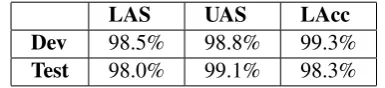
[image:8.595.84.277.359.403.2]NUDAR, and manually checked and fixed to cre-ate a gold test set. This gold subset was used to test the performance of the final version of the conver-tor. The scores that we got in both subsets against the gold were very high. We show the Labeled and Unlabeled Attachment Scores (LAS and UAS re-spectively) and Label Accuracy Score (LAcc) in Table 4.
LAS UAS LAcc
Dev 98.5% 98.8% 99.3%
Test 98.0% 99.1% 98.3%
Table 4: Conversion scores against manually cre-ated gold trees
An error analysis shows that the majority of the errors originated from the gold annotations of the PATB treebank. These errors are caused by ei-ther having the wrong dashtag, or attachment in the PATB trees (Habash et al., 2007a). A small number of errors were caused either by bugs in the conversion rules, or by missing rules.
3.6 Comparing PAUDT and NUDAR
A direct comparison between PAUDT and NUDAR proved hard to perform. Even though both treebanks follow the UD guidelines in gen-eral, there were many differences originating from the data sources, as well as from the interpretation of the guidelines. The data in PAUDT comes from portions of PATB parts 1 and 2, and from Ara-bic Gigaword. The data in the current NUDAR treebank comes from PATB parts 1, 2, and 3. In total, NUDAR contains 1,834 documents, and PAUDT contains 874 documents. The two tree-banks overlap in 207 documents (based on doc-ument IDs). Within these shared docdoc-uments, we find a number of differences such as PAUDT’s
inclusion of article titles and full stop sentence segmentation, compared with missing article titles and occasional trees covering multiple sentences in NUDAR. Even among sentences that are sim-ilarly segmented, we find many tokenization dif-ferences: dates and times are tokenized differently
(e.g., 11-5 vs 11 - 5), as well as specific Arabic
words that are treated differently (e.g.,
AÒJ ¯
fymaor
AÓ ú ¯
fy mA‘in that’). Out of the shared 207 documents, only 335 sentences had the same tok-enization, and these had additional differences in POS choice as well as tree structures and labels. We plan a more detailed comparison in the future to help consolidate the two treebanks.4 Parsing Experiment
We conducted some experiments to benchmark the parsing scores in the NUDAR treebank. We also compare the result of parsing directly in NUDAR space to parsing in CATiB space then converting to NUDAR representation.
For our parsing experiments, we used the Malt-Parser (Nivre et al., 2006) to train an Arabic de-pendency parser in the space of both CATiB and NUDAR. We compared the output of the NUDAR parser, to the results of converting the output of the CATiB parser to NUDAR using the system de-scribed in Section 3.
For the CATiB parser, we used the optimized settings described by Shahrour et al. (2016), and were able to achieve comparable results. We used the gold CATiBex POS tags (Marton et al., 2013), and gold morphological features derived from gold BW tags, to train the parser on the
TRAIN dataset of PATB parts 1, 2, and 3. We
tested on the TEST dataset of the same treebank
parts. The output of the parser was then converted to NUDAR representation.
For the NUDAR parser, we ran the MaltOpti-mizer (Ballesteros and Nivre, 2012) on the full
TRAINdataset of NUDAR. We used the optimized
settings to train and run our parser.
CATiB
—————-VRB
ÈA¯qAl ‘said’
SBJ
NOM
YKA®Ë@AlqAˆyd ‘the-leader’
MOD
PNX : : ‘:’
OBJ
VRB
YKQ Knryd ‘we-want’
MOD
PNX " " ‘"’
OBJ
NOM
ÐCË@AlslAm ‘peace’
MOD
PNX " " ‘"’
MOD
PNX . . ‘.’
NUDAR
—————-VERB
ÈA¯qAl ‘said’
NSUBJ
NOUN
YKA®Ë@AlqAˆyd ‘the-leader’
PUNCT
PUNCT : : ‘:’
CCOMP
VERB
YKQ Knryd ‘we-want’
PUNCT
PUNCT " " ‘"’
OBJ
NOUN
ÐCË@AlslAm ‘peace’
PUNCT
PUNCT " " ‘"’
PUNCT
PUNCT . . ‘.’
. "ÐCË@ YKQ K":YKA®Ë@ ÈA¯
qAla AlqAˆyidu:"nuriydu AlsalAma".
[image:9.595.112.486.59.239.2]‘The leader said: "we want peace."’
Figure 15: Clausal Complement Construct
Our results show that training a parser in NUDAR space produces better results than train-ing a parser in CATiB space and converttrain-ing the output to NUDAR representation. This can be at-tributed to the fact that the output of the CATiB parser does not produce the dashtags that are present in CATiB++, which help in the conversion process.
We also observe that the scores of the NUDAR parser are slightly lower than the scores of the CATiB parser. Although it is not possible to di-rectly compare both parsers because of the differ-ent structures, we hypothesize that the larger label set in NUDAR (more than 40 labels compared to the eight labels of CATiB), and factors related to the structures, such as the longer distance between words and their parents in NUDAR (4.4 on aver-age compared to 3.5 in CATiB) may be harder for a parser. We offer these insights as possible explana-tions, with the assumption that measuring and con-firming these hypotheses need more research. It is also possible that further optimization will help in-crease the scores achieved by the NUDAR parser.
System REF LAS UAS LAcc
NUDAR-Parser NUDAR-GOLD 81.9% 83.7% 93.8%
CATiB-Parser CATiB-Gold 83.1% 85.0% 94.3%
CATiB-Parser+converted NUDAR-GOLD 75.3% 80.0% 88.3%
Table 5: Scores for the NUDAR and CATiB pars-ing and conversion experiments
5 Conclusion and Future Work
In this paper, we presented a fully automated con-verter from PATB to the UD syntactic representa-tion. The conversion includes converting the POS
tags and other morphological features, as well as the dependency relations and tree structures to UD, through a pipeline of conversion rules. The work was validated through a manually checked test set. We also present the results of an initial parsing experiment. This treebank will be made available as part of the UD v2.0 release as “UD Arabic-NYUAD”.
In the future, we plan to improve the conversion process, and to convert the remaining available PATB parts, in both MSA and dialectal Arabic into the UD syntactic representation. We also plan on converting other Arabic dependency treebanks, such as the CATiB treebank, and the Quranic tree-bank (Dukes and Habash, 2010) into UD. This will require enriching these treebanks with addi-tional morphosyntactic features, as per the tech-niques described by Alkuhlani et al. (2013). More experiments on optimizing the parsing process are planned, to make use of the available features to improve the parsing results. Finally, we plan on exploiting the NUDAR treebanks and parsers for use in other areas of NLP such as machine trans-lation.
Acknowledgments
The work done by the third author was supported by the grant 15-10472S of the Czech Science Foundation.
References
In The 5th Workshop on Balto-Slavic Natural Lan-guage Processing (BSNLP 2015).
Sarah Alkuhlani, Nizar Habash, and Ryan Roth. 2013. Automatic morphological enrichment of a morpho-logically underspecified treebank. InHLT-NAACL, pages 460–470.
Héctor Martínez Alonso and Daniel Zeman. 2016. Universal dependencies for the ancora treebanks. Procesamiento del Lenguaje Natural, 57:91–98. Miguel Ballesteros and Joakim Nivre. 2012.
Mal-toptimizer: an optimization tool for maltparser. In Proceedings of the Demonstrations at the 13th Con-ference of the European Chapter of the Association for Computational Linguistics, pages 58–62. Asso-ciation for Computational Linguistics.
Daša Berovi´c, Željko Agi´c, and Marko Tadi´c. 2012. Croatian dependency treebank: Recent development and initial experiments. In Seventh International Conference on Language Resources and Evaluation (LREC 2012).
Tim Buckwalter. 2002. Buckwalter Arabic Mor-phological Analyzer Version 1.0. Linguistic Data Consortium, University of Pennsylvania, 2002. LDC Catalog No.: LDC2002L49.
Tim Buckwalter. 2004. Buckwalter Arabic Morpho-logical Analyzer Version 2.0. LDC catalog number LDC2004L02, ISBN 1-58563-324-0.
Marie-Catherine De Marneffe and Christopher D. Manning. 2008. The stanford typed dependen-cies representation. InColing 2008: proceedings of the workshop on cross-framework and cross-domain parser evaluation, pages 1–8. Association for Com-putational Linguistics.
Marie-Catherine De Marneffe, Bill MacCartney, Christopher D. Manning, et al. 2006. Generat-ing typed dependency parses from phrase structure parses. InProceedings of LREC, volume 6, pages 449–454. Genoa.
Marie-Catherine De Marneffe, Timothy Dozat, Na-talia Silveira, Katri Haverinen, Filip Ginter, Joakim Nivre, and Christopher D. Manning. 2014. Univer-sal stanford dependencies: A cross-linguistic typol-ogy. InLREC, volume 14, pages 4585–92.
Mona Diab, Nizar Habash, Owen Rambow, and Ryan Roth. 2013. LDC Arabic treebanks and associ-ated corpora: Data divisions manual. arXiv preprint arXiv:1309.5652.
Kais Dukes and Nizar Habash. 2010. Morphological Annotation of Quranic Arabic. In Proceedings of the Language Resources and Evaluation Conference (LREC), Malta.
Sašo Džeroski, Tomaž Erjavec, Nina Ledinek, Petr Pa-jas, Zdenek Žabokrtsky, and Andreja Žele. 2006. Towards a slovene dependency treebank. InProc. of the Fifth Intern. Conf. on Language Resources and Evaluation (LREC).
David Graff, Ke Chen, Junbo Kong, and Kazuaki Maeda. 2006. Arabic Gigaword. Linguistic Data Consortium, Philadelphia, second edition.
Nizar Habash and Ryan M. Roth. 2009. CATiB: The Columbia Arabic Treebank. InProceedings of the ACL-IJCNLP 2009 Conference Short Papers, pages 221–224. Association for Computational Linguis-tics.
Nizar Habash, Ryan Gabbard, Owen Rambow, Seth Kulick, and Mitchell P. Marcus. 2007a. Deter-mining case in Arabic: Learning complex linguis-tic behavior requires complex linguislinguis-tic features. In EMNLP-CoNLL, pages 1084–1092.
Nizar Habash, Abdelhadi Soudi, and Tim Buckwalter. 2007b. On Arabic Transliteration. In A. van den Bosch and A. Soudi, editors, Arabic Computa-tional Morphology: Knowledge-based and Empiri-cal Methods. Springer.
Nizar Habash, Reem Faraj, and Ryan Roth. 2009. Syn-tactic Annotation in the Columbia Arabic Treebank. InProceedings of MEDAR International Conference on Arabic Language Resources and Tools, Cairo, Egypt.
Nizar Habash. 2010. Introduction to Arabic natural language processing, volume 3. Morgan & Clay-pool Publishers.
Jan Hajiˇc, Eva Hajiˇcová, Petr Pajas, Jarmila Panevová, Petr Sgall, and Barbora Vidová-Hladká. 2001. Prague Dependency Treebank 1.0. LDC catalog number LDC2001T10, ISBN 1-58563-212-0. Jan Hajiˇc, Otakar Smrž, Petr Zemánek, Petr Pajas,
Jan Šnaidauf, Emanuel Beška, Jakub Kráˇcmar, and Kamila Hassanová. 2004. Prague Arabic depen-dency treebank 1.0. LDC2004T23. web download. Anders Johannsen, Héctor Martínez Alonso, and
Bar-bara Plank. 2015. Universal dependencies for dan-ish. In International Workshop on Treebanks and Linguisic Theories (TLT14), page 157.
Mohamed Maamouri, Ann Bies, Tim Buckwalter, and Wigdan Mekki. 2004. The Penn Arabic Treebank: Building a Large-Scale Annotated Arabic Corpus. In NEMLAR Conference on Arabic Language Re-sources and Tools, pages 102–109, Cairo, Egypt. Mohamed Maamouri, Ann Bies, Sondos Krouna,
Fatma Gaddeche, and Basma Bouziri, 2009. Penn Arabic Treebank Guidelines. Linguistic Data Con-sortium.
Mohamed Maamouri, Ann Bies, Seth Kulick, Fatma Gaddeche, Wigdan Mekki, Sondos Krouna, Basma Bouziri, and Wadji Zaghouani. 2010a. Arabic tree-bank: Part 1 v 4.1 ldc2010t13.
Mohamed Maamouri, Ann Bies, Seth Kulick, Sondos Krouna, Fatma Gaddeche, and Wadji Zaghouani. 2010b. Arabic treebank: Part 3 v 3.2 ldc2010t08. Mohamed Maamouri, Ann Bies, Seth Kulick, Fatma
Gaddeche, Wigdan Mekki, Sondos Krouna, Basma Bouziri, and Wadji Zaghouani. 2011. Arabic tree-bank: Part 2 v 3.1 ldc2011t09.
Mitchell P. Marcus, Beatrice Santorini, and Mary Ann Marcinkiewicz. 1993. Building a large annotated corpus of English: The Penn treebank. Computa-tional Linguistics, 19(2):313–330, June.
Yuval Marton, Nizar Habash, and Owen Rambow. 2013. Dependency parsing of modern standard Ara-bic with lexical and inflectional features. Computa-tional Linguistics, 39(1):161–194.
Ryan T. McDonald, Joakim Nivre, Yvonne Quirmbach-Brundage, Yoav Goldberg, Dipan-jan Das, Kuzman Ganchev, Keith B Hall, Slav Petrov, Hao Zhang, Oscar Täckström, et al. 2013. Universal dependency annotation for multilingual parsing. InACL (2), pages 92–97.
Kadri Muischnek, Kaili Müürisep, Tiina Puolakainen, Eleri Aedmaa, Riin Kirt, and Dage Särg. 2014. Estonian dependency treebank and its annotation scheme. InProceedings of 13th Workshop on Tree-banks and Linguistic Theories (TLT13), pages 285– 291.
Jens Nilsson, Sebastian Riedel, and Deniz Yuret. 2007. The conll 2007 shared task on dependency parsing. InProceedings of the CoNLL shared task session of EMNLP-CoNLL, pages 915–932. sn.
Joakim Nivre, Johan Hall, and Jens Nilsson. 2006. MaltParser: A data-driven parser-generator for de-pendency parsing. InIn Proc. of LREC-2006, pages 2216–2219.
Joakim Nivre, Marie-Catherine de Marneffe, Filip Gin-ter, Yoav Goldberg, Jan Hajic, Christopher D. Man-ning, Ryan McDonald, Slav Petrov, Sampo Pyysalo, Natalia Silveira, Reut Tsarfaty, and Daniel Zeman. 2016. Universal dependencies v1: A multilingual treebank collection. In Nicoletta Calzolari (Con-ference Chair), Khalid Choukri, Thierry Declerck, Sara Goggi, Marko Grobelnik, Bente Maegaard, Joseph Mariani, Helene Mazo, Asuncion Moreno, Jan Odijk, and Stelios Piperidis, editors, Proceed-ings of the Tenth International Conference on Lan-guage Resources and Evaluation (LREC 2016), Paris, France, may. European Language Resources Association (ELRA).
Joakim Nivre. 2014. Universal dependencies for Swedish. InProceedings of the Swedish Language Technology Conference (SLTC).
Joakim Nivre. 2016. Universal dependencies: Du-bious linguistics and crappy parsing? COLING Keynote Talk.
Petya Osenova and Kiril Simov. 2015. Universaliz-ing bultreebank: a lUniversaliz-inguistic tale about glocalization. BSNLP 2015, page 81.
Lilja Øvrelid and Petter Hohle. 2016. Universal de-pendencies for norwegian.
Arfath Pasha, Mohamed Al-Badrashiny, Mona Diab, Ahmed El Kholy, Ramy Eskander, Nizar Habash, Manoj Pooleery, Owen Rambow, and Ryan M. Roth. 2014. MADAMIRA: A Fast, Comprehensive Tool for Morphological Analysis and Disambiguation of Arabic. InProceedings of the Language Resources
and Evaluation Conference (LREC), Reykjavik, Ice-land.
Slav Petrov, Dipanjan Das, and Ryan McDonald. 2011. A universal part-of-speech tagset. arXiv preprint arXiv:1104.2086.
Sampo Pyysalo, Jenna Kanerva, Anna Missilä, Veronika Laippala, and Filip Ginter. 2015. Univer-sal dependencies for finnish. InProceedings of the 20th Nordic Conference of Computational Linguis-tics, NODALIDA 2015, May 11-13, 2015, Vilnius, Lithuania, number 109, pages 163–172. Linköping University Electronic Press.
Rudolf Rosa, Jan Mašek, David Mareˇcek, Martin Popel, Daniel Zeman, and Zdenˇek Žabokrtský. 2014. HamleDT 2.0: Thirty dependency tree-banks stanfordized. In Nicoletta Calzolari, Khalid Choukri, Thierry Declerck, Hrafn Loftsson, Bente Maegaard, and Joseph Mariani, editors, Proceed-ings of the 9th International Conference on Lan-guage Resources and Evaluation (LREC 2014), pages 2334–2341, Reykjavík, Iceland. European Language Resources Association.
Mojgan Seraji, Filip Ginter, and Joakim Nivre. 2016. Universal dependencies for persian.
Anas Shahrour, Salam Khalifa, Dima Taji, and Nizar Habash. 2016. Camelparser: A system for arabic syntactic analysis and morphological disambigua-tion.
Otakar Smrž, Jan Šnaidauf, and Petr Zemánek. 2002. Prague Dependency Treebank for Arabic: Multi-Level Annotation of Arabic Corpus. In Proceed-ings of the International Symposium on Processing of Arabic, pages 147–155, Manouba, Tunisia. Otakar Smrž, Viktor Bielický, Iveta Kouˇrilová, Jakub
Kráˇcmar, Jan Hajiˇc, and Petr Zemánek. 2008. Prague Arabic dependency treebank: A word on the million words. InProceedings of the Workshop on Arabic and Local Languages (LREC 2008), pages 16–23, Marrakech, Morocco. European Language Resources Association.
Naiwen Xue, Fei Xia, Fu-Dong Chiou, and Marta Palmer. 2005. The penn chinese treebank: Phrase structure annotation of a large corpus. Natural lan-guage engineering, 11(02):207–238.