Annotating Negation in Spanish Clinical Texts
Noa P. Cruz D´ıaz1, Roser Morante Vallejo2, Manuel J. Ma˜na L´opez3, Jacinto Mata V´azquez3 and Carlos L. Parra Calder´on1
1IBiS/Virgen del Roc´ıo University Hospital/CSIC/University of Seville 2CLTL Lab, VU Amsterdam
3Departamento de Tecnolog´ıas de la Informaci´on, University of Huelva
{noapatricia.cruz.exts,carlos.parra.sspa}@juntadeandalucia.es {r.morantevallejo}@vu.nl
{manuel.mana,jacinto.mata}@dti.uhu.es
Abstract
In this paper we present on-going work on annotating negation in Spanish clinical documents. A corpus of anamnesis and radiology reports has been annotated by two domain expert annotators with nega-tion markers and negated events. The Dice coefficient for inter-annotator agreement is higher than 0.94 for negation markers and higher than 0.72 for negated events. The corpus will be publicly released when the annotation process is finished, constituting the first corpus annotated with negation for Spanish clinical reports available for the NLP community.
1 Introduction
In this paper we present the UHU-HUVR corpus of Spanish clinical reports annotated with nega-tion informanega-tion. Neganega-tion processing (Morante and Blanco, 2012) is an emergent task in Nat-ural Language Processing (NLP). Initially, nega-tion processing systems were developed to detect negation in clinical texts in order to extract ac-curate information about the patients. The sys-tems were rule-based (Chapman et al., 2001) be-cause of the lack of annotated corpora to train ma-chine learning systems. Currently, annotated cor-pora are still scarce due to the legal and ethical requirements that have to be fulfilled. In addition, most of the corpora only contain documents writ-ten in English. An example is the BioScope cor-pus (Szarvas et al., 2008) which contains 1,954 ra-diology reports from the Computational Medicine Center in Cincinnati, annotated for negations and uncertainty along with the scopes of each phe-nomenon.
For Spanish clinical reports, to the best of our knowledge, there are only a few attempts to
anno-tate negation, mostly as a secondary task within broader projects, and none of the annotated re-sources are publicly available. For example, Cos-tumero et al. (2014) adapted the NegEx algorithm (Chapman et al., 2001) to detect negated clini-cal conditions in Spanish written mediclini-cal docu-ments. Although the authors mention that 500 medical texts have been manually annotated, they do not provide more information about this gold-standard. Oronoz et al. (2015), annotated negated adverse drug reactions, but they did not annotate the words expressing negation. The negation was annotated as a modifier of the disorder or drug. Stricker et al. (2015) used a dataset composed of about 85,600 reports of ultrasonography studies performed in a Spanish public hospital. Clinical findings were annotated in a subset of the reports as being affirmed (if it was possible to infer that the finding was present in the patient) or negated (if the finding was absent). The annotations were recently expanded by Cotik et al. (2016), includ-ing the valuesprobable(if it was not certain that the finding was present, but it was probable) and
doubt (if the finding corresponded to the past or if it was not clear for the annotator if the finding was present or not). None of the studies provides information about the availability of the corpora.
Being aware of the limitations of the current ap-proaches and the necessity of filling this gap, we present the first version of the UHU-HUVR Cor-pus, a set of clinical documents annotated with negation markers and their linguistic scope. The annotated corpus and its guidelines will be made publicly available. The paper is structured as fol-lows: Section 2 describes the annotation process and provides information about the corpus. Sec-tion 3 presents the results of the agreement analy-sis and discusses difficult or interesting cases. Fi-nally, conclusions and future work are presented in Section 4.
2 Annotating Negation in Spanish Clinical Reports
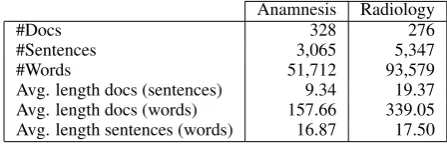
The corpus that we present consists of 604 clini-cal reports from the Virgen del Roc´ıo Hospital in Seville (Spain). Specifically, the set of documents consists of diagnosis information of 276 radiology reports and the personal history of 328 anamnesis reports written in free text, as shown in Table 1. The reports were randomly collected among re-ports from the first semester of 2013, and were fully anonymized in order to satisfy legal and eth-ical issues. The radiology documents are longer than the anamnesis documents (339.05 and 157.66 average words per document respectively), but the average words per sentence is similar (17.50 ver-sus 16.87).
Anamnesis Radiology
#Docs 328 276
#Sentences 3,065 5,347
#Words 51,712 93,579
[image:2.595.70.294.302.374.2]Avg. length docs (sentences) 9.34 19.37 Avg. length docs (words) 157.66 339.05 Avg. length sentences (words) 16.87 17.50
Table 1: Statistics about the UHU-HUVR corpus.
The entire corpus was annotated by two domain experts who followed the guidelines that we de-veloped. The annotation process started with two pilot experiments. In the first one, the authors an-notated 7 reports in order to gain insight to pro-duce the first version of the guidelines, which was written by one of the authors, who is a linguistics expert. In the second one 100 anamnesis docu-ments were annotated by the two annotators in or-der to train them, and test and improve the guide-lines. These documents are not included in the fi-nal corpus. During all the annotation process, the annotators were not allowed to communicate with each other. The problematic cases that they en-countered were discussed with the expert linguist and author of the guidelines. As work in progress, another author who is expert annotator is currently solving the disagreement cases, acting as adjudi-cator, in order to generate the gold-standard cor-pus. The annotation tool used was CAT (Lenzi et al., 2012). Two markables were defined (negation marker and negated event) plus a negation relation between the marker and the event.
The annotation task consisted on annotating the events that are affected by contextual negation, as well as the words that express negation. We will
refer to these words as markers. In the exam-ples that follow, negated events are marked within brackets and negation markers in bold. In exam-ple 1, the wordnois the negation marker and al-teraciones en el luminograma a´ereo de tr´aquea
is the event affected by this negation. Examples of events with negative polarity are the following ones:1
1. Novisualizamos [alteraciones en el lumino-grama a´ereo de tr´aquea]. (En. We did not visualize alterations in the aerial luminogram of trachea.)
2. No [aumentos ganglionares hilio medi-ast´ınicos]ni[hallazgos de inter´es a lo largo del es´ofago]. (En. No mediastinal hilum nodal enlargement nor findings of interest along the esophagus.)
3. Sin [lesiones ´oseas focales que sugieran met´astasis en este barrido]. (En. No focal bone lesions suggestive of metastasis in this scan.)
4. Desde hace 20 a˜nos abandono radical del [h´abito tab´aquico]. (En. During the last 20 years radical stopping of smoking habit.) The annotation guidelines follow closely the Thyme corpus guidelines (Styler IV et al., 2014) with some adaptations. We defined as clinical event any event that is relevant to elaborate the clinical chronology of a patient such as a diagno-sis, tumors, habits, medical tests, or events related to the functional evaluation of the patient. Events that do not contribute clinical information are not annotated. The difficulty of annotating events lies not just in identifying what is an event, but in determining which is the chain of words that ex-press the event. We decided to annotate all the words that express the event, excluding punctu-ation marks. In Example (1) the full NP is an-notated as event: alteraciones en el luminograma a´ereo de tr´aquea. For negation markers, the mini-mum number of words is annotated.
We do not always annotate the mentions of neg-ative results of a test as negation markers because the fact that a test is negative does not necessar-ily imply that a clinical event is not happening. In Example (5) no negation is annotated because, al-though the results of the Z-N stain are negative,
1We provide between parentheses English translations for
the test has taken place. However, when the name of the test is the same as the name of the clini-cal condition, such as a disease, then the negative results are annotated as negation because the neg-ative result indicates that the patient does not have the disease (see Example (6)).
5. T´ecnicas de Z-N (normal y largo) negativo. (En. Negative Z-N stain (normal and long).) 6. Serolog´ıa materna: [Toxoplasma]:
Nega-tivo. [VHB]: Negativo. [Rubeola]: Nega-tivo. [Lues]: Negativo. (En. Maternal serol-ogy: Toxoplasma: Negative. VHB: Negative. Rubella: Negative. Lues: negative.)
In addition, negative results are sometimes ex-pressed with the “-” sign, which was annotated as negation marker in the same cases as indicated above.
As for affixal negation, we take a pragmatic ap-proach and annotate the full word where the af-fix occurs as a negation marker and as a negated event, when an event is negated. It is the case of
afebril(En. without fever), wherea-is the nega-tion marker. Due to limitanega-tions of the tools we could not split the affixes in order to mark them independently.
Finally, some coordination structures involve negation markers. In this cases, each negation marker in the structure has its own scope, as shown in Example (7), where the first coordina-tion marker no scopes over alteraciones a nivel de los distintos ligamentos y estructuras m´usculo-tendinosas and Example (8), where the second coordination marker as´ı como scopes over al-teraciones ... de las restantes partes blandas. In clinical reports, some expressions like as´ı como, which are usually not negation markers, are used as such, and thus, we decided to mark them as negation markers, even if what brings negation to the event is the coordination structure and not only the second coordinating element. We have also marked ”/” as negation marker when it acts as a coordinating particle, as in Examples (9) and (10).
7. No hemos observado [alteraciones a nivel de los distintos ligamentos y estructuras m´usculo-tendinosas], as´ı como de las restantes partes blandas. (En. We have not observed alterations at the level of the different ligaments and musculo-tendinous structures, as well as of the other soft parts.)
8. No hemos observado [alteraciones] a nivel de los distintos ligamentos y estructuras m´usculo-tendinosas, as´ı como [de las restantes partes blandas]. (En. We have not observed alterations at the level of the differ-ent ligamdiffer-ents and muscle-tendon structures, as well as of the other soft parts.)
9. Actualmente no hay evidencia de [n´odulos pulmonares] / adenomegalias mediast´ınicas. (En. No evidence of pulmonary nodules / me-diastinal adenomegalies)
10. Actualmente no hay evidencia de n´odulos pulmonares/[adenomegalias mediast´ınicas].
2.1 Negation in Spanish Clinical Texts
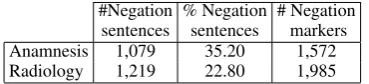
The annotations show that negation is a frequent phenomenon in Spanish clinical texts. As it is shown in Table 2, more than 22% of the sen-tences in radiology reports contain negation mark-ers, whereas in anamnesis reports this percentage is even higher, 35.20%. This fact is related to the nature of the two types of documents. Whereas a radiology report reflects the radiologists obser-vations, the anamnesis report describes the history of the patient, including clinical conditions that the patient has not gone through.
In Spanish clinical domain, (Oronoz et al., 2015) reported that 27.58% of diseases pre-sented in a corpus of electronic health records are negated. Although this percentage is not directly comparable with the percentage of negated sen-tences shown in Table 2, the numbers seem sim-ilar. The frequency of negation in Spanish for the reviews domain is sensibly higher. Mart´ı et al. (2016) analysed the 75% of SFU Review SP-NEG corpus and claimed that 46.64% of sentences contain at least one negation. However, unpub-lished analysis about the entire SFU Review SP-NEG corpus shown that the amount of sentences that contain at least one negation in this corpus is the 31.90%, which represents a similar value to negation frequency in anamnesis reports.
[image:3.595.325.510.682.724.2]#Negation % Negation # Negation sentences sentences markers Anamnesis 1,079 35.20 1,572 Radiology 1,219 22.80 1,985
Negation markers in the UHU-HUVR corpus amounted to 69 in the anamnesis subcollection and 52 in the radiology subcollection, with the top 10 most frequent markers shown in Tables 3 and 4. It is interesting to note that, in Spanish, the first two markers, no(’no’) and sin (’without’), constitute more than 70% of the total frequency of all the markers found in the corpus, while the remaining markers cover only about 30%. 28 of the mark-ers are common for radiology and anamnesis re-ports. It is also interesting to see that signs as “/” or “-” are considered to be negation markers. A specific negation marker of the radiology reports isnamcwhich stands forno alergias medicamen-tosas conocidas(En. no known drug allergies).
Marker Frequency % Acc. %
no 936 59.54 59.54
sin 197 12.53 72.07
ni 143 9.10 81.17
niega 66 4.20 85.37
namc 31 1.97 87.34
negativo 26 1.65 88.99
nunca 20 1.27 90.26
o 19 1.21 91.47
- 14 0.89 92.36
[image:4.595.312.522.140.183.2]independiente 11 0.70 93.06
Table 3: The most frequent negation markers in the anamnesis subcollection of the UHU-HUVR corpus.
Marker Frequency % Acc. %
sin 877 44.18 44.18
no 662 33.35 77.53
ni 258 13.00 90.53
as´ı como 28 1.41 91.94
ausencia 27 1.36 93.30
o 27 1.36 94.66
tampoco 14 0.71 95.37
desaparecido 7 0.35 95.72
/ 6 0.30 96.02
asimetr´ıa 6 0.30 96.32
[image:4.595.87.276.275.387.2]inespec´ıficas 6 0.30 96.62 inespec´ıfico 6 0.30 96.92
Table 4: The most frequent negation markers in the radiology subcollection of the UHU-HUVR corpus.
3 Preliminary results
Table 5 illustrates the results obtained for Inter-Annotator Agreement (IAA) between the two annotators in terms of Dice’s coefficient mea-sure (Dice, 1945) as calculated by the CAT anno-tation tool. We are currently working on the ad-judication process. The IAA for markers is high
and almost equal in radiology (0.949) and anam-nesis (0.947) reports, whereas the IAA for events is lower than for markers. The IAA for events in radiology reports is lower (0.729) than for anam-nesis reports (0.840).
Marker Level Token Level Markers Events Markers Events Anamnesis 0.947 0.840 0.947 0.896
Radiology 0.949 0.729 0.949 0.860
Table 5: Preliminary Inter-Annotator Agreement in terms of Dice’s coefficient.
The lower scores for radiology reports can be explained by the fact that the average length for events in anamnesis reports is lower (2,10 words) than in radiology reports (2,81 words), and thus there are more tokens that can be differently anno-tated for the same event. Additionally, it is also the case that interpreting the information in the radiol-ogy reports requires more specialised knowledge than interpreting the information in the anamnesis reports. In the latter, the events are better delimited and there are certain frequent negated expressions that are repeated throughout the reports, such as
NoorNiegafollowed by an event, as in the exam-ples below.
11. No[h´abitos t´oxicos]. (En. No toxic habits.) 12. Niega[alergias]. (En. Denies allergies.) 13. No[alergias medicamentosas]. (En. No drug
allergies.)
In the radiology reports it is more difficult to agree on which is the event affected by the marker, as in Example (14).
14. Sin [hallazgos en la distribuci´on visual-izaci´on de asas y mesos intestinales y ´organos p´elvicos]. (En. No findings in the distribution visualization of intestinal loops and mesen-teries and pelvic organs.)
Furthermore, in many radiology reports incor-rect syntactic constructions are used, as in Exam-ple (15), where two negation markers are used af-ter each other forming an agrammatical expression
ni tampoco, which can be confusing for the anno-tators.
[image:4.595.91.273.459.592.2]The IAA is similar to the IAA reported for the clinical collection of the BioScope cor-pus (Szarvas et al., 2008) in English, where the IAA between the two annotators was 0.907 for the markers and 0.762 for the scope. This shows that the difficulty of the task is independent of the lan-guage in which the documents are written and in-herent to the type of texts.
Disagreement cases were analysed by the ad-judicator who decides on the correct annotations. Most of the disagreements were the result of a hu-man error, i.e., the annotators missed a word or included a word that did not belong either to the event or to the marker. However, other cases of disagreement can be explained by the difficulty of the task and the lack of clear guidance.
A great number of disagreements are related to the difficulty of detecting what is an event and which is the chain of words that express the event, as in Example (16), where the first annotator iden-tified as event the wordsContraste Iwhile the sec-ond one annotatedContraste I . V ., but none an-notated the correct span of the event.
16. Sin [Contraste I. V. de Senos Paranasales] (En. Without Contrast I.V. of paranasal si-nuses.)
Cases in which negation is expressed by affixes were a source of disagreement due to the lack of initial guidelines. An example is the wordafebril
which expresses absence of fever. In these cases, the whole word should be marked both as an event and as a marker. In contrast, words such as incon-tinencia urinaria (‘urinary incontinence’), which contain a negation affix (in- in this case) do not have to be annotated as negation markers since the clinical condition that they express is not negated. More cases of disagreement involve a false dou-ble negation as shown in Example (17). One of the annotators identified two markers (noand tam-poco) instead of one, which is the correct solution because this is not a case of double negation.
17. Nunca le han dicho que tuviera anemia porque no [ha acudido tampoco al m´edico]. (En. (S)he has never been told that (s)he had anemia because (s)he did not go to the doctor either.)
Another source of disagreement are cases in which one marker negates several events, as in Example (18). One annotator annotated the word
niegaas a marker and marked as event the rest of the sentence, while the other annotator also iden-tified the word niega as a marker but annotated each event separately, which is the correct solu-tion. This case represents an enumeration where several events are negated by the same marker. Therefore, each event had to be annotated and re-lated to the marker independently, generating 4 negation relations.
18. Niega [HTA], [diabetes], [dislipemias] u [otros FR vascular]. (En. Denies AHT, di-abetes, dyslipidemia or other FR vascular.)
Jim´enez-Zafra et al. (2016) encountered the same type of disagreements when annotating a Spanish review corpus (Taboada et al., 2006) with negation information, i.e., lack of agreement be-tween annotators about the scope, the event and the discontinuities. This type of errors amount to 63.26% of the total. They also mentioned seman-tic problems that arose from the interpretation of negation patterns in comparative and contrastive constructions.
4 Conclusions
We have presented the first version of the UHU-HUVR Corpus, a collection of 604 clinical docu-ments written in Spanish and annotated with nega-tion markers, negated events and their relanega-tions. The corpus contains two types of reports, anam-nesis and radiology. In both of them negation is a frequent phenomenon that needs to be treated for natural language processing purposes. The high IAA obtained suggests that the task is well defined. As expected, the agreement is higher for negation markers than for negated events, and higher in the anamnesis reports than in the radiol-ogy reports. As future work we plan to perform a detailed disagreement analysis in order to improve the guidelines for future annotation projects and to gain insight into the complexity of the task.
Acknowledgments
Many thanks to the annotators Carmen Cirilo and Jos´e Manuel Asencio.
References
Wendy W. Chapman, Will Bridewell, Paul Hanbury, Gregory Cooper, and Bruce G. Buchanan. 2001. A simple algorithm for identifying negated findings
and diseases in discharge summaries. Journal of
biomedical informatics, 35(5):301–310.
Roberto Costumero, Federico Lopez, Consuelo Gonzalo-Mart´ın, Marta Millan, and Ernestina
Menasalvas, 2014. An Approach to Detect Negation
on Medical Documents in Spanish, pages 366–375. Springer International Publishing, Cham.
Viviana Cotik, Dar´ıo Filippo, and Jos´e Casta no. 2016. An approach for automatic classification of radiol-ogy reports in spanish. Stud Health Technol Inform, 216:634–638.
Lee R. Dice. 1945. Measures of the amount of
ecologic association between species. Ecology,
26(3):297–302.
Salud Mar´ıa Jim´enez-Zafra, Maite Mart´ın, L. Alfonso Ure˜na Lopez, Toni Mart´ı, and Mariona Taul´e. 2016. Problematic cases in the annotation of negation in
spanish. InProceedings of the Workshop on
Extra-Propositional Aspects of Meaning in Computational Linguistics (ExProM), pages 42–48, Osaka, Japan, December. The COLING 2016 Organizing Commit-tee.
Valentina Bartalesi Lenzi, Giovanni Moretti, and Rachele Sprugnoli. 2012. Cat: the celct annotation
tool. In In Proceedings of the Eigth International
Conference on Language Resources and Evaluation (LREC 2012, pages 333–338.
M. Ant`onia Mart´ı, M. Teresa Mart´ın-Valdivia, Mar-iona Taul´e, Salud Mar´ıa Jim´enez-Zafra, Montser-rat Nofre, and Laia Mars´o. 2016. La negaci´on en espa˜nol: an´alisis y tipolog´ıa de patrones de
negaci´on. Procesamiento del Lenguaje Natural,
57:41–48.
Roser Morante and Eduardo Blanco. 2012. *SEM 2012 Shared Task: Resolving the scope and focus of negation. InProceedings of the First Joint Con-ference on Lexical and Computational Semantics, pages 265–274, Stroudsburg, PA, USA. Association for Computational Linguistics.
Maite Oronoz, Koldo Gojenola, Alicia P´erez, Arantza D´ıaz de Ilarraza, and Arantza Casillas. 2015. On the creation of a clinical gold standard
corpus in spanish. J. of Biomedical Informatics,
56(C):318–332, August.
Vanesa Stricker, Ignacio Iacobacci, and Viviana Coti. 2015. Negated findings detection in radiology re-ports in spanish: an adaptation of negex to spanish.
In Proceedings of the IJCAI - Workshop on Repli-cability and Reproducibility in Natural Language Processing: adaptative methods, resources and soft-ware, Buenos Aires, Argentina.
William Styler IV, Steven Bethard, Sean Finan, Martha Palmer, Sameer Pradhan, Piet de Groen, Brad Erick-son, Timothy Miller, Chen Lin, Guergana Savova, and James Pustejovsky. 2014. Temporal annotation in the clinical domain. Transactions of the Associa-tion for ComputaAssocia-tional Linguistics, 2:143–154. Gy¨orgy Szarvas, Veronika Vincze, Rich´ard Farkas, and
J´anos Csirik. 2008. The bioscope corpus: anno-tation for negation, uncertainty and their scope in
biomedical texts. InProceedings of the Workshop
on Current Trends in Biomedical Natural Language Processing, pages 38–45, Columbus, Ohio, June. Association for Computational Linguistics.
Maite Taboada, Caroline Anthony, and Kimberly Voll. 2006. Methods for creating semantic orientation
dictionaries. InConference on Language Resources