Joint SIGHUM Workshop on Computational Linguistics for Cultural Heritage, Social Sciences, Humanities and Literature. Proceedings,pages 57–67, Vancouver, BC, August 4, 2017. c2017 Association for Computational Linguistics
An End-to-end Environment for Research Question-Driven
Entity Extraction and Network Analysis
Andre Blessing♥ and Nora Echelmeyer♣ and Markus John♦ and Nils Reiter♥ ♥Institute for Natural Language Processing
♣Institute for Literary Studies
♦Institute for Visualization and Interactive Systems Stuttgart University
{andre.blessing@ims, nora.echelmeyer@ilw}.uni-stuttgart.de {markus.john@vis, nils.reiter@ims}.uni-stuttgart.de
Abstract
This paper presents an approach to ex-tract co-occurrence networks from literary texts. It is a deliberate decision not to aim for a fully automatic pipeline, as the liter-ary research questions need to guide both the definition of the nature of the things that occur as well as how to decide co-occurrence. We showcase the approach on a Middle High German romance,Parzival. Manual inspection and discussion shows the huge impact various choices have.
1 Introduction
The main contribution of this paper is the presen-tation of a conceptualized and implemented work-flow for the study of relations between entities mentioned in text. The workflow has been re-alized for multiple, diverse but structurally simi-lar research questions from Humanities and Social Sciences, although this paper focuses on one from literary studies in particular. We see this work-flow as exemplary for research involving Natu-ral Language Processing (NLP) and Digital Hu-manities (DH), in which operationalization and modularization of complex research questions of-ten has to be a first step. It is important to re-alize that this modularization can not be guided by NLP standards alone – the interests of the re-spective humanities discipline need to be consid-ered, and practical considerations regarding timely availability of analyses as well: If a large portion of the funding period is spent with developing, adapting and fine-tuning NLP tools, the analysis of the results (with often leads to new adaptation requests) risks being missed out.
Our workflow combines clearly defined tasks for which we follow the relatively strict NLP paradigm (annotation guidelines, gold standard,
evaluation) with elements that are more directly related to specific Humanities research questions (that often are not defined as strictly). The fi-nal module of this workflow consists in the man-ual exploration and assessment of the resulting so-cial networks by literary scholars with respect to their research questions and areas. In order to en-able scholars to explore the resulting relations, we make use of interactive visualization, which can also show developments and changes over time.
More generally, this workflow is the result of ongoing work on the modularization and standard-ization of Humanities research questions. The need for modularization is obvious for computer scientists (and computational linguists), as they are often consciously restricting their tasks to clearly defined problems (e.g., dependency pars-ing). However, this opposes typical Humanities research style, which involves the consideration of different perspectives, contexts and information sources – ignoring the big picture would be a no-go in literary studies. This makes research ques-tions seemingly unique and incomparable to oth-ers, which in turn leaves little room for standards applied across research questions.
Our ultimate goal is to develop methodology that supports the work of humanities scholars on their research questions. This in turn makes inter-pretability of the results of NLP-tools an important constraint, which sometimes goes against the ten-dency of NLP research to produce methods that are solely judged on their prediction performance. However, we intentionally do not focus on tool de-velopment: The appropriate use of tools and ad-equate interpretation of their results is of utmost importance if these form the basis of hermeneuti-cal interpretations. To that end, scholars need to understand fundamental concepts of quantitative analysis and/or machine learning.
The trade-off between interpretability and
diction performance has also been discussed in other projects, e.g. in B¨ogel et al. (2015). In our project we follow two strategies: (i) Offer-ing visualization and inspection tools as well as a close feedback loop and (ii) integrating humanities scholars early into the development cycle, such that they are involved in the relevant decisions.
Parzival We will use Parzivalas an example in this paper, because it involves a number of DH-related challenges. The text is an Arthurian grail novel and has been written between 1200 and 1210 CE by Wolfram von Eschenbach in Middle High German. The text comprises of 25k lines and is di-vided into 16 books. The story of the books mainly follows the two knights Parzivˆal and Gˆawˆan and their interaction with other characters. One of the key characteristics ofParzivalis a large inventory of characters that have complex genealogical pat-terns and familial relations. This led to an ongoing discussion about the social relations in Parzival
(Bertau,1983;Delabar,1990;Schmidt,1986; Sut-ter,2003), which are much more complex than in other Arthurian romances (Erec,Iwein). The sys-tematic comparison of the social/spatial relations in different narrations of a similar story is one of our goals. With that in mind, we investigate vari-ous operationalization options for these networks. 2 Workflow
Given the above discussion aboutParzival, we are aiming to establish a workflow to extract social networks from text, such that scholarly/domain experts are enabled to compare the resulting net-works from different narrations. Therefore, the steps in this workflow need to be reasonably trans-parent, errors traceable and the overall results interpretable for scholars without deep technical background.
Next to our example case Parzival, we be-lieve that many research questions in Humanities and Social Sciences can be cast as such a net-work/relation extraction task, at least on a struc-tural level: Studying the relation of characters in narrative texts is structurally similar to the relation of concepts in philosophical texts, for instance. The workflow we employ consists of the follow-ing steps:
1. Identification of textual references to entities of various types (Sect.3),
2. Grounding of detected entity references (e.g.,
identifying “the knight” as a reference to the main character Parzivˆal; Sect.4),
3. Segmentation of the texts in appropriate parts (e.g., story taking place at a specific location; Sect.5),
4. Manual, interactive exploration of proto-networks for validation (Sect.6), and
5. Creation and analysis of networks of entities that co-occur within a segment (e.g., the char-acters that take part in a great feast; Sect.7). It is important to note that this workflow is impacted by the Humanities research question at multiple stages. The notion ofentityis relatively generic and we have applied it to a number of dif-ferent genres. However, in order to group entity references into entity types, one has to determine what entity types are actually relevant in the text at hand and for the specific research question. While we assume intersubjective agreement on entity an-notations, we make no such assumption for seg-ment annotations. Different segmentation crite-ria can be tested and the resulting networks com-pared.
In general, we make no assumptions on every step being automatic. Semi-automatic, manual, in-terpretative or other kinds of work packages can be integrated in such workflows (and, given the na-ture of (Digital) Humanities, often need to be).
The Parzival corpus is preprocessed by sev-eral webservices from the CLARIN infrastruc-ture1 (Mahlow et al., 2014) to obtain a sentence splitted, tokenized and part-of-speech tagged cor-pus for the previously described workflow steps. 3 Detecting Entity References
3.1 Conceptualisation and Annotation
the well-known NLP tasks of named entity recog-nition (NER) and coreference resolution. This was a pragmatic decision, in order to avoid the most difficult coreference resolution challenges (as pro-nouns are the most ambiguous mentions) and still include more occurrences than just names. In ad-dition, the referents for appellative noun phrases can be resolved with only a limited amount of context, which makes their grounding (cf. Sec4) faster for Humans and more promising to auto-matically support. Our annotation scheme distin-guishes between different types of entities. Entity references are marked with the type of the entity they refer to.
We annotate manually five books of Parzival, following the annotation guidelines developed in parallel with the annotation process2. The man-ual annotation is done in parallel by two different annotators. Annotation differences have been ad-judicated by a third person, after discussion with the annotators. Difficult cases have been discussed with annotation groups for different texts.
InParzival, two different types are actually ap-pearing: Persons and locations. Table 1 shows the distributions of the entity types across the five books that constitute our gold standard. As can be seen, the variance across the books is quite low.
Book Lines Tokens PER LOC
III 1,898 12,015 610 120
IV 1,338 8,035 464 122
V 1,682 10,441 472 140
[image:3.595.307.529.179.533.2]VI 1,740 10,918 594 144 VII 1,800 11,358 687 134 Mean 1,691.6 10,553.4 565.4 132 SD 213.2 1,522.5 95.7 10.7
Table 1: Corpus Statistics. PER/LOC: References to persons or locations, SD: Standard deviation.
3.2 Automatic Entity Reference Detection
Our entity reference tagger is built using ClearTK (Bethard et al.,2014), which in turn employs mal-let CRF (McCallum,2002) and the BIO scheme.
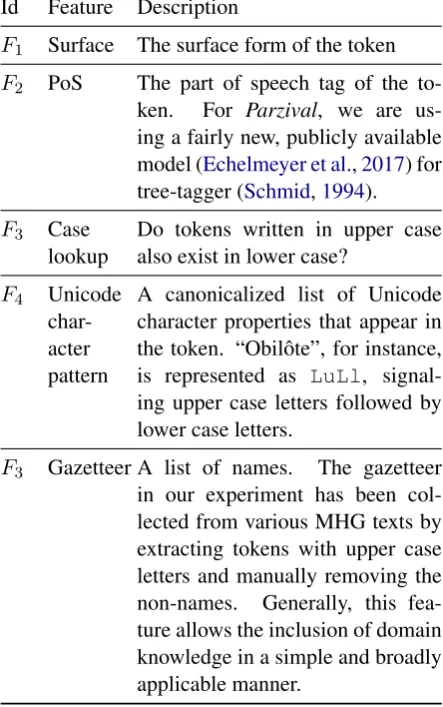
Feature set The features presented in Table 2 are extracted for the current, two preceding and one succeeding tokens. Since we are applying this 2The (German) guidelines are available on the project web sitehttp://www.creta.uni-stuttgart.de.
tagger to different corpora in different languages, we use language-, genre- or text-specific resources only in two, clearly defined cases: part of speech and names gazetteers. Part of speech taggers are available even for many low resource languages (or are among the first being created), gazetteers can often be created by domain experts.
Id Feature Description
F1 Surface The surface form of the token
F2 PoS The part of speech tag of the
to-ken. For Parzival, we are us-ing a fairly new, publicly available model (Echelmeyer et al.,2017) for tree-tagger (Schmid,1994).
F3 Case
lookup Do tokens written in upper casealso exist in lower case?
F4 Unicode
char-acter pattern
A canonicalized list of Unicode character properties that appear in the token. “Obilˆote”, for instance, is represented as LuLl, signal-ing upper case letters followed by lower case letters.
F3 Gazetteer A list of names. The gazetteer
[image:3.595.80.283.440.566.2]in our experiment has been col-lected from various MHG texts by extracting tokens with upper case letters and manually removing the non-names. Generally, this fea-ture allows the inclusion of domain knowledge in a simple and broadly applicable manner.
Table 2: Feature set
3.3 Evaluation
The entity reference tagger is evaluated using book-wise cross-validation (i.e., 5-fold CV). In thestrictsetting, we only count exactly matching boundaries as correct, while in theloose setting, we count a true positive as long as there is a one-token overlap between system and reference.
Person Location
Prec Rec Prec Rec
strict
BLNER 27.3 1.2 27.6 2.4
BLCase 36.2 19 0 0
ERT 71.2 56.8 71.8 48
loose
[image:4.595.81.281.63.188.2]BLNER 72.9 3.6 41.9 3.9 BLCase 74.8 38.5 0 0 ERT 91.6 76.1 85.3 57.9
Table 3: Evaluation results for the entity reference tagger (ERT), compared with two baselines (NER and case-based).
Discussion The results achieved purely auto-matically can be seen in Table 3. As expected, evaluation scores for the loose setting are higher than for the strict setting. The loose setting in fact is more representative for the actual performance of the tagger in our workflow. As the domain ex-perts perform semi-manual grounding anyway, the exact boundaries of the found entity reference are not that important. In addition, manual inspection revealed that in many cases the entity tagger in fact marked the head of the noun phrase.
Performance scores are higher for Person refer-ences, which can be attributed to their frequency. Both baselines are clearly outperformed, although both have their presumed strengths for the proper noun references. Manual inspection also revealed that most of the remaining recall errors are ap-pellative noun phrases (e.g., “des burcgrˆaven to-hterlˆın”/“the burgrave’s daughter”).
3.4 Semi-Automatic Labeling
Although automatic labeling of entity references is an important part of our workflow, a recall error of about 25% of the persons severely limits its use-fulness for applications in digital literary studies. We therefore implemented a user interface (not shown) in which scholars can inspect the found entity references on unseen texts and mark them as eithercorrect,incorrect, orboundary-incorrect, for span errors as well as subsequently annotate missing entity references (recall errors). For once, these annotations are then stored as manual anno-tations that can be used in subsequent workflow steps and secondly, they can be employed as addi-tional training material.
This procedure also gives clear guidance on where to focus the improvements of the tagger:
[image:4.595.308.525.64.205.2]Figure 1: Grounding view: Annotated entity ref-erence types (left) mapped to characters (right)
Figure 2: For each mention type all occurrences including textual context can be shown
Precision errors are much easier to spot and cor-rect in this fashion, making improvements in terms of recall our priority.
4 Entity Grounding
[image:4.595.309.527.254.409.2]Character #ER #Proper nouns Ratio
Parzivˆal 427 111 25.8
Gˆawˆan 185 118 63.8
Artˆus 128 88 68.8
Jeschˆute 103 30 29.1
Clˆamidˆe 74 47 63.5
[image:5.595.82.281.65.170.2]Herzeloyde 69 9 13
Table 4: Ratio of proper nouns among references
each textual context and map each occurrence dif-ferently (Fig.2).
Table 4 shows the grounding result for some main characters. These characters can be divided into two classes: i) characters which are often ref-ered by their name (Gˆawˆan, Artˆus, Clˆamidˆe); ii) characters (Parzivˆal, Jeschˆute, Herzeloyde) which are mainly referred to by appellative noun phrases.
5 Text Segmentation
For the later network analysis a segmentation is needed to define windows in which relations be-tween characters are extracted. In contrast to the task of entity reference detection, we do not cast text segmentation as a ‘real’ NLP task, for which we create annotation guidelines, train annotators etc. The reason for this is that this task is directly related to the research question a scholar wants to investigate. It is difficult to imagine context-and text-independent criteria for the segmentation. Annotation guidelines created forParzival might not generalise to other texts.
We therefore explore segmentation approaches based on linguistic and structural criteria and with regards to the content. For all segmentation set-tings, we (manually) removed non-narrative sec-tions (in which the heterodiegetic narrator gives comments; cf.Coste and Pier(2014)).
Linguistics Straightforwardly, one can segment according to sentences. Sentence boundaries have been detected automatically using rules based on punctuation. The lack of abbreviations inParzival
also removes the most frequent error source for punctuation-based sentence splitting. Each sen-tence is considered an individual segment.
Structure Parzivalis structured into strophes of 30 lines each. There is no apparent meaning to these strophes, and sometimes sentences are split
over multiple strophes. In this segmentation set-ting, each strophe is used as a segment.
Content Content-based segments are designated as episodes. An episode is a self-contained and ho-mogenous segment of the story. Typical indicators of an episode break are changes in character con-stellations, time and/or space. Episodes have been annotated manually by one of the authors.
6 Interactive Visual Exploration
To inspect and verify automatic results we use a web-based tool that supports close and distant reading. It provides different views including word clouds, plot views, and graph visualizations that allow analyzing entities and exploring their relationships. Each view allows to directly access the corresponding text passage(s).
In this context particularly relevant is the inter-active graph visualization, through which process-ing errors become apparent quickly. The graph vi-sualization uses a force-directed graph layout and represents the relations between entities, as de-picted in Fig.3(on the left side). The nodes rep-resent characters/persons and the edges the rela-tions between them. The view is complemented by a fingerprint visualization (A) that indicate where the characters are mentioned in the text. A range slider (B) enables users to select a certain range of the text, for example a single chapter. This way, users can analyze not only the overall text but also the development of the relationships between characters. In a list view (C) users can dynami-cally adapt the network by selecting or deselect-ing the entities in the list. Furthermore, they can select an edge in the network view to highlight the co-occurrences of two related entities in the fin-gerprint visualization. By selecting an occurrence, users can jump to the corresponding text passage as depicted in Fig.3(right side).
Figure 3: Graph visualization and the text view with selected entities Parzivˆal and Clˆamidˆe.
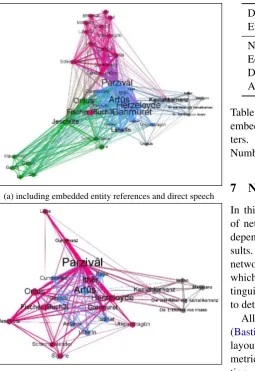
(a) including embedded entity references and direct speech
(b) without embedded entity references and direct speech. Sev-eral nodes and sub-networks (around Gurzgrˆı or Gˆalˆoes) dis-appear; some characters (Gahmuret) become less important be-cause they are often embedded in other entities’ expressions.
Figure 4: Entity network of Book III, using content-based segmentation
(graph visualization) and inspect or verify them in detail (text view).
Direct speech + − −
Embedded ERs + + −
Nodes 41 24 24
Edges 431 144 130
Density 0.526 0.522 0.47 Avgerage degree 21 12 10.8
Table 5: Influence of removing direct speech and embedded entity references on network parame-ters. Density: Edges / Possible edges; degree: Number of edges in a node.
7 Network Analysis
In this section we compare different parameters of network visualization and analyze their inter-dependencies and influences on the network re-sults. In the moment, we focus on person-based networks and leave aside the spatial information, which can be used in further analysis, e.g., to dis-tinguish between static and dynamic characters or to detect events (cf.Lotman,1977).
All network graphs are created with Gephi (Bastian et al., 2009), which provides various layout algorithms, offers statistics and network metrics, and supports dynamic graph visualiza-tion. Plots and tables in this section are based on Book III ofParzival.
7.1 Embedded entities and direct speech
As a first step, we explore the influence of ERs within a) other ERs (embedded) and b) direct speech. This is due to the fact that neither em-bedded entities (as Gahmuret in “vil li roy Gah-muret”/“son of the king Gahmuret”) nor entities mentioned in (direct) speech are neccesarily tak-ing part in the narrated story or event.
[image:6.595.76.332.236.608.2]Segmentation by sentence by strophe by content
Entity grounding + − + − + −
Edges 24 18 24 19 130 74
Nodes 65 25 79 26 24 20
Density 0.18 0.15 0.27 0.16 0.47 0.39
Avgerage degree 5.4 2.74 6.48 2.84 10.83 7.4
Connected components 1 3 1 3 1 1
Network diameter 4 4 3 6 2 3
Table 6: Influence of the different segmentation types on the network parameters. Comparison of the network parameters with and without entity grounding. Connected components: Isolated groups of nodes (lower number: stronger connectivity); diameter: Largest distance between two nodes.
entites and direct speech visually, Table5provides a numerical view. The network without embed-ded ERs or direct speech is less dense (0.47 vs. 0.526), the average degree is much lower (10.8 vs. 21), and the number of nodes and edges decreases from 41 nodes and 431 edges to 24 nodes and 130 edges.
7.2 Segmentation
Figures5a-c show the effects of the different seg-mentation criteria (cf. Sect. 5) on the networks, quantitative network properties are displayed in Table 6. First we observe a decrease in den-sity from the largest content-based segmentation (0.47) to the medium-sized segmentation in stro-phes (0.27) to the smallest segmentation in sen-tences (0.177), which comes along with a reduc-tion of the number of edges (from 130 to 79 to 65). The highest average degree can be found in the content-based network (10.8), in the strophe-based network it is reduced to 6.5 and in the sentence-based network it decreases further to 5.5. As the nodes are less and less connected, the network di-ameter becomes bigger the smaller the segmenta-tion gets. Since the chosen segmentasegmenta-tion serves as basis for the extraction of co-occurrences of char-acters, it has a huge impact on the network proper-ties which is important to reflect for later interpre-tations of the network.
7.3 Entity grounding
To estimate the influence of entity grounding on the networks we compare networks based on en-tity grounding (Sect. 4) to those only based on proper names. We identify an interdependency between entity grounding and segmentation. The sentence-based and strophe-based segmentation are relatively small and therefore more dependent
on entity grounding. The co-occurrence of two proper names in a sentence is rare (in Book III of Parzival: 25 co-occurrences in over 750 sen-tences), even in a strophe it rarely appears (26 co-occurrences in 63 strophes). As we see in Fig.5, the sentence- and strophe-based networks with-out entity grounding disintegrate into three com-ponents, they become less dense and most of the relations get lost.
The last example (Fig.6) shows the high influ-ence of entity grounding and its importance for an appropriate representation of the character config-urations of a narrative text. The unequal ratio of proper names and nouns (cf. Table4) underlines the importance: By only taking into account the proper names, we found that Parzivˆal is mentioned 111 times (in Books III-VII) and that Gˆawˆan is mentioned 118 times. Whereas the consideration of other references to both characters leads to the fact that Parzivˆal amounts to 427 mentions and Gˆawˆan to 185 mentions. This means that the pri-macy of Parzivˆal only becomes apparent by in-cluding entity grounding.
Thus, being aware of the chosen parameters is a precondition for an adequate analysis and inter-pretation of the networks. To represent the plot and narrative structure of Parzival by analyzing the development of character configurations over time, for instance, it is necessary to exclude em-bedded entities and direct speech as well as to in-clude entity grounding. The appropriate way of segmentation still needs to be reconsidered.
8 Related Work
[image:7.595.117.482.64.182.2](a) by sentences
(b) by strophes (c) by content
[image:8.595.93.509.61.330.2](d) by sentences (e) by strophes (f) by content
Figure 5: Different segmentation options. (a)-(c): With entity grounding; (d)-(f): Without grounding.
(a) with entity grounding
(b) without entity grounding
Figure 6: Parzivˆals childhood, content-based seg-mentation with and without entity grounding. Without entity grounding (b) he is not present de-spite being a central character (a).
2013;Agarwal et al.,2014b). The strong structur-ing of such texts (scenes, acts) and clearly defined speakers make identifying co-occurring characters simple. The networks extracted from narrative texts byElson et al.(2010) only include conversa-tional relations: If two characters appear together in a dialogue, they are connected in a network. The work has been conducted on 19th century British novels and is based on named entities only, with a rule-based co-reference resolution. Agar-wal et al. (2012) identify ‘social events’ in Al-ice in Wonderland and extract different types of networks (interaction- and observation-network) to investigate the roles/profiles of the charac-ters. Using Mouse and Alice as an example they demonstrate the limitations of static networks and the need for dynamic networks that can display change over time. In later publications, they em-ploy automatically created FrameNet frames as a basis to detect social events between named enti-ties (Agarwal et al.,2014a).
[image:8.595.71.300.408.655.2]used in FeatureLens (Don et al.,2007), which has been designed to support analysts in finding inter-esting text patterns and co-occurrences in texts.
There are quite a number of approaches ( Vuille-mot et al.,2009;Stasko et al.,2008) that provide node-link diagrams to represent social networks. In general, nodes represent entities and edges re-lations between them. An alternative method is a matrix-based representation which shows rela-tionships among a large number of items where rows and columns represent the nodes of the net-work (Henry and Fekete,2007). Both approaches have their drawbacks respective the readability of the structure of the overall network and also for detailed analysis (Ghoniem et al.,2005). There-fore,Henry et al.(2007) introduced a hybrid repre-sentation for social networks which combines the benefits of both approaches. It supports a set of in-teractions which allow users to flexibly change the representation to and from node-link and matrix forms of certain areas in the network.
9 Conclusions
We have presented an end-to-end environment for the extraction of co-occurrence networks based on criteria guided by literary research questions. This guidance not only informs the kinds of entities we are taking into account, but also the different ways of segmenting the text and even the fact that we are including non-named entities in the net-works. The given examples in Section7 demon-strate the influence of these choices on the net-works of one and the same narrative text, thus it is important to make these decisions in close col-laboration with the domain experts who will use the results. Ultimately, relying solely on named entities can lead to highly skewed impressions of the relative importance of characters in a text, to misleading interpretations of networks and thus, of literary texts. This becomes even more dangerous when large text collections are analyzed, for which a manual inspection is simply not possible. Allow-ing interactive exploration of aggregated data (net-works) mitigates this issue: Domain experts inter-actively working with a network of a text become aware of such issues quickly. The early integration of scholarly experts even into primarily technical modules is therefore of utmost importance.
The collaboration with experts from different disciplines from Humanities and Social Sciences not only greatly benefits the conceptual
develop-ments of, e.g., entity reference annotation guide-lines: Difficult cases that appear frequently in one text type might appear rarely in another – Re-searchers working on the latter benefit from the collaboration because it would have taken much longer to come across rare cases. But in addi-tion, this collaboration helps to ensure that techni-cal and methodologitechni-cal developments are not too specialized for one particular text or text type. Too specialized software is relatively expensive to de-velop and will be outdated quickly. It also runs counter to the often purely methodological com-puter science goals of ‘generic problem solving’. We therefore also concentrate on the fundamental methodological questions rather than on tool de-velopment.
We have focused here on one particular re-search question and corpus, but the above de-scribed workflow has been applied to narrative (modern and medieval) texts, theoretical philo-sophical texts (with the goal of establishing rela-tions between philosophical networks) and parlia-mentary debates (with the goal of connecting po-litical parties to popo-litical issues). We believe that it is worthwhile and feasible to search for com-mon interests across multiple Humanities and So-cial Sciences disciplines and research questions. The identification of – at least structurally – com-mon research questions allows to develop work-flows that are supported by NLP and visualization methods that otherwise would just not pay off due to the development efforts.
Acknowledgments
This research has been conducted within the CRETA project4 which is funded by the German Ministry for Education and Research (BMBF).
References
Apoorv Agarwal, Sriramkumar Balasubramanian, Anup Kotalwar, Jiehan Zheng, and Owen
Ram-bow. 2014a. Frame semantic tree kernels for
social network extraction from text. In Pro-ceedings of the 14th Conference of the Euro-pean Chapter of the Association for Computa-tional Linguistics. Association for Computational Linguistics, Gothenburg, Sweden, pages 211–219.
http://www.aclweb.org/anthology/E14-1023. Apoorv Agarwal, Sriramkumar Balasubramanian,
Jiehan Zheng, and Sarthak Dash. 2014b.
Pars-ing screenplays for extractPars-ing social networks from movies. In Proceedings of the 3rd Workshop on Computational Linguistics for Lit-erature (CLFL). Association for Computational Linguistics, Gothenburg, Sweden, pages 50–58.
http://www.aclweb.org/anthology/W14-0907. Apoorv Agarwal, Augusto Corvalan, Jacob Jensen,
and Owen Rambow. 2012. Social network
anal-ysis of alice in wonderland. In David K. El-son, Anna Kazantseva, Rada Mihalcea, and Stan
Szpakowicz, editors, Proceedings of the
NAACL-HLT 2012 Workshop on Computational Linguis-tics for Literature. Association for Computa-tional Linguistics, Montr´eal, Canada, pages 88–96.
http://www.aclweb.org/anthology/W12-2513. Mathieu Bastian, Sebastien Heymann, and Mathieu
Ja-comy. 2009. Gephi: An open source software for
exploring and manipulating networks. In
Proceed-ing of International AAAI Conference on Weblogs and Social Media.
Karl Bertau. 1983. Wolfram von Eschenbach. Ver-such ¨uber die Verhaltenssemantik von Verwandten
im ”Parzival”. In Karl Bertau, editor, Neun
Ver-suche ¨uber Subjektivit¨at und Urspr¨unglichkeit in der Geschichte, M¨unchen, Germany, pages 190–240. Steven Bethard, Philip Ogren, and Lee Becker. 2014.
Cleartk 2.0: Design patterns for machine learn-ing in uima. In Nicoletta Calzolari (Conference Chair), Khalid Choukri, Thierry Declerck, Hrafn Loftsson, Bente Maegaard, Joseph Mariani, Asun-cion Moreno, Jan Odijk, and Stelios Piperidis,
ed-itors, Proceedings of the Ninth International
Con-ference on Language Resources and Evaluation (LREC’14). European Language Resources Associ-ation (ELRA), Reykjavik, Iceland.
Thomas B¨ogel, Michael Gertz, Evelyn Gius, Janina Jacke, Jan Christoph Meister, Marco Petris, and Jannik Str¨otgen. 2015. Gleiche Textdaten, unter-schiedliche Erkenntnisziele? Zum Potential ver-meintlich widerspr¨uchlicher Zug¨ange zu
Textanal-yse. InProceedings of DHd. Digital Humanities im
deutschsprachigen Raum, Graz, Austria.
Didier Coste and John Pier. 2014. Narrative levels
(revised version; uploaded 23 april 2014). In Peter H¨uhn, editor, the living handbook of narratology,
Hamburg University Press.
http://www.lhn.uni- hamburg.de/article/narrative-levels-revised-version-uploaded-23-april-2014.
Walter Delabar. 1990. Erkantiu sippe unt hoch
geselleschaft: Studien zur Funktion des Ver-wandtschaftsverbandes in Wolframs von Eschen-bach “Parzival”. K¨ummerle, G¨oppingen, Germany. Anthony Don, Elena Zheleva, Machon Gregory, Sureyya Tarkan, Loretta Auvil, Tanya Clement, Ben Shneiderman, and Catherine Plaisant. 2007.
Discovering interesting usage patterns in text col-lections: Integrating text mining with visualiza-tion. In Proceedings of the 16th ACM Confer-ence on ConferConfer-ence on Information and Knowledge Management. ACM, CIKM ’07, pages 213–222.
https://doi.org/10.1145/1321440.1321473.
Nora Echelmeyer, Nils Reiter, and Sarah Schulz. 2017.
Ein PoS–Tagger f¨ur “das” Mittelhochdeutsche. In
Book of Abstracts of DHd 2017. Bern, Switzerland,
pages 141–147.
https://doi.org/10.18419/opus-9023.
David K. Elson, Nicholas Dames, and Kathleen
McK-eown. 2010. Extracting social networks from
liter-ary fiction. In Jan Hajiˇc, Sandra Carberry, Stephen
Clark, and Joakim Nivre, editors, Proceedings of
the 48th Annual Meeting of the Association for Computational Linguistics. Association for Compu-tational Linguistics, Uppsala, Sweden, pages 138– 147. http://www.aclweb.org/anthology/P10-1015. Mohammad Ghoniem, Jean-Daniel Fekete, and
Philippe Castagliola. 2005. On the readability of graphs using node-link and matrix-based repre-sentations: a controlled experiment and statistical analysis. Information Visualization4(2):114–135. Nathalie Henry and Jean-Daniel Fekete. 2007.
Matlink: Enhanced matrix visualization for
analyzing social networks. Human-Computer
Interaction–INTERACT 2007pages 288–302. Nathalie Henry, Jean-Daniel Fekete, and Michael J
McGuffin. 2007. Nodetrix: a hybrid visualization of social networks. IEEE transactions on visualization and computer graphics13(6):1302–1309.
Heng Ji and Ralph Grishman. 2011. Knowledge base population: Successful approaches and challenges. In Proceedings of the 49th Annual Meeting of the Association for Computational Linguistics: Human Language Technologies-Volume 1. Association for Computational Linguistics, pages 1148–1158. D. Keim and D. Oelke. 2007. Literature fingerprinting:
A new method for visual literary analysis. In Pro-ceedings of the IEEE Symposium on Visual Analytics Science and Technology. VAST ’07, pages 115–122.
https://doi.org/10.1109/VAST.2007.4389004. Juri Lotman. 1977. The Structure of the Artistic Text.
Cerstin Mahlow, Kerstin Eckart, Jens Stegmann, Andre Blessing, Gregor Thiele, Markus Grtner, and Jonas Kuhn. 2014. Resources, Tools, and Applications at
the CLARIN Center Stuttgart. InProceedings of the
12th Konferenz zur Verarbeitung natrlicher Sprache (KONVENS 2014). pages 11–21.
Andrew Kachites McCallum. 2002. Mallet:
A machine learning for language toolkit. Http://mallet.cs.umass.edu.
Franco Moretti. 2011. Network theory, plot analysis. Pamphlets of the Stanford Literary Lab 2, Stanford Literary Lab.
D. Oelke, D. Kokkinakis, and D. A. Keim. 2013.
Fingerprint matrices: Uncovering the dy-namics of social networks in prose literature.
Computer Graphics Forum 32(3pt4):371–380.
https://doi.org/10.1111/cgf.12124.
Helmut Schmid. 1994. Probabilistic part-of-speech
tagging using decision trees. Proceedings of the
conference on New Methods in Language Process-ing12.
Elisabeth Schmidt. 1986. Familiengeschichten und
Heilsmythologie. Die Verwandtschaftsstrukturen in den franz¨osischen und deutschen Gralromanen des 12. und 13. Jahrhunderts. T¨ubingen, Germany.
John Stasko, Carsten G¨org, and Zhicheng
Liu. 2008. Jigsaw: Supporting
investiga-tive analysis through interacinvestiga-tive visualiza-tion. Information Visualization 7(2):118–132.
https://doi.org/10.1057/palgrave.ivs.9500180. Rolf Sutter. 2003. mit saelde ich gerbet han den gral:
Genealogische Strukturanalyse zu Wolframs von Es-chenbach ”Parzival”. Ph.D. thesis, Eberhard-Karls-Universit¨at, T¨ubingen, Germany.
Peer Trilcke, Frank Fischer, Mathias G¨obel, and
Dario Kampkaspar. 2016. Theatre plays as ‘small
worlds’? network data on the history and ty-pology of german drama. In Digital Humanities 2016: Conference Abstracts. Jagiellonian University & Pedagogical University, Krak´ow, pages 385–387.
http://dh2016.adho.org/abstracts/360.
R. Vuillemot, T. Clement, C. Plaisant, and A. Kumar.
2009. What’s being said near “martha”? exploring
name entities in literary text collections. In Proceed-ings of the IEEE Symposium on Visual Analytics Sci-ence and Technology, 2009. VAST ’09, pages 107– 114. https://doi.org/10.1109/VAST.2009.5333248. Thomas Wilhelm, Manuel Burghardt, and Christian
Wolff. 2013. ”To See or Not to See” - An Inter-active Tool for the Visualization and Analysis of
Shakespeare Plays. In Kultur und Informatik: