Intra-Topic Variability Normalization based on Linear Projection for Topic
Classification
Quan Liu†, Wu Guo†, Zhen-Hua Ling†, Hui Jiang‡, Yu Hu†§
†National Engineering Laboratory for Speech and Language Information Processing
University of Science and Technology of China, Hefei, Anhui, China
‡Department of Electrical Engineering and Computer Science
York University, 4700 Keele Street, Toronto, Ontario, M3J 1P3, Canada
§iFLYTEK Research, Hefei, China
emails: [email protected], [email protected], [email protected] [email protected], [email protected]
Abstract
This paper proposes a variability normaliza-tion algorithm to reduce the variability be-tween intra-topic documents for topic classi-fication. Firstly, an optimization problem is constructed based on linear variability remov-able assumption. Secondly, a new feature s-pace for document representation is found by solving the optimization problem with kernel principle component analysis (KPCA). Final-ly, effective feature transformation is taken through linear projection. As for experiments, state-of-the-art SVM and KNN algorithm are adopted for topic classification respectively. Experimental results on a free-style conversa-tional corpus show that the proposed variabili-ty normalization algorithm for topic classifica-tion achieves 3.8% absolute improvement for micro-F1measure.
1 Introduction
Topic classification is now faced with the problem of enormous variability between documents due to the exponential growth of free-style unstructured texts in recent years. This paper treats variability as d-ifferences between text documents and aims at re-ducing the intra-topic document variability for bet-ter topic classification. There are various factors to cause the intra-topic variability problem, such as the different language usages of different persons (Chambers, 1995; Fillmore et al., 2014). In free-style conversations experimented in this paper, d-ifferent people would use very dd-ifferent words to express their opinions. Therefore, documents in a
same topic could be quite different because of the intra-topic variability problem.
In this work, we are interested in finding a ro-bust document representation strategy to address the intra-topic variability problem. Traditional method represents document by a high-dimensional TF-IDF vector based on the bag-of-word approach (Salton and McGill, 1986; Salton and Buckley, 1988). How-ever, the TF-IDF feature reveals little semantic sim-ilarity information between terms, which would increase the differences between intra-topic docu-ments when different words are used. Beyond the TF-IDF strategy, there are two class of techniques, i.e., unsupervised technique and supervised tech-nique for document representations. The unsuper-vised technique includes some latent semantic anal-ysis methods. The typical method is Latent Se-mantic Indexing (LSI) while the features estimated by LSI are linear combinations of the original fea-tures (Deerwester et al., 1990; Wang et al., 2013). Meanwhile, the popular Latent Dirichlet Allocation (Blei et al., 2003; Morchid et al., 2014) algorithm was proposed to represent document by a generative probabilistic model (Blei et al., 2003). Moreover, in recent years, many neural network based meth-ods have been investigated for document represen-tations (Hinton and Salakhutdinov, 2006; Srivasta-va et al., 2013; Le and Mikolov, 2014). For exam-ple, in (Le and Mikolov, 2014), a model called
para-graph vectorwas designed to represent each
docu-ment by a dense vector while the vector is trained by predicting all words in the corresponding doc-ument. On the other hand, supervised technique for document representation includes some
inative approaches, e.g., Linear Discriminant Anal-ysis (Berry et al., 1995; Chakrabarti et al., 2003; Torkkola, 2004) and supervised latent semantic in-dexing (Sun et al., 2004; Chakraborti et al., 2007; Bai et al., 2009). Meanwhile, some improved lin-ear analysis methods were proposed for encoding documents with a reliable similarity information (Y-ih et al., 2011; Chang et al., 2013). However, all those works for document representation paid little attention to the variability of intra-topic documents. Therefore, they could hardly solve the intra-topic variability problem in a direct way.
This paper makes a preliminary investigation to deal with the intra-topic variability problem. The main purpose of this work is to find a new feature space with minimized intra-topic variability. An objective criterion is constructed for optimization. Mathematically, we make use of the topic label in-formation of the training set to create a weighting matrix, and then sum over all the differences of intra-topic documents. Then a robust feature space with minimized intra-topic variability is generated by solving the optimization problem with effective KPCA based algorithm. Finally, we accomplish the variability normalization operations for the baseline features. We also employ the linear discriminant analysis as a supplementary algorithm. As for exper-iments, state-of-the-art SVM and KNN algorithms are employed for topic classification. System per-formances are evaluated on a challenging free-style conversational database.
The rest of this paper is organized as follows. In section 2, we introduce the proposed variability nor-malization algorithm for topic classification in de-tail. After it, section 3 presents experimental set-up and results. Finally, conclusions and future work would be given in section 4.
2 Variability Normalization Algorithm 2.1 Motivation for variability normalization This work aims to find a robust document repre-sentation strategy for topic classification. The pro-posed algorithm is motivated by the Nuisance At-tribute Projection (NAP) algorithm in speaker veri-fication field (Solomonoff et al., 2005; Solomonoff et al., 2007). We firstly make alinear variability re-movable assumptionfor document representation.
Mathematically, given a document, it could be de-noted by a column vectorxwith dimensionality of
das follows
x=xt+xv (1)
where xt denotes the useful signal information in current document,xvstands for the remaining noise. It is very difficult to model the noise signal in a document since it could come from various sources. Therefore, in this paper, we focus on the noise cre-ated by the variability among intra-topic documents. Our goal is to find a new document representation through linear projection:
˜
x=Px (2)
where P is the projection matrix. Since the goal of this paper is not dimensionality reduction, the dimensionality of the new document representation is the same as the source document representation. Therefore, the size ofPisd×d. This paper propos-es to learnPby minimizing the following intra-topic variability
Q=X
i,j
wijkP(xi−xj)k2 (3)
where wij is thei-th row and j-th column element of a weighting matrixWcreated in this work. The matrix is determined by the topic label information of training set as follows
wij =
(
1 ifxiandxjbelong to a same topic
0 othervise
(4)
2.2 Variability normalization algorithm
For deriving the variability normalization algorithm, we follow the work of (Solomonoff et al., 2007) and re-write the projection matrix P by the variability space (denoted as a unit vectorvhere) as follows
P=I−vvT (5)
where I is a (d ×d) dimensional identity matrix. Combining (3) and (5), we get
Q=X
i,j
Since the first part ofQin (6) is independent onv, we discard it and create the final criterion
Q=−X
i,j
wij(vT(xi−xj))2). (7)
Unfolding (7) by linear operation, we get
Q= 2vTX·(W−diag(W·1))·XTv. (8) where Xdenotes the training set matrix, each row of X represents one document vector, 1 is a vec-tor with all elements equal to 1. Minimizing (8) is equivalent to solving the flowing eigenvalue decom-position problem
X·(diag(W·1)−W)XTv=λv. (9)
Here we apply the idea of KPCA (Solomonoff et al., 2007; Sch¨olkopf et al., 1997) to solve (9). Denoting
vby a new vectorXu, findinguturns to solving a generalized eigenvalue problem in kernel space as
KZKu=λKu
K=XTX
Z=diag(W·1)−W.
(10)
The variability space is then constructed by selecting a set of eigenvectors corresponding to thed1largest
eigenvalues.
U= [u1,u2, ...,ud1] (11)
Finally, a(d×d) projection matrix is obtained by combining (5), (11) andv=Xu.
Based on this variability normalization algorithm, the baseline document vectors could be transformed to a new feature space with minimized intra-topic variability. The main procedure to implement intra-topic variation normalization could be divided into the following steps:
• Generate sample matrixX using the wholen
documents of training set.
• Construct weighting matrixWaccording to (4) with the use of topic label information.
• Estimate a projection matrixPby solving the aforementioned eigenvalue problem.
• Transform all documents to new feature space through linear projection according to (2).
It should be noticed that after making feature transformation by the proposed variability normal-ization algorithm, the dimensionality of document representation has not been changed. This is dif-ferent with all the existing dimensionality reduction methods since our goal is to re-define the feature representation space for topic document representa-tion. To prove the effectiveness of the proposed al-gorithm, this paper presents experimental results on a challenging conversational dataset.
3 Experiments
In this section, we evaluate the proposed variability normalization method in a typical topic classifica-tion problem. We will firstly introduce the exper-imental setup, including dataset, evaluation criteria and system description. After it, all the experimen-tal results would be reported in detail.
3.1 Experimental setup 3.1.1 Dataset
The data set used in this paper is the text tran-scripts of free-style conversational speech database, Fisher English corpus released by LDC, which con-tains 11699 recorded conversations (Cieri et al., 2004). This corpus is collected from 40 different topics, and each document includes relatively a dis-tinct topic (e.g. “Comedy”, “Smoking”, “Terroris-m”, etc.) as well as topics covering similar sub-ject areas (e.g. “Airport Security”, “Bioterrorism”, “Issues in the Middle East”). This paper randomly chooses 60 documents and 50 documents per topic for the training set and testing set respectively. An-other 50 documents for each topic are randomly se-lected to for the development set.
3.1.2 Evaluation criteria
We use two types of criteria to make a compre-hensive evaluations for this work. The first evalu-ation creterion is F1 measure corresponding to the
recall and precision rates for a typical classification system. In detail, we would report micro-average
F1 and macro-average F1 results. In consideration
3.1.3 System description
Module Methods
Text processing stop-word removal, stemming Representation TF-IDF feature
[image:4.612.72.296.84.144.2]Classification KNN, SVM algorithm
Table 1:Baseline system modules for topic classification.
This paper constructs several systems for compar-ison. The configurations of our baseline system are shown in Table 1. Porter algorithm (Porter, 1980) is adopted for word stemming after stop-words re-moval. Then a vocabulary with 19534 unique words is determined according to the occurrence frequency information of training set. Documents in the base-line system are represented by using the popular TF-IDF term weighting strategy (Salton and Buckley, 1988). Two popular algorithms SVM and KNN are used for classification separately. The SVM classi-fication is implemented using the LIBSVM toolkit (Chang and Lin, 2011).
Based on the baseline system, descriptions of oth-er systems are given as below.
(1) LSI: documents are represented in latent se-mantic space estimated by the LSI algorithm (Deer-wester et al., 1990) based on the baseline features.
(2) LDA: document features are transformed by linear discriminant analysis. We select 50 eigenvec-tors for the low dimensional feature space.
(3)VarNorm: document features are transformed
from the baseline TF-IDF vectors by the approach proposed in this paper. We select 60 eigenvectors for generating the project matrix.
(4) VarNorm-LDA: system combined VarNorm
with LDA, which employs feature transformation operations twice on the original TF-IDF document features. The number of eigenvectors forVarNorm
andLDAare set to 60 and 50 respectively.
All the parameters suggested in this paper are tuned on the development set. However, the eigen-vector number is not restricted to 50 or 60. It is rec-ommended to set the eigenvector num from 45 to 75 since we have 40 topics for experiments.
3.2 Experimental Results
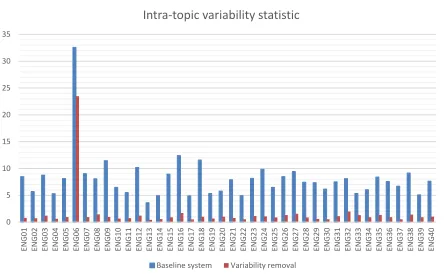
3.2.1 Variability normalization performance According to (3), we compare the intra-topic vari-ability for the baseline and theVarNormsystem. The
difference for variability calculation is whether to use the projection matrixPor not. Figure 1 shows the intra-topic variability on 40 topics of the train-ing set. The vertical axis represents the variabili-ty for each topic, while the horizontal axis stands for 40 topics in the conversation corpus. As we can see clearly, the variability of baseline system is high. After conducting variability normalization, it could be reduced effectively.
0 5 10 15 20 25 30 35 EN G 01 EN G 02 EN G 03 EN G 04 EN G 05 EN G 06 EN G 07 EN G 08 EN G 09 EN G 10 EN G 11 EN G 12 EN G 13 EN G 14 EN G 15 EN G 16 EN G 17 EN G 18 EN G 19 EN G 20 EN G 21 EN G 22 EN G 23 EN G 24 EN G 25 EN G 26 EN G 27 EN G 28 EN G 29 EN G 30 EN G 31 EN G 32 EN G 33 EN G 34 EN G 35 EN G 36 EN G 37 EN G 38 EN G 39 EN G 40
Intra-topic variability statistic
Baseline system Variability removal
Figure 1:Variability normalization performance.
After making detailed analysis, we find for the topic ENG06, the theme is “Hypothetical Situations: Perjury – Do either of you think that you would
com-mit perjury for a close friend or family member?”,
the variability among documents from this topic is largest in the whole corpus. However, for the top-ic ENG13, “Movies: Do each of you enjoy going to the movies in a theater, or would you rather rent a movie and stay home? What was the last movie that
you saw? Was it good or bad and why?”, the
vari-ability is the lowest. This is the difference between common topics and infrequent topics. Since people would use various words to express their ideas, it is reasonable to find the variability problem is more serious for infrequent topics than common topics. 3.2.2 Classification Results using KNN
Experimental results using KNN classification al-gorithm are given in Table 2. The results show that, compared to the baseline system, the variabil-ity normalization systemVarNormachieves 2% ab-soluteF1 improvement, and 29% relative
[image:4.612.316.539.194.333.2]im-Table 2:Classification results using KNN algorithm System EER macro-F1 micro-F1
Baseline 6.10 84.72 83.15
LSI 4.25 86.24 85.45
LDA 4.49 88.94 88.15
VarNorm 4.30 86.46 85.60
[image:5.612.77.293.186.275.2]VarNorm-LDA 2.51 90.29 90.00
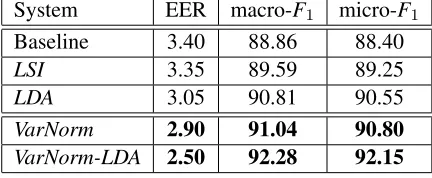
Table 3:Classification results using SVM algorithm System EER macro-F1 micro-F1
Baseline 3.40 88.86 88.40
LSI 3.35 89.59 89.25
LDA 3.05 90.81 90.55
VarNorm 2.90 91.04 90.80
VarNorm-LDA 2.50 92.28 92.15
proved by 65% relatively, and the micro-F1measure
is improved by 6.85% absolutely. The reason for this performance is straightforward. Since the proposed algorithm effectively reduce the differences among intra-topic documents, the LDA algorithm would be more easier and effective to maximize the ratio of between-class-variance to within-class-variance. 3.2.3 Classification Results using SVM
Similarly, the experimental results using SVM classification algorithm are shown in Table 3. The baseline performance is better than system us-ing KNN algorithm. The improvements achieved by LSI in KNN sytem almost vanish here, while
the VarNorm system keeps its improvement. The
VarNorm system even works better than the LDA
system, with nearly 15% relative improvement on EER, and 3.4% absolute improvement on
micro-F1 measure. The best results are obtained by the
VarNorm-LDAsystem. There are 36% relative
im-provement for EER, and 3.75% absolute improve-ment for micro-F1measure.
4 Conclusions and Future Work
In this paper, we investigated the intra-topic vari-ability problem for topic classification. The major contribution of this work is that we proposed a ef-fective variability normalization approach for robust document representation. An optimization problem was constructed after making a linear variability re-movable assumption. In order to take a deep insight
into the performance of the proposed variability nor-malization algorithm, we conducted experiments on a challenge free-style conversation corpus. Experi-mental results based on the SVM and KNN classifi-cation algorithm all confirmed the robustness of the proposed approach. As a conclusion, the variability normalization algorithm could be used as a front-end feature transformation strategy, and we also suggest to combine it with linear discriminant analysis algo-rithm or some other algoalgo-rithms to further improve system performances.
Further study will investigate the adaptive meth-ods for constructing robust feature spaces. We would also combine this work with more document representations methods as well. Moreover, it would be very interesting to extend and combine our work to some novel unsupervised machine learning tech-niques, like the work of (Zhang and Jiang, 2015) while they proposed a model for high-dimensional data by combineing a linear orthogonal projection and a finite mixture model under a unified genera-tive modeling framework.
Acknowledgments
This work was supported in part by the Science and Technology Development of Anhui Province, Chi-na (Grants No. 2014z02006) and the Fundamental Research Funds for the Central Universities (Grant No. WK2350000001). At the same time, we want to give special thanks to the anonymous reviewers for their insightful comments as well as suggestions.
References
Bing Bai, Jason Weston, David Grangier, Ronan Collobert, Kunihiko Sadamasa, Yanjun Qi, Olivier Chapelle, and Kilian Weinberger. 2009. Supervised semantic indexing. In Proceedings of the 18th ACM conference on Information and knowledge manage-ment, pages 187–196. ACM.
Michael W Berry, Susan T Dumais, and Gavin W O’Brien. 1995. Using linear algebra for intelligent information retrieval. SIAM review, 37(4):573–595. D. M. Blei, A. Y. Ng, and M. I. Jordan. 2003. Latent
dirichlet allocation. the Journal of machine Learning research, 3:993–1022.
classifica-tion via multiple linear discriminant projecclassifica-tions. The VLDB Journal, 12(2):170–185.
Sutanu Chakraborti, Rahman Mukras, Robert Lothian, Nirmalie Wiratunga, Stuart NK Watt, and David J Harper. 2007. Supervised latent semantic indexing using adaptive sprinkling. InIJCAI, pages 1582–1587. Jack K Chambers. 1995. Sociolinguistic theory.
Black-well.
Chih-Chung Chang and Chih-Jen Lin. 2011. LIBSVM: a library for support vector machines. ACM Trans-actions on Intelligent Systems and Technology (TIST), 2(3):27.
Kai-Wei Chang, Wen-tau Yih, and Christopher Meek. 2013. Multi-relational latent semantic analysis. In EMNLP, pages 1602–1612.
C. Cieri, D. Miller, and K. Walker. 2004. The Fisher corpus: a resource for the next generations of speech-to-text. InLREC, pages 69–71.
S. C. Deerwester, S. T. Dumais, T. K. Landauer, G. W. Furnas, and R. A. Harshman. 1990. Indexing by latent semantic analysis.JASIS, 41(6):391–407.
Charles J Fillmore, Daniel Kempler, and William SY Wang. 2014. Individual differences in language a-bility and language behavior. Academic Press. Geoffrey E Hinton and Ruslan R Salakhutdinov. 2006.
Reducing the dimensionality of data with neural net-works. Science, 313(5786):504–507.
Quoc V Le and Tomas Mikolov. 2014. Distributed repre-sentations of sentences and documents. arXiv preprint arXiv:1405.4053.
Mohamed Morchid, Richard Dufour, and Georges Linares. 2014. A lda-based topic classification ap-proach from highly imperfect automatic transcriptions. LREC14.
Martin F Porter. 1980. An algorithm for suffix stripping. Program, 14(3):130–137.
Gerard Salton and Christopher Buckley. 1988. Term-weighting approaches in automatic text retrieval. In-formation processing&management, 24(5):513–523. Gerard Salton and Michael J McGill. 1986. Introduction
to modern information retrieval.
B. Sch¨olkopf, A. Smola, and KR. M¨uller. 1997. Ker-nel principal component analysis. InArtificial Neural Networks-ICANN’97, pages 583–588. Springer. Alex Solomonoff, William M Campbell, and Ian
Board-man. 2005. Advances in channel compensation for svm speaker recognition. InICASSP, pages 629–632. A. Solomonoff, W. M. Campbell, and C. Quillen. 2007.
Nuisance attribute projection. Speech Communica-tion.
Nitish Srivastava, Ruslan R Salakhutdinov, and Geof-frey E Hinton. 2013. Modeling documents with deep boltzmann machines. arXiv preprint arX-iv:1309.6865.
Jian-Tao Sun, Zheng Chen, Hua-Jun Zeng, Yu-Chang Lu, Chun-Yi Shi, and Wei-Ying Ma. 2004. Supervised latent semantic indexing for document categorization. InData Mining, 2004. ICDM’04. Fourth IEEE Inter-national Conference on, pages 535–538. IEEE. K. Torkkola. 2004. Discriminative features for text
doc-ument classification. Formal Pattern Analysis & Ap-plications, 6(4):301–308.
Quan Wang, Jun Xu, Hang Li, and Nick Craswell. 2013. Regularized latent semantic indexing: A new approach to large-scale topic modeling. ACM Transactions on Information Systems (TOIS), 31(1):5.
Wen-tau Yih, Kristina Toutanova, John C Platt, and Christopher Meek. 2011. Learning discriminative projections for text similarity measures. In CoNLL, pages 247–256. Association for Computational Lin-guistics.