Using Zero-Resource Spoken Term Discovery for Ranked Retrieval
Jerome White New York University
Abu Dhabi, UAE [email protected]
Douglas W. Oard University of Maryland College Park, MD USA
Jiaul Paik University of Maryland College Park, MD USA
Rashmi Sankepally University of Maryland College Park, MD USA [email protected]
Aren Jansen John Hopkins HLTCOE
Baltimore, MD USA [email protected]
Abstract
Research on ranked retrieval of spoken con-tent has assumed the existence of some auto-mated (word or phonetic) transcription. Re-cently, however, methods have been demon-strated for matching spoken terms to spoken content without the need for language-tuned transcription. This paper describes the first application of such techniques to ranked re-trieval, evaluated using a newly created test collection. Both the queries and the collection to be searched are based on Gujarati produced naturally by native speakers; relevance assess-ment was performed by other native speak-ers of Gujarati. Ranked retrieval is based on fast acoustic matching that identifies a deeply nested set of matching speech regions, cou-pled with ways of combining evidence from those matching regions. Results indicate that the resulting ranked lists may be useful for some practical similarity-based ranking tasks.
1 Introduction
Despite new methods of interaction, speech contin-ues to be a dominant modality for information ex-change, particularly among the half of the world’s almost five billion mobile phone users who currently lack text-based Internet access. Recording speech poses no particular problems, but retrieval of spoken content using spoken queries is presently available only for the approximately two dozen languages in which there is an established path to market; En-glish, German, or Chinese, for example. However, many of the mobile-only users who could benefit
most from such systems speak only one of the sev-eral hundred other languages that each have at least a million speakers;1Balochi, Mossi or Quechua, for example. Addressing this challenge in a scalable manner requires an integration of speech processing and information retrieval techniques that can be ef-fectively and affordably extended to a large number of languages.
To this end, the experiments in this paper were conducted in a conventional ranked retrieval frame-work consisting of spoken queries, spoken “doc-uments” (responses, hereafter), graded relevance judgments, and standard evaluation measures. As with other information retrieval tasks, there is an el-ement of uncertainty in our best representations of what was said. Our focus on speech processing tech-niques that are language-agnostic creates the poten-tial for explosive growth in the uncertainty that our search techniques must accommodate. The design and evaluation of such techniques is therefore the central focus of the work explored in this paper.
Our results are both heartening and disconcerting. On the positive side, useful responses can often be found. As one measure of success, we show that a Mean Reciprocal Rank near 0.5 can be achieved when more than one relevant response exists; this corresponds to a relevant response appearing in the second position of a ranked list, on average (by the harmonic mean). On the negative side, the zero-resource speech processing technique that we rely on to generate indexing terms has quadratic time complexity, making even the hundred-hour scale of
1There are 393 languages with at least one million speakers according to Ethnologue.
the collection on which we have run our experi-ments computationally strenuous. We believe, how-ever, that by demonstrating the utility of the tech-niques introduced in this paper we can help to moti-vate further work on even more affordable scalable language-agnostic techniques for generating index-able terms from speech.
2 Motivation and Related Work
Extending spoken language processing to low-resource languages has been a longstanding goal of the Spoken Web Search task of MediaEval. In this task, research teams are challenged to identify in-stances of specific spoken terms that are provided as queries in a few hours of speech. Between 2011 and 2013, the task was run three times on a total of 16 different languages (Rajput and Metze, 2011; Metze et al., 2012; Anguera et al., 2013).2 Two broad classes of techniques over this span proved to be practical: one based on phonetic recognition followed by phonetic matching; the other based on direct matching of acoustic features. Of the two approaches, phonetic recognition was, at the time, slightly more accurate. Directly matching acoustic features, the focus of this paper, potentially offers easier extensibility to additional languages.
From the perspective of information retrieval, the principal limitation of the “spoken term detection” design of the MediaEval task was the restriction to single-term queries. While single-term queries are common in Web search (Spink et al., 2001), the best reported Actual Term Weighted Value (ATWV) from any MediaEval Spoken Web Search participant was 0.4846 (Abad and Astudillo, 2012). This cor-responds to a system that correctly detects 48 per cent of all instances of the spoken query terms, while producing at most ten false alarms for every missed detection (Fiscus et al., 2007). Thus, if users are willing to tolerate low precision, moderate levels of recall are possible. Speech search arguably de-mands higher precision than does Web search, how-ever, since browsing multiple alternatives is eas-ier in text than in speech. One way of potentially improving retrieval performance is to encourage a searcher to speak at length about what they are
look-2For example, Gujarati, isiNdebele, isiXhosa, Sepedi, Setswana, Telugu, Tshivenda, and Xitsonga.
ing for (Oard, 2012). Such an approach, however, introduces the new challenge of properly leveraging the additional matching potential of verbose multi-term queries (White et al., 2013).
To this end, our work builds on two components: a term matching system, and a test collection. As a term matching system, we used our zero-knowledge speech matching system. In MediaEval 2012, this system achieved an ATWV of 0.321 in the Spo-ken Web Search task (Jansen et al., 2012). A ver-sion of this system has previously been evaluated in an example-based topic classification task using English speech, achieving a classification accuracy of 0.8683 (Drezde et al., 2010). Ranked retrieval using naturally occurring queries is more challeng-ing, however, both because topics in information re-trieval are often not easily separable, and because the form of a query may be unlike the form of the responses that are sought. Our goal now, therefore, is to use an information retrieval evaluation frame-work to drive the development of robust techniques for accommodating representational uncertainty.
Traditional spoken term detection (STD) tries to address uncertainty by learning speech-signal to language-model mappings; using neural net-works (Cui et al., 2013; Gales et al., 2014) or Markov models (Chan et al., 2013), for example. From a broad perspective, the method utilized in our work does not use an acoustic model for its analy-sis. More fundamentally, however, speech signals in our collection map to dozens of smaller terms that are not necessarily the same across utterances of the same word. Thus, it is more accurate to think of the work herein as matching signal features rather than linguistic features.
For this reason, widely used techniques such as stemming, spelling correction, and stopword re-moval that rely to some extent on linguistic features do not apply in our setting. We therefore rely on term and corpus statistics. Even here there are limi-tations, since our lexical items are not easily aligned with those found in other collections. For this rea-son, we can not leverage external corpus statistics from, for example, Google or Wikipedia (Bendersky et al., 2011; Bendersky et al., 2010; Bendersky and Croft, 2008; Lease, 2009), or phrases from search logs (Svore et al., 2010).
x2
x1 y1
y2
r1
(a) Term discovery.
x1,x2
[
]
[
y1,y2]
r1x3,x4
[
]
[
y3,y4]
r2
…
xm−1,xm
[ ]
rn
ym−1,ym
[ ]
(b) Term extraction.
x5,x6
[ ] [y5,y6] r3
x7,x8
[ ] r4 [y7,y8] x1,x2
[ ] r1 [y1,y2]
x3,x4
[ ] [y3,y4]
r2 e1
e2
(c) Term overlap.
Cluster 2
x5,x6
[ ] [y5,y6] r3
x7,x8
[ ] [y7,y8]
r4
e2
Cluster 1
x1,x2
[ ] [y1,y2]
r1
x3,x4
[ ] [y3,y4]
r2 e1
[image:3.612.74.536.52.212.2](d) Term clustering.
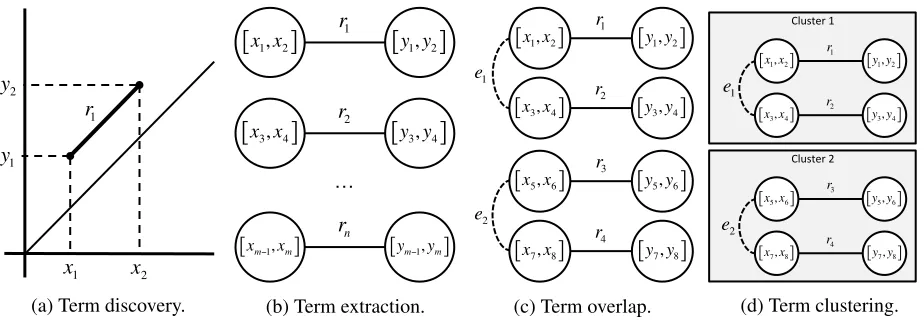
Figure 1: Overview of the pseudo-term creation process. The term discovery system is run over the audio. A threshold,δ, dictates the acceptable length,r, and thus the number of regions extracted. Extracted regions are then made into a graph structure, where vertices are regions of speech, and edges denote a connection be-tween those regions. A second edge set is added based on region overlap. Resulting connected components are then clustered; these clusters are known aspseudo-terms.
in low-resource languages has to date been ham-pered by a lack of suitable test collections. We have therefore made our new test collection freely avail-able for research use in recent shared-task informa-tion retrieval evaluainforma-tions (Oard et al., 2013; Joshi and White, 2014).
3 Zero-Resource Term Discovery
In traditional speech retrieval applications, document-level features are derived from the outputs of supervised phonetic or word recognizers. Recent term discovery systems automatically iden-tify repeating words and phrases in large collections of audio (Park and Glass, 2008; Jansen et al., 2010), providing an alternative means of extracting lexical features for retrieval tasks. Critically, this discovery is performed without the assistance of any supervised speech tools by instead resorting to a search for repeated trajectories in a suitable acoustic feature space (for example, Mel Frequency Cepstrum Coefficients (MFCC) and Perceptual Linear Prediction (PLP)) followed by a graph clustering procedure. We refer to the discovered units as pseudo-terms (by analogy to the terms built from character sequences that are commonly used in text retrieval), and we can represent each query and response as a set of pseudo-term offsets and durations. We summarize each step in the
subsections below. Complete specifications can be found in the literature (Drezde et al., 2010; Jansen and Van Durme, 2011).
3.1 Repetition and Clustering
Our test collection consists of nearly 100 hours of speech audio. Term discovery is inherently anO(n2) search problem, and application to a
cor-pus of this size is unprecedented in the literature. We applied the scalable system described by Jansen and Van Durme (2011), which employs a pure-to-noisy strategy to achieve a very substantial (orders-of-magnitude) speedup over its predecessor state-of-the-art system (Park and Glass, 2008). The system functions by constructing a sparse (thresholded) dis-tance matrix across the frames of the entire corpus and then searching for approximately diagonal line structures in that matrix, as such structures are in-dicative that a word or phrase has been repeated (Figure 1a).
es-�� �� ��� ��� ��� ��� ��� ��� ��� ��� ���
��� ��� ��� ��� ��� ��� ��� ��� ��� ���
�������������������
��������������
[image:4.612.88.529.62.276.2]���� ������ �����
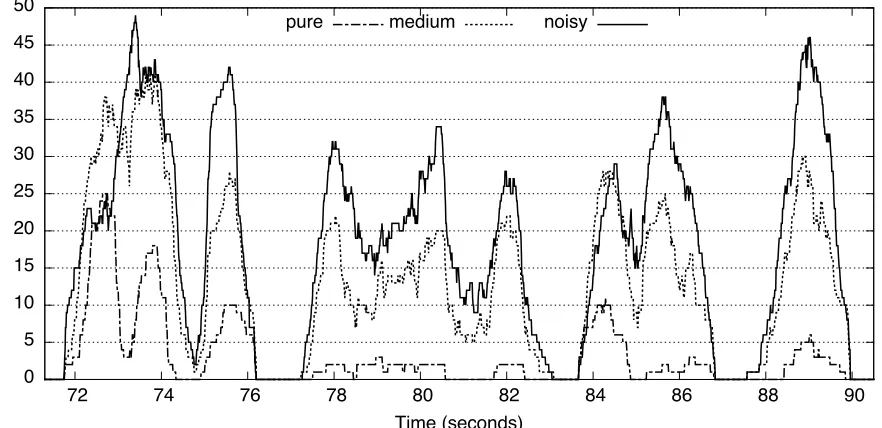
Figure 2: Different pseudo-term nesting structures for various settings of the speech-to-term extraction model. They-axis represents the number of terms extracted at a given period in time. This figure represents an approximately twenty second interval of Query 42.
sential some DTW distance threshold δ is applied before a repetition is passed along to the clustering procedure. This produces a graph consisting of a set of disconnected “dumbbells.”
Finally, the original edge list is augmented with a set of “overlap” edges between corresponding nodes in different dumbbells (Figure 1c); these overlap edges indicate that two nodes correspond to essen-tially the same segment of speech. For two nodes (two segments of speech) to be considered essen-tially the same, we require a minimal fractional over-lap of 0.97, which is set less than unity to allow some noise in the segment end points. These over-lap edges act to effectively merge vertexes across the dumbbells, enabling transitive matches between acoustic segments that did not match directly. The pseudo-terms are defined to be the resulting con-nected components of the graph, each consisting of a set of corresponding acoustic segments that can oc-cur anywhere in the collection (Figure 1d).
In the experiments described in this paper, three pseudo-term feature variants arising from three set-tings of the DTW distance threshold are considered. Lower thresholds imply higher fidelity matches that yield fewer and purer pseudo-term clusters. These are referred to aspure clustering(δ = 0.06,
produc-ing 406,366 unique pseudo-terms),medium cluster-ing(δ= 0.07, producing 1,213,223 unique pseudo-terms) andnoisy clustering (δ = 0.075, producing 1,503,169 unique pseudo-terms).
3.2 Nested Pseudo-Terms
Each pseudo-term cluster consists of a list of occur-rences. A term is denoted using start and end off-sets, in units of 10 milliseconds, from the beginning of the file. It is thus a simple matter of bookkeep-ing to construct a bag-of-pseudo-terms representa-tion for each query and response. Moreover, because we have start and end offsets for each pseudo-term, we can also construct more sophisticated represen-tations that are based on filtering or grouping the pseudo-terms based on the ways in which they over-lap temporally.
�� �� �� �� �� �� �� �� �� ��� ��� ��� ��� ��� ��� ��� ��� ��� ��� ��� ���
���� �� ���� �� ����
�����������
���������������������������������
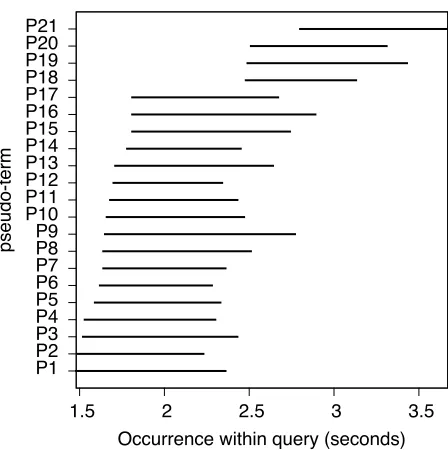
Figure 3: Example of overlapping pseudo-terms within Query 42 under medium clustering. Terms are presented as horizontal bars denoting their start and end time.
separately to support partial matching. Because pseudo-term detection can find any pair of match-ing regions, we could, continumatch-ing the analogy, not only get pseudo-terms for “White House Spokes-man” and “White House,” but also for parts of those words such as “Whit” and “Whi”. Indeed, nesting to depth 50 has been observed in practice for noisy clustering, as displayed in Figure 2. This is a fairly typical pseudo-term nesting graph, in which noisy clustering yields deeper nesting than medium clus-tering, and much deeper nesting than pure cluster-ing.
Figure 3 shows a collection of pseudo-terms within an overlapping region; in this case a medium clustering representation of the 1.48 second to 3.67 second region of Query 42.3 As can be seen, calling this “nesting” is somewhat of an oversimpli-fication, the region is actually a set of pseudo-terms that generally overlap to some degree, although not all pseudo-term pairs in one of these “nested” re-gions actually overlap—pseudo-terms P1 and P21, for example. What gives a nested region its depth
3Figure 2 shows the same query between 70 and 90 seconds.
is the overlap between pseudo-terms that have adja-cent start times. Although in this case, as is typi-cal, there is no one dominating pseudo-term for the entire nested region, there are some cases in which one pseudo-terms is entirely subsumed by another; pseudo-terms P5 and P6, for example. This trait can be leveraged during term matching.
4 Retrieval Models
The development of ranking functions, referred to as “retrieval models,” proceeded in three stages. To establish a baseline, we first implemented a stan-dard bag-of-words approach. We then looked to techniques from Cross-Language Information Re-trieval (CLIR) for inspiration, since CLIR tech-niques must accommodate some degree of transla-tion ambiguity and for which robust techniques have been established. Our zero-resource pseudo-term discovery techniques result in representations that differ from the CLIR case in two key ways, however: 1) in CLIR the translation relationship is normally represented such that one side (query or document) exhibits no ambiguity, whereas we have ambiguity on both sides; and 2) in CLIR the typical scope of all translation alternatives are aligned, whereas we have complex nested units that contain terms with differ-ing temporal extents. We therefore developed a new class of techniques that leverage the temporal extent of a pseudo-term as a measure of specificity (Fig-ure 2) and the fraction of a nested unit covered by a pseudo-term as a measure of descriptiveness (Fig-ure 3). This section describes each of these three types of retrieval models in turn.
Indri (Strohman et al., 2004) indexes were built using pseudo-terms from pure, medium or noisy clustering; in each case, stemming and stopword re-moval were disabled. Indri’s query language pro-vides operators that make it possible to implement all of our retrieval models using query-time process-ing from a sprocess-ingle index.
4.1 Types of Retrieval Models
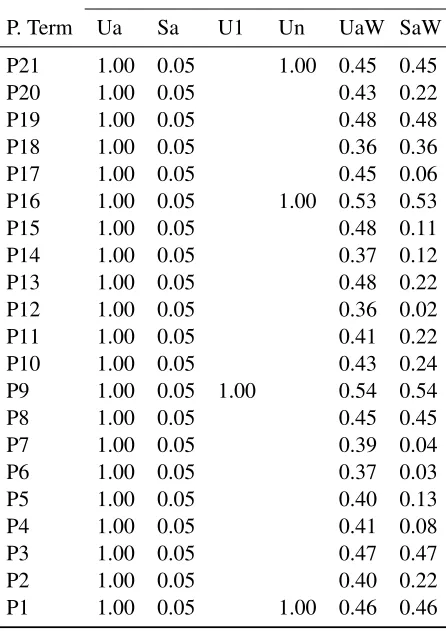
[image:5.612.76.300.61.286.2]mod-els (S) treat nested pseudo-terms with varying levels of synonymy. Unstructured models (U) treat nested pseudo-terms as independent. Selective models re-tain only a subset (1 or n) of the pseudo-terms from each nested region; inclusive models retain them all (a). Finally, weighted models (W) include a heuristic adjustment to give some pseudo-terms (in our experiments, longer ones) greater influence; un-weighted models treat each pseudo-term in the same manner. Table 1 illustrates the weights given to each term by each of the retrieval models defined below. Unweighted models implicitly take a binary approach to term weighting—with unweighted se-lective models omitting many pseudo-terms—while structured and weighted models yield real values be-tween zero and one. Note that both weighted and unweighted models reward term repetition (term quency) and term specificity (inverse collection fre-quency).
4.2 Bag-of-Words Baseline (Ua)
Our first set of experiments had three goals: 1) to serve as a dry run for system development, as we had no prior experience with indexing or ranked re-trieval based on pseudo-terms; 2) to gain experience with performing relevance judgments using only the audio responses; and 3) to understand the feasibility of speech retrieval based on pseudo-terms. For these initial experiments, each pseudo-term was treated as a “word” in a bag-of-words representation (coded Ua). No consideration was given to term length or nesting. Although this set of runs was largely ex-ploratory, it provided a good baseline for compari-son to other methods considered.
4.3 Terms as Synonyms (Sa, U1)
Moving beyond the bag of words method of term selection involves various forms of term analysis within an overlapping region. The first family of methods treats terms in each overlapping group as synonymous. Aside from being straightforward, treating terms as unweighted synonyms has been a successful technique in cross-language IR. There are generally two methods that can be used in such cases. The first is to treat all overlapping pseudo-terms as synonyms of a single term. This is accom-plished in Indri by placing each pseudo-term in an overlapping region within the syn operator. This
Retrieval Model
P. Term Ua Sa U1 Un UaW SaW
P21 1.00 0.05 1.00 0.45 0.45
P20 1.00 0.05 0.43 0.22
P19 1.00 0.05 0.48 0.48
P18 1.00 0.05 0.36 0.36
P17 1.00 0.05 0.45 0.06
P16 1.00 0.05 1.00 0.53 0.53
P15 1.00 0.05 0.48 0.11
P14 1.00 0.05 0.37 0.12
P13 1.00 0.05 0.48 0.22
P12 1.00 0.05 0.36 0.02
P11 1.00 0.05 0.41 0.22
P10 1.00 0.05 0.43 0.24
P9 1.00 0.05 1.00 0.54 0.54
P8 1.00 0.05 0.45 0.45
P7 1.00 0.05 0.39 0.04
P6 1.00 0.05 0.37 0.03
P5 1.00 0.05 0.40 0.13
P4 1.00 0.05 0.41 0.08
P3 1.00 0.05 0.47 0.47
P2 1.00 0.05 0.40 0.22
[image:6.612.316.539.70.386.2]P1 1.00 0.05 1.00 0.46 0.46
Table 1: Weights assigned to pseudo-terms in Fig-ure 3 by each retrieval model (zero values shown as blank).
model is coded Sa.
One risk with the Sa model is that including shorter terms may add more noise than signal. An-other method of dealing with alternatives in the cross-language IR literature is to somehow select a single term from the set. For our experiments with this technique, only the longest pseudo-term from an overlapping set is retained; all other (“nested”) pseudo-terms are simply deleted from the query. The thinking behind this is that the longest term should contain the greatest amount of information. This method is coded U1.
4.4 Length Measure of Specificity (UaW, SaW)
taken, however, to do so in a way that emphasizes coverage rather than nesting depth: more weight should not be given to some region in a query or a response just because it is deeply nested (indicat-ing extreme uncertainty). Both the U1 and Sa mod-els do this, but in a rather unnuanced manner. For a more nuanced approach, inspiration can be found in techniques from cross-language IR that give more weight to some term choices than to others.
Our basic approach is to downweight terms that are dominated temporally by several other terms, where the amount of downweighting is proportional to the number of terms that cover it. This is im-plemented by adjusting the contribution of each pseudo-term based on the extent of its overlap with other pseudo-terms. This could be done in a way that would give the greatest weight to either the shortest or the longest nested pseudo-term.
Formally, let T = {t1, t2, . . . , tn} be the nested
term class, ordered by term length. Letl(ti)denote the length of termti, in seconds. Further, let
w(ti) = 1 +α×α×l(tli)(t i)
be the weight of termti, whereαis a free
parame-ter. For our experiments,α = 0.5. Thediscounted weightis
d(ti) =
w(ti) i= 1
w(ti)× i−Q1
j=1(1−w(tj)) otherwise,
wheretj refers, implicitly, to other members ofT.
The factor 1 − w(ti) is used to discount the weight of ti due to the contribution made by the
previous term(s). We assume T to be in de-scending order and define two heuristics: total weight discounted (UaW) and longest weight dis-counted (SaW). The former uses Indri’s weight operator to specify term weights at query time; the latter useswsyn.
4.5 Coverage Measure of Descriptiveness (Un)
Recall Figure 3, a visual display of pseudo-term overlap within an arbitrary region of speech. Out-side of the bounds of that figure there is either silence—no terms to describe a particular segment of time—or a region of terms that describe some
other utterance within the overall speech. Of par-ticular note, however, is that within the bounds there are a potentially large number of terms that can be used todescribea region of speech. Thus, the larger the number of terms present, the larger the amount of redundancy in the segment of speech each term de-scribes. This observation motivates our final query methodology: removing redundancy within a region by extracting a seemingly descriptive subset of terms from that region. Here we begin to move beyond the ideas inspired by cross-language IR.
Specifically, we posit that an optimal subset con-tains the beginning and ending terms of the region, along with a series of intra-terms that connect the two. It is with this logic that theunweighted shortest path(coded Un) was conceived. Un attempts to find the subset that captures the most information using the smallest number of terms. Formally, consider a directed graph in which the set of vertexes is the set of pseudo-terms within an overlapping region. For an arbitrary pair of vertexes,u, v ∈ V, there is an outgoing edge from u tov if y(u) ≥ x(v), where
x(·)andy(·) denote the start and end time, respec-tively, of a given pseudo-term. Further, the weight of such an edge is the difference between these times:
w(u, v) =y(u)−x(v). Note that an edge betweenu
andvdoes not exist if they have the same start time,
x(u) =x(v).
Letuˆandˆvbe the endpoints of the graph; that is, for allu, v ∈ P, x(ˆu) ≤ x(u), andy(ˆv) ≥ y(v). Our objective is to find the shortest path fromuˆtovˆ
that minimizes the standard deviation of the edge weights. Minimizing standard deviation results in a set of terms with more uniform overlaps.
5 Building a Test Collection
an-swered. To this end, farmers would call into an Inter-active Voice Response (IVR) system and peruse an-swers to existing questions, or would pose their own questions for the community. Other farmers would call into the system to leave answers to those ques-tions. On occasion, there were also a small group of system administrators who would periodically call in to leave announcements that they expected would be of interest to the broader farming community. The system was completely automated—no human intervention or call center was involved.
Avaj Otalo’s recorded speech was divided into 50
queries and 2,999 responses. Queries were state-ments on a particular topic, sometimes phrased as a question, sometimes phrased as an announcement. Responses were sometimes answers to questions, sometimes they were related announcements, and sometimes they were questions on a similar topic. This represented approximately two-thirds of the to-tal audio present in the system. Very short record-ings were omitted, as were those in which little speech activity was automatically detected. The av-erage length of a query is approximately 70 sec-onds (SD = 14.40s), or approximately 61 sec-onds (SD = 15.76s) after automated silence re-moval. Raw response lengths averaged 110 seconds (SD = 88.80s), and 96.52 seconds (SD= 82.75s) after silence was removed.
5.1 Relevance Judgments and Evaluation
Pools for judgment were formed by combining the results from every system reported in our results sec-tion below, along with several other systems that yielded less interesting results that we omit for space reasons. Three native speakers of Gujarati per-formed relevance assessment; none of the three had any role in system development. Relevance assess-ment was performed by listening to the audio and making a graded relevance judgment. Assessors could assign one of the following judgments for each response: 1) unable to assess, 2) not relevant, 3) rel-evant, and 4) highly relevant.
For evaluation measures that require binary judg-ments, and for computing inter-annotator agree-ment, the relevance judgments were subsequently binarized by removing all the unassessable cases. Highly relevant and relevant responses were then collapsed into a single relevant category. To
com-Retrieval Model
U1 Un Ua UaW Sa SaW
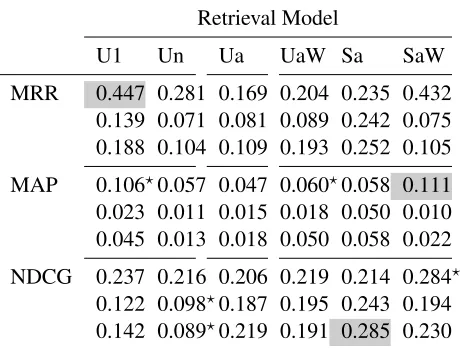
MRR 0.447 0.281 0.169 0.204 0.235 0.432 0.139 0.071 0.081 0.089 0.242 0.075 0.188 0.104 0.109 0.193 0.252 0.105 MAP 0.106?0.057 0.047 0.060?0.058 0.111
0.023 0.011 0.015 0.018 0.050 0.010 0.045 0.013 0.018 0.050 0.058 0.022 NDCG 0.237 0.216 0.206 0.219 0.214 0.284?
0.122 0.098?0.187 0.195 0.243 0.194
[image:8.612.314.545.56.230.2]0.142 0.089?0.219 0.191 0.285 0.230
Table 2: Results for pure (top), medium (middle) and noisy (bottom) clustering for the 10 queries for which more than one relevant response is known. Shaded cells are best-performers, per measure; starred values indicate NDCG or MAP is signifi-cantly better or worse than same-row Ua (two-sided pairedt-test,p <0.05).
pute NDCG, relevant and highly relevant categories were assigned the scores 1 and 2, respectively, while non-relevant judgments retained a score of 0. Three rounds of relevance assessments were conducted as query models were developed and assessor agree-ment was characterized.
6 Results
Each retrieval model was run for each of the three clustering results. For each method, there were three metrics of interest: normalized discounted cumula-tive gain (NDCG), mean reciprocal rank (MRR), and mean average precision (MAP). Results are outlined in Table 2. To limit the effect of quantization noise on the evaluation measures, results are reported for queries having three or more relevant documents. There were a total of 10 such queries, having a to-tal of 61 relevant documents and yielding an average of 6.10 documents per query (SD= 2.13).
Relevance judgments were performed in an order that obscured, from the assessor, the source of the response being judged. The 10 random selections were then evaluated for each of the six topics as if they had been a system run. None of the 60 randomly selected documents were judged by assessors to be relevant to their respective randomly selected topic; thus the random baseline for each of our measures is zero. Without multiple draws, con-fidence intervals on this value cannot be established. However, we are confident that random baselines even as high as 0.1 for any of our measures would be surprising.
Pure clustering produced the best results with re-spect to other clustering domains. SaW was, gener-ally, the best performing retrieval model. Although SaW did not produce the highest pure cluster MRR numbers, it was within 0.015 of U1, the best per-forming method. This is notable given that the dif-ference between U1 and the third best method was 0.166. Further, given the highly quantized nature of MRR, a difference of 0.015 says little about any overall difference between the rankings. In the case of NDCG, SaW was the best performer with pure clustering, significantly better than BoW with pure clustering and second best overall. Sa with noisy clustering was best numerically with NDCG, but the difference is minuscule (1/1000th).
Under pure clustering, Ua was generally the worst performer. Thus, query refinement using the tempo-ral extent of pseudo-terms is a good idea. Further, the MRR of U1 and SaW both approach one-half. Since MRR is the inverse of the harmonic mean of the rank, we can interpret this as meaning that it is likely that a user will get a relevant document some-where in the first three positions of the result set. Such a result is encouraging, as it means that, under the correct conditions, a retrieval system built using zero-resource term detection is a potentially useful tool in practice. We should note, however, that this result was obtained for result-rich queries in which three or more relevant responses were known to ex-ist; MRR results on needle-in-a-haystack queries for which only a single relevance response exists would likely be lower. As with all search, precision-biased measures benefit from collection richness.
7 Conclusions and Future Work
Recent advances in zero-resource term discovery have facilitated spoken document retrieval without the need for traditional transcription or ASR. There are still open questions, however, as to best prac-tices around building useful IR systems on top of these tools. This work has been a step in filling that void. The results show that these zero-resource methods can be used to find relevant responses, and that in some cases such relevant responses can also be highly ranked. Retrieval results vary depending on how much redundancy exists in the transcribed data, and how that redundancy is handled within the query. One common theme, at least for the tech-niques that we have explored, is that pure cluster-ing seems to be the best overall choice when ranked retrieval is the goal. A promising next step is to look to techniques from speech retrieval for insights that might be applicable to the zero-resource setting. One possibility in this regard is to explore extending the zero-resource term matching techniques to gen-erate a lattice representation from which expected pseudo-term counts could be computed.
8 Acknowledgments
The authors wish to thank Nitendra Rajput for pro-viding the spoken queries and responses, and for early discussions about evaluation design; Komal Kamdar, Dhwani Patel, and Yash Patel for perform-ing relevance assessments; and Nizar Habash for his insightful comments on early drafts. Thanks is also extended to the anonymous reviewers for their com-ments and suggestions. This work has been sup-ported in part by NSF award 1218159.
References
Alberto Abad and Ram´on Fernandez Astudillo. 2012. The L2F spoken web search system. InMediaEval. Xavier Anguera, Florian Metze, Andi Buzo, Igor Sz¨oke,
and Luis Javier Rodr´ıguez-Fuentes. 2013. The spoken web search task. InMediaEval.
Michael Bendersky, Donald Metzler, and W. Bruce Croft. 2010. Learning concept importance using a weighted dependence model. InProceedings of the Third ACM International Conference on Web Search and Data Mining, pages 31–40.
Michael Bendersky, Donald Metzler, and W. Bruce Croft. 2011. Parameterized concept weighting in verbose queries. InProceedings of the 34th International ACM SIGIR Conference on Research and Development in Information Retrieval, pages 605–614.
Chun-an Chan, Cheng-Tao Chung, Yu-Hsin Kuo, and Lin shan Lee. 2013. Toward unsupervised model-based spoken term detection with spoken queries without an-notated data. InInternational Conference on Acous-tics, Speech and Signal Processing, pages 8550–8554, May.
Jia Cui, Xiaodong Cui, B. Ramabhadran, J. Kim, B. Kingsbury, J. Mamou, L. Mangu, M. Picheny, T.N. Sainath, and A. Sethy. 2013. Developing speech recognition systems for corpus indexing under the IARPA Babel program. In International Conference on Acoustics, Speech and Signal Processing, pages 6753–6757, May.
Mark Drezde, Aren Jansen, Glen Coppersmith, and Ken Church. 2010. NLP on spoken documents without ASR. InConference on Empirical Methods on Natural Language Processing, pages 460–470.
Jonathan Fiscus, Jerome Ajot, John Garofolo, and George Doddington. 2007. Results of the 2006 spoken term detection evaluation. InSIGIR Workshop on Searching Spontaneous Conversational Speech, pages 51–57. Mark Gales, Kate Knill, Anton Ragni, and Shakti Rath.
2014. Speech recognition and keyword spotting for low resource languages: Babel project research at CUED. InSpoken Language Technologies for Under-Resourced Languages.
Aren Jansen and Benjamin Van Durme. 2011. Efficient spoken term discovery using randomized algorithms. InAutomatic Speech Recognition and Understanding. Aren Jansen, Kenneth Church, and Hynek Hermansky. 2010. Towards spoken term discovery at scale with zero resources. In Interspeech Conference, pages 1676–1679.
Aren Jansen, Benjamin Van Durme, and Pascal Clark. 2012. The JHU-HLTCOE spoken web search system for MediaEval. InMediaEval.
Hardik Joshi and Jerome White. 2014. Document sim-ilarity amid automatically detected terms. Forum for Information Retrieval Evaluation, December.
Matthew Lease. 2009. An improved Markov random field model for supporting verbose queries. In Pro-ceedings of the 32nd International ACM SIGIR Con-ference on Research and Development in Information Retrieval, pages 476–483.
Florian Metze, Nitendra Rajput, Xavier Anguera, Marelie Davel, Guillaume Gravier, Charl van Heerden, Gau-tam Mantena, Armando Muscariello, Kishore Prahal-lad, Igor Szoke, and Javier Tejedor. 2012. The spoken web search task at MediaEval 2011. InInternational Conference on Acoustics, Speech and Signal Proccess-ing, pages 3487–3491.
Douglas Oard, Jerome White, Jiaul Paik, Rashmi Sankepally, and Aren Jansen. 2013. The FIRE 2013 question answering for the spoken web task. Forum for Information Retrieval Evaluation, December. Douglas W. Oard. 2012. Query by babbling: A research
agenda. InWorkshop on Information and Knowledge Management for Developing Regions, pages 17–22. Alex Park and James R. Glass. 2008. Unsupervised
pattern discovery in speech. Transactions on Audio, Speech, and Language Processing, 16(1):186–197. Neil Patel, Deepti Chittamuru, Anupam Jain, Paresh
Dave, and Tapan S. Parikh. 2010. Avaaj Otalo: A field study of an interactive voice forum for small farmers in rural India. InHuman Factors in Computing Systems, pages 733–742.
Nitendra Rajput and Florian Metze. 2011. Spoken web search. InMediaEval.
Amanda Spink, Dietman Wolfram, Bernard Jansen, and Tefko Saracevic. 2001. Searching the Web: The pub-lic and their queries. Journal of the American Society for Information Science and Technology, 52(3):226– 234.
Trevor Strohman, Donald Metzler, Howard Turtle, and W. Bruce Croft. 2004. Indri: A language model-based search engine for complex queries. In International Conference on Intelligence Analysis.
Krysta Svore, Pallika Kanani, and Nazan Khan. 2010. How good is a span of terms? exploiting proximity to improve Web retrieval. InProceedings of the 33rd International ACM SIGIR Conference on Research and Development in Information Retrieval, pages 154– 161.