140
SpatialVOC2K: A Multilingual Dataset of Images with Annotations and
Features for Spatial Relations between Objects
Anja Belz
Computing, Engineering and Mathematics University of Brighton
Lewes Road, Brighton BN2 4GJ, UK [email protected]
Adrian Muscat
Communications and Computer Engineering University of Malta
Msida MSD 2080, Malta [email protected]
Pierre Anguill Mouhamadou Sow Ga´etan Vincent Yassine Zinessabah
INSA Rouen Normandie 685 Avenue de l’Universit´e 76800 Saint-Etienne-du-Rouvray, France
Abstract
We present SpatialVOC2K, the first multi-lingual image dataset with spatial relation annotations and object features for image-to-text generation, built using 2,026 im-ages from the PASCAL VOC2008 dataset. The dataset incorporates (i) the labelled object bounding boxes from VOC2008, (ii) geometrical, language and depth fea-tures for each object, and (iii) for each pair of objects in both orders, (a) the single best preposition and (b) the set of possible prepositions in the given language that de-scribe the spatial relationship between the two objects. Compared to previous ver-sions of the dataset, we have roughly dou-bled the size for French, and completely reannotated as well as increased the size of the English portion, providing single best prepositions for English for the first time. Furthermore, we have added explicit 3D depth features for objects. We are re-leasing our dataset for free reuse, along with evaluation tools to enable compara-tive evaluation.
1 Introduction
Research in image labelling, description and un-derstanding has a long tradition, but has recently seen explosive growth. Work in this area is most commonly motivated in terms of accessibility and data management, and has a range of different spe-cific application tasks. One current research
fo-cus is detection of relations between objects, in particular for image description generation, and the research presented here contributes to this line of work with a new dataset, SpatialVOC2K,1 in which object pairs in images have been an-notated with spatial relations encoded as sets of prepositions, specifically for image-to-text gener-ation. We start below with the source datasets from which we obtained the images, bounding boxes, and candidate prepositions (Section2), fol-lowed by an overview of directory structure and file schemas (Section3), and a summary of the an-notation process (Section4) and spatially relevant features (Section5). We describe the two evalu-ation tools supplied with the dataset (Section 6), and finish with a survey of other datasets with ob-ject relation annotations (Section7).
2 Source Data
Our main data source for SpatialVOC2K was the PASCAL VOC2008 image dataset (Everingham et al., 2010) in which every object belonging to one of 20 object classes is annotated with class la-bel, bounding box (BB), viewpoint, truncation, oc-clusion, and identification difficulty (Everingham et al., 2010). Of these annotations we retain just the BB geometries and the class labels (aeroplane, bird, bicycle, boat, bottle, bus, car, cat, chair, cow, dining table, dog, horse, motorbike, person, potted plant, sheep, sofa, train, tv/monitor).
We also used Rashtchian et al.’s VOC’08 1K corpus (2010), which has 5 descriptions per
age obtained via Mechanical Turk for 50 images from each VOC2008 class, in order to determine an initial set of candidate prepositions for our an-notations (for details see Section4). Due to quality control measures, the VOC’08 1K descriptions are of relatively high quality with few errors.
For SpatialVOC2K, we selected all images from the VOC2008 data that had two or three object bounding boxes (BBs), meaning that images con-tained exactly two and three objects from the VOC2008 object classes, respectively. We also selected all images with four and five BBs where three were of normal size and the remainder very small (bearing the VOC2008 label ‘difficult’). This selection process resulted in a set of 2,026 images with 9,804 unique object pairs. Numbers of BBs in images were distributed as follows:
Number of BBs 2 3 3+1 3+2
Number of images 1,020 534 357 141
For each image, we then (i) collected additional annotations (Section 4) which list, for each or-dered object pair, (a) the single best, and (b) all possible prepositions that correctly describe the spatial relationship between the objects; and (ii) computed a range of spatially relevant features from the image and BB geometries, BB labels, and image depth maps (Section1). All annotations and features are included in this dataset release.
3 SpatialVOC2K Structure and Schemas
The overall structure and file conventions of the SpatialVOC2K dataset mirror those of the VOC2008 dataset where possible:
SpatialVOC2K
Annotations Best
2008 000002.xml
2008 000003.xml ...
All
2008 000002.xml
2008 000003.xml ...
Evaluation Tools
systemAccuracy.py
relationPrecision.py
Spatial Features
2008 000002.xml
2008 000003.xml ...
All files in the Annotationsdirectory start with a
line that is simply the original annotations from VOC2008. In the Best subdirectory, the remain-ing lines have the pattern Object1 Object2
Preposition, whereObject1 andObject2
are the exact word strings, including any sub-scripts, of the object labels in the first line in the file, andPrepositionis the single best prepo-sition chosen by annotators for the two given ob-jects presented in the given order (more about object order in Section 4 below). Each pair of annotated objects is thus associated with exactly two prepositions in theBestfiles, the best human-selected preposition for each order. The following is a simple example of aBestfile:
1 VOC2012 2008 000008.jpg The VOC2008 Database PASCAL VOC2008 flickr 500 442 3 0 horse Left 0 1 53 87 471 420 0 person Unspecified 1 0 158 44 289 167 0
2 horse person under 3 person horse on
In theAll directory, files have the same structure except that in the preposition lines, instead of a single preposition, there are as many prepositions as were selected by the human annotators as pos-sible for a given ordered object pair.
The Spatial Features files also have the same basic structure, except that instead of prepositions, there are 19 feature-value pairs (explained in Sec-tion5) for each ordered object pair (some feature values differ depending on object order), e.g.:
1 VOC2012 2008 000008.jpg The VOC2008 Database PASCAL VOC2008 flickr 500 442 3 0 horse Left 0 1 53 87 471 420 0 person Unspecified 1 0 158 44 289 167 0
2 horse person F0 12 F1 14 F2 0.65 F3 0.42 F4 1.54 ...
3 person horse F0 14 F1 12 F2 0.42 F3 0.65 F4 0.65 ...
In the following three sections, we explain how we obtained the preposition annotations and spa-tial features, and how the metrics encoded by the evaluation tools are defined.
4 Preposition Annotations
We derived a set of candidate prepositions from the VOC2008 1K dataset (Section 2) by pars-ing the 5,000 descriptions in it with the Stanford Parser version 3.5.22 with the PCFG model, ex-tracting the nmod:prepprepositional modifier re-lations, and manually removing the non-spatial
2
ones. This gave us 38 English prepositions:
V0E = {about, above, across, against, along, alongside, around, at, atop, behind, below, be-neath, beside, beyond, by, close to, far from, in, in front of, inside, inside of, near, next to, on, on top of, opposite, outside, outside of, over, past, through, toward, towards, under, under-neath, up, upon, within}
To obtain prepositions for French, we first asked two French native speakers to compile a list of possible translations of the English prepositions, and to check these against 200 sample images rdomly selected from the complete set to be an-notated. This produced 21 prepositions which were reduced to 19, based on evidence from pre-vious work (Muscat and Belz,2015), by eliminat-ing prepositions that were used fewer than three times by annotators (en haut de, parmi). After the first batch of 1,020 images had been anno-tated, we furthermore merged prepositions which co-occur with another preposition more than 60%3 of the times they occur in total (´a l’interieur de, en dessous de), in accordance with the general sense of synonymity defined in previous work ( Mus-cat and Belz, 2017). We found this kind of co-occurrence to be highly imbalanced, e.g. the like-lihood of seeing ´a l’interieur de given dans is 0.43, whereas the likelihood of seeingdansgiven ´a l’interieur deis 0.91. We take this as justifica-tion for merging ´a l’interieur deintodans, rather than the other way around, and proceed in this way for all prepositions. The process leaves a final set of 17 French prepositions:
VF ={`a cˆot´e de, ´a l’´exterieur de, au dessus de, au niveau de, autour de, contre, dans, derri`ere, devant, en face de, en travers de, le long de, loin de, par del`a, pr`es de, sous, sur}
We also reduced the set of 38 English prepositions, using the same elimination process, starting with prepositions that occurred fewer than three times (toward, towards, about, across, along, outside, outside of, through, up). A further 12 prepositions were merged into others (within, inside, inside of, beside, alongside, by, against, upon, atop, on top of, beneath, under), yielding a final set of 17 En-glish prepositions:
VE = {above, around, at, behind, below, be-yond, close to, far from, in, in front of, near, next to, on, opposite, over, past, underneath}
3This is a very high threshold and far above co-occurrence
percentages for any other preposition pairs.
As discussed in more detail in previous work (Muscat and Belz, 2017), we make the domain-specific assumption that there is a one-to-one map-ping from each preposition to the SR it denotes (whereas an SR can map to multiple prepositions). While our machine learning task is SR detec-tion, we ask annotators to annotate our data with the corresponding prepositions (a more human-friendly task).
We used the above preposition sets in collecting annotations as follows. For each object pair Oi andOj in each image, and for both orderings of the object labels,Li, LjandLj, Li, the task for an-notators was to select (i) the single best preposition for the given pair (free text entry), and (ii) the pos-sible prepositions for the given pair (selected from a given list) that accurately described the relation-ship between the two objects in the pair, given the templateL1 is L2(isbecomesetfor French).
Even though in annotation task 1, annotators were not limited in their choice of preposition, they did not use any that were not in the list of prepositions offered in annotation task 2 (a few typos we corrected manually). As it would have been virtually impossible to remember the exact list of prepositions and only use those, we inter-pret this as meaning that annotators did not feel other prepositions were needed.
We used average pairwise kappa to assess inter-annotator and intra-inter-annotator agreement as de-scribed in previous work (Muscat and Belz,2017). First, figures for the first batch of French annota-tions (1,020 images with 2 or 3 objects in BBs4). For single best prepositions (annotation task 1), average inter-annotator agreement was 0.67, and average intra-annotator agreement was 0.81. For all possibleprepositions (annotation task 2), age inter-annotator agreement was 0.63, and aver-age intra-annotator agreement was 0.77.
For the second batch of French annotations (1,006 images with 3, 4 or 5 BBs), average inter-annotator agreement for single best prepositions (annotation task 1) was 0.33, and average intra-annotator agreement was 0.66. For all possible prepositions (annotation task 2), average inter-annotator agreement was 0.3, and average intra-annotator agreement was 0.62. A possible reason for the lower annotator agreement on batch 2 is that as the number of dominant objects in an
im-4Annotators were only ever shown images with 2 BBs in
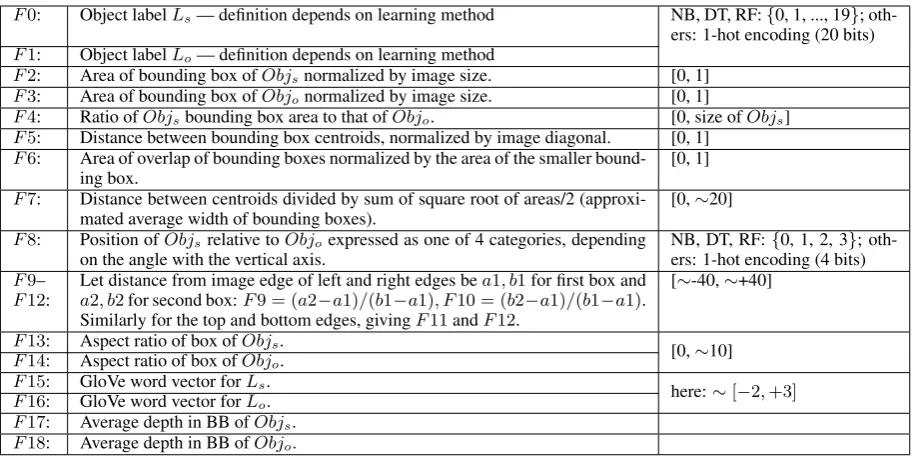
F0: Object labelLs— definition depends on learning method NB, DT, RF:{0, 1, ..., 19};
oth-ers: 1-hot encoding (20 bits)
F1: Object labelLo— definition depends on learning method
F2: Area of bounding box ofObjsnormalized by image size. [0, 1]
F3: Area of bounding box ofObjonormalized by image size. [0, 1]
F4: Ratio ofObjsbounding box area to that ofObjo. [0, size ofObjs]
F5: Distance between bounding box centroids, normalized by image diagonal. [0, 1]
F6: Area of overlap of bounding boxes normalized by the area of the smaller bound-ing box.
[0, 1]
F7: Distance between centroids divided by sum of square root of areas/2 (approxi-mated average width of bounding boxes).
[0,∼20]
F8: Position ofObjsrelative toObjoexpressed as one of 4 categories, depending
on the angle with the vertical axis.
NB, DT, RF:{0, 1, 2, 3}; oth-ers: 1-hot encoding (4 bits)
F9–
F12:
Let distance from image edge of left and right edges bea1, b1for first box and
a2, b2for second box:F9 = (a2−a1)/(b1−a1), F10 = (b2−a1)/(b1−a1). Similarly for the top and bottom edges, givingF11andF12.
[∼-40,∼+40]
F13: Aspect ratio of box ofObjs.
[0,∼10]
F14: Aspect ratio of box ofObjo.
F15: GloVe word vector forLs.
here:∼[−2,+3]
F16: GloVe word vector forLo.
F17: Average depth in BB ofObjs.
[image:4.595.72.530.61.289.2]F18: Average depth in BB ofObjo.
Table 1: Spatially relevant features as included in SpatialVOC2K. Note that the 19 numbered features above correspond to feature vectors of length between 116 and 140, depending on conversion method for ML inputs.
age increases, the annotation task becomes more difficult; we also used different annotators for the second batch which may be a contributing factor.5
5 Spatially Relevant Features
Table1provides an overview of the 19 features in-cluded in SpatialVOC2K: F0, F1, F15 and F16 are language features. F0 is the class label of the first object, F1 of the second (e.g. person). F15 and F16 are GloVe word vectors of length 50 ( Pen-nington et al., 2014) for the object labels.6 F2– F14 are visual features measuring various aspects of the geometries of the image and two bounding boxes (BBs). Most features express a property of just one of the objects, but F4–F9 express a prop-erty of both objects jointly, e.g. F6 is the normal-ized BB overlap.
F17 and F18 are the average pixel-level depth value within the BB of Objs and Objo, respec-tively. Pixel-level depth values were computed via the method described in (Birmingham et al.,
2018), which uses depth maps computed with monoDepth7(Godard et al.,2017) .
5
Inter-AA/intra-AA for English and additional dataset statistics will be added to the project home on Github.
6GloVe is a count-based method for creating distributed
word representations.
7https://github.com/mrharicot/monodepth
6 Evaluation Tools
SpatialVOC2K includes two evaluation tools which we have used in all previous work involving similar data. The two tools,systemAccuracy
andrelationPrecision implement the fol-lowing two methods, respectively.
System-level Accuracy: There are four dif-ferent variants of system-level Accuracy, denoted Acc(n),n∈ {1,2,3,4}. Each variant returns Ac-curacy rates for the topnoutputs returned by sys-tems, in the sense that a system output is consid-ered correct if at least one of the reference prepo-sitions (the human-selected prepoprepo-sitions from the dataset annotations) can be found in the top n prepositions returned by the system (for n = 1
this yields standard Accuracy).
Weighted Average Per-preposition Precision: This measure, denoted AccP, computes the weighted mean of individual per-preposition cision scores. The individual per-preposition pre-cision for a given system and a given preposition p is the proportion of times that p is among the corresponding human-selected prepositions out of all the times that p is returned as the top-ranked preposition by the system.
7 Related Datasets
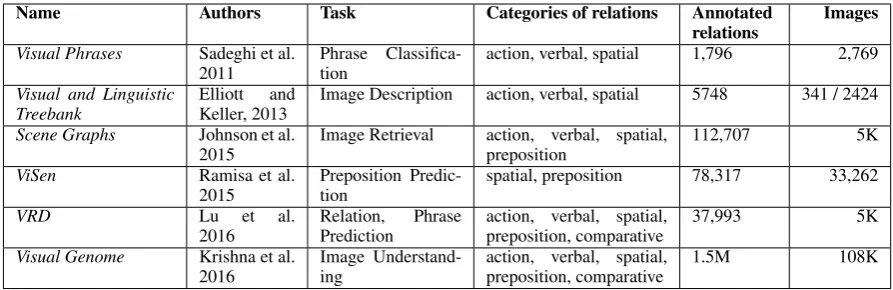
Name Authors Task Categories of relations Annotated relations
Images
Visual Phrases Sadeghi et al. 2011
Phrase Classifica-tion
action, verbal, spatial 1,796 2,769
Visual and Linguistic Treebank
Elliott and Keller, 2013
Image Description action, verbal, spatial 5748 341 / 2424
Scene Graphs Johnson et al. 2015
Image Retrieval action, verbal, spatial, preposition
112,707 5K
ViSen Ramisa et al.
2015
Preposition Predic-tion
spatial, preposition 78,317 33,262
VRD Lu et al.
2016
Relation, Phrase Prediction
action, verbal, spatial, preposition, comparative
37,993 5K
Visual Genome Krishna et al. 2016
Image Understand-ing
action, verbal, spatial, preposition, comparative
[image:5.595.75.522.61.206.2]1.5M 108K
Table 2: Overview of related datasets. For explanation of relation categories see in text.
in images. Types of relationships that have been annotated include actions (e.g.person kicks ball), other verbal relations (person wears shirt), spa-tial relations (person on horse), and comparative relations (one car bigger than another). In this section, we provide a brief overview of available datasets with relation annotations, in terms of their stated purpose (application task), the types of re-lations included, the range of spatial prepositions included, as well as size and other properties of the dataset. Table2has a summary of the datasets.
Visual Phrases (Sadeghi and Farhadi, 2011)
was the first image dataset with object relation an-notations, and used the concept of a visual phrase (VP) which is defined as a bounding box that sur-rounds two objects in an image. Out of 17 differ-ent types of VPs annotated in the data set, 13 com-prise 2 objects, and 4 comcom-prise one object. How-ever, there are 120 predicates per object category.
Visual and Linguistic Treebank (Elliott and Keller,2013)contains 341 images that are anno-tated with regions (362 in total) and visual depen-dency representations, which unfold to a total of 5,748 spatial relations (from a set of 8) and are aligned to the dependency parse of the image de-scription. This setup allows for the prediction of actions as well as spatial relations (using a set of 8 manual created rules).
Scene Graphs (Johnson et al.,2015)is a dataset of 5,000 human-generated scene graphs grounded to images; scene graphs describe objects and their relationships.
ViSen (Ramisa et al., 2015) associates sets of (object 1, preposition, object 2) triples with im-ages, where the triples have been extracted from parses of the image descriptions in MSCOCO (Lin
et al., 2014) and Flickr30k (Young et al., 2014). Prepositions covered include all those extracted from the image descriptions including non-spatial ones. By far not all descriptions contain preposi-tions so not all images have spatial relation annota-tions; the task addressed is preposition prediction, not spatial relation prediction.
Visual Relationships Dataset (VRD) (Lu et al., 2016) contains 5,000 images, 100 object cate-gories, 6,672 unique relationships, and 24.25 re-lations per object category. Scant information is available about how the dataset was created other than that relations broadly fit into the categories action, verbal, spatial, preposition and compara-tive.
Visual Genome (Krishna et al., 2017) contains 108K images, split into 4M regions, correspond-ing to 108K scene graphs and about 4K region graphs, 1.5M object-object relations, 40K unique relations, and an average of 17 relations per image and 0.63 relations per region.
8 Future Work
We plan to expand the SpatialVOC2K dataset to other languages, and to more object pairs per lan-guage, in the future. Given the ever growing need for image description and labelling, and in combi-nation with the image segmentation and descrip-tion annotadescrip-tions that exist for the same VOC im-ages, SpatialVOC2K can potentially be used in a range of different application tasks, including but not limited to image description generation.
References
images. InProceedings of INLG’18.
D. Elliott and F. Keller. 2013. Image description using visual dependency representations. In Proc. 18th Conf. on Empirical Methods in Natural Language Processing (EMNLP), pages 1292–1302, Seattle.
M. Everingham, L. Van Gool, C. K. Williams, J. Winn, and A. Zisserman. 2010. The pascal visual object classes (voc) challenge. Int. J. of Computer Vision, 88(2):303–338.
C. Godard, O. M. Aodha, and G. J. Brostow. 2017. Unsupervised monocular depth estimation with left-right consistency. In 2017 IEEE Conference on Computer Vision and Pattern Recognition (CVPR), pages 6602–6611.
J. Johnson, R. Krishna, M. Stark, L. Li, D. A. Shamma, M. S. Bernstein, and L. Fei-Fei. 2015. Image re-trieval using scene graphs. In2015 IEEE Confer-ence on Computer Vision and Pattern Recognition (CVPR), pages 3668–3678.
Ranjay Krishna, Yuke Zhu, Oliver Groth, Justin John-son, Kenji Hata, Joshua Kravitz, Stephanie Chen, Yannis Kalantidis, Li-Jia Li, David A. Shamma, Michael S. Bernstein, and Li Fei-Fei. 2017. Vi-sual genome: Connecting language and vision us-ing crowdsourced dense image annotations. Inter-national Journal of Computer Vision, pages 1–42.
Tsung-Yi Lin, Michael Maire, Serge Belongie, James Hays, Pietro Perona, Deva Ramanan, Piotr Doll´ar, and C Lawrence Zitnick. 2014. Microsoft Coco: Common objects in context. In European confer-ence on computer vision, pages 740–755. Springer.
Cewu Lu, Ranjay Krishna, Michael Bernstein, and Li Fei-Fei. 2016. Visual relationship detection with language priors. InComputer Vision – ECCV 2016, pages 852–869, Cham. Springer International Pub-lishing.
A. Muscat and A. Belz. 2015. Generating descrip-tions of spatial reladescrip-tions between objects in im-ages. In Proc. 15th European Workshop on Natu-ral Language Generation (ENLG), pages 100–104, Brighton, UK.
Adrian Muscat and Anja Belz. 2017. Learning to gen-erate descriptions of visual data anchored in spatial relations. IEEE Computational Intelligence Maga-zine, 12(3):29–42.
Jeffrey Pennington, Richard Socher, and Christopher Manning. 2014. Glove: Global vectors for word representation. In Proc. 19th Conference on Em-pirical Methods in Natural Language Processing (EMNLP), pages 1532–1543, Doha, Qatar.
Arnau Ramisa, Josiah Wang, Ying Lu, Emmanuel Dellandrea, Francesc Moreno-Noguer, and Robert Gaizauskas. 2015. Combining geometric, textual and visual features for predicting prepositions in
image descriptions. In Proc. 20th Conf. on Em-pirical Methods in Natural Language Processing (EMNLP), pages 214–220, Lisbon, Portugal.
Cyrus Rashtchian, Peter Young, Micah Hodosh, and Julia Hockenmaier. 2010. Collecting image anno-tations using amazon’s mechanical turk. In Proc. NAACL HLT 2010 Workshop on Creating Speech and Language Data with Amazon’s Mechanical Turk, pages 139–147, Los Angeles, California.
Mohammad Amin Sadeghi and Ali Farhadi. 2011. Recognition using visual phrases. InComputer Vi-sion and Pattern Recognition (CVPR), pages 1745– 1752. IEEE Computer Society.