594
A Stable Variational Autoencoder for Text Modelling
Ruizhe Li♠, Xiao Li♠, Chenghua Lin♥, Matthew Collinson♠and Rui Mao♠ ♠Department of Computing Science, University of Aberdeen, UK
{r02rl17, x.li, matthew.collinson, r03rm16}@abdn.ac.uk
♥Department of Computer Science, University of Sheffield, UK
Abstract
Variational Autoencoder (VAE) is a powerful method for learning representations of high-dimensional data. However, VAEs can suffer from an issue known as latent variable collapse (or KL loss vanishing), where the posterior collapses to the prior and the model will ig-nore the latent codes in generative tasks. Such an issue is particularly prevalent when em-ploying VAE-RNN architectures for text mod-elling (Bowman et al.,2016). In this paper, we present a simple architecture called holistic regularisation VAE (HR-VAE), which can ef-fectively avoid latent variable collapse. Com-pared to existing VAE-RNN architectures, we show that our model can achieve much more stable training process and can generate text with significantly better quality.
1 Introduction
Variational Autoencoder (VAE) (Kingma and Welling, 2013) is a powerful method for learning representations of high-dimensional data. How-ever, recent attempts of applying VAEs to text modelling are still far less successful compared to its application to image and speech ( Bach-man,2016;Fraccaro et al.,2016;Semeniuta et al., 2017). When applying VAEs for text modelling, recurrent neural networks (RNNs)1are commonly used as the architecture for both encoder and de-coder (Bowman et al.,2016;Xu and Durrett,2018; Dieng et al., 2019). While such a VAE-RNN based architecture allows encoding and generating sentences (in the decoding phase) with variable-length effectively, it is also vulnerable to an issue known as latent variable collapse (or KL loss van-ishing), where the posterior collapses to the prior and the model will ignore the latent codes in gen-erative tasks.
1NB: here we refer RNN to any type of recurrent neural
architectures including LSTM and GRU.
Various efforts have been made to alleviate the latent variable collapse issue. Bowman et al. (2016) uses KL annealing, where a variable weight is added to the KL term in the cost function at training time. Yang et al. (2017) discovered that there is a trade-off between the contextual capacity of the decoder and effective use of encoding infor-mation, and developed a dilated CNN as decoder which can vary the amount of conditioning con-text. They also introduced a loss clipping strategy in order to make the model more robust. Xu and Durrett(2018) addressed the problem by replacing the standard normal distribution for the prior with the von Mises-Fisher (vMF) distribution. With vMF, the KL loss only depends on the concentra-tion parameter which is fixed during training and testing, and hence results in a constant KL loss. In a more recent work, Dieng et al. (2019) avoided latent variable collapse by including skip connec-tions in the generative model, where the skip con-nections enforce strong links between the latent variables and the likelihood function.
Although the aforementioned works show ef-fectiveness in addressing the latent variable col-lapse issue to some extent, they either require carefully engineering to balance the weight be-tween the reconstruction loss and KL loss ( Bow-man et al., 2016; Sønderby et al., 2016), or re-sort to designing more sophisticated model struc-tures (Yang et al.,2017;Xu and Durrett,2018; Di-eng et al.,2019).
Encoder
𝑡 = 0
Encoder
𝑡 = 1
Encoder
𝑡 = 𝑁
𝑤' 𝑤( 𝑤)
ℎ' ℎ(
Decoder 𝑤'+ 𝑤(+ … 𝑤)+
ℎ) 𝒩(0,1)
𝐾𝐿
𝑧 𝜇 𝜎7
(a)
Encoder
𝑡 = 0 Encoder𝑡 = 1 Encoder𝑡 = 𝑁
𝑤' 𝑤( 𝑤)
ℎ' ℎ( ℎ)
Decoder
𝑤'+ 𝑤(+ … 𝑤)+ 𝒩(0,1)
𝐾𝐿
𝜇 𝜎6 𝑧 𝜇 𝜎6
𝒩(0,1)
𝐾𝐿
𝜇 𝜎6 𝒩(0,1)
𝐾𝐿
(b)
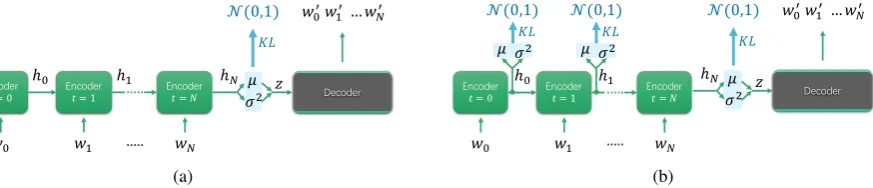
Figure 1: (a) The typical architecture of RNN-based VAE; (b) the proposed HR-VAE architecture.
is generic and can be applied to any existing VAE-RNN-based architectures.
We evaluate our model against several strong baselines which apply VAE for text mod-elling (Bowman et al., 2016; Yang et al., 2017; Xu and Durrett, 2018). We conducted experi-ments based on two public benchmark datasets, namely, the Penn Treebank dataset (Marcus and Marcinkiewicz) and the end-to-end (E2E) text generation dataset (Novikova et al., 2017). Ex-perimental results show that our HR-VAE model not only can effectively mitigate the latent variable collapse issue with a stable training process, but also can give better predictive performance than the baselines, as evidenced by both quantitative (e.g., negative log likelihood and perplexity) and qualitative evaluation. The code for our model is available online2.
2 Methodology
2.1 Background of VAE
A variational autoencoder (VAE) is a deep genera-tive model, which combines variational inference with deep learning. The VAE modifies the conven-tional autoencoder architecture by replacing the deterministic latent representationzof an inputx
with a posterior distributionP(z|x), and imposing a prior distribution on the posterior, such that the model allows sampling from any point of the latent space and yet able to generate novel and plausible output. The prior is typically chosen to be stan-dard normal distributions, i.e., P(z) = N(0,1), such that the KL divergence between posterior and prior can be computed in closed form (Kingma and Welling,2013).
To train a VAE, we need to optimise the marginal likelihood Pθ(x) =
R
P(z)Pθ(x|z)dz,
where the log likelihood can take following form:
2https://github.com/ruizheliUOA/HR-VAE
logPθ(x) =L(θ, φ;x) +KL(Qφ(z|x)kPθ(z|x))
(1)
L(θ, φ;x) =EQφ(z|x)[logPθ(x|z)]
−KL(Qφ(z|x)kP(z)) (2)
HereQφ(z|x)is the variational approximation for
the true posteriorPθ(z|x). Specifically, Qφ(z|x)
can be regarded as an encoder (a.k.a. the recogni-tion model) and Pθ(x|z) the decoder (a.k.a. the
generative model). Both encoder and decoder are implemented via neural networks. As proved in (Kingma and Welling, 2013), optimising the marginal log likelihood is essentially equivalent to maximisingL(θ, φ;x), i.e., the evidence lower bound (ELBO), which consists of two terms. The first term is the expected reconstruction error in-dicating how well the model can reconstruct data given a latent variable. The the second term is the KL divergence of the approximate posterior from prior, i.e., a regularisation pushing the learned pos-terior to be as close to the prior as possible.
2.2 Variational Autoendoder with Holistic
Regularisation
In this section, we discuss the technical details of the proposed holistic regularisation VAE (HR-VAE) model, a general architecture which can ef-fectively mitigate the KL vanishing phenomenon.
[image:2.595.87.524.64.158.2]data and a good generative model, it is crucial to impose the standard normal prior on all the hidden states of the RNN-based encoder (see Figure1b), which allows a better regularisation of the model learning process.
We implement the HR-VAE model using a two-layer LSTM for both the encoder and decoder. However, one should note that our architecture can be readily applied to other types of RNN such as GRU. For each time stamp t (see Figure 1b), we concatenate the hidden state ht and the cell
state ct of the encoder. The concatenation (i.e.,
[ht;ct]) is then fed into two linear transformation
layers for estimating µt and σ2t, which are pa-rameters of a normal distribution corresponding to the concatenation ofhtandct. LetQφt(zt|x) =
N(zt|µt,σ2t), we wishQφt(zt|x)to be close to a
priorP(zt), which is a standard Gaussian. Finally,
the KL divergence between these two multivariate Gaussian distributions (i.e., Qφt andP(zt)) will
contribute to the overall KL loss of the ELBO. By taking the average of the KL loss at each time stamp t, the resulting ELBO takes the following form
L(θ, φ;x) =EQφ(zN|x)[logPθ(x|zN)]
− 1
N
N
X
t=0
KL(Qφt(zt|x)kP(zt)).
(3)
As can be seen in Eq.3, our solution to the KL collapse issue does not require any engineering for balancing the weight between the reconstruction term and KL loss as commonly the case in exist-ing works (Bowman et al.,2016;Sønderby et al., 2016). The weight between these two terms of our model is simply1 : 1.
3 Experimental Setup
3.1 Datasets
We evaluate our model on two public datasets, namely, Penn Treebank (PTB) (Marcus and Marcinkiewicz) and the end-to-end (E2E) text generation corpus (Novikova et al., 2017), which have been used in a number of previous works for text generation (Bowman et al.,2016;Xu and Durrett, 2018; Wiseman et al., 2018; Su et al., 2018). PTB consists of more than 40,000 sen-tences from Wall Street Journal articles whereas the E2E dataset contains over 50,000 sentences
of restaurant reviews. The statistics of these two datasets are summarised in Table1.
3.2 Implementation Details
For the PTB dataset, we used the train-test split following (Bowman et al., 2016; Xu and Dur-rett, 2018). For the E2E dataset, we used the train-test split from the original dataset (Novikova et al., 2017) and indexed the words with a fre-quency higher than 3. We represent input data with 512-dimensional word2vec embeddings (Mikolov et al.,2013). We set the dimension of the hidden layers of both encoder and decoder to 256. The Adam optimiser (Kingma and Ba,2014) was used for training with an initial learning rate of 0.0001. Each utterance in a mini-batch was padded to the maximum length for that batch, and the maximum batch-size allowed is 128.
3.3 Baselines
We compare our HR-VAE model with three strong baselines using VAE for text modelling:
VAE-LSTM-base3: A variational autoencoder
model which uses LSTM for both encoder and de-coder. KL annealing is used to tackled the latent variable collapse issue (Bowman et al.,2016);
VAE-CNN4: A variational autoencoder model
with a LSTM encoder and a dilated CNN de-coder (Yang et al.,2017);
vMF-VAE5: A variational autoencoder model
us-ing LSTM for both encoder and decoder where the prior distribution is the von Mises-Fisher (vMF) distribution rather than a Gaussian distri-bution (Xu and Durrett,2018).
4 Experimental Results
We evaluate our HR-VAE model in two experi-mental settings, following the setup of (Bowman et al.,2016;Xu and Durrett,2018). In thestandard setting, the input to the decoder at each time stamp is the concatenation of latent variable z and the ground truth word of the previous time stamp. Un-der this setting, the decoUn-der will be more power-ful because it uses the ground truth word as input, resulting in little information of the training data captured by latent variable z. The inputless set-ting, in contrast, does not use the previous ground truth word as input for the decoder. In other words,
3
https://github.com/timbmg/Sentence-VAE
4
https://github.com/kefirski/contiguous-succotash
Dataset Training Development Testing Avg. sent. length Vocab.
PTB 42,068 3,370 3,761 21.1 10K
[image:4.595.90.506.129.218.2]E2E 42,061 4,672 4,693 22.67 2.8K
Table 1: The statistics of the PTB and E2E datasets.
Model
PTB E2E
Standard Inputless Standard Inputless
NLL PPL NLL PPL NLL PPL NLL PPL
VAE-LSTM-base 101†(2†) 119† 125†(15†) 380† 50 (1.88) 5.77 101 (5.48) 34.70
VAE-CNN 99 (3.1) 113 121 (16.2) 323 41 (3.02) 4.23 82 (5.95) 17.81
vMF-VAE 96†(5.7†) 98† 117†(18.6†) 262† 34 (7.63) 3.29 61 (19.58) 8.52
HR-VAE (Ours) 79 (10.4) 43 85 (17.32) 54 20 (5.37) 2.02 38 (7.78) 3.74
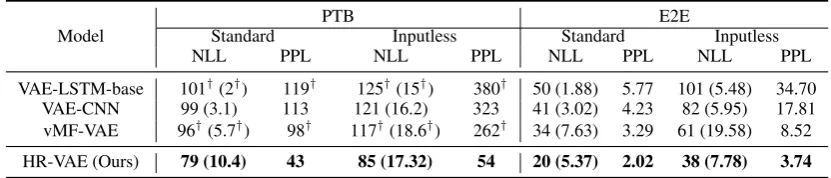
Table 2: Language modelling results on the PTB and E2E datasets.†indicates the results which are reported from the prior publications. KL loss is shown in the parenthesis.
the decoder needs to predict the entire sequence with only the help of the given latent variable z. In this way, a high-quality representation abstract-ing the information of the input sentence is much needed for the decoder, and hence enforcingz to learn the required information.
Overall performance. Table 2 shows the
lan-guage modelling results of our approach and the baselines. We report negative log likelihood (NLL), KL loss, and perplexity (PPL) on the test set. As expected, all the models have a higher KL loss in the inputless setting than the standard set-ting, asz is required to encode more information about the input data for reconstruction. In terms of overall performance, our model outperforms all the baselines in both datasets (i.e., PTB and E2E). For instance, when comparing with the strongest baseline vMF-VAE in the standard setting, our model reduces NLL from 96 to 79 and PPL from 98 to 43 in PTB, respectively. In the inputless setting, our performance gain is even higher, i.e., NLL reduced from 117 to 85 and PPL from 262 to 54. A similar pattern can be observed for the E2E dataset. These observations suggest that our approach can learn a better generative model for data.
Loss analysis. To conduct a more thorough
eval-uation, we further investigate model behaviours in terms of both reconstruction loss and KL loss, as shown in Figure2. These plots were obtained based on the E2E training set using the inputless setting.
We can see that the KL loss of VAE-LSTM-base, which uses Sigmoid annealing (Bowman et al., 2016), collapses to zero, leading to a poor generative performance as indicated by the high
reconstruction loss. The KL loss for both VAE-CNN and vMF-VAE are nonzero, where the for-mer mitigates the KL collapse issue with a KL loss clipping strategy and the latter by replacing the standard normal distribution for the prior with the vMF distribution (i.e., with the vMF distribution, the KL loss only depends on a fixed concentra-tion parameter, and hence results in a constant KL loss). Although both VAE-CNN and vMF-VAE outperform VAE-LSTM-base by a large margin in terms of reconstruction loss as shown in Figure2, one should also notice that these two models actu-ally overfit the training data, as their performance on the test set is much worse (cf. Table 2). In contrast to the baselines which mitigate the KL collapse issue by carefully engineering the weight between the reconstruction loss and KL loss or choosing a different choice of prior, we provide a simple and elegant solution through holistic KL regularisation, which can effectively mitigate the KL collapse issue and achieve a better reconstruc-tion error in both training and testing.
Sentence reconstruction. Lastly, we show some
(b) VAE-CNN
(c) vMF-VAE (d) HR-VAE
(a) VAE-LSTM-base
Figure 2: Training curves of reconstruction loss and KL loss of (a) VAE-LSTM-base, (b) VAE-CNN, (c) vMF-VAE, and (d) our model, based on the E2E training set using the inputless setting.
Input
1. blue spice is a coffee shop in city centre . 2. giraffe is a coffee shop found near the bakers . 3. a pub in the city centre area called blue spice
4. pub located near caf´e sicilia called cocum with a high customer rating
5. the cricketers is a one star coffee shop near the ranch that is not family friendly .
vMF-V
AE
1. blue spice is a coffee in city centre . it is not , and 2. cotto is a coffee shop located near the bakers . . is 5 out of 3. a coffee in the city city area is blue spice spice . the is is
4. located located near caf´e rouge , cotto has a high customer rating and a customer 5. the cricketers is a low rated coffee shop near the bakers that is a star , is is
Ours
1. blue spice is a coffee shop in city centre . 2. giraffe is a coffee shop located near the bakers . 3. a restaurant in the city centre called blue spice italian
4. located place near caf´e sicilia called punter has a high customer rating
[image:5.595.123.477.60.269.2]5. the cricketers is a one star coffee shop near ranch ranch that is not family friendly .
Table 3: Example input sentences from the E2E test dataset (top); sentences reconstructed by vMF-VAE (middle); sentences reconstructed by our model (bottom).
5 Conclusion
In this paper, we present a simple and generic ar-chitecture called holistic regularisation VAE (HR-VAE), which can effectively avoid latent variable collapse. In contrast to existing VAE-RNN models which merely impose a standard normal distribu-tion prior on the last hidden state of the RNN en-coder, our HR-VAE model imposes regularisation on all the hidden states, allowing a better regular-isation of the model learning process. Empirical results show that our model can effectively miti-gate the latent variable collapse issue while giving a better predictive performance than the baselines.
Acknowledgment
This work is supported by the award made by the UK Engineering and Physical Sciences Research
Council (Grant number: EP/P011829/1).
References
Philip Bachman. 2016. An architecture for deep, hier-archical generative models. InAdvances in Neural Information Processing Systems, pages 4826–4834.
Samuel Bowman, Luke Vilnis, Oriol Vinyals, An-drew M Dai, Rafal Jozefowicz, and Samy Ben-gio. 2016. Generating sentences from a continu-ous space. InProceedings of the Twentieth Confer-ence on Computational Natural Language Learning (CoNLL).
Marco Fraccaro, Søren Kaae Sønderby, Ulrich Paquet, and Ole Winther. 2016. Sequential neural models with stochastic layers. InAdvances in neural infor-mation processing systems, pages 2199–2207.
Diederik P Kingma and Jimmy Ba. 2014. Adam: A method for stochastic optimization. arXiv preprint arXiv:1412.6980.
Diederik P Kingma and Max Welling. 2013. Auto-encoding variational bayes. arXiv preprint arXiv:1312.6114.
Mitchell P Marcus and Mary Ann Marcinkiewicz. Building a large annotated corpus of english: The penn treebank. Computational Linguistics, 19(2).
Tomas Mikolov, Ilya Sutskever, Kai Chen, Greg S Cor-rado, and Jeff Dean. 2013. Distributed representa-tions of words and phrases and their compositional-ity. InAdvances in neural information processing systems, pages 3111–3119.
Jekaterina Novikova, Ondˇrej Duˇsek, and Verena Rieser. 2017. The e2e dataset: New challenges for end-to-end generation. InProceedings of the 18th Annual SIGdial Meeting on Discourse and Dialogue, pages 201–206.
Stanislau Semeniuta, Aliaksei Severyn, and Erhardt Barth. 2017. A hybrid convolutional variational au-toencoder for text generation. InProceedings of the 2017 Conference on Empirical Methods in Natural Language Processing, pages 627–637.
Casper Kaae Sønderby, Tapani Raiko, Lars Maaløe, Søren Kaae Sønderby, and Ole Winther. 2016. How to train deep variational autoencoders and proba-bilistic ladder networks. In33rd International Con-ference on Machine Learning (ICML 2016).
Shang-Yu Su, Kai-Ling Lo, Yi Ting Yeh, and Yun-Nung Chen. 2018. Natural language generation by hierarchical decoding with linguistic patterns. In Proceedings of the 2018 Conference of the North American Chapter of the Association for Computa-tional Linguistics: Human Language Technologies, Volume 2 (Short Papers), pages 61–66.
Sam Wiseman, Stuart Shieber, and Alexander Rush. 2018. Learning neural templates for text generation. In Proceedings of the 2018 Conference on Empiri-cal Methods in Natural Language Processing, pages 3174–3187.
Jiacheng Xu and Greg Durrett. 2018. Spherical latent spaces for stable variational autoencoders. In Pro-ceedings of the 2018 Conference on Empirical Meth-ods in Natural Language Processing, pages 4503– 4513.