Proceedings of the 11th International Workshop on Semantic Evaluations (SemEval-2017), pages 139–143, Vancouver, Canada, August 3 - 4, 2017. c2017 Association for Computational Linguistics
OPI-JSA at SemEval-2017 Task 1:
Application of Ensemble learning for computing semantic textual
similarity
Martyna ´Spiewak, Piotr Sobecki and Daniel Kara´s National Information Processing Institute al. Niepodlego´sci 188b, 00-608 Warsaw, Poland
{mspiewak, psobecki, dkaras}@opi.org.pl
Abstract
Semantic Textual Similarity (STS) evalua-tion assesses the degree to which two parts of texts are similar, based on their semantic evaluation. In this paper, we describe three models submitted to STS SemEval 2017. Given two English parts of a text, each of proposed methods outputs the assessment of their semantic similarity.
We propose an approach for computing monolingual semantic textual similarity based on an ensemble of three distinct methods. Our model consists of recursive neural network (RNN) text auto-encoders ensemble with supervised a model of vec-torized sentences using reduced part of speech (PoS) weighted word embeddings as well as unsupervised a method based on word coverage (TakeLab). Addition-ally, we enrich our model with additional features that allow disambiguation of en-semble methods based on their efficiency. We have used Multi-Layer Perceptron as an ensemble classifier basing on estimations of trained Gradient Boosting Regressors. Results of our research proves that us-ing such ensemble leads to a higher ac-curacy due to a fact that each member-algorithm tends to specialize in particular type of sentences. Simple model based on PoS weighted Word2Vec word embed-dings seem to improve performance of more complex RNN based auto-encoders in the ensemble. In the monolingual English-English STS subtask our Ensemble based model achieved mean Pearson correlation of .785 compared with human annotators.
1 Introduction
The objective of a system for evaluating seman-tic textual similarity, is to produce a value which serves as a rating of semantic similarity between pair of text samples. Such task certainly could not be regarded as toy problem, the results could be used to solve multiple real-world problems, e.g. plagiarism detection. We used described meth-ods in STS task in the SemEval 2017 competition (Bethard et al.,2017).
2 Methods
2.1 Data
For the purpose of this research we have used datasets provided by the SemEval challenge or-ganizers containing English sentence pairs coming from several sources. STS Task objective is to produce a value in the range between 0.0 and 5.0, which assessing semantic similarity of a given pair of sentences. Intermediate levels are correspond-ing to partial similarity such as rough or topical equivalence but with differing details. In this study, we have used all English datasets provided by the challenge organizers until this year to train our su-pervised models.
2.2 Models
The core of the system is based on widely used Gradient Boosting algorithm. The main novelty of described system lies in the formulation of its feature vectors.
Each feature vector can be divided into two main parts: similarity scores and sentences’ descriptors. The process of feature extraction compiles simi-larity scores of three distinct methods (described later in detail) — effectively forming an ensemble. Additionally, for every pair of sentences, follow-ing descriptors are also attached to feature vector:
lengths of the evaluated sentences, Word2Vec cov-erage as well as two boolean predicates — one of them indicates if a sentence is a question and an-other one indicating if sentence contains numbers. Word2Vec coverage is defined as follows:
Glv(Si) = |Si|S∩G| i|
where Si denotes set of all words present in ith sentence andGis a set of all words available in Word2Vec.
The logic behind introduction of these descrip-tors is based on observations made during evalu-ation of each separate method. Overall they all achieved a similar Pearson score, but accuracy of every method in context of particular instances of sentence pairs was different. For example, model based on cosine similarity of Word2Vec vectors performed worse in case of long sentences and when the sentences contained words not present in Word2Vec. Ideally introduction of sentences’ de-scriptors to feature vectors would let the regressor ”pick” the right method for each case by learning the correlations between features exhibited by sen-tences and performance of particular method. This hypothesis has been proven true, which is further backed by achieved results.
We used the implementation of Gradient Boost-ing and Multi-layer Perceptron (MLP) from scikit-learn library (Pedregosa et al., 2011). Facilities present in mentioned library were also used for evaluation using 3-fold crossvalidation and hyper-parameters optimization using grid search method. We have used low number of folds in Cross Valida-tion to prevent over-fitting.
2.2.1 TakeLab
This method contributes three components for fea-ture vector used by the meta-regressor. These components correspond to three word similarity measures defined by (ˇSari´c et al.,2012) — ngram overlap, weighted word overlap and WordNet-augmented word overlap. Authors of (ˇSari´c et al., 2012) use Google Books Ngrams for computing in-formation content used in the weighted word over-lap measure — we, in comparison, use the fre-quency list from British National Corpus (Leech, 2016).
Mentioned overlaps were implemented in Java programming language. The WS4J library was used for computing the WordNet path lengths between words with Wu-Palmer method. The
OpenNLP library was used for both lemmatiza-tion and PoS-tagging. For complete overview of TakeLab measures see (ˇSari´c et al.,2012).
2.2.2 Run 1: Part of Speech weighted Word2Vec Similarity (PoS-Word2Vec) Described model is based on a well-documented Word2Vec (Mikolov et al.,2013) method of textual information encoding that allows vectorized repre-sentation of words, enforces vector space proximity for semantically similar words.
Given sentence pairs (x, y) of words length
(ni, nj), part of speech (PoS) weights of words
wxn andwyn and vector representation of words
vxnandvyn coming from given sentencesxandy, respectively.To evaluate vector similarity we have used cosine similarity between vectorsxandy:
cos(x, y) = ||xx|| · ||·yy||
We have extracted following features for each sentence pair, to produce resulting vectorr:
• cosine similarity of the mean of word vectors in each sentence
r(0) =cos
Pni
k=1vxk
ni ,
Pnj k=1vyk
nj
!
• cosine similarity of the mean of word vectors in each sentence weighted by the PoS of the word
r(1) =cos
Pni
k=1wxk·vxk
Pni
k=1wxk ,
Pnj
k=1wyk·vyk
Pnj k=1wyk
!
Furthermore, we have analyzed cross sentence word-wise cosine similarity:
M(i, j) =cos(vxi, vyj),
and obtained maximum, PoS weighted, cross sen-tence word similarity vectorv:
v(k) = max
j=1,...,njM(k, j)·wx, fork= 1, . . . , ni, and
v(k) = max
i=1,...,niM(i, k−ni)·wy,
We have extracted following statistical features from the resulting vectorvand added to the result-ing vectorr:, Mean , Kurtosis, Skewness, Standard deviation, Maximum value, Minimum value, Per-centiles (5th, 25th, 75th and 95th).
r(3) =mean(v)
r(4) =kurtosis(v)
r(5) =skewness(v)
r(6) =sd(v)
r(7) =max(v)
r(8) =min(v)
r(9) =percentile(v,5)
r(10) =percentile(v,25)
r(11) =percentile(v,75)
r(12) =percentile(v,95)
We have used precomputed Word2Vec vectors from GloVe dataset (300 dimensions) (Pennington et al.,2014) for words in sentence pairs and British National Corpus dataset (Leech,2016) to obtain information about PoS of given word. PoS weights have been experimentally assigned using results from random walk evaluated using Spearman cor-relation. Statistical moments and percentiles have been experimentally selected during manual trial and error optimization. We trained Gradient Boost-ing Regressor on the extracted features and eval-uated it using 3 fold cross validation to prevent over-fitting.
2.2.3 Run 2: Skip Thoughts Vectors
Skip-thought vectors is an encoder-decoder model (Kiros et al., 2015), which is based on an RNN encoder with GRU acivations and an RNN decoder with a conditional GRU. Instead, in our approach, we only used skip-thought vectors’ encoder pre-trained on the BookCorpus dataset (Zhu et al., 2015), which maps words to a sentence vector. We determined skip-thought vectors as generic features for all sentences.
Next, we computed component-wise features for given pair of sentences. Denoting a and b
as two skip-thought vectors, we computed their component-wise features: producta·b, absolute difference|a−b|, and the other statistics between sentence pairs used by (Socher et al.,2011). For two compared sentenced the used statistics are as follows:
• 1 if sentences contain exactly the same num-bers or no numnum-bers and 0 otherwise,
• 1 if both sentences contain the same numbers,
• 1 if the set of numbers in one sentence is a strict subset of the numbers in the second sen-tence,
• the percentage of words in one sentence which are in the second sentence and vice-versa,
• the mean of the ratios the number of words in one sentence by the numbers of words in the other sentence.
Finally, we concatenated all aforementioned fea-tures together as a final feafea-tures vector. Again Gradient Boosting Regressor was trained on the obtained features.
2.2.4 Run 3: Ensemble
Using all English pair of sentences from previous years of this task with the available gold scores we computed TakeLab score and trained Gradient Boosting algorithm on PoS weighted Word2Vec features (Run 1) and skip thoughts vectors (Run 2). We used GridSearchCV function with 3 fold cross validation from scikit-learn library to determine the best parameters of Gradient Boosting algorithm according to Pearson measure, separately for each run. Next, we obtained three values as features of Multi-layer Perceptron to determined the final predicted gold scores for each pair of sentences.
3 Results
The purpose of the STS task is to assess the se-mantic similarity of two sentences. Sentences are scored using the continuous interval[0,5], where 0 denotes a complete dissimilarity and 5 implies a complete semantic equivalence between the sen-tences. The final result is the Pearson score be-tween the fixed gold scores and the predicted values from the user system (Agirre et al.,2016).
Table 1: The official results on the test dataset for Subtask 5 (english-english).
Method Pearson score
Run 3: Ensemble 0.7850
Run 2: Skip Thoughts Vectors 0.7342
STS Baseline 0.7278
Run 1: PoS-Word2Vec 0.6796
As mentioned above, our intention was to cre-ate a system to measure the level of paraphrasing, which may be applied to Polish pair of sentences in a relatively easy way in the future. It is worth
noticing that the Run 1 and the Run 2 strongly de-pend on particular language tools, e.g. Word2Vec or a corpus using to train Skip Thoughts Vectors. Furthermore, we did not have appropriate datasets to train these tools for other languages, so we de-cided to only take part in the Subtask 5 for English pair of sentences. In Table1we present the official results only for this subtask.
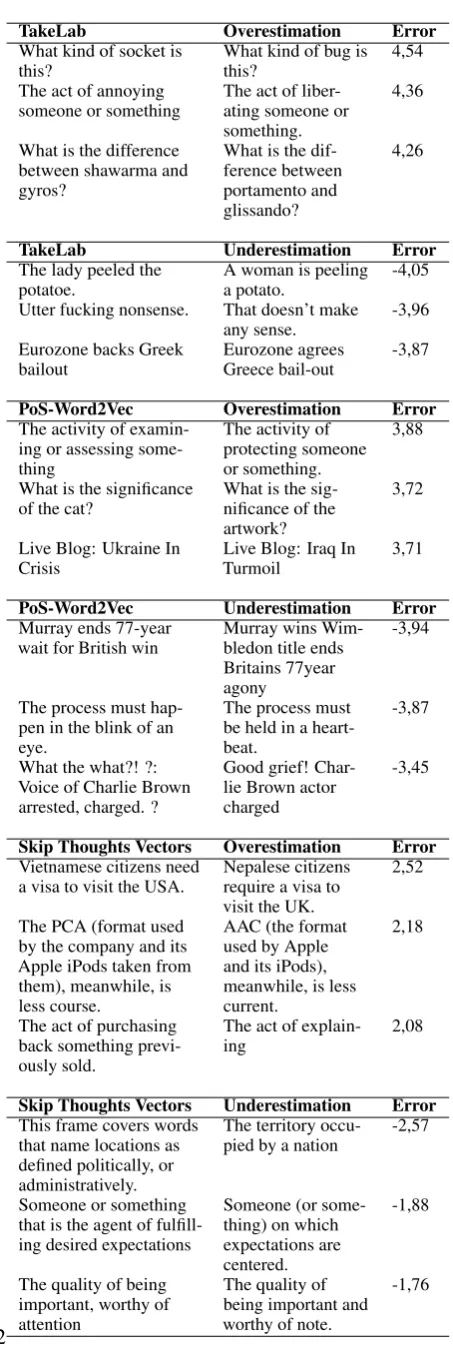
As was expected the best score was obtained for the ensemble approach. Due to the fact that used pair of sentences had a different format, the final regressor chose which method is better for a particular type of sentence (see Table2).
Analysis of PoS-Word2Vec method clearly shows that overestimation occurs when subject in compared sentences differs. However cases of underestimation display lack of representation of idioms and use of informal speech. Overall the method seems to be too focused on the meaning of particular words. On the other hand, TakeLab ex-hibits poor performance in case of nearly-duplicate pairs of sentences. This doesn’t come as much of surprise due to the way all TakeLab measures es-timate similarity between sentences. This in turn translates to overestimation in cases when two sen-tences have high word coverage, but effectively differ in semantic meaning (see first example in Table2). Skip thoughts vectors approach has the biggest problem with significant differences be-tween the length of compared sentences, then there are also over and underestimation error. Also, this method does not handle near-duplicated sentences that sentences differ in only one or two words, and the different words are not synonyms.
4 Conclusion
[image:4.595.304.531.124.798.2]In this paper, we have presented the OPI-JSA sys-tem submitted by our team for SemEval 2017, Task 1, Subtask 5. The proposed system uses a lot of different tools to encode a sentence to a features vector. We used machine learning algorithms to predict the gold score for given pairs of sentences which measure their similarity. Additionally, we showed that an ensemble method improved the per-formance of our system. The best results we have obtained is equal to 0.785 according to a Pearson’s correlation while placing OPI - JSA as 36 of all reported solutions (77) and 16 of 32 teams in the Subtask 5.
Table 2: Examples of maximum over and underes-timation of STS evaluation for proposed methods and sentence pairs. Error corresponds to difference between assessed STS and gold scores.
TakeLab Overestimation Error What kind of socket is
this? What kind of bug isthis? 4,54 The act of annoying
someone or something The act of liber-ating someone or something.
4,36
What is the difference between shawarma and gyros?
What is the dif-ference between portamento and glissando?
4,26
TakeLab Underestimation Error The lady peeled the
potatoe. A woman is peelinga potato. -4,05 Utter fucking nonsense. That doesn’t make
any sense. -3,96 Eurozone backs Greek
bailout Eurozone agreesGreece bail-out -3,87 PoS-Word2Vec Overestimation Error The activity of
examin-ing or assessexamin-ing some-thing
The activity of protecting someone or something.
3,88
What is the significance
of the cat? What is the sig-nificance of the artwork?
3,72
Live Blog: Ukraine In
Crisis TurmoilLive Blog: Iraq In 3,71 PoS-Word2Vec Underestimation Error Murray ends 77-year
wait for British win Murray wins Wim-bledon title ends Britains 77year agony
-3,94
The process must hap-pen in the blink of an eye.
The process must be held in a heart-beat.
-3,87
What the what?! ?: Voice of Charlie Brown arrested, charged. ?
Good grief! Char-lie Brown actor charged
-3,45
Skip Thoughts Vectors Overestimation Error Vietnamese citizens need
a visa to visit the USA. Nepalese citizensrequire a visa to visit the UK.
2,52
The PCA (format used by the company and its Apple iPods taken from them), meanwhile, is less course.
AAC (the format used by Apple and its iPods), meanwhile, is less current.
2,18
The act of purchasing back something previ-ously sold.
The act of
explain-ing 2,08
Skip Thoughts Vectors Underestimation Error This frame covers words
that name locations as defined politically, or administratively.
The territory
occu-pied by a nation -2,57
Someone or something that is the agent of fulfill-ing desired expectations
Someone (or some-thing) on which expectations are centered.
-1,88
The quality of being
References
Eneko Agirre, Carmen Banea, Daniel M. Cer, Mona T. Diab, Aitor Gonzalez-Agirre, Rada Mihalcea, Ger-man Rigau, and Janyce Wiebe. 2016. Semeval-2016 task 1: Semantic textual similarity, mono-lingual and cross-mono-lingual evaluation. In Steven Bethard, Daniel M. Cer, Marine Carpuat, David Ju-rgens, Preslav Nakov, and Torsten Zesch, editors, SemEval@NAACL-HLT. The Association for Com-puter Linguistics, pages 497–511.
Steven Bethard, Marine Carpuat, Marianna Apidianaki, Saif M. Mohammad, Daniel Cer, and David Jurgens, editors. 2017.Proceedings of the 11th International Workshop on Semantic Evaluation (SemEval-2017). Association for Computational Linguistics, Vancou-ver, Canada. http://www.aclweb.org/anthology/S17-2.
Ryan Kiros, Yukun Zhu, Ruslan Salakhutdi-nov, Richard S. Zemel, Antonio Torralba, Raquel Urtasun, and Sanja Fidler. 2015.
Skip-thought vectors. CoRR abs/1506.06726.
http://arxiv.org/abs/1506.06726.
Geoffrey Leech. 2016. Word frequencies in written and spoken english: based on the british national corpus. Routlege.
Tomas Mikolov, Ilya Sutskever, Kai Chen, Greg S Corrado, and Jeff Dean. 2013. Distributed representations of words and phrases and their compositionality. In C. J. C. Burges, L. Bottou, M. Welling, Z. Ghahramani, and K. Q. Wein-berger, editors, Advances in Neural Information Processing Systems 26, Curran Associates, Inc., pages 3111–3119. http://papers.nips.cc/paper/5021- distributed-representations-of-words-and-phrases-and-their-compositionality.pdf.
F. Pedregosa, G. Varoquaux, A. Gramfort, V. Michel, B. Thirion, O. Grisel, M. Blondel, P. Prettenhofer, R. Weiss, V. Dubourg, J. Vanderplas, A. Passos, D. Cournapeau, M. Brucher, M. Perrot, and E. Duch-esnay. 2011. Scikit-learn: Machine learning in Python. Journal of Machine Learning Research 12:2825–2830.
Jeffrey Pennington, Richard Socher, and Christopher Manning. 2014.Glove: Global vectors for word rep-resentation.Proceedings of the 2014 Conference on Empirical Methods in Natural Language Processing (EMNLP)https://doi.org/10.3115/v1/d14-1162. Richard Socher, Eric H. Huang, Jeffrey Pennington,
Andrew Y. Ng, and Christopher D. Manning. 2011. Dynamic pooling and unfolding recursive autoencoders for paraphrase detection. In Pro-ceedings of the 24th International Conference on Neural Information Processing Systems. Curran Associates Inc., USA, NIPS’11, pages 801–809.
http://dl.acm.org/citation.cfm?id=2986459.2986549. Frane ˇSari´c, Goran Glavaˇs, Mladen Karan, Jan
ˇSnajder, and Bojana Dalbelo Baˇsi´c. 2012. Takelab:
Systems for measuring semantic text similarity. In Proceedings of the First Joint Conference on Lexical and Computational Semantics - Volume 1: Proceedings of the Main Conference and the Shared Task, and Volume 2: Proceedings of the Sixth International Workshop on Semantic Evaluation. Association for Computational Linguistics, Strouds-burg, PA, USA, SemEval ’12, pages 441–448.
http://dl.acm.org/citation.cfm?id=2387636.2387708. Yukun Zhu, Ryan Kiros, Richard Zemel, Ruslan
Salakhutdinov, Raquel Urtasun, Antonio Torralba, and Sanja Fidler. 2015. Aligning books and movies: Towards story-like visual explanations by watch-ing movies and readwatch-ing books. arXiv preprint arXiv:1506.06724.