95
Medical Entity Linking using Triplet Network
1Ishani Mondal 1Sukannya Purkayastha 1Sudeshna Sarkar 1Pawan Goyal 2Jitesh K Pillai 2Amitava Bhattacharyya 2Mahanandeeshwar Gattu
1Department of Computer Science and Engineering, IIT Kharagpur 2Excelra Knowledge Solutions Pvt Ltd, Hyderabad, India
Abstract
Entity linking (or Normalization) is an essen-tial task in text mining that maps the entity mentions in the medical text to standard en-tities in a given Knowledge Base (KB). This task is of great importance in the medical do-main. It can also be used for merging different medical and clinical ontologies. In this paper, we center around the problem of disease link-ing or normalization. This task is executed in two phases: candidate generation and candi-date scoring. In this paper, we present an ap-proach to rank the candidate Knowledge Base entries based on their similarity with disease mention. We make use of the Triplet Net-work for candidate ranking. While the existing methods have used carefully generated sieves and external resources for candidate genera-tion, we introduce a robust and portable can-didate generation scheme that does not make use of the hand-crafted rules. Experimental results on the standard benchmark NCBI dis-ease dataset demonstrate that our system out-performs the prior methods by a significant margin.
1 Introduction
A disease is an abnormal medical condition that poses a negative impact on the organisms and en-abling access to disease information is the goal of various information extraction as well as text mining tasks. The task of disease normalization consists of assigning a unique concept identifier to the disease names occurring in the clinical text. However, this task is challenging as the diseases mentioned in the text may display morphological or orthographical variations, may utilize different word orderings or equivalent words. Consider the following examples:
Example 1: “..characteristics of the disor-der include ashort trunk and extremities...”
Source: (PMID:7874117)
Example 2: “Renal amyloidosis, prevented by colchicine, is the most severe complication of FMF ...”Source: (PMID:10364520)
In Example 1, the disease mention short trunk and extremitiesshould be mapped to a candidate Knowledge Base entry(D006130) containing syn-onyms likeGrowth Disorder. In Example 2, Re-nal amyloidosisshould be assigned to Knowledge Base ID (C538249) which has synonyms such as,
Amyloidosis 8.
Based on our studies and analysis of the med-ical literature, it has been observed that the same disease name may occur in multiple variant forms such as. synonyms replacement (e.g.“lung cancer”, “lung carcinoma”), spelling variation (“Acetolysis”, “acetolisis”), a short description modifier precedes the disease name (e.g. “mas-sive heart attack”), different word orderings (eg.
“alpha-galactosidase deficiency”, “deficiency of alpha-galactosidase”).
In this paper, we have formulated the task of learning mention-candidate pair similarity using Triplet Networks (Hoffer and Ailon,2015). Fur-thermore, we have explored in-domain word1and subword embeddings (Bojanowski et al.,2017) as input representations. We find that sub-word infor-mation boosts up the performance due to gained information for out-of-vocabulary terms and word compositionality of the disease mentions.
The primary contributions of this paper are three-fold: 1) By identifying positive and neg-ative candidates concerning a disease mention, we optimize the Triplet Network with a loss function that influences the relative distance con-straint 2) We have explored the capability of
Dataset Abstracts Total Unique
Training set 692 5932 1538
Test set 100 960 427
[image:2.595.81.283.63.119.2]Total 792 6892 1965
Table 1: NCBI Disease Corpus Statistics
domain sub-word level information2in solving the task of disease normalization. 3) Unlike exist-ing systems (D’Souza and Ng, 2015), (Li et al.,
2017), we present a robust and portable candi-date generation approach without making use of external resources or hand-engineered sieves to deal with morphological variations. Our system achieves state-of-the-art performance on NCBI disease dataset (Dogan et al.,2014)
2 Dataset
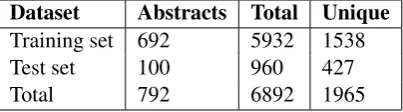
The NCBI disease corpus (Dogan et al., 2014) contains 792 Pubmed abstracts with disorder con-cepts manually annotated. In this dataset, disorder mentions in each abstract are manually annotated with the identifier of the concept in the reference ontology to which it refers. It uses MEDIC lexi-con (Davis et al.,2012) as the reference ontology. (See Table 1 for dataset statistics)
3 Methodology
The dataset consists of a certain number of abbre-viations, in order to identify these cases, we have considered the mentions composed of all upper-case letters as abbreviations. We find the disease mentions immediately preceding the abbreviated terms and substitute all the occurrences of the ab-breviated words in that document with the corre-sponding expanded disease mentions. Our system primarily consists of two modules: 1)Candidate generation: (See section 3.1) Generate potential candidates from the Knowledge Base correspond-ing to a disease mention. 2)Candidate ranking: (See section 3.2) Rank those potential candidates corresponding to a disease mention.
3.1 Candidate generation
In this section, we discuss the algorithm which generates the potential candidates to which the dis-ease mentions might be referring. In this study, the Knowledge Base entries were sampled from
2https://github.com/ncbi-nlp/BioSentVec.git
the entire MEDIC Lexicon, but not limited to only annotations in the NCBI Disease Corpus.
For a given disease mention, the candidate gen-eration algorithm generates candidates from the Knowledge Base entries. Suppose, the Knowledge Base consists of k entries, each having a certain number of synonyms. Each multi-word synonym represented by the sum of its word embeddings. For a given mentionmconsisting oflwords rep-resented by{m1, m2, . . . , ml}, we representmas the sum of its word embeddings. The steps for the candidate generation algorithm are as follows:
• Step 1: Candidate Set 1, {C1} : Calculate the cosine similarity between vector repre-sentation of each synonym (candidate) of the KBIDs and the mention. Identify the topk1 ids whose candidates have cosine similarity greater than or equal to thresholdt1.
• Step 2: Candidate Set 2,{C2}: Calculate the Jaccard overlap of the mention and the can-didates of each KBID. Identify the topk2ids having Jaccard overlap score greater than or equal to thresholdt2.
Note: min (|C1|,|C2|)≤|C1∪C2 | ≤(k1+k2) In our experiments, we chooset1= 0.7,t2 = 0.1,
k1 = 3andk2 = 7.
We provide examples of candidates generated from our proposed algorithm below.
Mention: “bacteremic infections due to Neis-seria”
Candidate Set 1,{C1}={“bacterial neisseria infections”}
Candidate Set 2,{C2}={“bacterial neisseria infections” , “DNA-virus infections” , “Screw-Worm Infections”}
3.2 Candidate Ranking
Figure 1: Pictorial Representation of the training Data Generation Process
3.2.1 Triplet data generation
In order to learn better semantic representations between a disease mention and its correspond-ing candidates, we have generated traincorrespond-ing data in the form of triplets consisting of disease mention
m, positive candidate qp, negative candidate qn. The triplet is represented as (qp, m, qni) wherei
∈ {1. . .[|k1∪k2| −1]}.
An example of the triplet data is given below:
Disease Mention: “bacteremic infections due to Neisseria”
Positive Candidate: “bacterial neisseria infec-tions”
Negative Candidates: “DNA-virus infec-tions”, “Screw-Worm Infections”.
The triplets are as follows:
• (“bacterial neisseria infections”, “bac-teremic infections due to Neisseria”, “DNA-virus infections”)
• (“bacterial neisseria infections”, “bac-teremic infections due to Neisseria”, “Screw-Worm Infections”)
3.2.2 Model Architecture
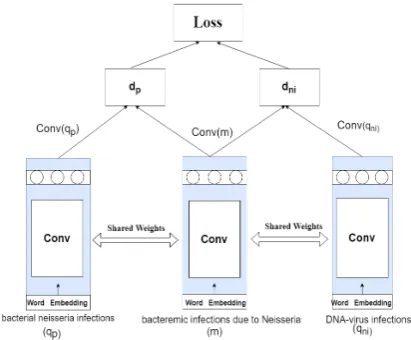
The Triplet Network architecture as proposed by (Hoffer and Ailon,2015) has been adopted for the task of entity normalization. To train the model, each triplet consisting of mentions and its candi-dates are fed into the parameter-shared network (Conv), as a sequence of word embeddings. For a triplet, (qp, m, qni) the layer outputs their
rep-resentations Conv(qp),Conv(m) andConv(qni)
respectively. Our objective is to make the
repre-Figure 2: The word and sub-word embeddings of triplet (‘bacterial neisseria infections’, ‘bacteremic infections due to Neisseria’, ’Screw-Worm Infections’) are fed as batches into the Triplet Network.
sentations of m and qp closer than the represen-tations ofm andqni. Thus the next layer uses a
distance function, denoted bydis, to compute the distances as follows:
dp =dis(Conv(m), Conv(qp))
dni =dis(Conv(m), Conv(qni))
Here dp specifies the distance between target disease mentionmandqp whiledni specifies the
distance between target disease mention m and
qni. The triplet loss function (L) used for
achiev-ing this goal has been formulated as follows:
L= max (dp−dni+α,0)
[image:3.595.310.516.281.451.2]the dissimilarities should be. Thereafter, by us-ing this loss function, we calculate the gradients and update the parameters of the network based on these gradient values. For training the network, we take mentionmand randomly sample qp andqni
and compute their loss function and update their gradients.
We use 200-dimensional word2vec (Mikolov et al.,2013) embeddings trained on Wikipedia and Pubmed PMC-Corpus (Pyysalo et al.,2013) as in-put to Conv. To deal with the huge number of out-of- vocabulary terms in the medical domain, we have used the f astT extbased sub-word em-beddings (Galea et al., 2018). f astT ext ( Bo-janowski et al.,2017) has been applied on PubMed and MIMIC-III (Johnson et al.,2016) to generate 200- dimensional word embeddings, the window size being 20, learning rate 0.05, sampling thresh-old 1e-4, and negative examples 10 (yijia zhang et al.,2018).
3.2.3 Training Details
Convis composed of one convolutional and max-pooling layer. ReLU non-linearity (Maas, 2013) is applied between two consecutive layers. The final embedding of Conv is a fixed-length(128) vector. For disand the loss function we use the L2 distance (Danielsson, 1980). The triplet loss has been applied. For training we use Adam Opti-mizer (Kingma and Ba,2015) with an initial learn-ing rate of 0.001. Training has been done for 50 epochs, and early stopping has been employed on the basis of the accuracy of the validation set. After hyperparameter tuning, several experiments have been performed, and the results on the best hyperparameter settings have been reported.
3.2.4 Evaluation
After the model has been trained, we evaluate the rank of each of the disease mentions in the test set. For each of the disease mentionmin the test set, we run the candidate generation algorithm to find out the maximum cosine similar candidates for the potential KnowledgeBaseIDs. The positive candi-date is labelled as1while the rest has been labelled as0. During the process of evaluation, we calcu-late the similarity score between the disease men-tion and its candidates. The similarity scores are then sorted in descending manner in order to rank the candidates based on its similarity. We choose the candidate with the maximum similarity score for each of the disease mentions.
Model Name Accuracy
(D’Souza and Ng,2015) 84.65
(Li et al.,2017) 86.10
[image:4.595.312.525.61.159.2]Triplet CNN + static word2vec 86.09 Triplet CNN + dynamic word2vec 87.85 Triplet CNN + subword 89.65 Triplet CNN + subword + abb 90.01
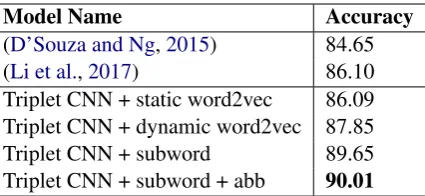
Table 2: The table shows the accuracy of our system in comparison with the baseline systems.
We choose the evaluation measure as accuracy. Since, the highest similar candidate is of primary interest in the task of entity linking, so we choose the top-K ( WhereK= 1).
T P = It signifies that the highest ranked candi-date for disease mention m is the actual referent KnowledgebaseID.
F P = It signifies that the highest ranked candi-date for disease mentionmis not the actual refer-ent KnowledgebaseID.
Accuracy= T P
T P +F P
4 Results
We report accuracy for our system in finding the correct Knowledge Base ID corresponding to a disease mention in the text. Table 2 shows that in comparison with the existing baseline systems,
Subword informationas input to the Triplet Net-work and abbreviation expansion from the doc-ument context (Triplet CNN+subword+abb) per-forms the best. From the feature ablation, it is clear that the in-domain word embeddings((Triplet CNN + dynamic word2vec) and (Triplet CNN + static word2vec)) are essential for capturing better semantic representations.
5 Analysis
In this section, we throw some light on both the merits and demerits of the proposed system with respect to the baseline models.
5.1 Merit Analysis
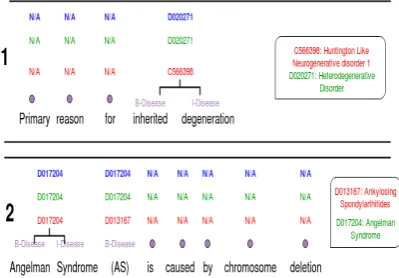
syntactic similarity using Triplet Network, we se-lect some examples from the labeled test set. In figure 2, two different cases have been shown which demonstrate the performance gap between our and the existing baseline systems.
In Example 1, the disease mention “inherited neurodegeneration”was not mapped with “here-dodegenerative disorders”( D020271) by the ex-isting methods, because of their incapability to capture the semantic similarity. In contrast to this, our system obtains additional semantic and syn-tactic information from the domain-specific sub-word embeddings and thereby maps to the correct concept ID.
[image:5.595.82.282.400.539.2]In Example 2, the abbreviation “AS” is poly-semous in nature as it can either be mapped to the concepts like “Angelman Syndrome” (PMID : 9585605 ) and“Ankolysing Spondylitis”( PMID : 9336417). Due to the lack of contextual infor-mation in the existing models, they were not able to handle the polysemous nature of the abbrevia-tions; but abbreviation expansion from the docu-ment level context in our system handles this sce-nario.
Figure 3: The NER tags as input are shown in pur-ple, the gold standard conceptID is shown in green, the predictions from the baseline systems are shown in red, whereas the prediction from the proposed system is shown inblue.
5.2 Demerit Analysis
The error types incurred by the proposed system have been explained in detail as follows:
1) Ambiguous distribution of importance to the disease name: The system fails to under-stand which part of disease mention to provide more attention while performing normalization. Suppose the disease mention is “colorectal ade-noma”, during normalization, the system
mistak-enly normalizes the disease to the concept ID pre-dominated by“colorectal”. Automatic identifica-tion of such semantic attenidentifica-tion is challenging and deserves a significant spot in the future research.
2) Incorrect mapping of certain ambiguous disease names: Suppose the disease mention dys-morphic features in “..loss of MAGEL2 may be critical to abnormalities in brain development and
dysmorphic featuresin individuals with PWS..” ( PMID: 10915770 ) has been mapped to D057215 whereas the same disease mention in “..She had minordysmorphic featuresconsistent with those of..” ( PMID: 8071957 ) has been assigned to D000013. Since, in these two examples, the dis-ease mention in these two examples have been as-signed as ”diseaseClass” and ”Modifier” features respectively. It happens due to different NER fea-tures of the mention annotated in the dataset. But incorporating this NER feature in our proposed model unnecessarily generates huge number of false positives.
6 Conclusion
In this paper, we have formulated the task of en-tity linking as a candidate ranking approach. Us-ing a Triplet Network, we learn high-quality rep-resentations of candidates, tailored to reveal rela-tive distances between the disease mention and its positive and negative candidates. Furthermore, we take a step towards eliminating the need to gener-ate candidgener-ates based on hand-crafted rules and ex-ternal knowledge resources. Though our method outperforms the existing systems by a strong mar-gin, there is a scope for improvement in terms of attention-based disease similarity (viz, “Neisseric infections” imply the importance of “Neisseric” during its similarity computation with the “bac-terial neisseria infections”). An intriguing course for future work is to further explore the robustness and scalability of this approach to other clinical datasets for entity normalization.
Acknowledgments
References
Piotr Bojanowski, Edouard Grave, Armand Joulin, and Tomas Mikolov. 2017. Enriching word vectors with subword information. Transactions of the Associa-tion for ComputaAssocia-tional Linguistics, 5:135–146.
Kevin Clark and Christopher D. Manning. 2016. Deep reinforcement learning for mention-ranking coref-erence models. In Proceedings of the 2016 Con-ference on Empirical Methods in Natural Language Processing, pages 2256–2262. Association for Com-putational Linguistics.
Per-Erik Danielsson. 1980. Euclidean distance map-ping. Computer Graphics and Image Processing, 14(3):227 – 248.
Allan Peter Davis, Thomas C. Wiegers, Michael C. Rosenstein, and Carolyn J. Mattingly. 2012. Medic: a practical disease vocabulary used at the compara-tive toxicogenomics database. Database (Oxford), 2012:bar065–bar065. 22434833[pmid].
Rezarta Islamaj Dogan, Robert Leaman, and Zhiyong Lu. 2014. Ncbi disease corpus: a resource for dis-ease name recognition and concept normalization.J Biomed Inform, 47:1–10. 24393765[pmid].
Jennifer D’Souza and Vincent Ng. 2015. Sieve-based entity linking for the biomedical domain. In Pro-ceedings of the 53rd Annual Meeting of the Associ-ation for ComputAssoci-ational Linguistics and the 7th In-ternational Joint Conference on Natural Language Processing (Volume 2: Short Papers), pages 297– 302.
Dieter Galea, Ivan Laponogov, and Kirill A. Veselkov. 2018. Sub-word information in pre-trained biomed-ical word representations: evaluation and hyper-parameter optimization. InBioNLP.
Elad Hoffer and Nir Ailon. 2015. Deep metric learning using triplet network. InSIMBAD.
Alistair E. W. Johnson, Tom J. Pollard, Lu Shen, Li-wei H. Lehman, Mengling Feng, Mohammad Ghas-semi, Benjamin Moody, Peter Szolovits, Leo An-thony Celi, and Roger G. Mark. 2016. Mimic-iii, a freely accessible critical care database. Scientific Data, 3:160035 EP –. Data Descriptor.
Diederik P. Kingma and Jimmy Ba. 2015. Adam: A method for stochastic optimization. CoRR, abs/1412.6980.
Haodi Li, Qingcai Chen, Buzhou Tang, Xiaolong Wang, Hua Xu, Baohua Wang, and Dong Huang. 2017. Cnn-based ranking for biomedical entity normalization. BMC Bioinformatics, 18(Suppl 11):385–385. 28984180[pmid].
Andrew L. Maas. 2013. Rectifier nonlinearities im-prove neural network acoustic models.
Tomas Mikolov, Ilya Sutskever, Kai Chen, Greg S Cor-rado, and Jeff Dean. 2013. Distributed representa-tions of words and phrases and their composition-ality. In C. J. C. Burges, L. Bottou, M. Welling, Z. Ghahramani, and K. Q. Weinberger, editors, Ad-vances in Neural Information Processing Systems 26, pages 3111–3119. Curran Associates, Inc.
Sampo Pyysalo, F Ginter, Hans Moen, T Salakoski, and Sophia Ananiadou. 2013. Distributional semantics resources for biomedical text processing. Proceed-ings of Languages in Biology and Medicine.