Original Article
Relationship between single nucleotide polymorphism
of ABCA1 gene and susceptibility of coronary
heart disease in Mongolian/Han population
Tuoya Yuan, Yuexi Wang, Xiaoyu Liu
Department of Cardiology, Inner Mongolia Medical University Affiliated Hospital, 010050, Inner Mongolia, China
Received October 16, 2016; Accepted December 20, 2016; Epub February 15, 2017; Published February 28, 2017
Abstract: To investigate the distribution profiles of single nucleotide polymorphisms on the coding region (R219K, M233V) and non-coding region (-565C/T, 69C/T) of ATP-binding cassette transporter 1 (ABCA1) gene and their rela
-tionship with blood lipids and coronary heart disease (CHD) in Mongolian and Han population of the Inner Mongolia region. The target fragments of ABCA1 gene was amplified and analyzed by polymerase chain reaction (PCR) in 101 Mongolian, 111 Han patients with CHD and 102 Mongolian, 101 Han control subjects without CHD. The frequency of KK genotype and K allele of ABCA1 R219K gene in Mongolian and Han population was all significantly higher in controls than that in CHD patients (P<0.05). KK genotype significant higher in high-density lipoprotein cholesterol (HDL-C) level (P<0.05) and significant lower triglyceride (TG) level than RR genotype (P>0.05) in both Mongolian and Han population. The KK genotype odds ratio was -0.313 (95% CI = 0.233-0.419, P<0.05). Logistic analysis showed
that KK genotype was protective factors for CHD. The frequency of TT genotype and T allele of ABCA1 69C/T gene in Mongolian and Han population was significantly higher in CHD patients than that of controls (P<0.05). The TT
genotype odds ratio was 2.698 (95% CI 1.408-5.170, P<0.05). Logistic analysis showed that TT genotype was a
risk factor for CHD. There was no significant difference in the frequency of -565C/T and M233V genotype between
Mongolian and Han population (P>0.05). No significant difference was found in the levels of HDL-C, low-density li
-poprotein cholesterol (LDL-C), cholesterol (TC) or TG among genotype of 69C/T, -565C/T and M233V gene (P>0.05). There was no difference in the distribution of R219K, 69C/T, -565C/T or M233V between Mongolian population and Han population. ABCA1 gene R219K and 69C/T polymorphisms were associated with CHD susceptibility in Mongo
-lian and Han population. The KK genotype benefits blood lipids, which may be a novel genetic marker for CHD. The C69T TT genotype polymorphism of the ABCA1 gene is associated with increased CHD risk.
Keywords: ATP binding cassette transporter 1, polymorphism, coronary heart disease
Introduction
ATP-binding cassette transporter A1 (ABCA1) belongs to the super-family of ATP-binding cas-sette transporter. Up to now more than 90 ABCA1 gene locus mutations, including coding and non-coding regions (promoter region included), have been found associated with various diseases. Although there is less single nucleotide polymorphism in the coding region, in the study of hereditary diseases the single nucleotide polymorphism is of great signifi-cance. The single nucleotide polymorphism located in the promoter sequences affects gene expression and impacts the human health. Coronary heart disease (CHD) might be
Patients and methods
Patients
203 cases of Inner Mongolia individuals (101 cases of CHD patients and 102 cases of con-trol) and 212 cases of Han individuals (111 cases of CHD patients and 101 cases of con-trol) were recruited into this study. Inner Mongolia individuals are from local residents. CHD patients were positive in cardiology coro-nary angiography examined in the department of cardiology, Mongolia Medical College First Affiliated Hospital (Huhhot. China) during January 2009 to June 2015 (at least one coro-nary artery stenosis ≥50%); the control group was confirmed by coronary angiography to exclude coronary artery disease. Other exclu-sion criteria includes: severe liver or kidney dys-function, blood diseases, tuberculosis, cancer, and artery disease. Questionnaire interviews were used to collect basic data, medical histo-ry, family histohisto-ry, and smoking history. Stand- ard of smoking history was set as “smoking more than 10 cigarettes daily in the past one or more than one year, without taking any lipid-control medicine”.
Measurement of lipid levels
3 ml of morning fasting blood was used in all laboratory tests. The lipid levels were mea-sured after serum was separated. Triglyceride (TG) and cholesterol (TC) were measured using oxidase method; high-density lipoprotein (HDL-C) and low density lipoprotein (LDL-(HDL-C) were detected with PEG allosteric enzymatic assay. Detection reagents were purchased from Leadman Company (Beijing, China). OLYMPUS
AU 600 automatic biochemical analyzer (Japan) was used in the study.
DNA extraction
3 ml of peripheral venous blood was collected with EDTA anticoagulated vacutainer, and then stored in -80°C before use. Blood DNA was extracted according to the manual in the blood/ cell/tissue extract genomic DNA Extraction kit.
PCR primers
The sequences of upstream and downstream primer of R219K, -565C/T, M233V, 69C/T gene are shown in Table 1, which were provid-ed by the Shanghai Biological Engineering Co., Ltd.
PCR procedure of ABCA1 polymorphic gene PCR reaction was carried out in a type PTC-200 cycler. The 50 μL of PCR reaction system includes 25 μL 2 × Taq PCR Master Mix, 2.0 μL DNA, 1.0 μL upstream and downstream prim-ers respectively, and 21 μL sterilized ultrapure water. PCR reaction procedure was as follows: 94°C denaturation for 5 min; 94°C denatur-ation for 30 s, 53-58°C annealing for 30 s, 72°C extension for 40 s, a total of 35 cycles; 72°C terminal extension for 5 min.
PCR product digestion
[image:2.612.90.515.85.152.2]The procedure was shown in Table 2. Endonuclease XagI (EcoNI), CviA II, AciI, BsmA I, and 10 × buffer were provided by BioLabs Company (USA). Digestion products were mea-sured in 2% agarose gel by electrophoresis. The sample genotype was determined. The DNA Marker is BioMarker I.
Table 1. PCR primers for R219K, -565C/T, M233V, 69C/T genes
Gene Upstream Downstream
R219K 5’-GTATTTTTGCTACCAGTTACATTTGACA-3’ 5’-GATTGGCTTCAGGATTGTTGGAA-3’
M233V 5’GCAAGGCTACCAGTTACATT3’ 5’GTCCAAGGAAAAGCCTCAC3’
-565C/T 5’-CTCGGGTCCTCTGAGGGACCT-3’ 5’-CCGCAGACTCTCTAGTCCAC-3’
69C/T 5’GGCTTTGACCGATAGTAACCT3’ 5’CTCTTTCTCCTACCCCTTGAC3’
Table 2. The PCR reaction systems
R219K reaction system M233V reaction system -565C/T reaction system 69C/T reaction system
10 × Buffer 2 μl 10 × Buffer 2.0 μl 10 × Buffer 2 μl 10 × Buffer 2 μl
PCR product 10 μl PCR product 10 μl PCR product 4 μl PCR product 10 μl
Xag-I 1.0 μl CviA II 0.6 μl AciI 1 μl BsmA I 0.4 μl
Pure water 18 μl Pure water 7.4 μl Pure water 14 μl Pure water 7.6 μl
[image:2.612.89.525.187.266.2]Statistical analysis
Data were expressed as the mean and stan-dard deviation and statistically analyzed with one-way Analysis of Variance (ANOVA) using SPSS13.0. Comparison between groups of count data was done with the chi-square test. OR and 95% CI were calculated by logistic regression analysis. P<0.05 was considered significant.
Results
General information
The general information on Mongolian CHD and control group, the Han CHD and control groups is shown in Table 3. A balancing test was per-formed to the genotypes distribution of CHD and control groups. The χ2 test showed that the distribution of ABCA1 gene R219K, M233V,
-565C/T and 69C/T of Mongolian and Han gen-otypes was in coincidence with the Hardy-Weinberg equilibrium laws of inheritance and had group representation.
Distribution frequencies of R219K geno -type and allele and comparison of lipids in
genotype groups among Mongolian and Han
population
[image:3.612.90.526.84.225.2]Distribution frequencies of R219K genotype and allele in CHD and control among Mongolian and Han population are shown in Tables 4 and 5. RR and R-type allele in CHD group of both Mongolian and Han population were significant-ly higher than control (P<0.05); KK and K allele were significantly lower than control (P<0.05). The HDL levels in KK genotype of Mongolian and Han population were significantly higher than that in RR type and RK type (P<0.05), Table 3. General information
Groups Han Control Han CHD Mongolian Control Mongolian CHD
N 101 111 102 101
Male/Female 42/59 60/51 51/51 73/28* Age 60.87±10.73 61.28±10.01 57.47±12.80 59.37±11.62 High blood pressure +/- 48/53 58/53 53/49 60/41 Diabetes +/- 13/88 29/82 12/90 19/82 Smoking history +/- 25/76 46/65 18/84 48/53 HDL-C (mmol/L) 1.12±0.33 1.04±0.26* 1.25±0.36 1.05±0.34* LDL-C (mmol/L) 2.71±0.86 2.84±0.87 2.99±0.90 2.91±0.83
TG (mmol/L) 1.64±0.95 1.75±0.92 1.51±0.82 1.89±1.11*
TC (mmol/L) 4.18±1.27 4.29±0.98 4.60±1.21 4.40±1.18
[image:3.612.90.522.281.355.2]*P<0.05 compared with control group.
Table 4. Distribution frequencies of R219K genotype and allele in CHD and control among Mongolian population
Groups N Genotype frequency Allele frequency
RR RK KK R K
Mongolian Control 102 16 (15.7) 54 (52.9) 32 (31.4) 86 (42.2) 118 (57.8) Mongolian CHD 101 34 (33.7) 53 (52.5) 14 (13.7) 121 (59.9) 81 (40.1)
χ2 13.5 12.8
P 0.001 0.000
Table 5. Distribution frequencies of R219K genotype and allele in CHD and control among Han popu-lation
Groups N Genotype frequency Allele frequency
RR RK KK R K
Han Control 101 18 (17.82) 49 (48.51) 34 (33.66) 85 (42.08) 117 (57.92) Han CHD 111 43 (38.74) 53 (47.75) 15 (13.51) 139 (62.61) 83 (37.39)
χ2 17.34 17.89
[image:3.612.89.524.406.480.2]while TG levels were significantly lower than that in RK and RR type (P<0.05), as shown in Tables 6 and 7.
Comparison of R219K genotype and allele
distribution frequency between Mongolian and
Han population
There was no difference in R219K genotype distribution between Mongolian and Han popu-lation (P>0.05).
Logistic regression analysis of the major risk factors of CHD
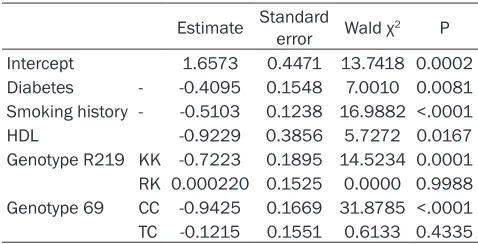
As shown in Table 8, the possible risk factors of the CHD were selected out of gender, national-ity, diabetes, hypertension, smoking history, family history, age, HDL, LDL, TG, TC, choles-terol, genotype R219K and genotype 69C/T by the method of the Logistic regression analysis. Table 9 shows OR values of major risk factors
that the TT genotype in Mongolian and Han population increased prevalence of CHD risk.
Comparison of 69C/T genotype and allele
distribution frequency between Mongolian and
Han population
There was no difference in 69C/T genotype dis-tribution between Mongolian and Han popula-tion (P>0.05).
Distribution frequencies of -565C/T genotype
and allele and comparison of lipids in
geno-type groups between Mongolian and Han
population
[image:4.612.91.328.93.171.2]There was no difference in distribution frequen-cies of -565C/T genotype and allele of CHD between Mongolian and Han population com-pared with control (P>0.05). The HDL-C, LDL-C, TG, TC levels among genotypes -565C/T CC, Table 6. Comparison of lipids in R219K genotype
groups among Mongolian population
Groups HDL-C LDL-C TG TC
RR 1.08±0.30 3.11±0.87 2.03±1.30 4.67±1.18
RK 1.12±0.28 2.97±0.90 1.68±0.85 4.50±1.20
KK 1.28±0.52* 2.74±0.75 1.37±0.81* 4.32±1.19
F 4.08 2.23 5.52 1.04
P 0.0184 0.1107 0.0046 0.3542
[image:4.612.91.330.226.299.2]*P<0.05 compared with RR group.
Table 7. Comparison of lipids in R219K genotype groups among Han population
Groups HDL-C LDL-C TG TC
RR 1.02±0.29 2.92±1.01 2.03±1.30 4.61±1.45
RK 1.07±0.27 2.69±0.73 1.68±0.85 4.08±0.89
KK 1.25±0.37* 2.73±0.85 1.37±0.81* 4.11±1.01
F 4.64 2.17 4.86 4.74
P 0.0107 0.1171 0.0087 0.0097
[image:4.612.88.327.354.476.2]*P<0.05 compared with RR group.
Table 8. Logistic regression analysis of the major risk factors of CHD
Estimate Standard error Wald χ2 P
Intercept 1.6573 0.4471 13.7418 0.0002 Diabetes - -0.4095 0.1548 7.0010 0.0081 Smoking history - -0.5103 0.1238 16.9882 <.0001 HDL -0.9229 0.3856 5.7272 0.0167
Genotype R219 KK -0.7223 0.1895 14.5234 0.0001
RK 0.000220 0.1525 0.0000 0.9988
Genotype 69 CC -0.9425 0.1669 31.8785 <.0001 TC -0.1215 0.1551 0.6133 0.4335
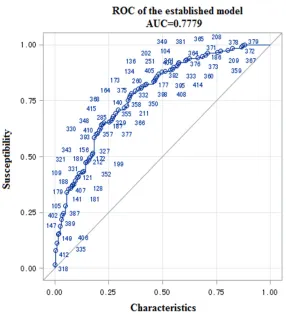
of CHD. Figure 1 shows the ROC curve of the established model. The AUC (Area under the curve) = 0.7779. As shown in Table 10, the major risk factors, KK and TT genotypes of 69C/T gene were intro-duced into the regression model, step-wise regression and Logistic regression were used to analyze the KK genotype: OR = -0.313; 95% CI is 0.233-0.419, P<0.05. The results imply that the KK genotype in Mongolian and Han popula-tion significantly reduced the risk of CHD. The main independent risk factors in Logistic regression analysis include dia-betes, smoking history, family history, age, low HDL-C, TT genotype of 69C/T gene.
Distribution frequencies of 69C/T geno -type and allele and comparison of lipids in genotype groups among Mongolian
and Han population
TC, TT in Mongolian and Han population showed no difference (P>0.05).
Comparison of -565C/T genotype and allele
distribution frequency between Mongolian and
Han population
There was no difference in -565C/T genotype distribution between Mongolian and Han popu-lation (P>0.05).
[image:5.612.91.381.85.184.2]from macrophages and reduce cholesterol and phospholipid efflux; thereby the apolipoprotein A1 could not combine with it effectively. It could be quickly cleared by kidneys and causes HDL-C synthesis disorders, which leads to massive ester accumulation of cholesterol and choles-terol in macrophages and foam cells formation, followed by infiltration into the vessel wall and development of atherosclerosis and CHD. ABCA1 gene mutation is closely related to the Table 9. OR values of major risk factors of CHD
Point estimation 95% Wald confidence limit
Diabetes Yes-No 0.441 0.240 0.809 Smoking history Yes-No 0.360 0.222 0.586
HDL 0.397 0.187 0.846
R219 genotype RR-KK 0.236 0.122 0.457
R219 genotype RR-RK 0.486 0.283 0.833
69 genotype TT-CC 0.134 0.070 0.257 69 genotype TT-TC 0.306 0.165 0.565
Figure 1. The ROC curve of the established model. Susceptibility of CHD =
1.6573-0.4095* Diabetes-0.5103* Smoking history -0.9229* HDL-0.7223*
R219 genotype KK/RR+0.00022* R219 genotype RK/RR-0.942569* geno
-type CC/TT-0.121569* geno-type TC/TT). The AUC (Area under the curve) =
0.7779.
Distribution frequencies of M233V genotype and allele and comparison of lipids in genotypes
The M233V polymorphisms of ABCA1 gene in Mongolian and Han population were pre-sented in genotypes MM, MV and VV. There was no differ-ence in distribution frequen-cies of M233V genotype and allele in Mongolian and Han population between CHD and control (P>0.05). The HDL-C, LDL-C, TG, TC levels among genotypes MM, MV, VV in Mongolian and Han popula-tion showed no difference (P>0.05).
Comparison of M233V geno-type and allele distribution frequency between
Mongo-lian and Han population
There was no difference in M233V genotype distribution between Mongolian and Han population (P>0.05).
Discussion
[image:5.612.91.377.203.520.2]occurrence and development of atherosclero-sis as well as lipids. Some mutations, such as R219K, may increase the levels of HDL-C [1], develop anti-atherosclerosis ability and reduce the risk of CHD. Some mutations, such as R230C, R1587K, and V825I [2, 3], may decrease HDL-C levels. The single nucleotide polymorphisms in the promoter region, such as 69C/T [4], may increase the risk of CHD. Some mutations, such as If -14 bp and ZNF [5], may have little or no impact on the function of ABCA1 or no significant correlation with plasma HDL-C levels.
Previous studies have shown that the single nucleotide polymorphisms of the same ABCA1 gene among different ethnic and regions had different impacts on lipid levels and CHD. The results obtained by Li et al [6] revealed that the R219K polymorphism of ABCA1 gene is a pro-tective factor for CHD in Asian populations, but in Caucasian population it has no correlation with the incidence of CHD. Andrikovic [7] report-ed that in the Hungarian population, the KK genotype is a protective factor for CHD. Doosti et al [8] found a significant correlation between R219K with CHD in Iran population. Compared to KK (AA) type, RR (GG) genotype increases the risk of CHD, making it an independent risk predictor for CHD. A meta-analysis found out that the R219K in KK genotype was a protec-tive gene for CHD in Asians and Caucasians, while KK genotypes was associated with
increased HDL-C [9]. Jing et al [1] suggested that the K allele in R219K genotype might reduce CHD susceptibility, K allele frequency in Asians (40%) was higher than that in the West (25%). Coban’s findings, however, contradicted the above conclusions. They revealed that the K allele in R219K increased the risk of CHD in women in Turkey, accompanied by increased TG levels [10]. There are fewer studies regard-ing the comparison of R219K between differ-ent ethnic groups in China. Sun et al reported a difference in R219K polymorphism in ABCA1 gene between Han and Xinjiang Uygur popula-tion, which is closely related to the serum high-density lipoprotein and triglyceride glycerol lev-els. However, no comparative study was done about the distribution of R219K genotypes of ABCA1 gene between the Inner Mongolian and Han population and CHD susceptibility. Results in the present study showed that there was no difference in the distribution of R219K geno-types of ABCA1 gene between Inner Mongolian and Han population. However, the KK geno-types in both Mongolian and Han population are protective factors for CHD. KK gene can produce beneficial clinical lipids spectrum, sug-gesting that the polymorphism may alter plas-ma HDL-C levels by changing the activity of encoding products [6], thereby affecting indi-vidual susceptibility to CHD.
[image:6.612.89.522.97.177.2]The results obtained by Versmissen indicated that the risk of patients suffering from CHD Table 10. Distribution frequencies of 69C/T genotype and allele in CHD and control among Mongo-lian population
Groups N Genotype frequency Allele frequency
TT TC CC T C
Mongolian Control 102 10 (9.80) 46 (45.10) 46 (45.10) 66 (32.35) 138 (67.65) Mongolian CHD 101 32 (31.68) 46 (45.54) 23 (22.77) 110 (54.46) 92 (45.54)
χ2 19.1860 20.1906
P 0.000 0.000
Table 11. Distribution frequencies of 69C/T genotype and allele in CHD and control among Han popu-lation
Groups N Genotype frequency Allele frequency
TT TC CC T C
Han Control 101 12 (11.88) 38 (37.62) 51 (50.50) 62 (30.69) 140 (69.31) Han CHD 111 37 (33.33) 48 (43.24) 26 (23.42) 122 (55.96) 96 (44.04)
χ2 21.6112 27.1986
[image:6.612.89.523.225.304.2]with TT genotype in promoter 69C/T gene is 1.7 times of that of CC genotype promoter 69C/T gene [4], which is consistent with the results of the present study. Our study showed that the TT genotype in 69C/T gene of both Mongolian and Han population had increased prevalence of CHD risk, but there was no difference in blood lipids in patients with various genotypes. Moreover, there was no difference in the di- stribution of 69C/T genotypes and alleles in ABCA1 gene between Mongolian and Han pop-ulation. Studies regarding the correlation bet- ween CHD and -565C/T polymorphism are con-troversial. Ruiz et al reported that the T allelic mutations of -565C/T increased the risk of sub-clinical cardiovascular disease and coronary atherosclerosis severity [11]. Inconsistent with Ruiz’s study, Rejeb [12] reported that -565C/T mutation had no correlation with CHD in Tunisians, which is consistent with our study. In the present study we revealed that there was no difference in distribution frequency in -565C/T allelic mutations of ABCA1 gene in Mongolia and Han population. The -565C/T allelic mutations of ABCA1 gene had no signifi-cant correlation with the incidence of CHD, indi-cating that the -565C/T is not a CHD suscepti-bility gene in either the Inner Mongolian or Han population, which suggests that ABCA1 poly-morphism genetic changes vary between differ-ent races.
M233V, a newly discovered single nucleotide polymorphism of ABCA1 gene, was barely reported in previous studies. The present study revealed a new mutation site of M233V in Mongolian and Han population, namely VV genotype. The impact of VV genotype on blood lipids and CHD is uncertain yet, which might be associated with genetic factors (it may be affected by other genotype mutation or genes), ethnic and regional differences. Further study with larger sample is needed to explore the specific mechanisms.
Conclusions
In the present study, we revealed that certain mutation on the ABCA1 gene was associated with blood lipid and CHD. The studies upon the relationship between the ABCA1 gene (R219K, M233V, -565C/T, 69C/T gene) in Inner Mongo- lian and Han population and blood lipid and CHD provide clues for further exploration on the association between atherosclerosis, CHD
rate and these four genes. It is possible that we can further develop or search for medicines affecting ABCA1 gene expression, which is valuable for the prevention and treatment of hyperlipidemia, atherosclerosis and CHD.
Disclosure of conflict of interest
None.
Address correspondence to: Tuoya Yuan, Depart-
ment of Cardiology, Inner Mongolia Medical Uni-
versity Affiliated Hospital, 010050, Inner
Mongo-lia, China. Tel: 86-471-2243257; Fax:
+86-471-2243257; E-mail: [email protected]
References
[1] Jiang Z, Zhou R, Xu C, Feng G and Zhou Y. Ge
-netic variation of the ATP-binding cassette
transporter A1 and susceptibility to coronary
heart disease. Mol Genet Metab 2011; 103:
81-88.
[2] Acuna-Alonzo V, Flores-Dorantes T, Kruit JK,
Villarreal-Molina T, Arellano-Campos O,
Hun-emeier T, Moreno-Estrada A, Ortiz-Lopez MG, Villamil-Ramirez H, Leon-Mimila P, Villalobos-Comparan M, Jacobo-Albavera L, Ramirez-Jimenez S, Sikora M, Zhang LH, Pape TD, Gra
-nados-Silvestre Mde A, Montufar-Robles I, Tito-Alvarez AM, Zurita-Salinas C, Bustos-Arria
-ga J, Cedillo-Barron L, Gomez-Trejo C, Barqu
-era-Lozano R, Vieira-Filho JP, Granados J, Romero-Hidalgo S, Huertas-Vazquez A, Gonza
-lez-Martin A, Gorostiza A, Bonatto SL, Rodri
-guez-Cruz M, Wang L, Tusie-Luna T, Aguilar-Sa -linas CA, Lisker R, Moises RS, Menjivar M,
Salzano FM, Knowler WC, Bortolini MC, Hayden MR, Baier LJ and Canizales-Quinteros S. A functional ABCA1 gene variant is associated
with low HDL-cholesterol levels and shows
evi-dence of positive selection in Native Ameri
-cans. Hum Mol Genet 2010; 19: 2877-2885. [3] Cao XL, Yin RX, Wu DF, Miao L, Aung LH, Hu XJ,
Li Q, Yan TT, Lin WX and Pan SL. Genetic vari
-ant of V825I in the ATP-binding cassette trans -porter A1 gene and serum lipid levels in the
Guangxi Bai Ku Yao and Han populations. Lip -ids Health Dis 2011; 10: 14.
[4] Versmissen J, Oosterveer DM, Yazdanpanah M, Mulder M, Dehghan A, Defesche JC, Kastelein JJ and Sijbrands EJ. A frequent vari
-ant in the ABCA1 gene is associated with in -creased coronary heart disease risk and a
bet-ter response to statin treatment in familial
[5] Cheng AJ, Mao YM and Cui RZ. [Association be
-tween -14 bp and ZNF polymorphisms of ABCA1 gene promoter and high density lipo -protein cholesterol level and cardiovascular
disease]. Zhonghua Yi Xue Yi Chuan Xue Za Zhi
2012; 29: 56-59.
[6] Sun P, Bo XP, Guo DP, Li XY, Hu ZB, Wang J, Li XR, Fan LM and Chen Q. [Study on the associa
-tion of ABCA1 gene common variants with the risk of coronary atherosclerotic heart disease]. Zhonghua Xin Xue Guan Bing Za Zhi 2005; 33:
627-630.
[7] Andrikovics H, Pongracz E, Kalina E, Szilvasi A, Aslanidis C, Schmitz G and Tordai A. De
-creased frequencies of ABCA1 polymorphisms R219K and V771M in Hungarian patients with
cerebrovascular and cardiovascular diseases. Cerebrovasc Dis 2006; 21: 254-259.
[8] Doosti M, Najafi M, Reza JZ and Nikzamir A. The role of ATP-binding-cassette-transporter-A1 (ABCATP-binding-cassette-transporter-A1) gene polymorphism on coronary
artery disease risk. Transl Res 2010; 155: 185-190.
[9] Ma XY, Liu JP and Song ZY. Associations of the ATP-binding cassette transporter A1 R219K
polymorphism with HDL-C level and coronary artery disease risk: a meta-analysis. Athero-sclerosis 2011; 215: 428-434.
[10] Coban N, Onat A, Komurcu Bayrak E, Gulec C, Can G and Erginel Unaltuna N. Gender specific association of ABCA1 gene R219K variant in
coronary disease risk through interactions with serum triglyceride elevation in Turkish adults.
Anadolu Kardiyol Derg 2014; 14: 18-25. [11] Ruiz JL, Fernandes LR, Levy D and Bydlowski
SP. Interrelationship between ATP-binding
cas-sette transporters and oxysterols. Biochem
Pharmacol 2013; 86: 80-88.
[12] Rejeb J, Omezzine A, Rebhi L, Boumaiza I, Kchock K, Belkahla R, Rejeb NB, Nabli N, Ab
-delaziz AB, Boughzala E and Bouslama A. As -sociations between common polymorphisms
of adenosine triphosphate-binding cassette