Improving Character-based Decoding Using Target-Side Morphological
Information for Neural Machine Translation
Peyman Passban, Qun Liu, Andy Way
ADAPT Centre School of Computing Dublin City University, Ireland
Abstract
Recently, neural machine translation (NMT) has emerged as a powerful alterna-tive to conventional statistical approaches. However, its performance drops consider-ably in the presence of morphologically rich languages (MRLs). Neural engines usually fail to tackle the large vocabulary and high out-of-vocabulary (OOV) word rate of MRLs. Therefore, it is not suitable to exploit existing word-based models to translate this set of languages. In this paper, we propose an extension to the state-of-the-art model of Chung et al. (2016), which works at the character level and boosts the decoder with target-side morphological information. In our archi-tecture, an additional morphology table is plugged into the model. Each time the decoder samples from a target vocabulary, the table sends auxiliary signals from the most relevant affixes in order to enrich the decoder’s current state and constrain it to provide better predictions. We evaluated our model to translate English into Ger-man, Russian, and Turkish as three MRLs and observed significant improvements.
1 Introduction
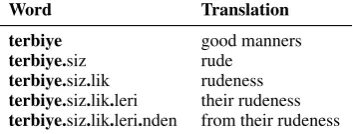
Morphologically complex words (MCWs) are multi-layer structures which consist of different subunits, each of which carries semantic informa-tion and has a specific syntactic role. Table1gives a Turkish example to show this type of complexity. This example is a clear indication that word-based models are not suitable to process such complex languages. Accordingly, when translating MRLs, it might not be a good idea to treat words as atomic units as it demands a large vocabulary that
im-poses extra overhead. Since MCWs can appear in various forms we require a very large vocabu-lary toi) cover as many morphological forms and words as we can, and ii) reduce the number of OOVs. Neural models by their nature are plex, and we do not want to make them more com-plicated by working with large vocabularies. Fur-thermore, even if we have quite a large vocabulary set, clearly some words would remain uncovered by that. This means that a large vocabulary not only complicates the entire process, but also does not necessarily mitigate the OOV problem. For these reasons we propose an NMT engine which works at the character level.
Word Translation
terbiye good manners
terbiye.siz rude
terbiye.siz.lik rudeness
terbiye.siz.lik.leri their rudeness
terbiye.siz.lik.leri.nden from their rudeness
Table 1: Illustrating subword units in MCWs. The boldfaced part indicates the stem.
In this paper, we focus on translating into MRLs and issues associated with word formation on the target side. To provide a better translation we do not necessarily need a large target lexicon, as an MCW can be gradually formed during decod-ing by means of its subunits, similar to the solu-tion proposed in character-based decoding models (Chung et al.,2016). Generating a complex word character-by-character is a better approach com-pared to word-level sampling, but it has other dis-advantages.
One character can co-occur with another with almost no constraint, but a particular word or mor-pheme can only collocate with a very limited num-ber of other constituents. Unlike words, characters are not meaning-bearing units and do not preserve syntactic information, so (in the extreme case) the
[image:1.595.329.506.421.488.2]chance of sampling each character by the decoder is almost equal to the others, but this situation is less likely for words. The only constraint that pri-oritize which character should be sampled is in-formation stored in the decoder, which we believe is insufficient to cope with all ambiguities. Fur-thermore, when everything is segmented into char-acters the target sentence with a limited number of words is changed to a very long sequence of characters, which clearly makes it harder for the decoder to remember such a long history. Ac-cordingly, character-based information flows in the decoder may not be as informative as word-or mword-orpheme-based infword-ormation.
In the character-based NMT model everything is almost the same as its word-based counterpart except the target vocabulary whose size is consid-erably reduced from thousands of words to just hundreds of characters. If we consider the de-coder as a classifier, it should in principle be able to perform much better over hundreds of classes (characters) rather than thousands (words), but the performance of character-based models is almost the same as or slightly better than their word-based versions. This underlines the fact that the character-based decoder is perhaps not fed with sufficient information to provide improved perfor-mance compared to word-based models.
Character-level decoding limits the search space by dramatically reducing the size of the target vo-cabulary, but at the same time widens the search space by working with characters whose sampling seems to be harder than words. The freedom in selection and sampling of characters can mislead the decoder, which prevents us from taking the maximum advantages of character-level decoding. If we can control the selection process with other constraints, we may obtain further benefit from re-stricting the vocabulary set, which is the main goal followed in this paper.
In order to address the aforementioned prob-lems we redesign the neural decoder in three dif-ferent scenarios. In the first scenario we equip the decoder with an additional morphology table in-cluding target-side affixes. We place an attention module on top of the table which is controlled by the decoder. At each step, as the decoder samples a character, it searches the table to find the most rel-evant information which can enrich its state. Sig-nals sent from the table can be interpreted as addi-tional constraints. In the second scenario we share
the decoder between two output channels. The first one samples the target character and the other one predicts the morphological annotation of the character. This multi-tasking approach forces the decoder to send morphology-aware information to the final layer which results in better predictions. In the third scenario we combine these two mod-els. Section3provides more details on our mod-els.
Together with different findings that will be dis-cussed in the next sections, there are two main contributions in this paper. We redesigned and tuned the NMT framework for translating into MRLs. It is quite challenging to show the impact of external knowledge such as morphological in-formation in neural models especially in the pres-ence of large parallel corpora. However, our mod-els are able to incorporate morphological informa-tion into decoding and boost its quality. We inject the decoder with morphological properties of the target language. Furthermore, the novel architec-ture proposed here is not limited to morphological information alone and is flexible enough to pro-vide other types of information for the decoder.
2 NMT for MRLs
There are several models for NMT of MRLs which are designed to deal with morphological complex-ities. García-Martínez et al.(2016) andSennrich and Haddow(2016) adapted the factored machine translation approach to neural models. Morpho-logical annotations can be treated as extra factors in such models. Jean et al. (2015) proposed a model to handle very large vocabularies. Luong et al.(2015) addressed the problem of rare words and OOVs with the help of a post-translation phase to exchange unknown tokens with their poten-tial translations. Sennrich et al.(2016) used sub-word units for NMT. The model relies on frequent subword units instead of words. Costa-jussà and Fonollosa(2016) designed a model for translating from MRLs. The model encodes source words with a convolutional module proposed by Kim et al.(2016). Each word is represented by a con-volutional combination of its characters.
differ-ent represdiffer-entation models (word-, morpheme, and character-level models) which try to capture com-plexities on the source side, for the task of trans-lating from MRLs.
Chung et al. (2016) proposed an architec-ture which benefits from different segmentation schemes. On the encoder side, words are seg-mented into subunits with the byte-pair segmen-tation model (bpe) (Sennrich et al., 2016), and on the decoder side, one target character is pro-duced at each time step. Accordingly, the tar-get sequence is treated as a long chain of charac-ters without explicit segmentation.Grönroos et al. (2017) focused on translating from English into Finnish and implicitly incorporated morphological information into NMT through multi-task learn-ing. Passban(2018) comprehensively studied the problem of translating MRLs and addressed po-tential challenges in the field.
Among all the models reviewed in this section, the network proposed byChung et al.(2016) could be seen as the best alternative for translating into MRLs as it works at the character level on the de-coder side and it was evaluated in different settings on different languages. Consequently, we consider it as a baseline model in our experiments.
3 Proposed Architecture
We propose a compatible neural architecture for translating into MRLs. The model benefits from subword- and character-level information and im-proves upon the state-of-the-art model of Chung et al.(2016). We manipulated the model to incor-porate morphological information and developed three new extensions, which are discussed in Sec-tions3.1,3.2, and3.3.
3.1 The Embedded Morphology Table
In the first extension an additional table containing the morphological information of the target lan-guage is plugged into the decoder to assist with word formation. Each time the decoder samples from the target vocabulary, it searches the mor-phology table to find the most relevant affixes given its current state. Items selected from the ta-ble act as guiding signals to help the decoder sam-ple a better character.
Our base model is an encoder-decoder model with attention (Bahdanau et al., 2014), imple-mented using gated recurrent units (GRUs) (Cho et al., 2014). We use a four-layer model in our
experiments. Similar to Chung et al.(2016) and Wu et al.(2016), we use bidirectional units to en-code the source sequence. Bidirectional GRUs are placed only at the input layer. The forward GRU reads the input sequence in its original order and the backward GRU reads the input in the reverse order. Each hidden state of the encoder in one time step is a concatenation of the forward and backward states at the same time step. This type of bidirectional processing provides a richer rep-resentation of the input sequence.
On the decoder side, one target character is sam-pled from a target vocabulary at each time step. In the original encoder-decoder model, the proba-bility of predicting the next tokenyi is estimated
based on i) the current hidden state of the de-coder, ii) the last predicted token, and iii) the context vector. This process can be formulated as p(yi|y1, ..., yi−1,x) = g(hi, yi−1,ci), where g(.)
is a softmax function, yi is the target token (to
be predicted), xis the representation of the input sequence, hi is the decoder’s hidden state at the
i-th time step, and ci indicates the context
vec-tor which is a weighted summary of the input se-quence generated by the attention module. ci is
generated via the procedure shown in (1):
ci= n X
j=1
αijsj
αij =
exp (eij) Pn
k=1exp (eik)
; eij =a(sj, hi−1)
(1)
where αij denotes the weight of the j-th hidden
state of the encoder (sj) when the decoder predicts
thei-th target token, anda()shows a combinato-rial function which can be modeled through a sim-ple feed-forward connection.nis the length of the input sequence.
In our first extension, the prediction prob-ability is conditioned on one more constraint in addition to those three existing ones, as in p(yi|y1, ..., yi−1,x) = g(hi, yi−1,ci,cmi ), where
cmi is the morphological context vector and car-ries information from those useful affixes which can enrich the decoder’s information.cm
i is
i= 1 2 3 4 5 6 7 8 9 10 11 12 13 14 15 16 17 18 19 20 21
yi b u t e r b i y e s i z l i k i ç i n
li
stem
-c
stem
-c
w
-s
p
a
ce
stem
-c
stem
-c
stem
-c
stem
-c
stem
-c
stem
-c
stem
-c
siz
-c siz-c siz-c
lik
-c lik-c lik-c w-spa
ce
stem
-c
stem
-c
stem
-c
stem
[image:4.595.74.523.63.123.2]-c
Figure 1: The target label that each output channel is supposed to predict when generating the Turkish sequence ‘bu1terbiyesizlik2için3’ meaning ‘because3of3this1rudeness2’.
generatingcmi is formulated as in (2):
cmi =
|A| X
u=1
βiufu
βiu= exp (e m iu) P|A|
v=1exp (eiv)
; emiu=am(fu, hi−1)
(2) wherefurepresents the embedding of theu-th
af-fix (u-th column) in the morphology/affix tableA, βiu is the weight assigned to fu when predicting
thei-th target token, andamis a feed-forward con-nection between the morphology table and the de-coder.
The attention module in general can be consid-ered as a search mechanism, e.g. in the origi-nal encoder-decoder architecture the basic atten-tion module finds the most relevant input words to make the prediction. In multi-modal NMT (Huang et al.,2016;Calixto et al.,2017) an extra attention module is added to the basic one in order to search the image input to find the most relevant image segments. In our case we have a similar additional attention module which searches the morphology table.
In this scenario, the morphology table including the target language’s affixes can be considered as an external knowledge repository that sends auxil-iary signals which accompany the main input se-quence at all time steps. Such a table certainly includes useful information for the decoder. As we are not sure which affix preserves those pieces of useful information, we use an attention module to search for the best match. The attention mod-ule over the table works as a filter which excludes irrelevant affixes and amplifies the impact of rel-evant ones by assigning different weights (β val-ues).
3.2 The Auxiliary Output Channel
In the first scenario, we embedded a morphology table into the decoder in the hope that it can enrich sampling information. Mathematically speaking, such an architecture establishes an extra constraint
for sampling and can control the decoder’s predic-tions. However, this is not the only way of con-straining the decoder. In the second scenario, we define extra supervision to the network via another predictor (output channel). The first channel is re-sponsible for generating translations and predicts one character at each time step, and the other one tries to understand the morphological status of the decoder by predicting the morphological annota-tion (li) of the target character.
The approach in the second scenario proposes a multi-task learning architecture, by which in one task we learn translations and in the other one mor-phological annotations. Therefore, all network modules –especially the last hidden layer just be-fore the predictors– should provide information which is useful enough to make correct predictions in both channels, i.e. the decoder should preserve translation as well as morphological knowledge. Since we are translating into MRLs this type of mixed information (morphology+translation) can be quite useful.
In our setting, the morphological annotationli
predicted via the second channel shows to which part of the word or morpheme the target character belongs, i.e. the label for the character is the mor-pheme that includes it. We clarify the prediction procedure via an example from our training set (see Section4). When the Turkish word ‘ terbiye-sizlik’ is generated, the first channel is supposed to predict t, e, r, up to k, one after another. For the same word, the second channel is supposed to pre-dictstem-Cfor the fist7steps as the first7 charac-ters ‘terbiye’ belong to the stem of the word. The
tags should be predicted by each channel.
To implement the second scenario we re-quire a single-source double-target training cor-pus: [source sentence]→[sequence of target char-acters& sequence of morphological annotations] (see Section4). The objective function should also be manipulated accordingly. Given a training set
{xt,yt,mt}Tt=1 the goal is to maximize the joint
loss function shown in (3):
λ
T X
t=1
logP(yt|xt;θ)+(1−λ) T X
t=1
logP(mt|xt;θ)
(3) wherextis thet-th input sentence whose
transla-tion is a sequence of target characters shown by
yt. mt is the sequence of morphological
annota-tions andT is the size of the training set. θis the set of network parameters andλis a scalar to bal-ance the contribution of each cost function. λis adjusted on the development set during training.
3.3 Combining the Extended Output Layer and the Embedded Morphology Table
In the first scenario, we aim to provide the de-coder with useful information about morphologi-cal properties of the target language, but we are not sure whether signals sent from the table are what we really need. They might be helpful or even harmful, so there should be a mechanism to con-trol their quality. In the second scenario we also have a similar problem as the last layer requires some information to predict the correct morpho-logical class through the second channel, but there is no guarantee to ensure that information in the decoder is sufficient for this sort of prediction. In order to address these problems, in the third exten-sion we combine both scenarios as they are com-plementary and can potentially help each other.
The morphology table acts as an additional use-ful source of knowledge as it already consists of affixes, but its content should be adapted accord-ing to the decoder and its actual needs. Accord-ingly, we need a trainer to update the table prop-erly. The extra prediction channel plays this role for us as it forces the network to predict the tar-get language’s affixes at the output layer. The error computed in the second channel is back-propagated to the network including the morphol-ogy table and updates its affix information into what the decoder actually needs for its predic-tion. Therefore, the second output channel helps us train better affix embeddings.
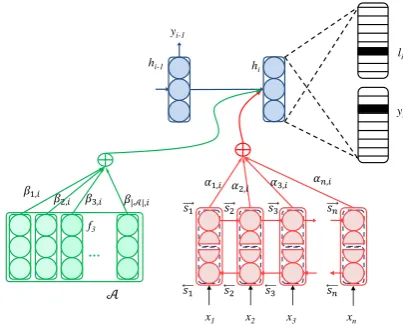
The morphology table also helps the second predictor. Without considering the table, the last layer only includes information about the input se-quence and previously predicted outputs, which is not directly related to morphological informa-tion. The second attention module retrieves useful affixes from the morphology table and concate-nates to the last layer, which means the decoder is explicitly fed with morphological information. Therefore, these two modules mutually help each other. The external channel helps update the mor-phology table with high-quality affixes (backward pass) and the table sends its high-quality signals to the prediction layer (forward pass). The relation between these modules and the NMT architecture is illustrated in Figure2.
hi
li
𝑠1 𝑠2 𝑠3 𝑠𝑛
hi-1
yi-1
𝑠1 𝑠2 𝑠3 𝑠𝑛
𝛼1,𝑖 𝛼2,𝑖 𝛼3,𝑖 𝛼𝑛,𝑖
yi
… 𝛽1,𝑖 𝛽
2,𝑖 𝛽3,𝑖 𝛽|𝒜|,𝑖
𝒜
f3
[image:5.595.313.515.296.460.2]x1 x2 x3 xn
Figure 2: The architecture of the NMT model with an auxiliary prediction channel and an extra morphology table. This network includes only one decoder layer and one encoder layer.⊕shows the attention modules.
4 Experimental Study
4.1 Experimental Setting
In order to make our work comparable we try to follow the same experimental setting used in CDNMT, where the GRU size is 1024, the affix and word embedding size is 512, and the beam width is20. Our models are trained using stochas-tic gradient descent with Adam (Kingma and Ba, 2015). Chung et al. (2016) and Sennrich et al. (2016) demonstrated thatbpeboosts NMT, so sim-ilar to CDNMT we also preprocess the source side of our corpora using bpe. We useWMT-15
corpora1 to train the models, newstest-2013
for tuning and newstest-2015 as the test sets. For English–Turkish (En–Tr) we use
theOpenSubtitle2016collection (Lison and
Tiedemann, 2016). The training side of the English–German (En–De), English–Russian (En– Ru), and En–Tr corpora include 4.5, 2.1, and 4 million parallel sentences, respectively. We ran-domly select3K sentences for each of the develop-ment and test sets for En–Tr. For all language pairs we keep the 400 most frequent characters as the target-side character set and replace the remainder (infrequent characters) with a specific character.
One of the key modules in our architecture is the morphology table. In order to implement it we use a look-up table whose columns include embed-dings for the target language’s affixes (each col-umn represents one affix) which are updated dur-ing traindur-ing. As previously mentioned, the table is intended to provide useful, morphological in-formation so it should be initialized properly, for which we use a morphology-aware embedding-learning model. To this end, we use the neural language model ofBotha and Blunsom(2014) in which each word is represented via a linear com-bination of the embeddings of its surface form and subunits, e.g. −−−−−−−−−→terbiyesizlik = −−−−−−−−−→terbiyesizlik +
−−−−→
terbiye+−→siz+−→lik. Given a sequence of words, the neural language model tries to predict the next word, so it learns sentence-level dependencies as well as intra-word relations. The model trains sur-face form and subword-level embeddings which provides us with high-quality affix embeddings.
Our neural language model is a recurrent net-work with a single1000-dimensional GRU layer, which is trained on the target sides of our paral-lel corpora. The embedding size is 512and we use a batch size of 100 to train the model. Be-fore training the neural language model, we need
1http://www.statmt.org/wmt15/
to manipulate the training corpus to decompose words into morphemes for which we use Morfes-sor (Smit et al., 2014), an unsupervised morpho-logical analyzer. Using Morfessor each word is segmented into different subunits where we con-sider the longest part as the stem of each word; what appears before the stem is taken as a member of the set of prefixes (there might be one or more prefixes) and what follows the stem is considered as a member of the set of suffixes.
Since Morfessor is an unsupervised analyzer, in order to minimize segmentation errors and avoid noisy results we filter its output and exclude sub-units which occur fewer than 500 times.2
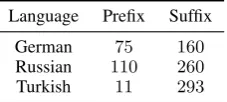
Af-ter decomposing, filAf-tering, and separating stems from affixes, we extracted several affixes which are reported in Table2. We emphasize that there might be wrong segmentations in Morfessor’s out-put, e.g. Turkish is a suffix-based language, so there are no prefixes in this language, but based on what Morfessor generated we extracted11 dif-ferent types of prefixes. We do not post-process Morfessor’s outputs.
Language Prefix Suffix
German 75 160
Russian 110 260
[image:6.595.361.475.398.449.2]Turkish 11 293
Table 2: The number of affixes extracted for each lan-guage.
Using the neural language model we train word, stem, and affix embeddings, and initialize the look-up table (but not other parts) of the decoder using those affixes. The look-up table includes high-quality affixes trained on the target side of the parallel corpus by which we train the transla-tion model. Clearly, such an affix table is an ad-ditional knowledge source for the decoder. It pre-serves information which is very close to what the decoder actually needs. However, there might be some missing pieces of information or some in-compatibility between the decoder and the table, so we do not freeze the morphology table during training, but let the decoder update it with respect to its needs in the forward and backward passes.
2The number may seem a little high, but for a corpus with
4.2 Experimental Results
Table3summarizes our experimental results. We report results for the bpe→char setting, which
means the source token is a bpeunit and the de-coder samples a character at each time step. CD-NMT is the baseline model. Table 3 includes scores reported from the original CDNMT model (Chung et al.,2016) as well as the scores from our reimplementation. To make our work comparable and show the impact of the new architecture, we tried to replicate CDNMT’s results in our exper-imental setting, we kept everything (parameters, iterations, epochs etc.) unchanged and evaluated the extended model in the same setting. Table3 reports BLEU scores (Papineni et al.,2002) of our NMT models.
Model En→De En→Ru En→Tr
CDNMT 21.33 26.00
-CDNMT∗ 21.01 26.23 18.01
CDNMT∗
m 21.27 26.78 18.44
CDNMT∗
o 21.39 26.39 18.59
CDNMT∗
mo 21.48 26.84 18.70
Table 3: CDNMT∗is our implementation of CDNMT.
mandoindicates that the base model is extended with
the morphology table and the additional output chan-nel, respectively.mois the combination of both the
ex-tensions. The improvement provided by the boldfaced number compared to CDNMT∗ is statistically signifi-cant according to paired bootstrap re-sampling (Koehn,
2004) withp= 0.05.
Table 3 can be interpreted from different per-spectives but the main findings are summarized as follows:
• The morphology table yields significant
im-provements for all languages and settings.
• The morphology table boosts the En–Tr en-gine more than others and we think this is be-cause of the nature of the language. Turkish is an agglutinative language in which mor-phemes are clearly separable from each other, but in German and Russian morphological transformations rely more on fusional oper-ations rather than agglutination.
• It seems that there is a direct relation between the size of the morphology table and the gain provided for the decoder, because Russian and Turkish have bigger tables and benefit from the table more than German which has fewer affixes.
• The auxiliary output channel is even more useful than the morphology table for all set-tings but En–Ru, and we think this is because of the morpheme-per-word ratio in Russian. The number of morphemes attached to a Rus-sian word is usually more than those of Ger-man and Turkish words in our corpora, and it makes the prediction harder for the classifier (the more the number of suffixes attached to a word, the harder the classification task).
• The combination of the morphology table
and the extra output channel provides the best result for all languages.
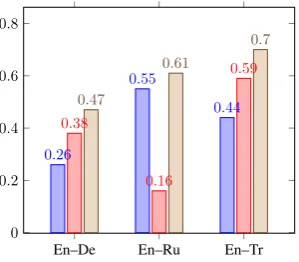
Figure3depicts the impact of the morphology ta-ble and the extra output channel for each language.
En–De En–Ru En–Tr
0 0.2 0.4 0.6 0.8
0.26
0.55
0.44 0.38
0.16
0.59
0.47
0.61
0.7
Figure 3: The y axis shows the difference between
the BLEU score of CDNMT∗and the extended model. The first, second, and third bars show them,o, andmo
extensions, respectively.
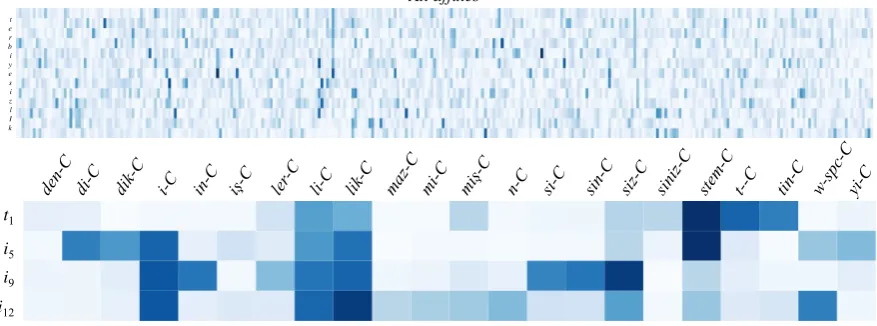
To further study our models’ behaviour and ensure that our extensions do not generate ran-dom improvements we visualized some attention weights when generating ‘terbiyesizlik’. In Figure 4, the upper figure shows attention weights for all Turkish affixes, where they axis shows different time steps and thexaxis includes attention weights of all affixes (304 columns) for those time steps, e.g. the first row and the first column represents the attention weight assigned to the first Turkish affix when samplingtin ‘terbiyesizlik’. While at the first glance the figure may appear to be some-what confusing, but it provides some interesting insights which we elaborate next.
[image:7.595.344.494.306.437.2]t e r b i y e s i z l I k
t1
i5
i9
i12
[image:8.595.77.516.71.234.2]All affixes
Figure 4: Visualizing the attention weights between the morphology table and the decoder when generating ‘ ter-biyesizlik.
(i9), and twelfth (i12) time steps when generating
the same Turkish word ‘t1erbi5yesi9zli12k’. t1 is
the first character of the word. We also have three icharacters from different morphemes, where the first one is part of the stem, the second one be-longs to the suffix ‘siz’, and the third one to ‘lik’. It is interesting to see how the table reacts to the same character from different parts. For each time step we selected the top-10affixes which have the highest attention weights. The set of top-10affixes can be different for each step, so we made a union of those sets which gives us22 affixes. The bot-tom part of Figure 4shows the attention weights for those22affixes at each time step.
After analyzing the weights we observed inter-esting properties about the morphology table and the auxiliary attention module.3 The main findings
about the behaviour of the table are as follows:
• The model assigns high attention weights to
stem-C for almost all time steps. However, the weights assigned to this class fort1andi5
are much higher than those of affix characters (as they are part of the stem). The vertical lines in both figures approve this feature (bad behaviour).
• For some unknown reasons there are some affixes which have no direct relation to that particulate time step but they receive a high attention, such asmazint12(bad behaviour).
• For almost all time steps the highest attention
weight belongs to the class which is expected
3Our observations are not based on this example alone
as we studied other random examples, and the table shows consistent behaviour for all examples.
to be selected, e.g. weights for (i5,stem-C) or
(i9,siz-C) (good behaviour).
• The morphology table may send bad or good signals but it is consistent for similar or co-occurring characters, e.g. for the last three time stepsl11,i12, and k13, almost the same
set of affixes receives the highest attention weights. This consistency is exactly what we are looking for, as it can define a reliable external constraint for the decoder to guide it. Vertical lines on the figure also confirm this fact. They show that for a set of con-secutive characters which belong to the same morpheme the attention module sends a sig-nal from a particular affix (good behaviour).
• There are some affixes which might not be directly related to that time step but receive high attention weights. This is because those affixes either include the same charac-ter which the decoder tries to predict (e.g.i-C
fori4 or t-Cand tin-Cfor t1), or frequently
appear with that part of the word which in-cludes the target character (e.g. mi-Chas a high weight when predictingt1becauset1
be-longs toterbiye which frequently collocates withmi-C:terbiye+mi) (good behaviour).
Reference: Geschäftsbedingungen für das Senden von Beiträgen an die BBC
CDNMT∗ allgemeinen geschaftsbedingungen fur die versendung von Beiträgen an die BBC
CDNMT∗
mo Geschäft s bedingungen für die versendung von Beiträgen zum BBC
Table 4: Comparing translation results for the CDNMT∗(baseline) and CDNMT∗
mo(improved) models when the
input sentence is ‘Terms and conditions for sending contributions to the BBC’.
The table demonstrates that our architecture is able to control the decoder and limit its selections, e.g. the word‘allgemeinen’generated by the base-line model is redundant. There is no constraint to inform the baseline model that this word should not be generated, whereas our proposed architec-ture controls the decoder in such situations. Af-ter analyzing our model, we realized that there are strong attention weights assigned to the w-space
(indicating white space characters) and BOS (be-ginning of the sequence) columns of the affix ta-ble while sampling the first character of the word
‘Geschäft’, which shows that the decoder is in-formed about the start point of the sequence. Sim-ilar to the baseline model’s decoder, our decoder can sample any character including ‘a’of ‘allge-meinen’or‘G’of‘Geschäft’. Translation informa-tion stored in the baseline decoder is not sufficient for selecting the right character ‘G’, so the de-coder wrongly starts with‘i’ and continues along a wrong path up to generating the whole word. However, our decoder’s information is accompa-nied with signals from the affix table which force it to start with a better initial character, whose sam-pling leads to generating the correct target word.
Another interesting feature about the table is the new structure ‘Geschäft s bedingungen’generated by the improved model. As the reference transla-tion shows, in the correct form these two structures should be glued together via‘s’, which can be con-sidered as an infix. As our model is supposed to detect this sort of intra-word relation, it treats the whole structure as two compounds which are con-nected to one another via an infix. Although this is not a correct translation and it would be trivial to post-edit into the correct output form, it is interest-ing to see how our mechanism forces the decoder to pay attention to intra-word relations.
Apart from these two interesting findings, the number of wrong character selections in the base-line model is considerably reduced in the im-proved model because of our enhanced architec-ture.
5 Conclusion and Future Work
In this paper we proposed a new architecture to incorporate morphological information into the NMT pipeline. We extended the state-of-the-art NMT model (Chung et al.,2016) with a morphol-ogy table. The table could be considered as an external knowledge source which is helpful as it increases the capacity of the model by increasing the number of network parameters. We tried to benefit from this advantage. Moreover, we man-aged to fill the table with morphological informa-tion to further boost the NMT model when trans-lating into MRLs. Apart from the table we also de-signed an additional output channel which forces the decoder to predict morphological annotations. The error signals coming from the second chan-nel during training inform the decoder with mor-phological properties of the target language. Ex-perimental results show that our techniques were useful for NMT of MRLs.
As our future work we follow three main ideas. i) We try to find more efficient ways to supply morphological information for both the encoder and decoder. ii) We plan to benefit from other types of information such as syntactic and seman-tic annotations to boost the decoder, as the table is not limited to morphological information alone and can preserve other sorts of information. iii) Finally, we target sequence generation for fusional languages. Although our model showed signifi-cant improvements for both German and Russian, the proposed model is more suitable for generating sequences in agglutinative languages.
Acknowledgments
References
Dzmitry Bahdanau, Kyunghyun Cho, and Yoshua Ben-gio. 2014. Neural machine translation by jointly learning to align and translate. In Proceedings of the International Conference on Learning Represen-tations. Banff, Canada.
Jan A Botha and Phil Blunsom. 2014. Compositional morphology for word representations and language modelling. InThe 3st International Conference on Machine Learning (ICML). Beijing, China, pages 1899–1907.
Iacer Calixto, Qun Liu, and Nick Campbell. 2017. Doubly-attentive decoder for multi-modal neural machine translation. InProceedings of the 55th An-nual Meeting of the Association for Computational Linguistics (Volume 1: Long Papers). Vancouver, Canada, pages 1913–1924.
Kyunghyun Cho, Bart van Merrienboer, Caglar Gul-cehre, Dzmitry Bahdanau, Fethi Bougares, Holger Schwenk, and Yoshua Bengio. 2014. Learning phrase representations using RNN encoder–decoder for statistical machine translation. InProceedings of the 2014 Conference on Empirical Methods in Nat-ural Language Processing (EMNLP). Doha, Qatar, pages 1724–1734.
Junyoung Chung, Kyunghyun Cho, and Yoshua Ben-gio. 2016. A character-level decoder without ex-plicit segmentation for neural machine translation. InProceedings of the 54th Annual Meeting of the As-sociation for Computational Linguistics (Volume 1: Long Papers). Berlin, Germany, pages 1693–1703. Marta R. Costa-jussà and José A. R. Fonollosa. 2016.
Character-based neural machine translation. In Pro-ceedings of the 54th Annual Meeting of the Associa-tion for ComputaAssocia-tional Linguistics (Volume 2: Short Papers). Berlin, Germany, pages 357–361.
Mercedes García-Martínez, Loïc Barrault, and Fethi Bougares. 2016. Factored neural machine transla-tion. arXiv preprint arXiv:1609.04621.
Stig-Arne Grönroos, Sami Virpioja, and Mikko Ku-rimo. 2017. Extending hybrid word-character neural machine translation with multi-task learning of mor-phological analysis. In Proceedings of the Second Conference on Machine Translation. Copenhagen, Denmark, pages 296–302.
Po-Yao Huang, Frederick Liu, Sz-Rung Shiang, Jean Oh, and Chris Dyer. 2016. Attention-based multi-modal neural machine translation. InProceedings of the first Conference on Machine Translation. pages 639–645.
Sébastien Jean, Kyunghyun Cho, Roland Memise-vic, and Yoshua Bengio. 2015. On using very large target vocabulary for neural machine trans-lation. In Proceedings of the 53rd Annual Meet-ing of the Association for Computational Lin-guistics and the 7th International Joint Confer-ence on Natural Language Processing (Volume
1: Long Papers). Beijing, China, pages 1–10.
http://www.aclweb.org/anthology/P15-1001.
Yoon Kim, Yacine Jernite, David Sontag, and Alexan-der M Rush. 2016. Character-aware neural lan-guage models. In Proceedings of the Thirtieth AAAI Conference on Artificial Intelligence (AAAI-16). Phoenix, Arizona, USA, pages 2741–2749.
Diederik Kingma and Jimmy Ba. 2015. Adam: A method for stochastic optimization. InInternational Conference on Learning Representations (ICLR). San Diego, USA.
Philipp Koehn. 2004. Statistical significance tests for machine translation evaluation. In Proceed-ings of Conference on Empirical Methods in Natural Language Processing (EMNLP). Barcelona, Spain, pages 388–395.
Pierre Lison and Jörg Tiedemann. 2016. Opensub-titles2016: Extracting large parallel corpora from movie and TV subtitles. InProceedings of the 10th International Conference on Language Resources and Evaluation. Portoroz, Slovenia, pages 923–929.
Minh-Thang Luong and Christopher D. Manning. 2016. Achieving open vocabulary neural machine translation with hybrid word-character models. In
Proceedings of the 54th Annual Meeting of the As-sociation for Computational Linguistics (Volume 1: Long Papers). Berlin, Germany, pages 1054–1063.
Thang Luong, Ilya Sutskever, Quoc Le, Oriol Vinyals, and Wojciech Zaremba. 2015. Addressing the rare word problem in neural machine translation. In
Proceedings of the 53rd Annual Meeting of the Association for Computational Linguistics and the 7th International Joint Conference on Natural Lan-guage Processing (Volume 1: Long Papers). Beijing, China, pages 11–19.
Kishore Papineni, Salim Roukos, Todd Ward, and Wei-Jing Zhu. 2002. BLEU: a method for automatic evaluation of machine translation. InProceedings of the 40th Annual Meeting of Association for Compu-tational Linguistics. Pennsylvania, PA., USA, pages 311–318.
Peyman Passban. 2018. Machine Translation of Mor-phologically Rich Languages Using Deep Neural Networks. Ph.D. thesis, School of Computing, Dublin City University, Ireland.
Rico Sennrich and Barry Haddow. 2016. Linguistic input features improve neural machine translation. InProceedings of the First Conference on Machine Translation. Berlin, Germany, pages 83–91.
Peter Smit, Sami Virpioja, Stig-Arne Grönroos, and Mikko Kurimo. 2014. Morfessor 2.0: Toolkit for statistical morphological segmentation. In Proceed-ings of the Demonstrations at the 14th Conference of the European Chapter of the Association for Com-putational Linguistics. Gothenburg, Sweden, pages 21–24.
Ekaterina Vylomova, Trevor Cohn, Xuanli He, and Gholamreza Haffari. 2016. Word representation models for morphologically rich languages in neu-ral machine translation. CoRR abs/1606.04217.
http://arxiv.org/abs/1606.04217.
Yonghui Wu, Mike Schuster, Zhifeng Chen, Quoc V. Le, Mohammad Norouzi, Wolfgang Macherey, Maxim Krikun, Yuan Cao, Qin Gao, Klaus Macherey, Jeff Klingner, Apurva Shah, Melvin Johnson, Xiaobing Liu, Lukasz Kaiser, Stephan Gouws, Yoshikiyo Kato, Taku Kudo, Hideto Kazawa, Keith Stevens, George Kurian, Nishant Patil, Wei Wang, Cliff Young, Jason Smith, Jason Riesa, Alex Rudnick, Oriol Vinyals, Greg Corrado, Macduff Hughes, and Jeffrey Dean. 2016. Google’s neural machine translation system: Bridging the gap between human and machine translation. CoRR