Proceedings of NAACL-HLT 2018, pages 976–986
Robust Multilingual Part-of-Speech Tagging via Adversarial Training
Michihiro Yasunaga Jungo Kasai Dragomir Radev
Department of Computer Science, Yale University
{michihiro.yasunaga,jungo.kasai,dragomir.radev}@yale.edu
Abstract
Adversarial training (AT)1 is a powerful
reg-ularization method for neural networks, aim-ing to achieve robustness to input perturba-tions. Yet, the specific effects of the robust-ness obtained from AT are still unclear in the context of natural language processing. In this paper, we propose and analyze a neural POS tagging model that exploits AT. In our ex-periments on the Penn Treebank WSJ corpus and the Universal Dependencies (UD) dataset (27 languages), we find that AT not only im-proves the overall tagging accuracy, but also 1) prevents over-fitting well in low resource languages and 2) boosts tagging accuracy for rare / unseen words. We also demonstrate that 3) the improved tagging performance by AT contributes to the downstream task of depen-dency parsing, and that 4) AT helps the model to learn cleaner word representations. 5) The proposed AT model is generally effective in different sequence labeling tasks. These posi-tive results motivate further use of AT for nat-ural language tasks.
1 Introduction
Recently, neural network-based approaches have become popular in many natural language pro-cessing (NLP) tasks including tagging, parsing, and translation (Chen and Manning, 2014; Bah-danau et al., 2015; Ma and Hovy, 2016). How-ever, it has been shown that neural networks tend to be locally unstable and even tiny perturba-tions to the original inputs can mislead the models (Szegedy et al.,2014). Such maliciously perturbed inputs are calledadversarial examples. Adversar-ial training(Goodfellow et al.,2015) aims to im-prove the robustness of a model to input perturba-tions by training on both unmodified examples and adversarial examples. Previous work (Goodfellow
[image:1.595.304.522.222.400.2]1We distinguish AT from Generative Adversarial Net-works (GANs).
Figure 1: Illustration of our architecture for adversar-ial POS tagging. Given a sentence, we input the nor-malized word embeddings (w1,w2,w3) and character embeddings (showingc1,c2,c3forw1). Each word is
represented by concatenating its word embedding and its character-level BiLSTM output. They are fed into the main BiLSTM-CRF network for POS tagging. In adversarial training, we compute and add the worst-case perturbationηto all the input embeddings for
reg-ularization.
et al.,2015;Shaham et al.,2015) on image recog-nition has demonstrated the enhanced robustness of their models to unseen images via adversarial training and has provided theoretical explanations of the regularization effects.
Despite its potential as a powerful regularizer, adversarial training (AT) has yet to be explored ex-tensively in natural language tasks. Recently, Miy-ato et al.(2017) applied AT on text classification, achieving state-of-the-art accuracy. Yet, the spe-cific effects of the robustness obtained from AT are still unclear in the context of NLP. For example, research studies have yet to answer questions such as 1) how can we interpret perturbations or robust-ness on natural language inputs? 2) how are they related to linguistic factors like vocabulary
tics? 3) are the effects of AT language-dependent? Answering such questions is crucial to understand and motivate the application of adversarial train-ing on natural language tasks.
In this paper, spotlighting a well-studied core problem of NLP, we propose and carefully ana-lyze a neural part-of-speech (POS) tagging model that exploits adversarial training. With a BiLSTM-CRF model (Huang et al., 2015; Ma and Hovy,
2016) as our baseline POS tagger, we apply ad-versarial training by considering perturbations to input word/character embeddings. In order to de-mystify the effects of adversarial training in the context of NLP, we conduct POS tagging experi-ments on multiple languages using the Penn Tree-bank WSJ corpus (Englsih) and the Universal De-pendencies dataset (27 languages), with thorough analyses of the following points:
• Effects on different target languages • Vocabulary statistics and tagging accuracy • Influence on downstream tasks
• Representation learning of words
In our experiments, we find that our adversarial training model consistently outperforms the base-line POS tagger, and even achieves state-of-the-art results on 22 languages. Furthermore, our anal-yses reveal the following insights into adversarial training in the context of NLP:
• The regularization effects of adversarial train-ing (AT) are general across different languages. AT can prevent overfitting especially well when training examples are scarce, providing an ef-fective tool to process low resource languages. • AT can boost the tagging performance for rare/
unseen words and increase the sentence-level accuracy. This positively affects the perfor-mance of down-stream tasks such as depen-dency parsing, where low sentence-level POS accuracy can be a bottleneck (Manning,2011). • AT helps the network learn cleaner word em-beddings, showing stronger correlations with their POS tags.
We argue that the effects of AT can be interpreted from the perspective of natural language. Finally, we demonstrate that the proposed AT model is generally effective across different sequence label-ing tasks. This work therefore provides a strong motivation and basis for utilizing adversarial train-ing in NLP tasks.
2 Related Work 2.1 POS Tagging
Part-of-speech (POS) tagging is a fundamental NLP task that facilitates downstream tasks such as syntactic parsing. While current state-of-the-art POS taggers (Ling et al.,2015;Ma and Hovy,
2016) yield accuracy over 97.5% on PTB-WSJ, there still remain issues. The per token accuracy metric is easy since taggers can easily assign cor-rect POS tags to highly unambiguous tokens, such as punctuation (Manning, 2011). Sentence-level accuracy serves as a more realistic metric for POS taggers but it still remains low. Another prob-lem with current POS taggers is that their accuracy deteriorates drastically on low resource languages and rare words (Plank et al.,2016). In this work, we demonstrate that adversarial training (AT) can mitigate these issues.
It is empirically shown that POS tagging perfor-mance can greatly affect downstream tasks such as dependency parsing (Dozat et al., 2017). In this work, we also demonstrate that the improvements obtained from our AT POS tagger actually con-tribute to dependency parsing. Nonetheless, pars-ing with gold POS tags still yields better results, bolstering the view that POS tagging is an essen-tial task in NLP that needs further development.
2.2 Adversarial Training
The concept of adversarial training (Szegedy et al.,
2014;Goodfellow et al.,2015) was originally in-troduced in the context of image classification to improve the robustness of a model by training on input images with malicious perturbations. Previ-ous work (Goodfellow et al.,2015;Shaham et al.,
2015;Wang et al.,2017) has provided a theoreti-cal framework to understand adversarial examples and the regularization effects of adversarial train-ing (AT) in image recognition.
that exploits AT in NLP tasks.
AT is related to other regularization methods that add noise to data such as dropout (Srivastava et al.,2014) and its variant for NLP tasks, word dropout (Iyyer et al.,2015). Xie et al.(2017) dis-cuss various data noising techniques for language modeling. While these methods produce random noise, AT generates perturbations that the current model is particularly vulnerable to, and thus is claimed to be effective (Goodfellow et al.,2015).
It should be noted that while related in name, adversarial training (AT) differs from Generative Adversarial Networks (GANs) (Goodfellow et al.,
2014). GANs have already been applied to NLP tasks such as dialogue generation (Li et al.,2017) and transfer learning (Kim et al.,2017;Gui et al.,
2017). Adversarial training also differs from ad-versarialevaluation, recently proposed for reading comprehension tasks (Jia and Liang,2017). 3 Method
In this section, we introduce our baseline POS tag-ging model and explain how we implement adver-sarial training on top.
3.1 Baseline POS Tagging Model
Following the recent top-performing models for sequence labeling tasks (Plank et al.,2016; Lam-ple et al.,2016;Ma and Hovy,2016), we employ a Bi-directional LSTM-CRF model as our baseline (see Figure1for an illustration).
Character-level BiLSTM. Prior work has
shown that incorporating character-level represen-tations of words can boost POS tagging accuracy by capturing morphological information present in each language. Major neural character-level models include the character-level CNN (Ma and Hovy,2016) and (Bi)LSTM (Dozat et al.,2017). A Bi-directional LSTM (BiLSTM) (Hochreiter and Schmidhuber, 1997; Schuster and Paliwal,
1997) processes each sequence both forward and backward to capture sequential information, while preventing the vanishing / exploding gradient problem. We observed that the character-level BiLSTM outperformed the CNN by 0.1% on the PTB-WSJ development set, and hence in all of our experiments we use the character-level BiLSTM. Specifically, we generate a character-level repre-sentation for each word by feeding its character embeddings into the BiLSTM and obtaining the concatenated final states.
Word-level BiLSTM. Each word in a sentence
is represented by concatenating its word embed-ding and its character-level representation. They are fed into another level of BiLSTM (word-level BiLSTM) to process the entire sentence.
CRF. In sequence labeling tasks it is beneficial to consider the correlations between neighboring labels and jointly decode the best chain of labels for a given sentence. With this motivation, we apply a conditional random field (CRF) (Lafferty et al.,2001) on top of the word-level BiLSTM to perform POS tag inference with global normaliza-tion, addressing the “label bias” problem. Specif-ically, given an input sentence, we pass the out-put sequence of the word-level BiLSTM to a first-order chain CRF to compute the conditional prob-ability of the target label sequence:
p(y|s;θ)
whereθrepresents all of the model parameters (in
the BiLSTMs and CRF), s andy denote the
in-put embeddings and the target POS tag sequence, respectively, for the given sentence.
For training, we minimize the negative log-likelihood (loss function)
L(θ;s,y) =−logp(y|s;θ) (1)
with respect to the model parameters. Decoding searches for the POS tag sequence y∗ with the
highest conditional probability using the Viterbi algorithm. For more detail about the BiLSTM-CRF formulation, refer toMa and Hovy(2016).
3.2 Adversarial Training
Generating adversarial examples. Adversarial training (AT) considers continuous perturbations to inputs, so we define perturbations at the level of dense word / character embeddings rather than one-hot vector representations, similarly to Miy-ato et al.(2017). Specifically, given an input sen-tence, we consider the concatenation of all the word / character embeddings in the sentence: s = [w1,w2, . . . ,c1,c2, . . .]. To prepare an
adversar-ial example, we aim to generate the worst-case perturbation of a small bounded normthat max-imizes the loss functionLof the current model:
η= arg max η0:kη0k2≤
L(ˆθ;s+η0,y)
whereθˆ is the current value of the model
param-eters, treated as a constant, andydenotes the
tar-get labels. Since the exact computation of suchη
is intractable in complex neural networks, we em-ploy the Fast Gradient Method (Liu et al., 2017;
Miyato et al.,2017) i.e. first order approximation to obtain an approximate worst-case perturbation of norm, by a single gradient computation:
η=g/kgk2, whereg=∇sL(ˆθ;s,y) (2)
is a hyperparameter to be determined in the de-velopment dataset. Note that the perturbation η
is generated in the direction that significantly in-creases the lossL. We find suchηagainst the
cur-rent model parameterized by θˆ, at each training
step, and construct an adversarial example by
sadv =s+η
However, if we do not restrict the norm of word / character embeddings, the model could trivially learn embeddings of large norms to make the per-turbations insignificant. To prevent this issue, we normalize word/character embeddings so that they have mean 0 and variance 1 for every entry, as in
Miyato et al. (2017). The normalization is per-formed every time we feed input embeddings into the LSTMs and generate adversarial examples. To ensure a fair comparison, we also normalize input embeddings in our baseline model.
While Miyato et al. (2017) set the norm of a perturbation(Eq2) to be a fixed value for all in-put sentences, to generate adversarial examples for an entire sentence of a variable length and to in-clude character embeddings besides word embed-dings, we make the perturbation sizeadaptive to the dimension of the concatenated input embed-dings ∈ RD. We setto beα√D (i.e.,
propor-tional to√D), as the expected squared norm ofs
after the embedding normalization isD. The scal-ing factorαis selected from{0.001, 0.005, 0.01, 0.05, 0.1}based on the development performance in each treebank. We used 0.01 for PTB-WSJ and UD-Spanish, and 0.05 for the rest. Note thatα= 0
would generate no noise (identical to the baseline); if α = 1, the generated adversarial perturbation
would have a norm comparable to the original em-bedding, which could change the semantics of the input sentence (Wu et al.,2017). Hence, the opti-mal perturbation scaleαshould lie in between and be small enough to preserve the semantics of the original input.
Adversarial training. At each training step, we
generate adversarial examples against the current model, and train on the mixture of clean examples and adversarial examples to achieve robustness to input perturbations. To this end, we define the loss function for adversarial training as:
˜
L=γL(θ;s,y) + (1−γ)L(θ;sadv,y)
whereL(θ;s,y),L(θ;sadv,y)represent the loss
from a clean example and the loss from its adver-sarial example, respectively, andγ determines the weighting between them. We usedγ = 0.5in all
our experiments. This objective function can be optimized with respect to the model parametersθ,
in the same manner as the baseline model. 4 Experiments
To fully analyze the effects of adversarial training, we train and evaluate our baseline/adversarial POS tagging models on both a standard English dataset and a multilingual dataset.
4.1 Datasets
As a standard English dataset, we use the Wall Street Journal (WSJ) portion of the Penn Treebank (PTB) (Marcus et al.,1993), containing 45 differ-ent POS tags. We adopt the standard split: sec-tions 0-18 for training, 19-21 for development and 22-24 for testing (Collins,2002;Manning,2011). For multilingual POS tagging experiments, to compare with prior work, we use treebanks from Universal Dependencies (UD) v1.2 (Nivre et al.,
2015) (17 POS) with the given data splits. We ex-periment on languages for which pre-trained Poly-glot word embeddings (Al-Rfou et al., 2013) are available, resulting in 27 languages listed in Table
Model Accuracy
Toutanova et al.(2003) 97.27
Manning(2011) 97.28
Collobert et al.(2011) 97.29
Søgaard(2011) 97.50
Ling et al.(2015) 97.78
Ma and Hovy(2016) 97.55
Yang et al.(2017) 97.55
Hashimoto et al.(2017) 97.55
[image:5.595.104.261.60.186.2] [image:5.595.305.528.62.349.2]Ours – Baseline(BiLSTM-CRF) 97.54 Ours – Adversarial 97.58
Table 1: POS tagging accuracy on the PTB-WSJ test set, with other top-performing systems.
4.2 Training & Evaluation Details
Model settings. We initialize word embeddings
with 100-dimensional GloVe (Pennington et al.,
2014) for English, and with 64-dimensional Poly-glot (Al-Rfou et al.,2013) for other languages. We use 30-dimensional character embeddings, and set the state sizes of character/word-level BiLSTM to be 50, 200 for English, 50, 100 for low resource languages, and 50, 150 for other languages. The model parameters and character embeddings are randomly initialized, as inMa and Hovy (2016). We apply dropout (Srivastava et al.,2014) to input embeddings and BiLSTM outputs for both base-line and adversarial training, with dropout rate 0.5.
Optimization. We train the model parameters
and word/character embeddings by the mini-batch stochastic gradient descent (SGD) with batch size 10, momentum 0.9, initial learning rate 0.01 and decay rate 0.05. We also use a gradient clipping of 5.0 (Pascanu et al.,2012). The models are trained with early stopping (Caruana et al., 2001) based on the development performance.
Evaluation. We evaluate per token tagging
ac-curacy on test sets. We repeat the experiment three times and report the statistical significance.
4.3 Results
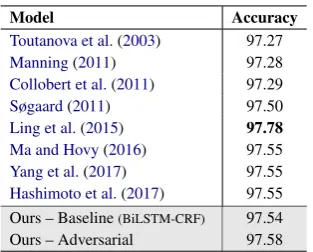
PTB-WSJ dataset. Table1shows the POS
tag-ging results. As expected, our baseline (BiLSTM-CRF) model (accuracy 97.54%) performs on par with other state-of-the-art systems. Built upon this baseline, our adversarial training (AT) model reaches accuracy 97.58% thanks to its regulariza-tion power, outperforming recent POS taggers ex-ceptLing et al.(2015). The improvement over the baseline is statistically significant, withp-value<
0.05 on thet-test. We provide additional analysis on this result in later sections.
Our Models Plank et al. (2016) Berend Nguyen et Baseline Adversarial BiLSTM TNT CRF (2017) al. (2017)
bg 98.34 98.53 97.97 96.84 96.36 95.63 97.4 cs 98.70 98.81 98.24 96.82 96.56 95.83 – da 96.63 96.74 96.35 94.29 93.83 93.32 95.8 de• 94.29 94.35 93.38 92.64 91.38 90.73 92.7 en 95.72 95.82 95.16 94.55 93.35 93.47 94.7 es 96.26 96.44 95.74 94.55 94.23 94.69 95.9 eu• 94.55 94.71 95.51 93.35 91.63 90.63 93.7 fa 97.38 97.51 97.49 95.98 95.65 96.11 96.8 fi• 94.54 95.40 95.85 93.59 90.32 89.19 94.6 fr 96.48 96.63 96.11 94.51 95.14 94.96 96.0 he 97.34 97.43 96.96 93.71 93.63 95.28 – hi 97.12 97.21 97.10 94.53 96.00 96.09 96.4 hr• 96.12 96.32 96.82 94.06 93.16 93.53 – id 93.95 94.03 93.41 93.16 92.96 92.02 93.1 it 98.04 98.08 97.95 96.16 96.43 96.28 97.5 nl 92.64 93.09 93.30 88.54 90.03 85.10 91.4 no 97.88 98.08 98.03 96.31 96.21 95.67 97.4 pl• 97.34 97.57 97.62 95.57 93.96 93.95 96.3 pt 97.94 98.07 97.90 96.27 96.32 95.50 97.5 sl• 97.81 98.11 96.84 94.92 94.77 92.70 97.1 sv 96.39 96.70 96.69 95.19 94.45 94.62 – Avg 96.45 96.65 96.40 94.55 94.11 93.59 95.55
el 98.18 98.24 – – – 97.12 –
et• 90.79 91.32 – – – 86.30 –
ga 90.66 91.11 – – – 88.82 –
hu• 93.39 94.02 – – – 89.47 –
ro 91.24 91.46 – – – 88.99 –
ta 82.91 83.16 – – – 81.80 –
Avg 91.20 91.55 – – – 88.41 –
Table 1: POS tagging accuracy (test) for 27 UD v1.2 treebanks. The first column shows languages and the rest show tagging accuracy of different models. For Plank et al. (2016), we include the traditional baselines TNT and CRF, and their state-of-the-art model that employs a multi-task BiL-STM.Berend(2017) andNguyen et al.(2017) are two recent works reporting POS tagging perfor-mance on UD v1.2. Languages with • are mor-phologically rich, and those at the bottom (‘el’ to ‘ta’) are low-resourced, containing less than 60k tokens in their training sets.
References
G´abor Berend. 2017. Sparse coding of neural word em-beddings for multilingual sequence labeling. TACL .
Dat Quoc Nguyen, Mark Dras, and Mark Johnson. 2017. A Novel Neural Network Model for Joint POS Tagging and Graph-based Dependency Parsing. In Proceedings of the CoNLL 2017 Shared Task: Multilingual Parsing from Raw Text to Universal Dependencies.
Barbara Plank, Anders Søgaard, and Yoav Goldberg. 2016. Multilingual part-of-speech tagging with bidirectional long short-term memory models and auxiliary loss. In The 54th Annual Meeting of the Association for Computational Linguistics. page 412.
Table 2: POS tagging accuracy (test) for 27 UD v1.2 treebanks, with other recent works,Plank et al.(2016),
Berend (2017) and Nguyen et al. (2017). For Plank et al.(2016), we include the traditional baselines TNT and CRF, and their state-of-the-art model that employs a multi-task BiLSTM. Languages with• are
morpho-logically rich, and those at the bottom (‘el’ to ‘ta’) are low-resource, containing less than 60k tokens in their training sets.
Multilingual dataset (UD). Experimental
re-sults are summarized in Table2. Our AT model shows clear advantages over the baseline in all of the 27 languages (average improvement∼0.25%; see the two shaded columns). Considering that our baseline (BiLSTM-CRF) is already a top per-forming model for POS tagging, these ments made by AT are substantial. The improve-ments are also statistically significant for all the languages, withp-value<0.05 on thet-test, sug-gesting that the regularization by AT is generally effective across different languages. Moreover, our AT model achieves state-of-the-art on nearly all of the languages, except the five wherePlank et al. (2016)’s multi-task BiLSTM yielded better results. Among the five, most languages are mor-phologically rich (•).2 We suspect that their joint
training of word rarity may be of particular help in processing morphologically complex words.
show until the early stop of adversarial training. despite dropout baseline overfits
0 50000 100000 150000 200000
1.5 2 2.5 3
Number of Iterations
De
v
loss
English (WSJ)
Baseline Adversarial
Figure 1: 3
0 10000 20000 30000 40000 50000
2 3 4 5
Number of Iterations
De
v
loss
French (UD)
Baseline Adversarial
Figure 2: 3
0 1000 2000 3000 4000 5000
7 8 9 10
Number of Iterations
De
v
loss
Romanian (UD)
Baseline Adversarial
Figure 3: 3
[image:6.595.102.489.63.144.2]1
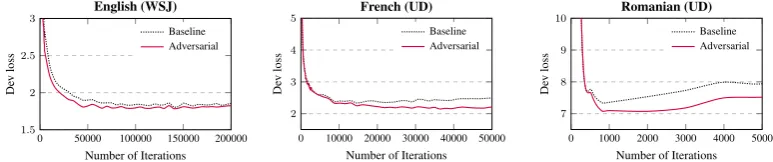
Figure 2: Learning curves for three representative languages (Romanian is low-resource). We show the transition of loss (defined in Eq1) on the development sets.
English (WSJ)
Word Frequency 0 1-10 10-100 100- Total # Tokens 3240 7687 20908 97819 129654 Baseline 92.25 95.36 96.03 98.19 97.53 Adversarial 92.01 95.52 96.10 98.23 97.57
French (UD)
Word Frequency 0 1-10 10-100 100- Total # Tokens 356 839 1492 *4523* *7210* Baseline 87.64 94.05 94.03 98.43 96.48 Adversarial 87.92 94.88 94.03 98.50 96.63
Table 3: POS tagging accuracy (test) on different sub-sets of words, categorized by their frequency of occur-rence in training. The second row shows the number of tokens in the test set that are in each category. The third and fourth rows show the performance of our two models. Better scores are underlined. The biggest im-provement isin bold.
Additionally, we see that our AT model achieves notably large improvements over the baseline in resource-poor languages (the bottom of Table 2), with average improvement 0.35%, as compared to that for resource-rich languages, 0.20%. To fur-ther visualize the regularization effects, we present the learning curves for three representative lan-guages, English (WSJ), French (UD-fr) and Ro-manian (UD-ro, low-resource), based on the de-velopment loss (see Figure 2). For all the three languages, we can observe that the AT model (red solid line) prevents overfitting better than the base-line (black dotted base-line), and this advantage is more significant in low resource languages. For exam-ple, in Romanian, the baseline model starts to in-crease development loss after 1,000 iterations even with dropout, whereas the AT model keeps im-proving until 2,500 iterations, achieving notably lower development loss (0.4 down). These results illustrate that AT can prevent overfitting especially well on small datasets and can augment the regu-larization power beyond dropout. AT can also be viewed as an effective means of data augmenta-tion, where we generate and train with new exam-ples the current model is particularly vulnerable to at every time step, enhancing the robustness of the
English (WSJ)
Word Frequency 0 1-10 10-100 100- Total # Tokens 6480 15374 41815 195637 259306 Baseline 97.76 97.71 97.80 97.45 97.53 Adversarial 98.06 97.71 97.89 97.47 97.57
French (UD)
Word Frequency 0 1-10 10-100 100- Total # Tokens 712 *1678* 2983 *9045* *14418* Baseline 95.08 97.08 97.58 96.11 96.48 Adversarial 95.37 97.26 97.79 96.23 96.63
Table 4: POS tagging accuracy (test) onneighboring
words. We cluster all words in the test set in the same way as Table3and consider the tagging performance on the neighbors (left and right) of these words in the test text.
model. AT can therefore be a promising tool to process low resource languages.
5 Analysis
In the previous sections, we demonstrated the reg-ularization power of adversarial training (AT) on different languages, based on the overall POS tag-ging performance and learning curves. In this sec-tion, we conduct further analyses on the robust-ness of AT from NLP specific aspects such as word statistics, sequence modeling, downstream tasks, and word representation learning.
We find that AT can boost tagging accuracy on rare words and neighbors of unseen words (§5.1). Furthermore, this robustness against rare / unseen words leads to better sentence-level accuracy and downstream dependency parsing (§5.2). We il-lustrate these findings using two major languages, English (WSJ) and French (UD), which have sub-stantially large training and testing data to dis-cuss vocabulary statistics and sentence-level per-formance. Finally, we study the effects of AT on word representation learning (§5.3), and the appli-cability of AT to different sequential tasks (§5.4).
5.1 Word-level Analysis
English (WSJ)
Sentence- Stanford Parser Parsey McParseface
level Acc. UAS LAS UAS LAS
Baseline 59.08 91.53 89.30 91.68 87.92
Adversarial 59.61 91.57 89.35 91.73 87.97
(w/ gold tags) – (92.07) (90.63) (91.98) (88.60)
French (UD)
Sentence- Parsey Universal
level Acc. UAS LAS
Baseline 52.35 84.85 80.36
Adversarial 53.36 85.01 80.55
[image:7.595.73.284.75.204.2](w/ gold tags) – (85.05) (80.75)
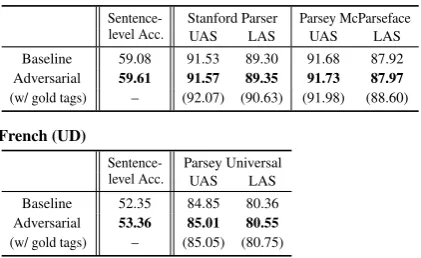
Table 5: Sentence-level accuracy and downstream de-pendency parsing performance by our baseline / adver-sarial POS taggers.
the effects of AT on rare / unseen words, we ana-lyze tagging performance at the word level, con-sidering vocabulary statistics.
Word frequency. To define rare/unseen words,
we consider each word’s frequency of occurrence in the training set. We categorize all words in the test set based on this frequency and study the test tagging accuracy for each group (see Table3).3 In
both languages, the AT model achieves large im-provements over the baseline on rare words (e.g., frequency 1-10 in training), as opposed to more frequent words. This result again corroborates the data augmentation power of AT under small train-ing examples. On the other hand, we did not ob-serve meaningful improvements on unseen words (frequency 0 in training). A possible explanation is that AT can facilitate the learning of words with at least a few occurrences in training (rare words), but is not particularly effective in inferring the POS tags of words for which no training examples are given (unseen words).
Neighboring words. One important
character-istic of natural language tasks is the sequential nature of inputs (i.e., sequence of words), where each word influences the function of its neighbor-ing words. Since our model uses BiLSTM-CRF for that reason, we also study the tagging perfor-mance on the neighbors of rare/unseen words, and analyze the effects of AT with the sequence model in mind. In Table4, we cluster all words in the test set based on their frequency in training again, and consider the tagging accuracy on the neighbors (left and right) of these words in the test text. We observe that AT tends to achieve large
improve-3To conduct the analysis, we picked the median result from the three repeated experiments.
ments over the baseline on the neighbors of unseen words (training frequency 0), while the improve-ments on the neighbors of more frequent words re-main moderate. Our AT model thus exhibits strong stability to uncertain neighbors, as compared to the baseline. We suspect that because we gener-ate adversarial examples against entire input sen-tences, training with adversarial examples makes the model more robust not only to perturbations in each word but also to perturbations in its neighbor-ing words, leadneighbor-ing to greater stability to uncertain neighbors.
5.2 Sentence-level & Downstream Analysis
In the word-level analysis, we showed that AT can boost tagging accuracy on rare words and the neighbors of unseen words, enhancing overall ro-bustness on rare/unseen words. In this section, we discuss the benefit of our improved POS tagger in a major downstream task, dependency parsing.
Most of the recent state-of-the-art dependency parsers take predicted POS tags as input (e.g.
Chen and Manning (2014); Andor et al. (2016);
Dozat and Manning(2017)). Dozat et al. (2017) empirically show that their dependency parser gains significant improvements by using POS tags predicted by a Bi-LSTM POS tagger, while POS tags predicted by the UDPipe tagger (Straka et al.,
2016) do not contribute to parsing performance as much. This observation illustrates that POS tag-ging performance has a great influence on depen-dency parsing, motivating the hypothesis that the POS tagging improvements gained from our ad-versarial training help dependency parsing.
To test the hypothesis, we consider three settings in dependency parsing of English and French: using POS tags predicted by the baseline model, using POS tags predicted by the AT model, and using gold POS tags. For English (PTB-WSJ), we first convert the treebank into Stanford Depen-dencies (SD) using Stanford CoreNLP (ver 3.8.0) (Manning et al.,2014), and then apply two well-known dependency parsers: Stanford Parser (ver 3.5.0) (Chen and Manning,2014) and Parsey Mc-Parseface (SyntaxNet) (Andor et al., 2016). For French (UD), we use Parsey Universal from Syn-taxNet. The three parsers are all publicly available and pre-trained on corresponding treebanks.
pre-English (WSJ)
POS Cluster NN VB JJ RB Avg.
1) Initial(GloVe) 0.243 0.426 0.220 0.549 0.359 2) Baseline 0.280 0.431 0.309 0.667 0.422 3) Adversarial 0.281 0.436 0.306 0.675 0.424
French (UD)
[image:8.595.73.280.74.189.2]POS Cluster NOUN VERB ADJ ADV Avg. 1) Initial(polyglot) 0.215 0.233 0.210 0.540 0.299 2) Baseline 0.258 0.271 0.262 0.701 0.373 3) Adversarial 0.263 0.272 0.263 0.720 0.379
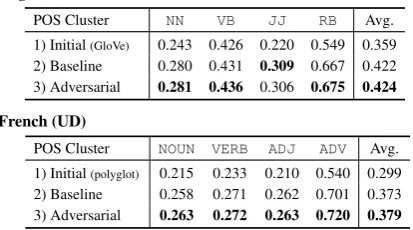
Table 6: Cluster tightness evaluation for word embed-dings, based on the cosine similarity measure. Higher scores indicate better clustering (cleaner word vector distribution). Each row corresponds to word vectors 1) at the beginning, 2) after baseline training, and 3) after adversarial training.
English (WSJ)
Perturbation scaleα 0 0.001 0.01 0.05 0.1 0.5 Avg. cluster tightness 0.422 0.423 0.424 0.429 0.436 0.429
Table 7: Average cluster tightness for word embed-dings trained with varied perturbation scaleα(0 indi-cates baseline training).
dicted POS tags are used for downstream depen-dency parsing, a single bad mistake in a sentence can greatly damage the usefulness of the POS tag-ger. The robustness of our AT POS tagger against rare/unseen words helps to mitigate such an issue. This advantage can also be observed from the AT POS tagger’s notably higher sentence-level accu-racy than the baseline (see Table5left). Nonethe-less, gold POS tags still yield better parsing results as compared to the baseline/AT POS taggers, sup-porting the claim that POS tagging needs further improvement for downstream tasks.
5.3 Effects on Representation Learning
Next, we perform an analysis on representation learning of words (word embeddings) for the En-glish (PTB-WSJ) and French (UD) experiments. We hypothesize that adversarial training (AT) helps to learn better word embeddings so that the POS tag prediction of a word cannot be influenced by a small perturbation in the input embedding.
To verify this hypothesis, we cluster all words in the test set based on their correct POS tags4and
evaluate the tightness of the word vector distribu-tion within each cluster. We compare this cluster-ing quality among the three settcluster-ings: 1) beginncluster-ing (initialized with GloVe or Polyglot), 2) after
base-4We excluded words with multiple tags in the test text.
line training (50 epochs), and 3) after adversarial training (50 epochs), to study the effects of AT on word representation learning.
For evaluating the tightness of word vector dis-tribution, we employ the cosine similarity metric, which is widely used as a measure of the closeness between two word vectors (e.g., Mikolov et al.
(2013);Pennington et al.(2014)). To measure the tightness of each cluster, we compute the cosine similarity for every pair of words within, and then take the average. We also report the average tight-ness across all the clusters.
The evaluation results are summarized in Ta-ble6. We report the tightness scores for the four major clusters: noun, verb,adjective, andadverb (from left to right). As can be seen from the table, for both languages, adversarial training (AT) re-sults in cleaner word embedding distributions than the baseline, with a higher cosine similarity within each POS cluster, and with a clear advantage in the average tightness across all the clusters. In other words, the learned word vectors show stronger correlations with their POS tags. This result con-firms that training with adversarial examples can help to learn cleaner word embeddings so that the meaning / grammatical function of a word cannot be altered by a small perturbation in its embed-ding. This analysis provides a means to interpret the robustness to input perturbations, from the per-spective of NLP.
Relation with perturbation size . We also
study how the size of added perturbations influ-ences word representation learning in adversarial training. Recall that we set the norm of a pertur-bationto beα√D, whereDis the dimension of the concatenated input embeddings (see §3.2). For instance, α = 0 would produce no noise; α = 1
would generate a perturbation of a norm equiv-alent to the original word embeddings. We hy-pothesize that AT facilitates word representation learning whenα is small enough to preserve the semantics of input words, but can hinder the learn-ing when α is too large. To test the hypothesis, we repeat the clustering evaluation for word em-beddings trained with varied perturbation scaleα: 0, 0.001, 0.01, 0.05, 0.1, 0.5 (see Table 7). We observe that the quality of learned word embed-ding distribution keeps improving as α goes up from 0 to 0.1, but starts to drop aroundα= 0.5.
Model F1
Tsuruoka et al.(2011) 93.81
Collobert et al.(2011) 94.32
Yang et al.(2017) 94.66
Suzuki and Isozaki(2008) 95.15 Søgaard and Goldberg(2016) 95.56
Hashimoto et al.(2017) 95.77
Peters et al.(2017) 96.37
[image:9.595.112.252.60.175.2]Ours – Baseline(BiLSTM-CRF) 95.18 Ours – Adversarial 95.25
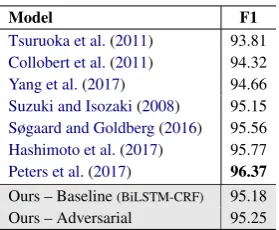
Table 8: Chunking F1 scores on the CoNLL-2000 task, with other top performing models.
Model F1
Collobert et al.(2011) 89.59
Huang et al.(2015) 90.10
Chiu and Nichols(2016) 90.91
Lample et al.(2016) 90.94
Luo et al.(2015) 91.20
Ma and Hovy(2016) 91.21
Peters et al.(2017) 91.93
Ours – Baseline(BiLSTM-CRF) 91.22
Ours – Adversarial 91.56
Table 9: NER F1 scores on the CoNLL-2003 (English) task, with other top performing models.
yielded the best tagging performance on develop-ment sets (i.e., 0.01 or 0.05). A possible expla-nation is that while word embeddings can adapt to relatively largeα (e.g., 0.1) during training, as adversarial perturbations are generated at the em-bedding level, suchαcould change the semantics of the input from the current tagging model’s per-spective and hinder the training oftagging.
5.4 Other Sequence Labeling Tasks
Finally, to further confirm the applicability of AT, we experiment with our BiLSTM-CRF AT model in different sequence labeling tasks: chunking and named entity recognition (NER).
Chunkingcan be performed as a sequence
label-ing task that assigns a chunklabel-ing tag (B-NP, I-VP, etc.) to each word. We conduct experiments on the CoNLL 2000 shared task with the standard data split: PTB-WSJ Sections 15-18 for training and 20 for testing. We use Section 19 as the develop-ment set and employ the IOBES tagging scheme, followingHashimoto et al.(2017).
NERaims to assign an entity type to each word, such asperson,location, organization, andmisc. We conduct experiments on the CoNLL-2003 (En-glish) shared task (Tjong Kim Sang and De Meul-der,2003), adopting the IOBES tagging scheme as in (Lample et al.,2016;Ma and Hovy,2016).
The results are summarized in Table 8 and 9.
AT enhanced F1 score from the baseline BiLSTM-CRF model’s 95.18 to 95.25 for chunking, and from 91.22 to 91.56 for NER, also significantly outperforming Ma and Hovy (2016). These im-provements made by AT are bigger than that for English POS tagging, most likely due to the larger room for improvement in chunking and NER. The improvements are again statistically significant, withp-value<0.05 on thet-test. The experimen-tal results suggest that the proposed adversarial training scheme is generally effective across dif-ferent sequence labeling tasks.
Our BiLSTM-CRF AT model did not reach the performance byHashimoto et al. (2017)’s multi-task model andPeters et al.(2017)’s state-of-the-art system that incorporates pretrained language models. It would be interesting future work to combine the strengths of these joint models (e.g., syntactic and semantic aids) and adversarial train-ing (e.g., robustness).
6 Conclusion
We proposed and carefully analyzed a POS tag-ging model that exploits adversarial training (AT). In our multilingual experiments, we find that AT achieves substantial improvements on all the lan-guages tested, especially on low resource ones. AT also enhances the robustness to rare/unseen words and sentence-level accuracy, alleviating the ma-jor issues of current POS taggers, and contribut-ing to the downstream task, dependency parscontribut-ing. Furthermore, our analyses on different languages, word / neighbor statistics and word representation learning reveal the effects of AT from the perspec-tive of NLP. The proposed AT model is applica-ble to general sequence labeling tasks. This work therefore provides a strong basis and motivation for utilizing AT in natural language tasks.
Acknowledgements
We would like to thank Rui Zhang, Jonathan Kum-merfeld, Yutaro Yamada, as well as all the anony-mous reviewers for their helpful feedback and sug-gestions on this work.
References
Rami Al-Rfou, Bryan Perozzi, and Steven Skiena. 2013. Polyglot: Distributed word representations for multilingual nlp. InCoNLL.
[image:9.595.112.250.213.329.2]Petrov, and Michael Collins. 2016. Globally nor-malized transition-based neural networks. InACL.
Dzmitry Bahdanau, Kyunghyun Cho, and Yoshua Ben-gio. 2015. Neural machine translation by jointly learning to align and translate. InICLR.
G´abor Berend. 2017. Sparse coding of neural word em-beddings for multilingual sequence labeling. TACL
.
Rich Caruana, Steve Lawrence, and C Lee Giles. 2001. Overfitting in neural nets: Backpropagation, conju-gate gradient, and early stopping. InNIPS.
Danqi Chen and Christopher D Manning. 2014. A fast and accurate dependency parser using neural net-works. InEMNLP.
Jason PC Chiu and Eric Nichols. 2016. Named entity recognition with bidirectional lstm-cnns. InTACL. Michael Collins. 2002. Discriminative training
meth-ods for hidden markov models. InEMNLP.
Ronan Collobert, Jason Weston, L´eon Bottou, Michael Karlen, Koray Kavukcuoglu, and Pavel Kuksa. 2011. Natural language processing (almost) from scratch. The Journal of Machine Learning Research
12:2493–2537.
Timothy Dozat and Christopher D. Manning. 2017. Deep biaffine attention for neural dependency pars-ing. InICLR.
Timothy Dozat, Peng Qi, and Christopher D. Manning. 2017. Stanford’s graph-based neural dependency parser at the conll 2017 shared task. InCoNLL 2017 Shared Task: Multilingual Parsing from Raw Text to Universal Dependencies. pages 20–30.
Ian Goodfellow, Jean Pouget-Abadie, Mehdi Mirza, Bing Xu, David Warde-Farley, Sherjil Ozair, Aaron Courville, and Yoshua Bengio. 2014. Generative ad-versarial nets. InNIPS.
Ian J Goodfellow, Jonathon Shlens, and Christian Szegedy. 2015. Explaining and harnessing adver-sarial examples. InICLR.
Tao Gui, Qi Zhang, Haoran Huang, Minlong Peng, and Xuanjing Huang. 2017. Part-of-speech tag-ging for twitter with adversarial neural networks. In
EMNLP.
Kazuma Hashimoto, Caiming Xiong, Yoshimasa Tsu-ruoka, and Richard Socher. 2017. A joint many-task model: Growing a neural network for multiple NLP tasks. InEMNLP.
Sepp Hochreiter and J¨urgen Schmidhuber. 1997. Long short-term memory. Neural Computation
9(8):1735–1780.
Zhiheng Huang, Wei Xu, and Kai Yu. 2015. Bidirec-tional lstm-crf models for sequence tagging. arXiv preprint arXiv:1508.01991.
Mohit Iyyer, Varun Manjunatha, Jordan Boyd-Graber, and Hal Daum´e III. 2015. Deep unordered compo-sition rivals syntactic methods for text classification. InACL.
Robin Jia and Percy Liang. 2017. Adversarial exam-ples for evaluating reading comprehension systems. InEMNLP.
Joo-Kyung Kim, Young-Bum Kim, Ruhi Sarikaya, and Eric Fosler-Lussier. 2017. Cross-lingual transfer learning for pos tagging without cross-lingual re-sources. InEMNLP.
John Lafferty, Andrew McCallum, and Fernando CN Pereira. 2001. Conditional random fields: Prob-abilistic models for segmenting and labeling se-quence data. InICML.
Guillaume Lample, Miguel Ballesteros, Sandeep Sub-ramanian, Kazuya Kawakami, and Chris Dyer. 2016. Neural architectures for named entity recognition. InNAACL.
Jiwei Li, Will Monroe, Tianlin Shi, Alan Ritter, and Dan Jurafsky. 2017. Adversarial learning for neural dialogue generation. InEMNLP.
Wang Ling, Tiago Lu´ıs, Lu´ıs Marujo, R´amon Fernan-dez Astudillo, Silvio Amir, Chris Dyer, Alan W Black, and Isabel Trancoso. 2015. Finding function in form: Compositional character models for open vocabulary word representation. InEMNLP.
Yanpei Liu, Xinyun Chen, Chang Liu, and Dawn Song. 2017. Delving into transferable adversarial exam-ples and black-box attacks. InICLR.
Gang Luo, Xiaojiang Huang, Chin-Yew Lin, and Za-iqing Nie. 2015. Joint entity recognition and disam-biguation. InEMNLP.
Xuezhe Ma and Eduard Hovy. 2016. End-to-end se-quence labeling via bi-directional lstm-cnns-crf. In
ACL.
Christopher D. Manning, Mihai Surdeanu, John Bauer, Jenny Finkel, Steven J. Bethard, and David Mc-Closky. 2014. The Stanford CoreNLP natural lan-guage processing toolkit. InAssociation for Compu-tational Linguistics (ACL) System Demonstrations.
Christopher D Manning. 2011. Part-of-speech tagging from 97% to 100%: is it time for some linguistics?
Computational Linguistics and Intelligent Text Pro-cessingpages 171–189.
Mitchell Marcus, Beatrice Santorini, and Mary Ann Marcinkiewicz. 1993. Building a large annotated corpus of english: The penn treebank. Computa-tional Linguistics19(2):313–330.
Takeru Miyato, Andrew M Dai, and Ian Goodfel-low. 2017. Adversarial training methods for semi-supervised text classification. InICLR.
Dat Quoc Nguyen, Mark Dras, and Mark Johnson. 2017. A Novel Neural Network Model for Joint POS Tagging and Graph-based Dependency Parsing. In CoNLL 2017 Shared Task: Multilingual Parsing from Raw Text to Universal Dependencies.
Joakim Nivre, ˇZeljko Agi´c, Maria Jesus Aranzabe, Masayuki Asahara, Aitziber Atutxa, Miguel Balles-teros, John Bauer, Kepa Bengoetxea, Riyaz Ah-mad Bhat, Cristina Bosco, Sam Bowman, Giuseppe G. A. Celano, Miriam Connor, Marie-Catherine de Marneffe, Arantza Diaz de Ilarraza, Kaja Do-brovoljc, Timothy Dozat, Tomaˇz Erjavec, Rich´ard Farkas, Jennifer Foster, Daniel Galbraith, Filip Ginter, Iakes Goenaga, Koldo Gojenola, Yoav Goldberg, Berta Gonzales, Bruno Guillaume, Jan Hajiˇc, Dag Haug, Radu Ion, Elena Irimia, An-ders Johannsen, Hiroshi Kanayama, Jenna Kan-erva, Simon Krek, Veronika Laippala, Alessan-dro Lenci, Nikola Ljubeˇsi´c, Teresa Lynn, Christo-pher Manning, C˘at˘alina M˘ar˘anduc, David Mareˇcek, H´ector Mart´ınez Alonso, Jan Maˇsek, Yuji Mat-sumoto, Ryan McDonald, Anna Missil¨a, Verginica Mititelu, Yusuke Miyao, Simonetta Montemagni, Shunsuke Mori, Hanna Nurmi, Petya Osenova, Lilja Øvrelid, Elena Pascual, Marco Passarotti, Cenel-Augusto Perez, Slav Petrov, Jussi Piitulainen, Bar-bara Plank, Martin Popel, Prokopis Prokopidis, Sampo Pyysalo, Loganathan Ramasamy, Rudolf Rosa, Shadi Saleh, Sebastian Schuster, Wolfgang Seeker, Mojgan Seraji, Natalia Silveira, Maria Simi, Radu Simionescu, Katalin Simk´o, Kiril Simov, Aaron Smith, Jan ˇStˇep´anek, Alane Suhr, Zsolt Sz´ant´o, Takaaki Tanaka, Reut Tsarfaty, Sumire Ue-matsu, Larraitz Uria, Viktor Varga, Veronika Vincze, Zdenˇek ˇZabokrtsk´y, Daniel Zeman, and Hanzhi Zhu. 2015. Universal dependencies 1.2. LIN-DAT/CLARIN digital library at the Institute of For-mal and Applied Linguistics, Charles University.
Razvan Pascanu, Tomas Mikolov, and Yoshua Bengio. 2012. On the difficulty of training recurrent neural networks. arXiv preprint arXiv:1211.5063.
Jeffrey Pennington, Richard Socher, and Christopher Manning. 2014. Glove: Global vectors for word representation. InEMNLP.
Matthew E Peters, Waleed Ammar, Chandra Bhagavat-ula, and Russell Power. 2017. Semi-supervised se-quence tagging with bidirectional language models. InACL.
Barbara Plank, Anders Søgaard, and Yoav Goldberg. 2016. Multilingual part-of-speech tagging with bidirectional long short-term memory models and auxiliary loss. InACL.
M. Schuster and K.K. Paliwal. 1997. Bidirec-tional recurrent neural networks. Trans. Sig. Proc.
45(11):2673–2681.
Uri Shaham, Yutaro Yamada, and Sahand Negahban. 2015. Understanding adversarial training: Increas-ing local stability of neural nets through robust opti-mization. arXiv preprint arXiv:1511.05432.
Anders Søgaard. 2011. Semi-supervised condensed nearest neighbor for part-of-speech tagging. In
ACL-HLT.
Anders Søgaard and Yoav Goldberg. 2016. Deep multi-task learning with low level tasks supervised at lower layers. InACL.
Nitish Srivastava, Geoffrey Hinton, Alex Krizhevsky, Ilya Sutskever, and Ruslan Salakhutdinov. 2014. Dropout: A simple way to prevent neural networks from overfitting. Journal of Machine Learning Re-search15:1929–1958.
Milan Straka, Jan Hajic, and Jana Strakov´a. 2016. Udpipe: Trainable pipeline for processing conll-u files performing tokenization, morphological analy-sis, pos tagging and parsing. InLREC.
Jun Suzuki and Hideki Isozaki. 2008. Semi-supervised sequential labeling and segmentation using giga-word scale unlabeled data. ACL-HLT.
Christian Szegedy, Wojciech Zaremba, Ilya Sutskever, Joan Bruna, Dumitru Erhan, Ian Goodfellow, and Rob Fergus. 2014. Intriguing properties of neural networks. InICLR.
Erik F Tjong Kim Sang and Fien De Meulder. 2003. Introduction to the conll-2003 shared task: Language-independent named entity recognition. In
CoNLL.
Kristina Toutanova, Dan Klein, Christopher D. Man-ning, and Yoram Singer. 2003. Feature-rich part-of-speech tagging with a cyclic dependency network. InHLT-NAACL.
Yoshimasa Tsuruoka, Yusuke Miyao, and Jun’ichi Kazama. 2011. Learning with lookahead: Can history-based models rival globally optimized mod-els? InCoNLL.
Beilun Wang, Ji Gao, and Yanjun Qi. 2017. A theoret-ical framework for robustness of (deep) classifiers against adversarial samples. InICLR.
Yi Wu, David Bamman, and Stuart Russell. 2017. Ad-versarial training for relation extraction. InEMNLP.
Ziang Xie, Sida I Wang, Jiwei Li, Daniel Levy, Aiming Nie, Dan Jurafsky, and Andrew Y Ng. 2017. Data noising as smoothing in neural network language models. InICLR.