Proceedings of NAACL-HLT 2018, pages 1252–1262
Reinforced Co-Training
Jiawei Wu
Department of Computer Science University of California Santa Barbara, CA 93106 USA jiawei [email protected]
Lei Li
Toutiao AI Lab Bytedance Co. Ltd Beijing, 100080 China [email protected]
William Yang Wang
Department of Computer Science University of California Santa Barbara, CA 93106 USA
Abstract
Co-training is a popular semi-supervised learning framework to utilize a large amount of unlabeled data in addition to a small la-beled set. Co-training methods exploit pre-dicted labels on the unlabeled data and se-lect samples based on prediction confidence to augment the training. However, the selec-tion of samples in existing co-training methods is based on a predetermined policy, which ig-nores the sampling bias between the unlabeled and the labeled subsets, and fails to explore the data space. In this paper, we propose a novel method, Reinforced Co-Training, to se-lect high-quality unlabeled samples to better co-train on. More specifically, our approach uses Q-learning to learn a data selection policy with a small labeled dataset, and then exploits this policy to train the co-training classifiers automatically. Experimental results on click-bait detection and generic text classification tasks demonstrate that our proposed method can obtain more accurate text classification re-sults.
1 Introduction
Large labeled datasets are often required to obtain satisfactory performance for natural language pro-cessing tasks. However, it is time-consuming to la-bel text corpus manually. In the meanwhile, there are abundant unlabeled text corpora available on the web. Semi-supervised methods permit learn-ing improved supervised models by jointly train on a small labeled dataset and a large unlabeled dataset (Zhu,2006;Chapelle et al.,2009).
Co-training is one of the widely used semi-supervised methods, where two complementary classifiers utilize large amounts of unlabeled ex-amples to bootstrap the performance of each other iteratively (Blum and Mitchell, 1998;Nigam and Ghani,2000). Co-training can be readily applied to NLP tasks since data in these tasks naturally
Data Space
Labeled Set
[image:1.595.318.515.220.368.2]Unlabeled Set
Figure 1: Illustration of sample-selection issues in co-training methods. (1) Randomly sampled unlabeled ex-amples (2) will result in high sampling bias, which
will cause bias shift towards the unlabeled dataset (←). (2) High-confidence examples (3) will contribute little
during the model training, especially for discriminat-ing the boundary examples (4), resulting in myopic trained models.
have two or more views, such as multi-lingual data (Wan, 2009) and document data (headline and content) (Ghani, 2000; Denis et al., 2003). In the co-training framework, each classifier is trained on one of the two views (aka a subset of features) of both labeled and unlabeled data, un-der the assumption that either view is sufficient to classify. In each iteration, the co-training al-gorithm selects high confidence samples scored by each of the classifiers to form an auto-labeled dataset, and the other classifier is then updated with both labeled data and additional auto-labeled set. However, as shown in Figure1, most of exist-ing co-trainexist-ing methods have some disadvantages. Firstly, the sample selection step ignores distribu-tional bias between the labeled and unlabeled sets. It is common in practice to use unlabeled datasets collected differently from the labeled set, result-ing in a significant difference in their sample dis-tribution. After iterative co-training, the sampling
bias may shift towards the unlabeled set, which re-sults in poor performance of the trained model at the testing time. To remedy such bias, an ideal al-gorithm should select those samples according to the target (potentially unknown) testing distribu-tion. Secondly, the existing sample selection and training can be myopic. Conventional co-training methods select unlabeled examples with high con-fidence predicted by trained models. This strategy often causes only those unlabeled examples that match well to the current model being picked dur-ing iteration and the model might fail to generalize to complete sample space (Zhang and Rudnicky, 2006). It relates to the well-known exploration-exploitation trade-off in machine learning tasks. An ideal co-training algorithm should explore the space thoroughly to achieve globally better perfor-mance. These intuitions inspire our work on learn-ing a data selection policy for the unlabeled dataset in co-training.
The iterate data selection steps in co-training can be viewed as a sequential decision-making problem. To resolve both issues discussed above, we propose Reinforced Co-Training, a rein-forcement learning (RL)-based framework for co-training. Concretely, we introduce a joint formu-lation of a Q-learning agent and two co-training classifiers. In contrast to previous predetermined data sampling methods of co-training, we design a Q-agent to automatically learn a data selection policy to select high-quality unlabeled examples. To better guide the policy learning of the Q-agent, we design a state representation to delivery the sta-tus of classifiers and utilize the validation set to compute the performance-driven rewards. Empir-ically, we indicate that our method outperforms previous related methods on clickbait detection and generic text classification problems. In sum-mary, our main contributions are three-fold:
• We are first to propose a joint formulation of RL and co-training methods;
• Our learning algorithm can learn a good data selection policy to select high-quality unla-beled examples for better co-training;
• We show that our method can apply to large-scale document data and outperform base-lines in semi-supervised text classification. In Section 2, we outline related work in semi-supervised learning and co-training. We then de-scribe our proposed method in Section3. We show
experimental results in Section4. Finally, we con-clude in Section5.
2 Related Work
Semi-supervised learning algorithms have been widely used in NLP (Liang, 2005). As for text classification, Dai and Le (2015) introduce a se-quence autoencoder to pre-train the parameters for the later supervised learning process.Johnson and Zhang (2015, 2016) propose a method to learn embeddings of small text regions from unlabeled data for integration into a supervised convolutional neural network (CNN) or long short-term mem-ory network (LSTM).Miyato et al.(2016) further apply perturbations to the word embeddings and pre-train the supervised models through adversar-ial training. However, these methods mainly focus on learning the local word-level information and pre-trained parameters from unlabeled data, which fails to capture the overall text-level information and potential label information.
Co-training can capture the text-level informa-tion of unlabeled data and generate pseudo labels during the training, which is especially useful on unlabeled data with two distinct views (Blum and Mitchell, 1998). However, the confidence-based data selection strategies (Goldman and Zhou, 2000;Zhou and Li,2005;Zhang and Zhou,2011) often focus on some special regions of the input space and fail to generate an accurate estimation of data space. Zhang and Rudnicky(2006) pro-poses a performance-driven data selection strategy based on pseudo-accuracy and energy regulariza-tion. Meanwhile, Chawla and Karakoulas(2005) argues that the random data sampling method of-ten causes sampling bias shift of the trained model towards the unlabeled set.
Comparing to previous related methods, our Reinforced Co-Training model can learn a performance-driven data selection policy to select high-quality unlabeled data. Furthermore, the per-formance estimation is more accurate due to the validation dataset and the data selection strategy is automatically learned instead of human designed. Lastly, the selected high-quality unlabeled data can not only help explore the data space but also reduce the sampling bias shift.
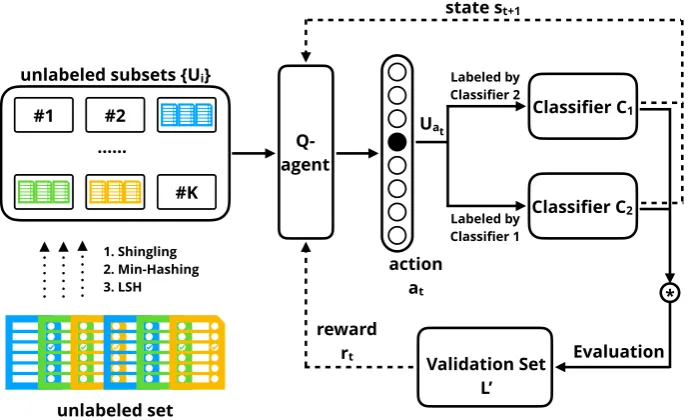
Q- agent
Classifier C1
Classifier C2
Validation Set L’ reward
rt
* action
at
state st+1
Labeled by Classifier 2
Labeled by Classifier 1
Evaluation #1 #2
#K ……
1. Shingling 2. Min-Hashing 3. LSH
unlabeled subsets {Ui}
unlabeled set
[image:3.595.125.470.76.286.2]Uat
Figure 2: The Reinforced Co-Training framework.
is one of the meta-learning methods ( Schmidhu-ber,1987;Bengio et al.,1991), where one model is trained to learn how to optimize the parame-ters of another certain algorithm. While previous studies focus more on neural network optimiza-tion (Chen et al.,2017;Wichrowska et al.,2017) and few-shot learning (Vinyals et al., 2016;Ravi and Larochelle, 2016;Finn et al., 2017), we are first to explore how to learn a high-quality data se-lection policy in semi-supervised methods, in our case, the co-training algorithm.
3 Method
In this section, we describe our RL-based frame-work for co-training in detail. The conventional co-training methods follow the framework:
1. Initialize two classifiers by training on the la-beled set;
2. Iteratively select a subset of unlabeled data based on a predetermined policy;
3. Iteratively update two classifiers with the se-lected subset of unlabeled data in addition to the labeled one.
Step 2 is the core of different co-training variants. The original co-training algorithm is equipped with a policy of selecting high-confidence samples by two classifiers. Our main idea is to improve the policy by reinforcement learning.
We formulate the data selection process as a se-quential decision-making problem and the deci-sion (action) at at each iteration (time step) t is
to select a portion of unlabeled examples. This problem can be solved with an RL-agent by learn-ing a policy. We first describe how we organize the large unlabeled dataset to improve the compu-tational efficiency. Then we briefly introduce the classifier models used in co-training. After that, we describe the Q-agent, the RL-agent used in our framework and the environment in RL. The two co-training classifiers are integrated into the envi-ronment and the Q-agent can learn a good data se-lection policy by interacting with the environment. Finally, we describe how to train the Q-agent in our unified framework.
3.1 Partition Unlabeled Data
Considering that the number of unlabeled samples is enormous, it is not efficient for the RL-agent to select only one example at each time stept. Thus, first we want to partition documents from the unla-beled dataset into different subsets based on their similarity. At each time stept, the RL-agent ap-plies a policy to select one subset instead of one sample and then update the two co-training classi-fiers, which can significantly improve the compu-tational efficiency.
these documents. These documents are partitioned into different subsets based on Jaccard similarity, which is defined as:
sim(D1, D2) = |
D1∩D2| |D1∪D2|
, (1)
whereD1, D2 ∈ R|V| are the one-hot vectors of each document example.
Based on Jaccard similarity, the unlabeled ex-amples can be split into different subsets using the following three steps, which have been widely used in large-scale web search (Rajaraman and Ullman,2010): 1) Shingling, 2) Min-Hashing, and 3) Locality-Sensitive Hashing (LSH).
After partition, the unlabeled setU can be con-verted into K different subset {U1, U2, ..., UK}.
Meanwhile, for each subsetUi, the first added
doc-ument exampleSiis recorded as the representative
example of the subsetUi. Choosing representative
samples will help evaluate the classifiers on dif-ferent subsets and obtain the state representations, which will be discussed in3.3.1.
3.2 Classifier Models
As mentioned before, much linguistic data natu-rally has two or more views, such as multi-lingual data (Wan, 2009) and document data (headline + paragraph) (Ghani, 2000; Denis et al., 2003). Based on the two views of data, we can construct two classifiers respectively. At the beginning of a training episode, the two classifiers are first seeded with a small set of labeled (seeding) training data L. At each time stept, the RL-agent makes a se-lection action at, and then the unlabeled subset
Uat is selected to train the two co-training
clas-sifiers. Following the standard co-training process (Blum and Mitchell, 1998), at each time step t, the classifierC1annotate the unlabeled subsetUat
and the pseudo-labeledUat and the small labeled
setLare then used to update the classifierC2, vice versa. In this way, we can boost the performance ofC1 andC2simultaneously.
3.3 Q-Learning Agent
Q-learning is a widely used method to find an op-timal action-selection policy (Watkins and Dayan, 1992). The core of our model is a Q-learning agent, which is trained to learn a good policy to se-lect high-quality unlabeled subsets for co-training. At each time stept, the agent observes the current state st, and selects an action at from a discrete
set of actionsA={1,2, ..., K}. Based on the ac-tion at, the two co-training classifiersC1 andC2 then can be updated with the unlabeled subsetUat
as described in Section3.2. After that, the agent receives a performance-driven reward rt and the
next state observation st+1. The goal of our Q-agent at each time stept is to choose the action that can maximize the future discount reward
Rt= T X
t0=t
γt0−trt0, (2)
where a training episode terminates at timeT and γis the discount factor.
3.3.1 State Representation
The state representation, in our framework, is de-signed to deliver the status of two co-training clas-sifiers to the Q-agent.Zhang and Rudnicky(2006) have proved that training with high-confidence ex-amples will consequently be a process that reforces what the current model already encodes in-stead of learning an accurate distribution of data space. Thus, one insight in formulating the state representation is to add some unlabeled examples with uncertainty and diversity during the train-ing iteration. However, too much uncertainty will make two classifiers unstable, while too much di-versity will cause the sampling bias shift towards the unlabeled dataset (Yeung et al.,2017). In or-der to automatically capture this insight and select high-quality subsects during the iteration, the Q-agent needs to fully understand the distribution of the unlabeled data.
Based on the above intuition, we formulate the agents state using the two classifiers’ probability distribution on the representative example Si of
each unlabeled subsetUi. Suppose aN-class
clas-sification problem, at each time stept, we evaluate the probability distribution of two classifiers onSi
separately. The state representation then can be defined as:
st={P11||P12, P21||P22, ..., PK1||PK2}t, (3)
wherePi1 andPi2 are the probability distribution of C1 and C2 on Si separately, and || denotes
the concatenation operation. Pi1, Pi2 ∈ RN and
Pi1||Pi2 ∈R2N. Note that the state representation
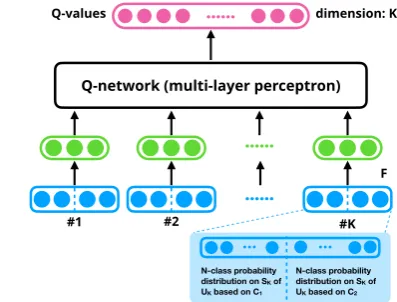
……
Q-network (multi-layer perceptron)
……
Q-values
#1 #2 #K
dimension: K
……
… …
N-class probability distribution on SK of UK based on C1
N-class probability distribution on SK of UK based on C2
[image:5.595.74.273.67.218.2]F
Figure 3: The structure of Q-network. It chooses a un-labeled subset from{U1, U2, ..., UK}at each time step.
The state representation is computed according to the two classifiers’N-class probability distribution on the
representative exampleSiof each subsetUi.
3.3.2 Q-Network
The agent takes an action at at time steptusing a policy
at= max
a Q(st, a), (4)
where st is the state representation mentioned
above. The Q-value Q(st, a) is determined by a
neural network as illustrated in Figure 3. Con-cretely,
za=φ({F(P11||P12), ..., F(PK1||PK2)};θ), (5)
where the function F maps state representation Pi1||Pi2 ∈ R2N into a common embedding space
ofydimensions, andφ(·)is a multi-layer
percep-tion.
We then use
Q(s, a) =softmax(za) (6)
to obtain the next action.
3.3.3 Reward Function
The agent is trained to select the high-quality un-labeled subsets to improve the performance of the two classifierC1andC2. We capture this intuition by a performance-driven reward function. At time step t, the reward of each classifier is defined as the change in the classifiers accuracy after updat-ing the unlabeled subsetUt:
r1t =Acc1t(L0)−Acc1t−1(L0), (7)
where Acc1
t(L0) is the model accuracy of C1 at time steptcomputed on the labeled validation set
L0. Then the r2
t is defined following the similar
formulation. The final rewardrtis defined as:
rt= (
r1t ×r2t ifrt1 >0andr2t >0,
0 otherwise.
Note that this reward is only available during train-ing process.
3.4 Training and Testing
The agent is trained with the Q-learning (Watkins and Dayan,1992), a standard reinforcement learn-ing algorithm that can be used to learn policies for an agent interacting with an environment. In our Reinforced Co-Training framework, the environ-ment is the classifierC1andC2.
The Q-network parametersθare learned by op-timizing:
Li(θi) =Es,a[(V(θi−1)−Q(s, a;θi))2], (8)
whereiis an iteration of optimization and
V(θi−1) =Es0[r+γmax a0 Q(s
0, a0;θ
i−1)|s, a]. (9) .
We optimize it using stochastic gradient de-scent. The detail of the training process is shown in Algorithm1.
At test time, the agent and the two co-training classifiers are again run simultaneously, but with-out access to the labeled validation dataset. The agent selects the unlabeled subset using the learned greedy policy:
at=maxaQ(st, a). (10)
After obtaining two classifiers from co-training, based on the weighted voting, the final ensemble classifierCis defined as:
C=βC1+ (1−β)C2. (11)
βis the weighted parameter, which can be learned by maximizing the classification accuracy on the validation set.
4 Experiments
Algorithm 1:The algorithm of our Reinforced Co-Training method.
1 Given a setLof labeled seeding training data;
2 Given a setL0of labeled validation data; 3 GivenKsubsets{U1, U2, ..., UK}of
unlabeled data;
4 forepisode←1toMdo 5 TrainC1&C2withL
6 fortime stept←1toT do
7 Choose the actionat= maxaQ(st, a) 8 UseC1to label the subsetUat
9 UpdateC2with pseudo-labeledUat, L 10 UseC2to label the subsetUat
11 UpdateC1with pseudo-labeledUat, L 12 Compute the rewardrtbased onL0 13 Compute the state representationst+1
14 Updateθusingg∝
∇θEs,a[(V(θi−1)−Q(s, a;θi))2]
4.1 Baselines
We compare our model with multiple baselines:
• Standard Co-Training: Co-Training with
randomly choosing unlabeled examples (Blum and Mitchell,1998).
• Performance-driven Co-Training: The
un-labeled examples are selected based on pseudo-accuracy and energy regularization (Zhang and Rudnicky,2006).
• CoTrade Co-Training: The confidence of
either classifiers prediction on unlabeled ex-amples is estimated based on specific data editing techniques, and then high-confidence examples are used to update the classifiers (Zhang and Zhou,2011).
• Semi-supervised Sequence Learning
(Sequence-SSL): The model uses an LSTM
sequence autoencoder to pre-train the pa-rameters for the later supervised learning process.(Dai and Le,2015).
• Semi-supervised CNN with Region
Em-bedding (Region-SSL): The model learns
embeddings of small text regions from un-labeled data for integration into a supervised CNN (Johnson and Zhang,2015).
• Adversarial Semi-supervised Learning
(Adversarial-SSL): The model apply pertur-bations to word embeddings into an LSTM and pre-train the supervised models through adversarial training (Miyato et al.,2016).
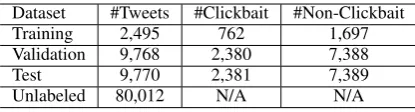
Dataset #Tweets #Clickbait #Non-Clickbait
Training 2,495 762 1,697
Validation 9,768 2,380 7,388
Test 9,770 2,381 7,389
[image:6.595.312.520.61.117.2]Unlabeled 80,012 N/A N/A
Table 1: Statistics of Clickbait Dataset.
4.2 Clickbait Detection
Clickbait is a pejorative term for web content whose headlines typically aim to make read-ers curious, but the documents usually have less relevance with the corresponding headlines (Chakraborty et al., 2016; Potthast et al., 2017; Wei and Wan,2017). Clickbait not only wastes the readers’ time but also damages the publishers’ rep-utation, which makes detecting clickbait become an important real-world problem.
However, most of the attempts focus on news headlines, while the relevance between headlines and context is usually ignored (Chen et al.,2015; Biyani et al., 2016; Chakraborty et al., 2016). Meanwhile, the labeled data is quite limited in this problem, but the unlabeled data is easily obtained from the web (Potthast et al.,2017). Considering these two challenges, we utilize our Reinforced Co-training framework to tackle this problem and evaluate our method.
4.2.1 Datasets
We evaluate our model on a large-size clickbait dataset, Clickbait Challenge 2017 (Potthast et al., 2017). The data is collected from twitter posts in-cluding tweet headlines and paragraphs, and the training and test sets are judged on a four-point scale [0,0.3,0.66,1] by at least five annotators.
Each sample is categorized into one class based on its average scores. The clickbait detection then can be defined as a two-class classification problem, including CLICKBAIT and NON-CLICKBAIT. There also exists an unlabeled set containing large amounts of collected samples without annotation. We then split the original test set into the valida-tion set and final test set by 50%/50%. The statis-tics of this dataset are listed in Table1.
4.2.2 Setup
For each document example in the clickbait dataset, naturally, we have two views, the head-line and the paragraph. Thus, we construct the two classifiers in co-training based on these two views.
a self-attentive bi-directional gated recurrent unit RNN (biGRU) to model the headlines of the docu-ment and train a classifier. Following the same set-ting, we choose self-attentive biGRU as the head-line classifier in co-training.
Paragraph Classifier The paragraphs usually have much longer sequences than the headlines. Thus, we utilize the CNN-non-static structure in Kim(2014) as the paragraph classifier to capture the paragraph information.
Note that the other three co-training baselines also use the same classifier settings.
In our Reinforce Co-Training model, we set the number of unlabeled subsets k as80. Consider-ing the clickbait detection as a 2-class classifica-tion problem (N = 2), the Q-network maps 4-d
input P1
i||Pi2 in the state representation to a 3-d
common embedding space (y= 3), with a further
hidden layer of 128 units on top. The dimensionk of the softmax layer is also80.
As for the other semi-supervised baselines, Sequence-SSL, Region-SSL and Adversarial-SSL, we concatenate the headline and the para-graph as the document and train these models di-rectly on the document data. To better analyze the experimental results, we also implement another baseline denoted as CNN (Document), which uses the CNN structure (Kim,2014) to model the doc-ument with supervised learning. The CNN (Doc-ument) model is trained on the (seeding) training set and the validation set.
Following the previous researches (Chakraborty et al., 2016; Potthast et al., 2017), we use Pre-cision, Recall and F1 Score to evaluate different models.
4.2.3 Results
The results of clickbait detection are shown in Ta-ble 2. From the results, we observe that: (1) Our Reinforced Co-Training model can outper-form all the baselines, which indicates the capa-bility of our methods in utilizing the unlabeled data. (2) The standard co-training is unstable due to the random data selection strategy, and the performance-driven and high-confidence data selection strategies both can improve the perfor-mance of co-training. Meanwhile, the significant improvement compared with previous co-training methods shows that the Q-agent in our model can learn a good policy to select high-quality subsets. (3) The three pre-trained based semi-supervised learning methods also show good results. We
Methods Prec. Recall F1 Score
Self-attentive biGRU 0.683 0.649 0.665 CNN (Document) 0.537 0.474 0.503 Standard Co-Training 0.418 0.433 0.425 Performance Co-Training 0.581 0.629 0.604 CoTrade Co-Training 0.609 0.637 0.623
Sequence-SSL 0.595 0.589 0.592
Region-SSL 0.674 0.652 0.663
[image:7.595.306.528.62.166.2]Adversarial-SSL 0.698 0.691 0.694 Reinforced Co-Training 0.709 0.684 0.696
Table 2: The experimental results on clickbait dataset. Prec.: precision.
Best Worst Average STDDEV F1 Score 0.708 0.685 0.692 0.0068
Table 3: The robustness analysis on clickbait dataset.
think these pre-trained based methods learn lo-cal embeddings during the unsupervised training, which may help them to recognize some impor-tant patterns in clickbait detection. (4) The self-attentive biGRU trained only on headlines of the labeled set actually show surprisingly good perfor-mance on clickbait detection, which demonstrates that most clickbait documents have obvious pat-terns in the headline field. The reason why CNN (Document) fails to capture these patterns may be that the concatenation of headlines and paragraphs dilutes these features. But for those cases with-out obvious patterns in the headline, our results demonstrate that the paragraph information is still a good supplement to detection.
4.2.4 Algorithm Robustness
Previous studies (Morimoto and Doya,2001; Hen-derson et al., 2017) show that reinforcement learning-based methods usually lack robustness and are sensitive to the seeding sets and pre-trained steps. Thus, we design an experiment to detect whether our learned data section policy is sensitive to the (seeding) training set. First, based on our original data partition, we train our reinforcement learning framework to learn a Q-agent. During the test time, instead of using the same seeding set when doing comparative experi-ments, we randomly sample other10seeding sets
from the labeled dataset and learn 10 classifiers
based without re-training the Q-agent (data selec-tion policy). Note that the validaselec-tion set is not available during the co-training period of the test time. Finally, we evaluate these10classifiers
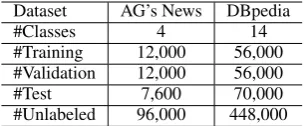
Dataset AG’s News DBpedia
#Classes 4 14
#Training 12,000 56,000 #Validation 12,000 56,000
#Test 7,600 70,000
[image:8.595.309.524.60.165.2]#Unlabeled 96,000 448,000
Table 4: Statistics of the Text Classification Datasets.
The results demonstrate that our learning algo-rithm is robust to different (seeding) training sets, which indicates that the Q-agent in our model can learn a good and robust data selection policy to select high-quality unlabeled subsets to help the co-training process.
4.3 Generic Text Classification
Generic text classification is a classic problem for natural language processing, where one needs to categorized documents into pre-defined classes (Kim, 2014; Zhang et al., 2015; Johnson and Zhang,2015,2016;Xiao and Cho, 2016;Miyato et al.,2016). We evaluate our model on generic text classification problem to study our method in a controlled setting.
4.3.1 Datasets
Following the settings inZhang et al.(2015), we use large-scale datasets to train and test our model. To maintain the two-view setting of the co-training method, we choose the following two datasets. The original annotated training set is then split into three sets, 10% labeled training set, 10% la-beled validation set and 80% unlala-beled set. The original proportion of different classes remains the same after the partition. The statistics of these two datasets are listed in Table4.
AG’s news corpus. The AGs corpus of news
articles is obtained from the web and each sample has the title and description fields.
DBpedia ontology dataset. This dataset is con-structed by picking 14 non-overlapping classes from DBpedia 2014. Each sample contains the ti-tle and abstract of a Wikipedia article.
4.3.2 Setup
For each document example in the above two datasets, naturally we have two views, the headline and the paragraph. Similar to clickbait detection, we also construct the two classifiers in co-training based on these two views. Following the (Kim, 2014), we set both the headline classifier and the paragraph classifier as the CNN-non-static model. Owing to that fact that the original datasets are
Methods AG’s News DBpedia
CNN (Training+Validation) 28.32% 9.53%
CNN (All) 8.69% 0.91%
Standard Co-Training 26.52% 7.66% Performance Co-Training 21.73% 5.84% CoTrade Co-Training 19.06% 5.12%
Sequence-SSL 19.54% 4.64%
Region-SSL 18.27% 3.76%
[image:8.595.105.259.62.125.2]Adversarial-SSL 8.45%∗ 0.89%∗ Reinforced Co-Training 16.64% 2.45%
Table 5: The experimental results on generic text clas-sification datasets. * Adversarial-SSL is trained on full labeled data after pre-training.
fully labeled, we implement two other baselines: (1) CNN (Training+Validation), which is super-vised trained on the partitioned training and val-idation sets; (2) CNN (All) which is supervised trained on the original (100%) dataset.
For AG’s News dataset, we set the number of unlabeled subsetskas96. The number of classes
N = 4, and thus the Q-network maps 8-d input
P1
i ||Pi2 in the state representation to a 5-d
com-mon embedding space (y= 5), with a further hid-den layer of 128 units on top. The dimensionk of the softmax layer is also96. As for DBpedia
dataset,k= 224, N = 14, andy= 10,.
Following the previous researches (Kim,2014), we use test error rate (%) to evaluate different models.
4.3.3 Results
The results of generic text classification are shown in Table 5. From the results, we can observe that: (1) Our Reinforced Co-Training model out-performs all the real semi-supervised baselines on two generic text classification datasets, which in-dicates that our method is consistent in differ-ent tasks. (2) The CNN (All) and Adversarial-SSL trained on all the original labeled data per-form best, which indicates there is still an obvious gap between semi-supervised methods and full-supervised methods.
4.3.4 Algorithm Robustness
Similar to Section 4.2.4, we evaluate whether our learned data section policy is sensitive to the different partitions and (seeding) training sets. First, based on our original data parti-tion (10%/10%/80%), we train our reinforcement
learning framework. During the test time, we randomly sample other10 data partitions instead
Datasets Best Worst Average STDDEV AG’s News 14.78 17.96 16.62 1.36
[image:9.595.76.287.62.96.2]DBPedia 2.18 4.06 2.75 0.94
Table 6: The robustness analysis on generic text classi-fication. Metric: test error rate (%).
Q-agent. Note that after sample different data par-titions, we will also reprocess the unlabeled sets as described in Section 3.1. We then evaluate these
10 classifiers using the same metric. The results
are shown in Table6.
The results demonstrate that our learning algo-rithm is robust to different (seeding) training sets and partitions of the unlabeled set, which again in-dicates that the Q-agent in our model is able to learn a good and robust data selection policy to select high-quality unlabeled subsets to help the co-training process.
4.4 Discussion about Stability
Previous studies (Zhang et al.,2014;Reimers and Gurevych, 2017) show that neural networks can be unstable even with the same training parame-ters on the same training data. As for our cases, when the two classifiers are initialized with differ-ent labeled seeding sets, they can be very unstable. However, after enough iterations with the properly selected unlabeled data, the performance would be stable generally.
Usually, the more substantial labeled training datasets will lead to more stable models. How-ever, the problem is that the AGs News and DB-pedia have 4 and 14 classes separately, while the Clickbait dataset only has 2 classes. That means the numbers of each class in AGs News, DBPedia and Clickbait actually are the same order of mag-nitude. Meanwhile, in our co-training setting, the prediction error is easy to accumulate because the two classifiers bootstrap the performance of each other. The classification could be harder with the increase of classes. Based on these reasons, the stability does not show a very strong correlation with the size of datasets in our experiments of Sec-tion4.2.4and4.3.4.
5 Conclusion and Future Work
In this paper, we propose a novel method, Rein-forced Co-Training, for training classifiers by uti-lizing both the labeled and unlabeled data. The Q-agent in our model can learn a good data selec-tion policy to select high-quality unlabeled data
for co-training. We evaluate our models on two tasks, clickbait detection and generic text classifi-cation. Experimental results show that our model can outperform other semi-supervised baselines, especially those conventional co-training methods. We also test the Q-agent and prove that the learned data selection policy is robust to different seeding sets and data partitions.
For future studies, we will investigate the data selection policies of other semi-supervised meth-ods and try to learn these policies automatically. We also plan to extend our method to source classification cases and utilize the multi-agent communication environment to boost the classification performance.
Acknowledgments
The authors would like to thank the anonymous reviewers for their thoughtful comments. The work was supported by an unrestricted gift from Bytedance (Toutiao).
References
Yoshua Bengio, Samy Bengio, and Jocelyn Cloutier. 1991. Learning a synaptic learning rule. In Pro-ceedings of the International Joint Conference on Neural Networks (IJCNN).
Prakhar Biyani, Kostas Tsioutsiouliklis, and John Blackmer. 2016. “8 amazing secrets for getting more click”: Detecting clickbaits in news streams using article informality. InProceedings of the 30th AAAI Conference on Artificial Intelligence (AAAI). pages 94–100.
Avrim Blum and Tom Mitchell. 1998. Combining la-beled and unlala-beled data with co-training. In Pro-ceedings of the 11th Annual Conference on Compu-tational Learning Theory (COLT). pages 92–100.
Abhijnan Chakraborty, Bhargavi Paranjape, Sourya Kakarla, and Niloy Ganguly. 2016. Stop clickbait: Detecting and preventing clickbaits in online news media. InProceedings of the 2016 IEEE/ACM In-ternational Conference on Advances in Social Net-works Analysis and Mining (ASONAM). pages 9–16.
Olivier Chapelle, Bernhard Scholkopf, and Alexander Zien. 2009. Semi-supervised learning. IEEE Trans-actions on Neural Networks20(3):542–542.
Yimin Chen, Niall J. Conroy, and Victoria L. Ru-bin. 2015. Misleading online content: Recognizing clickbait as “false new”. InProceedings of the 2015 ACM on Workshop on Multimodal Deception Detec-tion. pages 15–19.
Yutian Chen, Matthew W Hoffman, Sergio G´omez Col-menarejo, Misha Denil, Timothy P Lillicrap, Matt Botvinick, and Nando Freitas. 2017. Learning to learn without gradient descent by gradient descent. InProceedings of the 34th International Conference on Machine Learning (ICML). pages 748–756.
Andrew M Dai and Quoc V Le. 2015. Semi-supervised sequence learning. InProceedings of the 28th Ad-vances in Neural Information Processing Systems (NIPS). pages 3079–3087.
Francois Denis, Anne Laurent, Rmi Gilleron, and Marc Tommasi. 2003. Text classification and co-training from positive and unlabeled examples. In Proceed-ings of the ICML 2003 Workshop: The Continuum from Labeled to Unlabeled Data. pages 80–87.
Chelsea Finn, Pieter Abbeel, and Sergey Levine. 2017. Model-agnostic meta-learning for fast adaptation of deep networks. In Proceedings of the 34th Inter-national Conference on Machine Learning (ICML). pages 1126–1135.
Rayid Ghani. 2000. Using error-correcting codes for text classification. InProceedings of the 17th Inter-national Conference on Machine Learning (ICML). pages 303–310.
Sally Goldman and Yan Zhou. 2000. Enhancing su-pervised learning with unlabeled data. In Proceed-ings of the 17th International Conference on Ma-chine Learning (ICML). pages 327–334.
Peter Henderson, Riashat Islam, Philip Bachman, Joelle Pineau, Doina Precup, and David Meger. 2017. Deep reinforcement learning that matters.
arXiv preprint arXiv:1709.06560.
Rie Johnson and Tong Zhang. 2015. Semi-supervised convolutional neural networks for text categoriza-tion via region embedding. In Proceedings of the 28th Advances in Neural Information Processing Systems (NIPS). pages 919–927.
Rie Johnson and Tong Zhang. 2016. Supervised and semi-supervised text categorization using lstm for region embeddings. In Proceedings of the 33rd International Conference on Machine Learn-ing (ICML). pages 526–534.
Yoon Kim. 2014. Convolutional neural networks for sentence classification. InProceedings of the 2014 Conference on Empirical Methods in Natural Lan-guage Processing (EMNLP). pages 1746–1751.
Percy Liang. 2005.Semi-Supervised Learning for Nat-ural Language. Ph.D. thesis, Massachusetts Insti-tute of Technology.
Dougal Maclaurin, David Duvenaud, and Ryan Adams. 2015. Gradient-based hyperparameter optimization through reversible learning. In Proceedings of the 32nd International Conference on Machine Learn-ing (ICML). pages 2113–2122.
Takeru Miyato, Andrew M Dai, and Ian Goodfel-low. 2016. Adversarial training methods for semi-supervised text classification. InProceedings of the 5th International Conference on Learning Represen-tations (ICLR).
Jun Morimoto and Kenji Doya. 2001. Robust rein-forcement learning. InProceedings of the 14th In-ternational Conference on Neural Information Pro-cessing Systems (NIPS). pages 1061–1067.
Kamal Nigam and Rayid Ghani. 2000. Analyzing the effectiveness and applicability of co-training. In
Proceedings of the 9th International Conference on Information and Knowledge Management (CIKM). pages 86–93.
M Potthast, T Gollub, M Hagen, and B Stein. 2017. The clickbait challenge 2017: Towards a regression model for clickbait strength.
A Rajaraman and JD Ullman. 2010. Finding similar items. Mining of Massive Datasets77:73–80. Sachin Ravi and Hugo Larochelle. 2016. Optimization
as a model for few-shot learning. InProceedings of the 5th International Conference on Learning Rep-resentations (ICLR).
Nils Reimers and Iryna Gurevych. 2017. Report-ing score distributions makes a difference: Perfor-mance study of lstm-networks for sequence tag-ging. In Proceedings of the 2017 Conference on Empirical Methods in Natural Language Processing (EMNLP). pages 338–348.
J¨urgen Schmidhuber. 1987. Evolutionary principles in self-referential learning, or on learning how to learn: the meta-meta-... hook. Ph.D. thesis, Tech-nische Universit¨at M¨unchen.
Oriol Vinyals, Charles Blundell, Tim Lillicrap, Daan Wierstra, et al. 2016. Matching networks for one shot learning. InProceedings of the 29th Advances in Neural Information Processing Systems (NIPS). pages 3630–3638.
Xiaojun Wan. 2009. Co-training for cross-lingual sentiment classification. In Proceedings of the Joint Conference of the 47th Annual Meeting of the ACL and the 4th International Joint Confer-ence on Natural Language Processing of the AFNLP (ACL/IJCNLP). pages 235–243.
Christopher JCH Watkins and Peter Dayan. 1992. Q-learning.Machine Learning8(3-4):279–292. Wei Wei and Xiaojun Wan. 2017. Learning to identify
Olga Wichrowska, Niru Maheswaranathan, Matthew W Hoffman, Sergio G´omez Colmenarejo, Misha Denil, Nando Freitas, and Jascha Sohl-Dickstein. 2017. Learned optimizers that scale and generalize. InProceedings of the 34th International Conference on Machine Learning (ICML). pages 3751–3760.
Yijun Xiao and Kyunghyun Cho. 2016. Efficient character-level document classification by combin-ing convolution and recurrent layers. arXiv preprint arXiv:1602.00367.
Serena Yeung, Vignesh Ramanathan, Olga Rus-sakovsky, Liyue Shen, Greg Mori, and Li Fei-Fei. 2017. Learning to learn from noisy web videos. In Proceedings of the IEEE Conference on Com-puter Vision and Pattern Recognition (CVPR). pages 5154–5162.
Huaguang Zhang, Zhanshan Wang, and Derong Liu. 2014. A comprehensive review of stability analysis of continuous-time recurrent neural networks. IEEE Transactions on Neural Networks and Learning Sys-tems25(7):1229–1262.
Min-Ling Zhang and Zhi-Hua Zhou. 2011. Cotrade: Confident co-training with data editing. IEEE Transactions on Systems, Man, and Cybernetics, Part B (Cybernetics)41(6):1612–1626.
Rong Zhang and Alexander I Rudnicky. 2006. A new data selection principle for semi-supervised incre-mental learning. In Proceedings of the 18th Inter-national Conference on Pattern Recognition (ICPR). pages 780–783.
Xiang Zhang, Junbo Zhao, and Yann LeCun. 2015. Character-level convolutional networks for text clas-sification. InProceedings of the 28th International Conference on Neural Information Processing Sys-tems (NIPS). pages 649–657.
Yiwei Zhou. 2017. Clickbait detection in tweets using self-attentive network. InProceddings of the Click-bait Challenge.
Zhi-Hua Zhou and Ming Li. 2005. Tri-training: Ex-ploiting unlabeled data using three classifiers. IEEE Transactions on Knowledge and Data Engineering
17(11):1529–1541.
Xiaojin Zhu. 2006. Semi-supervised learning literature survey. Technical Report 1530, Computer Science, University of Wisconsin-Madison2(3).