Proceedings of NAACL-HLT 2018: Demonstrations, pages 51–55
Madly Ambiguous:
A Game for Learning about Structural Ambiguity
and Why It’s Hard for Computers
Ajda Gokcen Department of Linguistics
University of Washington Seattle, WA 98195
Ethan Hill IBM Watson Health Cleveland, OH 44114 [email protected]
Michael White Department of Linguistics The Ohio State University
Columbus, OH 43210 [email protected]
Abstract
Madly Ambiguous is an open source, online game aimed at teaching audiences of all ages about structural ambiguity and why it’s hard for computers. After a brief introduction to structural ambiguity, users are challenged to complete a sentence in a way that tricks the computer into guessing an incorrect interpre-tation. Behind the scenes are two different NLP-based methods for classifying the user’s input, one representative of classic rule-based approaches to disambiguation and the other representative of recent neural network ap-proaches. Qualitative feedback from the sys-tem’s use in online, classroom, and science museum settings indicates that it is engaging and successful in conveying the intended take home messages.
1 Introduction
Madly Ambiguous is an open source,1in-browser
online game2 aimed at teaching audiences of all
ages about structural ambiguity and some of the difficulties it poses for natural language process-ing. Users are introduced to the spunky Mr. Com-puter Head (Figure1), a character who gives them an introduction to structural ambiguity and then challenges them to complete a sentence with a prepositional phrase attachment ambiguity in a way that he will misinterpret (Figures4–5). After playing a round of the game, users may read more about how Mr. Computer Head and systems like him are trained to deal with tasks of ambiguity. Bringing Madly Ambiguous to fruition required an integration of NLP capabilities, cross-platform compatibility, and accessible pedagogical expla-nation of some fairly complex linguistic and com-putational concepts, the last of which proved to be the biggest challenge.
1https://github.com/ajdagokcen/
madlyambiguous-repo
[image:1.595.374.452.234.336.2]2http://madlyambiguous.osu.edu
Figure 1: Mr. Computer Head, who acts as the oppo-nent in the game, also narrates the introduction and ex-planation.
Madly Ambiguous has been developed as an outreach component of a project whose aim is to develop methods for avoiding ambiguity in nat-ural language generation and for using disam-biguating paraphrases to crowd source interpreta-tions of structurally ambiguous sentences (Duan and White,2014;Duan et al.,2016;White et al.,
2017). The game was initially intended solely as an iPad demo outside of Ohio State’s Language Sciences Research Lab, or “Language Pod,” a fully functional research lab embedded within the Columbus Center of Science and Industry (COSI), one of the premier science centers in the country (Wagner et al., 2015). The COSI research pods are glass-enclosed research spaces where museum visitors can observe actual scientific research as it is occurring, creating excitement in children about science and encouraging scientific careers. Out-side the pod, Ohio State graduate and undergradu-ate students (the “explainers”) provide educational explanations to both adult and child COSI visitors about the work being conducted within the pod as well as language science in general. The
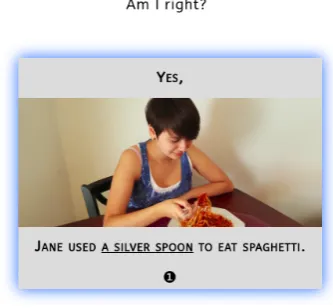
Figure 2: An illustration of why interpreting the sen-tence Jane ate spaghetti with a fork as the fork be-ing part of the dish (instead of a utensil) is ridiculous and easy for a human to dismiss (albeit still a potential source of confusion for a computer).
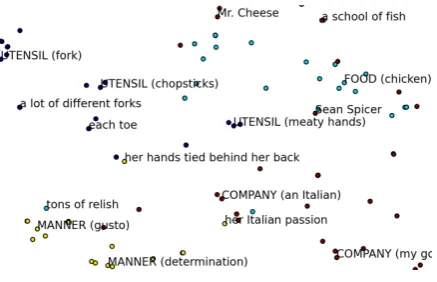
Figure 3: A zoomed-in view of a t-SNE plot show-ing some of the clusters of similar input phrases to the word2vec model. Phrases like “an Italian” and “her Italian passion” have different interpretations (COMPANY and MANNER, respectively), but are very
close to one another on this plot, showing that even the more advanced method has its difficulties.
ers receive extensive training on how to talk about science to a general audience via courses offered at OSU and also from the COSI educational team. The Language Pod organizers were enthusiastic about the development of Madly Ambiguous since they were aware of no general audience demos that dealt with syntax-related linguistic phenom-ena. After gathering feedback on the initial iPad version of Madly Ambiguous at COSI, it was com-pletely redesigned as an in-browser demo that can be used on iPad, Android, and desktop browsers, both for informal science learning and undergrad-uate classroom use, as well as a stand-alone demo on the web. Qualitative feedback on the revamped Madly Ambiguous suggests that it is educational and engaging for all ages.
2 Design
2.1 Interface
Madly Ambiguous’s interface is implemented us-ing Node.js3 as a single dynamic web page. It
includes three primary sections: the introduction, the game, and the explanation of how it works. The introduction discusses the more general prin-ciples of structural ambiguity as well as the par-ticular rules of the game, including interactive el-ements and humorous examples to make the in-structions more interesting (Figure2). The expla-nation of how it works can be read once the user has gone through at least one round of the game; it gives the basics of the two different methods the system uses for classifying the input, as described further in the next subsection.
The game itself has two phases of user inter-action. First, users fill in the blank in the sen-tence, “Jane ate spaghetti with .” (See Figure4.) The system gives a waiting screen depicting a con-templative Mr. Computer Head as it processes and classifies their input, and then displays the guess for users to confirm or deny based on their in-tended interpretation, as shown in Figure5. Four different interpretations are possible, with one ad-ditional selection if the user feels none of the four capture the meaning. Once the user selects an an-swer, s/he is given the option to play again, possi-bly switching between basic and advanced mode.
As we discovered during trials of the initial ver-sion of the system, the main challenge of the face was in presenting the different possible inter-pretations to users in a way that those with no prior understanding of linguistics could quickly grasp. In the current version, this is accomplished by pre-senting each option not just with a paraphrase of the sentence that captures the same meaning in a less ambiguous way, but also with a picture depict-ing the interpretation. Note that the pictures that accompany each meaning are based on the sen-tences in the introduction as opposed to the user’s input, so even if the user enters a utensil such asa silver spoon, the picture for theUTENSIL interpre-tation always shows a fork.
Given the importance of illustrative pictures in making the demo accessible, along with the diffi-culty of staging such pictures, the current version includes only the sentence for which we have cor-responding photos for each interpretation.
[image:2.595.74.293.295.436.2]Figure 4: The main screen of the game, where users are asked to complete the ambiguous sentence in a way that the system will misinterpret.
2.2 The NLP
Behind the scenes, the system classifies the user’s completion of the sentence “Jane ate spaghetti with ” as having one of the following four semantic roles, as represented by keywords and paraphrases:
• UTENSIL:Jane used to eat spaghetti. • PART:Jane had spaghetti and .
• MANNER:Jane exhibited while eating spaghetti. • COMPANY:Jane ate spaghetti in the presence of .
There are two different methods of analysis that can be employed. Basic moderepresents a clas-sic rule-based approach to NLP, utilizing part-of-speech tagging, lemmatization, and WordNet (Miller,1995) to arrive at an answer. This requires some heuristics based on the part-of-speech tags and lemmas in order to decide what the “most im-portant” word of the input phrase is for cases like Jane ate spaghetti with a bowl full of meatballs. The most important word (or multiword phrase) is then looked up in WordNet and its hypernyms are used to choose the category, much as with how se-lectional restrictions have been traditionally used (e.g.Allen et al.,2001).
Advanced modeuses methods closer to the cur-rent state-of-the-art for modern NLP, namely word embeddings (Mikolov et al., 2013). The gensim implementation of word2vec (ˇReh˚uˇrek and Sojka,
2010) is used with vectors that have been pre-trained on the Google News corpus. A training set of phrases and interpretation labels is used to create clusters for each of the four interpreta-tions. Inputs are then classified based on the near-est neighbor in the model to the average of all of the word vectors in the input phrase, not unlike in recent memory-based approaches to one-shot learning (Vinyals et al.,2016).
Figure 5: Once users complete the sentence, they’re shown the system’s guess for the sentence’s meaning and can confirm or deny its veracity.
The explanation of how it works additionally covers common sources of interpretation errors. In basic mode, infrequent word senses listed in WordNet can cause confusion; for example,trump is listed as an archaic form of trumpet, leading Mr. Computer Head to conjecture that President Trumpis a utensil. In advanced mode, the blend-ing of unrelated senses in word embeddblend-ings can cause trouble; for example, as shown in the vi-sualization of the clusters in Figure 3, the food and manner senses represented in the embedding for relish can lead to mistakes, as tons of relish is closer to one of the MANNERcluster centroids than the intendedFOODclusters.
3 Educational Objectives and Feedback
computers.4 Depending on the audience, the
ex-plainers might also skip the intro and jump right into the game with the pitch,Hey, do you want to try to trick a computer?
To separate the notion of intended meaning from the form of the sentence, users of the demo are encouraged to visualize the meaning they have in their head before clicking to see how Mr. Com-puter Head interprets their sentence completion. With more advanced audiences, the explainers will discuss how linguists use technical tools (like de-pendency trees) to analyze structural ambiguities and go over how the basic and advanced mode work. Finally, by discussing the kinds of errors the system makes, the explainers can broach the topic of why computers remain so much worse at am-biguity resolution than people. Classroom use can be similar, but with more background knowledge, students can be challenged to come up with ways to improve upon the system’s current strategies.
Since the demo went live in Summer 2017, Mr. Computer Head’s accuracy against user judgments is currently 64% for basic mode and 70% for ad-vanced mode, well above the majority baseline of 29% despite most users trying hard to fool him.5
Qualitatively, a high level of engagement with the demo can be observed by examining the lengths to which users go to win, cleverly coming up exam-ples likea cucumber dressed as a personasCOM -PANYrather thanFOOD,pins and needlesasMAN -NERrather thanUTENSIL, andvery British reserve as MANNER rather than COMPANY, all of which fool Mr. Computer Head in one mode or the other. Madly Ambiguous received more widespread community feedback after popular linguistics blog All Things Linguisticmade a post about it, describ-ing it as “a nice intro to automatic sentence pro-cessing” (McCulloch,2017). From there the link was shared across Twitter, Facebook, and beyond. Translation platform Smartcat reached out to learn more about computational linguistics in a webcast interview (Banffy,2017;Academy, 2017), while other computational linguistics pages like UW-CLMS discussed it on Facebook (CLMS,2017).
Teachers of courses related to language and computers have also made posts about using Madly Ambiguous in the classroom, making com-ments such as, “I actually cannot believe I showed
4Indeed, PP-attachment ambiguities have remained a
pri-mary source of parser errors (Kummerfeld et al.,2012).
5To our surprise, the youngest users of Madly Ambiguous
often want tohelpMr. Computer Head get the right answer!
word2vec visualizations in a 100 level course – some people were at least nodding, and they are not all from [a] CS background. Absolutely loved using it as a pedagogical tool, and the students also seemed to have understood better” (Vajjala,2017).
4 Summary and Future Work
In this paper we have introduced Madly Ambigu-ous, a game aimed at teaching audiences of all ages about structural ambiguity and demonstrating why it’s hard for computers—an important lesson that serves to demystify natural language process-ing at a time when AI in general is arguably over-hyped, risking societal overreactions to the tech-nology. Although Madly Ambiguous is complete and publicly available as-is, there are still more di-rections it could be taken in, as well as improve-ments to be made. Since the system saves the data from each round played, there are, as of February 2018, over 13,000 user inputs and judgments col-lected, which could be used as dynamic feedback for training future versions or possibly as data for other studies of structural ambiguity.
The game could be extended to include other sentences and types of structural ambiguity, such as with coordination (e.g., The old dogs and cats went to the vet, whereold may modifydogs and cats or dogs alone). This may call for addi-tional illustrative pictures, however. Other ex-pansions might incorporate different successful vector-based methods into the word2vec mode to make it even more sophisticated. Compositional character models, as in Ling et al. (2015), could allow the system to meaningfully model even out-of-vocabulary words; syntactically/semantically compositional models as in Socher et al. (2012) could yield a single vector for multi-word phrases that composes the representations for each word rather than averaging them, potentially providing more separation between clusters. Another direc-tion would be to dynamically generate explana-tions. It is an open source project, so anyone could contribute to the code!
Acknowledgments
References
Smartcat Academy. 2017. Computational lin-guistics. https://www.crowdcast.io/e/
computational-linguistics.
James F Allen, Donna K Byron, Myroslava Dzikovska, George Ferguson, Lucian Galescu, and Amanda Stent. 2001. Toward conversational human-computer interaction. AI magazine, 22(4):27.
Oct´avio Banffy. 2017. Madly ambiguous linguistic game. https://community.smartcat.ai/
topic/792-madly-ambiguous-linguistic-game/.
UW CLMS. 2017. Uw professional master’s in computational linguistics: A fun game from ohio state. https://www.facebook.com/
uwclma/posts/10155182653273246.
Manjuan Duan, Ethan Hill, and Michael White. 2016.
Generating disambiguating paraphrases for struc-turally ambiguous sentences. InProceedings of the 10th Linguistic Annotation Workshop held in con-junction with ACL 2016 (LAW-X 2016), pages 160– 170, Berlin, Germany. Association for Computa-tional Linguistics.
Manjuan Duan and Michael White. 2014. That’s Not What I Meant! Using Parsers to Avoid Structural Ambiguities in Generated Text. In Proceedings of the 52nd Annual Meeting of the Association for Computational Linguistics (Volume 1: Long Pa-pers), pages 413–423, Baltimore, Maryland. Asso-ciation for Computational Linguistics.
Jonathan K. Kummerfeld, David Hall, James R. Cur-ran, and Dan Klein. 2012. Parser showdown at the wall street corral: An empirical investigation of error types in parser output. InProceedings of the 2012 Joint Conference on Empirical Methods in ral Language Processing and Computational Natu-ral Language Learning, pages 1048–1059, Jeju Is-land, South Korea. Association for Computational Linguistics.
Wang Ling, Chris Dyer, Alan W Black, Isabel Tran-coso, Ramon Fermandez, Silvio Amir, Luis Marujo, and Tiago Luis. 2015. Finding function in form: Compositional character models for open vocabu-lary word representation. InProceedings of the 2015 Conference on Empirical Methods in Natural Lan-guage Processing, pages 1520–1530.
Gretchen McCulloch. 2017. Madly ambiguous is a fill-in-the-blank game that teaches you about ambiguity while you try to trick a computer.
http://allthingslinguistic.com/
post/165950061882/madly-ambiguous-is-a-fill-in-the-blank-game-that.
Tomas Mikolov, Kai Chen, Greg Corrado, and Jef-frey Dean. 2013. Efficient estimation of word representations in vector space. arXiv preprint arXiv:1301.3781.
George A Miller. 1995. Wordnet: a lexical database for english. Communications of the ACM, 38(11):39– 41.
Radim ˇReh˚uˇrek and Petr Sojka. 2010. Software Frame-work for Topic Modelling with Large Corpora. In Proceedings of the LREC 2010 Workshop on New Challenges for NLP Frameworks, pages 45–50, Valletta, Malta. ELRA. http://is.muni.cz/
publication/884893/en.
Richard Socher, Brody Huval, Christopher D Manning, and Andrew Y Ng. 2012. Semantic compositional-ity through recursive matrix-vector spaces. In Pro-ceedings of the 2012 joint conference on empirical methods in natural language processing and com-putational natural language learning, pages 1201– 1211. Association for Computational Linguistics.
Sowmya Vajjala. 2017. Teaching Notes — Teaching about ‘What is NLP?’. https://
nishkalavallabhi.github.io/LandC5/.
Oriol Vinyals, Charles Blundell, Timothy P. Lilli-crap, Koray Kavukcuoglu, and Daan Wierstra. 2016.
Matching networks for one shot learning. CoRR, abs/1606.04080.
Laura Wagner, Shari R. Speer, Leslie C. Moore, Eliza-beth A. McCullough, Kiwako Ito, Cynthia G. Clop-per, and Kathryn Campbell-Kibler. 2015. Linguis-tics in a science museum: Integrating research, teaching, and outreach at the language sciences re-search lab. Language and Linguistics Compass, 9(10):420–431.