Proceedings of the Thirteenth Workshop on Innovative Use of NLP for Building Educational Applications, pages 110–116
Annotating Student Talk in Text-based Classroom Discussions
Luca Lugini, Diane Litman, Amanda Godley, Christopher Olshefski University of Pittsburgh
Pittsburgh, PA 15260
{lul32,dlitman,agodley,cao48}@pitt.edu
Abstract
Classroom discussions in English Language Arts have a positive effect on students’ read-ing, writread-ing, and reasoning skills. Although prior work has largely focused on teacher talk and student-teacher interactions, we fo-cus on three theoretically-motivated aspects of high-quality student talk: argumentation, specificity, and knowledge domain. We intro-duce an annotation scheme, then show that the scheme can be used to produce reliable annota-tions and that the annotaannota-tions are predictive of discussion quality. We also highlight opportu-nities provided by our scheme for educational and natural language processing research.
1 Introduction
Current research, theory, and policy surround-ing K-12 instruction in the United States high-light the role of student-centered disciplinary dis-cussions (i.e. disdis-cussions related to a specific academic discipline or school subject such as physics or English Language Arts) in instruc-tional quality and student learning opportunities (Danielson, 2011;Grossman et al., 2014). Such student-centered discussions – often called “dia-logic” or “inquiry-based” – are widely viewed as the most effective instructional approach for dis-ciplinary understanding, problem-solving, and lit-eracy (Elizabeth et al., 2012; Engle and Conant,
2002;Murphy et al.,2009). In English Language Arts (ELA) classrooms, student-centered discus-sions about literature have a positive impact on the development of students’ reasoning, writing, and reading skills (Applebee et al.,2003; Reznit-skaya and Gregory,2013). However, most stud-ies have focused on the role of teachers and their talk (Bloome et al.,2005;Elizabeth et al., 2012;
Michaels et al.,2008) rather than on the aspects of student talk that contribute to discussion quality.
Additionally, studies of student-centered dis-cussions rarely use the same coding schemes, making it difficult to generalize across studies (Elizabeth et al., 2012;Soter et al., 2008). This limitation is partly due to the time-intensive work required to analyze discourse data through quali-tative methods such as ethnography and discourse analysis. Thus, qualitative case studies have gen-erated compelling theories about the specific fea-tures of student talk that lead to high-quality dis-cussions, but few findings can be generalized and leveraged to influence instructional improvements across ELA classrooms.
As a first step towards developing an automated system for detecting the features of student talk that lead to high quality discussions, we propose a new annotation scheme for student talk during ELA “text-based” discussions - that is, discussions that center on a text or piece of literature (e.g., book, play, or speech). The annotation scheme was developed to capture three aspects of class-room talk that are theorized in the literature as im-portant to discussion quality and learning oppor-tunities: argumentation(the process of systemat-ically reasoning in support of an idea),specificity
(the quality of belonging or relating uniquely to a particular subject), andknowledge domain(area of expertise represented in the content of the talk). We demonstrate the reliability and validity of our scheme via an annotation study of five transcripts of classroom discussion.
2 Related Work
One discourse feature used to assess the quality of discussions is students’ argument moves: their claims about the text, their sharing of textual evi-dence for claims, and their warranting or reason-ing to support the claims (Reznitskaya et al.,2009;
Toulmin, 1958). Many researchers view student
reasoning as of primary importance, particularly when the reasoning is elaborated and highly infer-ential (Kim,2014). In Natural Language Process-ing (NLP), most educationally-oriented argumen-tation research has focused on corpora of student persuasive essays (Ghosh et al., 2016; Klebanov et al., 2016; Persing and Ng, 2016; Wachsmuth et al., 2016; Stab and Gurevych, 2017; Nguyen and Litman, 2018). We instead focus on multi-party spoken discussion transcripts from class-rooms. A second key difference consists in the inclusion of the warrant label in our scheme, as it is important to understand how students explicitly use reasoning to connect evidence to claims.
Educational studies suggest that discussion quality is also influenced by the specificity of stu-dent talk (Chisholm and Godley, 2011; Sohmer et al., 2009). Chisholm and Godley found that as specificity increased, the quality of students’ claims and reasoning also increased. Previous NLP research has studied specificity in the con-text of professionally written newspaper articles (Li and Nenkova,2015;Li et al.,2016;Louis and Nenkova, 2011, 2012). While the annotation in-structions used in these studies work well for gen-eral purpose corpora, specificity in text-based dis-cussions also needs to capture particular relations between discussions and texts. Furthermore, since the concept of a sentence is not clearly defined in speech, we annotate argumentative discourse units rather than sentences (see Section3).
The knowledge domain of student talk may also matter, that is, whether the talk focuses on dis-ciplinary knowledge or lived experiences. Some research suggests that disciplinary learning oppor-tunities are maximized when students draw on ev-idence and reasoning that are commonly accepted in the discipline (Resnick and Schantz,2015), al-though some studies suggest that evidence or rea-soning from lived experiences increases discus-sion quality (Beach and Myers, 2001). Previ-ous related work in NLP analyzed evidence type for argumentative tweets (Addawood and Bashir,
2016). Although the categories of evidence type are different, their definition of evidence type is in line with our definition of knowledge domain. However, our research is distinct from this re-search in its application domain (i.e. social me-dia vs. education) and in analyzing knowledge do-main for all argumentative components, not only those containing claims.
3 Annotation Scheme
Our annotation scheme1 uses argument moves as
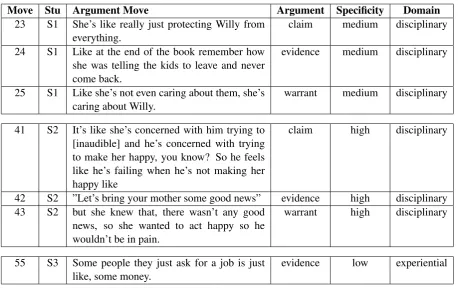
the unit of analysis. We define an argument move as an utterance, or part of an utterance, that contains an argumentative discourse unit (ADU) (Peldszus and Stede, 2013). Like Peldszus and Stede (2015), in this paper we use transcripts al-ready segmented into argument moves and focus on the steps following segmentation, i.e., label-ing argumentation, specificity, and knowledge do-main. Table 1 shows a section of a transcribed classroom discussion along with labels assigned by a human annotator following segmentation.
3.1 Argumentation
The argumentation scheme is based on (Lee,2006) and consists of a simplified set of labels derived from Toulmin’s (1958) model: (i) Claim: an ar-guable statement that presents a particular inter-pretation of a text or topic. (ii) Evidence: facts,
documentation, text reference, or testimony used to support or justify a claim. (iii) Warrant:
rea-sons explaining how a specific evidence instance supports a specific claim. Our scheme specifies that warrants must come after claim and evidence, since by definition warrants cannot exist without them.
The first three moves in Table1show a natural expression of an argument: a student first claims that Willy’s wife is only trying to protect him, then provides a reference as evidence by mentioning something she said to her kids at the end of the book, and finally explains how not caring about her kids ties the evidence to the initial claim. The second group shows the same argument progres-sion, with evidence given as a direct quote.
3.2 Specificity
Specificity annotations are based on (Chisholm and Godley, 2011) and have the goal of captur-ing text-related characteristics expressed in stu-dent talk. Specificity labels are directly related to four distinct elements for an argument move: (1) it is specific to one (or a few) character or scene; (2) it makes significant qualifications or elabora-tions; (3) it uses content-specific vocabulary (e.g. quotes from the text); (4) it provides a chain of reasons. Our annotation scheme for specificity in-cludes three labels along a linear scale: (i) Low:
Move Stu Argument Move Argument Specificity Domain
23 S1 She’s like really just protecting Willy from
everything. claim medium disciplinary
24 S1 Like at the end of the book remember how she was telling the kids to leave and never come back.
evidence medium disciplinary
25 S1 Like she’s not even caring about them, she’s
caring about Willy. warrant medium disciplinary
[image:3.595.71.530.59.348.2]41 S2 It’s like she’s concerned with him trying to [inaudible] and he’s concerned with trying to make her happy, you know? So he feels like he’s failing when he’s not making her happy like
claim high disciplinary
42 S2 ”Let’s bring your mother some good news” evidence high disciplinary 43 S2 but she knew that, there wasn’t any good
news, so she wanted to act happy so he wouldn’t be in pain.
warrant high disciplinary
55 S3 Some people they just ask for a job is just
like, some money. evidence low experiential
Table 1: Examples of argument moves and their respective annotations from a discussion of the bookDeath of a
Salesman. As shown by the argument move numbers, boxes for students S1, S2, and S3 indicate separate, non
contiguous excerpts of the discussion.
statement that does not contain any of these ele-ments. (ii)Medium: statement that accomplishes
one of these elements. (iii) High: statement that
clearly accomplishes at least two specificity ele-ments. Even though we do not explicitly use la-bels for the four specificity elements, we found that explicitly breaking down specificity into mul-tiple components helped increase reliability when training annotators.
The first three argument moves in Table 1 all contain the first element, as they refer to select characters in the book. However, no content-specific vocabulary, clear chain of reasoning, or significant qualifications are provided; therefore all three moves are labeled as medium specificity. The fourth move, however, accomplishes the first and fourth specificity elements, and is labeled as high specificity. The fifth move is also labeled high specificity since it is specific to one char-acter/scene, and provides a direct quote from the text. The last move is labeled as low specificity as it reflects an overgeneralization about all humans.
3.3 Knowledge Domain
The possible labels for knowledge domain are:(i) Disciplinary: the statement is grounded in
knowl-edge gathered from a text (either the one under discussion or others), such as a quote or a descrip-tion of a character/event. (ii) Experiential: the
statement is drawn from human experience, such as what the speaker has experienced or thinks that other humans have experienced.
In Table 1 the first six argument moves are labeled as disciplinary, since the moves reflect knowledge from the text currently being dis-cussed. The last move, however, draws from a stu-dent’s experience or perceived knowledge about the real world.
4 Reliability and Validity Analyses
Moves Argumen-tation (kappa)
Specificity
(qwkappa) Domain(kappa)
169 0.729 0.874 0.980
[image:4.595.73.290.61.133.2]81 0.725 0.930 1
Table 2: Inter-rater reliability for pairs P1 and P2.
Argumentation evidence warrant claim
evidence 25 5 0
warrant 6 92 12
claim 0 2 27
Specificity low medium high
low 59 5 3
medium 5 25 2
high 1 6 63
Knowledge
Domain discipl-inary experi-ential
disciplinary 138 1
[image:4.595.72.295.163.336.2]experiential 0 30
Table 3: Confusion matrices for argumentation, speci-ficity, and knowledge domain, for annotator pair P1.
unweighted for argumentation and knowledge do-main, but quadratic-weighted for specificity given its ordered labels.
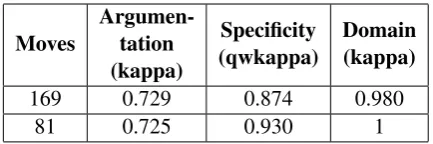
Table 2 shows that kappa for argumentation ranges from0.61−0.8, which generally indicates
substantial agreement (McHugh, 2012). Kappa values for specificity and knowledge domain are in the0.81−1range which generally indicates
al-most perfect agreement (McHugh, 2012). These results show that our proposed annotation scheme can be used to produce reliable annotations of classroom discussion with respect to argumenta-tion, specificity, and knowledge domain.
Table 3shows confusion matrices2 for
annota-tor pair P1 (we observed similar trends for P2). The argumentation section of the table shows that the largest number of disagreements happens be-tween the claim and warrant labels. One reason may be related to the constraint we impose on war-rants - they require the existence of a claim and evidence. If a student tries to provide a warrant for a claim that happened much earlier in the dis-cussion, the annotators might interpret the warrant as new claim. The specificity section shows rel-atively few low-high label disagreements as
com-2The class distributions for argumentation and specificity
labels vary significantly across transcripts, as can be seen in (Lugini and Litman,2017) and (Godley and Olshefski,2017).
pared to low-med and med-high. This is also re-flected in the quadratic-weighted kappa as low-high disagreements will carry a larger penalty (un-weighted kappa is 0.797). The main reasons for disagreements over specificity labels come from two of the four specificity elements discussed in Section 3.2: whether an argument move is related to one character or scene, and whether it provides a chain of reasons. With respect to the first of these two elements we observed disagreements in argu-ment moves containing pronouns with an ambigu-ous reference. Of particular note is the pronounit. If we consider the argument move“I mean even if you know you have a hatred towards a standard or whatever, you still don’t kill it”, the pronounit
clearly refers to something within the move (i.e. the standard) that the student themselves men-tioned. In contrast, for argument moves such as“It did happen”it might not be clear to what previous move the pronoun refers, therefore creating con-fusion on whether this specificity element is ac-complished. Regarding specificity element (4) we found that it was easier to determine the presence of a chain of reasons when discourse connectives (e.g. because, therefore) were present in the ar-gument move. The absence of explicit discourse connectives in an argument move might drive an-notators to disagree on the presence/absence of a chain of reasons, which is likely to result in a dif-ferent specificity label. Additionally, annotators found that shorter turns at talk proved harder to an-notate for specificity. Finally, as we can see from the third section in the table, knowledge domain has the lowest disagreements with only one.
We also (Godley and Olshefski,2017) explored the validity of our coding scheme by comparing our annotations of student talk to English Ed-ucation experts’ evaluations (quadratic-weighted kappa of 0.544) of the discussion’s quality. Us-ing stepwise regressions, we found that the best model of discussion quality (R-squared of0.432)
included all three of our coding dimensions: argu-mentation, specificity, and knowledge domain.
5 Opportunities and Challenges
discussion quality, these were small-scale studies based on manual annotations. Once automated classifiers are developed, such relations between talk and learning can be examined at scale. Also, automatic labeling via a standard coding scheme can support the generalization of findings across studies, and potentially lead to automated tools for teachers and students.
The proposed annotation scheme also intro-duces NLP opportunities and challenges. Exist-ing systems for classifyExist-ing specificity and argu-mentation have largely been designed to analyze written text rather than spoken discussions. This is (at least in part) due to a lack of publicly avail-able corpora and schemes for annotating argumen-tation and specificity in spoken discussions. The development of an annotation scheme explicitly designed for this problem is the first step towards collecting and annotating corpora that can be used by the NLP community to advance the field in this particular area. Furthermore, in text-based discussions, NLP methods need to tightly couple the discussion with contextual information (i.e., the text under discussion). For example, an argu-ment move from one of the discussions argu-mentioned in Section 4 stated “She’s saying like free like, I don’t have to be, I don’t have to be this salesman’s wife anymore, your know? I don’t have to play this role anymore.”The use of the termsalesman
shows the presence of specificity element (3) (see Section 3.2) because the text under discussion is indeedDeath of a Salesman. If the students were discussing another text, the mention of the term
salesmanwould not indicate one of the specificity elements, therefore lowering the specificity rating. Thus, using existing systems is unlikely to yield good performance. In fact, we previously ( Lug-ini and Litman, 2017) showed that while using an off-the-shelf system for predicting specificity in newspaper articles resulted in low performance when applied to classroom discussions, exploiting characteristics of our data could significantly im-prove performance. We have similarly evaluated the performance of two existing argument min-ing systems (Nguyen and Litman, 2018; Niculae et al., 2017) on the transcripts described in Sec-tion4. We noticed that since the two systems were trained to classify only claims and premises, they were never able to correctly predict warrants in our transcripts. Additionally, both systems classified the overwhelming majority of moves as premise,
resulting in negative kappa in some cases. Using our scheme to create a corpus of classroom dis-cussion data manually annotated for argumenta-tion, specificity, and knowledge domain will sup-port the development of more robust NLP predic-tion systems.
6 Conclusions
In this work we proposed a new annotation scheme for three theoretically-motivated features of stu-dent talk in classroom discussion: argumentation, specificity, and knowledge domain. We demon-strated usage of the scheme by presenting an an-notated excerpt of a classroom discussion. We demonstrated that the scheme can be annotated with high reliability and reported on scheme va-lidity. Finally, we discussed some possible ap-plications and challenges posed by the proposed annotation scheme for both the educational and NLP communities. We plan to extend our anno-tation scheme to label information about collabo-rative relations between different argument moves, and release a corpus annotated with the extended scheme.
Acknowledgements
We want to thank Haoran Zhang, Tazin Afrin, and Annika Swallen for their contribution, and all the anonymous reviewers for their helpful sugges-tions.
This work was supported by the Learning Re-search and Development Center at the University of Pittsburgh.
References
Aseel Addawood and Masooda Bashir. 2016. ”what is your evidence?” a study of controversial topics on social media. InProceedings of the Third Workshop
on Argument Mining (ArgMining2016), pages 1–11.
Arthur N Applebee, Judith A Langer, Martin Nystrand, and Adam Gamoran. 2003. Discussion-based ap-proaches to developing understanding: Classroom instruction and student performance in middle and high school english. American Educational Re-search Journal, 40(3):685–730.
Richard Beach and Jamie Myers. 2001. Inquiry-based English instruction: Engaging students in life and literature, volume 55. Teachers College Press.
language and literacy events: A microethnographic
perspective. Lawrence Erlbaum.
James S Chisholm and Amanda J Godley. 2011. Learn-ing about language through inquiry-based discus-sion: Three bidialectal high school students talk about dialect variation, identity, and power. Journal of Literacy Research, 43(4):430–468.
Charlotte Danielson. 2011. Evaluations that help teachers learn. Educational leadership, 68(4):35– 39.
Tracy Elizabeth, Trisha L Ross Anderson, Elana H Snow, and Robert L Selman. 2012. Academic dis-cussions: An analysis of instructional discourse and an argument for an integrative assessment frame-work. American Educational Research Journal, 49(6):1214–1250.
Randi A Engle and Faith R Conant. 2002. Guiding principles for fostering productive disciplinary en-gagement: Explaining an emergent argument in a community of learners classroom. Cognition and Instruction, 20(4):399–483.
Debanjan Ghosh, Aquila Khanam, Yubo Han, and Smaranda Muresan. 2016. Coarse-grained argu-mentation features for scoring persuasive essays. In
Proceedings of the 54th Annual Meeting of the As-sociation for Computational Linguistics (Volume 2: Short Papers), volume 2, pages 549–554.
Amanda Godley and Christopher Olshefski. 2017. The role of argument moves, specificity and evidence type in meaningful literary discussions across di-verse secondary classrooms. Unpublished paper presented at Literacy Research Association 67th An-nual Conference: Literacy Research for Expanding Meaningfulness.
Pam Grossman, Julie Cohen, Matthew Ronfeldt, and Lindsay Brown. 2014. The test matters: The rela-tionship between classroom observation scores and teacher value added on multiple types of assessment.
Educational Researcher, 43(6):293–303.
Il-Hee Kim. 2014. Development of reasoning skills through participation in collaborative synchronous online discussions. Interactive Learning Environ-ments, 22(4):467–484.
Beata Beigman Klebanov, Christian Stab, Jill Burstein, Yi Song, Binod Gyawali, and Iryna Gurevych. 2016. Argumentation: Content, structure, and relationship with essay quality. In Proceedings of the Third
Workshop on Argument Mining (ArgMining2016),
pages 70–75.
Carol D Lee. 2006. every good-bye aint gone: ana-lyzing the cultural underpinnings of classroom talk.
International Journal of Qualitative Studies in Edu-cation, 19(3):305–327.
Junyi Jessy Li and Ani Nenkova. 2015. Fast and accu-rate prediction of sentence specificity. In Proceed-ings of the Twenty-Ninth Conference on Artificial In-telligence (AAAI), pages 2281–2287.
Junyi Jessy Li, Bridget ODaniel, Yi Wu, Wenli Zhao, and Ani Nenkova. 2016. Improving the annotation of sentence specificity. InProceedings of the Tenth International Conference on Language Resources
and Evaluation (LREC).
Annie Louis and Ani Nenkova. 2011. General versus specific sentences: automatic identification and ap-plication to analysis of news summaries. Technical Report MS-CIS-11-07, University of Pennsylvania. Annie Louis and Ani Nenkova. 2012. A corpus of
gen-eral and specific sentences from news. In LREC, pages 1818–1821.
Luca Lugini and Diane Litman. 2017. Predicting speci-ficity in classroom discussion. InProceedings of the 12th Workshop on Innovative Use of NLP for Build-ing Educational Applications, pages 52–61. Mary L McHugh. 2012. Interrater reliability: the
kappa statistic.Biochemia medica: Biochemia med-ica, 22(3):276–282.
Sarah Michaels, Catherine OConnor, and Lauren B Resnick. 2008. Deliberative discourse idealized and realized: Accountable talk in the classroom and in civic life. Studies in philosophy and education, 27(4):283–297.
P Karen Murphy, Ian AG Wilkinson, Anna O Soter, Maeghan N Hennessey, and John F Alexander. 2009. Examining the effects of classroom discussion on students comprehension of text: A meta-analysis.
Journal of Educational Psychology, 101(3):740. Huy V Nguyen and Diane J Litman. 2018. Argument
mining for improving the automated scoring of per-suasive essays. InProceedings of the Thirty-Second AAAI Conference on Artificial Intelligence.
Vlad Niculae, Joonsuk Park, and Claire Cardie. 2017. Argument Mining with Structured SVMs and RNNs. InProceedings of ACL.
Andreas Peldszus and Manfred Stede. 2013. From ar-gument diagrams to arar-gumentation mining in texts: A survey. International Journal of Cognitive Infor-matics and Natural Intelligence (IJCINI), 7(1):1–31. Andreas Peldszus and Manfred Stede. 2015. Joint pre-diction in mst-style discourse parsing for argumen-tation mining. InProceedings of the 2015 Confer-ence on Empirical Methods in Natural Language Processing, pages 938–948.
Isaac Persing and Vincent Ng. 2016. End-to-end ar-gumentation mining in student essays. In Proceed-ings of the 2016 Conference of the North Ameri-can Chapter of the Association for Computational
Linguistics: Human Language Technologies, pages
Lauren B Resnick and Faith Schantz. 2015. Talking to learn: The promise and challenge of dialogic teach-ing. Socializing Intelligence through academic talk
and dialogue, pages 441–450.
Alina Reznitskaya and Maughn Gregory. 2013. Stu-dent thought and classroom language: Examining the mechanisms of change in dialogic teaching. Ed-ucational Psychologist, 48(2):114–133.
Alina Reznitskaya, Li-Jen Kuo, Ann-Marie Clark, Brian Miller, May Jadallah, Richard C Anderson, and Kim Nguyen-Jahiel. 2009. Collaborative rea-soning: A dialogic approach to group discussions.
Cambridge Journal of Education, 39(1):29–48.
Richard Sohmer, Sarah Michaels, MC OConnor, and Lauren Resnick. 2009. Guided construction of knowledge in the classroom. Transformation of
knowledge through classroom interaction, pages
105–129.
Anna O Soter, Ian A Wilkinson, P Karen Murphy, Lucila Rudge, Kristin Reninger, and Margaret Ed-wards. 2008. What the discourse tells us: Talk and indicators of high-level comprehension. Interna-tional Journal of EducaInterna-tional Research, 47(6):372– 391.
Christian Stab and Iryna Gurevych. 2017. Parsing ar-gumentation structures in persuasive essays. Com-putational Linguistics, 43(3):619–659.
Stephen Toulmin. 1958. The uses of argument. Cam-bridge: Cambridge University Press.