Proceedings of the Twelfth Workshop on Graph-Based Methods for Natural Language Processing (TextGraphs-12), pages 59–69
Embedding Text in Hyperbolic Spaces
Bhuwan Dhingra∗1 Christopher J. Shallue2 Mohammad Norouzi2
Andrew M. Dai2 George E. Dahl2
1Carnegie Mellon University 2Google Brain
[email protected], {shallue, mnorouzi, adai, gdahl}@google.com
Abstract
Natural language text exhibits hierarchical structure in a variety of respects. Ideally, we could incorporate our prior knowledge of this hierarchical structure into unsupervised learn-ing algorithms that work on text data. Recent work byNickel and Kiela(2017) proposed us-ing hyperbolic instead of Euclidean embed-ding spaces to represent hierarchical data and demonstrated encouraging results when em-bedding graphs. In this work, we extend their method with a re-parameterization technique that allows us to learn hyperbolic embeddings of arbitrarily parameterized objects. We ap-ply this framework to learn word and sen-tence embeddings in hyperbolic space in an unsupervised manner from text corpora. The resulting embeddings seem to encode certain intuitive notions of hierarchy, such as word-context frequency and phrase constituency. However, the implicit continuous hierarchy in the learned hyperbolic space makes interrogat-ing the model’s learned hierarchies more diffi-cult than for models that learn explicit edges between items. The learned hyperbolic em-beddings show improvements over Euclidean embeddings in some – but not all – down-stream tasks, suggesting that hierarchical or-ganization is more useful for some tasks than others.
1 Introduction
Many real-world datasets exhibit hierarchical structure, either explicitly in ontologies like Word-Net, or implicitly in social networks (Adcock et al., 2013) and natural language sentences ( Ev-eraert et al.,2015). When learning representations of such datasets, hyperbolic spaces have recently been advocated as alternatives to the standard Eu-clidean spaces in order to better represent the hier-archical structure (Nickel and Kiela,2017;
[image:1.595.310.525.223.296.2]Cham-∗Work done while interning at Google Brain.
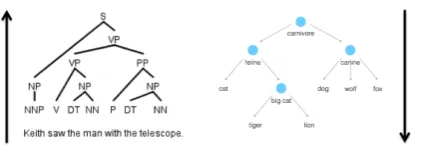
Figure 1:Two examples of hierarchical structure in natural language. Left: A constituent parse tree. Right: A frag-ment of WordNet. Arrows represent the direction in which the nodes become semantically more specific.
berlain et al.,2017). Hyperbolic spaces are non-Euclidean geometric spaces that naturally repre-sent hierarchical relationships; for example, they can be viewed as continuous versions of trees ( Kri-oukov et al., 2010). Indeed, Nickel and Kiela
(2017) showed improved reconstruction error and link prediction when embedding WordNet and sci-entific collaboration networks into a hyperbolic space of small dimension compared to a Euclidean space of much larger dimension.
In this work, we explore the use of hyper-bolic spaces for embedding natural language data, which has natural hierarchical structure in terms
ofspecificity. For example, sub-phrases in a
sen-tence can be arranged into a consituency-based parse tree where each node is semantically more specific than its parent (Figure1left). This hier-archical structure is not usually annotated in text corpora. Instead, we hypothesize that this struc-ture is implicitly encoded in the range of natural language contexts in which a concept appears: se-mantically general concepts will occur in a wider range of contexts than semantically specific ones. We use this intuition to formulate unsupervised objectives for learning hyperbolic embeddings of text objects. By contrast,Nickel and Kiela(2017) only embedded graphs with an explicit hierarchi-cal structure.
Further, Nickel and Kiela (2017) only consid-ered the non-parametric case where each object to be embedded is assigned its representation from a lookup table1. This approach is impractical for
embedding natural language because there are too many sentences and phrases for such a table to fit in memory. For natural language, we must adopt a parametric approach where we learn the parametersθof an encoder functionfθ that maps sequences of text to their embeddings. When training their non-parametric model, Nickel and Kiela (2017) relied on a projection step to keep their embeddings within their model of hyper-bolic space. Specifically, they embedded their data in the Poincar´e ball model of hyperbolic space, which consists of points in the unit ballBd={x∈
Rd : kxk < 1}, but their Reimannian gradient-descent algorithm was not guaranteed to keep their embeddings within the unit ball. To address this issue, they applied a projection step after each gra-dient step to force the embeddings back into the unit ball, but this projection is not possible when the representations are the output of an encoderfθ. Our main contribution is to propose a simpler parametrization of hyperbolic embeddings that al-lows us to train parametric encoders. We avoid the need for a projection step by separately pa-rameterizing the direction and norm of each em-bedding and applying a sigmoid activation func-tion to the norm. This ensures that embeddings al-ways satisfykek<1(as required by the Poincar´e ball model of hyperbolic space), even after arbi-trary gradient steps. Once the embeddings are constrained in this way, all that is needed to in-duce hyperbolic embeddings is an appropriate dis-tance metric (see Equation1) in the loss function in place of the commonly used Euclidean or cosine distance metrics. In addition to allowing paramet-ric encoders, this parameterization has an added benefit that instead of Riemannian-SGD (as used in Nickel and Kiela, 2017), we can use any of the popular optimization methods in deep learn-ing, such as Adam (Kingma and Ba, 2014). We show that re-parameterizing in this manner leads to comparable reconstruction error to the method of Nickel and Kiela (2017) when learning non-parametric embeddings of WordNet.
We test our framework by learning
unsuper-1Note that the term “non-parametric” has a different
meaning here than in the case of Bayesian non-parametric statistics. Here it refers to the fact that the embeddings are not output by a parameterized function.
vised embeddings for two types of natural lan-guage data. First, we embed a graph of word co-occurrences extracted from a large text corpus. The resulting embeddings are hierarchically orga-nized such that words occurring in many contexts are placed near the origin and words occurring in few contexts are placed near the boundary of the space. Using these embeddings, we see improved performance on a lexical entailment task, which supports our hypothesis that co-occurrence fre-quency is indicative of semantic specificity. How-ever, this improvement comes at the cost of worse performance on a word similarity task. In the second experiment, we learn embeddings of sen-tences (and sub-sentence sequences) by applying the hyperbolic metric to a modified version of the Skip-Thoughts model (Kiros et al.,2015) that uses embeddings to predict local context in a text corpus. Since most sentences are unique, there is no clear notion of co-occurrence frequency in this case. However, we find a high correlation (0.67) between the norms of embedded constituent phrases from Penn Treebank (Marcus et al.,1993) and the height at which those phrases occur in their parse trees. We conclude that hyperbolic sen-tence embeddings encode some of the hierarchical structure represented by parse trees, without being trained to do so. However, experiments on down-stream tasks do not show consistent improvements over baseline Euclidean embeddings.
2 Background – Poincar´e Embeddings
In this section we give an overview of the Poincar´e embeddings method from Nickel and Kiela(2017). A similar formulation was also pre-sented inChamberlain et al.(2017).
d-dimensions. d-dimensional hyperbolic space is unique up to a “curvature” constantK<0that sets the length scale. Without loss of generality we as-sumeK=−1.
In hyperbolic space, circle circumference (2πsinhr) and disc area (2π(coshr −1)) grow exponentially with radius, as opposed to Euclidean space where they only grow linearly and quadrati-cally. This makes it particularly efficient to embed hierarchical structures like trees, where the num-ber of nodes grows exponentially with depth ( Kri-oukov et al., 2010). We hope that such embed-dings will simultaneously capture both the similar-ity between objects (in their distances), and their relative depths in the hierarchy (in their norms).
There are several ways to model hyperbolic space within the more familiar Euclidean space. Of these, the Poincar´e ball model is most suited for use with neural networks because its dis-tance function is differentiable and it imposes a relatively simple constraint on the representa-tions (Nickel and Kiela, 2017). Specifically, the Poincar´e ball model consists of points within the unit ball Bd, in which the distance between two pointsu,v∈ Bdis
d(u,v) = cosh−1
1 + 2 ku−vk
2
(1− kuk2)(1− kvk2)
. (1)
Notice that, as kuk approaches 1, its distance
to almost all other points increases exponentially. Hence, an effective tree representation will place root nodes near the origin and leaf nodes near the boundary to ensure that root nodes are relatively close to all points while leaf nodes are relatively distant from most other leaf nodes.
In order to learn representations Θ = {θi}ni=1
for a set of objectsS = {si}n
i=1, we must define
a loss functionL(Θ, d)that minimizes the hyper-bolic distance between embeddings of similar ob-jects and maximizes the hyperbolic distance be-tween embeddings of different objects. Then we can solve the following optimization problem
ˆ
Θ = arg min
Θ L
(Θ, d) s.t. kθik<1 ∀θi ∈Θ
(2)
Nickel and Kiela(2017) use Riemannian-SGD to optimize Equation2. This involves computing the Riemannian gradient (which is a scaled ver-sion of the Euclidean gradient) with respect to the loss, performing a gradient-descent step, and pro-jecting any embeddings that move out ofBdback within its boundary. In the following section, we
propose a re-parametrization of Poincar´e embed-dings that removes the need for the projection step and allows the use of any of the popular optimiza-tion techniques in deep learning, such as Adam.
3 Parametric Poincar´e Embeddings
Our goal is to learn a function f : S → Bd that maps objects from a set S to the Poincar´e ballBd. However, the encoders typically used in deep learning, such as LSTMs, GRUs, and feed-forward networks, may produce representations in arbitrary subspaces of Rd0
. We introduce a re-parameterization technique that maps Rd0
to Bd and can be used on top of any existing encoder. Let
e(s) ∈ Rd0
denote the output of the original en-coder for a givens∈ S. The re-parameterization involves computing a direction vector v and a
norm magnitudepfrome(s)as follows:
¯
v=φdir(e(s)), v=
¯ v
kv¯k,
¯
p=φnorm(e(s)), p=σ(¯p),
whereφdir : Rd0 → Rd, φnorm : Rd0 → R can be arbitrary parametric functions, whose parame-ters will be optimized during training, andσis the sigmoid function that ensures the resulting norm p ∈ (0,1). We will introduce specific instanti-ations of φdir and φnorm in the subsections be-low. The re-parameterized embedding is defined asθ=pv, which lies inBd.
Let w denote the model parameters in e(s),
φdir, andφnorm. We wish to optimize a loss func-tion L(w, d) that minimizes the hyperbolic dis-tance d between embeddings of similar objects and maximizes the hyperbolic distance between embeddings of dissimilar objects. Since the em-beddingsθare guaranteed to lie inBd, we can use any of the optimization methods popular in deep learning – we use Adam (Kingma and Ba,2014).
Next we discuss specific instantiations of en-coders, re-parameterization functions and loss functions for three types of problems.
3.1 Non-Parametric Supervised Embeddings
we use a lookup table Las the base encoder, i.e,
e(u) = L(u) ∈ Rd+1. We setφ
dir = x1:d and φnorm =xd+1to be slicing functions that extract
the firstdand the (d+ 1)-th dimensions respec-tively.
We use the same loss function as Nickel and Kiela (2017), which uses negative samples N(u) ={v: (u, v)∈ D/ , v6=u}to maximize dis-tance between embeddings of unrelated objects:
L(w, d) =− X
(u,v)∈D
log e− d(u,v) P
v0∈N(u)∪{v}e−d(u,v0)
.
Note that this loss function makes no use of the direction of the edge(u, v), becaused(u, v)is symmetric. Nevertheless, we expect it to recover the hierarchical structure ofD.
3.2 Non-Parametric Unsupervised Word Embeddings
Next, we consider the problem of embedding words from a vocabulary SV given a text corpus
T = (w1, . . . , w|T |), wherewi ∈ SV.
Traditional unsupervised methods, like word2vec (Mikolov et al., 2013b) and GloVe (Pennington et al., 2014), are optimized for preserving semantic similarity: the embeddings of similar words should be close, and the embed-dings of semantically different words should be distant. Remarkably, these unsupervised embed-dings also exhibit structural regularities, such as vector offsets corresponding to male-to-female or singular-to-plural transformations (Mikolov et al., 2013c,b). In this work, by embedding in hyperbolic space, we hope to encode both semantic similarity (in the hyperbolic distances between embeddings) and semantic specificity (in the hyperbolic norms of embeddings). Our hypothesis is that words denoting more general concepts will appear in varied contexts and hence will be placed closer to the origin – similar to how nodes close to the root in WordNet are placed close to the origin in Nickel and Kiela (2017). Tasks that rely on a hierarchical relationship between words might benefit from embeddings with these properties.
The idea of using specialized vector space mod-els for encoding various lexical relations was pre-viously explored byHenderson and Popa(2016). While they looked exclusively at the entailment re-lation, the notion we study here is that ofsemantic
specificity, which is more general but also difficult
to define formally. One example is that “musician” is related to “music” and more specific than it, but not necessarily entailed by it.
Both word2vec and GloVe embed words using co-occurrences of pairs of words occur within a fixed window size inT. Here, we construct a co-occurrence graphG ={(w, v)}that consists of all pairs of words that occur within a fixed window of each other. Certain pairs co-occur more frequently than others, and we preserve this information by allowing repeated edges inG: each pair(w, v) oc-cursfctimes inG, wheref is the frequency of that pair inT andc < 1is a downsampling constant. We embed G in the Poincar´e ball in the manner described in Section3.1.
3.3 Parametric Unsupervised Sentence Embeddings
Finally, we consider embedding longer units of text such as sentences and phrases. We denote the set of all multi-word expressions of interest asSZ. Our goal is to learn an encoder function
f : SZ → Bd in an unsupervised manner from a text corpusT = (s1, . . . , s|T |), wheresi ∈ SZ.
Sentence embeddings are motivated by the phe-nomenal success of word embeddings as general purpose feature representations for a variety of downstream tasks. The desiderata of multi-word embeddings are similar to those of word embed-dings: semantically similar units should be close to each other in embedding space, and complex se-mantic properties should map to geometric proper-ties in the embedding space. Our hypothesis is that embedding multi-word units in hyperbolic space will capture the hierarchical structure of speci-ficity of the meanings of these units.
We start with Skip-Thoughts (Kiros et al.,
2015), an unsupervised model for sentence em-beddings that is trained to predict sentences sur-rounding a source sentence from its representa-tion. Skip-Thoughts consists of an encoder and two decoders, all of which are parameterized as Gated Recurrent Units (GRUs) (Cho et al.,2014). The encoder produces a fixed-size representation fθ(si) forsi ∈ SZ, and the two decoders
recon-struct the previous sentencesi−1and the next
sen-tencesi+1in an identical manner, as follows:
ht=GRU(w<t, fθ(si)), P(wt|w<t, fθ(si))∝exp(vTwtht),
in si−1 or si+1 and vw denotes an out-put embedding for w. The loss minimizes −PtlogP(wt|w<t, fθ(si)).
In order to learn hyperbolic embeddings, the loss must depend directly on the hyperbolic dis-tance between the source and target embeddings. As an intermediate step, we present a modified version of Skip-Thoughts where we remove the GRU from the decoding step and instead directly predict a bag-of-words surrounding the source sentence, as follows:
ct= 1
2K K
X
k=1
vw0t−k +v0wt+k,
P(wt|w6=t, fθ(si))∝exp (vTwtfθ(si) +v
T wtct).
Here,ctis an average word embedding of the bi-directional local context around the word to be predicted. We found it was important to condi-tion the prediccondi-tion onctin order to learn a good quality encoder model fθ, since it can take care of uninteresting language modeling effects. Em-pirically, the sentence encoder trained in this man-ner gives around 1% lower average performance on downstream tasks (discussed in Section 4.3) than the original Skip-Thoughts model, while be-ing considerably faster. More importantly, the pre-diction probability now directly depends on the in-ner product betweenvwt andfθ(si). We can now
introduce a hyperbolic version of the likelihood as follows:
P(wt|w6=t, fθ(si))∝
exp (−λ1d(vwt, fθ(si))−λ2d(vwt,ct)).
Here,dis the hyperbolic distance function (Equa-tion1) andλ1, λ2are learned coefficients that
con-trol the importance of the two terms. After train-ing, we observed that λ2 > λ1, which supports
our intuition that local context is more important in predicting a word.
To ensure thatvwt, fθ(si),ct∈ Bd, we use the
following parameterization:
φdir(x) =W1Tx, φnorm(x) =W2Tx,
wherex={ˆvwt,ˆct,fˆθ(si)};vˆwt is the Euclidean
output embedding for word wt, obtained from a lookup table;ˆctis the Euclidean local context em-bedding, obtained by averaging Euclidean word vectors from a window aroundwt; andfˆθis a
bidi-Method Dim
5 20 100
FromNickel and Kiela(2017)
Euclidean RankMAP 3542.30.024 1685.90.087 1187.30.162
Poincar´e RankMAP 0.8234.9 0.8553.8 0.8573.9
This work
[image:5.595.316.517.64.181.2]Poincar´e (re-parameterized) RankMAP 0.73610.7 0.8756.3 0.8185.5
Table 1: Reconstruction errors for various embedding di-mensions on WordNet.
rectional GRU encoder over the words ofsi:
hfT =−−→GRU(si), hb1 =←−−GRU(si) ˆ
fθ(si) =hfTkhb1
Similar to Skip-Thoughts, the loss minimizes −PtlogP(wt|w6=t, fθ(si)).
4 Experiments & Results 4.1 WordNet
The WordNet noun hierarchy is a collection of tuples D = {(u, v)}, where each pair (u, v) denotes that u is a hypernym of v. Following
Nickel and Kiela(2017), we learned embeddings using the transitive closure D+, which consists
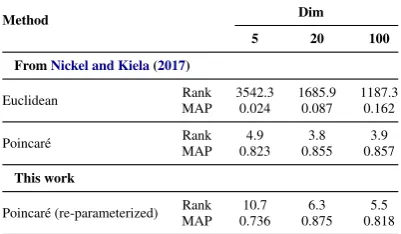
of 82,114 nouns and 743,241 hypernym-hyponym edges. We compared our results to the original method fromNickel and Kiela(2017) across three different embedding sizes. In each case, we evalu-ated the embeddings by attempting to reconstruct the WordNet tree using the nearest neighbors of the nodes. For each node, we retrieved a ranked list of its nearest neighbors in embedding space and computed the mean rank of its ground truth children, and also computed the Mean Average
Precision (MAP), which is the average precision
at the threshold of each correctly retrieved child. Results are presented in Table1.
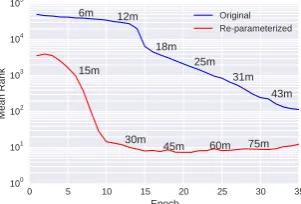
The re-parameterized Poincar´e embeddings method has comparable reconstruction error to the original Poincar´e method, whereas both are significantly superior to the Euclidean embed-dings method. Figure2 shows reconstruction er-ror after each epoch when training the original and re-parameterized Poincar´e embeddings, along with the elapsed wall time in minutes2. The 2For the original method we used the official code release
0 5 10 15 20 25 30 35
Epoch
100 101 102 103 104 105
Mean Rank
15m 6m
30m 12m
45m 18m
60m 25m
75m 31m
43m
[image:6.595.101.252.73.175.2]Original Reparameterized
Figure 2:Mean Rank for reconstructing the WordNet graph after each training epoch (up to epoch 35) for the original Poincar´e embeddings method (Nickel and Kiela,2017) and our re-parameterized version. Wall time elapsed in minutes is also shown against the curves. Dimensiond= 10.
Word Nearest neighbors
[image:6.595.86.277.261.381.2]vapor boiling, melting, evaporation, cooling, vapour towering eruptions, tsunamis, hotspots, himalayas, volcanic mercedes dmg, benz, porsche, clk, mclaren forties twenties, thirties, roaring, koniuchy, inhabitant eruption caldera, vents, calderas, limnic, volcano palladium boron, anion, uranium, ceric, hexafluoride employment incentives, benefits, financial, incentive, investment weighed tonnes, weigh, weighs, kilograms, weighing
Table 2: Nearest Neighbors in terms of cosine distance for Poincar´e embeddings of words (d= 20).
re-parameterized method converges much faster, with its best error achieved around epoch 20, compared to the original method that reaches its best error after hundreds of epochs. This is de-spite using a larger batch size of 1024 for the re-parameterized method than the original method, which uses batch size 50. We hypothesize that the speed-up is largely due to using the Adam op-timizer which is made possible by the fact that the re-parameterization ensures the embeddings always lie within the Poincar´e ball.
4.2 Word Embeddings
We used theTEXT8 corpus3 to evaluate our tech-nique for learning non-parametric unsupervised word embeddings (Section 3.2). Though small (17M tokens), theTEXT8 corpus is a useful bench-mark for quickly comparing embedding methods.
For hyperbolic embeddings, the nearest
neigh-poincare-embeddings with the recommended hy-perparameter settings. Our re-parameterized model is implemented in TensorFlow (Abadi et al.,2016). Wall time was recorded on a CPU with 8-core AMD Opteron 6376 Processor.
3http://mattmahoney.net/dc/text8.zip
bors of most words by hyperbolic distance (Equa-tion 1) are all uninteresting common words (e.g. numbers, quantifiers, etc), because points near the origin are relatively close to all points, whereas distances between points increases exponentially as the points approach the boundary of Bd. In-stead, we find nearest neighbors in hyperbolic space using cosine distance, which is motivated by the fact that the Poincar´e ball model is confor-mal: angles between vectors are identical to their Euclidean counterparts. Some nearest neighbors of hyperbolic word embeddings are shown in Ta-ble 2. The closest neighbors typically represent one of several semantic relations with the query word. For example, “boiling” produces “vapor”, “towering” is a quality of “eruptions”, “dmg” is the parent company of “mercedes”, “tonnes” is a measure of “weighed”, and so on. This is a con-sequence of embedding the word-cooccurrence graph, which implicitly represents these relations. Table3shows lists of related words that contain a particular substring in order of increasing hyper-bolic norm. We also show the counts in the corpus of these words, which are correlated to the num-ber of contexts they occur in. As expected, words occurring in fewer contexts have higher hyperbolic norm, and this corresponds to increased specificity as we move down the list; for example “bulldogs” has a higher norm than “dog”, and “greatest” has a higher norm than “great”. The Spearman corre-lation between1/f, wheref is the frequency of a word in the corpus, and the norm of the embedding is0.77.
We quantitatively evaluate hyperbolic embed-dings on two tasks against the baseline Skip-Gram with Negative Sampling (SGNS) embed-dings (Mikolov et al., 2013a)4. The first task
is Word-Similarity on the WordSim-353 dataset (Finkelstein et al.,2001), which measures whether the embeddings preserve semantic similarity be-tween words as judged by humans. We compute Spearman’s correlation between ground truth sim-ilarity scores and cosine distances in embedding space between all pairs of words in the dataset. The second task is HyperLex (Vuli´c et al.,2017), which measures the extent to which embeddings preserve lexical entailment relationships of the form “X is a type of Y”. These are precisely the
4We use the code available at https://github. com/tensorflow/models/tree/master/
tutorials/embedding, which was tuned for the
“bank” “music” “dog” “great”
Word Count Norm Word Count Norm Word Count Norm Word Count Norm
bank 1076 2.56 music 4470 1.58 dog 566 3.21 great 4784 2.11
[image:7.595.100.499.63.144.2]bankruptcy 106 4.61 musical 1265 2.56 dogs 184 4.27 greater 1502 2.51 banking 185 5.92 musicians 435 4.07 dogme 16 6.52 greatest 753 2.97 bankrupt 28 5.93 musician 413 4.32 bulldogs 8 7.08 greatly 530 3.46 banks 407 6.45 musicals 38 5.76 endogenous 5 7.55 greatness 12 6.41 banknote 13 6.62 musicology 18 6.38 sheepdog 5 7.73
Table 3:Words in order of increasing hyperbolic norm which contain the substring indicated in the top row. Their counts in theTEXT8 corpus are also shown. Dimension sized= 20.
Task Method Dimension
5 20 50 100
WordSim-353 Poincar´eSGNS 0.3500.305 0.5660.451 0.6760.451 0.6890.455
HyperLex Poincar´eSGNS -0.0020.259 0.0930.246 0.1240.246 0.1400.248
Table 4:Spearman’sρcorrelation coefficient for Word Simi-larity and Lexical Entailment tasks using SGNS and Poincar´e embeddings of various sizes.
kind of relations we hope to capture in the norm of hyperbolic embeddings. Given a pair(x, y) of words, we compute the score for the relationship is-a(x, y) in the same way as Nickel and Kiela
(2017):
score(is-a(x, y))=−(1 +α(kyk − kxk))d(x, y). Ifxandyare close andkyk<kxk, the above score will be positive, implyingxis a type ofy.
Table4shows the scores on these two tasks for both SGNS and Poincar´e embeddings for various embedding sizes. SGNS embeddings are superior for preserving word similarities, while Poincar´e embeddings are superior for preserving lexical en-tailment. However, the best score for Poincar´e embeddings is only0.259, which is quite low. In comparison to the unsupervised baselines studied inVuli´c et al.(2017), Poincar´e embeddings rank second behind the simple Frequency Ratio base-line which, achieves0.2795.
4.3 Sentence Embeddings
We use the BookCorpus (Zhu et al.,2015) to learn sentence and phrase embeddings. We pre-process the data into triples of the form (si−1, si, si+1)
consisting of both full sentences, as in the orig-inal Skip-Thoughts model, and sub-sentence se-quences of words sampled according to the same lengths as sentences in the corpus. We found that
5This does not include baselines that use extra
informa-tion like WordNet while learning the embeddings.
Sentence Norm
a creaky staircase gothic . 6.21
[image:7.595.86.276.196.266.2]it ’s a rare window on an artistic collaboration . 6.32 a dopey movie clothed in excess layers of hipness . 6.35 an imponderably stilted and self-consciously arty movie . 6.65 there’s a delightfully quirky movie ... , but brooms isn’t it . 6.83 a trifle of a movie, with a few laughs ... unremarkable soft center . 6.86
Table 5: Sentences from Movie Reviews dataset with their norms. Each row represents a nearest neighbor to and with a greater norm than the sentence in the row above.
augmenting the dataset in this manner led to con-sistent improvements on downstream tasks.
4.0
2.9
3.3
2.5
operations 1.7
UNK 1.6
big 1.6
have 4.3
3.0
2.5
2.2
10 1.7
the 1.9
of 1.9
Most
2.5
2.4
2.2
1.9
Monday 2.8
Black 2.4
n’t 2.5
was 1.5
it 1.8
, 1.7
No
7.7
2.7
2.2
2.0
2.4
2.1
worms 1.9
of 1.8
1.8
can 1.7
a 2.0
open 1.9
would 1.5
[image:8.595.126.470.70.170.2]It
Figure 3:Constituent parse trees from the Penn Treebank with hyperbolic norms of the phrase embeddings at each node.
Encoder Dim Word Dim Method Perplexity CR SUBJ MPQA MR MultiNLI SNLI
10 100 EuclideanPoincar´e 117110 0.6390.640 0.5820.623 0.6890.769 0.5460.534 0.4170.419 0.4830.480
100 200 EuclideanPoincar´e 6153 0.7190.722 0.8820.890 0.8230.848 0.6940.696 0.5370.534 0.6920.684
1000 620 EuclideanPoincar´e 6146 0.8040.792 0.9250.921 0.8600.880 0.7420.746 0.6200.617 0.7410.746
2400 620 Skip-Thoughts –∗ 0.836 0.938 0.889 0.795 0.650 0.766
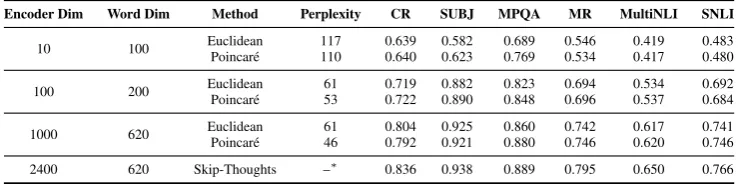
Table 6:Held out set perplexity and downstream task performance for sentence embeddings of various sizes. ∗Perplexity of the Skip-Thoughts model is not comparable to our methods since it only uses uni-directional local context.
Next, following common practice for evaluating sentence representations, we evaluate the trained Poincar´e encoder as a black-box feature extrac-tor for downstream tasks. We choose four binary classification benchmarks from the original Skip-Thoughts evaluation – CR, MR, MPQA and SUBJ – and two entailment tasks – MultiNLI (Williams et al., 2017) and SNLI (Bowman et al., 2015). For the binary classification tasks we train SVM models with a kernel based on hyperbolic dis-tance between sentences, and for the entailment tasks we train multi-layer perceptrons on top of the premise and hypothesis embeddings and their element-wise products and differences. As a base-line, we compare to embeddings trained using the Euclidean distance metric. Table6reports the re-sults of these evaluations for various embedding dimensions. Poincar´e embeddings achieve a lower perplexity in each case, suggesting a more efficient use of the embedding space. However, both sets of embeddings perform similarly on downstream tasks, except for the MPQA opinion polarity task where Poincar´e embeddings do significantly bet-ter. Training with embedding sizes greater than 1000 did not show any further improvements in our experiments.
4.4 Discussion
The goal of this work was to explore whether hy-perbolic spaces are useful for learning embeddings of natural language data. Ultimately, the
useful-ness of an embedding method depends on its per-formance on downstream tasks of interest. In that respect we found mixed results in our evaluation. For word embeddings, we found that hyperbolic embeddings preserve co-occurrence frequency in-formation in their norms, and this leads to im-proved performance on a lexical entailment task. However, decreased performance on a word sim-ilarity task means that these embeddings may not be useful across all tasks. In general, this suggests that different architectures are needed for captur-ing different types of lexical relations. We ex-perimented with several other loss functions, pre-processing techniques and hyper-parameter set-tings, which we did not describe in this paper due to space constraints, but the conclusions remained the same.
[image:8.595.114.484.202.294.2]metric for learning useful embeddings of natural language data.
5 Related Work
Tay et al.(2018) used the hyperbolic distance met-ric to learn question and answer embeddings on the Poincar´e ball for question-answer retrieval. The main difference to our work is that we ex-plore unsupervised objectives for learning generic word and sentence representations from a text cor-pus. Furthermore, we show that by using re-parameterization instead of projection to constrain the embeddings, we can view the distance metric as any other non-linear layer in a deep network and remove the need for Riemannian-SGD.
Several works have attempted to learn hierarchi-cal word embeddings. Order Embeddings ( Ven-drov et al., 2015) and LEAR (Vuli´c and Mrkˇsi´c,
2017) are supervised methods that also encode hi-erarchy information in the norm of the embed-dings by adding regularization terms to the loss function. In comparison, our method is unsuper-vised. HyperVec (Nguyen et al., 2017) is a su-pervised method which ensures that the hyper-nymy relation is assigned a higher similarity score in the learned embeddings than other relations such as synonymy. The vector space model for distribution semantics introduced by Henderson and Popa(2016) is unsupervised and re-interprets word2vec embeddings to predict entailment rela-tions between pairs of words. DIVE (Chang et al.,
2017) is also unsupervised, and achieves a score of 32.6%on the lexical entailment task, but it is un-clear how well the embeddings preserve semantic similarity.
For sentence embeddings, several works have looked at improved loss functions for Skip-Thoughts to make the model faster and light-weight (Tang et al.,2017c,a,b).Ba et al.(2016) in-troduced a layer normalization method that shows consistent improvements when included in the GRU layers in Skip-Thoughts, and we used this in our encoder. More recently, improved sen-tence representations were obtained using dis-course based objectives (Jernite et al., 2017;Nie et al., 2017) and using supervision from natural language inference data (Conneau et al.,2017).
6 Conclusion
We presented a re-parameterization method that allows us to learn Poincar´e embeddings on top
of arbitrary encoder modules using arbitrary distance-based loss functions. We showed that this re-parameterization leads to comparable per-formance to the original method fromNickel and Kiela (2017) when explicit hierarchical structure is present in the data. When we applied this method to natural language data at the word- and sentence-level, we found evidence of intuitive no-tions of hierarchy in the learned embeddings. This led to improvements on some – but not all – down-stream tasks. Future work could either focus on alternative formulations for unsupervised hyper-bolic embeddings, or alternative downstream tasks where hierarchical organization may be more use-ful.
References
Mart´ın Abadi, Paul Barham, Jianmin Chen, Zhifeng Chen, Andy Davis, Jeffrey Dean, Matthieu Devin, Sanjay Ghemawat, Geoffrey Irving, Michael Isard, et al. 2016. Tensorflow: A system for large-scale machine learning. InOSDI, volume 16, pages 265– 283.
Aaron B Adcock, Blair D Sullivan, and Michael W Mahoney. 2013. Tree-like structure in large social and information networks. InData Mining (ICDM), 2013 IEEE 13th International Conference on, pages 1–10. IEEE.
Jimmy Lei Ba, Jamie Ryan Kiros, and Geoffrey E Hin-ton. 2016. Layer normalization. arXiv preprint arXiv:1607.06450.
Samuel R. Bowman, Gabor Angeli, Christopher Potts, and Christopher D. Manning. 2015. A large an-notated corpus for learning natural language infer-ence. In Proceedings of the 2015 Conference on Empirical Methods in Natural Language Processing (EMNLP). Association for Computational Linguis-tics.
Benjamin Paul Chamberlain, James Clough, and Marc Peter Deisenroth. 2017. Neural embeddings of graphs in hyperbolic space. arXiv preprint arXiv:1705.10359.
Haw-Shiuan Chang, ZiYun Wang, Luke Vilnis, and Andrew McCallum. 2017. Distributional inclusion vector embedding for unsupervised hypernymy de-tection. arXiv preprint arXiv:1710.00880.
1734, Doha, Qatar. Association for Computational Linguistics.
Alexis Conneau, Douwe Kiela, Holger Schwenk, Lo¨ıc Barrault, and Antoine Bordes. 2017. Supervised learning of universal sentence representations from natural language inference data. InProceedings of the 2017 Conference on Empirical Methods in Nat-ural Language Processing, pages 670–680. Associ-ation for ComputAssoci-ational Linguistics.
Martin BH Everaert, Marinus AC Huybregts, Noam Chomsky, Robert C Berwick, and Johan J Bolhuis. 2015. Structures, not strings: linguistics as part of the cognitive sciences. Trends in cognitive sciences, 19(12):729–743.
Lev Finkelstein, Evgeniy Gabrilovich, Yossi Matias, Ehud Rivlin, Zach Solan, Gadi Wolfman, and Ey-tan Ruppin. 2001. Placing search in context: The concept revisited. InProceedings of the 10th inter-national conference on World Wide Web, pages 406– 414. ACM.
James Henderson and Diana Popa. 2016. A vector space for distributional semantics for entailment. In
Proceedings of the 54th Annual Meeting of the As-sociation for Computational Linguistics (Volume 1: Long Papers), pages 2052–2062. Association for Computational Linguistics.
Yacine Jernite, Samuel R Bowman, and David Son-tag. 2017. Discourse-based objectives for fast un-supervised sentence representation learning. arXiv preprint arXiv:1705.00557.
Diederik P Kingma and Jimmy Ba. 2014. Adam: A method for stochastic optimization. In Proceed-ings of the 3rd International Conference on Learn-ing Representations (ICLR).
Ryan Kiros, Yukun Zhu, Ruslan R Salakhutdinov, Richard Zemel, Raquel Urtasun, Antonio Torralba, and Sanja Fidler. 2015. Skip-thought vectors. In
Advances in neural information processing systems, pages 3294–3302.
Dmitri Krioukov, Fragkiskos Papadopoulos, Maksim Kitsak, Amin Vahdat, and Mari´an Bogun´a. 2010. Hyperbolic geometry of complex networks. Phys-ical Review E, 82(3):036106.
Mitchell P Marcus, Mary Ann Marcinkiewicz, and Beatrice Santorini. 1993. Building a large annotated corpus of english: The penn treebank. Computa-tional linguistics, 19(2):313–330.
Tomas Mikolov, Kai Chen, Greg Corrado, and Jef-frey Dean. 2013a. Efficient estimation of word representations in vector space. arXiv preprint arXiv:1301.3781.
Tomas Mikolov, Ilya Sutskever, Kai Chen, Greg S Cor-rado, and Jeff Dean. 2013b. Distributed representa-tions of words and phrases and their compositional-ity. InAdvances in neural information processing systems, pages 3111–3119.
Tomas Mikolov, Wen-tau Yih, and Geoffrey Zweig. 2013c. Linguistic regularities in continuous space word representations. InProceedings of the 2013 Conference of the North American Chapter of the Association for Computational Linguistics: Human Language Technologies, pages 746–751.
Kim Anh Nguyen, Maximilian K¨oper, Sabine Schulte im Walde, and Ngoc Thang Vu. 2017.
Hierarchical embeddings for hypernymy detection and directionality. In Proceedings of the 2017 Conference on Empirical Methods in Natural Language Processing, pages 233–243. Association for Computational Linguistics.
Maximillian Nickel and Douwe Kiela. 2017. Poincar´e embeddings for learning hierarchical representa-tions. In I. Guyon, U. V. Luxburg, S. Bengio, H. Wallach, R. Fergus, S. Vishwanathan, and R. Gar-nett, editors, Advances in Neural Information Pro-cessing Systems 30, pages 6338–6347. Curran As-sociates, Inc.
Allen Nie, Erin D Bennett, and Noah D Goodman. 2017. Dissent: Sentence representation learning from explicit discourse relations. arXiv preprint arXiv:1710.04334.
Bo Pang, Lillian Lee, and Shivakumar Vaithyanathan. 2002. Thumbs up?: sentiment classification using machine learning techniques. InProceedings of the ACL-02 conference on Empirical methods in natural language processing-Volume 10, pages 79–86. As-sociation for Computational Linguistics.
Jeffrey Pennington, Richard Socher, and Christopher Manning. 2014. Glove: Global vectors for word representation. InProceedings of the 2014 confer-ence on empirical methods in natural language pro-cessing (EMNLP), pages 1532–1543.
Shuai Tang, Hailin Jin, Chen Fang, Zhaowen Wang, and Virginia de Sa. 2017a. Rethinking skip-thought: A neighborhood based approach. InProceedings of the 2nd Workshop on Representation Learning for NLP, pages 211–218. Association for Compu-tational Linguistics.
Shuai Tang, Hailin Jin, Chen Fang, Zhaowen Wang, and Virginia R de Sa. 2017b. Exploring asym-metric encoder-decoder structure for context-based sentence representation learning. arXiv preprint arXiv:1710.10380.
Shuai Tang, Hailin Jin, Chen Fang, Zhaowen Wang, and Virginia R de Sa. 2017c. Trimming and improving skip-thought vectors. arXiv preprint arXiv:1706.03148.
Yi Tay, Luu Anh Tuan, and Siu Cheung Hui. 2018.
Ivan Vendrov, Ryan Kiros, Sanja Fidler, and Raquel Urtasun. 2015. Order-embeddings of images and language.arXiv preprint arXiv:1511.06361.
Ivan Vuli´c, Daniela Gerz, Douwe Kiela, Felix Hill, and Anna Korhonen. 2017. Hyperlex: A large-scale evaluation of graded lexical entailment. Computa-tional Linguistics, 43(4):781–835.
Ivan Vuli´c and Nikola Mrkˇsi´c. 2017. Specialising word vectors for lexical entailment. arXiv preprint arXiv:1710.06371.
Adina Williams, Nikita Nangia, and Samuel R Bow-man. 2017. A broad-coverage challenge corpus for sentence understanding through inference. arXiv preprint arXiv:1704.05426.
Yukun Zhu, Ryan Kiros, Rich Zemel, Ruslan Salakhut-dinov, Raquel Urtasun, Antonio Torralba, and Sanja Fidler. 2015. Aligning books and movies: Towards story-like visual explanations by watching movies and reading books. In Proceedings of the IEEE international conference on computer vision, pages 19–27.
A Implementation Details A.1 WordNet Experiments
For our re-parameterized Poincar´e embeddings we used a batch size1024, learning rate0.005, and no burn-in period. The loss was optimized using the Adam optimizer. Embeddings were initialized in U[−0.001,0.001]. We sampled 10 negatives on the fly during training independently for each pos-itive sample. We clipped gradients to a norm of 5. Embeddings were initialized to a small norm aroundσ(−5).
A.2 Word Embedding Experiments
The TEXT8 corpus contains around 17M tokens preprocessed such that all tokens are lowercase, numbers are spelled out, and any characters not in a-z are replaced by whitespace. We removed stopwords and constructed the word-cooccurrence graph G by adding an edge between words ap-pearing within 5 tokens of each other in the re-sulting corpus. We used c = 0.25 for subsam-pling frequent edges, and trained our embedding model using the Adam optimizer with batch size 512and learning rate0.005. We sampled50 nega-tives per step for the loss. We initialized the norms of the word embeddings aroundσ(−5). All hyper-parameters were tuned to maximize performance on the word similarity task.
A.3 Sentence Embedding Experiments