Priberam: A Turbo Semantic Parser with Second Order Features
Andr´e F. T. Martins∗† Mariana S. C. Almeida∗†
∗Priberam Labs, Alameda D. Afonso Henriques, 41, 2o, 1000-123 Lisboa, Portugal †Instituto de Telecomunicac¸˜oes, Instituto Superior T´ecnico, 1049-001 Lisboa, Portugal
{atm,mla}@priberam.pt
Abstract
This paper presents our contribution to the SemEval-2014 shared task on Broad-Coverage Semantic Dependency Parsing. We employ a feature-rich linear model, in-cluding scores for first and second-order dependencies (arcs, siblings, grandparents and co-parents). Decoding is performed in a global manner by solving a linear relax-ation with alternating directions dual de-composition (AD3). Our system achieved the top score in the open challenge, and the second highest score in the closed track.
1 Introduction
The last decade saw a considerable progress in sta-tistical modeling for dependency syntactic pars-ing (K¨ubler et al., 2009). Models that incorporate rich global features are typically more accurate, even if pruning is necessary or decoding needs to be approximate (McDonald et al., 2006; Koo and Collins, 2010; Bohnet and Nivre, 2012; Martins et al., 2009, 2013). This paper applies the same ratio-nale to semantic dependency parsing, in which the output variable is a semantic graph, rather than a syntactic tree. We extend a recently pro-posed dependency parser,TurboParser(Martins et al., 2010, 2013), to be able to perform semantic parsing using any of the three formalisms consid-ered in this shared task (DM, PAS, and PCEDT). The result isTurboSemanticParser, which we re-lease as open-source software.1
We describe here asecond order modelfor se-mantic parsing (§2). We follow prior work in se-mantic role labeling (Toutanova et al., 2005; Jo-This work is licensed under a Creative Commons At-tribution 4.0 International Licence. Page numbers and pro-ceedings footer are added by the organisers. Licence details: http://creativecommons.org/licenses/by/4.0/
1http://labs.priberam.com/Resources/ TurboSemanticParser
Figure 1: Example of a semantic graph in theDM formalism (sentence #22006003). We treat top nodes as a special semantic roleTOPwhose predi-cate is a dummy root symbol.
hansson and Nugues, 2008; Das et al., 2012; Flani-gan et al., 2014), by adding constraints and model-ing interactions among arguments within the same frame; however, we go beyond such sibling in-teractions to consider more complex grandpar-ent and co-pargrandpar-ent structures, effectively correlat-ing different predicates. We formulate parscorrelat-ing as a global optimization problem and solve a relax-ation through AD3, a fast dual decomposition al-gorithm in which several simple local subprob-lems are solved iteratively (§3). Through a rich set of features (§4), we arrive at top accuracies at parsing speeds around 1,000 tokens per second, as described in the experimental section (§5).
2 A Second Order Model for Parsing
Figure 1 depicts a sentence and its semantic graph. We cast semantic parsing as a structured predic-tion problem. Let x be a sentence and Y(x) the set of possible dependency graphs. We assume each candidate graph y ∈ Y(x) can be repre-sented as a set of substructures (called parts) in an underlying set S (e.g., predicates, arcs, pairs of adjacent arcs). We design a score function f
which decomposes as a sum over these substruc-tures,f(x, y) := Ps∈Sfs(x, ys). We parametrize
this function using a weight vectorw, and write each atomic function asfs(x, ys) :=w·φs(x, ys),
whereφs(x, ys) is a vector of local features. The decoding problemconsists in obtaining the
Algorithm 1Decoding in an Arc-Factored Model 1: input: Predicate scoresσP(p), arc scoresσA(p→a),
labeled arc scoresσLA(p→r a). 2: Initialize semantic graphG←∅
3: forp= 0toLdo
4: Initializeσ←σP(p), frameA(p)←∅ 5: fora= 1toLdo
6: Setr0←arg maxrσLA(p→r a) 7: ifσA(p→a) +σLA(p→r0 a)>0then
8: A(p)←A(p)∪ {hp, a, r0i}
9: σ←σ+σA(p→a) +σLA(p→r0 a) 10: end if
11: end for
12: ifσ >0thensetG←G∪ {hp, A(p)i}
13: end for
14: output:semantic graphG.
scored semantic graphybgiven a sentencex:
b
y = arg max
y∈Y(x)f(x, y). (1)
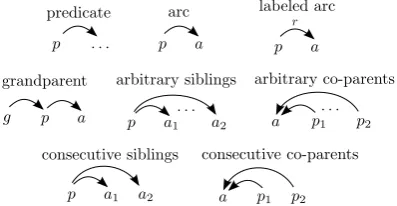
Our choice of parts is given in Figure 2. The sec-ond order parts are inspired by prior work in syn-tactic parsing, modeling interactions for pairs of (unlabeled) dependency arcs, such as grandpar-ents(Carreras, 2007) andsiblings(Smith and Eis-ner, 2008; Martins et al., 2009). The main novelty isco-parentparts, which, to the best of our knowl-edge, were never considered before, as they only make sense when multiple parents are allowed.
If all parts were basic, decoding could be done independently for each predicatep, as illustrated in Algorithm 1. The total runtime, for a sentence with L words, is O(L2|R|), where R is the set of semantic roles. Adding consecutive siblings still permits independent decoding for each pred-icate, but dynamic programming is necessary to decode the best argument frame, increasing the runtime to O(L3|R|). The addition of consec-utive co-parents, grandparents, and arbitrary sib-lings and co-parents breaks this independency and sets a demand for approximate decoding. Even without second-order parts, the inclusion of hard constraints (such as requiring some roles to be unique, see§3) also makes the problem harder.2
Rather than looking for a model in which exact decoding is tractable, which could be even more stringent for parsing semantic graphs than for de-pendency trees, we embrace approximate decod-ing strategies. Namely, our approach is based on
[image:2.595.317.516.63.166.2]2Albeit the dynamic program could still incorporate con-straints for unique roles (by appending a bit-string to the state to mark semantic roles that have been filled), runtime be-comes exponential in the number of unique roles, only being feasible when this number is small.
Figure 2: Parts considered in this paper. The top row illustrate thebasic parts, representing the event that a word is a predicate, or the existence of an arc between a predicate and an argument, even-tually labeled with a semantic role. Our second-order modellooks at some pairs of arcs: arcs bear-ing a grandparent relationship, arguments of the same predicate, predicates sharing the same argu-ment, and consecutive versions of these two.
dual decomposition, a class of optimization tech-niques that tackle the dual of combinatorial prob-lems in a modular and extensible manner (Ko-modakis et al., 2007; Rush et al., 2010). We em-ployalternating directions dual decomposition
(AD3; Martins et al., 2011). Like the subgradi-ent algorithm of Rush et al. (2010), AD3 splits the original problem intolocal subproblems, and seeks an agreement on the overlapping variables. The difference is that the AD3 subproblems have an additional quadratic term to accelerate con-sensus, achieving a faster convergence rate both in theory and in practice (Martins et al., 2012, 2013). For several factors (such as logic factors representing AND, OR and XOR constraints, bud-get constraints, and binary pairwise factors), these quadratic subproblems can be solved efficiently. For dense or structured factors, the quadratic sub-problems can be solved as a sequence of local Viterbi decoding steps, via an active set method (Martins, 2014); this local decoding operation is the same that needs to be performed in the subgra-dient algorithm. We describe these subproblems in detail in the next section.
3 Solving the Subproblems
Predicate and Arc-Factored Parts. We capture all the basic parts with a single component. As stated in§2, local decoding in this component has a runtime ofO(L2|R|), by using Algorithm 1.
same predicate.3 To cope with unique roles, we
add hard constraints of the kind
P
aI(p→r a∈y)≤1, ∀p,∀r ∈Runiq, (2)
whereRuniqis the set of unique roles. This set is obtained from the training data by looking at the roles that never occur multiple times in the gold argument frames.4 The constraint above
corre-sponds to a ATMOSTONEfactor, which is built-in in AD3 and can be decoded in linear time (ren-dering the runtimeO(L2|Runiq|) when aggregat-ing all such factors). These have also been used by Das et al. (2012) in frame-semantic parsing.
Grandparents, Arbitrary Siblings and Co-parents. The second-order parts in the middle row of Figure 2 all involve the simultaneous inclu-sion of a pair of arcs, without further dependency on the remaining arcs. We handle each of these parts using a simple pairwise factor (called PAIR in the AD3 toolkit). The total runtime to locally decode these factors isO(L3).
Predicate Automata. To handle consecutive siblings, we adapt the simple head automaton model (Alshawi, 1996; Smith and Eisner, 2008; Koo et al., 2010) to semantic parsing. We in-troduce one automaton for each predicate p and attachment direction (left or right). We describe right-side predicate automata; their left-side coun-terparts are analogous. Letha0, a1, . . . , ak+1i be the sequence of right modifiers of p, with a0 =
START andak+1 = END. Then, we have the fol-lowing component capturing consecutive siblings:
fCSIB
p,→(p→a1, . . . , p→ak) = Pk+1
j=1σCSIB(p, aj−1, aj). (3)
MaximizingfCSIB
p,→ via dynamic programming has a cost ofO(L2), yieldingO(L3)total runtime.
Argument Automata. For consecutive co-parents, we introduce another automaton which is analogous to the predicate automaton, but where arrows are reversed. Let hp0, p1, . . . , pk+1i be the sequence of right predicates that take a as argument (the left-side case is analagous), with
p0 =STARTandpk+1=END. We define:
fCCP
a,←(a←p1, . . . , a←pk) = Pk+1
j=1σCCP(a, pj−1, pj). (4) 3Such roles have been called “deterministic” by Flanigan et al. (2014).
4For PAS, all 43roles were found unique; forDM, this number is40out of52, and forPCEDTonly3out of69.
The total runtime is alsoO(L3).
4 Features
We define binary features for each part represented in Figure 2. Most of the features are taken from
TurboParser (Martins et al., 2013), while others are inspired by the semantic parser of Johansson and Nugues (2008). Those features marked with† require information from the dependency syntactic parser, and are only used in the open track.5
Predicate Features. Our predicate features are:
• PREDWORD, PREDLEMMA, PREDPOS. Lexi-cal form, lemma, and POS tag of the predicate.
• PREDREL.† Syntactic dependency relation be-tween the predicate and its head.
• PREDHEADWORD/POS.† Form and POS tag of the predicate syntactic head, conjoined with the predicate word and POS tag.
• PREDMODWORD/POS/REL.†Form, POS tag, and dependency relation of the predicate syn-tactic dependents, conjoined with the predicate word and POS tag.
Arc Features. All features above, plus the fol-lowing (conjoined with arc direction and label):
• ARGWORD, ARGLEMMA, ARGPOS. The lex-ical form, lemma, and POS tag of the argument.
• ARGREL.† Syntactic dependency relation be-tween the argument and its head.
• LEFTWORD/POS,† RIGHTWORD/POS.† Form/POS tag of the leftmost/rightmost de-pendent of the argument, conjoined with the predicate word and POS tag.
• LEFTSIBWORD/POS,†RIGHTSIBWORD/POS.† Form/POS tag of the left/right sibling of the argument, conjoined with the predicate tag.
• PREDCONTEXTWORD, PREDCONTEXTPOS, PREDCONTEXTLEMMA. Word, POS, and lemma on the left and right context of the pred-icate (context size is2).
• PREDCONTEXTPOSBIGRAM/TRIGRAM. Bi-gram and triBi-gram of POS tags on the left and right side of the predicate.
• PREDVOICE.† Predicate voice: active, passive, or none. Determined from the syntactic depen-dency tree as in Johansson and Nugues (2008).
• PREDWORDARGWORD, PREDWORDARG -POS, PREDPOSARGWORD, PREDPOSARG -POS. Predicate word/tag conjoined with argument word/tag.
• PREDARGPOSCONTEXT. Several features conjoining the POS of words surrounding the predicate and argument (similar to the contex-tual features in McDonald et al. (2005)).
• EXACTARCLENGTH, BINNEDARCLENGTH. Exact and binned arc length (distance between predicate and argument), conjoined with the predicate and argument POS tags.
• POSINBETWEEN, WORDINBETWEEN. POS and forms between the predicate and argument, conjoined with their own POS tags and forms.
• RELPATH,† POSPATH.† Path in the syntactic dependency tree between the predicate and the argument. The path is formed either by depen-dency relations or by POS tags.
Second Order Features. These involve a pred-icate, an argument, and a “companion word” (which can be a second argument, in the case of siblings, a second predicate, for co-parents, or the argument of another argument, for grandparents). In all cases, features are of the following kind:
• POSTRIPLET. POS tags of the predicate, the argument, and the companion word.
• UNILEXICAL. One word form (for the predi-cate/argument/companion) and two POS tags.
• BILEXICAL. One POS tag (for the predi-cate/argument/companion) and two word forms.
• PAIRWISE. Backed-off pair features for the companion word form/POS tag and the word form/POS of the predicate/argument.
5 Experimental Results
All models were trained by running 10 epochs of max-loss MIRA withC = 0.01(Crammer et al., 2006). The cost function takes into account mis-matches between predicted and gold dependen-cies, with a cost cP on labeled arcs incorrectly
predicted (false positives) and a cost cR on gold
labeled arcs that were missed (false negatives). These values were set through cross-validation in the dev set, yieldingcP = 0.4andcR= 0.6in all
runs, except for theDMandPCEDTdatasets in the closed track, for whichcP = 0.3andcR= 0.7.
To speed up decoding, we discard arcs whose posterior probability is below10−4, according to a probabilistic unlabeled first-order pruner. Table 1 shows a significant reduction of the search space with a very small drop in recall.
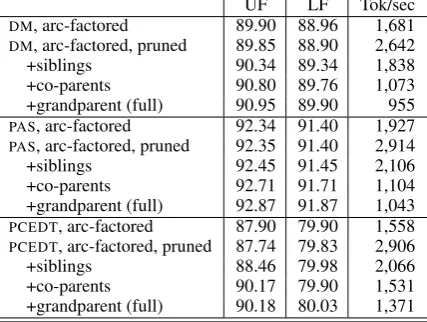
Table 2 shows our final results in the test set, for a model trained in the train and development partitions. Our system achieved the best score in the open track (an LF score of 86.27%, averaged overDM,PAS, andPCEDT), and the second best in the closed track, after the Peking team. Overall, we observe that the precision and recall inPCEDT are far below the other two formalisms, but this difference is much smaller when looking at unla-beled scores. Comparing the results in the closed and open tracks, we observe a consistent improve-ment in the three formalisms of around 1% inF1 from using syntactic information. While this con-firms previous findings that syntactic features are important in semantic role labeling (Toutanova et al., 2005; Johansson and Nugues, 2008), these im-provements are less striking than expected. We conjecture this is due to the fact that our model in the closed track already incorporates a variety of contextual features which are nearly as informa-tive as those extracted from the dependency trees. Finally, to assess the importance of the second order features, Table 3 reports experiments in the dev-set that progressively add several groups of features, along with runtimes. We can see that siblings, co-parents, and grandparents all provide valuable information that improves the final scores (with the exception of the PCEDT labeled scores, where the difference is negligible). This comes at only a small cost in terms of runtime, which is around 1,000 tokens per second for the full mod-els.
UR # UA/tok LR # LA/tok DM 99.33 3.5 (13.4%) 99.22 34.4 (2.5%) PAS 99.53 3.3 (12.5%) 99.49 20.8 (1.9%) PCEDT 99.03 2.1 (8.2%) 98.77 54.5 (3.0%)
UP UR UF LP LR LF
DM, closed 90.14 88.65 89.39 88.82 87.35 88.08 PAS, closed 93.18 91.12 92.14 91.95 89.92 90.93
PCEDT, closed 90.21 85.51 87.80 78.80 74.70 76.70
average, closed – – 89.77 – – 85.24
DM, open 91.41 89.26 90.32 90.23 88.11 89.16
PAS, open 93.62 92.01 92.81 92.56 90.97 91.76
PCEDT, open 91.58 86.61 89.03 80.14 75.79 77.90
[image:5.595.72.293.62.156.2]average, open – – 90.72 – – 86.27 Table 2: Submitted results for the closed and open tracks. For comparison, the best-performing sys-tem in the closed track (Peking) obtained averaged UF and LF scores of 91.03% and 85.91%, respec-tively.
UF LF Tok/sec
DM, arc-factored 89.90 88.96 1,681 DM, arc-factored, pruned 89.85 88.90 2,642
+siblings 90.34 89.34 1,838
+co-parents 90.80 89.76 1,073 +grandparent (full) 90.95 89.90 955
PAS, arc-factored 92.34 91.40 1,927
PAS, arc-factored, pruned 92.35 91.40 2,914
+siblings 92.45 91.45 2,106
+co-parents 92.71 91.71 1,104 +grandparent (full) 92.87 91.87 1,043
PCEDT, arc-factored 87.90 79.90 1,558
PCEDT, arc-factored, pruned 87.74 79.83 2,906
+siblings 88.46 79.98 2,066
+co-parents 90.17 79.90 1,531 +grandparent (full) 90.18 80.03 1,371 Table 3: Results in the dev-set for the open track, progressively adding several groups of features, until the full model is obtained. We report un-labeled/labeled F1 and parsing speeds in tokens per second. Our speeds include the time necessary for pruning, evaluating features, and decoding, as measured on a Intel Core i7 processor @3.4 GHz.
6 Conclusions
We have described a system for broad-coverage semantic dependency parsing. Our system, which is inspired by prior work in syntactic parsing, im-plements a linear model with second-order fea-tures, being able to model interactions between siblings, grandparents and co-parents. We have shown empirically that second-order features have an impact in the final scores. Approximate de-coding was performed via alternating directions dual decomposition (AD3), yielding fast runtimes of around 1,000 tokens per second.
Acknowledgements
We would like to thank the reviewers for their helpful comments. This work was
par-tially supported by the EU/FEDER programme, QREN/POR Lisboa (Portugal), under the Intelligo project (contract 2012/24803) and by a FCT grant PTDC/EEI-SII/2312/2012.
References
Hiyan Alshawi. 1996. Head automata and bilingual tiling: Translation with minimal representations. In Proc. of Annual Meeting of the Association for Com-putational Linguistics, pages 167–176.
Bernd Bohnet and Joakim Nivre. 2012. A transition-based system for joint part-of-speech tagging and la-beled non-projective dependency parsing. InProc. of the Empirical Methods in Natural Language Pro-cessing, pages 1455–1465.
Xavier Carreras. 2007. Experiments with a higher-order projective dependency parser. InInternational Conference on Natural Language Learning, pages 957–961.
Koby Crammer, Ofer Dekel, Joseph Keshet, Shai Shalev-Shwartz, and Yoram Singer. 2006. On-line Passive-Aggressive Algorithms. Journal of Ma-chine Learning Research, 7:551–585.
Dipanjan Das, Andr´e F. T. Martins, and Noah A. Smith. 2012. An Exact Dual Decomposition Algorithm for Shallow Semantic Parsing with Constraints. In Proc. of First Joint Conference on Lexical and Com-putational Semantics (*SEM), pages 209–217.
Jeffrey Flanigan, Sam Thomson, Jaime Carbonell, Chris Dyer, and Noah A. Smith. 2014. A discrim-inative graph-based parser for the abstract mean-ing representation. In Proc. of the Annual Meet-ing of the Association for Computational LMeet-inguis- Linguis-tics, pages 1426–1436.
Richard Johansson and Pierre Nugues. 2008. Dependency-based syntactic–semantic analysis with PropBank and NomBank. International Conference on Natural Language Learning, pages 183–187.
Nikos Komodakis, Nikos Paragios, and Georgios Tzir-itas. 2007. MRF optimization via dual decompo-sition: Message-passing revisited. In Proc. of In-ternational Conference on Computer Vision, pages 1–8.
Terry Koo and Michael Collins. 2010. Efficient third-order dependency parsers. InProc. of Annual Meet-ing of the Association for Computational LMeet-inguis- Linguis-tics, pages 1–11.
[image:5.595.75.289.246.407.2]Sandra K¨ubler, Ryan McDonald, and Joakim Nivre. 2009. Dependency parsing. Morgan & Claypool Publishers.
Andr´e F. T. Martins, Noah A. Smith, and Eric P. Xing. 2009. Concise Integer Linear Programming Formu-lations for Dependency Parsing. InProc. of Annual Meeting of the Association for Computational Lin-guistics, pages 342–350.
Andr´e F. T. Martins, Noah A. Smith, Eric P. Xing, Pedro M. Q. Aguiar, and M´ario A. T. Figueiredo. 2010. Turbo Parsers: Dependency Parsing by Ap-proximate Variational Inference. In Proc. of Em-pirical Methods for Natural Language Processing, pages 34–44.
Andr´e F. T. Martins, Noah A. Smith, Pedro M. Q. Aguiar, and M´ario A. T. Figueiredo. 2011. Dual De-composition with Many Overlapping Components. InProc. of Empirical Methods for Natural Language Processing, pages 238–249.
Andr´e F. T. Martins, M´ario A. T. Figueiredo, Pedro M. Q. Aguiar, Noah A. Smith, and Eric P. Xing. 2012. Alternating directions dual decomposition. Arxiv preprint arXiv:1212.6550.
Andr´e F. T. Martins, Miguel B. Almeida, and Noah A. Smith. 2013. Turning on the turbo: Fast third-order non-projective turbo parsers. InProc. of the Annual Meeting of the Association for Computational Lin-guistics, pages 617–622.
Andr´e F. T. Martins. 2014. AD3: A Fast Decoder
for Structured Prediction. In S. Nowozin, P. Gehler, J. Jancsary, and C. Lampert, editors, Advanced Structured Prediction. MIT Press, Cambridge, MA, USA.
Ryan McDonald, Koby Crammer, and Fernando Pereira. 2005. Online large-margin training of de-pendency parsers. InProc. of Annual Meeting of the Association for Computational Linguistics, pages 91–98.
Ryan McDonald, Kevin Lerman, and Fernando Pereira. 2006. Multilingual dependency analysis with a two-stage discriminative parser. InProc. of International Conference on Natural Language Learning, pages 216–220.
Alexander M. Rush, David Sontag, Michael Collins, and Tommi Jaakkola. 2010. On dual decomposi-tion and linear programming relaxadecomposi-tions for natural language processing. InProc. of Empirical Methods for Natural Language Processing.
David A. Smith and Jason Eisner. 2008. Dependency parsing by belief propagation. InProc. of Empirical Methods for Natural Language Processing, pages 145–156.