Sentence Alignment using Unfolding Recursive Autoencoders
Jeenu Grover
IIT Kharagpur India - 721302
Pabitra Mitra
IIT Kharagpur India - 721302
Abstract
In this paper, we propose a novel two step algorithm for sentence alignment in mono-lingual corpora using Unfolding Recursive Autoencoders. First, we useunfolding re-cursive auto-encoders(RAE) to learn fea-ture vectors for phrases in syntactical tree of the sentence. To compare two sentences we use a similarity matrix which has di-mensions proportional to the size of the two sentences. Since the similarity matrix generated to compare two sentences has varying dimension due to different sen-tence lengths, a dynamic pooling layer is used to map it to a matrix of fixed dimen-sion. The resulting matrix is used to calcu-late the similarity scores between the two sentences. The second step of the algo-rithm captures the contexts in which the sentences occur in the document by us-ing a dynamic programmus-ing algorithm for global alignment.
1 Introduction
Neural Network based architectures are increas-ingly being used for capturing the semantics of the Natural Language (Pennington et al., 2014). We put them to use for alignment of the sentences in monolingual corpora. Sentence alignment can be formally defined as a mapping of sentences from one document to other such that a sentence pair be-longs to the mapping iff both the sentences convey the same semantics in their respective texts. The mapping can be many-to-many as a sentence(s) in one document could be split into multiple sen-tences in the other to convey same information. It is to be noted that this task is different form para-phrase identification because here we are not just considering the similarity between two individual
sentences but we are also considering the context in a sense that we are making use of the order in which the sentences occur in documents.
Text alignment in Machine Translation (MT) tasks varies a lot from sentence alignment in monolingual corpora as MT tasks deal with bilin-gual corpora which exhibits a very strong level of alignment. But two comparable documents in monolingual corpora, such as two articles writ-ten about a common entity or two newspaper re-ports about an event, use widely divergent forms to express same information content. They may contain paraphrases, alternate wording, change of sentence and paragraph order etc. As a result, the surface-based techniques which rely on compar-ing the sentence lengths, sentence ordercompar-ing etc. are less likely to be useful for monolingual sen-tence alignment as opposed to their effectiveness in alignment of bilingual corpora.
Sentence alignment finds its use in applica-tions such as plagiarism detection(Clough et al.,
2002), information retrieval and question answer-ing(Marsi and Krahmer,2005). It can also be used to generate training set data for tasks such as text summarization.
2 Related Work
A lot of work has been done on the problem of sen-tence alignment which relies on the surface prop-erties of the text in natural language such as word overlap(Hatzivassiloglou et al.,2001;Barzilay and Elhadad,2003), bag-of-words model(Nelken and Shieber,2006). It relies mainly in the field of sta-tistical machine learning (Barzilay and Elhadad,
2003). A little has been done to improve upon this task by capturing the semantics of the text.
Barzilay and Elhadad show that a similarity measure combined with contextual information outperforms methods based on sentence
ity functions. Nelken and Shieberimproved upon the sentence similarity function by borrowing TF-IDF based scoring from the information retrieval literature and outperformed all other methods.
Their work can be summarized in 4 steps: 1. TF*IDF : Treat each sentence as a document
and compute it’s TF*IDF vector. For a word
tin sentence1 s,T Fs(t)denotes the number of times t occurs ins, Nis the number of sentences in document andDF(t) indicates the occurrences of t in document.
ws(t) =T fs(t)×logDFN(t) (1)
wherews(t), denotes the value for dimension corresponding to wordtin TF-IDF vector of sentences.
2. The previous step gave the similarity mea-sure of 2 sentences. It was converted to an appropriate probability measure denoting the
P r(align(si, sj) = 1)by using logistic re-gression on the training data.
3. Heuristic Alignment : They simply choose sentence pairs between two documents with
pr(align) > th,where th is the threshold. Additionally heuristics such as mapping the first sentences of two documents (as justified by Quirk et al.(Dolan et al., 2004) ) and al-lowing 2-to-1 mapping of adjacent sentences are followed.
4. Global Alignment with Dynamic Program-ming: They compute the optimal alignment between sentences 1..i of one text and sen-tences 1..j of the elementary version by using a dynamic programming approach similar to
Needleman and Wunsch(1970). 3 Approach
In this section, we briefly visit the neural network models and other techniques that would be used in our task.
3.1 Neural Embeddings
The idea of using neural embeddings is to getn -dimensional space representations for the words in vocabularyV. We define a mapping
Lw :V→Rn (2)
1We are using terms ”word” and ”sentence” in their literal
sense and not according to the TF-IDF terminology.
which embeds words into a semantic vector space where the metric approximates semantic similar-ity. The idea of neural embeddings was first in-troduced by Bengio et al.(2003) and later worked upon byTurian et al.(2010). Mikolov et al.(2013) points that the words with similar meaning are mapped closer in this new feature space. The di-rections in the vector space correspond to different semantic concepts.
Turian et al.(2010) gave us an encoding from a given word to a vector in the semantic space. Now, we want to have an embedding from a sentence to a vector in the semantic space, i.e. given,
Lw:V→Rn (3) we want to get,
Ls:V∗ →Rn (4) To get such a mapping, we use autoencoders re-cursively on the parse tree representation of the sentence. Each node in the parse tree represents a vector of dimensionncorresponding to that word or phrase in the sentence.
3.2 Unfolding Recursive Autoencoders with Dynamic Pooling
Socher et al.(2011) first used Unfolding Recursive Autoencoders with dynamic pooling for the pur-pose of paraphrase identification. We would be using their method in our paper for sentence align-ment. We learn the embeddings of all the phrases in the parse tree of the sentences using unfolding RAE. For a given sentence withNwords, we have total 2N−1 nodes in the parse tree of the sen-tence,Nfor the words andN−1for the internal nodes or phrases in the sentence as determined by the parsing of the sentence.
For computing the similarity matrix for two sen-tences, the rows and columns denote the words in their original sentence order. We then add to each row and column the nonterminal nodes of the parse tree in a depth-first and right-to-left order.
For a sentence with N words, and with word embeddingsx1:N and RAE encoding for phrases
y1:N−1, form
s= [x1, ..., xN, y1, ..., yN−1] (5) For two sentences(s1, s2), the similarity matrix
S contains the Euclidean distance between (s1)i and(s2)j.
For sentences1 of size n and sentence s2 of size m, the matrix has dimension(2n−1)×(2m−1). Since the resulting similarity matrix has dimen-sion which depends on the lengths of the given sentences, we would use dynamic pooling to con-vert it into a matrix of fixed dimension.
We would be using dynamic min-pooling to convert the variable sized matrix into a matrix of sizenp × np. AsSocher et al.(2011) reported, the best suited size for np is 15. For dynamic pool-ing, we divide each dimension of 2D matrix into
np chunks of
j
len np
k
size, wherelenis the length of dimension. If the lengthlenof any dimension is lesser than np, we duplicate the matrix entries along that dimension tilllenbecomes greater than or equal tonp. If there arelleftover entries where
l=len−np∗
j
len np
k
, we distribute them to the last
lchunks. We do it for both the dimensions.
We are using min-pooling because closer the two phrases are, lesser is the euclidean distance between them. Min-pooling would be able to cap-ture this relationship if there are two phrases in the window which are closer to each other.
3.3 Alignment using similarity scores
The fixed dimension matrix obtained in the pre-vious step was fed to the softmax classifier to get a confidence score about similarity between sen-tences. We would use a dynamic programming algorithm to find the optimum alignment of sen-tences between the documents. This approach re-lies on the document comparability and linearity of sentence ordering in the two documents (albeit weak). We find the maximum optimum alignment between two documents and then backtrack using the alignment matrixM to find the sentences that were aligned. Here, M(i, j) denotes the maxi-mum alignment between sentences1..iof one doc-ument to sentences1..jof the other document and
sim(i, j)denotes the confidence score as given by softmax classifier for similarity between sentences
i and j of the two documents respectively. The
offdiagconstant is used to skip a match between two sentences if the similarity between them is very low. The value ofoffdiagconstant was
cho-sen to be 0.1 for our experiment.
M(i, j) = max
M(i−1, j−1) +sim(i, j) M(i−1, j) +offdiag M(i, j−1) +offdiag
(7)
4 Experiment
We would list below the detailed steps of our ex-periment,
4.1 Unfolding RAE’s training
We used a pre-trained model of RAE’s as given by Socher et al.(2011) which is trained using a subset of 150,000 sentences from the NYT and AP sec-tions of the Gigaword corpus. They used Stanford parser(De Marneffe et al.,2006) to create the parse trees for all sentences. 100-dimensional vectors computed via the unsupervised method of Col-lobert and Weston (Collobert and Weston, 2008) and provided by Turian et al.(Turian et al.,2010) were used. The RAE used had two encoding lay-ers. The size of hidden layer used is 200 units.
4.2 Softmax Classifier
For training the softmax classifier to get the sim-ilarity scores between two sentences, we used the dataset for similar task i.e. Paraphrase Identifica-tion for training as both the tasks are similar when only individual sentences irrespective of their con-text are considered. Microsoft Research para-phrase corpus (MSRPC) consists of 5801 pairs of sentences which have been extracted from news sources on the web, along with human annota-tions indicating whether each pair captures a para-phrase/semantic equivalence relationship.All sen-tences are labeled by two annotators who agreed in 83% of the cases and third annotator resolved the conflicts. A total of 3,900 sentence pairs are labeled as paraphrases. We used the standard split of 70-30 for training and testing.
4.3 Dataset
For testing our algorithm we took articles litera-cynet archives2. It maintains a collection of stories from CNN and CBF5. The material is intended to be used for promoting the literacy. Each story in the archive has an abridged or shorter version. We
took 5 such pairs of stories and their abridged ver-sions leading two 2033 sentence pairs that could potentially be aligned. We manually annotated the dataset to find the ground truth. The alignment di-versity measure (ADM) for two texts, T1, T2, is defined to be:
ADM(T1, T2) = 2×matches(T|T1|+|T2|1, T2) (8)
where matches denote the actual number of aligned sentence pairs between two documents. Intuitively, for closely aligned document pairs, as prevalent in bilingual alignment or MT tasks, one would expect an ADM value close to 1. The aver-age ADM in our dataset is 0.61.
4.4 Algorithm
1. Given two textsT1, T2, we split each into its sentences. For all sentencessi inT1 and for all sentences s0
j in T2, we generate the em-bedding vectors for all the words and phrases in the sentences using unfolding RAE. 2. The similarity matrix S is generated for si
and s0
j by taking Euclidean distance of be-tween all the possible words and phrases of both the sentences as mentioned earlier. 3. Each similarity matrix is converted to fixed
size matrix Spooled by using dynamic Min-pooling and is fed to softmax classifier which assigns the confidence score of the two sen-tences being similar. Now, we have matrixP
for all the sentence pairs inT1 andT2 such that Pi,j represents a measure of similarity betweensiinT1ands0j inT2.
4. Let Mi,j denote the maximum similarity score obtained by aligning the sentencess1:i ofT1 with sentencess01:j ofT2. We then use a dynamic programming algorithm to max-imize this score. We also store the choices made at each step of dynamic programming algorithm and back track to find the optimum sentence alignment.
5. Additionally, we can use heuristics like al-lowing mapping of multiple sentences in the vicinity of the given sentence to the corre-sponding sentence in other document, such as to cover cases of splitting a sentence into sentences or vice-versa. But such cases occur rarely and this step can safely be neglected.
4.5 Results
To evaluate our result, we also implemented the
Nelken and Shieber(2006)’s approach to com-pare their results with our results and get a better idea of our method’s performance. We chose Nelken’s(2006) approach because they have shown that it out performs all other methods. We tested our algorithm on the dataset and found that our approach yielded a precision of 78.84% on a recall of 67.21% giving us an F1-score of 0.7256 . While on the same dataset, Nelken and Shieber’s approach gave 65.95% precision on a re-call of 50.81% and thus an F1-score of 0.5739. Thus, our approach clearly outperforms Neilken and Shieber’s approach. It is to be noted that
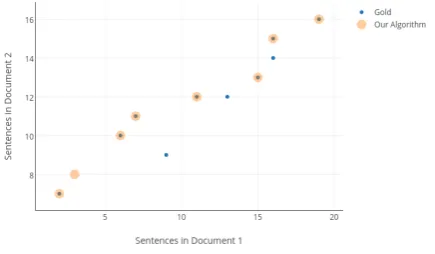
Nelken and Shieberreport an F1-score of 0.6676 at a recall of 0.558, while our implementation of their approach achieved an F1-score of 0.5739 at recall of 0.508. The change in F1-score may be because of the different types of dataset used in the two experiments. Nelken and Shieber had used Britannica encyclopedia and its elementary version containing information about the cities. We have used news reports and their abridged versions which used widely divergent language forms, such as abundant use of change of tense, change of grammatical person, change of writing style etc. which could not be captured by their TF-IDF based similarity. Fig.1shows one instance of alignment of a document pair by our approach vs. the gold alignment.
Approach Precision Recall F1-score RAE+Pool+Align 0.7884 0.6721 0.7256
Nelken’s 0.6595 0.5081 0.5739 Table 1: Results of different approaches on dataset
5 Conclusion
Figure 1: Gold Assignment vs Our Approach on an example. The orange circles with blue dot de-note True Positives, orange circles dede-note False Positives and the blue dots denote False Negatives.
function.
Acknowledgments
We would like to thank all the anonymous review-ers for their valuable feedback.
References
Regina Barzilay and Noemie Elhadad. 2003. Sentence alignment for monolingual comparable corpora. In
Proceedings of the 2003 conference on Empirical methods in natural language processing. Associa-tion for ComputaAssocia-tional Linguistics, pages 25–32. Yoshua Bengio, R´ejean Ducharme, Pascal Vincent, and
Christian Jauvin. 2003. A neural probabilistic lan-guage model. journal of machine learning research
3(Feb):1137–1155.
Paul Clough, Robert Gaizauskas, Scott SL Piao, and Yorick Wilks. 2002. Meter: Measuring text reuse. InProceedings of the 40th Annual Meeting on Asso-ciation for Computational Linguistics. Association for Computational Linguistics, pages 152–159. Ronan Collobert and Jason Weston. 2008. A unified
architecture for natural language processing: Deep neural networks with multitask learning. In Pro-ceedings of the 25th international conference on Machine learning. ACM, pages 160–167.
Marie-Catherine De Marneffe, Bill MacCartney, Christopher D Manning, et al. 2006. Generat-ing typed dependency parses from phrase structure parses. InProceedings of LREC. volume 6, pages 449–454.
Bill Dolan, Chris Quirk, and Chris Brockett. 2004. Unsupervised construction of large paraphrase cor-pora: Exploiting massively parallel news sources. In
Proceedings of the 20th international conference on Computational Linguistics. Association for Compu-tational Linguistics, page 350.
Vasileios Hatzivassiloglou, Judith L Klavans, Melissa L Holcombe, Regina Barzilay, Min-Yen Kan, and Kathleen R McKeown. 2001. Simfinder: A flexible clustering tool for summarization. In
Proceedings of the NAACL workshop on automatic summarization. volume 1.
Erwin Marsi and Emiel Krahmer. 2005. Explorations in sentence fusion. InProceedings of the European Workshop on Natural Language Generation. Cite-seer, pages 109–117.
Tomas Mikolov, Wen-tau Yih, and Geoffrey Zweig. 2013. Linguistic regularities in continuous space word representations. InHLT-NAACL. volume 13, pages 746–751.
Saul B Needleman and Christian D Wunsch. 1970. A general method applicable to the search for simi-larities in the amino acid sequence of two proteins.
Journal of molecular biology48(3):443–453. Rani Nelken and Stuart M Shieber. 2006. Towards
ro-bust context-sensitive sentence alignment for mono-lingual corpora. InEACL.
Jeffrey Pennington, Richard Socher, and Christopher D Manning. 2014. Glove: Global vectors for word representation. InEMNLP. volume 14, pages 1532– 1543.
Richard Socher, Eric H. Huang, Jeffrey Pennington, Andrew Y. Ng, and Christopher D. Manning. 2011. Dynamic Pooling and Unfolding Recursive Autoen-coders for Paraphrase Detection. In Advances in Neural Information Processing Systems 24.