Biomedical Event Extraction using Abstract Meaning Representation
Sudha Rao1,Daniel Marcu2,Kevin Knight2,Hal Daum´e III1 1Computer Science, University of Maryland, College Park, 2Information Sciences Institute, University of Southern California [email protected], [email protected], [email protected], [email protected]
Abstract
We propose a novel, Abstract Meaning Representation (AMR) based approach to identifying molecular events/interactions in biomedical text. Our key contributions are: (1) an empirical validation of our hy-pothesis that an event is a subgraph of the AMR graph, (2) a neural network-based model that identifies such an event sub-graph given an AMR, and (3) a distant su-pervision based approach to gather addi-tional training data. We evaluate our ap-proach on the 2013 Genia Event Extrac-tion dataset1 (Kim et al., 2013) and show promising results.
1 Introduction
For several years now, the biomedical community has been working towards the goal of creating a curated knowledge base of biomolecule entity in-teractions. The scientific literature in the biomed-ical domain runs to millions of articles and is an excellent source of such information. However, automatically extracting information from text is a challenge because natural language allows us to express the same information in several differ-ent ways. The series of Genia Evdiffer-ent Extraction shared tasks (Kim et al.,2009,2011,2013,2016) has resulted in various significant approaches to biomolecule event extraction spanning methods that use learnt patterns from annotated text (Bui et al.,2013) to machine learning methods (Bj¨orne and Salakoski,2013) that use syntactic parses as features. In this work, we find that a semantic analysis of text that relies on Abstract Meaning Representations (Banarescu et al.,2013) is highly useful because it normalizes many lexical and syn-tactic variations in text.
[image:1.595.307.537.222.354.2]1This dataset is different from BioNLP 2016 GE dataset
Figure 1: AMR with sample event annotations for sentence “This LPA-induced rapid phosphoryla-tion of radixin was significantly suppressed in the presence of C3 toxin, a potent inhibitor of Rho”
AMR is a rooted, directed acyclic graph (DAG) that captures the notion ofwho did what to whom
in text, in a way that sentences that have the same basic meaning often have the same AMR. The nodes in the graph (also called concepts) map to words in the sentence and the edges map to re-lations between the words. In the recent past, there have been several efforts towards parsing a sentence into its AMR (Flanigan et al., 2014; Wang et al.,2015;Pust et al.,2015;May,2016). AMR naturally captures hierarchical relations be-tween entities in text making it favorable for com-plex event detection. For example, consider the following sentence from the biomedical litera-ture:“This LPA-induced rapid phosphorylation of radixin was significantly suppressed in the pres-ence of C3 toxin, a potent inhibitor of Rho”. Fig-ure1shows its Abstract Meaning Representation (AMR). The subgraph rooted at phosphorylate-01 identifies the eventE1 and the subgraph rooted at induce-01 identifies the eventE2where
E1 =phosphorylation of radixin; E2 =LPA inducesE1.
We hypothesize that an event structure is a
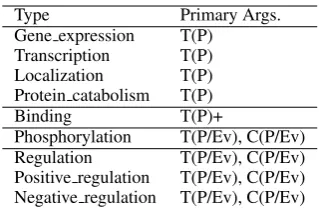
Type Primary Args. Gene expression T(P)
Transcription T(P) Localization T(P) Protein catabolism T(P)
Binding T(P)+
Phosphorylation T(P/Ev), C(P/Ev) Regulation T(P/Ev), C(P/Ev) Positive regulation T(P/Ev), C(P/Ev) Negative regulation T(P/Ev), C(P/Ev)
Table 1: Event types and their arguments in the 2013 Genia Event Extraction task
graph of a DAG structure like AMR and under this assumption, we cast the event extraction task as a graph identification problem. Our first con-tribution is the testing of the above hypothesis that an event structure is a subgraph of an AMR graph. Given a sentence, we automatically obtain its AMR using an AMR parser (Pust et al.,2015) and explain how an event can be defined as a sub-graph of the AMR sub-graph. Under the assumption that we can correctly identify such an event sub-graph from an AMR sub-graph when it exists, we eval-uate how good is our definition (Section 2).
Oursecond contributionis a supervised neural network-based model that is trained to identify an event subgraph given an AMR (Section 3). Our model is built on the intuition that the path be-tween an interaction term and an entity term in an AMR graph contains important signal for identify-ing the relation between them. For e.g. in figure1 the path{‘induce-01’, ‘arg0’, ‘LPA’}suggests that
LPAis the cause ofinduce. We encode this path using word embeddings pre-trained on millions of biomedical text and develop two pipelined neural network models: (a) to identify the theme of an
interaction; and (b) to identify thecauseof the in-teraction, if there exists one.
Experimental results show that our model, al-though achieves a reasonable precision, suffers from low recall. Ourthird contributionis a dis-tant supervision (Mintz et al., 2009) based ap-proach to collect additional annotated training data. Distant supervision works on the assump-tion that given a known relaassump-tion between two enti-ties, a sentence containing the two entities is likely to express this relation and hence can serve as training data for that relation. Data gathered us-ing such a method can be noisy (Takamatsu et al., 2012). Roth et al.(2013) have discussed several prior work that address this issue. In our work, we introduce a method based on AMR path heuristic
This LPA-induced rapid phosphorylation of radixin was sig-nificantly suppressed in the presence of C3 toxin, a potent inhibitor of Rho
T1 (Protein, LPA) T2 (Protein, radixin) T2 (Protein, C3) T4 (Protein, Rho)
T5 (Phosphorylation, phosphorylate) T6 (Positive regulation, induce) T7 (Negative regulation, suppress) T8 (Negative regulation, inhibit) E1 (Type: T5, Theme: T2)
E2 (Type: T6, Theme: E1, Cause: T1) E3 (Type: T7, Theme: E1)
[image:2.595.101.261.60.165.2]E4 (Type: T8, Theme: T4, Cause: T3) Table 2: Example event annotation. The protein anno-tations T1- T4 are given as starting points. The task is to identify the events E1-E4 with their interaction type and ar-guments.
to selectively sample the sentences we obtain us-ing distant supervision (Section3) and show its ef-fectiveness over our vanilla neural network model. We evaluate our event extraction model on the 2013 Genia Event Extraction dataset and show that our model achieves promising results when compared to the state-of-the-art system. Given that AMR parsing is still a young field, our model, which currently uses a parser of 67% ac-curacy, would perform better with improved AMR parsers.
2 AMR based event extraction model
2.1 Task description
The biomedical event extraction task in this work is adopted from the Genia Event Extraction sub-task of the well-known BioNLP shared sub-task ((Kim et al., 2009), (Kim et al., 2011), (Kim et al., 2013)). Table2shows a sample event annotation for the sentence in Figure 1. The protein anno-tations T1- T4 are given as starting points. The task is to identify the events E1-E4 with their inter-action type and arguments. Table1describes the various event types and the arguments they accept. The first four event types require only unary theme argument. The binding event can take a variable number of theme arguments. The last four events take a theme argument and, when expressed, also a cause argument. Their theme or cause may in turn be another event, creating a nested event (For e.g. event E2 in Table2).
2.2 Model description
[image:2.595.313.520.85.228.2]first obtain its AMR graph automatically using an AMR parser (Pust et al.,2015). Next, we identify protein nodes and interaction nodes in the graph.
Protein Node Identification:In both the training and the test set, protein terms are pre-annotated (e.g. T1toT4in Table2). We then use the AMR graph alignment information to identify nodes in the AMR graph aligned to these protein terms to get our protein nodesP.
Interaction Node Identification: In the training data, interaction terms are pre-annotated (e.g. T5
to T8 in Table 2). To identify the interaction terms in the test set we use the following heuristic: any term that was annotated as an interaction term more than once in the training data is considered as an interaction term in the test data as well. We then use the AMR graph alignment information to identify nodes in the AMR graph aligned to the in-teraction terms to get our inin-teraction nodesT. Given P andT, we identify an event sub-graph using the following two-step process:
a. Theme Identification: Every pair (pi, tj)
wherepi ∈ P andtj ∈ T, is a candidate for an
event em defined as em: (Type: tj, Theme: pi)
where Typeis one of the nine event types in Ta-ble 1. If em can take other events as arguments
(last four event types in Table1) and if the short-est path betweentj andpi includes an interaction
term tk, such that the pair(pi, tk) is an eventen
in itself, then we define the event em instead as
em: (Type: tj,Theme: en). For e.g. in Figure1,
the path between induce-01 andradixin includes
phosphorylate-01which is an event in itself (E1). Hence eventE2is defined withE1as its theme (in Table2).
b. Cause Identification: For events em: (Type:
tj: Theme: pi) that can take a cause argument, we identify possible candidates for their cause by again looking for all pairs(pl, tj) wherepl ∈ P
andl 6= iand add cause to the event em asem: (Type: tj, Theme: pi, Cause: pl). Since these
events can even take other events as their cause argument, we identify additional candidates for their cause by looking for all pairs(en, tj)where
en∈E andn6=mand add cause to the eventem
asem: (Type:tj, Theme:pi, Cause:en).
2.3 Upper bound using“event is a subgraph of AMR”hypothesis
Before we learn to identify event sub-graphs from an AMR graph, we first calculate the upper bound
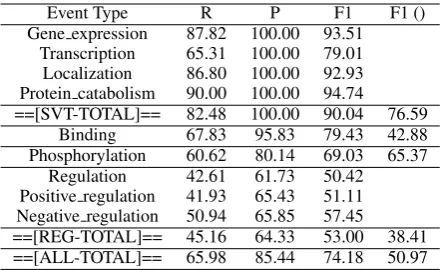
Event Type R P F1 F1 ()
Gene expression 87.82 100.00 93.51 Transcription 65.31 100.00 79.01 Localization 86.80 100.00 92.93 Protein catabolism 90.00 100.00 94.74 ==[SVT-TOTAL]== 82.48 100.00 90.04 76.59
Binding 67.83 95.83 79.43 42.88 Phosphorylation 60.62 80.14 69.03 65.37
Regulation 42.61 61.73 50.42 Positive regulation 41.93 65.43 51.11 Negative regulation 50.94 65.85 57.45 ==[REG-TOTAL]== 45.16 64.33 53.00 38.41 ==[ALL-TOTAL]== 65.98 85.44 74.18 50.97
Table 3: Upper bound on the dev set using our
“event is a subgraph of AMR”hypothesis
that we are setting for our model because we are using an AMR parser instead of obtaining gold AMRs. For calculating this upper bound, we first obtain the AMR graph of a sentence using the AMR parser and then assume that if an event is a sub-graph of this AMR graph then we can iden-tify it correctly. Table 3 shows the upper bound we get on the dev set of the 2013 Genia Event Ex-traction dataset (described in Section 5.1). The last column in the table is the state-of-the-art F1 score obtained by the system EVEX (Hakala et al., 2013) on the test set of the dataset2.
In case of simple events i.e. events that take only proteins as theme arguments, an event is al-ways a subgraph of the AMR unless there is an alignment error causing the protein node or the interaction node to be missing. Hence the upper bound on our precision is 100% whereas the up-per bound on our recall is 82.48% for these simple events. In case of the other event types where an event can take other events as arguments, an event is correctly identified only if the path between the pair(pi, tj)in the AMR graph includes all its
sub-events. Therefore we lose more on the precision and recall in these cases due to AMR parsing er-rors bringing our overall upper bound on precision down to 85.44% and our overall upper bound on recall down to 65.98%. These results give us fol-lowing two important insights:
1. By using this hypothesis we have set an upper bound of 74.18% F1-score for our learning model.
2. As the accuracy of automatic AMR parsers improve, our model will perform better at the event extraction task.
[image:3.595.307.528.62.197.2]3 LSTM based learning model
In this section we will describe our model that learns to identify an event sub-graph from an AMR graph. The key idea is that the path between the interaction node and the entity node (where the term entity is used to denote both a protein and a sub-event) contains information about how the event is structured. We build on this idea to de-velop a supervised model using Long Short Term Memory (LSTM) (Hochreiter and Schmidhuber, 1997) architecture that can learn to identify events using the nodes and the edges in the AMR path between the interaction term and the entity term.
3.1 Motivation
The input to our problem is a sequence of words (wi) interwound with edge labels (ej) of the form:
w1, e1, w2, e2, ..., en−1, wn that exists in the path
between an interaction node and an entity node in an AMR graph. Due to large semantic varia-tions that exist in naturally occurring texts, tradi-tional feature based methods suffer from sparsity issues while learning from such a sequence. Neu-ral network based models provide a framework for learning from non-sparse representations. Specifi-cally, LSTM is known to handle sequences of vari-able length and capture long range dependencies well. Since the input sequence in our case falls into this category, we build our model using the LSTM framework.
3.2 Event identification
We model the event identification task as a two-step process: Theme Identification and Cause Identification. For simple events, this process in-cludes only theme identification (since they don’t have cause). We describe the two LSTM models corresponding to the two steps as follows:
3.2.1 Theme Identification
Given a pair of interaction node (tj) and protein
node (pi), the task is to identify if there exists
an event with tj as the interaction and pi as the
theme; and if yes, what is the type of the event. We cast this problem as a multi-class classification task with label set asL: {NULL ∪Event types}
[image:4.595.308.535.61.221.2]where Event types correspond to the nine event types described in Table1andNULLcorresponds to no event. We train an LSTM model for this task with the input layer as the embeddings cor-responding to the sequence of words interwound
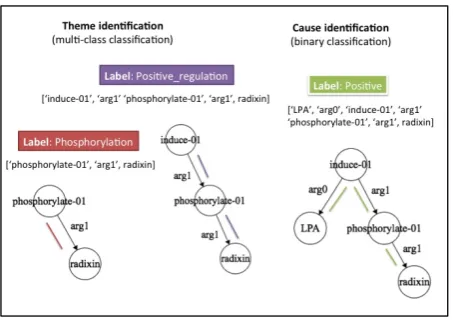
Figure 2: Theme identification and Cause identi-fication stages
with edge labels in the shortest path between pi
andtj in the AMR graph. We use a hidden layer
of size 100 and an output layer of the size of our label set L. For e.g. in Figure 2, the sequence
{‘phosphorylate-01’, ‘arg1’, ‘radixin’} is the in-put sequence and the event typePhosphorylation
is its label.
3.2.2 Cause Identification
The last four event types in Table1 can take pro-teins or other events as cause argument. We cast this problem as a binary classification task where for an event we ask the question if a protein/event is its cause argument or not for every protein and every other event in that sentence. Letem be the
event identified asem : (T ype :tj, T heme : pi)
that can take a cause argument. LetC = P ∪E whereP is the set of all other proteins in the AMR graph (exceptpi) andEis the set of all identified
events (except em). For every ck ∈ C, we get
the shortest path betweenck andtj and combine
it with the shortest path betweenpi andtj and use
the words and edges in this combined path as the input layer of our second LSTM model. We use a hidden layer of size 100 and an output layer of size one corresponding to the binary prediction of whetherckis the cause of the eventemor not.
3.3 Initialization of Embeddings
2008;Socher et al.,2011). We initialize the vec-tors corresponding to words in our input layer with 100-dimensional vectors generated by a word2vec (Mikolov et al., 2013) model trained on over one million words from the PubMed central article repository. Words not included in the pre-trained model and the edges are initialized randomly using uniform sampling from [-0.25, +0.25] to match the embedding standard deviation.
3.4 Event Construction
During test time, we first make predictions us-ing our LSTM model for Theme identification. For every pair (pi, tj) with a non-zero label l,
we construct events as follows: For label l cor-responding to interaction types that take only pro-teins as theme arguments, we construct event as em : (T ype : tj, T heme : pi). For labell
corre-sponding to interaction types that can take another event as its theme, we look at the path between tj andpi in the AMR. If this path includes a pair
(tk, pi) that has a non-zero label, then we construct
an eventen: (T ype:tj, T heme:ep)whereepis
the event constructed from the pair (tk, pi).
Oth-erwise, we construct the event as en : (T ype :
tj, T heme:pi).
For each of the predicted event em : (T ype :
tj : T heme: pi)that can take a cause argument,
we run the second LSTM model for its Cause iden-tification. If there is a pair (pi, ck) which has a
positive label, then we assign ck as the cause of
the eventem.
4 Distant Supervision
An empirical evaluation of our LSTM-based learning model (Section5.4) shows that it can suf-fer from low recall. Obtaining additional human annotated data for our complex event extraction task can be very costly. This motivates us to de-velop an approach that can gather more training data with minimal supervision.
4.1 Motivation
Distant supervision as a learning paradigm was in-troduced byMintz et al.(2009) for relation extrac-tion in general domain. They use Freebase to get a set of relation instances and entity pairs partici-pating in those relations, extract all sentences con-taining those two entity pairs from Wikipedia text and use these sentences as their training data. This work and many others show that distant
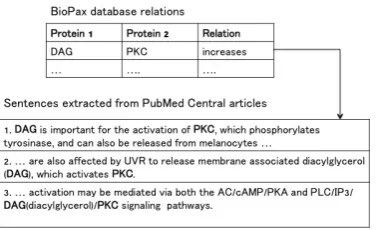
supervi-Figure 3: Distant Supervision: Sentences extracted from PubMed Central articles using BioPax database relations sion technique yields significant improvements in relation extraction. Neural network models like LSTM need to be trained on substantial amounts of training data for them to be able to general-ize well. However due to lack of labeled data in biomedical domain, most work in relation extrac-tion in this domain has been restricted to purely supervised techniques. In this work we cope with this problem by gathering additional training data using distant supervision from a knowledge base.
4.2 Methodology
Relation extraction using distant supervision re-quires two things: 1) A knowledge base contain-ing relations between proteins, and 2) A large cor-pus of unannotated text that contain protein men-tions. We use the BioPax (Biological Pathway Exchange) database (Demir et al., 2010) as our knowledge base of protein relations and we use the PubMed central articles as our unannotated text corpus. Given a database entry of the form (‘Pro-tein1’, ‘Protein2’, ‘relation’), we extract all sen-tences from the PubMed central articles in which the two proteins co-occur. For example, Figure 3shows some sample sentences extracted for the database entry (’DAG’, ’PKC’, increases). The first two sentences in the figure indeed express the relation in the database but the third sentence just mentions the two proteins in a comma sepa-rated list. We observe that a lot of the extracted sentences fall into the category of the third sen-tence. Hence as a first step, we filter such instances by tagging the sentence with their parts-of-speech and removing those in which the two proteins are separated only by nouns (or punctuations).
4.3 AMR Path Based Selection
[image:5.595.328.517.65.180.2]un-Event Type Biopax relation Gene expression adds modification
Transcription adds modification Localization adds modification Protein catabolism adds modification
Binding binds
Phosphorylation adds modification Regulation increases, increases activity Positive regulation increases, increases activity Negative regulation
-Table 4: Mapping between event types and Biopax model relations
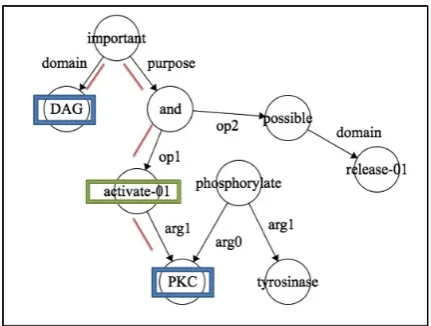
der the assumption that all sentences in which the proteins co-occur express the relation mentioned in the database. HoweverTakamatsu et al.(2012) note that this approach can often lead to a lot of false positives. Roth et al.(2013) have discussed several prior work that try to reduce such noise in the data. In our work, we develop a novel selec-tion technique for reducing such noise using AMR path heuristic. We make the observation that given two protein nodes in an AMR, if there is a relation r between the two then the shortest path between the two protein nodes in the AMR contains the in-teraction term expressing the relationr.
For e.g. Figure 4shows the AMR for the sen-tence “DAG is important for the activation of PKC, which phosphorylates tyrosinase, and can also be released...” that was extracted using the database entry{‘DAG’, ‘PKC’, ‘increases’}. The interaction term‘activate’suggesting the relation ‘increases’ exists in the shortest path between the proteins DAG and PKC. Figure 5 shows AMR for the sentence “The sun-network links TCF3 with ZYX and HOXA9 via NEDD9 and CREBBP, respectively.” extracted for the pair (‘TCF3’, ‘HOXA9’, increases). There is no interaction term suggesting the relation ‘increases’ in the shortest path between the proteinsTCF3andHOXA9.
[image:6.595.81.282.61.162.2]Table4 shows the mapping we define between the event types and the relations found in the en-tries (‘Protein1’, ‘Protein2’, ‘relation’) that we extracted from the Biopax model. In each sentence extracted for the database entry(‘P1’, ‘P2’, ‘r’), we check if the shortest path between the two pro-tein nodesP1 andP2in the AMR of the sentence contains one of the interaction terms correspond-ing to the event type mapped to the relationr. We discard all those sentences that do not satisfy this constraint.
Figure 4: Interaction term‘activate’corresponding to the relation ’increases’ exists in the shortest path betweenDAG andPKC
Figure 5: No interaction term corresponding to the rela-tion ‘increases’ exists in the shortest path betweenTCF3and HOXA9
4.4 Using Data for LSTM Model
We use these selected sentences as additional training data for our two LSTM models as follows:
a. Theme identification: LetS be the sentence extracted for the database entry (‘DAG’, ‘PKC’, ‘increases’)and let‘activates0 be the interaction term that exists in the shortest path between the protein nodes. Since the database entry refers to
‘DAG’ as the cause and ‘PKC’as the theme, we assume these roles for the two proteins in the ex-tracted sentenceSas well. Therefore, we can now use the path between the interaction term ‘acti-vates’and the theme‘PKC’as an input sequence for our model with the label corresponding to the event type of the interaction term’activates’.
[image:6.595.308.524.62.225.2] [image:6.595.307.525.282.421.2]5 Experiments
5.1 Dataset and task setting
The event extraction task described in this work corresponds to the Task 1 of the Genia Event Extraction task described by the BioNLP Shared Task series (2009, 2011 and 2013). We train a model on a combination of abstract collection
(from 2009 edition) andfull text collection(from 2011 and 2013). We test our model on the dev set of the 2013 edition (since the gold annotation is publicly available only for the dev set and not the test set).
5.2 Data prepraration
The dataset made available for the Shared Task is in the form of sentences and event annotations as shown in Table 2. We convert these event annota-tions into input sequences and labels for our multi-class multi-classification task (theme identification) and for our binary classification task (cause identifica-tion) as follows
a. Theme identification: Given a sentence, we define the setT as the set of interaction terms cor-responding to all its event annotations. We de-fine the set P as the set of all its protein men-tions. For every pair (tj, pi) where pi ∈ P and
tj ∈ T, we create a training data of the form {w1, e1, w2, e2, ..., en−1, wn,label}where the
in-put sequence corresponds to the words interwound with edge labels in shortest path betweentjandpi;
and thelabel is the event type of the event em if
there exists an event em : (T ype : tj, T heme :
pi),NULLotherwise. We create the test data
sim-ilarly; except we do not use event annotations for creating the setT but instead identify terms in the sentence that was annotated as an interaction term in the training data more than once.
b. Cause identification: For every pair (tj, pk)
where tj is part of some event annotation em : (T ype : tj, T heme : pi) of event type that can
take cause argument andpk ∈P, we create a
train-ing data of the form{w1, e1, w2, e2, ..., en−1, wn,
label} where the input sequence corresponds to the shortest path between pk and pi via tj; and
the label is 1 if pk is the cause of the event em,
0 otherwise.
5.3 LSTM model setup
We implement our LSTM model using thelasagne
library. For the first LSTM model, we use softmax as our non-linear function and optimize the
cat-egorical cross entropy loss using adam (Kingma and Ba,2014). For the second LSTM model, we use a sigmoid non-linear function and optimize the binary loss using adam. We use a dropout of 0.5, batch size of 100 and a learning rate of 0.001.
5.4 Results and Discussion
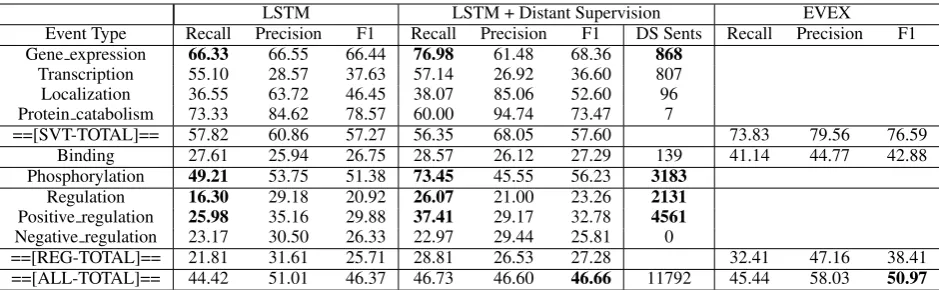
Table 5 shows the results of our LSTM and dis-tant supervision based event extraction model. We compare our results with the state-of-the-art event extraction system EVEX (Hakala et al.,2013). We report the Approximate Span/Approximate Re-cursive metric in all our tables (described in the Shared Task (Kim et al., 2013)). The columns to the left (with column heading LSTM) show the performance of our model trained only on the official training data. The columns to the right (with column heading LSTM+Distant Super-vision) show the performance of our model trained on official training data plus the additional training data of 11792 sentences we gather using our dis-tant supervision strategy.
The table highlights some of our results. Firstly, we note that, in cases where we obtain a large number of extra sentences using distant supervi-sion (highlighted in the column “DS Sents”), we see a considerable gain in the recall values be-tween “LSTM” and “LSTM+Distant Supervision” models. On the contrary, in cases where we ex-tract only a small number, we see a small gain (or sometimes even a decrease in performance). This suggests we explore further ways of selecting our extra sentences. Secondly, although the over-all performance of our model using the automatic AMR parser is lower than the current state-of-the-art system, the gap of 5% in the F1 score can hope-fully be reduced with the ongoing improvements in AMR parsing.
6 Related work
LSTM LSTM + Distant Supervision EVEX Event Type Recall Precision F1 Recall Precision F1 DS Sents Recall Precision F1 Gene expression 66.33 66.55 66.44 76.98 61.48 68.36 868
Transcription 55.10 28.57 37.63 57.14 26.92 36.60 807 Localization 36.55 63.72 46.45 38.07 85.06 52.60 96 Protein catabolism 73.33 84.62 78.57 60.00 94.74 73.47 7
==[SVT-TOTAL]== 57.82 60.86 57.27 56.35 68.05 57.60 73.83 79.56 76.59 Binding 27.61 25.94 26.75 28.57 26.12 27.29 139 41.14 44.77 42.88 Phosphorylation 49.21 53.75 51.38 73.45 45.55 56.23 3183
Regulation 16.30 29.18 20.92 26.07 21.00 23.26 2131
Positive regulation 25.98 35.16 29.88 37.41 29.17 32.78 4561
Negative regulation 23.17 30.50 26.33 22.97 29.44 25.81 0
==[REG-TOTAL]== 21.81 31.61 25.71 28.81 26.53 27.28 32.41 47.16 38.41 ==[ALL-TOTAL]== 44.42 51.01 46.37 46.73 46.60 46.66 11792 45.44 58.03 50.97
Table 5: Evaluation results (Recall/Precision/F1) on the 2013 Genia Event Extraction dev set. LSTM and LSTM + Distant Supervision are our models. The last column corresponds to the results of EVEX (Hakala et al.,2013) model on the 2013 test set. Certain notable numbers are emphasized and discussed under results5.4.
(Liu et al., 2013; MacKinlay et al., 2013) learn subgraph patterns from the event annotations in the training data and cast the event detection as subgraph matching problem. Non-feature based approaches like graph kernels compare syntactic structures directly (Airola et al., 2008; Bunescu et al., 2005). Rule based methods that either use manually crafted rules or generate rules from training data (Cohen et al.,2009;Kaljurand et al., 2009; Kilicoglu and Bergler, 2011; Bui et al., 2013) have obtained high precision on these tasks. In our work, we take inspiration from the Turk Event Extraction System (TEES) (Bj¨orne and Salakoski,2013) (the event extraction system for EVEX) that has consistently been the top per-former in these series of tasks. They represent events using a graph format and break the event extraction task into separate multi-class classifica-tion tasks using SVM as their classifier. In our work we take a step further by making use of a deeper semantic representation as a starting point and identifying subgraphs in the AMR graph.
AMR has been successfully used for deeper se-mantic tasks like entity linking (Pan et al.,2015) and abstractive summarization (Mihalcea et al., 2015). Work byGarg et al.(2015) is the first one to make use of AMR representation for extracting interactions from biomedical text. They use graph kernel methods to answer the binary question of whether a given AMR subgraph expresses an in-teraction or not. Our work departs from theirs in that they concentrate only on binary interactions whereas we use AMR to identify complex nested events. Also, our approach additionally makes use of distant supervision to cope with the problem of
limited annotated data.
Distant supervision techniques have been suc-cessfully used before for relation extraction (Mintz et al., 2009) in general domain. Recent work by (Liu et al., 2014) uses minimal supervi-sion strategy for extracting relations particularly in biomedical texts. Our work departs from theirs in that we introduce a novel AMR path based heuris-tic to selectively sample the sentences obtained from distant supervision.
7 Conclusion
[image:8.595.73.543.62.207.2]References
Antti Airola, Sampo Pyysalo, Jari Bj¨orne, Tapio Pahikkala, Filip Ginter, and Tapio Salakoski. 2008. All-paths graph kernel for protein-protein interac-tion extracinterac-tion with evaluainterac-tion of cross-corpus learn-ing. BMC bioinformatics9(11):1.
Laura Banarescu, Claire Bonial, Shu Cai, Madalina Georgescu, Kira Griffitt, Ulf Hermjakob, Kevin Knight, Philipp Koehn, Martha Palmer, and Nathan Schneider. 2013. Abstract meaning representation
for sembanking. InAssociation for Computational
Linguistics.
Jari Bj¨orne and Tapio Salakoski. 2013. Tees 2.1: Au-tomated annotation scheme learning in the bionlp
2013 shared task. In Proceedings of the BioNLP
Shared Task 2013 Workshop. pages 16–25.
Quoc-Chinh Bui, David Campos, Erik van Mulligen, and Jan Kors. 2013. A fast rule-based approach for
biomedical event extraction. InProceedings of the
BioNLP Shared Task 2013 Workshop. Association for Computational Linguistics, pages 104–108.
Razvan Bunescu, Ruifang Ge, Rohit J Kate, Edward M Marcotte, Raymond J Mooney, Arun K Ramani, and Yuk Wah Wong. 2005. Comparative experiments on learning information extractors for proteins and their interactions. Artificial intelligence in medicine
33(2):139–155.
K Bretonnel Cohen, Karin Verspoor, Helen L Johnson, Chris Roeder, Philip V Ogren, William A Baum-gartner Jr, Elizabeth White, Hannah Tipney, and Lawrence Hunter. 2009. High-precision biologi-cal event extraction with a concept recognizer. In
Proceedings of the Workshop on Current Trends in Biomedical Natural Language Processing: Shared
Task. Association for Computational Linguistics,
pages 50–58.
Ronan Collobert and Jason Weston. 2008. A unified architecture for natural language processing: Deep
neural networks with multitask learning. In
Pro-ceedings of the 25th international conference on Machine learning. ACM, pages 160–167.
Emek Demir, Michael P Cary, Suzanne Paley, Ken Fukuda, Christian Lemer, Imre Vastrik, Guanming Wu, Peter D’Eustachio, Carl Schaefer, Joanne Lu-ciano, et al. 2010. The biopax community
stan-dard for pathway data sharing. Nature
biotechnol-ogy28(9):935–942.
Jeffrey Flanigan, Sam Thomson, Jaime Carbonell, Chris Dyer, and Noah A Smith. 2014. A discrim-inative graph-based parser for the abstract meaning representation. InIn ACL. Citeseer.
Sahil Garg, Aram Galstyan, Ulf Hermjakob, and Daniel Marcu. 2015. Extracting biomolecular inter-actions using semantic parsing of biomedical text.
arXiv preprint arXiv:1512.01587.
Kai Hakala, Sofie Van Landeghem, Tapio Salakoski, Yves Van de Peer, and Filip Ginter. 2013. Evex in st?13: Application of a large-scale text mining resource to event extraction and network
construc-tion. In Proceedings of the BioNLP Shared Task
2013 Workshop. Association for Computational Lin-guistics, pages 26–34.
Sepp Hochreiter and J¨urgen Schmidhuber. 1997.
Long short-term memory. Neural computation
9(8):1735–1780.
Kaarel Kaljurand, Gerold Schneider, and Fabio Ri-naldi. 2009. Uzurich in the bionlp 2009 shared
task. In Proceedings of the Workshop on Current
Trends in Biomedical Natural Language Process-ing: Shared Task. Association for Computational Linguistics, pages 28–36.
Halil Kilicoglu and Sabine Bergler. 2011. Adapting a general semantic interpretation approach to
biologi-cal event extraction. InProceedings of the BioNLP
Shared Task 2011 Workshop. Association for Com-putational Linguistics, pages 173–182.
Jin-Dong Kim, Tomoko Ohta, Sampo Pyysalo, Yoshi-nobu Kano, and Jun’ichi Tsujii. 2009. Overview of bionlp’09 shared task on event extraction. In
Proceedings of the Workshop on Current Trends in Biomedical Natural Language Processing: Shared
Task. Association for Computational Linguistics,
pages 1–9.
Jin-Dong Kim, Yue Wang, Nicola Colic, Seung Han Baek, Yong Hwan Kim, and Min Song. 2016. Refactoring the genia event extraction shared task toward a general framework for ie-driven kb
devel-opment.ACL 2016page 23.
Jin-Dong Kim, Yue Wang, Toshihisa Takagi, and Aki-nori Yonezawa. 2011. Overview of genia event task
in bionlp shared task 2011. In Proceedings of the
BioNLP Shared Task 2011 Workshop. Association for Computational Linguistics, pages 7–15.
Jin-Dong Kim, Yue Wang, and Yamamoto Yasunori. 2013. The genia event extraction shared task, 2013
edition-overview. In Proceedings of the BioNLP
Shared Task 2013 Workshop. Association for Com-putational Linguistics, pages 8–15.
Diederik Kingma and Jimmy Ba. 2014. Adam: A
method for stochastic optimization. arXiv preprint
arXiv:1412.6980.
Haibin Liu, Karin Verspoor, Donald C Comeau, An-drew MacKinlay, and W John Wilbur. 2013. Gen-eralizing an approximate subgraph matching-based system to extract events in molecular biology and
cancer genetics. In Proceedings of the BioNLP
Shared Task 2013 Workshop. pages 76–85.
IEEE International Conference on. IEEE, pages 444–449.
Andrew MacKinlay, David Martinez, Antonio Jimeno Yepes, Haibin Liu, W John Wilbur, and Karin Ver-spoor. 2013. Extracting biomedical events and mod-ifications using subgraph matching with noisy
train-ing data. InProceedings of the BioNLP Shared Task
2013 Workshop. Association for Computational Lin-guistics, Sofia, Bulgaria. pages 35–44.
Jonathan May. 2016. Semeval-2016 task 8:
Mean-ing representation parsMean-ing. Proceedings of SemEval
pages 1063–1073.
Rada Mihalcea, Joyce Yue Chai, and Anoop Sarkar,
editors. 2015. NAACL HLT 2015, The 2015
Con-ference of the North American Chapter of the Asso-ciation for Computational Linguistics: Human Lan-guage Technologies, Denver, Colorado, USA, May 31 - June 5, 2015. The Association for Computa-tional Linguistics.
Tomas Mikolov, Ilya Sutskever, Kai Chen, Greg S Cor-rado, and Jeff Dean. 2013. Distributed representa-tions of words and phrases and their
compositional-ity. InAdvances in neural information processing
systems. pages 3111–3119.
Mike Mintz, Steven Bills, Rion Snow, and Dan Ju-rafsky. 2009. Distant supervision for relation
ex-traction without labeled data. In Proceedings of
the Joint Conference of the 47th Annual Meeting of the ACL and the 4th International Joint Conference on Natural Language Processing of the AFNLP: Volume 2-Volume 2. Association for Computational Linguistics, pages 1003–1011.
Makoto Miwa, Rune Sætre, Jin-Dong Kim, and Jun’ichi Tsujii. 2010. Event extraction with com-plex event classification using rich features. Jour-nal of bioinformatics and computatioJour-nal biology
8(01):131–146.
Makoto Miwa, Paul Thompson, and Sophia
Ana-niadou. 2012. Boosting automatic event
ex-traction from the literature using domain
adapta-tion and coreference resoluadapta-tion. Bioinformatics
28(13):1759–1765.
Xiaoman Pan, Taylor Cassidy, Ulf Hermjakob, Heng
Ji, and Kevin Knight. 2015. Unsupervised
en-tity linking with abstract meaning representation. In (Mihalcea et al., 2015), pages 1130–1139.
http://aclweb.org/anthology/N/N15/N15-1119.pdf. Michael Pust, Ulf Hermjakob, Kevin Knight, Daniel
Marcu, and Jonathan May. 2015. Using syntax-based machine translation to parse english into ab-stract meaning representation. InEMNLP.
Sebastian Riedel and Andrew McCallum. 2011. Ro-bust biomedical event extraction with dual
decom-position and minimal domain adaptation. In
Pro-ceedings of the BioNLP Shared Task 2011
Work-shop. Association for Computational Linguistics,
pages 46–50.
Benjamin Roth, Tassilo Barth, Michael Wiegand, and Dietrich Klakow. 2013. A survey of noise reduction
methods for distant supervision. InProceedings of
the 2013 workshop on Automated knowledge base construction. ACM, pages 73–78.
Richard Socher, Eric H Huang, Jeffrey Pennin, Christo-pher D Manning, and Andrew Y Ng. 2011. Dy-namic pooling and unfolding recursive autoencoders for paraphrase detection. InAdvances in Neural In-formation Processing Systems. pages 801–809. Shingo Takamatsu, Issei Sato, and Hiroshi Nakagawa.
2012. Reducing wrong labels in distant supervi-sion for relation extraction. In Proceedings of the 50th Annual Meeting of the Association for Compu-tational Linguistics: Long Papers-Volume 1. Associ-ation for ComputAssoci-ational Linguistics, pages 721–729. Chuan Wang, Nianwen Xue, Sameer Pradhan, and Sameer Pradhan. 2015. A transition-based
algo-rithm for amr parsing. InHLT-NAACL. pages 366–