Conjunctive Categorial Grammars
Stepan Kuznetsov Steklov Mathematical Institute
Moscow, Russia [email protected]
Alexander Okhotin St. Petersburg State University
St. Petersburg, Russia
Abstract
Basic categorial grammars are enriched with a conjunction operation, and it is proved that the formalism obtained in this way has the same expressive power as con-junctive grammars, that is, context-free grammars enhanced with conjunction. It is also shown that categorial grammars with conjunction can be naturally embed-ded into the Lambek calculus with con-junction and discon-junction operations. This further implies that a certain NP-complete set can be defined in the Lambek calculus with conjunction.
1 Introduction
This paper establishes a connection between two formal grammar models that emerged within two different theories of syntax.
One theory is the immediate constituent anal-ysis, which has its roots in the traditional gram-mar, and was investigated in the early 20th cen-tury by the structural linguists. It reached uni-versal recognition under the name “context-free grammars,” introduced in Chomsky’s early work. In this paradigm, a grammar assigns certain prop-erties to groups of words, such as “noun phrase” (NP), “verb phrase” (VP) or “sentence” (S). These properties are known as syntactic categories, or, in Chomsky’s terminology,nonterminal symbols. Rules of a grammar, such asS → NP VP, show how shorter substrings with known properties can be concatenated to form longer strings belonging to a certain category.
In the other theory, which was discovered by Aj-dukiewicz(1935), further developed byBar-Hillel et al. (1960), and is nowadays known as cate-gorial grammars, syntactic categories are defined in different way. “Noun phrases” are treated as
“the category of phrases equivalent to nouns,” whereas verb phrases are defined as “the cate-gory of phrases, which would form a complete sentence, if a noun, or anything equivalent to a noun, is concatenated on the left,” denoted by NOUN\SENTENCE. A categorial grammar ex-plicitly assigns categories to individual words; and then, by definition, a concatenation of any string of type NOUN with any string of type NOUN\SENTENCE forms a complete sentence. The crucial feature of this approach is that the laws that govern reduction of categories, namely,
A(A\B) toB, and(B / A)A toB, are
univer-sal. In contrast, Chomsky’s context-free formal-ism uses different rules for different categories.
A formal connection between these two models was established by Bar-Hillel et al. (1960), who proved them to be equivalent in power: a language is defined by a context-free grammar if and only if it is defined by a basic categorial grammar (assum-ing languages do not contain the empty str(assum-ing).
More than half a century of research gave birth to many extensions of both basic models. Cate-gorial grammars were the first to get an interest-ing extension: the Lambek calculus, introduced byLambek(1958), augments the model with ad-ditional derivation rules. Later,Pentus(1993) es-tablished that this extended model is still equiva-lent in power to context-free grammars. Pentus’ translation yields a context-free grammar of ex-ponential size with respect to the original Lam-bek grammar. For the special case of unidirec-tional Lambek grammars, which use only one kind of division operators (\, /), but not both,
Kuznetsov (2016), using the ideas of Savateev (2009), presents a polynomial translation into context-free grammars. Other generalizations of categorial grammars include combinatory catego-rial grammars bySteedman(1996), categorial de-pendency grammars by Dekhtyar and Dikovsky
(2008), and others.
Lambek grammars, in their turn, can be gener-alized further. Modern extensions of the Lambek calculus with new operations, such as those con-sidered byCarpenter(1997), Morrill(2011), and Moot and Retor´e (2012), are capable of describ-ing quite sophisticated syntactic phenomena.
From the point of view of modern logic, the Lambek calculus is a substructural logical sys-tem, namely, a non-commutative variation of lin-ear logic, introduced by Girard(1987), see Abr-usci (1990), Yetter (1990). Linear logic offers many logical operations, and some of them can be used in the non-commutative case for extending Lambek grammars.
Morrill (2011) and his collaborators, follow-ing and extendfollow-ing Moortgat (1996), consider a system, based on the Lambek calculus, with dis-continuous connectives, subexponentials for con-trolled linearity, brackets for concon-trolled non-associativity, and many other operations. The use of negation in categorial grammars was considered byBuszkowski(1996). Kanazawa(1992) investi-gated the power of Lambek grammars with con-junction and discon-junction operations that are “addi-tive operations” in terms of linear logic.
Numerous generalized models have also been introduced in the paradigm of immediate con-stituent analysis, as extensions of the context-free formalism. One direction is to extend the form of constituents, that is, sentence fragments to which syntactic categories are being assigned in a gram-mar. The most well-known of these models are the multi-component grammars, introduced by Vijay-Shanker et al.(1987) and bySeki et al.(1991), in-spired by an earlier model byFischer(1968): these grammars define the properties of discontinuous constituents, that is, substrings with a bounded number of gaps. Extensions of another kind aug-ment the model by introducing new logical opera-tors to be used in grammar rules: for instance, con-junctive grammars, featuring a conjunction oper-ation, and Boolean grammars, further equipped with negation, were introduced byOkhotin(2001, 2004). Earlier,Latta and Wall (1993) argued for the relevance of such operations in linguistic de-scriptions. The main results on conjunctive gram-mars indicate that they preserve the practically useful properties of context-free grammars, such as efficient parsing algorithms, while substantially extending their expressive power. The known
re-sults on conjunctive grammars are presented in a fairly recent survey byOkhotin(2013).
A few years ago, Kuznetsov (2013) compared the expressive power of Lambek grammars with conjunction, as considered by Kanazawa (1992), with that of conjunctive grammars. It was proved that a large subclass of conjunctive grammars (namely, conjunctive grammars in Greibach nor-mal form) can be simulated in the Lambek calcu-lus with conjunction, but the exact power of the latter remains undetermined.
This paper makes a fresh attempt at introduc-ing conjunction in categorial grammars. The new model extends basic categorial grammars, rather than Lambek grammars, and for that reason it uses categories and rules of a simpler form than in the earlier model byKanazawa(1992) andKuznetsov (2013). Yet, it is shown that this model can simu-late every conjunctive grammar. A converse sim-ulation is presented as well, which implies the equivalence of the two models.
As compared to the classical equivalence re-sult for context-free grammars and basic catego-rial grammars, the new result requires a more elaborate construction. One particular difficulty is that the normal form theorems for conjunctive grammars are weaker than those for the context-free grammars: in particular, no analogue of the Greibach normal form is known for conjunctive grammars. For this reason, the simulation of conjunctive grammars by the proposed conjunc-tive categorial grammars relies on a different nor-mal form by Okhotin and Reitwießner (2010). This leads to a representation of the whole class of conjunctive grammars, in contrast to the re-sult byKuznetsov(2013), which is valid only for grammars in Greibach normal form.
2 Basic Categorial Grammars and Context-Free Grammars
LetΣ be a finitealphabet of the language being defined. Its elements are called symbols. In lin-guistic descriptions, symbols typically represent words of the language. The set of non-empty strings overΣis denoted byΣ+. Throughout this paper, any subset ofΣ+is alanguage, that is, all languages are assumed to be without the empty string.
The models considered in this paper are derived from two classical formal grammar frameworks: basic categorial grammars and context-free gram-mars.
Basic categorial grammars (BCG) have their roots in the works ofAjdukiewicz (1935). Let Σ be an alphabet. LetPr={p, q, r, . . .}be a finite set of primitive categories, and let s ∈ Pr be a
designatedtarget categoryof all syntactically cor-rect sentences.
The setBCatofbasic categoriesis defined as
follows.
• Every primitive category is a basic category.
• IfA ∈ BCat andp ∈ Pr, then(p\A) ∈
BCatand(A / p)∈BCat.
The definition of a basic categorial grammar is given in terms of logical propositions, which are expressions of the formB(v), whereB ∈ BCat
andv ∈ Σ+. This proposition states that v is a
string of syntactic categoryB.
The language of propositions is indeed very simple: all propositions are atomic, there are no variables and quantifiers (if the syntactic category
B is considered, in the spirit of first-order logic,
as a predicate, then its argument,v, is a constant
term).
A categorial grammar is regarded as a logical calculus for deriving categorial propositions. It includes a finite set of axioms (axiomatic propo-sitions) of the formA(a), whereA ∈ BCatand
a∈Σ, and the following inference rules.
p(u) (p\A)(v)
A(uv)
(A / p)(u) p(v)
A(uv)
The stringwbelongs to the language generated
by the BCG if and only if the propositions(w)is derivable by means of this calculus.
Example 1. The basic categorial grammar with the following axiomatic propositions and withsas
the target category (Pr={s, p, q}) describes the language{bancan|n>0}.
(s / p)(b), p(c), (p / q)(a), (p\q)(a) Another, more well-known formal grammar framework is the phrase-structure formalism, de-fined by Chomsky (1956) and later renamed into
context-free grammars(CFG). In a CFG, there is a fixed finite set of categories N (usually called
“non-terminal symbols”), and one of them is des-ignated as the initial symbolS ∈ N. The
gram-mar is defined by a finite set of rules (or “produc-tions”) of the formA → β, where A ∈ N and
β ∈(Σ∪N)+.
Even though Chomsky’s original definition of context-free grammars was given in terms of string rewriting, it is more convenient—at least in this paper—to present it as a logical derivation similar to the one in categorial grammars. Propositions in the context-free framework are of the formβ(u), whereβ ∈ (Σ∪N)+ andu ∈ Σ+. Intuitively, such a proposition means that u can be derived from β using the rules of the CFG. Axioms of
the calculus of propositions are of the forma(a),
a∈Σ, and the rules of inference are as follows.
β1(u1) β2(u2)
(β1β2)(u1u2) β(v)
A(v) for each ruleA→β
Again, the stringwbelongs to the language gen-erated by this grammar if and only if the proposi-tionS(w)is derivable.
Example 2. The language from Example1is de-scribed by the following CFG.
S →bA A→aAa|c
As usual, “A→aAa|c” is a short-hand notation for two rules,A→aAaandA→c.
There is an important difference between BCGs and CFGs: in BCGs, the linguistic information is stored in the axioms (in other words, it is lexical-ized), while the inference rules are the same for all BCGs. For CFGs, the situation is opposite: ax-ioms are trivial, and all information is kept in the rules. However, these two formalisms are equiva-lent in power.
b(b)
a(a)
c(c)
B(c) a(a)
B(aca) c(a)
a(a)
A(a)
bBcA(bacaca)
b(b)
a(a)
A(a) c(a)
a(a)
c(c)
B(c) a(a)
B(aca)
bAcB(bacaca)
[image:4.595.115.482.66.145.2]S(bacaca)
Figure 1
3 Conjunction in Grammars
In this section, both grammar formalisms are en-riched with a conjunction operation. Using junction, one can impose multiple syntactic con-straints on the same phrase at the same time. The extension of context-free grammars with conjunc-tion, calledconjunctive grammars,was introduced byOkhotin(2001).
Let Σbe the alphabet, and letN be the set of
categories (“non-terminal symbols”), withS ∈N
representing all well-formed sentences. A con-junctive grammar is defined by a finite set of rules of the formA → β1&. . .&βk, withβi ∈ (Σ∪
N)+. Ifkis1, then this is an ordinary ruleA→β,
as in an ordinary context-free grammar.
Propositions in a conjunctive grammar are of the formβ(u), whereu∈Σ+andβ∈(Σ∪N)+. Axioms of the calculus of propositions are of the forma(a), wherea∈ Σ. The first inference rule is as follows.
β1(u1) β2(u2)
(β1β2)(u1u2)
The other inference rule is valid for each grammar ruleA→β1&. . .&βkand for each stringv.
β1(v) . . . βk(v)
A(v)
The stringwbelongs to the language generated
by the grammar if and only if the propositionS(w) is derivable from the axioms.
Example 3. The following conjunctive grammar describes the language{bancancan|n>1}.
S→bBcA&bAcB A→aA|a
B→aBa|c
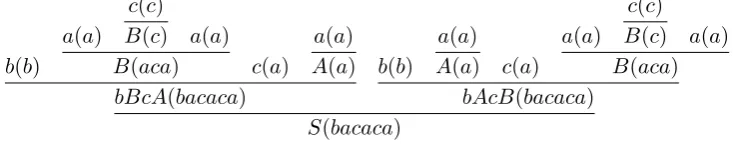
The rules for A andB use no conjunction, and have the same effect as in ordinary context-free grammars. Thus,bBcA(w)is true for all strings
of the formw = bancancai, withn > 0,i > 1,
whereas bAcB(w) holds true for strings of the
form w = baicancan. The conjunction of these two conditions is exactly the condition of member-ship in the desired language, and the rule for S ensures it by derivations of the following form.
bBcA(bancancan) bAcB(bancancan)
S(bancancan)
A full derivation of the stringw=bacacais given in Figure1.
The notion of a conjunctive categorial gram-maris defined by extending basic categorial gram-mars with the conjunction operation. Let Pr = {p, q, r, . . .} be the set of primitive categories,
s∈Pris the target category.
The set ofconjuncts,Conj, is defined as follows:
1. every primitive category is a conjunct;
2. ifp1, . . . , pk ∈ Pr, then(p1 ∧ · · · ∧pk) ∈
Conj.
The set of basic categories with conjunction,
BCat∧, is defined as follows.
1. Every primitive category belongs toBCat∧.
2. If C ∈ Conj and A ∈ BCat∧, then
(C \A)∈BCat∧ and(A /C)∈BCat∧.
Categorial propositions are expressions of the formB(v), where v ∈ Σ+ and B ∈ BCat
∧ ∪
Conj. A conjunctive categorial grammar is a log-ical theory deriving categorial propositions. It in-cludes an arbitrary finite set of axioms of the form
A(a), withA ∈ BCat∧ anda∈ Σ, and the fol-lowing inference rules.
p1(v) . . . pk(v) (p1∧ · · · ∧pk)(v)
C(u) (C \A)(v)
A(uv)
(A /C)(v) C(u)
(s /(x∧y))(b) (p / q)(a)
p(c) (p\q)(a)
q(ca)
p(aca) (p\(x / r))(c) (x / r)(acac) r(a)
x(acaca)
r(a)
((r\y)/ p)(c)
(p / q)(a)
p(c) (p\q)(a)
q(ca)
p(aca) (r\y)(caca)
y(acaca) (x∧y)(acaca)
[image:5.595.78.518.73.159.2]s(bacaca)
Figure 2
The stringwbelongs to the language generated
by this grammar if and only if the propositions(w) is derivable.
Example 4. The categorial conjunctive gram-mar with the set of primitive categories Pr = {s, x, y, p, q, r},sas the target category, and with the following set of axioms describes the language
{bancancan|n>1}, the same as in Example3.
r(a), (r / r)(a),
p(c), (p / q)(a), (p\q)(a),
(p\(x / r))(c), ((r\y)/ p)(c),
(s /(x∧y))(b).
The category p is defined in the same way as in Example1. Then, using further categories without conjunction, the propositions x(ancancai) and
y(aicancan), for all n > 0, i > 1, are derived
as in an ordinary categorial grammar. The only strings that satisfy both conditions, x andy, are those of the formancancan, and these are
there-fore all strings in the category s, derived as fol-lows.
(s /(x∧y))(b)
x(ancancan) y(ancancan) (x∧y)(ancancan)
s(bancancan)
A complete derivation of the proposition s(bacaca)is presented in Figure2.
The calculus used in the conjunctive categorial grammar formalism enjoys the followinginverted subformula property (ISF): if a category of the form(C \A)or(A /C)appears somewhere in the derivation, then it is a subexpression of some cate-gory used in an axiom. (The notion of subexpres-sion on categories is defined in a standard way: each conjunct (in particular, primitive category) is a subexpression of itself, and subexpressions of (C \A) include C \A, C, and all subexpressions
ofA; symmetrically for(A /C). To prove the ISF, we trace the rightmost branch of the derivation up-wards; finally we reach an axiom that includes the goal category as a subexpression.)
Another useful property is the fact that the rule for∧is invertible: if(p1∧. . .∧pk)(v)is derivable, then so arep1(v), . . . ,pk(v). Indeed, the only way to derive(p1∧. . .∧pk)(v)is by applying this rule. The calculus used in conjunctive categorial grammars also enjoys the following cut elimina-tionproperty.
Lemma 1. LetA(u)(for someA ∈BCat∧ and
u ∈ Σ+) be derivable in the given conjunctive categorial grammar. Consider a new conjunc-tive categorial grammar over an extended alpha-betΣ∪ {b}, whereb /∈Σ. The new grammar has
all the same axioms as the original grammar, and an additional axiomA(b). Then, if the new
gram-mar derivesB(v1bv2), for someB ∈BCat∧and arbitrary, possibly empty, strings v1, v2 over Σ, thenB(v1uv2) is derivable in the original gram-mar.
Proof. Consider the derivation ofB(v1bv2)in the
extended grammar and substituteu for all occur-rences ofb. Applications of inference rules remain
valid; the same for axioms of the old grammar (they don’t include b). The new axiomA(b) be-comesA(u), which is derivable in the old gram-mar by assumption.
4 Equivalence of Conjunctive Grammars and Conjunctive Categorial Grammars The main result of this paper is an extension of TheoremAfor grammars with conjunction, stated as follows.
The proof uses the following two known prop-erties of conjunctive grammars. The first result is their closure under quotient with a single symbol.
Lemma B. IfL is a language overΣ described
by a conjunctive grammar, and a ∈ Σ is any symbol, then there exists a conjunctive grammar that describes the language a−1L = {w | aw ∈ L}.(Okhotin and Reitwießner,2010, Thm. 2)
The other result is a normal form theorem. A conjunctive grammarGwith the initial symbolS
is in theodd normal form, if all its rules are of the following form, withA∈N,a∈Σ,Bi, Ci ∈N, andai ∈Σ.
A→a
A→B1a1C1&. . .&BkakCk
S →aA
Rules of the latter kind are allowed only if S is
never referenced in any rules.
Theorem C. Every language described by a con-junctive grammar can be described by a conjunc-tive grammar in odd normal form. (Okhotin and Reitwießner,2010)
Proof of Theorem1. The “if” part is easier. A conjunctive grammar equivalent to a given cate-gorial grammarGhas the setN comprised of all
categories used in the axioms ofG, and of all their
subexpressions (categories and conjuncts). The conjunctive rules are now as follows.
(p1∧. . .∧pk)→p1&. . .&pk,
A→ C(C \A), A→(A /C)C,
for all(p1∧. . .∧pk),(C \A),(A /C)∈N, and
A→a, ifA(a)is an axiom inG.
For the “only if” part of the proof, the first step is to transform a given conjunctive grammar. Let Σ = {a1, . . . , an}. For each symbol ai, by LemmaB, there is a conjunctive grammarGithat describes the quotienta−1i L. By TheoremC, this
grammar can be assumed to be in the odd normal form. It can also be assumed that, fori 6= j, the
grammars Gi and Gj have disjoint sets of non-terminal symbols. LetSi be the initial symbol of
Gi. Then this grammar is further modified as fol-lows. Every rule
A→B1a1C1&. . .&BkakCk
is replaced withk+ 1new rules:
A→Xe1&. . .&Xek and Xei→BiaiCi,
whereXeiare fresh non-terminals. For the sake of uniformity, rules of the form
Si →aA
are replaced with
Si →Ye and Ye →aA,
and rules of the form
A→a
are replaced with
A→ZeandZe→a.
Finally, a new conjunctive grammar forLis
ob-tained by joining these grammars together, for all
i, adding the following extra rules for the new
ini-tial symbolSe.
e
S →a1S1, . . . , Se→anSn
In the resulting grammar, all non-terminals are of two sorts (with and without a tilde), and the rules have the following form.
A→Xe1&. . .&Xek (herekcould be 1)
e
X →BaC, Ye →aA, and Ze→a
It is then transformed to a conjunctive catego-rial grammar, with the set of primitive categories
Pr={pXe |Xe is a non-terminal decorated with a
tilde}, and with the following axioms.
1. For each rule Ze → a, there is an axiom pZe(a).
2. For each pair of rules Ye → aA and A → e
X1&. . .&Xek, the axiom is
pYe/(pXe
1 ∧
. . .∧pXe
k)
(a).
3. For each triple of rules Xe → BaC, B →
e
Y1&. . .&Yek, andC → Ze1&. . .&Zem, the axiom is
(pYe
1∧. . .∧pYek)\pXe
/(pZe
1∧. . .∧pZem)
(a).
Claim. For every non-terminalXe decorated with a tilde, the propositionpXe(v)is derivable in the
newly constructed conjunctive categorial gram-mar if and only ifXe(v)is derivable in the original conjunctive grammar.
Proof. The “if” part. The proof proceeds by in-duction on the derivation size. There are three pos-sible cases.
Case 1. The propositionXe(v)is actually of the formZe(a)and is derived froma(a)using the rule
e
Z →a. ThenpZe(a)is an axiom in the conjunctive categorial grammar.
Case 2. The proposition Xe(v) is of the form
e
Y(av1) and is derived from a(a) and A(v1)
us-ing a rule of the form Ye → aA. Next, a rule
of the form A → Xe1&. . .&Xek should be ap-plied for A. Therefore, the propositions Xei(v1)
are derivable (for alli) in the original conjunctive
grammar. Then, by induction hypothesis,pXe
i(v1)
are derivable in the conjunctive categorial gram-mar, and there is a derivation forpYe(av1)shown
in Figure3.
Case 3. The proposition Xe(v) is of the form
e
X(v1av2)and is derived from some propositions
of the form B(v1), a(a), and C(v2), following
the rule Xe → BaC. Next, for B and C, some rules for the formB → Ye1&. . .&Yek andC →
e
Z1&. . .&Zem should be applied. Therefore, the propositionsYei(v1)andZej(v2) are derivable (for
alli,j) in the original conjunctive grammar. Then,
by induction hypothesis,pYe
i(v1)andpZej(v2)are
derivable in the conjunctive categorial grammar, and there is a derivation forpXe(v1av2), as shown
in Figure4.
The “only if” part. This time, it is assumed that pXe(v) is derivable in the newly constructed conjunctive categorial grammar. The proof is by induction on its derivation.
Theaxiom caseis trivial: any axiom of the form
pZe(a)is associated with a ruleZe→ain the
orig-inal conjunctive grammar, and thenZe(a)is deriv-able froma(a).
In theleft divisioncase,v = v1w, and the last
step of the derivation is as follows. C(v1) (C \pXe)(w)
pXe(v1w)
By the ISF (see above), (C \pXe) is a subex-pression of the category in one of the axioms. The only possibility is that (C \pXe) is a subex-pression ((pYe
1 ∧ . . . ∧ pYek)\pXe) of an axiom
((pYe
1∧. . .∧pYek)\pXe)/(pZe1∧. . .∧pZem).
More-over, again by the ISF, the only way to derive (C \pXe)(w) is to apply the right division rule to the category used in the axiom. This analysis shows that the derivation must end in the way de-picted in the earlier Figure4, wherew=av2.
Since the rules for∧are invertible (see above), the propositions pYe
1(v1), . . . , pYek(v1), pZe1(v2), . . . ,pZe
m(v2)are derivable. By induction
hypoth-esis, Yei(v1) and Zej(v2), for all i, j, are
deriv-able in the original conjunctive grammar. Then, the derivation uses the rules Xe → BaC, B →
e
Y1&. . .&Yek, andC →Ze1&. . .&Zem, and is of the following form.
e
Y1(v1) . . . Yek(v1) B(v1) a(a)
e
Z1(v2) . . . Zem(v2) C(v2) e
X(v1av2)
The right divisioncase is even easier. Here a derivation ends as follows.
(pYe/C)(w) C(v1) pYe(wv1)
By the ISF, the left premise could be nothing but an axiom of the form pYe/(pXe
1 ∧. . .∧pXek)
(a) (and w = a). Then, C(v1) is (pXe1 ∧ . . . ∧
pXe
k)(v1), and by the invertibility of the∧rule, all
pXe
i(v1) are derivable. By the induction
hypothe-sis, Xei(v1), for alli, are derivable in the original
conjunctive grammar, and there is the following derivation for Ye(av1), using the rules Ye → aA
andA→Xe1&. . .&Xek.
a(a)
e
X1(v1) . . . Xek(vk)
A(v1) e
Y(av1)
This claim immediately yields the main result, sinceSe(w)is derivable in the original conjunctive grammar if and only ifpSe(w) is derivable in the constructed conjunctive categorial grammar.
5 Conjunctive Categorial Grammars and Lambek Grammars with Additives Lambek(1958) suggested a richer logic as a back-ground for categorial grammars, called the Lam-bek calculus. In the Lambek calculus, or L for
pYe/(pXe
1∧. . .∧pXek)
(a)
pXe
1(v1) . . . pXek(v1)
(pXe
1∧. . .∧pXek)(v1)
pYe(av1)
Figure 3
(pYe
1 ∧. . .∧pYek)(v1)
((pYe
1∧. . .∧pYek)\pXe)/(pZe1 ∧. . .∧pZem)
(a) (pZe
1∧. . .∧pZem)(v2)
((pYe
1 ∧. . .∧pYek)\pXe)(av2)
pXe(v1av2)
Figure 4
{p1, p2, p3, . . .}of primitive categories using three
binary operations: product (·), which means con-catenation, left division (\), and right division (/).
The formal recursive definition is as follows. 1. Every primitive category is a category. 2. If A and B are categories, then (A · B),
(A\B), and(B / A)are also categories.
The set of all Lambek categories is denoted by
Cat. As opposed to basic categories, deep
nest-ing of division operations is allowed here, that is denominators are allowed to be non-primitive.
A Lambek categorial grammar consists of a tar-get categorys ∈Cat(usuallysis required to be
a primitive category) and a finite number of ax-iomatic propositions of the formA(a), whereAis
a category andais a letter of the alphabet.
A string w = a1. . . an is considered ac-cepted by the grammar, if, for some categoriesA1,
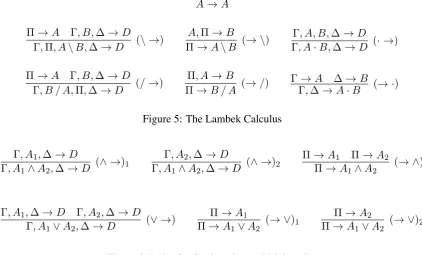
. . . , An, the propositions Ai(ai) are included in the grammar as axiomatic ones, and the sequent A1, . . . , An → sis derivable in the Lambek cal-culus, which consists of the axioms and inference rules listed in Figure5. In all rules, left-hand sides of the sequents are required to be non-empty.
Note that in Lambek grammars, arrows tran-ditionally point in an opposite direction than in context-free grammars (. . .→svs.S→. . .).
The followingcut ruleis not officially included in the system, but is admissible (Lambek,1958).
Π→A Γ, A,∆→D
Γ,Π,∆→D (cut)
As one can easily see, all basic categories, as defined in Section 2, are also Lambek cate-gories: BCat ⊂ Cat. Moreover, as noticed
byBuszkowski(1985), if a basic categorial gram-mar is regarded as a Lambek categorial gramgram-mar with the same set of axiomatic propositions, then it describes the same language.
Next, the Lambek calculus is extended with the so-called “additive” conjunction and disjunction, as defined by Kanazawa(1992). These new op-erations correspond to the additive opop-erations in linear logic byGirard(1987). Inference rules for these operations are depicted in Figure6.
This calculus, denoted by MALC
(“multiplicative-additive Lambek calculus”), also enjoys cut elimination and the subformula property.
Lambek categories with ∧ and ∨ generalize conjunctive categories (and conjuncts):
BCat∧∪Conj⊂Cat∧,∨,
and every conjunctive categorial grammar can be translated into a Lambek grammar with∧and∨. However, one cannot simply take the axiomatic propositions of a conjunctive categorial grammar and use them as axiomatic propositions in the sense of Lambek grammars: this would yield a grammar that is not equivalent to the original one (for instance, the Lambek grammar with the ax-iomatic propositions from Example4does not ac-cept any strings at all). The construction has to be more subtle.
Theorem 2. LetΣ = {a1, . . . , an}and consider
a conjunctive categorial grammar with the follow-ing axiomatic propositions.
A1,1(a1), A1,2(a1), . . . A1,k1(a1),
A2,1(a2), A2,2(a2), . . . A2,k2(a2),
...
A→A
Π→A Γ, B,∆→D
Γ,Π, A\B,∆→D (\ →)
A,Π→B
Π→A\B (→ \)
Γ, A, B,∆→D
Γ, A·B,∆→D (· →)
Π→A Γ, B,∆→D
Γ, B / A,Π,∆→D (/→)
Π, A→B
Π→B / A (→/)
Γ→A ∆→B
Γ,∆→A·B (→ ·)
Figure 5: The Lambek Calculus
Γ, A1,∆→D
Γ, A1∧A2,∆→D (∧ →)1
Γ, A2,∆→D
Γ, A1∧A2,∆→D (∧ →)2
Π→A1 Π→A2
Π→A1∧A2 (→ ∧)
Γ, A1,∆→D Γ, A2,∆→D
Γ, A1∨A2,∆→D (∨ →)
Π→A1
Π→A1∨A2 (→ ∨)1
Π→A2
[image:9.595.86.509.69.324.2]Π→A1∨A2 (→ ∨)2
Figure 6: Rules for Conjunction and Disjunction
Then the Lambek grammar with atomic propo-sitions (Ai,1 ∧Ai,2 ∧ . . . ∧Ai,ki)(ai) (for i =
1, . . . , n) describes the same language as the orig-inal conjunctive categorial grammar. (Ifki = 1,
we take justAi,1(ai).)
Proof. LetBi =Ai,1∧Ai,2∧. . .∧Ai,ki. The new
Lambek grammar uses axiomatic propositions of the form Bi(ai), one for each symbol in Σ. It is sufficient to prove the following: for the target categorys ∈ Prand for a string ai1. . . aim, the
propositions(ai1. . . aim)is derivable in the
con-junctive categorial grammar if and only if the se-quentBi1, . . . , Bim →sis derivable inMALC.
The “only if” part. In order to use induc-tion on the length of derivainduc-tion in the conjunc-tive categorial grammar, the statement is proved not only fors, but for an arbitrary category D ∈
BCat∧∪Conj.
The proof in the base case is immediate: if
D(ai) is an axiom, then D is one of the Ai,j in the conjunction Bi, and the sequent Bi → Ai,j is derivable by several applications of the(∧ →) rules.
For the induction step, there are three cases.
Case 1: D= (p1∧. . .∧pk). Then, by the in-duction hypothesis, Bi1, . . . , Bim → pj is
deriv-able inMALCfor everyj, andBi1, . . . , Bim →
p1∧. . .∧pkis derived by the(→ ∧)rule.
Case 2: D(ai1. . . aim) is derived from
C(ai1. . . ai`) and(C \D)(ai`+1. . . aim) for some
C ∈ Conj. Then, by the induction
hy-pothesis, the sequents Bi1, . . . , Bi` → C and
Bi`+1, . . . , Bim → C \D are derivable, and
then Bi1, . . . , Bim → D can be derived in the
following way. First, Bi1, . . . , Bi`,C \D →
D is derived from Bi1, . . . , Bi` → C and
D → D, and then it is combined with Bi`+1, . . . , Bim → C \Dusing the cut rule, to get
Bi1, . . . , Bi`, Bi`+1, . . . , Bim →D.
Case 3: D(ai1. . . aim) is derived from
(D /C)(ai1. . . ai`) and C(ai`+1. . . aim). The
proof is symmetric.
The “if” part. The following more general statement is claimed. For every j = 1, . . . , m,
let Bi0j be a conjunction of an arbitrary subset of formulaeAij,k used in the conjunctionBij; in
other words, Bi0j may coincide with Bij or lack
some of the conjuncts. Then, for anyC ∈ Conj
(in particular, for C = s ∈ Pr ⊂ Conj), if
Bi01, . . . , Bi0m → C is derivable inMALC, then the proposition C(ai1. . . aim) is derivable in the
original conjunctive categorial grammar.
The claim is proved by induction on the cut-free derivation of the sequent Bi01, . . . , Bi0m → C in
MALC.
Case 1.C=p1∧. . .∧pk,k>2. Since the(→ ∧)rule inMALCis invertible (this follows from
applications of this rule were applied immediately.
Bi01, . . . , Bi0m →p1 . . . Bi01, . . . , B
0
im →pk
Bi01, . . . , Bi0m →p1∧. . .∧pk
Then, by the induction hypothesis, all propositions
pj(a1. . . am)are derivable in the conjunctive cat-egorial grammar, and from them one can derive (p1∧. . .∧pk)(a1. . . am).
In all other cases,C ∈Pr.
Case 2: an axiom. Then, m = 1, B0i1 = C, and, since all elements of Bi01 should be of the
formAi1,k, the proposition C(a1) is an axiom of the conjunctive categorial grammar, and therefore derivable.
Case 3: the last rule of the derivation is(∧ →). Then,Bi0`=Bi00`∧Ai`,k:
Bi01, . . . , Bi00`, . . . , Bi0m→ C
B0
i1, . . . , Bi00`∧Ai`,k, . . . , Bi0m → C
or
Bi01, . . . , Ai`,k, . . . , Bi0m → C
Bi01, . . . , Bi00`∧Ai`,k, . . . , Bi0m → C
In both cases the induction hypothesis is applied: sinceBi00` orAi`,k can act asB0i`, the proposition
C(ai1. . . ai`. . . aim) is derivable in the
conjunc-tive categorial grammar.
Case 4: the last rule is (\ →). In this case,
Bi0h = Aih,k = C0\A0, for some h and for
C0 ∈ Conj andA0 ∈ BCat∧, and the sequent
Bi01, . . . , Bi0`
−1, B
0
i`, . . . , B
0
ih−1,C
0\A0, B0
ih+1, . . . ,
Ba0m → C is derived from Bi0`, . . . , Bi0h
−1 → C
0
and Bi01, . . . , Bi0`
−1, A
0, B0
ih+1, . . . , B
0
im → C.
By the induction hypothesis, the proposition C0(ai`. . . aih−1)can be derived in the conjunctive categorial grammar, and, since (C0\A0)(ai
h) is
an axiom, the proposition A0(ai`. . . aih−1aih) is
also derivable.
Now, the conjunctive categorial grammar is ex-tended by adding a new symbolan+1to the
orig-inal alphabetΣ = {a1, . . . , an}, with a new ax-iom, A0(an+1). For the new grammar, we have
the same Bj for j = 1, . . . , n, andBn+1 = A0.
SinceBi01, . . . , Bi0`
−1, A
0, B0
ih+1, . . . , B
0
im → C is
derivable inMALC, by the induction hypothesis,
the proposition C(ai1. . . ai`−1an+1aih+1. . . aim)
is derivable in the extended conjunctive categorial grammar.
By Lemma 1, the desired proposition C(ai1. . . ai`−1ai`. . . aih−1aihaih+1. . . aim),
where the string u = ai`. . . aih−1aih has been
substituted for a fresh symbol b = an+1, can
be derived in the original conjunctive categorial grammar.
Case 5: the last rule is(/→). Symmetric.
This embedding immediately implies that every language generated by a conjunctive grammar can be generated by anMALC-grammar. This
super-sedes the result byKuznetsov(2013).
In the classical case without the conjunction, a converse result was shown by Pentus (1993): every language generated by a Lambek gram-mar is context-free. Whether an analogous prop-erty holds for MALC (that is, whether every MALC-language is generated by a conjunctive
grammar) remains an open problem. Establishing any such upper bound on the power of the new model would require proving a non-trivial variant of the famous theorem by Pentus (1993), which would likely be difficult.
However, there is some evidence thatMALC
should be strictly more powerful than conjunc-tive grammars. First, there is a result byOkhotin (2011) that conjunctive grammars can describe a certain P-complete language representing the Cir-cuit Value Problem (CVP) under a suitable encod-ing. On the other hand, the class of languages generated by MALC-grammars is, by
defini-tion, closed under symbol-to-symbol homomor-phisms. These two facts are sufficient to develop aMALCrepresenation for an NP-complete
lan-guage, which is the last result of this paper.
Theorem 3. The family of languages generated by MALC-grammars contains anNP-complete
language.
Sketch of proof. It is not difficult to transform the grammar for the CVP given byOkhotin(2011), so that each CVP instance is represented in the form
uk,Cv, whereuk,C ∈ Σ∗ is a description of a cir-cuitC withkinputs, whilev ∈ {0,1}k contains the input values, and0,1 ∈/ Σ. The grammar then describes the set of all such strings, on which the circuit evaluates to 1 on the given input values.
CVP ={uk,Cv|C(v) = 1}
Circuit Value Problem to the Circuit Satisfiability Problem, which is NP-complete.
h(CVP) ={uk,C?k | ∃v∈ {0,1}k : C(v) = 1}
Since the language CVP is described by a conjunctive grammar, by Theorem 1, it is also described by a conjunctive categorial grammar, and then, by Theorem 2, also by an MALC
-grammar. Next, as observed by Kanazawa (1992), its symbol-to-symbol homomorphic im-ageh(CVP) must have anMALC-grammar as
well.
On the other hand, every language described by a conjunctive grammar can be parsed in poly-nomial time—to be exact, in time O(nω), where
ω <3is the exponent in the complexity of matrix multiplication (Okhotin,2014). This leads to the following corollary.
Corollary 1. Under the assumption that P 6= NP, conjunctive categorial grammars are strictly weaker in power thanMALC.
It would be interesting to establish an uncondi-tional separation of these two classes.
Acknowledgments
Stepan Kuznetsov’s research was supported by the Russian Foundation for Basic Research (grants 15-01-09218-a and 14-01-00127-a) and the Presi-dential Council for Support of Leading Scientific Schools of Russia (grant NˇS-9091.2016.1).
References
V. M. Abrusci. 1990. A comparison between Lambek syntactic calculus and intuitionistic linear proposi-tional logic. Zeitschrift f¨ur mathematische Logik und Grundlagen der Mathematik36(1):11–15.
K. Ajdukiewicz. 1935. Die syntaktische Konnexit¨at.
Studia Philosophica1:1–27.
Y. Bar-Hillel, C. Gaifman, and E. Shamir. 1960. On categorial and phrase-structure grammars. Bulletin of the Research Council of Israel, Section F 9F:1– 16.
W. Buszkowski. 1985. The equivalence of unidirec-tional Lambek categorial grammars and context-free grammars. Zeitschrift f¨ur mathematische Logik und Grundlagen der Mathematik31:369–384.
W. Buszkowski. 1996. Categorial grammars with neg-ative information. In H. Wansing, editor,Negation. A Notion in Focus, De Gruyter, pages 107–126.
B. Carpenter. 1997. Type-Logical Semantics. MIT Press, Cambridge, MA.
N. Chomsky. 1956. Three models for the description of language. IRE Transactions on Information Theory
2:113–124.
M. Dekhtyar and A. Dikovsky. 2008. Generalized cat-egorial dependency grammars. InPillars of Com-puter Science (Trakhtenbrot Festschrift), Springer, volume 4800 ofLNCS, pages 230–255.
M. J. Fischer. 1968. Grammars with macro-like productions. In Proc. 9th Annual Symposium on Switching and Automata Theory (SWAT 1968). New York, pages 131–142.
J.-Y. Girard. 1987. Linear logic.Theoretical Computer Science50(1):1–102.
M. Kanazawa. 1992. The lambek calculus enriched with additional connectives. Journal of Logic, Lan-guage, and Information1:141–171.
S. Kuznetsov. 2013. Conjunctive grammars in greibach normal form and the lambek calculus with additive connectives. In Proc. Formal Grammar 2012 and Formal Grammar 2013. Springer, volume 8036 of
LNCS, pages 242–249.
S. L. Kuznetsov. 2016. On translating Lambek gram-mars with one division into context-free gramgram-mars.
Proceedings of Steklov Institute of Mathematics
294:129–138.
J. Lambek. 1958. The mathematics of sentence struc-ture. American Mathematical Monthly65:154–170. M. Latta and R. Wall. 1993. Intersective context-free languages. InLenguajes Naturales y Lenguajes For-males IX. Barcelona, pages 15–43.
M. Moortgat. 1996. Multimodal linguistic inference.
Journal of Logic, Language, and Information 5(3, 4):349–385.
R. Moot and C. Retor´e. 2012. The Logic of Categorial Grammars: A Deductive Account of Natural Lan-guage Syntax and Semantics. Springer, Heidelberg. G. V. Morrill. 2011. Categorial Grammar: Logical
Syntax, Semantics, and Processing. Oxford Univer-sity Press.
A. Okhotin. 2001. Conjunctive grammars. Jour-nal of Automata, Languages, and Combinatorics
6(4):519–535.
A. Okhotin. 2004. Boolean grammars. Information and Computation194(1):19–48.
A. Okhotin. 2011. A simple p-complete problem and its language-theoretic representations. Theoretical Computer Science412(1–2):68–82.
A. Okhotin. 2013. Conjunctive and boolean grammars: the true general case of the context-free grammars.
A. Okhotin. 2014. Parsing by matrix multiplication generalized to boolean grammars. Theoretical Com-puter Science516:101–120.
A. Okhotin and C. Reitwießner. 2010. Conjunctive grammars with restricted disjunction. Theoretical Computer Science411(26–28):2559–2571.
M. Pentus. 1993. Lambek grammars are context-free. In Proc. 8th Annual IEEE Symposium on Logic in Computer Science (LICS 1993). Montreal, pages 430–433.
Yu. V. Savateev. 2009. Recognition of derivability for the lambek calculus with one division. Moscow Uni-versity Mathematics Bulletin64(2):73–75.
H. Seki, T. Matsumura, M. Fujii, and T. Kasami. 1991. On multiple context-free grammars. Theoretical Computer Science88(2):191–229.
M. Steedman. 1996. Surface structure and interpreta-tion. MIT Press.
K. Vijay-Shanker, D. J. Weir, and A. K. Joshi. 1987. Characterizing structural descriptions produced by various grammatical formalisms. InProc. 25th An-nual Meeting of the Association for Computational Linguistics (ACL 1987). pages 104–111.