Original Article
Safety and efficacy of Kanglaite injection in the
treatment of malignant pleural effusion:
a meta-analysis
Lin Chen1,2*, Jun Xu2*, Shaohui Cai2
1Institution of Drug Clinical Trials, The First Affiliated Hospital, Jinan University, Jinan, China; 2College of Pharmacy, Jinan University, Guangzhou, China. *Equal contributors.
Received January 20, 2016; Accepted August 2, 2016; Epub September 15, 2016; Published September 30, 2016
Abstract: Background: Kanglaite injection (KLT) has been increasingly used to control malignant pleural effusion (MPE); however, it remains unclear whether KLT combined with chemotherapy is more effective than chemotherapy
alone. In this review, we performed a meta-analysis to evaluate the efficacy and safety of KLT combined with cispla -tin in the treatment of MPE. Methods: A literature search was performed using the following databases: MEDLINE (PubMed), Embase, PsycINFO, Chinese Biomedical (1980-2014), Chinese Journal Full-text (1980-2014), Weipu
Scientific Journal (1989-2014), and Cochrane Central Register of Controlled Trials (CENTRAL database, updated
to December 15, 2014). All reports that compared KLT and cisplatin with cisplatin monotherapy in the treatment of MPE were included. Primary outcomes were complete response (CR) and partial response (PR). Secondary out-comes were complications and Karnofsky performance status (KPS) results. Meta-analysis of pooled CR, PR, and KPS was performed using a effects model with inverse-variance weighting. Results: In total, seven random-ized controlled studies and three controlled studies comprising 488 participants (age range, 18-35 years) were
included in the meta-analysis. The results identified a significant difference between the combined therapy and
monotherapy groups in response rates, with response rates higher in patients receiving Kanglaite and cisplatin
(Risk ratio (RR), 2.46; 95% confidence interval (CI), 1.68-3.59; P<0.001). Combined therapy significantly improved KPS (RR, 3.07; 95% CI, 1.30-7.23). A significant reduction in nausea and vomiting was found in the combined
therapy group compared with the monotherapy group (RR, 0.22; 95% CI, 0.10-0.48; P=0.9, from four studies
com-prising 62 patients). There was no significant difference between the test and control groups regarding leucopenia,
chest pain, and fever.
Keywords: Chinese traditional herb, kanglaite injection, cisplatin, malignant pleural effusion, systematic review
Introduction
Malignant pleural effusion (MPE) occurs fre-quently in patients with advanced malignancies due to metastases originating from tumors in the lung, breast, and ovary, and from lympho-mas. MPE results in chest tightness, chest pain, and respiratory symptoms that seriously impact quality of life and is associated with a shorter life expectancy. Despite recent prog-ress in multidisciplinary treatment with chemo-therapy, radiochemo-therapy, immunochemo-therapy, hyper-thermia, and other therapies, the prognosis for patients with MPE is poor. Identification of novel therapeutic methods for the treatment of patients with MPE is becoming increasingly urgent.
2014), Chinese Journal Full-text (1980-2014), Weipu Scientific Journal (1989-2014), and Coc- hrane Central Register of Controlled Trials (CENTRAL database; updated to December 15, 2014). Keyword searches included various combinations of the following terms: “Kang- laite”, “traditional Chinese herb”, “cisplatin”, and “pleural effusion”. This search strategy was amended for each database. Two authors inde-pendently screened all citations and abstracts identified by the search strategy to identify eli-gible studies.
Inclusion and exclusion criteria
The inclusion criteria were as follows: random-ized controlled trials (RCTs) or non-randomrandom-ized controlled trials (non-RCTs); patients with cyto-logically or histocyto-logically confirmed MPE; patients with intrathoracic injection or infusion of KLT combined with cisplatin or cisplatin alone; patients with a Karnofsky performance status (KPS) of 50% or greater; patients with a life expectancy of greater than 2 months; and adequate hematologic, renal, hepatic, and car-diac function.
Patients were excluded from the study if they had undergone chemotherapy or radiotherapy treatment within the previous 2 months; rece- ived local antitumor drugs; had severe heart, hepatic, or renal disease; had markedly abnor-mal blood biochemistry findings; or had hepatic or renal dysfunction. Editorials, letters to the editor, review articles, case reports, and animal experimental studies were excluded.
Data extraction
Independent extraction of the full-text articles that met our eligibility criteria was performed by two authors (L.C. and J.X.). The primary out-come measures were as follows: a complete response (CR) when no pleural effusion was observed; a partial response (PR) when pleural effusion was observed, but the level of effusion was less than 25% of the long axis of the hemi-thorax; and no response (NR) when effusion
was larger than that defined by PR. The second
-assess the risk of bias of the included trials. The risk of bias tool comprises six domains: random sequence generation (selection bias), allocation concealment (selection bias), blind-ing of participants, personnel, and outcome assessment (performance and detection bias), assessment of incomplete data outcome (attri-tion bias), selective reporting (reporting bias), and other sources of bias. Each item was grad-ed as a low or high risk of bias if there was suf-ficient information to assess; otherwise, the item was graded as unclear. Two authors (L.C. and J.X.) independently assessed the quality, and any disagreement between the review authors was resolved by discussion.
Statistical analyses
Statistical analyses were performed using the RevMan 5.1 software (Nordic Cochrane Cen- ter, Copenhagen, Denmark). Dichotomous data were expressed as relative risks. Continuous data were expressed as the weighted mean dif-ferences (WMD). I2 statistic was used to
evalu-ate heterogeneity among the studies. Hete- rogeneity was considered statistically signifi-cant when I2>50%. The data from the studies
were pooled on the basis of a random-effects model or a fixed-effects model depending on the presence of heterogeneity.
Results
Search results and study selection
rapy of KLT and cisplatin (test group, T) and patients with cisplatin alone (control group, C). All eligible studies were published between 2005 and 2012. All of the participants were at least 18 years old. The length of the interven-tion was 4 weeks. Detailed characteristics of the ten studies are summarized in Table 1. Quality of the included studies
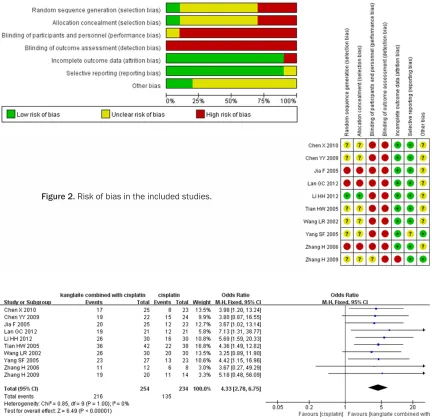
The risk of bias (Figure 2) in the included stud-ies was evaluated using the Cochrane Risk of lack a control group. In total, seven RCTs and
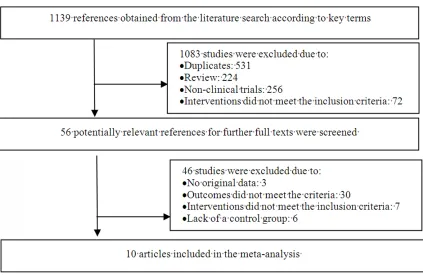
three non-RCTs were selected for data extrac-tion and analysis. The included trials involved 488 patients. The detailed steps of our litera-ture search are shown in Figure 1.
Study characteristics
[image:3.612.94.517.68.343.2]All of the RCTs and non-RCTs were conducted in patients with MPE in China. In these studies, CR, PR, KPS, and reported adverse events were assessed in patients with a combination the-
Figure 1. Diagram of the study selection procedures.
Table 1. Characteristics of the studies included in the meta-analysis
Author (year) Design Study period Age range (years) No. of partic-ipants T/C Duration (weeks)
Chen X 2010 [8] RCT June 2005-June 2006 42-81 25/23 4
Chen YY 2009 [9] RCT January 2005-January 2009 32-70 22/24 4
Jia F 2005 [10] Non-RCT October 1998-October 2000 39-87 25/23 4 Lan GC 2012 [11] Non-RCT August 2008-October 2010 38-76 21/21 4
Li HH 2012 [12] RCT September 2010-January 2012 35-78 30/30 4
Tian HW 2005 [13] RCT August 1999-August 2002 Not mentioned 42/38 4
Wang LR 2002 [14] RCT 1999-2002 22-73 30/30 4
Yang SF 2005 [15] RCT June 2000-June 2005 Not mentioned 27/27 4
Zhang H 2006 [16] Non-RCT May 2003-August 2005 50-75 12/8 4
Zhang H 2009 [17] RCT February 2007-February 2008 Not mentioned 20/14 4
[image:3.612.91.526.400.555.2]Bias Tool. Ten studies comprising seven RCTs
[8, 9, 12-15, 17] and three controlled trials [10, 11, 16, 17] were included in the analysis. Methods of generating randomization seque- nces using a random digital table were described in only one study [12]. The blinding method was not reported in any of the studies. Pooled analysis
Response rate: All of the included RCTs report-ed response rates. Results of the response rate are depicted in Figure 3. The response rate was analyzed in 488 patients treated with both KLT and cisplatin, and cisplatin alone. There was no significant heterogeneity and the
fixed-effects model was used (P=1.00; I2=0%).
Results of the pooled analysis of response rates showed a significant difference between the combined therapy and cisplatin control groups, with a higher rate observed in patients receiving both KLT and cisplatin (risk ratio (RR), 4.33; 95% confidence interval (CI), 2.78-6.75; P<0.00001).
Improvement in quality of life: A change in the KPS score was reported in three of ten studies comprising 114 patients [12, 16, 17] (Figure 4). No heterogeneity was found, and the fixed-effects model was used (P=0.75; I2=0%). An
[image:4.612.90.522.72.492.2]improvement in the KPS score (increase of KPS≥10) was reported in 66.13% of patients in
Figure 2. Risk of bias in the included studies.
the combined KLT and cisplatin group (n=62) and 46.15% of patients in the cisplatin mono-therapy group (n=52). Combined treatment sig-nificantly improved KPS compared with mono-therapy (RR, 3.07; 95% CI, 1.30-7.23).
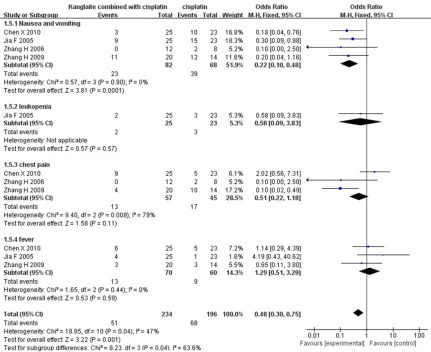
Adverse events: Mild and low-grade adverse events were reported in four studies compris-ing 150 patients [8, 10, 18]. The most common adverse events arising from treatment were nausea and vomiting. A significant reduction in nausea and vomiting was observed in the com-bined therapy group compared with the
[image:5.612.93.521.72.148.2]mono-therapy group (RR, 0.22; 95% CI, 0.10-0.48; P=0.9 from four studies) [8, 10, 17] (Figure 5). Leucopenia was reported in one study (48 patients) [10], although there was no significant difference between the two groups. Chest pain was reported in three studies comprising 102 patients [8, 16, 17], and an additional three studies (130 patients) [8, 10, 16, 17] reported fever as an adverse effect. Statistical analyses did not reveal a significant difference between both groups for both of the reported adverse effects.
Figure 4. Forest plot and meta-analysis of improvement in quality of life.
[image:5.612.91.522.191.543.2]block the tumor cell cycle at the G2/M phase, inhibit proliferation of tumor cells, and induce tumor cell apoptosis by activating the expres-sion of apoptotic factors [19]. KLT may activate a series of cytokines and, hence, inhibit the generation of fibrinolytic activity and promote fibrin deposition in the lung [20]. Various clini-cal studies show that Kanglaite significantly decreases cancer cachexy, improves the quali-ty of life of cancer patients, and may ameliorate multiple drug resistance of cancers when com-bined with radiotherapy and chemotherapy in clinical use [21-23].
In the present study, a systematic review and meta-analysis of all controlled clinical trials published to date that involved the treatment of MPE via combined therapy with KLT and cispla-tin and cisplacispla-tin alone were performed. We included ten studies comprising 488 partici-pants in our analysis. Following comparison of combined therapy with monotherapy, a signifi-cant difference in response rates was observed between the combined therapy and monother-apy groups, with a higher rate observed in patients receiving both KLT and cisplatin (RR, 4.33; 95% CI, 2.78-6.75; P<0.00001). Comb- ined treatment significantly improved KPS (RR, 3.07; 95% CI, 1.30-7.23]. Regarding adverse events, a significant reduction in nausea and vomiting was observed in the combined thera-py group compared with the monotherathera-py group (RR, 0.22; 95% CI, 0.10-0.48; P=0.0001, from four studies comprising 62 patients). Fur- thermore, there was no significant difference between the combined therapy and mon-other-apy groups regarding leucopenia, chest pain, and fever.
To date, our study was the first to evaluate the clinical efficacy and safety of the administra-tion of KLT in the treatment of MPE in patients with different types of cancers. The risk of bias in the included studies was evaluated using the Cochrane Risk of Bias Tool. We included ten studies that comprised seven RCTs and three controlled trials. All of the included studies reported data with a small sample size, and the quality of the included studies was uniformly
Other limitations of the present study are as fol -lows: publication bias in the meta-analysis of the published studies; the number of available studies in the literature was too small and the studies were of low sample size; the search was expanded to non-RCTs, and the risk of bias in such studies is high; the meta-analysis in this study was based on Chinese research, and studies from other parts of the world were not found, which may generate a partial result; lack of data on different tumor subgroups; and lack of data on Kanglaite combined with other che-motherapeutic agents, hence it was difficult to comprehensively compare the efficacy and safety of combination therapy with chemother-apy alone. Future prospective cohort studies are required to address many of the limitations of our meta-analysis.
In conclusion, the results of the meta-analysis presented here suggest that combination ther-apy comprising KLT and cisplatin achieves an increased curative effect and decreased adverse reactions compared with cisplatin monotherapy. Given the generally low method-ological quality of the included studies, to test the efficacy and safety of Kanglaite in MPE and determine further clinical application, addition-al studies with methodologicaddition-ally rigorous triaddition-als are required.
Disclosure of conflict of interest
None.
Address correspondence to: Shaohui Cai, College of Pharmacy of Jinan University, 163 Huangpu Road, Guangzhou 510630, China. Tel: +86-020-85228025; E-mail: [email protected]
References
[1] Xiaowei X. System Review on Kanglaite Com-bined with Chemotherapy in Treatment of Non-Small Cell Lung Cancer. Chinese Archives of Traditional Chinese Medicine 2014; 32: 733-739.
Can-cer: A Systematic Review.] Zhongguo Fei Ai Za Zhi 2009; 12: 208-15.
[3] Ying L. Clinical efficacy and influence of Kan -glaite combined with chemotherapy on the ac-tivity of immune cells in patients with liver can-cer. Progress in Modern Biomedicine 2014; 14: 2103-2106.
[4] Yonghong Z. Clinical observation of intraperito-neal hyperthermic perfusion of Kanglaite com-bined with FOLFOX6 chemotherapy for local advanced gastric cancer. J Shanxi Med Univ 2014; 45: 382-384.
[5] Zhan YP, Huang XE, Cao J, Lu YY, Wu XY, Liu J,
Xu X, Xiang J, Ye LH. Clinical safety and efficacy
of Kanglaite(R) (Coix Seed Oil) injection com-bined with chemotherapy in treating patients with gastric cancer. Asian Pac J Cancer Prev 2012; 13: 5319-21.
[6] Lin GL. Role of Kanglaite injection in the neo-adjuvant chemotherapy of breast cancer. Tu-mor 2009: 283-285.
[7] Zan L and Hui Y. Kanglaite injection in the treatment of malignant pleural effusion of 30 patients. Modern Oncology 2006; 08: 1014-1015.
[8] Xin C. Effect of cisplatin combined with Kan-glaite injection in treatment of malignant pleu-ral effusion. Shangdong Medical Journal 2010; 50: 71-72.
[9] Y C. Study of malignant pleural effusion treat-ed with intra-pleural injection of Kanglaite combined with cisplatin. Proceeding of Clinical Medicine 2009; 18: 531-532.
[10] F J. Effect of Kanglaite Injection and PDD in treatment of malignant pleural effusion. J Modern Oncol 2005; 13: 249-250.
[11] GC L. Kanglaite combined with cisplatin treat-ment for malignant pleural effusion. Modern Traditional Chinese Medicine 2012; 32: 39-40.
[12] HH L. The clinical observation of malignant pleural effusion in nonsmall-cell lung cancer through Kanglaite. Guide of China Medicine 2012; 10: 438-439.
[13] Hongwen T. The study of comparactive meth-ods, between connecting kang Lai Te with DDP, and using DDP single to cure malignant effu-sion. Haerbin Medicine Journal 2005; 25: 22-23.
[14] Liru W. Clinical study of KLT treating malignant pleural effusion. Shanxi Oncology Medicine 2002; 10: 144-145.
[15] Shufan Y. The clinical observation of Kanglaite injection combined with cisplatin in the treat-ment of malignant pleural effusion. Practical Oncology Journal 2005; 19: 291-292.
[16] Hong Z. Clinical research and mechanism ex-plore of Kanglaite combined with cisplatin in the treatment of malignant pleural effusion. Journal of Modern Oncology 2006; 14: 835-836.
[17] Hong Z. Safety and efficacy of Kanglaite com -bined with cisplatin in the treatment of malig-nant pleural effusion. Traditional Chinese Drug Research and Clinical Pharmacology 2009; 20: 278-279.
[18] YY C. Study of malignant pleural effusion treat-ed with intra-pleural injection of Kanglaite combined with cisplatin. Proceeding of Clinical Medicine 2009; 18: 531-532.
[19] Lu Y, Li CS and Dong Q. Chinese herb related molecules of cancer-cell-apoptosis: a minire-view of progress between Kanglaite injection and related genes. J Exp Clin Cancer Res 2008; 27: 31.
[20] Xuehong W. The plasma levels of PSI-1, TGF-beta and TNF-alpha in effusion before and af-ter intrapleural injection of Kanglaite com-bined with cisplatin. Tianjin Med J 2009; 37. [21] Liu X, Xu F, Wang G, Diao X, Li Y. Kanglaite
in-jection plus chemotherapy versus chemother-apy alone for non-small cell lung cancer pa-tients: A systematic review and meta-analysis. Curr Ther Res Clin Exp 2008; 69: 381-411. [22] Liu Y, Zhang W, Wang XJ, Liu S. Antitumor
ef-fect of Kanglaite(R) injection in human pancre-atic cancer xenografts. BMC Complement Al-tern Med 2014; 14: 228.