782
UHH-LT at SemEval-2019 Task 6: Supervised vs. Unsupervised
Transfer Learning for Offensive Language Detection
Gregor Wiedemann Eugen Ruppert* Chris Biemann
Language Technology Group / *Base.Camp Department of Informatics
University of Hamburg, Germany
{gwiedemann, ruppert, biemann}@informatik.uni-hamburg.de
Abstract
We present a neural network based approach of transfer learning for offensive language de-tection. For our system, we compare two types of knowledge transfer: supervised and unsu-pervised pre-training. Suunsu-pervised pre-training of our bidirectional GRU-3-CNN architecture is performed as multi-task learning of parallel training of five different tasks. The selected tasks are supervised classification problems from public NLP resources with some over-lap to offensive language such as sentiment detection, emoji classification, and aggressive language classification. Unsupervised transfer learning is performed with a thematic cluster-ing of 40M unlabeled tweets via LDA. Based on this dataset, pre-training is performed by predicting the main topic of a tweet. Results indicate that unsupervised transfer from large datasets performs slightly better than super-vised training on small ‘near target category’ datasets. In the SemEval Task, our system ranks 14 out of 103 participants.
1 Introduction
The automatic detection of hate speech, cyberbul-lying, abusive, aggressive or offensive language has become a vital field of research in natural lan-guage processing (NLP) during recent years. Es-pecially in social media, the tone of conversations escalates in a disturbing way that often threatens a free, democratic and argumentative discourse of users. Concerning the tremendous amount of digi-tal texts posted on platforms such as Twitter, Face-book or in comments sections of online newspa-pers, automatic approaches to offensive language detection are of high relevancy for moderation and filtering of content as well as for studying the phe-nomenon of offensive language use in social me-dia at large scale.
To take account of this development, a shared task on ”offensive language detection” was
con-ducted at the SemEval 2019 workshop. This paper describes our approach to the shared task 6 (Of-fensEval) as organized and described in detail by
Zampieri et al.(2019b). The task contains three hi-erarchically ordered sub-tasks: Task A requires a classification of tweets into either offensive (OFF) or not offensive (NOT), Task B subdivides all of-fensive tweets into either targeted insults (TIN) or generally offensive expressions not targeted to any specific entity (UNT), and Task C finally asks to assign one out of three specific target labels to all targeted insults: groups (GRP, e.g. ethnic groups), individuals (IND, e.g. a politician or a specific Twitter user), or other (OTH, e.g. the media in-dustry). The dataset consisting of 14,100 exam-ples (13,240 in the training set, 860 in the test set) was annotated via crowdsourcing (Zampieri et al.,
2019a). Each tweet was labeled by at least two an-notators who must reach an agreement of at least 66% for including the tweet in the dataset. The dataset is characterized by a high imbalance of la-bel distributions, especially for Tasks B and C.
(“@Barack-Obama he is a Muslim”).
Our approach to the OffensEval shared task is based on two main contributions: First, we in-troduce a BiGRU-3CNN neural network architec-ture in combination with pre-trained sub-word em-beddings that are able to handle social media lan-guage robustly. Second, we investigate two types of knowledge transfer: supervised and unsuper-vised pre-training. Superunsuper-vised pre-training of our neural network architecture is performed as multi-task learning of parallel training of five different NLP tasks with some overlap to offensive lan-guage detection. Unsupervised transfer learning is performed with a thematic clustering of a large dataset of unlabeled tweets via LDA. After shortly referencing related work (Section2), we introduce both approaches in detail in Section3and present the results in Section4.
2 Related Work
Two recent survey papers,Schmidt and Wiegand
(2017) and Fortuna and Nunes (2018), summa-rize the current state of the art in offensive lan-guage detection and related tasks such as hate speech or abusive language detection. Specifi-cally for offensive language detection, the paper by Davidson et al. (2017) introduced a publicly available dataset which was reused in (Malmasi and Zampieri,2017,2018;ElSherief et al.,2018;
Zhang et al.,2018) as well as in our approach of supervised pre-training.
A predecessor of our transfer learning approach has already successfully been applied at GermEval 2018 (Wiegand et al.,2018), a shared task on of-fensive language detection in German language tweets. In our paper (Wiedemann et al.,2018), we tested different types of knowledge transfer and transfer learning strategies. We further found that latent semantic clusters of user handles in tweets (e.g. user accounts run by media companies or politicians) are a very helpful feature to predict of-fensive language since they provide valuable con-text information how to interpret otherwise am-biguous tweets. Unfortunately, this feature can-not be used for the SemEval 2019 Task 6 since user mentions have all been unified to the token ‘@USER’ in the training data. Thus, we base our approach on the best performing transfer learning strategy fromWiedemann et al.(2018) but imple-ment several minor improveimple-ments, which will be described in detail in the following.
Input
(sub word embeddings)
Bi-GRU (100 units)
CNN
(200 units, kernel=3)
CNN
(200 units, kernel=4)
CNN
(200 units, kernel=5)
Global Max-Pooling
Global Max-Pooling
Global Max-Pooling
Dense
(100 units)
Dense
(n units)
1
2
3
[image:2.595.310.514.67.425.2]4
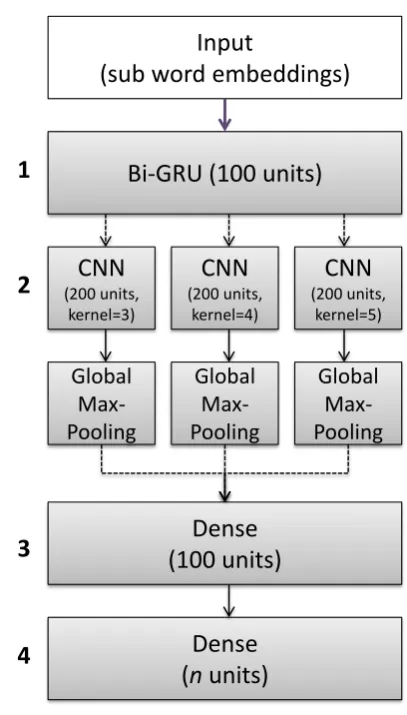
Figure 1: BiGRU-3-CNN model architecture. We use a combination of recurrent and convolutional cells for learning. As input, we rely on (sub-)word embeddings. Dashed lines indicate dropout with rate 0.5 between layers. The last dense layer containsnunits for pre-diction of the probability of each of thenclassification labels per sub-task.
3 Methodology
We utilize a neural network architecture for text classification with randomly initialized weights as a baseline, and together with two types of pre-training layer weights for transfer learning: super-vised and unsupersuper-vised pre-training. Evaluation for model selection is performed via 10-fold cross-validation to determine submission candidates for the SemEval shared task.
Preprocessing: Tweets are tokenized with an
from hashtags. If hashtags contain camel casing, we split them into separate tokens at each upper-case letter occurrence (e.g. ’#DemocratsForPeace’ is tokenized into ’# democrats for peace’). Finally, all tokens are reduced to lower case. In order to account for atypical language, we use sub-word embeddings to represent the input of token se-quences to our model. FastText embeddings ( Bo-janowski et al., 2017) are derived from character n-grams and, thus, provide meaningful word vec-tors even for words unseen during training, mis-spelled words and words specifically used in the context of social media such as emojis. We uti-lize a pre-trained model for the English language published byBojanowski et al.(2017).
Model architecture: We employ a neural
net-work architecture implemented with the Keras framework for Python1as shown in Fig.1. It com-bines a bi-directional Gated Recurrent Unit (GRU) layer (Cho et al., 2014) with 100 units followed by three parallel convolutional layers (CNN), each with a different kernel sizek∈3,4,5, and a filter size 200. The outputs of the three CNN blocks are reduced by global max-pooling and concatenated into a single vector. This vector is then fed into a dense layer with LeakyReLU activation produc-ing a final feature vector of length 100, which is forwarded into the prediction layer (softmax acti-vation). For regularization, dropout is applied to the recurrent layer and to each CNN block after global max-pooling (dropout rate 0.5). For train-ing, we use categorical cross-entropy loss and the Nesterov Adam optimization with a learning rate of 0.002. To account for imbalance in the train-ing set, we set class weights to pay more attention to samples from the under-represented class in the loss function.
Supervised Pre-training: Instead of end-to-end
text classification based on a random initialization of the parameters weights of our model, we seek to increase performance from knowledge trans-fer. For the supervised approach, we pre-train the model weights in a multi-task learning setup with related semantic categories. Instead of one prediction layer (see layer 4 in Fig. 1), we use m prediction layers connected to layer 3 to train m tasks in parallel. The following four publicly available datasets were compiled into one train-ing set: offensive language tweets by (Davidson
1https://keras.io
et al., 2017), flamewar comments from the Ya-hoo news annotated corpus (Napoles et al.,2017), sentiments of tweets from (Go et al., 2009), ag-gressive tweets and Facebook comments from the TRAC shared task (Kumar et al., 2018). A fifth dataset was compiled from about 30,000 randomly sampled tweets in our unsupervised background collection (see next Section) containing either a happy or an angry emoji. The merged dataset con-tains ca. 115k partially labeled instances for pre-training from which a sample of 5k was used as validation set. Missing labels for the combined set were filled by training a separate model for each of themindividual tasks on the respective dataset and predict a label for each instance in the other four datasets. Multi-task pre-training is performed with a batch-size of 256 for 15 epochs.
Unsupervised Pre-training: For the
unsuper-vised approach, we utilize a large background cor-pus of tweets that were collected from the Twit-ter streaming API in 2018. Since the API pro-vides a random fraction of all tweets (1%), lan-guage identification is performed to filter for En-glish tweets only. From this tweet collection, we sample 20 million non-duplicate tweets containing at least two non-URL tokens as our background corpus. As a pre-training task, we first compute a Latent Dirichlet Allocation (LDA) model (Blei et al.,2003) withK = 1,000topics to obtain se-mantic clusters of our background corpus.2 From the topic-document distribution of the resulting LDA model, we determine the majority topic id for each tweet as a target label for prediction dur-ing pre-traindur-ing our neural model. Pre-traindur-ing of the neural model is performed with a batch-size of 256 for 10 epochs.
Transfer learning: Once the neural model has
been pre-trained, we can apply it for learning our actual target task. For this, we need to remove the final prediction layer of the pre-trained model (i.e. Layer 4 in Fig.1) and add a new dense layer for prediction of one of the actual label sets. To prevent the effect of “catastrophic forgetting” of pre-trained knowledge during task-specific model training, we apply a specific layer weight freez-ing strategy as suggested in Wiedemann et al.
(2018). First, the newly added final prediction layer is trained while all other model weights
Task No transfer Supervised Unsupervised
A 76.26 77.46 77.36
B 58.87 61.24 60.57
[image:4.595.308.517.63.270.2]C 56.66 54.16 58.26
Table 1: Model selection (cross-validation, macro-F1)
main frozen. Training is conducted for 15 epochs. After each epoch performance is tested on the vali-dation set. The best performing model state is then used in the next step of fine-tuning the pre-trained model layers. Employing a bottom-up strategy, we unfreeze the lowest layer (1) containing the most general knowledge first, then we continue optimization with the more specific layers (2 and 3) one after the other. During fine-tuning of ev-ery single layer, all other layers remain frozen and training is performed again for 15 epochs select-ing the best performselect-ing model at the end of each layer optimization. In a final round of fine-tuning, all layers are unfrozen.
Ensemble: For each sub-task A, B and C, the
cross-validation results in 10 best performing models from transfer learning per configuration. For submission to the shared task, we select the model with the highest average performance across all folds. Moreover, as a simple ensem-ble classification, predictions of these 10 models on the test set instances are combined via majority vote.
4 Results
Model selection: To compare different types of
pre-training for knowledge transfer, we use the of-ficial shared task metric macro-averaged F1. Ta-ble 1 displays the averaged results of 10-fold cross-validation for all three tasks with no transfer as baseline compared to supervised transfer from multi-task learning and pre-training on unsuper-vised LDA clustering. The results indicate that transfer learning is able to improve performance for offensive language detection for all tasks. With the exception of supervised transfer for task C, the relative improvements are larger the smaller the training datasets get for each of the hierarchically ordered tasks. In general, for the lower level tasks B and C, a severe performance drop can be ob-served compared to task A.
The comparison between unsupervised and su-pervised pre-training delivers a mixed result. While the performance of the supervised
trans-System F1 (macro) Accuracy
Task A
All NOT baseline 0.4189 0.7209
All OFF baseline 0.2182 0.2790
Supervised 0.7887 0.8372
Unsupervised 0.7722 0.8337
Task B
All TIN baseline 0.4702 0.8875
All UNT baseline 0.1011 0.1125
Unsupervised 0.6608 0.8917
Task C
All GRP baseline 0.1787 0.3662
All IND baseline 0.2130 0.4695
All OTH baseline 0.0941 0.1643
Unsupervised 0.5752 0.6761
Table 2: Official test set performance results
fer approach slightly exceeds the unsupervised ap-proach for task A and B, for task C, containing only very small numbers of positive examples for each class in the training dataset, the unsupervised approach clearly beats the network pre-training by supervised near-target category tasks. Supervised transfer even fails to beat the baseline of no trans-fer learning at all. We assume that this type of pre-training tends to over-fit the model if there is only little training data to learn from. Unsuper-vised pre-training on very large datasets, in con-trast, better captures generic language regularities which is beneficial for arbitrary categories.
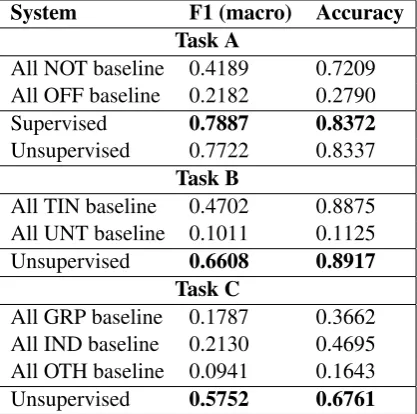
Shared task submissions: Table2displays our
best official results of ensemble classifications submitted to the shared tasks A, B, and C. A sys-tematic comparison between the two compared approaches of pre-training would have required submission of two classifications per sub-task, one for supervised and one for unsupervised pre-training. Unfortunately, the official shared task website only allowed for three submissions per sub-task3. This policy led to the decision to submit only variations / repeated runs of the best classifier we had until the task submission deadline.
Our supervised pre-training approach ranks 14 out of 103 for sub-task A. For sub-tasks B and C, only classifiers pre-training with the unsuper-vised approach have been submitted. They rank 21 out of 75 for B, and 13 out of 65 for C (see
3Also, the official test set was not released yet, so we
[image:4.595.73.286.63.112.2]NOT OFF
Predicted label NOT
OFF
True label
566 54
86 154
Confusion Matrix
[image:5.595.78.526.63.195.2]0.0 0.2 0.4 0.6 0.8
Figure 2: Sub-task A, supervised
TIN UNT
Predicted label TIN
UNT
True label
206 7
19 8
Confusion Matrix
0.0 0.2 0.4 0.6 0.8
Figure 3: Sub-task B, unsupervised
GRP IND OTH
Predicted label GRP
IND
OTH
True label
60 12 6
15 77 8
19 9 7
Confusion Matrix
0.0 0.1 0.2 0.3 0.4 0.5 0.6 0.7
Figure 4: Sub-task C, unsupervised
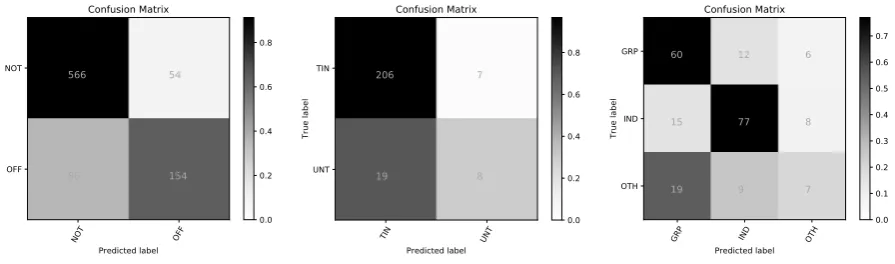
Zampieri et al.(2019b) for a detailed comparison of all submissions). Fig. 2 to 4 show confusion matrices for the three best runs. The ratio be-tween false positives and false negatives for sub-task A is fairly balanced. False positives mainly comprise hard cases where, for instance, swear words are used in a non-offensive manner. In the highly unbalanced annotations for sub-task B, more tweets were wrongly predicted as targeted insults than true yet unpredicted targeted insults. Here we observe many cases which contain offen-sive language and some mentioning of individu-als or groups but both are not directly linked. A similar situation, where actually characteristics of two categories are contained in a tweet, can be ob-served for task C in which the classifier falsely predicts a group target instead of ‘other’.
5 Conclusion
We systematically compared to types of knowl-edge transfer for offensive language detection: supervised and unsupervised pre-training of a BiGRU-3-CNN neural network architecture. The former uses a set of near-target category labeled short texts while the latter relies on a very large set of unlabeled tweets. On average, our system performs among the top 20% of all submissions of the OffensEval 2019 shared task. From our ex-periments, we can draw the following three main conclusions:
• Supervised pre-training with annotated near-target category data is beneficial if the near-target training data is fairly large.
• Unsupervised pre-training with unlabeled data from LDA clustering processes im-proves learning for arbitrary tasks even for fairly small target training datasets.
• For unsupervised pre-training, the benefit of transfer learning compared to the baseline without transfer is larger the smaller the tar-get training dataset tar-gets.
In future work, we plan to further investigate the differences between the two types of transfer learning by systematically investigating the influ-ence of different near-target category datasets, and unsupervised topic clustering methods other than LDA for pre-training deep neural network archi-tectures.
References
Steven Bird, Ewan Klein, and Edward Loper. 2009. Natural Language Processing with Python: An-alyzing Text with the Natural Language Toolkit. O’Reilly.
David M. Blei, Andrew Y. Ng, and Michael I. Jordan. 2003. Latent Dirichlet Allocation. Journal of Ma-chine Learning Research, 3:993–1022.
Piotr Bojanowski, Edouard Grave, Armand Joulin, and Tomas Mikolov. 2017. Enriching word vectors with subword information. Transactions of the Associa-tion for ComputaAssocia-tional Linguistics, 5:135–146.
Kyunghyun Cho, Bart van Merrienboer, Caglar Gul-cehre, Dzmitry Bahdanau, Fethi Bougares, Holger Schwenk, and Yoshua Bengio. 2014. Learning phrase representations using RNN encoder–decoder for statistical machine translation. InProceedings of the 2014 Conference on Empirical Methods in Nat-ural Language Processing (EMNLP), pages 1724– 1734, Doha, Qatar. ACL.
Mai ElSherief, Vivek Kulkarni, Dana Nguyen, William Yang Wang, and Elizabeth Belding. 2018. Hate Lingo: A Target-based Linguistic Analysis of Hate Speech in Social Media. arXiv preprint arXiv:1804.04257.
Paula Fortuna and S´ergio Nunes. 2018. A Survey on Automatic Detection of Hate Speech in Text. ACM Computing Surveys (CSUR), 51(4):85:1–85:30.
Alec Go, Richa Bhayani, and Lei Huang. 2009. Twit-ter sentiment classification using distant supervision. CS224N Project Report, Stanford, 1(12):1–6.
Ritesh Kumar, Atul Kr. Ojha, Shervin Malmasi, and Marcos Zampieri. 2018. Benchmarking Aggression Identification in Social Media. InProceedings of the First Workshop on Trolling, Aggression and Cyber-bulling (TRAC), pages 1–11, Santa Fe, NM, USA.
Shervin Malmasi and Marcos Zampieri. 2017. Detect-ing Hate Speech in Social Media. InProceedings of the 2017 International Conference Recent Ad-vances in Natural Language Processing (RANLP), pages 467–472, Varna, Bulgaria. ACL.
Shervin Malmasi and Marcos Zampieri. 2018. Chal-lenges in Discriminating Profanity from Hate Speech. Journal of Experimental & Theoretical Ar-tificial Intelligence, 30:1–16.
Courtney Napoles, Joel Tetreault, Enrica Rosata, Brian Provenzale, and Aasish Pappu. 2017. Finding Good Conversations Online: The Yahoo News Annotated Comments Corpus. InProceedings of The 11th Lin-guistic Annotation Workshop, pages 13–23, Valen-cia, Spain. ACL.
Anna Schmidt and Michael Wiegand. 2017. A Sur-vey on Hate Speech Detection Using Natural Lan-guage Processing. InProceedings of the Fifth Inter-national Workshop on Natural Language Process-ing for Social Media., pages 1–10, Valencia, Spain. ACL.
Gregor Wiedemann, Eugen Ruppert, Raghav Jindal, and Chris Biemann. 2018. Transfer Learning from LDA to BiLSTM-CNN for Offensive Language De-tection in Twitter. InProceedings of GermEval Task 2018, 14th Conference on Natural Language Pro-cessing (KONVENS), pages 85–94, Vienna, Austria.
Michael Wiegand, Melanie Siegel, and Josef Rup-penhofer. 2018. Overview of the GermEval 2018 Shared Task on the Identification of Offensive Lan-guage. InProceedings of GermEval Task 2018, 14th Conference on Natural Language Processing (KON-VENS), pages 1–10, Vienna, Austria.
Marcos Zampieri, Shervin Malmasi, Preslav Nakov, Sara Rosenthal, Noura Farra, and Ritesh Kumar. 2019a. Predicting the Type and Target of Offen-sive Posts in Social Media. In Proceedings of the 2019 Conference of the North American Chapter of the Association for Computational Linguistics (NAACL), Minneapolis, MN, USA.
Marcos Zampieri, Shervin Malmasi, Preslav Nakov, Sara Rosenthal, Noura Farra, and Ritesh Kumar. 2019b. SemEval-2019 Task 6: Identifying and Cat-egorizing Offensive Language in Social Media (Of-fensEval). InProceedings of the 13th International Workshop on Semantic Evaluation (SemEval), Min-neapolis, MN, USA. ACL.