ECNU at SemEval-2016 Task 4: An Empirical Investigation of Traditional
NLP Features and Word Embedding Features for Sentence-level and
Topic-level Sentiment Analysis in Twitter
Yunxiao Zhou1, Zhihua Zhang1, Man Lan1,2∗
1Department of Computer Science and Technology,
East China Normal University, Shanghai, P.R.China
2Shanghai Key Laboratory of Multidimensional Information Processing
{10122130215, 51131201039}@ecnu.cn, [email protected]∗
Abstract
This paper reports our submissions to Task 4, i.e., Sentiment Analysis in Twitter (SAT), in SemEval 2016, which consists of five subtasks grouped into two levels: (1) sentence level, i.e., message polarity classification (subtask A), and (2) topic level, i.e., tweet classification and quantification according to two-point s-cale (subtask B and D) or five-point ss-cale (sub-task C and E). We participated in all these five subtasks. To address these subtasks, we inves-tigated several traditional Natural Language Processing (NLP) features including senti-ment lexicon, linguistic and domain specific features, and word embedding features togeth-er with suptogeth-ervised machine learning methods. Officially released results showed that our sys-tems rank above average.
1 Introduction
In recent years, with the emergence of social media, more and more users have shared and obtained in-formation through microblogging websites, such as Twitter. As a result, a huge amount of available data attracts a lot of researchers. SemEval 2016 provides such a universal platform for researchers to explore in the task of Sentiment Analysis in Twitter (Nakov et al., 2016) (Task 4), which includes five subtasks grouped into two levels, i.e., sentence level and top-ic level. Subtask A is a sentence level task aiming at sentiment polarity classification of the whole tweet. The other four subtasks are at topic level, i.e., given one topic, the sentiment polarity of tweets are clas-sified or assigned by a two-point scale (i.e., subtask
B and D) and by a five-point scale (i.e., subtask C and E). Specifically, subtask B is to identify the
sen-timent polarity label (i.e, Positive andNegative) of
tweets with respect to the given topic while subtask D aims at estimating the sentiment distribution of tweets with respect to the given topic. Both subtask B and D are on a two-point scale. The purposes of subtask C and E are similar with that of subtask B and D, except for using a five-point scale, that is, the class labels are of5values, i.e,2,1,0, -1and -2
rep-resentingVery Positive, Positive, Neutral, Negative
andVery Negative.
Given the character limitations on tweets, senti-ment orientation classification on tweets can be re-garded as a sentence-level sentiment analysis. Many researchers focus on feature engineering to improve the performance of SAT. For example, (Turian et al., 2010; Liu, 2012; Zhang et al., 2006) showed that
one-hot representation onn-gram features is a
rela-tively strong baseline. Furthermore, (Mohammad et al., 2013) proposed a state-of-the-art model which implemented several sentiment lexicons and a vari-ety of manual features. Apart from the traditional methods, more and more researchers have paid their attention to use deep learning methods. Word em-bedding is one of such methods, where each word is represented as a continuous, low-dimension vec-tor and has been applied into NLP tasks as a crit-ical and fundamental step. Commonly, there are several types of word embedding models, e.g.,
Ben-gio proposed aNeural Probabilistic Language
Mod-el (NNLM) in (Bengio et al., 2003) to learn dis-tributed representation for each word and Mikolov
simplified the structure of NNLM and presented
wo efficient log-linear models in (Mikolov et al., 2013). Moreover, (Zhang and Lan, 2015; Tang et al., 2014) further proposed learning sentiment-based word embeddings to settle SAT. Meanwhile, topic-based opinion always adheres on certain words or phrases rather than whole tweet. To address topic-based SAT, (Wang et al., 2011) used the hashtag information, (Lin and He, 2009) utilized the topic model to extract topic information from tweets and (Zhang et al., 2015) picked out related words rather than all words in whole tweet as pending words for consequential feature extraction.
Previous work showed that feature engineering has a significant impact on this task. Thus, in this work, we presented multiple types of traditional NLP features to perform SAT, e.g., sentiment
lex-icon features (e.g., MPQA, IMDB, Bing Liu
opin-ion lexicon, etc), linguistic features (e.g., negations,
n-gram at the word level and character level, etc)
and tweet specific features (e.g., emoticons, capi-tal words, elongated words, hashtags, etc,). Besides, the word embedding features were adopted. We also performed a series of experiments to select effective feature subsets and supervised machine learning al-gorithms with optimal parameters.
The rest of this paper is organized as follows. Section 2 describes our system framework including preprocessing, feature engineering, evaluation met-rics, etc. The experiments are reported in Section 3. Finally, this work is concluded in Section 4.
2 System Description
2.1 Data Preprocessing
With the aid of approximate 5,000 abbreviations
and slangs collected from Internet, we converted the
informal writing into regular forms, e.g.,“asap”
re-placed by“as soon as possible”,“3q”replaced by
“thank you”, etc. And we recovered the
elongat-ed words to their original forms, e.g.,“soooooo”to
“so”. Finally, the processed data was performed for
tokenization, POS tagging and parsing by using
C-MU Parsing tools(Owoputi et al., 2013).
2.2 Feature Engineering
We used four types of features, i.e, linguistic
fea-tures (e.g., negations, n-gram, etc), tweet specific
features (e.g., emoticons, all-caps, hashtags, etc),
sentiment lexicon features (the score calculated from eight sentiment lexicons) and word embedding fea-tures.
2.2.1 Linguistic Features:
• Character n-grams: The character-level n
-grams are used, wheren={3,4,5}.
• Word n-grams: The word-level unigrams, bi-grams,trigrams and4-grams are adopted.
• POS: The absolute frequency of each
part-of-speech tag is recorded.
• Negation: Negation in a message always re-verses its sentiment orientation. We
collect-ed29negations from Internet and recorded the
frequency of negations in the whole tweet.
• Cluster: The CMU TweetParser toolprovides
1,000token clusters produced with the Brown
clustering algorithm on56million English
lan-guage tweets. We recorded the existence of
to-kens in tweets with respect to these1,000
clus-ters.
• Dependency triple: The dependency tree is
generated by Stanford Parser tool and each
tweet contains several dependency triples (e.g.,
relation(government, dependent)). We used a binary feature to record if a dependency triple is present or absent in a tweet.
2.2.2 Tweet Specific Features:
• Punctuation:Punctuation marks (e.g, exclama-tion mark (!) and quesexclama-tion mark (?) ) usually indicate the strength of sentiment. Therefore, we recorded the numbers of these marks in iso-lation and in combination. Besides, the posi-tion of punctuaposi-tion in tweet is also an impor-tant clue for sentiment, thus we used a binary feature to indicate whether it is the last token of tweet.
• All-caps:The number of words in uppercase is recorded.
• Hashtag:We recorded the number of hashtags
• Emoticon:We collected67emoticons from
In-ternet and this feature type records the number of positive and negative emoticons respective-ly. Moreover, two binary values are to record whether the last token is a positive or negative emoticon respectively.
• Elongated: It indicates the number of elongat-ed words in the raw text of tweet.
2.2.3 Sentiment Lexicon Features (SentiLexi): We employed the following eight sentiment
lexi-cons to extract sentiment lexicon features: Bing Liu
lexicon1,General Inquirer lexicon2,AFINN3,
IMD-B4,MPQA5,NRC Emotion Sentiment Lexicon6,
NR-C Hashtag Sentiment Lexicon7, andNRC
Sentimen-t140 Lexicon8. Generally, we transformed the scores of all words in all sentiment lexicons to the range of
-1 to 1, where the positive number indicates
posi-tive sentiment and the minus sign denotes negaposi-tive sentiment.
The following six scores are calculated on the w-hole data for each sentiment lexicon: (1) the ratio of positive words to all words, (2) the ratio of negative words to all words, (3) the maximum sentiment s-core, (4) the minimum sentiment ss-core, (5) the sum of sentiment scores, and (6) the sentiment score of the last word in tweet. If a word does not exist in one sentiment lexicon, its corresponding score is set to0.
2.2.4 Word Embedding Features:
In this work, we employed three different types of word vectors. The general word vectors are trained by Google on huge amount of News, which is a d-ifferent domain from Twitter. The other two sen-timent word vectors are both trained on tweets but using different methods. The purpose of this feature
1
http://www.cs.uic.edu/liub/FBS/sentiment-analysis.html#lexicon
2http://www.wjh.harvard.edu/inquirer/homecat.htm 3http://www2.imm.dtu.dk/pubdb/views/publication
detail-s.php?id=6010
4http://anthology.aclweb.org//S/S13/S13-2.pdf#page=444 5http://mpqa.cs.pitt.edu/
6http://www.saifmohammad.com/WebPages/lexicons.html 7
http://www.umiacs.umd.edu/saif/WebDocs/NRC-Hashtag-Sentiment-Lexicon-v0.1.zip
8http://help.sentiment140.com/for-students/
type is to examine the effects of word embedding and sentiment word embedding on performance.
• General Word Vector (GeneralW2V): We
adopted theword2vectool9to obtain word
vec-tors with the dimensionality of300(i.e.,
Gen-eralW2V), trained on 100 billion words from
Google News.
• Sentiment Word Vector (SWV): (Zhang and
Lan, 2015) proposed a Combined-Sentiment
Word Embedding Model to learn
sentimen-t word vecsentimen-tors (SWV) for sentiment analysis
task. In this work, we learnSWV on NRC140
tweet corpus(Go et al., 2009), where the corpus
is made up of 1.6 million tweets (0.8 million
positive and0.8 million negative). The vector
dimension is set as100.
• Sentiment-specific Word Embedding (SSWE):
Similar withSWV, the sentiment-specific word
embedding model proposed by (Tang et al., 2014) used a multi-hidden-layers neural
net-work to trainSSWEwith dimensionality of50.
To convert the above word vectors into a sentence
vector, we simply adopted themin,maxandaverage
operations. Obviously, this combination strategy ne-glects the word sequence in tweet but it is simple and straightforward. As a result, the final sentence vec-torV(s)was concatenated byVmin(s),Vmax(s)and Vaverage(s).
2.3 Evaluation Metrics
For subtask A, we used the macro-averaged F
s-core of positive and negative classes (i.e.,Fmacro=
Fpos+Fneg
2 ) to evaluate the performance. Subtask B
and D just contain positive and negative labels. The
official metric for subtask B ismacro-averaged
re-call among positive and negative (i.e., Rmacro =
RP os+RN eg
2 ). As for subtask D, it isKullback-Leibler
Divergence(KLD) among distributions of two class-es (i.e., KLD(pos, neg) = Pcj∈pos,negP(cj) · logP(cj)
ˆ
P(cj), where P denotes the probability of
pre-dicted label andPˆ is the probability of gold label).
There are5classes existing in subtask C and E, and
the organizers adoptedMacroaveraged Mean Abso-lute Error (i.e., M AEM) and Earth Mover’s
Dis-tance (EM D) among 5 predefined classes for two
subtasks respectively, where the detail information of two metrics for evaluation is described in the
of-ficial document available on the website10.
3 Experiments
3.1 Datasets
Since only tweet IDs are provided by organizers, dif-ferent participants may collect difdif-ferent numbers of tweets due to missing tweets or system errors. Sub-task B and D are of the same data set. And subSub-task C and E share one common data set. The statistics of all datasets for these subtasks are shown in Tables 1, 2, and 3, respectively.
For subtask A, the training data set consist-s of four partconsist-s which are consist-shown in Table 1, i.e.,
2013train,2013dev,2016trainand2016dev. The
data set 2013train means SemEval-2013 Task 2
training data set (Nakov et al., 2013), and the fol-lowing data sets are named in the same way. Ac-tually, in consideration of the difference of
polar-ity distribution between data set 2016devtest and
2013&2014test, we just adopted 2016devtest as
development data. For subtask B, C, D and E, the data is divided into many topic sets.
dataset Positive Negative Neutral Total
train
2013train 3,250(37%) 1,276(15%) 4,151(48%) 8,677 2013dev 575(35%) 340(20%) 739(46%) 1,654 2016train 2,839(51%) 787(14%) 1,892(34%) 5,518 2016dev 772(42%) 359(20%) 702(38%) 1,833 dev 2016devtest2013&2014test 5,078(40%)886(49%) 2,142(16%)287(16%) 5,580(44%)626(35%) 12,8001,799 test 2016test 7,059(34%) 3,231(16%) 10,342(50%) 20,632
Table 1:Statistics of data sets in training (train), development (dev), test (test) data for subtask A.
dataset Positive Negative Total train 4,191(81%) 997(19%) 5,188 dev 1,027(81%) 238(19%) 1,265 test 8,212(78%) 2,339(22%) 10,551
Table 2: Statistics of data sets in training, development, test data for subtask B and D.
3.2 Experiments on Training Data
In order to improve the performance of sentimen-t analysis, we performed feasentimen-ture selecsentimen-tion
experi-10http://alt.qcri.org/semeval2016/task4/data/uploads/eval.pdf
dataset 2 1 0 -1 -2 Total
[image:4.612.313.543.57.88.2]train 475(6%) 3,815(50%) 2,295(30%) 906(12%) 120(2%) 7,611 dev 123(7%) 900(50%) 535(30%) 211(12%) 29(1%) 1,798 test 382(2%) 7,830(38%) 10,081(49%) 2,201(10%) 138(1%) 20,632
Table 3:Statistics of data sets in training, development, test set for subtask C and E.
ments on all subtasks and the optimum feature sets are shown in Table 4. From Table 4, it is interesting to find that: (1) Negation features and tweet spe-cific features such as emoticon and all-caps make contributions to almost all subtasks. (2) The fea-ture set with the best performance of subtask B is not quite beneficial for subtask D even though they have the same data set, perhaps because of the es-sential difference between binary classification and binary quantification: in the latter, errors of differ-ent polarity compensate each other. The similar ob-servation is found in subtask C and E. (3) The sen-timent lexicon features make contributions to per-formance improvement of subtask A, B and C, but are not quite useful for subtask D and E. A possible reason is that the latter two subtasks focus on quan-tification analysis while the sentiment lexicon only contains sentiment orientation rather than sentiment strength. (4) The word embedding features are not as effective as expected. It maybe because we ob-tained sentence vectors by the simplest combination method described above, which does not take into account contextual information and semantic rela-tions among words.
Besides, since subtask B, C, D and E focus on topic-level sentiment analysis, we tried to extract features from related words rather than whole tweet. But the preliminary experimental results showed that extracting features from related words under-performed the latter strategy for extracting features. The possible reason is that in many cases a tweet only has one single sentiment polarity. Thus the sentiment polarity of sentence can always represent that of topic and extracting features from the related words may drop important information.
3.3 Learning Algorithm
For these subtasks, we examined several super-vised machine learning classification algorithms with different parameters (e.g., Logistic Regres-sion withc={0.1,1}, Support Vector Machine with
Features Subtask A (Fmacro) Subtask B (Rmacro) Subtask C (M AEM) Subtask D(KLD) Subtask E (EM D)
SentiLexi Sentiment Lexicon √ √ √
Linguistic
Unigram √ √
Bigram √
Trigram √ √ √
4-gram √
3-char √ √
4-char √ √ √
5-char √
POS √
Negation √ √ √ √ √
Cluster √
Dependency Triple √ √ √
Tweet-specific
All-caps √ √ √ √ √
Elongated √ √
Punctuation √ √
Emoticon √ √ √ √
Hashtag √
Word Embedding GoogleW2V
√ √
SWV √
SSWE √
[image:5.612.81.531.57.216.2]Results 0.63 0.82 0.87 0.01 0.03
Table 4:Results of feature selection experiments for subtask A, B, C, D and E in terms of the corresponding evaluation metrics on the training data, where√indicates this feature was employed in the corresponding subtask system.
Forest withn={20,50,100,400,1000,2000}, SGD
withloss={hinge, log}, etc). Finally, Logistic
Re-gression withc=1implemented inLiblinear11was
adopted for all five subtasks for its good perfor-mance in preliminary experiments.
3.4 Results on Test Data
Based on the optimum feature sets shown in Table 4 and configuration of classifiers described above, we trained separate models for each subtask.
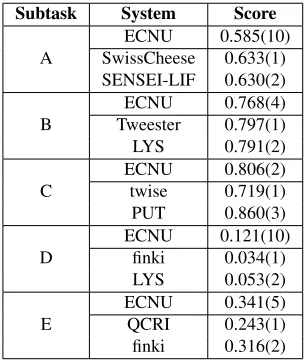
Subtask System Score
A
ECNU 0.585(10) SwissCheese 0.633(1) SENSEI-LIF 0.630(2)
B
ECNU 0.768(4) Tweester 0.797(1) LYS 0.791(2)
C
ECNU 0.806(2) twise 0.719(1) PUT 0.860(3)
D
ECNU 0.121(10) finki 0.034(1) LYS 0.053(2)
[image:5.612.109.263.413.593.2]E ECNUQCRI 0.341(5)0.243(1) finki 0.316(2)
Table 5: Performance of our systems and the top-ranked sys-tems on all five subtasks. The numbers in the brackets are the official ranking.
Table 5 shows the results of our systems and the top-ranked systems on all five subtasks. Our
sys-tems ranked 10th out of 34 submissions for
sub-11https://www.csie.ntu.edu.tw/ cjlin/liblinear/
task A, 4th/19 for subtask B, 2nd/11 for subtask
C, 10th/14 for subtask D and 5th/10 for subtask
E. Compared with the top ranked systems, there is much room for improvement in our work. Although word embedding features were adopted in this work, we used the simplest combination method to convert word vectors to sentence vectors. The effective con-volution method is expected to be able to improve the performance of sentiment analysis.
4 Conclusion
In this paper, we extracted several traditional NLP features(e.g., linguistic features, tweet specific fea-tures, etc) and word embedding features from whole tweet and constructed classifiers using supervised machine learning algorithms to accomplish senti-ment analysis towards sentence level(i.e., subtask A) and topic level(i.e., subtask B, C, D and E). Word embedding features are not as effective as expected since the way of using these features are quite simple and naive, thus it is too hasty to make a conclusion that the word embedding features make marginal contribution. In future work, we consider to focus on developing advanced convolution neural network to model sentence with the aid of sentiment word vector.
Acknowledgements
Software for Internet of Things (ZF1213).
References
Yoshua Bengio, R´ejean Ducharme, Pascal Vincent, and Christian Janvin. 2003. A neural probabilistic lan-guage model. The Journal of Machine Learning Re-search, 3:1137–1155.
Alec Go, Richa Bhayani, and Lei Huang. 2009. Twit-ter sentiment classification using distant supervision.
CS224N Project Report, Stanford, pages 1–12. Chenghua Lin and Yulan He. 2009. Joint sentiment/topic
model for sentiment analysis. In Proceedings of the 18th ACM conference on Information and knowledge management, pages 375–384. ACM.
Bing Liu. 2012. Sentiment analysis and opinion mining.
Synthesis Lectures on Human Language Technologies, 5(1):1–167.
Tomas Mikolov, Kai Chen, Greg Corrado, and Jeffrey Dean. 2013. Efficient estimation of word representa-tions in vector space. arXiv preprint arXiv:1301.3781. Saif Mohammad, Svetlana Kiritchenko, and Xiaodan Zhu. 2013. NRC-Canada: Building the state-of-the-art in sentiment analysis of tweets. In Second Joint Conference on Lexical and Computational Semantics (*SEM), Volume 2: Proceedings of the Seventh Inter-national Workshop on Semantic Evaluation (SemEval 2013), pages 321–327, Atlanta, Georgia, USA, June. Preslav Nakov, Sara Rosenthal, Zornitsa Kozareva,
Veselin Stoyanov, Alan Ritter, and Theresa Wilson. 2013. SemEval-2013 Task 2: Sentiment analysis in Twitter. In Second Joint Conference on Lexical and Computational Semantics (*SEM), Volume 2: Pro-ceedings of the Seventh International Workshop on Se-mantic Evaluation (SemEval 2013), pages 312–320, Atlanta, Georgia, USA, June.
Preslav Nakov, Alan Ritter, Sara Rosenthal, Veselin Stoy-anov, and Fabrizio Sebastiani. 2016. SemEval-2016 task 4: Sentiment analysis in Twitter. InProceedings of the 10th International Workshop on Semantic Eval-uation, SemEval ’16, San Diego, California, June. As-sociation for Computational Linguistics.
Olutobi Owoputi, Brendan O’Connor, Chris Dyer, Kevin Gimpel, Nathan Schneider, and Noah A Smith. 2013. Improved part-of-speech tagging for online conversa-tional text with word clusters. InHLT-NAACL, pages 380–390.
Duyu Tang, Furu Wei, Nan Yang, Ming Zhou, Ting Li-u, and Bing Qin. 2014. Learning sentiment-specific word embedding for twitter sentiment classification. In The Annual Meeting of the Association for Com-putational Linguistics, pages 1555–1565.
Joseph Turian, Lev Ratinov, and Yoshua Bengio. 2010. Word representations: a simple and general method for semi-supervised learning. InThe Annual Meeting of the Association for Computational Linguistics, pages 384–394. Association for Computational Linguistics. Xiaolong Wang, Furu Wei, Xiaohua Liu, Ming Zhou, and
Ming Zhang. 2011. Topic sentiment analysis in Twit-ter: a graph-based hashtag sentiment classification ap-proach. InProceedings of the 20th ACM internation-al conference on Information and knowledge manage-ment, pages 1031–1040.
Zhihua Zhang and Man Lan. 2015. Learning sentiment-inherent word embedding for word-level and sentence-level sentiment analysis. In2015 International Con-ference on Asian Language Processing, IALP. Kuo Zhang, Hui Xu, Jie Tang, and Juanzi Li. 2006.
Key-word extraction using support vector machine. In Ad-vances in Web-Age Information Management, pages 85–96. Springer.