LIMSI-COT at SemEval-2016 Task 12:
Temporal relation identification using a pipeline of classifiers
Julien TourilleLIMSI, CNRS, Univ. Paris-Sud, Universit´e Paris-Saclay [email protected]
Olivier Ferret CEA, LIST,
Gif-sur-Yvette, F-91191 France. [email protected]
Aur´elie N´ev´eol LIMSI, CNRS, Universit´e Paris-Saclay [email protected]
Xavier Tannier LIMSI, CNRS, Univ. Paris-Sud, Universit´e Paris-Saclay [email protected]
Abstract
SemEval 2016 Task 12 addresses temporal reasoning in the clinical domain. In this paper, we present our participation for relation ex-traction based on gold standard entities (sub-tasks DR and CR). We used a supervised approach comparing plain lexical features to word embeddings for temporal relation identi-fication, and obtained above-median scores.
1 Introduction
SemEval 2016 Task 12 offers 6 subtasks address-ing temporal reasonaddress-ing in the clinical domain usaddress-ing the THYME corpus (Styler IV et al., 2014). This corpus provides annotated clinical and pathological notes from colon cancer patients. The first group of subtasks concerns the identification of time and event expressions within raw text. The second group of subtasks deals with the identification of tempo-ral relations. The latter consists of two subtasks. In theDocument Creation Time Relationsubtask (DR), participants are challenged to identify relations be-tween the events and the document creation time. For the Container Relation subtask (CR), partici-pants have to identity container relations between entities. Participants may submit either a complete system extracting entities and relations or focus on either the entity extraction or relation extraction (us-ing the gold standard entities provided by the orga-nizers). More details about the task and the defini-tion of each subtask can be found in Bethard et al. (2016).
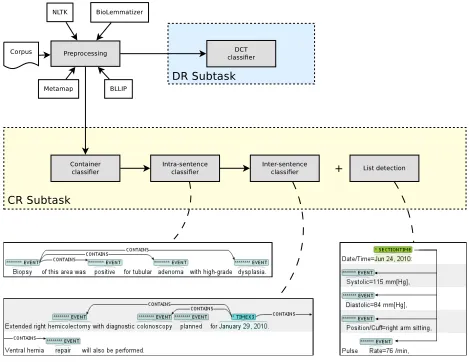
In this paper, we present our submission for the CR and DR subtasks based on gold-standard entities (phase 2). Our global approach, which is illustrated in Figure 1, tackles the identification of temporal relations as a set of supervised classification tasks. We submitted two runs, one using plain lexical fea-tures and one using word embeddings computed on a large clinical corpus. We obtained scores well above the median scores in both subtasks.
The remainder of this paper is organized as fol-lows. Section 2 presents our system for the DR sub-task while Section 3 describes our system for the CR subtask. Section 4 gives an overview of the system implementation. Finally, Section 5 presents our re-sults.
2 Document Creation Time Relation (DR) Subtask
We treated the subtask as a supervised classification problem where each EVENT entity was classified into four categories (Before,Before-Overlap, Over-lap,After).
We extracted lexical, contextual and structural features from the texts. Regarding the lexical fea-tures ofEVENTentities, we took their surface forms, their gold standard attributes (type, modality, de-greeandpolarity), their lemma(s)1, as well as their
Part-Of-Speech (POS) and Coarse Part-Of-Speech (CPOS) tags. We also extracted the semantic types
1The span of anEVENTentity can overlap with several
to-kens.
Figure 1:Overview of the processing chain
and semantic groups of the medical entities that have been detected by Metamap (Aronson and Lang, 2010) and that share a span overlap with theEVENT
entities.
Concerning the contextual features, we extracted the gold standard entities that were present in the right and left contexts2 within the sentence. We
added the corresponding lemmas, surface forms, types, POS and CPOS tags, as well as the corre-sponding semantic groups and semantic types. We also added the lemmas of the tokens occurring in both left and right contexts. At the section level, we added entities occurring before and after theEVENT
entity within the section. We used the same set of features as the one we used for the intra-sentence context: surface forms, lemmas, types, POS and CPOS tags, semantic types and semantic groups. We
2There is no size restriction on the contexts
also added the gold standard attributes of these enti-ties.
Regarding the structural features, we used the sition of the sentence within the section and the po-sition of the section within the document. We added the number of tokens and entities occurring before and after theEVENTentity within the section, and the number of entities figuring before and after the
EVENTentity at the document level.
3 Container Relation (CR) Subtask 3.1 Principles
restriction would lead to unbalanced training exam-ples where the negative examexam-ples largely outnumber the positive examples. Hence, some choices have been made to reduce the number of training exam-ples.
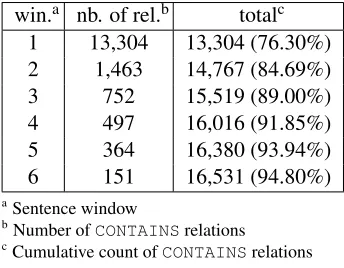
The analysis of the training corpus shows that a large majority – around 76% – of the CONTAINS
relations are intra-sentence relations, which means that the problem of their scope actually occur for one quarter only. The remaining relations, called inter-sentence relations, spread over at least two sen-tences. Given this context, we have built two sep-arate classifiers, the first one for the intra-sentence relations, the second one for the inter-sentence re-lations. This distinction has two main advantages: first, it reduces drastically the number of negative examples, which produces better results as we ob-served on our development set; second, the intra-sentence classifier can benefit from a larger and richer set of features coming from sentence-level lin-guistic analyzers.
Concerning the inter-sentence relations, consider-ing all pairs ofEVENTand/or TIMEentities would still give us a very large amount of negative exam-ples. We first observed that all of them were con-tained within sections (no relation overlaps section boundaries). Within the scope of a section, we fur-ther noticed that inter-sentence relations within a 3-sentence window covered approximately 89% over all existing relations. A wider window would bring too much noise while giving us a very small bump on coverage. Table 1 shows the number of covered relations according to the size of the window, ex-pressed in the number of sentences. The first line corresponds to the intra-sentence level (window=1). To further reduce the number of candidates for both inter- and intra-sentence classifiers, we trans-formed the 2-category problem (contains vs. no-relation) into a 3-category classification problem (contains, is-contained or no-relation). Instead of considering all permutations of events within a sen-tence or a sensen-tence-window, we considered all pairs of events from left to right, changing when neces-sary the contains relations into is-contained rela-tions. This strategy allowed us to divide by a fac-tor of two the number of candidates. We obtained 111,349 pairs for the intra-sentence classifier and 311,284 pairs for the inter-sentence classifier.
win.a nb. of rel.b totalc
1 13,304 13,304 (76.30%)
2 1,463 14,767 (84.69%)
3 752 15,519 (89.00%)
4 497 16,016 (91.85%)
5 364 16,380 (93.94%)
6 151 16,531 (94.80%)
aSentence window
[image:3.612.339.511.60.194.2]bNumber ofCONTAINSrelations cCumulative count ofCONTAINSrelations
Table 1: CONTAINS relations according to sentence window size. Window of size 1 cor-responds to the intra-sentence level.
Some entities are more likely to be containers. By example,SECTIONTIME and TIMEXentities are, by nature, potential containers. This is also the case for some medical events. For instance, asurgical op-erationmay contain other events such asbleedingor
suturing. It will not be the same with the two latter in most cases. Following this observation, we have built a model to classify entities as being a potential
containerornot. As we will show in Section 5, this classifier obtain a high accuracy. We used its out-put as feature for our intra- and inter-sentence clas-sifiers.
Finally, we developed a rule-based module to cap-ture specificCONTAINSrelations. There are some strong regularities in the handling of laboratory re-sults where the firstSECTIONTIMEcontains all the results, which are expressed with EVENT entities (see an example in Figure 1). The module we have built aims at capturing these inter-sentential regular-ities with the use of rules.
To summarize, our system is composed of four modules:
1. Container detection module: entities are clas-sified according to whether or not they are the source of one or moreCONTAINSrelations;
2. Intra-sentence relation module: combina-tions of entities within sentences are consid-ered (relations contains, is-contained or no-relation);
considered. We use the same relation classes as those used for intra-sentence relations;
4. List detection module: specific laboratory re-sults written as lists are handled via manual rules.
3.2 Feature Extraction
For the container classifier, we used the form and the type of the considered entity, as well as its gold standard attributes. We extracted the semantic types and semantic groups of the entities that have been detected by Metamap and that share an over-lap with the considered entity. We also extracted its lemma(s), POS and CPOS tags. Concerning the contextual features, we extracted the entities that are present in both left and right contexts within the sen-tence boundaries. Similarly to the DR subtask, we used entity forms, types, semantic groups and se-mantic types, POS and CPOS tags and lemmas. We also added the tokens from both left and right con-texts. We used the corresponding lemmas, POS and CPOS tags. Finally, we added the number of entities within the sentence and the number of entities before and after the considered entity within the sentence.
For the intra-sentence classifier, we extracted the forms, semantic types and semantic groups, and the gold standard attributes of the two considered en-tities. We added their lemmas and their POS and CPOS tags. We added the number of tokens occur-ring between the two entities. We also extracted the entities occurring between the two considered enti-ties. We used their entity types, gold standard at-tributes, semantic groups and semantic types. We added the number of entities that have been clas-sified as containers by our container classification model and the number of entities that appear be-tween the pair of entities. Finally, we added the syn-tactic paths3 between the two entities (from left to
right). We also added the results of our contain clas-sification model for the two considered entities.
For the inter-sentence classifier, we used similar features. We extracted the forms, types, gold stan-dard attributes and semantic groups and semantic types of the two considered entities. We also ex-tracted features from the results of the intra-sentence
3Several paths are considered when the entities spread over
more that one token.
classifier. We specified whether the considered en-tities are intra-sentence containers or are contained by other entities at the intra-sentence level. We also extracted entities that are positioned between the two considered entities. We used entity types, gold-standard attributes, semantic groups and semantic types. We also added a feature specifying if these entities are containers at the intra-sentence level and the number of entities between the considered pair of entities. Finally we added the positions, at the section level, of the sentences in which the consid-ered events are embedded.
4 System Implementation 4.1 Strategies
We implemented two strategies to represent the lex-ical features in both the DR and CR subtasks. In the first one, we used the plain forms of the different lex-ical attributes we mentioned (Strategy 1). In the sec-ond strategy, we substituted the lemmas and forms with word embeddings (Strategy 2). These em-beddings have been computed on the Mimic 2 cor-pus (Saeed et al., 2011) using the word2vec tool with a CBOW model4(Mikolov et al., 2013). We used the
mean of the vectors for multi-word units. Lexical contexts are thus represented by 200-dimensional vectors. When several contexts are considered e.g. right and left, several vectors are used.
4.2 Algorithm Selection
A grid search strategy was applied to select the most appropriate machine learning algorithm and its pa-rameters. For Strategy 1, three algorithms were con-sidered in our search: Random Forests, Linear Sup-port Vector Machine (liblinear) and SupSup-port Vector Machine with a RBF kernel (libsvm). For Strat-egy 2, we only considered the Linear Support Vector Machine for the CR task and Random Forests for the DR task.
In both cases, 5-fold cross-validation was used to choose the algorithm and its parameters. We also implemented statistical feature selection as part of the grid search for Strategy 1 reducing progressively the number of attributes, using ANOVA F-test.
4Parameters used during computation: min-count: 5; vector
Run Classifier Algorithm Parameters % feat.a
1c
CONTAINER SVM (RBF) C=10, gamma=0.01 60
INTRA SVM (RBF) C=10, gamma=0.01 60
INTER SVM (RBF) C=1000, gamma=0.01 100
DCT SVM (Linear) C=1, tolb=0.0001, normalization=l2, loss function=hinge 100
2d
CONTAINER LinearSVM C=1, tol=0.01, normalization=l2, loss function=hinge 100 INTRA SVM (Linear) C=1, tol=0.01, normalization=l2, loss function=squared hinge 100 INTER SVM (Linear) C=1000, tol=0.01, normalization=l2, loss function=hinge 100 DCT Random Forests max features=auto, criterion=entropy, estimators=100 100
aPercentage of feature space kept for final submission (using ANOVA F-test) bTolerance for stopping criteria
[image:5.612.75.538.61.201.2]cUsing plain text features dUsing word embeddings
Table 2: Machine learning algorithms and parameters used for the final submission
The machine learning algorithms used for the fi-nal submission are presented in Table 2 together with their parameters and the percentage of the fea-ture space kept after statistical feafea-ture selection. We used the Scikit-learn machine learning library (Pe-dregosa et al., 2011) for both implementing our clas-sification models and performing statistical feature selection.
4.3 Corpus Preprocessing
We applied a four-step preprocessing on the 440 texts that were provided for the subtasks. First, we used NLTK (Loper and Bird, 2002) to segment the texts into sentences with the Punkt Sentence Tokenizer pre-trained model for English provided within the framework.
The second step consisted of parsing the result-ing sentences. For this task, we used the BLLIP Reranking Parser (Charniak and Johnson, 2005) and a pre-trained biomedical parsing model (McClosky, 2010).
In the third step, we lemmatized the corpus us-ing BioLemmatizer (Liu et al., 2012), a tool built for processing the biomedical literature. We used the Part-Of-Speech tags from the previous step as pa-rameters for the lemmatization.
The last step consisted in using Metamap (Aron-son and Lang, 2010) to detect biomedical events and linking them, after disambiguation, to their related UMLS® (Unified Medical Language System)
con-cept. We chose to keep biomedical entities that had a
span overlapping with at least one entity of the gold standard.
5 Results and Discussion
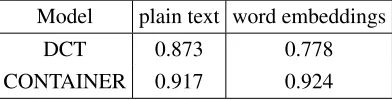
In Table 3, we present the cross-validation accura-cies of our DCT and Container models over the de-velopment corpus. For DCT, we obtain high per-formance with Strategy 1, which is based on plain lexical features. Strategy 2, which exploits words embeddings, gives lower performance. Concerning the Container model, we obtain high performance with both strategies.
Model plain text word embeddings
DCT 0.873 0.778
CONTAINER 0.917 0.924
Table 3:DCT and CONTAINER model accuracies
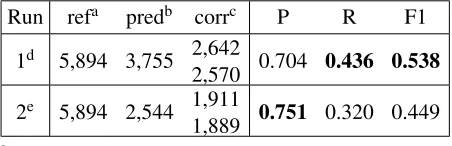
We submitted two runs with our system, one for each strategy. The results for both subtasks are pre-sented in Tables 4 and 5.
[image:5.612.328.524.468.518.2]obtained during cross-validation, where Strategy 1 performed best.
In the CR subtask, we obtained above-median F1 for the first run and median scores for the sec-ond run (median score: 0.449). Using plain lexi-cal features gives us a more balanced system than using word embeddings. With a F1 of 0.538, our system achieves performance close to the best sys-tem (0.573), thus validating our modeling choices. These results are consistent with those we obtained when testing against the development part of the cor-pus. The reasons for the decrease in recall when using the second strategy are however unclear and need further investigation.
Run refa predb corrc P R F1
1d 18,990 18,989 14,603 0.769 0.769 0.769
2e 18,990 18,989 15,317 0.807 0.807 0.807
[image:6.612.74.300.405.478.2]aNumber of gold standard relations bNumber of predicted relations cNumber of correct predictions dUsing plain text features eUsing word embeddings
Table 4: DR subtask - Evaluation script output
Run refa predb corrc P R F1
1d 5,894 3,755 2,642
2,570 0.704 0.436 0.538 2e 5,894 2,544 1,911
1,889 0.751 0.320 0.449
aNumber of gold standard relations bNumber of predicted relations
cNumber of correct relations (without and with temporal
clo-sure)
dUsing plain text features eUsing word embeddings
Table 5: CR subtask - Evaluation script output
Acknowledgments
We would like to thank the Mayo Clinic for granting us the permission to use the THYME corpus. This work has been funded by Labex Digicosme, oper-ated by the Foundation for Scientific Cooperation (FSC) Paris-Saclay. This work was supported in part by the French National Agency for Research under grant CABeRneT, ANR-13-JS02-0009-01.
References
Alan R Aronson and Franc¸ois-Michel Lang. 2010. An overview of MetaMap: historical perspective and re-cent advances. Journal of the American Medical In-formatics Association, 17(3):229–236.
Steven Bethard, Guergana Savova, Wei-Te Chen, Leon Derczynski, James Pustejovsky, and Marc Verhagen. 2016. SemEval-2016 Task 12: Clinical TempEval. In
Proceedings of the 10th International Workshop on Se-mantic Evaluation (SemEval 2016), San Diego, Cali-fornia, June. Association for Computational Linguis-tics.
Eugene Charniak and Mark Johnson. 2005. Coarse-to-Fine n-Best Parsing and MaxEnt Discriminative Reranking. InProceedings of the 43rd Annual Meet-ing of the Association for Computational LMeet-inguis- Linguis-tics (ACL’05), pages 173–180, Ann Arbor, Michigan, June. Association for Computational Linguistics. Haibin Liu, Tom Christiansen, William A
Baumgart-ner Jr, and Karin Verspoor. 2012. BioLemmatizer: a lemmatization tool for morphological processing of biomedical text. Journal of Biomedical Semantics, 3(3).
Edward Loper and Steven Bird. 2002. NLTK: The Natu-ral Language Toolkit. InProceedings of the ACL-02 Workshop on Effective Tools and Methodologies for Teaching Natural Language Processing and Compu-tational Linguistics, pages 63–70, Philadelphia, Penn-sylvania. Association for Computational Linguistics. David McClosky. 2010. Any Domain Parsing:
Auto-matic Domain Adaptation for Natural Language Pars-ing. Ph.D. thesis, Department of Computer Science, Brown University.
Tomas Mikolov, Ilya Sutskever, Kai Chen, Greg S Cor-rado, and Jeff Dean. 2013. Distributed Representa-tions of Words and Phrases and their Compositionality. In C. J. C. Burges, L. Bottou, M. Welling, Z. Ghahra-mani, and K. Q. Weinberger, editors,Advances in Neu-ral Information Processing Systems 26, pages 3111– 3119. Curran Associates, Inc.
F. Pedregosa, G. Varoquaux, A. Gramfort, V. Michel, B. Thirion, O. Grisel, M. Blondel, P. Prettenhofer, R. Weiss, V. Dubourg, J. Vanderplas, A. Passos, D. Cournapeau, M. Brucher, M. Perrot, and E. Duches-nay. 2011. Scikit-learn: Machine Learning in Python.
Journal of Machine Learning Research, 12:2825– 2830.
public-access intensive care unit database. Critical Care Medicine, 39:952–960, May.