Key-Value Retrieval Networks for Task-Oriented Dialogue
Mihail Eric1, Lakshmi Krishnan2,
Francois Charette2, andChristopher D. Manning1 [email protected],[email protected]
[email protected],[email protected]
Stanford NLP Group1 Ford Research and Innovation Center2
Abstract
Neural task-oriented dialogue systems of-ten struggle to smoothly interface with a knowledge base. In this work, we seek to address this problem by proposing a new neural dialogue agent that is able to effec-tively sustain grounded, multi-domain dis-course through a novel key-value retrieval mechanism. The model is end-to-end dif-ferentiable and does not need to explicitly model dialogue state or belief trackers. We also release a new dataset of 3,031 dia-logues that are grounded through underly-ing knowledge bases and span three dis-tinct tasks in the in-car personal assistant space: calendar scheduling, weather infor-mation retrieval, and point-of-interest nav-igation. Our architecture is simultaneously trained on data from all domains and sig-nificantly outperforms a competitive rule-based system and other existing neural di-alogue architectures on the provided do-mains according to both automatic and hu-man evaluation metrics.
1 Introduction
With the success of new speech-based human-computer interfaces, there is a great need for ef-fective task-oriented dialogue agents that can han-dle everyday tasks such as scheduling events and booking hotels. Current commercial dialogue agents are often brittle pattern-matching systems which are unable to maintain the kind of flexible conversations that people desire. Neural dialogue agents present one of the most promising avenues for leveraging dialogue corpora to build statisti-cal models directly from data by using powerful distributed representations (Bordes and Weston, 2016;Wen et al.,2016b;Dhingra et al.,2016).
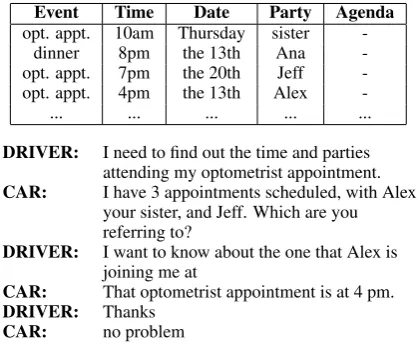
Event Time Date Party Agenda
opt. appt. 10am Thursday sister -dinner 8pm the 13th Ana -opt. appt. 7pm the 20th Jeff -opt. appt. 4pm the 13th Alex
-... ... ... ... ...
DRIVER: I need to find out the time and parties attending my optometrist appointment.
CAR: I have 3 appointments scheduled, with Alex, your sister, and Jeff. Which are you referring to?
DRIVER: I want to know about the one that Alex is joining me at
CAR: That optometrist appointment is at 4 pm.
DRIVER: Thanks
[image:1.595.312.521.221.395.2]CAR: no problem
Figure 1: Sample dialogue from our dataset. Note some columns and rows from the knowledge base are not included due to space constraints. A dash indicates a missing value.
While this work has been somewhat successful, these task-oriented neural dialogue models suffer from a number of problems: 1) They struggle to effectively reason over and incorporate knowledge base information while still preserving their end-to-end trainability and 2) They often require ex-plicitly modelling user dialogues with belief track-ers and dialogue state information, which neces-sitates additional data annotation and also breaks differentiability.
To address some of the modelling issues in previous neural dialogue agents, we introduce a new architecture called the Key-Value Retrieval Network. This model augments existing recur-rent network architectures with an attention-based key-value retrieval mechanism over the entries of a knowledge base, which is inspired by re-cent work on key-value memory networks (Miller et al.,2016). By doing so, it is able to learn how to extract useful information from a knowledge base directly from data in an end-to-end fashion,
out the need for explicit training of belief or in-tent trackers as is done in traditional task-oriented dialogue systems. The architecture has no depen-dence on the specifics of the data domain, learn-ing how to appropriately incorporate world knowl-edge into its dialogue utterances via attention over the key-value entries of the underlying knowledge base.
In addition, we introduce and make publicly available a new corpus of 3,031 dialogues span-ning three different domain types in the in-car personal assistant space: calendar schedul-ing, weather information retrieval, and point-of-interest navigation. The dialogues are grounded through knowledge bases. This makes them ideal for building dialogue architectures that seamlessly reason over world knowledge. The multi-domain nature of the dialogues in the corpus also makes this dataset an apt test bed for generalizability of modelling architectures.1
The main contributions of our work are there-fore two-fold: 1) We introduce the Key-Value Re-trieval Network, a highly performant neural task-oriented dialogue agent that is able to smoothly in-corporate information from underlying knowledge bases through a novel key-value retrieval mech-anism. Unlike other dialogue agents which only rely on prior dialogue history for generation (Kan-nan et al.,2016;Eric and Manning,2017), our ar-chitecture is able to access and use database-style information, while still retaining the text genera-tion advantages of recent neural models. By do-ing so, our model outperforms a competitive rule-based system and other baseline neural models on a number of automatic metrics as well as human evaluation. 2) We release a new publicly-available dialogue corpus across three distinct domains in the in-car personal assistant space that we hope will help further work on task-oriented dialogue agents.
2 Key-Value Retrieval Networks
While recent neural dialogue models have explic-itly modelled dialogue state through belief and user intent trackers (Wen et al., 2016b;Dhingra et al.,2016;Henderson et al.,2014b), we choose instead to rely on learned neural representations for implicit modelling of dialogue state, forming 1The data is available for download at https://nlp.stanford.edu/blog/a-new-multi-turn-multi-domain-task-oriented-dialogue-dataset/
a truly end-to-end trainable system. Our model starts with an encoder-decoder sequence architec-ture and is further augmented with an attention-based retrieval mechanism that effectively reasons over a key-value representation of the underlying knowledge base. We describe each component of our model in the subsequent sections.
2.1 Encoder
Given a dialogue between a user (u) and a sys-tem (s), we represent the dialogue utterances as {(u1, s1),(u2, s2), . . . ,(uk, sk)}wherekdenotes the number of turns in the dialogue. At the
ith turn of the dialogue, we encode the aggre-gated dialogue context composed of the tokens of
(u1, s1, . . . , si−1, ui). Letting x1, . . . , xm denote these tokens, we first embed these tokens using a trained embedding functionφembthat maps each token to a fixed-dimensional vector. These map-pings are fed into the encoder to produce context-sensitive hidden representations h1, . . . , hm, by
repeatedly applying the recurrence:
hi=LSTM(φemb(xi), hi−1) (1)
where the recurrence uses a long-short-term mem-ory unit, as described by (Hochreiter and Schmid-huber,1997).
2.2 Decoder
The vanilla sequence-to-sequence decoder pre-dicts the tokens of the ith system responses
i by first computing decoder hidden states via the re-current unit. We denoteh˜1, . . . ,h˜nas the hidden states of the decoder andy1, . . . , ynas the output tokens. We extend this decoder with an attention-based model (Bahdanau et al.,2015;Luong et al., 2015a), where, at every time steptof the decod-ing, an attention score at
i is computed for each hidden statehi of the encoder, using the attention mechanism of (Vinyals et al.,2015). Formally this attention can be described by the following equa-tions:
ut
i =wTtanh(W2tanh(W1[hi,˜ht]))) (2)
at
i =Softmax(uti) (3)
˜
h0t=
m
X
i=1
atihi (4)
ot=U[˜ht,˜h0t] (5)
whereU,W1,W2, andware trainable parameters
of the model andotrepresents the logits over the tokens of the output vocabularyV. In (2) above, the attention logit on hi is computed via a two-layer MLP function with a tanh nonlinearity at the intermediate layers. During training, the next token yt is predicted so as to maximize the log-likelihood of the correct output sequence given the input sequence.
2.3 Key-Value Knowledge Base Retrieval Recently, some neural task-oriented dialogue agents that query underlying knowledge bases (KBs) and extract relevant entities either do the following: 1) create and execute well-formatted API calls to the KB, operations which require in-termediate supervision in the form of training slot trackers and which break differentiability (Wen et al., 2016b), or 2) softly attend to the KB and combine this probability distribution with belief trackers as state input for a reinforcement learn-ing policy (Dhlearn-ingra et al.,2016). We choose to build off the latter approach as it fits nicely into the end-to-end trainable framework of sequence-to-sequence modelling, though we are in a super-vised learning setting and we do away with ex-plicit representations of belief trackers or dialogue state.
For storing the KB of a given dialogue, we take inspiration from the work of (Miller et al., 2016) which found that a key-value structured memory allowed for efficient machine reading of documents. We store every entry of our KB us-ing a(subject, relation, object)representation. In our representation a KB entry from the dialogue in Figure 1 such as (event=dinner, time=8pm, date=the 13th,party=Ana,agenda=“-”) would be normalized into four separate triples of the form (dinner, time, 8pm). Every KB has at most 230 normalized triples. This formalism is similar to a neo-Davidsonian or RDF-style representation of events.
Recent literature has shown that incorporat-ing a copyincorporat-ing mechanism into neural architec-tures improves performance on various sequence-to-sequence tasks (Jia and Liang,2016;Gu et al., 2016;Ling et al.,2016;Gulcehre et al.,2016;Eric and Manning, 2017). We build off this intuition in the following way: at every timestep of decod-ing, we take the decoder hidden state and compute an attention score with the key of each normalized
KB entry. For our purposes, the key of an entry corresponds to the sum of the word embeddings of the subject (meeting) and relation (time). The attention logits then become the logits of the value for that KB entry. For our KB attentions, we re-place the embedding of the value with a canonical-ized token representation. For example, the value
5pm is replaced with the canonicalized represen-tationmeeting time. At runtime, if we decode this canonicalized representation token, we convert it into the actual value of the KB entry (5pmin our running example) through a KB lookup. Note that this means we are expanding our original output vocabulary to |V|+nwhere nis the number of separate canonical key representation KB entries.
In particular, letkj denote the word embedding of the key of ourjthnormalized KB entry. We can now formalize the decoding for our KB attention-based retrieval. Assume that we havem distinct triples in our KB and that we are in thetthtimestep of decoding:
ut
j =rT tanh(W20tanh(W10[kj,˜ht]))) (7)
ot=U[˜ht,˜h0t] + ¯vt (8)
yt=Softmax(ot) (9)
where r, W0
1, and W20 are trainable parameters.
In (8) above, ¯vt is a sparse vector with length |V|+n. Within v¯t, the entry for the value em-bedding vj corresponding to the key kj is equal to the logit score ut
j on kj. Hence, the m en-tries of ¯vt corresponding to the values in the KB are non-zero, whereas the remaining entries cor-responding to the original vocabulary tokens are
0. This sparse vector contains our aggregated KB logit scores which we combine with the original logits to get a modified ot. We then select the argmax token as input to the next timestep. This description seeks to capture the intuition that in response to the query What time is my meeting, we want the model to put a high attention weight on the key representation for the (meeting, time,
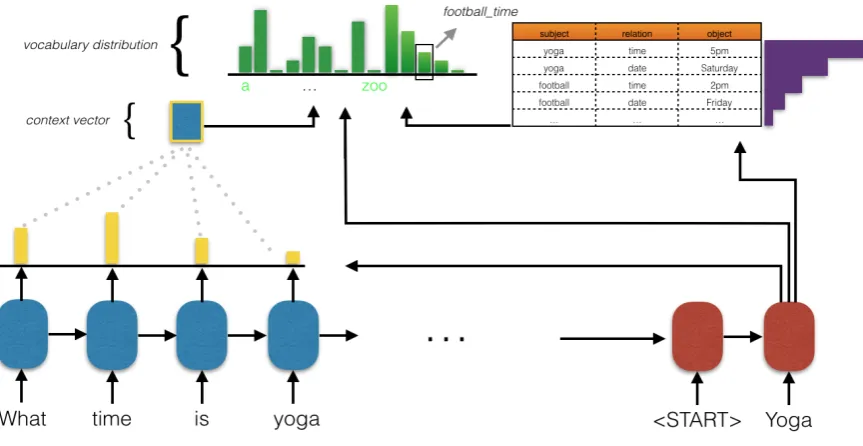
5pm) KB triple, which should then lead the model to favor outputting the value token at the given timestep. We provide a visualization of the Key-Value Retrieval Network in Figure 2.
3 A Multi-Turn, Multi-Domain Dialogue Dataset
Figure 2: Key-value retrieval network. For each time-step of decoding, the cell state is used to compute an attention over the encoder states and a separate attention over the key of each entry in the KB. The attentions over the encoder are used to generate a context vector which is combined with the cell state to get a distribution over the normal vocabulary. The attentions over the keys of the KB become the logits for their associated values and are separate entries in a now augmented vocabulary that we argmax over.
dialogues in three distinct domains: calendar scheduling, weather information retrieval, and point-of-interest navigation. While these domains are different, they are all relevant to the overar-ching theme of tasks that users would expect of a sophisticated in-car personal assistant.
3.1 Data Collection
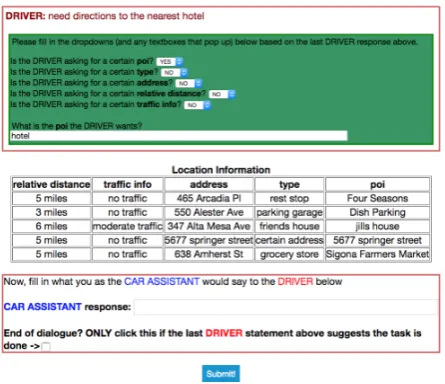
The data for the multi-turn dialogues was collected using a Wizard-of-Oz scheme inspired by that of (Wen et al.,2016b). In our scheme, users had two potential modes they could play: DriverandCar Assistant. In the Driver mode, users were pre-sented with a task that listed certain information they were trying to extract from theCar Assistant
as well as the dialogue history exchanged between
DriverandCar Assistantup to that point. An ex-ample task presented could be: You want to find what the temperature is like in San Mateo over the next two days. TheDriverwas then only re-sponsible for contributing a single line of dialogue that appropriately continued the discourse given the prior dialogue history and the task definition.
Tasks were randomly specified by selecting val-ues (5pm,Saturday,San Francisco, etc.) for three to five slots (time,date,location, etc.),
de-pending on the domain type. Values specified for the slots were chosen according to a uniform dis-tribution from a per-domain candidate set.
In theCar Assistantmode, users were presented with the dialogue history exchanged up to that point in the running dialogue and a private knowl-edge base known only to theCar Assistant with information that could be useful for satisfying the
Driverquery. Examples of knowledge bases could include a calendar of event information, a collec-tion of weekly forecasts for nearby cities, or a col-lection of nearby points-of-interest with relevant information. TheCar Assistantwas then respon-sible for using this private information to provide a single utterance that progressed the user-directed dialogues. TheCar Assistantwas also asked to fill in dialogue state information for mentioned slots and values in the dialogue history up to that point. Each private knowledge base had six to seven distinct rows and five to seven attribute types. The private knowledge bases used were generated by uniformly selecting a value for a given attribute type, where each attribute type had a variable number of candidate values. Some knowledge bases intentionally lacked attributes to encourage diversity in discourse.
Calendar Scheduling Weather Information Retrieval POI Navigation
Slot Types party, room, agendaevent, time, date, temperature, weather attributelocation, weekly time, POI category, address, distancePOI name, traffic info,
[image:5.595.78.518.63.108.2]# Distinct Slot Values 79 65 140
Table 1: Slots types and number distinct slot values for different domains. POI denotes point-of-interest.
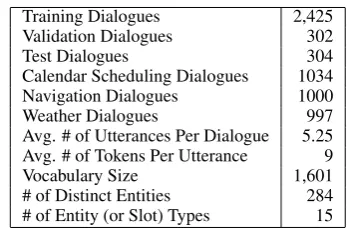
Training Dialogues 2,425 Validation Dialogues 302
Test Dialogues 304
Calendar Scheduling Dialogues 1034 Navigation Dialogues 1000
Weather Dialogues 997
Avg. # of Utterances Per Dialogue 5.25 Avg. # of Tokens Per Utterance 9
Vocabulary Size 1,601
# of Distinct Entities 284 # of Entity (or Slot) Types 15
Table 2: Statistics of Dataset.
in the calendar scheduling domain did not ex-plicitly require the use of a KB. For example, in a task such as Set a meeting reminder at 3pm, we hoped to encourage dialogues that required the Car Assistant to execute a task while asking forDriverclarification on underspecified informa-tion. Roughly half of the scheduling dialogues fell into this category.
While specifying the attribute types and val-ues in each task presented to theDriver allowed us to ground the subject of each dialogue with our desired entities, it would occasionally result in more mechanical discourse exchanges. To en-courage more naturalistic, unbiased utterances, we had users record themselves saying commands in response to underspecified visual depictions of an action a car assistant could perform. These com-mands were transcribed and then inserted as the first exchange in a given dialogue on behalf of the Driver. Roughly ∼1,500 of the dialogues employed this transcribed audio command first-utterance technique.
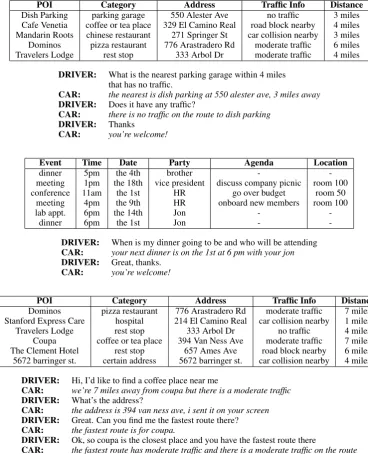
241 unique workers from Amazon Mechanical Turk were anonymously recruited to use the interface we built over a period of about six days. Data statistics are provided in Table 1 and slot types and values are provided in Table 2. A screenshot of the user-facing interfaces for the data collection, as well as a visual used to prompt user recorded commands, are provided in the supplementary material.
4 Related Work
Task-oriented agents for spoken dialogue systems have been the subject of extensive research ef-fort. One line of work by (Young et al., 2013) has tackled the problem using partially observ-able Markov decision processes and reinforcement learning with carefully designed action spaces, though the number of distinct action states makes this approach often brittle and computationally in-tractable.
The recent successes of neural architectures on a number of traditional natural language process-ing subtasks (Bahdanau et al., 2015; Sutskever et al., 2014; Vinyals et al., 2015) have moti-vated investigation into dialogue agents that can effectively make use of distributed neural repre-sentations for dialogue state management, belief tracking, and response generation. Recent work by (Wen et al., 2016b) has built systems with modularly-connected representation, belief state, and generation components. These models learn to explicitly represent user intent through interme-diate supervision, which breaks end-to-end train-ability. Other work by (Bordes and Weston,2016; Liu and Perez,2016) stores dialogue context in a memory module and repeatedly queries and rea-sons about this context to select an adequate sys-tem response from a set of all candidate responses. Another line of recent work has developed task-oriented models which are amenable to both su-pervised learning and reinforcement learning and are able to incorporate domain-specific knowledge via explicitly-provided features and model-output restrictions (Williams et al., 2017). Our model contrasts with these works in that training is done in a strictly supervised fashion via a per utterance token generative process, and the model does not need dialogue state trackers, relying instead on latent neural embeddings for accurate system re-sponse generation.
[image:5.595.92.266.141.257.2]Bennett and Rudnicky, 2002). Another well-known corpus is derived from a series of com-petitions on the task of dialogue-state tracking (Williams et al., 2013). While the competitions were designed to test systems for state tracking, recent work has chosen to repurpose this data by only using the transcripts of dialogues without state annotation for developing systems (Bordes and Weston,2016;Williams et al.,2017). More re-cently, Maluuba has released a dataset of hotel and travel-booking dialogues collected in a Wizard-of-Oz Scheme with elaborate semantic frames an-notated (Asri et al., 2017). This dataset aims to encourage research in non-linear decision-making processes that are present in task-oriented dia-logues.
5 Experiments
In this section we first introduce the details of the experiments and then present results from both au-tomatic and human evaluation.
5.1 Details
For our experiments, we divided the dialogues into train/validation/test sets using a 0.8/0.1/0.1 data split and ensured that each domain type was equally represented in each of the splits.
To reduce lexical variability, in a pre-processing step, we map the variant surface expression of entities to a canonical form using named entity recognition and linking. For example, the surface form20 Main Streetis mapped toPizza My Heart address. During inference, our model outputs the canonical forms of the entities, and so we realize their surface forms by running the system output through an inverse lexicon. The inverse lexicon converts the entities back to their surface forms by sampling from a multinomial distribution with pa-rameters of the distribution equal to the frequency count of a given surface form for an entity as ob-served in the training and validation data. Note that for the purposes of computing our evaluation metrics, we operate on the canonicalized forms, so that any non-deterministic variability in surface form realization does not affect the computed met-rics.
5.2 Hyperparameters
We trained using a cross-entropy loss and the Adam optimizer (Kingma and Ba, 2015) with learning rates sampled from the interval
[10−4,10−3]. We applied dropout (Hinton et al.,
2012) as a regularizer to the input and output of the LSTM. We also added anl2regularization penalty
on the weights of the model. We identified hyper-parameters by random search, evaluating on the held-out validation subset of the data. Dropout keep rates were sampled from [0.8,0.9] and the
l2 coefficient was sampled from[3·10−6,10−5].
We used word embeddings, hidden layer, and cell sizes with size 200. We applied gradient clipping with a clip-value of 10 to avoid gradient explo-sions during training. The attention, output param-eters, word embeddings, and LSTM weights were randomly initialized from a uniform unit-scaled distribution in the style of (Sussillo and Abbott, 2015). We also added a bias of 1 to the LSTM cell forget gate in the style of (Pham et al.,2014).
5.3 Baseline Models
We provide several baseline models for comparing performance of the Key-Value Retrieval Network:
• Rule-Based Model: This model is a tra-ditional rule-based system with modular di-alogue state trackers, KB query, and natu-ral language generation components. It first does an extensive domain-dependent key-word search in the user utterances to detect intent. The user utterances are also provided to a lexicon to extract any entities mentioned. Collectively, this information forms the dia-logue state up to a given point in the diadia-logue. This dialogue state is used to query the KB as appropriate, and the returned KB values are used to fill in predefined template system re-sponses.
Model BLEU Ent. F1 Scheduling Ent. F1 Weather Ent. F1 Navigation Ent. F1
Rule-Based 6.6 43.8 61.3 39.5 40.4
Copy Net 11.0 37.0 28.1 50.1 28.4
Attn. Seq2Seq 10.2 30.0 30.0 42.4 17.9
KV Retrieval Net (no enc. attn.) 10.8 40.9 59.5 35.6 36.6
KV Retrieval Net 13.2 48.0 62.9 47.0 41.3
[image:7.595.69.530.62.133.2]Human Performance 13.5 60.7 64.3 61.6 55.2
Table 3: Evaluation on our test data. Bold values indicate best model performance. We provide both an aggregated F1 score as well as domain-specific F1 scores. Attn. Seq2Seq refers to a
sequence-to-sequence model with encoder attention. KV Retrieval Net (no enc. attn.) refers to our new model with no encoder attention context vector computed during decoding.
model performed worse on our data with this added mechanism. We choose this model for comparison as it is also end-to-end trainable and implicitly models dialogue state through learned neural representations, putting it in the same class of dialogue models as our key-value retrieval net. This model has also been shown to be a competitive task-oriented dialogue baseline that can accurately inter-pret user input and act on this input through latent distributed representation. We refer to this model as Copy Net in the results tables.
5.4 Automatic Evaluation 5.4.1 Metrics
Though prior work has shown that automatic eval-uation metrics often correlate poorly with human assessments of dialogue agents (Liu et al.,2016), we report a number of automatic metrics in Table 3. These metrics are provided for coarse-grained evaluation of dialogue response quality:
• BLEU: We use the BLEU metric, commonly employed in evaluating machine translation systems (Papineni et al., 2002), which has also been used in past literature for evaluat-ing dialogue systems both of the chatbot and task-oriented variety (Ritter et al., 2011; Li et al.,2016;Wen et al.,2016b). While work by (Liu et al.,2016) has demonstrated that n-gram based evaluation metrics such as BLEU and METEOR do not correlate well with hu-man perforhu-mance on non-task-oriented dia-logue datasets, recently (Sharma et al.,2017) have shown that these metrics can show com-paratively stronger correlation with human assessment on task-oriented datasets. We, therefore, calculate average BLEU score over all responses generated by the system, and primarily report these scores to gauge our
model’s ability to accurately generate the lan-guage patterns seen in our data.
• Entity F1: Each human Turker’sCar Assis-tant response in the test data defines a gold set of entities. To compute an entity F1,
we micro-average over the entire set of sys-tem dialogue responses and use the entities in their canonicalized forms. This metric evaluates the model’s ability to generate rele-vant entities from the underlying knowledge base and to capture the semantics of the user-initiated dialogue flow. Given that our test set contains dialogues from all three domains, we compute a per-domain entity F1 as well
as an aggregated dataset entity F1. We note
that other work on task-oriented dialogue by (Wen et al.,2016b;Henderson et al.,2014a) have reported the slot-tracking accuracy of their systems, which is a similar but perhaps more informative and fine-grained notion of a system’s ability to capture user semantics. Because our model does not have provisions for slot-tracking by design, we are unable to report such a metric and hence report our en-tity F1.
5.4.2 Results
We see that of our baseline models, Copy Net has the lowest aggregate entity F1 performance.
Though it has the highest model entity F1 for the
Our rule-based model has the lowest BLEU score, which is a consequence of the fact that the naturalness of the system output is very limited by the number of diverse and distinct response tem-plates we manually provided. This is a common issue with heuristic dialogue agents and one that could be partially alleviated through a larger col-lection of lexically rich response templates. How-ever, the rule-based system has a very competitive aggregate entity F1. This is because it was
de-signed to accurately parse the semantics of user utterances and query the underlying KB of the di-alogue, through manually-provided heuristics.
As precursors to our key-value retrieval net, we first report results of a model that does not com-pute an attention over the KB (referred to as Attn. Seq2Seq) and show that without computing atten-tion over the KB, the model performs poorly in entity F1as its output is agnostic to the world state
represented in the KB. Note that this model is ef-fectively a sequence-to-sequence model with en-coder attention. If we include an attention over the KB but do not compute an encoder attention (referred to as KV Retrieval Net no enc. attn.), the entity F1 increases drastically, showing that
the model is able to incorporate relevant entities from the KB. Finally, we combine these two at-tention mechanisms to get our final key-value re-trieval net. Our proposed key-value rere-trieval net has the highest modelling performance in BLEU, aggregate entity F1, and entity F1for the
schedul-ing and navigation domains. It outperforms the rule-based aggregate entity F1 by 4.2%and
out-performs the Copy Net BLEU score by2.2points as well as its entity F1 by 11%. These salient
gains are noteworthy because our model is able to achieve them by learning its latent representationts directly from data, without the need for heuristics or manual labelling.
We also report human performance on the pro-vided metrics. These scores were computed by taking the dialogues of the test set and having a second distinct batch of Amazon Mechanical Turk workers provide system responses given prior di-alogue context. This, in effect, functions as an interannotator agreement score and sets a human upper bound on model performance. We see that there is a sizable gap between human performance on entity F1and that of our key-value retrieval net
(∼ 12.7%), though our model is on par with hu-man perforhu-mance in BLEU score.
5.5 Human Evaluation
We randomly generated 120 distinct scenarios across the three dialogue domains, where a sce-nario is defined by an underlying KB as well as a user goal for the dialogue (e.g.find the nearest gas station, avoiding heavy traffic). We then paired Amazon Mechanical Turkers with one of our sys-tems in a real-time chat environment, where each Turker played the role of theDriver. We evaluated the rule-based model, Copy Net, and key-value retrieval network on each of the 120 scenarios. We also paired a Turker with another Turker for each of the scenarios, in order to get evaluations of human performance. At the end of the chat, the Turker was asked to judge the quality of their partner according to fluency, cooperativeness, and humanlikeness on a scale from 1 to 5. The aver-age scores per pairing are reported in Table 4. In a separate experiment, we also had Turkers evalu-ate the outputs of the systems on 80 randomly se-lected dialogues from the test split of our dataset. Those outputs were evaluated according to cor-rectness, appropriateness, and humanlikeness of the responses, and the scores are reported in Ta-ble 5.
We see that on real-time dialogues the key-value retrieval network outperforms the baseline mod-els on all of the metrics, with especially sizeable performance gains over the Copy Net which is the only other recurrent neural model evaluated. We also see that human performance on this as-sessment sets the upper bound on scores, as ex-pected. The results on human evaluation of test outputs show that the rule-based model provides the most correct system responses, the KV net-work provides the most appropriate responses, and the Copy Net gives the most humanlike responses by small margins. We should note, however, that the second regime for human evaluation is more unrealistic because it involves providing a dia-logue context that is directly sampled from our dataset, whereas the first regime of real-time di-alogues measures the models’ abilities to adapt to new and noisier user input. This suggests that the first set of results are more meaningful and repre-sentative for assessing overall model efficacy.
Model Fluency Cooperative Humanlike
Rule-based 3.20 3.39 2.87
Copy Net 2.33 2.42 2.02
KV Ret. Net 3.36 3.43 3.09
[image:9.595.76.287.62.113.2]Human 3.98 3.95 4.04
Table 4: Human evaluation results on realtime di-alogues.
still producing very naturalistic utterances. The model is able to do this effectively across multi-ple domains.
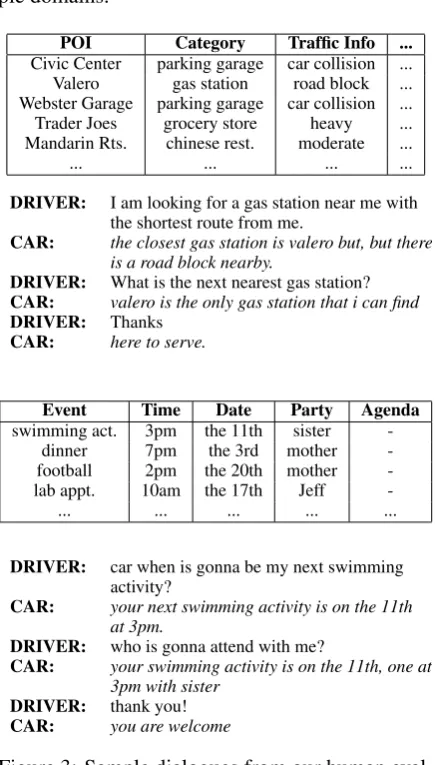
POI Category Traffic Info ...
Civic Center parking garage car collision ... Valero gas station road block ... Webster Garage parking garage car collision ... Trader Joes grocery store heavy ... Mandarin Rts. chinese rest. moderate ...
... ... ... ...
DRIVER: I am looking for a gas station near me with the shortest route from me.
CAR: the closest gas station is valero but, but there is a road block nearby.
DRIVER: What is the next nearest gas station?
CAR: valero is the only gas station that i can find DRIVER: Thanks
CAR: here to serve.
Event Time Date Party Agenda
swimming act. 3pm the 11th sister -dinner 7pm the 3rd mother -football 2pm the 20th mother -lab appt. 10am the 17th Jeff
-... ... ... ... ...
DRIVER: car when is gonna be my next swimming activity?
CAR: your next swimming activity is on the 11th at 3pm.
DRIVER: who is gonna attend with me?
CAR: your swimming activity is on the 11th, one at 3pm with sister
DRIVER: thank you!
[image:9.595.308.524.63.105.2]CAR: you are welcome
Figure 3: Sample dialogues from our human eval-uation, conducted between a Turker and the KV Retrieval Net. In the dialogue, our model re-sponses are italicized. Additional dialogues are included in the supplementary material.
6 Conclusion and Future Work
In this work, we have presented a novel neural task-oriented dialogue model that is able to sus-tain grounded discourse across a variety of do-mains by retrieving world knowledge represented in knowledge bases. It smoothly incorporates
Model Correct Appropriate Humanlike
Rule-based 3.96 3.57 3.28
Copy Net 3.52 3.63 3.56
[image:9.595.73.291.206.589.2]KV Ret. Net 3.70 3.64 3.50
Table 5: Human evaluation of system outputs on test set.
this world knowledge into natural-sounding sys-tem responses in an end-to-end trainable fash-ion, without the need to explicitly model dialogue state. Our model outperforms competitive heuris-tic and neural baselines on both automaheuris-tic and human evaluation metrics. In addition, we have introduced a publicly available dialogue dataset across three domains in the in-car personal assis-tant space that we hope will help the data scarcity issue present in task-oriented dialogue research.
Future work will address closing the margin be-tween the Key-Value Retrieval Network and hu-man perforhu-mance on the various metrics. This will include developing new methods for robust han-dling of joint KB attributes as well as usage of the KB that requires more pragmatic understanding of the world via notions such as temporal reasoning.
Acknowledgments
The authors wish to thank He He, Peng Qi, Ur-vashi Khandelwal, and Reid Pryzant for their valu-able feedback and insights. We gratefully ac-knowledge the funding of the Ford Research and Innovation Center, under Grant No. 124344.
References
L. El Asri, H. Schulz, S. Sharma, J. Zumer, J. Harris, E. Fine, R. Mehrotra, and K.
Sule-man. 2017. Frames: A corpus for adding
memory to goal-oriented dialogue systems.
http://www.maluuba.com/publications/ .
Dzimitry Bahdanau, Kyunghyun Cho, and Yoshua Bengio. 2015. Neural machine translation by jointly learning to align and translate. InInternational Con-ference on Learning Representations (ICLR2015).
Christina Bennett and Alexander I. Rudnicky. 2002.
The carnegie mellon communicator corpus. In
IC-SLP.
Antoine Bordes and Jason Weston. 2016.
Learn-ing end-to-end goal-oriented dialog. arXiv preprint arXiv:1605.07683.
2016. End-to-end reinforcement learning of dia-logue agents for information access. arXiv preprint arXiv:1609.00777.
Mihail Eric and Christopher Manning. 2017. A
copy-augmented sequence-to-sequence architecture gives good performance on task-oriented dialogue. In
Proceedings of the 15th Conference of the Eu-ropean Chapter of the Association for Computa-tional Linguistics: Volume 2, Short Papers. Associa-tion for ComputaAssocia-tional Linguistics, pages 468–473.
http://aclweb.org/anthology/E17-2075.
Jiatao Gu, Zhengdong Lu, Hang Li, and
Vic-tor O.K. Li. 2016. Incorporating copying
mech-anism in sequence-to-sequence learning. In Pro-ceedings of the 54th Annual Meeting of the As-sociation for Computational Linguistics (Volume 1: Long Papers). Association for Computational Linguistics, Berlin, Germany, pages 1631–1640.
http://www.aclweb.org/anthology/P16-1154.
Caglar Gulcehre, Sungjin Ahn, Ramesh Nallap-ati, Bowen Zhou, and Yoshua Bengio. 2016.
Pointing the unknown words. In Proceed-ings of the 54th Annual Meeting of the As-sociation for Computational Linguistics (Volume 1: Long Papers). Association for Computational Linguistics, Berlin, Germany, pages 140–149.
http://www.aclweb.org/anthology/P16-1014.
C.T. Hemphill, J. J. Godfrey, and G. R. Doddington. 1990. The atis spoken language systems pilot
cor-pus. InProceedings of the DARPA speech and
natu-ral language workshop.
Matthew Henderson, Blaise Thomson, and Jason Williams. 2014a. The second dialog state tracking
challenge. 15th Annual Meeting of the Special
In-terest Group on Discourse and Dialoguepage 263.
Matthew Henderson, Blaise Thomson, and Steve Young. 2014b. Word-based dialog state tracking
with recurrent neural networks. InProceedings of
the SIGDIAL 2014 Conference.
Geoffrey E. Hinton, Nitish Srivastava, Alex Krizhevsky, Ilya Sutskever, and Ruslan R.
Salakhut-dinov. 2012. Improving neural networks by
preventing co-adaptation of feature detectors. arXiv preprint arXiv:1207.0580.
Sepp Hochreiter and Jurgen Schmidhuber. 1997. Long
short-term memory. Neural Computation pages
1735–1780.
Robin Jia and Percy Liang. 2016. Data
recom-bination for neural semantic parsing. In Pro-ceedings of the 54th Annual Meeting of the Association for Computational Linguistics (Vol-ume 1: Long Papers). Association for Computa-tional Linguistics, Berlin, Germany, pages 12–22.
http://www.aclweb.org/anthology/P16-1002.
Anjuli Kannan, Karol Kurach, Sujith Ravi, Tobias Kaufman, Balint Miklos, Greg Corrado, Andrew Tomkins, Laszlo Lukacs, Marina Ganea, Peter
Young, and Vivek Ramavajjala. 2016. Smart
re-ply: Automated response suggestion for email. In Proceedings of the ACM SIGKDD Conference on Knowledge Discovery and Data Mining (KDD) (2016)..https://arxiv.org/pdf/1606.04870v1.pdf.
Diederik Kingma and Jimmy Ba. 2015. Adam:
a method for stochastic optimization. In
Inter-national Conference on Learning Representations (ICLR2015).
Jiwei Li, Michel Galley, Chris Brockett, Jianfeng
Gao, and Bill Dolan. 2016. A diversity-promoting
objective function for neural conversation mod-els. In Proceedings of the 2016 Conference of the North American Chapter of the Association for Computational Linguistics: Human Language Technologies. Association for Computational Lin-guistics, San Diego, California, pages 110–119.
http://www.aclweb.org/anthology/N16-1014. Wang Ling, Phil Blunsom, Edward Grefenstette,
Karl Moritz Hermann, Tom´aˇs Koˇcisk´y, Fumin
Wang, and Andrew Senior. 2016. Latent
pre-dictor networks for code generation. In Pro-ceedings of the 54th Annual Meeting of the As-sociation for Computational Linguistics (Volume 1: Long Papers). Association for Computational Linguistics, Berlin, Germany, pages 599–609.
http://www.aclweb.org/anthology/P16-1057. Chia-Wei Liu, Ryan Lowe, Iulian Serban, Mike
Nose-worthy, Laurent Charlin, and Joelle Pineau. 2016.
How not to evaluate your dialogue system: An em-pirical study of unsupervised evaluation metrics for dialogue response generation. In Proceedings of the 2016 Conference on Empirical Methods in Natu-ral Language Processing. Association for Computa-tional Linguistics, Austin, Texas, pages 2122–2132.
https://aclweb.org/anthology/D16-1230.
Fei Liu and Julien Perez. 2016. Gated
end-to-end memory networks. arXiv preprint
arXiv:1610.04211.
Minh-Thang Luong, Hieu Pham, and Christopher D. Manning. 2015a. Effective approaches to
attention-based neural machine translation. Empirical
Meth-ods in Natural Language Processing pages 1412– 1421.
Alexander Miller, Adam Fisch, Jesse Dodge, Amir-Hossein Karimi, Antoine Bordes, and Jason
We-ston. 2016. Key-value memory networks for
di-rectly reading documents. In Proceedings of the 2016 Conference on Empirical Methods in Natu-ral Language Processing. Association for Computa-tional Linguistics, Austin, Texas, pages 1400–1409.
https://aclweb.org/anthology/D16-1147.
Kishore Papineni, Salim Roukos, Todd Ward,
for automatic evaluation of machine transla-tion. In Proceedings of 40th Annual Meeting of the Association for Computational
Linguis-tics. Association for Computational Linguistics,
Philadelphia, Pennsylvania, USA, pages 311–318.
https://doi.org/10.3115/1073083.1073135.
Vu Pham, Theodore Bluche, Christopher Kermorvant, and Jerome Louradour. 2014. Dropout improves re-current neural networks for handwriting recognition.
arXiv preprint arXiv:1312.4569v2.
Alan Ritter, Colin Cherry, and William B. Dolan. 2011. Data-driven response generation in social media.
Empirical Methods in Natural Language Processing
pages 583–593.
Sikhar Sharma, Layla El Asri, Hannes Schulz, and
Jeremie Zumer. 2017. Relevance of
unsuper-vised metrics in task-oriented dialogue for
evalu-ating natural language generation. arXiv preprint
arXiv:1706.09799.
David Sussillo and L.F. Abbott. 2015. Random walk initialization for training very deep feed forward
net-works. arXiv preprint arXiv:1412.6558.
Ilya Sutskever, Oriol Vinyals, and Quoc V Le. 2014.
Sequence to sequence learning with neural net-works. In Z. Ghahramani, M. Welling, C. Cortes, N. D. Lawrence, and K. Q. Weinberger, editors,
Advances in Neural Information Processing Sys-tems 27, Curran Associates, Inc., pages 3104–
3112.
http://papers.nips.cc/paper/5346-sequence-to-sequence-learning-with-neural-networks.pdf. Oriol Vinyals, Ł ukasz Kaiser, Terry Koo, Slav Petrov,
Ilya Sutskever, and Geoffrey Hinton. 2015.
Gram-mar as a foreign language. In C. Cortes, N. D. Lawrence, D. D. Lee, M. Sugiyama, and R. Garnett,
editors,Advances in Neural Information Processing
Systems 28, Curran Associates, Inc., pages 2773–
2781.
http://papers.nips.cc/paper/5635-grammar-as-a-foreign-language.pdf.
Tsung-Hsien Wen, David Vandyke, Milica Gasic, Nikola Mrksic, Lina. M. Rojas-Barahona, Pei-Hao Su, Stefan Ultes, and Steve Young. 2016b. A network-based end-to-end trainable task-oriented
di-alogue system. arXiv preprint arXiv:1604.04562.
Jason D. Williams, Kavosh Asadi, and Geoffrey Zweig. 2017. Hybrid code networks: practical and efficient end-to-end dialog control with
super-vised and reinforcement learning. arXiv preprint
arXiv:1702.03274.
Jason D. Williams, Antoine Raux, Deepak Ramachad-ran, and Alan Black. 2013. The dialog state tracking
challenge. In Proceedings of the SIGDIAL. Metz,
France.
Steve Young, Milica Gasic, Blaise Thomson, and Ja-son D. Williams. 2013. POMDP-based statistical spoken dialog systems: a review. Proceedings of the
POI Category Address Traffic Info Distance
Dish Parking parking garage 550 Alester Ave no traffic 3 miles Cafe Venetia coffee or tea place 329 El Camino Real road block nearby 4 miles Mandarin Roots chinese restaurant 271 Springer St car collision nearby 3 miles Dominos pizza restaurant 776 Arastradero Rd moderate traffic 6 miles Travelers Lodge rest stop 333 Arbol Dr moderate traffic 4 miles
DRIVER: What is the nearest parking garage within 4 miles that has no traffic.
CAR: the nearest is dish parking at 550 alester ave, 3 miles away DRIVER: Does it have any traffic?
CAR: there is no traffic on the route to dish parking DRIVER: Thanks
CAR: you’re welcome!
Event Time Date Party Agenda Location
dinner 5pm the 4th brother -
-meeting 1pm the 18th vice president discuss company picnic room 100 conference 11am the 1st HR go over budget room 50
meeting 4pm the 9th HR onboard new members room 100
lab appt. 6pm the 14th Jon -
-dinner 6pm the 1st Jon -
-DRIVER: When is my dinner going to be and who will be attending
CAR: your next dinner is on the 1st at 6 pm with your jon DRIVER: Great, thanks.
CAR: you’re welcome!
POI Category Address Traffic Info Distance
Dominos pizza restaurant 776 Arastradero Rd moderate traffic 7 miles Stanford Express Care hospital 214 El Camino Real car collision nearby 1 miles Travelers Lodge rest stop 333 Arbol Dr no traffic 4 miles Coupa coffee or tea place 394 Van Ness Ave moderate traffic 7 miles The Clement Hotel rest stop 657 Ames Ave road block nearby 6 miles 5672 barringer st. certain address 5672 barringer st. car collision nearby 4 miles
DRIVER: Hi, I’d like to find a coffee place near me
CAR: we’re 7 miles away from coupa but there is a moderate traffic DRIVER: What’s the address?
CAR: the address is 394 van ness ave, i sent it on your screen DRIVER: Great. Can you find me the fastest route there?
CAR: the fastest route is for coupa.
DRIVER: Ok, so coupa is the closest place and you have the fastest route there
CAR: the fastest route has moderate traffic and there is a moderate traffic on the route do you want to go there?
DRIVER: yes
CAR: i sent the info on your screen, drive carefully! DRIVER: Thanks
CAR: you’re welcome, have a great day.
monday tuesday wednesday thursday friday ...
los angeles hail, 60-70f foggy, 30-40f cloudy, 20-30f stormy 30-40f drizzle, 30-50f ... durham rain, 80-90f cloudy, 50-70f misty, 40-60f dry, 80-100f rain, 50-70f ... boston overcast, 30-50f misty, 40-60f foggy, 40-50f foggy, 40-50f clear skies 20-30f ... seattle warm, 60-70f foggy, 30-40f cloudy, 20-30f stormy, 30-40f drizzle, 30-50f ... fresno clear skies, 40-60f drizzle, 70-80f humid, 70-90f stormy, 60-70f cloudy, 90-100f ... san francisco foggy, 40-60f hot, 90-100f humid, 50-70f rain, 80-100f misty, 20-40f ... alhambra dew, 30-40f dry, 30-50f dry, 50-60f humid, 80-90f snow, 60-80f ...
DRIVER: how is the weather
CAR: what city would you like the weather for? DRIVER: is it foggy in seattle?
CAR: it will not be foggy in seattle today DRIVER: thanks
[image:12.595.109.478.65.520.2]CAR: you’re welcome!
Figure 5: An image provided to users to elicit unbiased audio commands for prompting more naturalistic dialogues
[image:13.595.188.411.551.743.2]Figure 6:Drivermode in the wizard-of-oz collection scheme