Approximating Style by N-gram-based Annotation
Melanie Andresen and Heike Zinsmeister
Universit¨at Hamburg
Institute for German Language and Literature Germany
{melanie.andresen, heike.zinsmeister}@uni-hamburg.de
Abstract
The concept of style is much debated in theoretical as well as empirical terms. From an empirical perspective, the key question is how to operationalize style and thus make it accessible for annotation and quantification. In authorship attribution, many different approaches have success-fully resolved this issue at the cost of lin-guistic interpretability: The resulting al-gorithms may be able to distinguish one language variety from the other, but do not give us much information on their dis-tinctive linguistic properties. We approach the issue of interpreting stylistic features by extracting linear and syntactic n-grams that are distinctive for a language variety. We present a study that exemplifies this process by a comparison of the German academic languages of linguistics and lit-erary studies. Overall, our findings show that distinctive n-grams can be related to linguistic categories. The results suggest that the style of German literary studies is characterized by nominal structures and the style of linguistics by verbal ones. 1 Introduction
The concept of style is hotly debated in theoretical as well as empirical terms. From an empirical per-spective, the key question is how to operational-ize style and thus make it accessible for annota-tion and quantificaannota-tion. Many recent definiannota-tions of style focus on this aspect, resulting in very general definitions:
Style is a property of texts constituted by an ensemble of formal features which can be observed quantitatively or quali-tatively. (Herrmann et al.,2015)
This is a good starting point and for many stud-ies focusing on applications such as authorship at-tribution or author profiling, this concept of style is perfectly sufficient. However, when the aim of investigation is interpretation rather than applica-tion, these ‘formal features’ need to meet addi-tional requirements.
Most importantly, the features need to be inter-pretable by human readers, which is not strictly true for features like character-n-grams. Also token-based n-grams can be difficult to interpret, as they do not necessarily correspond to an actual phrase. To give a meaningful description of a lan-guage variety’s style, we need to map the features to linguistic categories and, if possible, also of-fer independent, non-linguistic explanations. For the former purpose, we suggest an annotation task with multiple annotators that ensures a certain de-gree of intersubjectivity.
In the present study, this process is exempli-fied by a comparison of the German academic lan-guages of linguistics and literary studies. It is part of a bigger research project that aims at describ-ing the stylistic differences between the two disci-plines. We consider this research question relevant because the two disciplines are often subsumed under one study program (e. g.German Studies). While this suggests a very close relationship be-tween linguistics and literary studies, they differ in many respects.
Our analysis is based on features that are not initially linguistically motivated, but widely used: n-grams based on tokens and part-of-speech (pos) annotation. We complement them by more lin-guistically informed syntactic n-grams (Sidorov et al., 2012; Goldberg and Orwant, 2013). The core of our study is the following annotation ex-periment: After determining distinctive n-grams automatically based on frequencies, we give the most distinctive 260 token n-grams and 160 pos
n-grams to three annotators. They annotated whether they found the n-grams to be interpretable and, if yes, what kind of linguistic category they could derive from the n-grams.
The paper is structured as follows: Section 2 gives an overview of work in computational stylis-tics relevant to our study. Section3gives a short overview of linguistic as well as non-linguistic properties of linguistics and literary studies to which we will relate our results. We present the study’s setup in section 4 by describing our data and how n-grams were generated (section4.1) and ranked (section4.2). Section4.3gives a detailed account of the annotation scheme and process. In section5, we present the results of the annotation experiment and relate them to non-linguistic prop-erties of the two disciplines. Section 6discusses our study’s implications.
2 Related Work
In this section we give an overview of studies in computational stylistics, focusing on those inter-ested in linguistically interpretable features.
Boukhaled et al. (2015) differentiate between two methodological types of computational stylis-tics: 1) the classification approachthat uses lin-guistic features to confirm or question a grouping of texts based on non-linguistic features, e. g. au-thor or genre, and 2) thehermeneutic approach1
identifying relevant linguistic features that serve as a data-driven starting point for human interpre-tation.
Most work has been done adopting the first ap-proach, dominated by studies on the task of au-thorship attribution as described in the survey by Stamatatos (2009). The huge variety of features presented here refers to all kinds of language as-pects that are meaningful to a greater or lesser extent, seen from a linguistic point of view. The use of a character-based data compression model is an extreme case of a linguistically uninforma-tive method. Especially syntactic features, on the other hand, potentially contain valuable stylistic information. Hirst and Feiguina(2007) is an ex-ample of such a study that is based on bigrams of syntactic labels.
Among the linguistically motivated features used in authorship attribution, syntactic n-grams
1This approach relates to hermeneutics, the distinctive
methodology of interpretation in the humanities, cf. Mantza-vinos(2016).
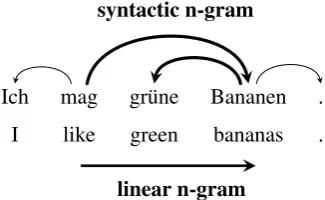
Ich mag gr¨une Bananen . I like green bananas .
syntactic n-gram
linear n-gram
Figure 1: Example of linear and syntactic n-grams: This sentence includes the linear trigram mag gr¨une Bananen and the syntactic trigram mag>Bananen>gr¨une.
are the most promising for our research. Sidorov et al.(2012) suggest a simple concept of syntactic n-grams: Instead of linearly following the text sur-face as regular n-grams do, syntactic n-grams fol-low the dependency path in the sentence from head to dependent. Figure1shows an example of a lin-ear vs. a syntactic n-gram, spanning the same set of tokens. In contrast to linear n-grams, syntactic n-grams encode syntactically meaningful relations in the sentence.Sidorov et al.(2012) achieve good results in a (non-competitive) authorship attribu-tion task with a model based on syntactic n-grams. Goldberg and Orwant(2013) andSidorov(2013) augment the concept to n-ary branching subtrees.
The hermeneutic approach is much less promi-nent than the classification approach and it is dominated by the stylistic investigation of literary works and academic language.
The features used here are primarily token-derived and lexical in nature. A widespread use of this type of analysis working with sequences of words followed uponBiber et al.(1999)’s defini-tion of ‘lexical bundles’2. This was mainly (but
not only) applied to the study of academic lan-guage (e. g. Biber et al. (2004); Hyland (2008); Chen and Baker (2010)). Durrant (2015) analy-ses academic writing by students. By looking at token 4-grams he creates a disciplinary cluster of student writers. Additionally, Durrant interprets the instances found by grouping them into func-tional categories based onHyland(2008).
The second field where this type of analysis has proved productive is literary stylistics. Ram-say(2007) bases his analysis of Virginia Woolf on the character-specific frequency of single words.
2We will not adopt this terminology as we see in section5
[image:2.595.335.498.62.162.2]Mahlberg(2007) looks at frequent token n-grams (using the term ‘clusters’) that function as a type of signature of characters in Charles Dickens’Bleak House. Mahlberg (2013) discusses this in more detail and gives a more comprehensive account of Dickens’ fiction. She also gives an overview of the varying terminology (e. g. n-grams, clusters, lexi-cal bundles) and different attempts of using these features for stylistics (Mahlberg,2013, 48-51).
Far fewer studies use more linguistically en-riched features and annotations. Boukhaled et al. (2015) include pos annotations in their investiga-tion of classic French novels. Their features are se-quences of pos tags that allow for gaps (so-called skipgrams,Guthrie et al.(2006)). Scharloth et al. (2012) use a similar approach that additionally in-cludes combinations of token, lemma and part of speech to compare the style of two social environ-ments in the late sixties in Germany and success-fully relate the resulting linguistic features to so-cial features of these two groups.
We consider our study as following the hermeneutic approach. In contrast to most stud-ies, we include the token and pos level as well as syntactic annotation following Sidorov et al. (2012)’s concept of syntactic n-grams. Addition-ally, we systematically assess the interpretability of n-gram-based features. For measuring the reli-ability of the interpretations (Krippendorff, 2013, 267-270), we base this judgment on more than one person and give the task to three annotators, as de-scribed in section4.3.
3 Linguistics and literary studies: Linguistic and non-linguistic differences
In this section, we will briefly describe established linguistic and non-linguistic differences between the two disciplines under investigation. We will refer back to these in the interpretation of our own results in section5.
Academic disciplines are commonly subdivided into hard and soft sciences, which is regarded as a continuum (Biglan, 1973;Hyland,2004). While linguistics as well as literary studies can clearly be considered disciplines of the soft sciences, most subdisciplines of linguistics tend more to the hard sciences than literary studies does.
Many differences between linguistics and liter-ary studies therefore correspond to the differences between soft and hard sciences, just on a smaller
scale. The soft sciences are characterized as being more interpretative, work hermeneutically, show several subjective perspectives and feature plural-ity of possible objects of study and methods. The hard sciences on the other hand are more analyt-ical, work empirically, have a high agreement on object of study and methods and rely on quantifi-cation (e. g.Biglan(1973);Durrant(2015)).
More specifically referring to the two disci-plines under examination,Gardt(2007) describes literary studies as focusing on the exemplary anal-ysis of individual objects of study (typically texts) and linguistics as focusing rather on patterns and generalizations. We will come back to these fea-tures in the interpretation of linguistic feafea-tures in section5.
These non-linguistic features naturally lead to stylistic differences between disciplines, which have been extensively researched so that our overview has to remain illustrative. For instance, Hyland (2004) looks at disciplinary differences along the hard sciences vs. soft sciences contin-uum. He describes, among other results, that the disciplines vary in their citation practices: The soft fields use more citations than the hard fields and use different types of reporting verbs (Hyland, 2004, 24-29). An analysis of evaluation practices in reviews shows that while the hard fields use more praise, the soft fields use more criticism ( Hy-land,2004, 49).
Biber and Gray(2016) investigate academic En-glish in contrast to other registers and with regard to disciplinary differences. They make a distinc-tion between phrasal (e. g. complex noun phrases) and clausal (e. g. subordination) complexity and find that the natural sciences rely more heavily on the former while the soft sciences prefer the latter. Afros and Schryer (2009) investigate promo-tional metadiscourse in linguistics and literary studies and find that the style of literary studies sometimes resembles literary texts and addresses aesthetic values of the research community.
4 Study
We proceed by presenting our data and the way we generated n-grams in section4.1, our ranking pro-cedure in section 4.2 and the annotation scheme and setup in section4.3.
4.1 Data and n-gram generation
The present study is based on a corpus of 60 PhD theses. The choice of this text type was motivated by the fact that it serves as a ‘gateway genre’ ( De-marest and Sugimoto,2014, 3), granting access to the academic world, and is therefore expected to highly conform to the disciplinary norms. Addi-tionally, it is a text type that has about the same status in all disciplines. However, we have to be careful about generalizing the results to academic language in general. We created two subcorpora:
• subcorpus of linguistics: 30 PhD theses
comprising 1,427,758 tokens,
• subcorpus of literary studies: 30 PhD
the-ses comprising 2,151,679 tokens.
Sections that do not belong to the register under investigation or that interrupt the text were ex-tracted semi-automatically: footnotes, citations, examples, tables, figures, title page, table of con-tents, reference section etc. This preprocessing followed rather simple heuristics and while the re-sults are not perfect, they are sufficient for a quan-titative analysis based on this amount of data.
We processed the data using the following tools: the systemPunkt (Kiss and Strunk, 2006)3
for tokenization and an off-the-shelf version of MATE dependency parser (Bohnet,2010) trained on the TIGER Corpus (Seeker and Kuhn, 2012) for lemma, pos and dependency annotation. We evaluated the parser’s annotations against a gold standard consensually created by two annotators for a sample of 22 sentences (600 tokens). Given that it is applied to out-of-domain data, the parser performance is good (UAS: 0.95, LAS: 0.93).
We extracted the following data sets from the resulting corpus:
• linear n-gramsof sizes 2-5 using tokens and
pos tags, respectively,
• syntactic n-gramsof sizes 2-5 using tokens
and pos tags, respectively, generated by tak-ing every word of the sentence as a start-ing point and followstart-ing the dependency path
3http://www.nltk.org/api/nltk.tokenize.html, 19.05.2017
backwards by n-1 steps (following the con-cept ofSidorov et al.(2012)).
4.2 Distinctiveness and collocational strength: n-gram ranking
For further analysis, only n-grams with a total fre-quency of more than 10 are included. For these n-grams we calculate their relative frequencies in all 60 texts.
In order to rank the n-grams in a way that is meaningful for later interpretation, two measures are of interest: distinctiveness and collocational strength.
First, we want to identify n-grams with a high difference in frequency between the two subcor-pora and thus corresponding to major differences between the disciplines. To achieve this, we use the t-test as suggested by Paquot and Bestgen (2009) and Lijffijt et al.(2014). One of the ben-efits of the t-test is that it takes variation within the corpora into account. Consequently, a single text cannot dominate the overall result.
Second, we include a measure for collocational strength between the elements of the n-gram. This is necessary because the t-test results disregard the influence of significant substructures of an n-gram. Consider, for instance, that the pos tag CARD4is
much more frequent in linguistics. Also, the bi-gram CARD ADJA5is much more frequent in
lin-guistics. The latter observation does not necessar-ily mean that this combination is characteristic of linguistics but can be caused by the high difference in frequency of CARD alone.
A measure for collocational strength tells us whether the bigram is more frequent than we would expect given the corresponding unigram frequencies. Evert(2008) gives a comprehensive overview of different measures and their proper-ties. We use the log-likelihood measure described byDunning(1993).
While this computation is very straightforward for bigrams, the situation becomes more compli-cated with higher n. We follow the approach of Zinsmeister and Heid (2003), who break down triples of verb, adjective and noun into nested bi-nary tuples ((adjective, noun), verb) to maintain a binary structure.
Our approach comprises the following steps:
4Cardinal number. The tagset used here isSchiller et al.
(1999).
1. For each n-gram that is found to be distinctive by the t-test, we generate all possible sub-n-grams contained in the n-gram. For instance, for a distinctive 4-gram, all trigrams, bigrams and unigrams contained are generated. 2. Each list of sub-n-grams is reduced to those
sub-n-grams which show a significant differ-ence between the subcorpora themselves and thus are possible candidates for causing the significance of the original n-gram alone. 3. For each of these distinctive sub-n-grams, we
calculate the collocational strength between this sub-n-gram and the rest of the original n-gram.
A low log-likelihood ratio indicates that the com-bination of the two elements does not occur more often than expected. Consequently, it is just one of the elements that causes the distinctive effect. We exclude n-grams from the ranking that contain a combination of elements with a log-likelihood ratio below a threshold of 50.
4.3 Annotating n-grams
The n-gram generation and ranking can be auto-mated to a high extent and is consequently highly replicable. For the following step of interpretation this is much less the case.
Our annotation process aims at objectifying the interpretation of n-grams as far as possible. To this end, the resulting n-grams are annotated by three annotators according to an annotation scheme that was developed in the process of annotating the data (Pustejovsky and Stubbs,2012, 109).
The n-grams we include in the annotation tasks vary in three dimensions: They are either linear or syntactic n-grams, they are of a size between 2 and 5 and they are either based on tokens or on pos labels.
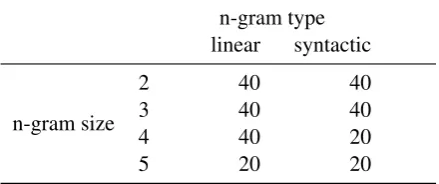
The sample of token n-grams was taken as Ta-ble 1 summarizes: For the n-gram sizes 2-5, we chose at least the 20 highest-scoring linear and syntactic n-grams. If more than 20 instances crossed the significance threshold of p=0.01 in the t-test, the sample size for that group was raised to 40 instances, giving a total sample size of 260 items.
The sample for pos n-grams comprises again the 20 highest-scoring items in our ranking of linear and syntactic n-grams for n=2-5, resulting in 160 items in total. One difference to token n-grams
n-gram type linear syntactic
n-gram size
2 40 40
3 40 40
4 40 20
[image:5.595.307.527.64.156.2]5 20 20
Table 1: Number of instances per category in the sample of token n-grams
is the fact that pos n-grams are more abstract and consequently more difficult to interpret for human annotators. The annotators are therefore provided with five token realizations of the pos n-gram at hand for illustration. These are randomly chosen from the subcorpus of the discipline in which the n-gram is more frequent. In all annotation tasks, the annotators are not provided with any contexts the n-grams appear in as these can be quite divers and our objective was to judge the interpretability of n-grams as such.
We present two annotation tasks: One classify-ing the structures in the n-gram as nominal, verbal or clausal and a second classifying them as carry-ing lexical or grammatical information (for token n-grams only).
First, we want to know whether the n-grams capture linguistically interpretable structures and if yes, what kind of structures we find for the two disciplines. Our first annotation scheme is roughly based onBiber et al.(2004, 381)’s ‘struc-tural types of lexical bundles’ and comprises the following categories:
1. This n-gram contains a verbal structure (V).
2. This n-gram contains a nominal structure (N).
3. This n-gram contains a clausal structure (sub-ordination) (C).
4. This n-gram contains a verbal structure that also indicates a clausal structure (subordina-tion) (V C).
5. This n-gram does not contain any of the above-mentioned structures (other).
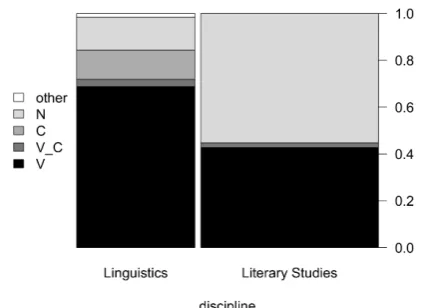
Figure 2: Annotation of structural types of token n-grams dependent on discipline, n=260 (note that the category V C did not occur here)
Figure 3: Annotation of structural types of pos n-grams dependent on discipline, n=160
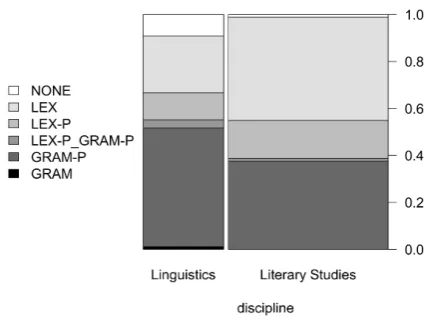
For the sample of token n-grams, we made an additional distinction between lexical and gram-matical information. This distinction allows for a general assessment of the nature of the differences between the disciplines. These two types of infor-mation contribute to style in different ways. For lexical items, it remains to be seen whether they sometimes reflect topic rather than style. The an-notation follows these categories:
1. This n-gram contains a (complex) lexical unit (LEX) or overlaps with one (LEX-P). 2. This n-gram contains a grammatical structure
(GRAM) or overlaps with one (GRAM-P). 3. This n-gram contains a structure that is
am-biguous between lexical unit and grammati-cal structure (LEX-P GRAM-P).
4. This n-gram does not contain a (com-plex) lexical unit or grammatical structure (NONE).
For categories 1 to 3, the annotators were asked to additionally provide the lexical unit or grammat-ical structure they were thinking of (e. g. relative clause). This results in very concrete phenomena and can be considered the most fine-grained an-notation category. At the same time, a general-izing, quantified evaluation of the results is more difficult due to the diversity of phenomena. For the annotation of pos n-grams the differentiation between lexical units and grammatical structures does not apply, as pos tags do not directly refer to the lexical level. Therefore, the annotators are
only asked for a label for the grammatical struc-ture represented in the n-gram.
5 Results and Discussion
We will first present the results of the first annota-tion task about nominal and verbal structures (sec-tion 5.1). This is followed by the results related to lexical and grammatical phenomena in token n-grams (section5.2), and finally by the analysis of these phenomena based on pos tags (section5.3).
5.1 Nominal vs. verbal style
For the first annotation scheme differentiating nominal, verbal and clausal structures, the three annotators reached an inter-annotator agreement of 0.83 for the annotation of 260 token n-grams, measured by Fleiss’ Kappa (Fleiss, 1971). Fig-ure 2 displays the results. In the horizontal di-mension we can see the two disciplines. The bars’ widths show how many of the distinctive n-grams are more frequent in linguistics and literary stud-ies, respectively. We can see that about two thirds of the n-grams in the sample are more frequent in literary studies than in linguistics. In the vertical dimension, the proportion of the annotation cat-egories is displayed. The distinctive n-grams for the style of literary studies are dominated by nom-inal structures (in light gray) while verbal struc-tures (in black) are more characteristic of linguis-tics. The data reveal a significant difference be-tween the disciplines (Fisher’s test, p<0.001).
[image:6.595.81.287.64.216.2]n-grams require more interpretation. When compar-ing the disciplines, we get a result similar to the token level: In Figure3we can see the distribution of nominal, verbal and clausal structures in pos n-grams across the disciplines. Even though the dif-ference is less pronounced than in Figure 2, the difference between the disciplines is also highly significant (Fisher’s test, p<0.001).
In the pos n-grams of both disciplines, verbal structures account for a higher proportion than on the token level. This shift emerges as many token instances belong to the same pos pattern, and are mapped to only one pos instance when abstracting from token to part of speech.
To summarize, we found that verbal structures are more characteristic of linguistics and nominal structures of literary studies. Assuming that our nominal structures correspond toBiber and Gray (2016)’s phrasal complexity, this result is in op-position to their observation that the hard sciences rely more on phrasal complexity than the soft sci-ences. We surmise that this might be due to the fact that the latter study is based on English data only. German literary studies is firmly rooted in the German academic tradition, which might re-sult in this deviation from the English-based ex-pectations.
Furthermore, we can see that among the sam-ple of most distinctive structures in both figures, about two thirds are more frequent in literary stud-ies than in linguistics. The interpretation of this fact is not straightforward and requires a careful review of the underlying patterns (e. g. their abso-lute frequencies and textual functions) that is be-yond the scope of the current paper.
[image:7.595.301.515.64.221.2]When interpreting these frequencies, we have to keep in mind that (slightly less than) half of the structures under investigation are syntactic n-grams. The dependency path through a sentence always starts with a finite verb and is relatively short in total. Consequently, most of the larger syntactic n-grams include the finite verb at the root, leading to the classification of the structure as verbal. Consequently, verbal structures are much more frequent among syntactic than linear n-grams (Fisher’s test, p<0.001). However, this applies to both disciplines and token as well as pos n-grams in the same way. For a more comprehen-sive comparison of linear and syntactic n-grams, seeAndresen and Zinsmeister(2017).
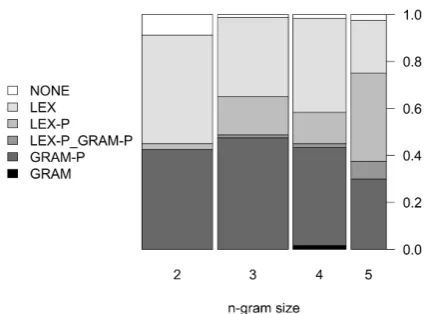
Figure 4: Annotation of information in token n-grams dependent on n-gram size, n=260
5.2 Lexical and grammatical structures in token features
The application of the second annotation scheme, labeling structures as being mainly characterized by grammatical or lexical properties, was more controversial. The inter-annotator agreement is 0.48 and shows that the data is rather ambiguous in terms of the annotated categories. At the same time it indicates the limits of n-gram interpretabil-ity: n-grams can invite multiple interpretations that have to be verified carefully. In these anno-tations, there initially were 20 instances where all three annotators chose different categories. These instances were discussed by two annotators who then agreed on one category. The results presented in the following are based on a majority vote.
Figure 5: Annotation of information in token n-grams dependent on discipline, n=260
small to fully capture many phenomena.
Figure 5shows the distribution across the two disciplines. We can see that, even when only taking the rather coarse-grained annotation labels (LEX, GRAM etc.) into account, we find signifi-cant differences between the disciplines (Fisher’s test, p<0.001). Generally speaking, there are more grammatical patterns distinctive for linguis-tics and more lexical patterns distinctive for liter-ary studies. When assessing this difference, we have to keep in mind that many of the linguis-tic phenomena are binary in nature, with one of the variants being more easily detectable by an n-gram analysis. For instance, the n-grammatical phe-nomenon ‘passive voice’ is more frequent in lin-guistics. The logical consequence is that active voice is more frequent in literary studies. How-ever, only the high frequency of passive voice is visible in the data, as it is realized by a rather sta-ble pattern of auxiliary verbs. This prosta-blem of de-tectability is especially pervasive for grammatical phenomena as they often require the realization of one of a set of options.
In addition to assigning these categories, the an-notators provided the lexical or grammatical struc-ture they derived from the n-gram. Here, the an-notation is increasingly interpretative. At the same time, clearer differences between the disciplines emerge.
Among the lexical patterns we found to be more frequent in linguistics “in der Regel” (‘as a rule, usually’) is very prominent. This corresponds to the initial assumption that in linguistics, general-ization plays a bigger role than in literary stud-ies. Patterns like “k¨onnen zur¨uckgef¨uhrt werden
auf” (‘can be traced back to’) show an attempt to give causal explanations. Other words like “Anal-yse” (‘analysis’) and “Auswahl” (‘selection’) mir-ror the empirical methodology of the discipline. For literary studies, on the other hand, we find many items referring to the temporal dimension: “in dem Moment” (‘at that moment’), “in einer Zeit” (‘at a time’), “das Ende” (‘the end’), “in der ersten H¨alfte des” (‘in the first half of the’). This characterizes the discipline as being more narra-tive when referring to the (e. g. temporal) dimen-sions of the literary object.
Among the grammatical structures literary stud-ies shows a higher frequency of personal pro-nouns, which is also related to narrative structures and individual objects of study. However, gram-matical structures are by far dominated by several patterns introducing relative clauses. This indi-cates a rather nominal style already found in sec-tion 5.1. Interestingly, the relatively few relative clauses more frequent in linguistics all use the rel-ative pronoun “die”, which can be feminine but is more likely to be plural. This corresponds to the idea that literary studies rather deals with individ-uals (mostly male individindivid-uals, as the frequencies show) while linguistics deals with groups of phe-nomena. Other grammatical structures character-istic for lingucharacter-istics are passive constructions and modal verbs as well as generally more indications of sub- and coordination (structures with “dass”, ‘that’ and “und”, ‘and’).
5.3 Lexical and grammatical structures in pos features
For the pos n-grams, the annotation of lexical vs. grammatical phenomena is less meaningful. But again, the annotators were asked to name or de-scribe the linguistic phenomenon they see repre-sented in the n-gram. This proved to be more dif-ficult than for the token annotation. Often the n-grams were annotated with phenomena that could be derived from a single pos tag in the sequence, e. g. all n-grams including the pos tag PRELS6
were annotated as relative clause, independent of the other tags in the sequence.
However, the following results can be found: Generally speaking, the phenomena mirror the dif-ferences between verbal and nominal structures found in section5.1. More specifically, passives as well as modals and predicatives are more
quent in linguistics. For literary studies, complex noun (and prepositional) phrases are more com-mon. In contrast to the results based on the token level, patterns with relative clauses occur in liter-ary studies only. Here, the token level offers an informative differentiation. Many of these noun phrases include possessive pronouns, which are hardly found in linguistics, cf. personal pronouns discussed in the previous section.
6 Conclusion and future work
Our study had the aim of determining the poten-tial of n-grams for linguistically describing style. We illustrated this by a study comparing the Ger-man academic languages of linguistics and liter-ary studies. By means of an annotation experi-ment, we could show that most n-grams are in-terpretable in the sense that they could be related to some linguistic category. However, interpreta-tions become more challenging with increasing n-gram length and abstractness, e. g. when interpret-ing parts of speech instead of tokens. Additionally, the results we found can clearly be related to non-linguistic properties of the disciplines: e. g. ref-erences to empirical methodology in linguistics, narrative structures in literary studies. Overall, the distinctive structures more frequent in literary studies are for the most part nominal. Linguistics, on the other hand, exhibits more verbal and clausal patterns.
These specific results might help scholars and especially students of the disciplines to reflect on and adapt to disciplinary writing conventions. More generally, we hope to have contributed to a better understanding of how n-gram analysis can add to the linguistic description of style. Last but not least, n-grams can serve as a starting point for subsequent in-depth analyses of language and style.
In the future, we intend to refine our method of dealing with the influence of significant sub-structures. Between some parts of speech there is a general collocation tendency in languages, e. g., in German a determiner and an adjective generally cooccur more often than expected by their unigram frequencies. Our current approach of using a measure of collocational strength, the log-likelihood measure, does not include this in-formation. It requires a more detailed composi-tional analysis of n-grams to determine to what ex-tend substructures can serve as a proxy of larger
n-grams. In addition, it is necessary to decide whether some of the n-grams are related to topic rather than style. This depends on the specific def-inition of style and the analysis’ objective.
In our opinion, the mathematical decisions be-hind the ranking of n-grams are especially impor-tant when an interpretation by humans is intended. When given an n-gram with the information that it is more frequent in one language variety than in another, humans will usually come up with some kind of interpretation of this fact. If the n-gram’s rank is more of a mathematical artifact, this can lead to a highly skewed interpretation of the data. Acknowledgments
We would like to thank Sarah Jablotschkin for contributing to the manual n-gram annotation, Piklu Gupta for improving our English and the anonymous reviewers for their extensive and de-tailed comments on our submission. All remain-ing errors are our own.
References
Elena Afros and Catherine F. Schryer. 2009. Promotional (meta)discourse in research ar-ticles in language and literary studies.
En-glish for Specific Purposes 28(1):58–68.
https://doi.org/10.1016/j.esp.2008.09.001.
Melanie Andresen and Heike Zinsmeister. 2017. The Benefit of Syntactic vs. Linear N-grams for Lin-guistic Description. In Proceedings of the 4th In-ternational Conference on Dependency Linguistics (Depling 2017). Pisa, Italy.
Douglas Biber, Susan Conrad, and Viviana Cortes. 2004. If you look at. . . : Lexical bundles in uni-versity teaching and textbooks. Applied linguistics
25(3):371–405.
Douglas Biber and Bethany Gray. 2016. Grammatical Complexity in Academic English: Linguistic Change in Writing. Studies in English language. Cambridge University Press, Cambridge.
Douglas Biber, Stig Johansson, Geoffrey Leech, Su-san Conrad, and Edward Finegan. 1999. Longman Grammar of Spoken and Written English. Longman, Harlow.
Anthony Biglan. 1973. The characteristics of subject matter in different academic areas.
Journal of Applied Psychology 57(3):195–203. https://doi.org/10.1037/h0034701.
Bernd Bohnet. 2010. Very High Accuracy and Fast Dependency Parsing is not a Contradiction. In
on Computational Linguistics (COLING 2010). Bei-jing, China.
Mohamed-Amine Boukhaled, Francesca Frontini, Gauvain Bourgne, and Jean-Gabriel Ganascia. 2015. Computational study of stylistics: A clustering-based interestingness measure for extracting rel-evant syntactic patterns. International Jour-nal of ComputatioJour-nal Linguistics and Applications
6(1):45–62.
Yu-Hua Chen and Paul Baker. 2010. Lexical bundles in L1 and L2 academic writing. Language Learning & Technology14(2):30–49.
Bradford Demarest and Cassidy R. Sugimoto. 2014. Argue, observe, assess: Measuring disciplinary identities and differences through socio-epistemic discourse. Journal of the Association for In-formation Science and Technology pages 1–14. https://doi.org/10.1002/asi.23271.
Ted Dunning. 1993. Accurate Methods for the Statis-tics of Surprise and Coincidence. Computational Linguistics19(1):61–74.
Philip Durrant. 2015. Lexical Bundles and Disci-plinary Variation in University Students’ Writing: Mapping the Territories. Applied Linguisticspages 1–30.https://doi.org/10.1093/applin/amv011.
Stefan Evert. 2008. Corpora and collocations. In Anke L¨udeling and Merja Kyt¨o, editors,Corpus Lin-guistics: An International Handbook, De Gruyter, Berlin, Boston, volume 2 ofHandbooks of Linguis-tics and Communication Science, pages 1212–1248.
Joseph L. Fleiss. 1971. Measuring nomi-nal scale agreement among many raters.
Psychological Bulletin 76(5):378–382.
https://doi.org/10.1037/h0031619.
Andreas Gardt. 2007. Linguistisches Interpretieren. Konstruktivistische Theorie und realistische Praxis. In Fritz Hermanns and Werner Holly, editors,
Linguistische Hermeneutik: Theorie und Praxis des Verstehens und Interpretierens, Niemeyer, T¨ubingen, number 272 in Reihe Germanistische Linguistik, pages 241–261.
Yoav Goldberg and Jon Orwant. 2013. A Dataset of Syntactic-Ngrams over Time from a Very Large Cor-pus of English Books. InSecond Joint Conference on Lexical and Computational Semantics (*SEM), Volume 1: Proceedings of the Main Conference and the Shared Task: Semantic Textual Similarity. Association for Computational Linguistics, Atlanta, Georgia, USA, pages 241–247.
David Guthrie, Ben Allison, Wei Liu, Louise Guthrie, and Yorick Wilks. 2006. A closer look at skip-gram modelling. In Proceedings of the 5th International Conference on Language Resources and Evaluation (LREC-2006). pages 1–4.
Berenike Herrmann, Karina van Dalen-Oskam, and Christof Sch¨och. 2015.Revisiting Style, a Key Con-cept in Literary Studies. Journal of Literary Theory
9(1):25–52. https://doi.org/10.1515/jlt-2015-0003. Graeme Hirst and Ol’ga Feiguina. 2007. Bigrams of
Syntactic Labels for Authorship Discrimination of Short Texts. Literary and Linguistic Computing
22(4):405–417.https://doi.org/10.1093/llc/fqm023. Ken Hyland. 2004. Disciplinary Discourses: Social Interactions in Academic Writing. The University of Michigan Press, Michigan.
Ken Hyland. 2008. As can be seen: Lexi-cal bundles and disciplinary variation.
En-glish for Specific Purposes 27(1):4–21.
https://doi.org/10.1016/j.esp.2007.06.001.
Tibor Kiss and Jan Strunk. 2006. Unsuper-vised Multilingual Sentence Boundary Detec-tion. Computational Linguistics 32(4):485–525. https://doi.org/10.1162/coli.2006.32.4.485.
Klaus Krippendorff. 2013. Content Analysis: An Intro-duction to Its Methodology. Sage, Thousand Oaks, CA, third edition.
Jefrey Lijffijt, Terttu Nevalainen, Tanja S¨aily, Panagi-otis Papapetrou, Kai Puolam¨aki, and Heikki Man-nila. 2014. Significance testing of word frequencies in corpora. Digital Scholarship in the Humanities
pages 1–24. https://doi.org/10.1093/llc/fqu064. Michaela Mahlberg. 2007. Corpus stylistics: Bridging
the gap between linguistic and literary studies. In Michael Hoey, Michaela Mahlberg, Michael Stubbs, and Wolfgang Teubert, editors,Text, Discourse and Corpora. Theory and Analysis, Continuum, London, Studies in corpus and discourse, pages 217–246. Michaela Mahlberg. 2013. Corpus Stylistics and
Dick-ens’s Fiction. Number 14 in Routledge advances in corpus linguistics. Routledge, New York.
Chrysostomos Mantzavinos. 2016. Hermeneutics. In Edward N. Zalta, editor,The Stanford Encyclopedia of Philosophy, Metaphysics Research Lab, Stanford University. Winter 2016 edition.
Magali Paquot and Yves Bestgen. 2009. Dis-tinctive words in academic writing: A compari-son of three statistical tests for keyword extrac-tion. In Andreas H. Jucker, Daniel Schreier, and Marianne Hundt, editors, Corpora: Prag-matics and Discourse, Brill, pages 247–269. https://doi.org/10.1163/9789042029101 014. James Pustejovsky and Amber Stubbs. 2012.
Nat-ural Language Annotation for Machine Learning. O’Reilly Media, Inc., Sebastopol, CA.
Stephen Ramsay. 2007. Algorithmic Criticism. In
Joachim Scharloth, Noah Bubenhofer, and Klaus Rothenh¨ausler. 2012. Andersschreiben aus ko-rpuslinguistischer Perspektive: Datengeleitete Zug¨ange zum Stil. In Britt-Marie Schuster and Doris Tophinke, editors, Andersschreiben. Formen, Funktionen, Traditionen, Erich Schmidt Verlag, Berlin, number 236 in Philologische Studien und Quellen, pages 157–178.
Anne Schiller, Simone Teufel, Christine Thielen, and Christine St¨ockert. 1999. Guidelines f¨ur das Tag-ging deutscher Textcorpora mit STTS (kleines und großes Tagset). Stuttgart, T¨ubingen.
Wolfgang Seeker and Jonas Kuhn. 2012. Making El-lipses Explicit in Dependency Conversion for a Ger-man Treebank. In Proceedings of the 8th Interna-tional Conference on Language Resources and Eval-uation. Istanbul, Turkey, pages 3132–3139.
Grigori Sidorov. 2013. Syntactic Dependency Based N-grams in Rule Based Automatic English as Sec-ond Language Grammar Correction. International Journal of Computational Linguistics and Applica-tions4(2):169–188.
Grigori Sidorov, Francisco Velasquez, Efstathios Sta-matatos, Alexander Gelbukh, and Liliana Chanona-Hern´andez. 2012. Syntactic Dependency-Based N-grams as Classification Features. In Ildar Batyr-shin and Miguel Gonz´alez Mendoza, editors, Ad-vances in Computational Intelligence, Springer, number 7630 in Lecture Notes in Computer Sci-ence, pages 1–11. https://doi.org/10.1007/978-3-642-37798-3 1.
Dirk Siepmann. 2006. Academic Writing and Cul-ture: An Overview of Differences between English, French and German. Meta: Journal des traduc-teurs/Meta: Translators’ Journal51(1):131–150. Efstathios Stamatatos. 2009. A survey of modern
au-thorship attribution methods. Journal of the Ameri-can Society for Information Science and Technology
60(3):538–556.https://doi.org/10.1002/asi.21001. Heike Zinsmeister and Ulrich Heid. 2003.