Improving coreference resolution
with automatically predicted prosodic information
Ina R¨osiger∗, Sabrina Stehwien∗, Arndt Riester, Ngoc Thang Vu
Institute for Natural Language Processing University of Stuttgart, Germany
{roesigia,stehwisa,arndt,thangvu}@ims.uni-stuttgart.de
Abstract
Adding manually annotated prosodic in-formation, specifically pitch accents and phrasing, to the typical text-based feature set for coreference resolution has previ-ously been shown to have a positive effect on German data. Practical applications on spoken language, however, would rely on automatically predicted prosodic informa-tion. In this paper we predict pitch ac-cents (and phrase boundaries) using a con-volutional neural network (CNN) model from acoustic features extracted from the speech signal. After an assessment of the quality of these automatic prosodic anno-tations, we show that they also signifi-cantly improve coreference resolution.
1 Introduction
Noun phrase coreference resolution is the task of grouping noun phrases (NPs) together that refer to the same discourse entity in a text or dialogue. In Example (1), taken from Umbach (2002), the question for the coreference resolver, besides link-ing the anaphoric pronoun he back toJohn, is to decide whetheran old cottageandthe shed refer to the same entity.
(1) {John}1has{an old cottage}2.
Last year{he}1reconstructed{the shed}?.
Coreference resolution is an active NLP research area, with its own track at most NLP conferences and several shared tasks such as the CoNLL or SemEval shared tasks (Pradhan et al., 2012; Re-casens et al., 2010) or the CORBON shared task 20171. Almost all work is based on text, although *The two first authors contributed equally to this work.
1http://corbon.nlp.ipipan.waw.pl/
there exist a few systems for pronoun resolution in transcripts of spoken text (Strube and M¨uller,
2003; Tetreault and Allen, 2004). It has been shown that there are differences between written and spoken text that lead to a drop in performance when coreference resolution systems developed for written text are applied on spoken text (Amoia et al., 2012). For this reason, it may help to use additional information available from the speech signal, for example prosody.
In West-Germanic languages, such as English and German, there is a tendency for coreferent items, i.e. entities that have already been intro-duced into the discourse (their information sta-tus isgiven), to be deaccented, as the speaker as-sumes the entity to be salient in the listener’s dis-course model (cf. Terken and Hirschberg(1994);
Baumann and Riester(2013);Baumann and Roth
(2014)). We can make use of this fact by providing prosodic information to the coreference resolver. Example (2), this time marked with prominence information, shows that prominence can help us resolve cases where the transcription is potentially ambiguous2.
(2) {John}1has{an old cottage}2.
a. Last year {he}1 reconstructed {the
SHED}3.
b. Last year {he}1 reconSTRUCted the
shed}2.
The pitch accent onshedin(2a)leads to the in-terpretation thatthe shed andthe cottagerefer to different entities, where the shed is a part of the cottage (they are in a bridging relation). In con-trast, in(2b), the shedis deaccented, which sug-gests thatthe shedandthe cottagecorefer.
A pilot study byR¨osiger and Riester(2015) has
2The anaphor under consideration is typed in boldface, its
antecedent is underlined. Accented syllables are capitalised.
shown that enhancing the text-based feature set for a coreference resolver, consisting of e.g. auto-matic part-of-speech (POS) tags and syntactic in-formation, with pitch accents and prosodic phras-ing information helps to improve coreference res-olution of German spoken text. The prosodic la-bels used in the experiments were annotated man-ually, which is not only expensive but not applica-ble in an automatic pipeline setup. In our paper, we present an experiment in which we replicate the main results from the pilot study by annotating the prosodic information automatically, thus omit-ting any manual annotations from the feature set. We show that adding prosodic information signif-icantly helps in all of our experiments.
2 Prosodic features for coreference resolution
Similar to the pilot study, we make use ofpitch ac-centsandprosodic phrasing. We predict the pres-ence of a pitch accent3and use phrase boundaries
to derive nuclear accents, which are taken to be the last (and perceptually most prominent) accent in an intonation phrase. This paper tests whether previously reported tendencies for manual labels are also observable for automatic labels, namely:
Short NPs Since long, complex NPs almost
al-ways have at least one pitch accent, the presence and the absence of a pitch accent is more helpful for shorter phrases.
Long NPs For long, complex NPs, we look for
nuclear accents that indicate the phrase’s overall prominence. If the NP contains a nuclear accent, it is assumed to be less likely to take part in coreference chains.
We test the following features that have proven beneficial in the pilot study. These features are de-rived for each NP.
Pitch accent presence focuses on the presence
of a pitch accent, disregarding its type. If one ac-cent is present in the NP, this boolean feature gets assigned the valuetrue, andfalseotherwise.
Nuclear accent presence is a boolean feature
comparable to pitch accent presence. It gets as-signed the value true if there is a nuclear accent present in the NP,falseotherwise.
3We do not predict the pitch accent type (e.g. fall H*L or
rise L*H) as this distinction was not helpful in the pilot study and is generally more difficult to model.
3 Data
To ensure comparability, we use the same dataset as in the pilot study, namely the DIRNDL cor-pus (Eckart et al., 2012;Bj¨orkelund et al.,2014), a German radio news corpus annotated with both manual coreference and manual prosody labels. We adopt the official train, test and development split4 designed for research on coreference
res-olution. The recorded news broadcasts in the DIRNDL-anaphora corpus were spoken by 13 male and 7 female speakers, in total roughly 5 hours of speech. The prosodic annotations follow the GToBI(S) standard for pitch accent types and boundary tones and are described in Bj¨orkelund et al. (2014). In this study we make use of two class labels of prosodic events: all accent types (marked by the standard ToBI *) grouped into a single class (pitch accent presence) and the same for intonational phrase boundaries (marked by %).
4 Automatic prosodic information
In this section we describe the prosodic event de-tector used in this work. It is a binary classifier that is trained separately for either pitch accents or phrase boundaries and predicts for each word, whether it carries the respective prosodic event.
4.1 Model
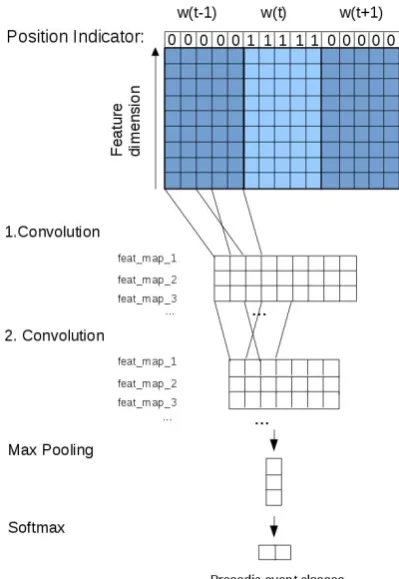
We apply a convolutional neural network (CNN) model, illustrated in Figure 1. The input to the CNN is a matrix spanning the current word and its right and left context word. The input matrix is a frame-based representation of the speech signal. The signal is divided into overlapping frames for each 20 ms with a 10 ms shift and are represented by a 6-dimensional feature vector for each frame.
We use acoustic features as well as position in-dicator features followingStehwien and Vu(2017) that are simple and fast to obtain. The acoustic features were extracted from the speech signal us-ing the OpenSMILE toolkit (Eyben et al.,2013). The feature set consists of 5 features that comprise acoustic correlates of prominence: smoothed fun-damental frequency (f0), RMS energy, PCM loud-ness, voicing probability and Harmonics-to-Noise Ratio. The position indicator feature is appended as an extra feature to the input matrices (see Fig-ure1) and aids the modelling of the acoustic
Figure 1: CNN for prosodic event recognition with an input window of 3 successive words and posi-tion indicating features.
text by indicating which frames belong to the cur-rent word or the neighbouring words.
We apply two convolution layers in order to ex-pand the input information and then use max pool-ing to find the most salient features. In the first convolution layer we ensure that the filters always span all feature dimensions. All resulting feature maps are concatenated to one feature vector which is fed into the two-unit softmax layer.
4.2 Predicting prosodic labels on DIRNDL
We predict prosodic events for the whole DIRNDL subcorpus used in this paper. To simulate an ap-plication setting, we train the CNN model on a different dataset. Since the acoustic correlates of prosodic events as well as the connection between sentence prosody and information status exploited in this paper are similar in English and German, we train the prosodic event detector on English data and apply the model to the German DIRNDL corpus5. The data used to train the model is a
2.5 hour subset of the Boston University Radio
5Rosenberg et al.(2012) report good cross-language
re-sults of pitch accent detection on this dataset.
News Corpus (Ostendorf et al.,1995) that contains speech from 3 female and 2 male speakers and that includes manually labelled pitch accents and into-national phrase boundary tones. Hence, both cor-pora consist of read speech by radio news anchors. The prediction accuracy on the DIRNDL anaphora corpus is 81.9% for pitch accents and 85.5% for intonational phrase boundary tones6. The
speaker-independent performance of this model on the Boston dataset is 83.5% accuracy for pitch accent detection and 89% for phrase boundary detection. We conclude that the prosodic event detector gen-eralises well to the DIRNDL dataset and the ob-tained accuracies are appropriate for our experi-ments.
5 Coreference resolution
In this section, we describe the coreference re-solver used in our experiments and how it was ap-plied to create the baseline system using only au-tomatic annotations.
5.1 IMS HotCoref DE
The IMS HotCoref DE coreference resolver is a state-of-the-art tool for German7 (R¨osiger and
Kuhn,2016). It is data-driven, i.e. it learns from annotated data with the help of pre-defined fea-tures using a structured perceptron that models coreference within a document as a directed tree. This way, it can exploit the tree structure to create non-local features (features that go beyond a pair of NPs). The standard features are text-based and consist mainly of string matching, part of speech, constituent parses, morphological information and combinations thereof.
5.2 Coreference resolution using automatic preprocessing
As we aim at coreference resolution applicable to new texts, all annotations used to create the text-based features are automatically predicted using NLP tools. It is frequently observed that the per-formance drops when the feature set is derived in this manner compared to using features based on manual annotations. For example, the perfor-mance of IMS HotCoref DE drops from 63.61
6The per-class accuracy is 82.1% for pitch accents and
37.1% for phrase boundaries. Despite these low quality phrase boundary annotations, we believe that, as a first step, their effectiveness can still be tested. This issue will be ad-dressed in future work.
to 48.61 CoNLL score8 on the reference dataset
T¨uBA-9 D/Z. The system, pre-trained on T¨uBA, yields a CoNLL score of 37.04 on DIRNDL with predicted annotations. This comparatively low score also confirms the assumption that the per-formance of a system trained on written text drops when applied to spoken text. The drop in perfor-mance can also be explained by the slightly dif-ferent domains (newspaper text and radio news). However, if we train on the concatenation of the train and development set of DIRNDL we achieve a score of 46.11. This will serve as a baseline in the following experiments.
6 Experiments
We test our prosodic features by adding them to the feature set used in the baseline. We define
short NPs to be of length 3 or shorter9. In this
setup, we apply the feature only to short NPs. In theall NPsetting, the feature is used for all NPs. The ratio of short vs. longer NPs in DIRNDL is roughly 3:1. Note that we evaluate on the whole test set in both cases. We report how the perfor-mance of the coreference resolver is affected in three settings:
(a) trained and tested
on manual prosodic labels (shortgold),
(b) trained on manual prosodic labels, but tested on automatic labels (this simulates an appli-cation scenario where a pre-trained model is applied to new texts (shortgold/auto) and
(c) trained and tested on
automatic prosodic labels (shortauto).
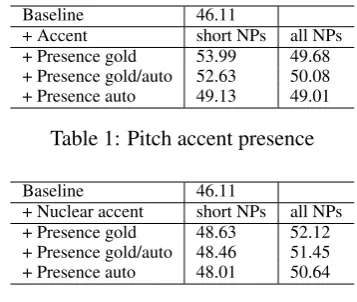
Table1shows the effect of the pitch accent pres-ence feature on our data. All features perform sig-nificantly better than the baseline10. As expected,
the numbers are higher if we limit this feature to short NPs. We believe that this is due to the fact that the feature contributes most when it is most meaningful: on short NPs, a pitch accent makes it more likely for the NP to contain new infor-mation, whereas long NPs almost always have at
8We report the performance of the coreference system in
terms of the CoNLL score, the standard measure to assess the quality of coreference resolution.
9In our experiments, this performed even better than
length 4 or shorter as used inR¨osiger and Riester(2015).
10We compute significance using the Wilcoxon signed rank
test (Siegel and Castellan,1988) at the 0.01 level.
Baseline 46.11
[image:4.595.325.504.60.211.2]+ Accent short NPs all NPs + Presence gold 53.99 49.68 + Presence gold/auto 52.63 50.08 + Presence auto 49.13 49.01
Table 1: Pitch accent presence
Baseline 46.11
[image:4.595.328.504.150.203.2]+ Nuclear accent short NPs all NPs + Presence gold 48.63 52.12 + Presence gold/auto 48.46 51.45 + Presence auto 48.01 50.64
Table 2: Nuclear accent presence
least one pitch accent, regardless of its informa-tion status. We achieve the highest performance with gold labels, followed by the gold/auto ver-sion with a score that is not significantly worse than thegoldversion. This is important for appli-cations as it suggests that the loss in performance is small when training on gold data and testing on predicted data. As expected, the version that is trained and tested on predicted data performs worse, but is still significantly better than the base-line. Hence, prosodic information is helpful in all three settings. It also shows that the assumption on short NPs in the pilot study is also true for au-tomatic labels.
Table 2shows the effect of adding nuclear ac-cent presence as a feature to the baseline. Again, we report results that are all significantly better than the baseline. The improvement is largest when we apply the feature to all NPs, i.e. also including long, complex NPs. This is in line with the findings in the pilot study for long NPs. If we restrict ourselves to just nuclear accents, this fea-ture will receive the valuetrue for only a few of the short NPs that would otherwise have been as-signedtruein terms of general pitch accent pres-ence. Therefore, nuclear pitch accents do not pro-vide sufficient information for a majority of the short NPs. For long NPs, however, the presence of a nuclear accent is more meaningful.
EXPERTEN {der Großen KOALITION}1 haben sich auf [...] ein Niedriglohn-Experts (of) the grand coalition have themselves on a low wage
Konzept VERST ¨ANDIGT. Die strittigen Themen [...] sollten bei der n¨achsten
concept agreed. The controversial topics shall at the next
Spitzenrunde {der Koalition}1 ANGESPROCHEN werden. meeting (of) the coalition raised be.
[image:5.595.91.507.61.158.2]EN: Experts within the the grand coalition have agreed on a strategy to address [problems associated with] low income. At the next meeting,the coalitionwill talk about the controversial issues.
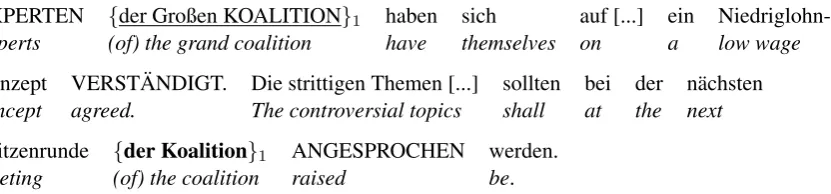
Figure 2: Example from the DIRNDL dataset with English translation. The candidate NP (anaphor) of the coreference chain in question is marked in boldface, the antecedent is underlined. Pitch accented words are capitalised.
7 Analysis
In the following section, we discuss two examples from the DIRNDL dataset that provide some in-sight as to how the prosodic features helped coref-erence resolution in our experiments.
The first example is shown in Figure2. The coref-erence chain marked in this example was not pre-dicted by the baseline version. With prosodic information, however, the fact that the NP “der Koalition” is deaccented helped the resolver to recognise that this was given information: it refers to the recently introduced antecedent“der Großen Koalition”. This effect clearly supports our as-sumption that the absence of pitch accents helps for short NPs.
An additional effect of adding prosodic infor-mation that we observed concerns the length of antecedents determined by the resolver. In several cases, e.g. in Example (3), the baseline system incorrectly chose an embedded NP (1A) as the an-tecedent for a pronoun. The system with access to prosodic information correctly chose the longer NP (1B)11. Our analysis confirms that this is due to
the accent on the short NP (onPhelps). The pres-ence or abspres-ence of a pitch accent on the adjunct NP (onUSA) does not appear to have an impact.
(3) {{Michael PHELPS}1Aaus den USA}1B. {Er}1...
Michael Phelps from the USA. He ...
11The T¨uBA-D/Z guidelines state that the maximal
exten-sion of the NP should be chosen as the markable.
http://www.sfs.uni-tuebingen.de/ fileadmin/static/ascl/resources/ tuebadz-coreference-manual-2007.pdf
8 Conclusion and future work
We show that using prosodic labels that have been obtained automatically significantly improves the performance of a coreference resolver. In this work, we predict these labels using a CNN model and use these as additional features in IMS Hot-Coref DE, a coreference resolution system for German. Despite the quality of the predicted la-bels being slightly lower than the gold lala-bels, we are still able to replicate results observed when using manually annotated prosodic information. This encouraging result also confirms that not only is prosodic information helpful to coreference res-olution, but that it also has a positive effect even when predicted by a system.
A brief analysis of the resolver’s output illus-trates the effect of deaccentuation. Further work is necessary to investigate the impact on the length of the predicted antecedent.
One possibility to increase the quality of the predicted prosody labels would be to include the available lexico-syntactic information into the prosodic event detection model, since this has been shown to improve prosodic event recogni-tion (Sun,2002;Ananthakrishnan and Narayanan,
2008). To pursue coreference resolution directly on speech, a future step would be to perform all necessary annotations on automatic speech recog-nition output. As a first step, our results on Ger-man spoken text are promising and we expect them to be generalisable to other languages with similar prosody.
Acknowledgements
was funded by the German Science Foundation (DFG), Sonderforschungsbereich 732, Project A6 and A8, at the University of Stuttgart.
References
Marilisa Amoia, Kerstin Kunz, and Ekaterina Lapshinova-Koltunski. 2012. Coreference in spo-ken vs. written texts: a corpus-based analysis. In Proceedings of LREC.
Sankaranarayanan Ananthakrishnan and Shrikanth S. Narayanan. 2008. Automatic prosodic event detec-tion using acoustic, lexical and syntactic evidence. In IEEE Transactions on Audio, Speech and Lan-guage Processing. volume 16, pages 216–228. Stefan Baumann and Arndt Riester. 2013. Coreference,
lexical givenness and prosody in German. Lingua 136:16–37.
Stefan Baumann and Anna Roth. 2014. Prominence and coreference – On the perceptual relevance of F0 movement, duration and intensity. InProceedings of Speech Prosody. pages 227–231.
Anders Bj¨orkelund, Kerstin Eckart, Arndt Riester, Nadja Schauffler, and Katrin Schweitzer. 2014. The extended DIRNDL corpus as a resource for auto-matic coreference and bridging resolution. In Pro-ceedings of LREC. pages 3222–3228.
Kerstin Eckart, Arndt Riester, and Katrin Schweitzer. 2012. A discourse information radio news database for linguistic analysis. In Sebastian Nordhoff Christian Chiarcos and Sebastian Hellmann, editors, Linked Data in Linguistics: Representing and Con-necting Language Data and Language Metadata, Springer, pages 65–76.
Florian Eyben, Felix Weninger, Florian Groß, and Bj¨orn Schuller. 2013. Recent developments in openSMILE, the Munich open-source multimedia feature extractor. In Proceedings of the 21st ACM international conference on Multimedia. pages 835– 838.
Mari Ostendorf, Patti Price, and Stefanie Shattuck-Hufnagel. 1995. The Boston University Radio News Corpus. Technical Report ECS-95-001, Boston Uni-versity.
Sameer Pradhan, Alessandro Moschitti, Nianwen Xue, Olga Uryupina, and Yuchen Zhang. 2012. Conll-2012 shared task: Modeling multilingual unre-stricted coreference in ontonotes. In Joint Confer-ence on EMNLP and CoNLL-Shared Task. Associa-tion for ComputaAssocia-tional Linguistics, pages 1–40. Marta Recasens, Llu´ıs M`arquez, Emili Sapena,
M. Ant`onia Mart´ı, Mariona Taul´e, V´eronique Hoste, Massimo Poesio, and Yannick Versley. 2010. Semeval-2010 task 1: Coreference resolution in multiple languages. In Proceedings of the 5th
International Workshop on Semantic Evaluation. Stroudsburg, PA, USA, SemEval ’10, pages 1–8. Andrew Rosenberg, Erica Cooper, Rivka Levitan, and
Julia Hirschberg. 2012. Cross-language prominence detection. InSpeech Prosody.
Ina R¨osiger and Jonas Kuhn. 2016. IMS HotCoref DE: a data-driven co-reference resolver for German. In Proceedings of LREC 2016.
Ina R¨osiger and Arndt Riester. 2015. Using prosodic annotations to improve coreference resolution of spoken text. InProceedings of ACL-IJCNLP. pages 83–88.
Sidney Siegel and N. John Jr. Castellan. 1988. Non-parametric Statistics for the Behavioral Sciences. McGraw-Hill, Berkeley, CA, 2nd edition.
Sabrina Stehwien and Ngoc Thang Vu. 2017. Prosodic event detection using convolutional neural networks with context information. InProceedings of Inter-speech.
Michael Strube and Christoph M¨uller. 2003. A ma-chine learning approach to pronoun resolution in spoken dialogue. InProceedings of the 41st Annual Meeting on Association for Computational Linguis-tics. pages 168–175.
Xuejing Sun. 2002. Pitch accent prediction using en-semble machine learning. InProceedings of ICSLP-2002. pages 16–20.
Jacques Terken and Julia Hirschberg. 1994. Deaccen-tuation of words representing ‘given’ information: Effects of persistence of grammatical function and surface position. Language and Speech37(2):125– 145.
Joel Tetreault and James Allen. 2004. Dialogue struc-ture and pronoun resolution. InProceedings of the 5th Discourse Anaphora and Anaphor Resolution Colloquium.