LIMSI@WMT’17
Franck Burlot and Pooyan Safari and Matthieu Labeau Alexandre Allauzen and Franc¸ois Yvon
LIMSI, CNRS, Universit´e Paris Saclay, 91 403 Orsay, France [email protected]
Abstract
This paper describes LIMSI’s submissions to the news shared task at WMT’17 for English into Czech and Latvian, as well as related experiments. This year’s novel-ties consist in the use of a neural machine translation system with a factored output predicting simultaneously a lemma deco-rated with morphological information and a fine-grained part-of-speech. Such a type of system drew our attention to the spe-cific step of reinflection, where lemmas and parts-of-speech are transformed into fully inflected words. Finally, we ran ex-periments showing an efficient strategy for parameter initialization, as well as data fil-tering procedures.
1 Introduction
The contribution of LIMSI laboratory to the WMT 2017 News shared task consisted in the submis-sion of different systems for English-to-Czech, as well as with this year’s “guest” language pair: English-to-Latvian.
Our main focus was on translation into mor-phologically rich languages (MRL), a challenging question in current state-of-the-art neural machine translation (NMT) architectures. Indeed, the va-riety of target word forms in these languages re-quires the use of an open vocabulary. To tackle this issue, we have experimented with a factored neu-ral machine translation system predicting simulta-neously at each timestep a normalized word and a fine-grained part-of-speech (section3). A normal-ized word (section5.2) is a specific representation where we removed part of the morphological con-tent of the word, keeping only the features that are relevant to the source language.
Such a factored architecture required a non-trivial step consisting in reinflecting the MT pre-dictions, i.e. transforming normalized words and parts-of-speech into fully inflected words. To this end, we have experimented with a character-based language model that is used to select ambigu-ous word forms returned by a look-up table (sec-tion5.5).
Further experiments show the use of an auto-encoder to initialize the NMT system’s auto-encoder (section4.1), which enables a faster convergence of the parameter and therefore a lower training time.
Finally, we report experiments performed with different data filtering procedures (section4.2) and their impact on translation quality.
2 Data and Preprocessing
The pre-processing of English data relies on in-house tools (D´echelotte et al., 2008). All the Czech data were tokenized and truecased using the Moses toolkit (Koehn et al., 2007). PoS-tagging was performed with Morphodita (Strakov´a et al.,
2014). The pre-processing of Latvian was pro-vided by TILDE.1Latvian PoS-tags were obtained with the LU MII Tagger (Paikens et al.,2013). All the data used to train our systems were provided at WMT’17.2
For English-to-Czech, the parallel data used consisted in nearly 20M sentences from a subset of WMT data relevant to the news domain: News-commentary, Europarl and specific categories of the Czeng corpus (news, paraweb, EU, fiction). Newstest-2015 was used for validation and the systems are tested on Newstest-2016 and 2017.
All systems were also trained on synthetic par-allel data (Sennrich et al., 2016a). The Czech
1www.tilde.com
2www.statmt.org/wmt17
monolingual corpus News-2016 was backtrans-lated to English using the single best system provided by the University of Edinburgh from WMT’16.3 We then added five copies of News-commentary and the news subcorpus from Czeng, as well as 5M sentences from the Czeng EU corpus randomly selected after running modi-fied Moore-Lewis filtering with XenC (Rousseau,
2013). This resulted in about 14M parallel sen-tences.
The English-to-Latvian systems used all the parallel data provided at WMT’17. The DCEP corpus was filtered with the Microsoft sentence aligner4 and using modified Moore-Lewis. We kept the best 1M sentences, which led to a total of almost 2M parallel sentences. The systems were validated on 2k sentences held out from the LETA corpus and we report results on newsdev-2017 and newstest-2017.
Training was carried on with synthetic parallel data. We used a backtranslation of the monolin-gual corpora News-2015 and 2016 provided by the University of Edinburgh (Moses system). To these corpora were added 10 copies of the LETA corpus, as well as 2 copies of Europarl and Rapid.
Bilingual Byte Pair Encoding (BPE) models (Sennrich et al.,2016b) for each language pair and system setup were learned on the bibtext (ie. not synthetic) parallel data used for the MT system. 90k merge operations where performed to obtain the final vocabularies.
3 System Setup
Results are reported for two NMT systems: Nema-tus (Sennrich et al.,2017) and NMTPY (Caglayan et al.,2017).
3.1 NMTPY
Once the data was preprocessed, only sentences of a maximum length of 50 were kept in the training data, except for the setup where cluster IDs were split in normalized words (see §5). In this case, we set the maximum length to 100.
All NMTPY systems have an embedding di-mension of 512 and hidden states of didi-mension 1024 for both encoder and decoder, which are im-plemented as GRU units. Dropout is enabled on
3http://data.statmt.org/rsennrich/
wmt16_systems/
4http://research.microsoft.com/apps/
catalog/
source embeddings, encoder states, as well as out-put layer. When training starts, all parameters are initialized with Xavier (Glorot and Bengio,2010). In order to slightly speed up training on bitext par-allel data, the learning rate was set to 0.0004, pa-tience to 30 with validation every 20k updates. On synthetic data, we finally set the learning rate to 0.0001 and performed validation every 5k updates. These systems were tuned with Adam optimizer (Kingma and Ba,2014) and have been training for approximately 1 month.
3.2 Nematus
The setup for Nematus is very similar to the one presented in the previous section. Training was performed on sentences with the same maximum length, the same embedding and hidden unit size. The difference lies in the fact that dropout for Ne-matus systems was enabled on all layers. The op-timizer used was Adadelta (Zeiler, 2012) and all systems had their learning rate set to 0.0001.
4 Experiments
4.1 Parameter initialization
In order to speed up the convergence of the train-ing procedure we tried to initialize the encoder pa-rameters with an a priori-trained model, instead of using random initialization. For the English-to-Czech translation system, this initial model was trained to translate from English into English. In order to do so, the same English corpus was fed into the neural model on both source and target side. After few updates according to the BLEU score on the validation set (which was higher than 99) it was possible to stop the training of this model and use the encoder parameters for the ini-tialization of the main NMT system.
4.2 Data Filtering
The English-Czech training data provided at WMT’17 was very large and some corpora con-tained a lot of noise. For instance, we noticed sev-eral duplicate sentences in the Czeng EU paral-lel corpus and entire paragraphs in it were in lan-guages other than English-Czech. Therefore, we decided to experiment with a system not contain-ing the Czeng EU corpus. However, this lead to a degradation in terms of BLEI (see Table1).
1 2 3 4 5 6 7 8 9 10 11 12
Beam size
15 15.5 16 16.5 17 17.5 18 18.5 19 19.5 20
BLEU
[image:3.595.72.292.60.233.2]newstest2017 newstest2016
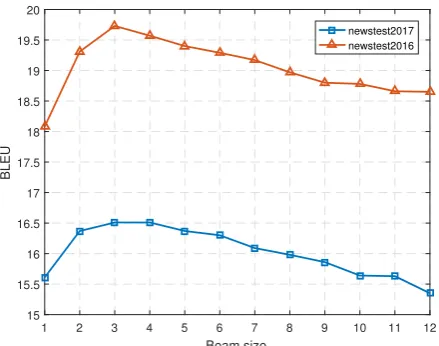
Figure 1: Comparison of different beam-size in terms of BLEU. The evaluation is performed on Newstest-2016 and Newstest-2017 English-Czech filtered data.
shown in Table1, filtering the data results in an im-provement in terms of BLEU for Newstest-2017, which is also consistent with the results we ob-tained on Newstest-2016 and validation set.
The filtering process was later followed by a sentence alignment check using the Microsoft sen-tence aligner. However, no further improvement was achieved with this method. The filtered-only data has shown the best performance on both Newstest-2016 and Newstest-2017 corpora.
Table 1: Comparison of BLEU scores of different filtering processes for English-to-Czech with Ne-matus systems. All the systems are evaluated with the beam search of size 2. The term “basic” is referred to the data without any filtering or align-ment. The termdiscard EUis adopted to refer to the training without Czeng EU corpus.
data filtering Newstest-2016 Newstest-2017
basic 18.66 15.67
discard EU 18.09 16.07
filt 19.31 16.37
filt+align 18.72 15.91
It is worthwhile to note that the model which had the best BLEU score performance on the vali-dation data (Newstest-2015) resulted in the BLEU scores of 18.43 and 15.81 on Newstest-2016 and Newstest-2017, respectively.
Figure1shows the accuracy wrt. different sizes of beam during decoding. The model was trained using the English-Czech filtered data as reported in thefiltrow of the Table1. We observed a
sim-ilar trend on both 2016 and Newstest-2017, where the best performance was obtained with a beam of size 3 for both test sets.
5 Submitted systems 5.1 Factored NMT
Additionally to standard NMTPY systems (base-lines), our best submissions in terms of BLEU at WMT’17 consisted in factored NMT systems.
The architecture of such systems was intro-duced in (Garc´ıa-Mart´ınez et al.,2016). The spe-cific setup we have used for the following factored systems consisted in an architecture that enables training towards a dual objective: at each timestep in the output sentence, a word and a PoS-tag are produced. Each one of these objectives produces a cost, that is summed in order to compute the gra-dients to be backpropagated.
The encoder and attention mechanism remain the same as in the baseline architecture. While in the baseline a decoder state takes as input the embedding of the prediction made at the previous step, a factored NMT decoder unit takes as input a concatenation of the two previous predictions for each factor. In this situation, the factored NMT systems deal with two sets of embeddings on tar-get side.
Another difference lies in the hidden-to-output layer. In our setup, we have used an architec-ture with two different such layers: the first one takes as input the representation of the previous prediction of the first factor (word) and the sec-ond one takes the previous secsec-ond factor predic-tion (PoS). Each layer is then passed through a last feed-forward layer leading to distinct softmax lay-ers.
While various word representations (Burlot et al.,2017) can be used in the first factor, our sys-tem predict at each timestep on the target side a normalized word and a PoS-tag.
fully infl. norm. words
plain koˇcky koˇcka+Noun+7
subword ko- ˇcky ko- ˇcka- Noun+7
Table 2: Different representations of the Czech wordkoˇcky(cats).
5.2 Normalization of Target Morphology
Newstest-2016 Newstest-2017
BLEU↑ BEER↑ CTER↓ BLEU↑ BEER↑ CTER↓
baseline 24.24 57.41 52.81 19.89 54.51 58.29
factored 23.77 57.50 52.53 19.95 54.71 58.30
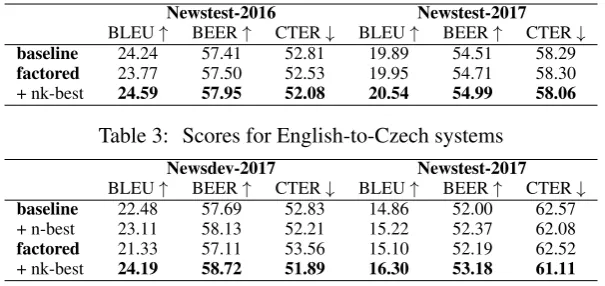
[image:4.595.148.451.61.204.2]+ nk-best 24.59 57.95 52.08 20.54 54.99 58.06
Table 3: Scores for English-to-Czech systems
Newsdev-2017 Newstest-2017
BLEU↑ BEER↑ CTER↓ BLEU↑ BEER↑ CTER↓
baseline 22.48 57.69 52.83 14.86 52.00 62.57
+ n-best 23.11 58.13 52.21 15.22 52.37 62.08
factored 21.33 57.11 53.56 15.10 52.19 62.52
+ nk-best 24.19 58.72 51.89 16.30 53.18 61.11
Table 4: Scores for English-to-Latvian systems
differences between the source and target lan-guages leads to difficulties. Indeed, an English adjective, that is invariable, may be translated into multiple different word forms corresponding to the same lemma. Such a variety of forms on the target side leads to serious sparsity issues and makes the estimate of reliable translation probabilities hard.
To address this issue, both Czech and Latvian vocabularies have been normalized. The normal-ization of a MRL consists in selecting the morpho-syntactic information that should remain encoded in a word. This selection is motivated by the fact that a target word contains more specificities than its source-side counterpart(s), leading to a lack of symmetry between both languages. For instance, when translating from English into Czech, target nouns mark grammatical case, which is removed in (Burlot et al., 2016) in order to make Czech nouns look more like their English translation(s).
Such a normalization is usually performed us-ing hand-crafted rules and requires expert knowl-edge for each language pair. In this paper, nor-malized words are obtained with an automatic and data-driven method5introduced in (Burlot and
Yvon,2017a).
In a nutshell, it performs a clustering of the mor-phologically rich language by grouping together words that tend to share the same translation(s) in English. In order to measure this translation sim-ilarity and using word alignments, the conditional entropy of the translation probability distribution over the English vocabulary is computed for each word form. The model merges two words when-ever the resulting aggregate cluster does not lead to an increase of conditional entropy, which guar-anties a minimal loss of information during the
5The source code is available at github.com/
franckbrl/bilingual_morph_normalizer
clustering procedure.
The normalization model is delexicalized and operates at the level of PoS. Each word is represented as a lemma, a coarse PoS and a sequence of morphological tags (e.g.
koˇcka+Noun+Sing+Accusative), therefore a
merge consists in grouping into one cluster two different tag sequences. As a result of this pro-cedure, we obtain words represented as a lemma and a cluster identificator (ID), i.e. a coarse PoS and an arbitrary integer, like koˇcka+Noun+7
in Table 2. In this example, the cluster ID
Noun+7stands for a set of fine-grained PoS, like
{Sing+Nominative, Sing+Accusative, ...}.
In our setup, the cluster ID was systematically split from the lemma. BPE segmentation was thus learned and applied to lemmas. Whenever the fac-tored NMT system predicts a lemma in the first factor, it is forced to predict a null PoS in the sec-ond factor. On the other hand, when a split cluster ID is predicted, the second factor should output an actual PoS. This specific treatment of the sec-ond factor is expected to give the system a better ability to map a word to a PoS that is relevant to it, thus avoiding, for instance, the prediction of a verbal PoS for the Czech nounkoˇcka(cat).
The normalization of the Czech data was trained on the bibtext parallel data used to train the MT systems (see § 2), except Czeng fiction and
paraweb subcorpora, which lead to over 10M sen-tences. As for the normalization of Latvian data it was trained on the same bitext parallel sentences used to train the MT systems.
5.3 Reinflection
Lemmali+1 Tags(tni)n=1..T
Hidden representationhi
Context representationxi
Whidden
ewi−1
←wiinf lected
cj−2
cj−1
cj
cj+1
cj+2
Max-pooling
Convolution FilterWconv
dot(ewinf lected i ,hi)
sigmoid(.)
ewi
[image:5.595.166.427.63.274.2]ewi−2 ewi+1 ewi+2
Figure 2: Architecture of the neural reinflection model
a fully inflected language. We refer to this last step as reinflection.
Given a lexical unit and a PoS-tag, word forms are retrieved with a dictionary lookup. In the context of MRL, deterministic mappings from a lemma and a PoS to a form are very rare. Instead, the dictionary often proposes several word forms corresponding to the same lexical unit and mor-phological analysis.
A first way to address this ambiguity is to sim-ply compute unigram frequencies of each word form, which was done over all the monolingual data available at WMT’17 for both Czech and Lat-vian. During a dictionary lookup, ambiguities can then be solved by taking the most frequent word form. The downside of this procedure is that it ignores important information given by the tar-get monolingual context. For instance, the Czech prepositions (with) will have different forms ac-cording to the right-side context: s tebou (with you), butsemnou(with me). A solution is to let a word-based system select the right word form from the dictionary. To this end, k-best hypothesis from the dictionary are generated. Given a sen-tence containing lemmas and PoS, we perform a beam search going through each word and keep-ing at each step the k-best reinflection hypothesis according to the unigram model mentioned above. For Czech word form generation, we used the Morphodita generator (Strakov´a et al.,2014). Since we had no such tool for Latvian, all mono-lingual data available at WMT’17 were
automat-ically tagged using the LU MII Tagger (Paikens et al.,2013) and we gathered the result in a dictio-nary. As one could expect, we obtained a large quantity of word forms (nearly 2.5M), among which a lot of noise was noticed.
5.4 Experimental Results
The systems we have submitted at WMT’17 are more specifically the following:
• English-to-Czech baseline: Ensemble of 5
best models.
• English-to-Czech factored: Ensemble of 2 best models with nk-best rescoring using the single best baseline.
• English-to-Latvian baseline: Ensemble of 3 best models with n-best rescoring using the single best Nematus system.
• English-to-Latvian factored: Ensemble of 3 best models with nk-best rescoring using the single best Nematus system.
The results are reported for these systems in tables 3 and 4, using BLEU, as well as BEER (Stanojevi´c and Sima’an,2014) and Char-acTER (Wang et al., 2016), which have shown a high correlation with human rankings for MRL (Bojar et al.,2016).
Newstest-2016 Newstest-2017
BLEU↑ BEER↑ CTER↓ BLEU↑ BEER↑ CTER↓
unigrams 24.24 57.41 52.81 19.89 54.51 58.29
+ n-best 24.47 57.91 52.16 20.53 54.99 58.05
neural 21.10 56.35 53.35 17.60 53.47 59.34
[image:6.595.151.450.62.124.2]+ n-best 21.52 56.36 53.52 18.12 53.64 59.21
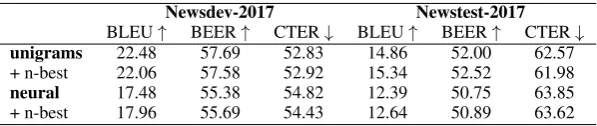
Table 5: Scores for different English-to-Czech reinflection methods.
Newsdev-2017 Newstest-2017
BLEU↑ BEER↑ CTER↓ BLEU↑ BEER↑ CTER↓
unigrams 22.48 57.69 52.83 14.86 52.00 62.57
+ n-best 22.06 57.58 52.92 15.34 52.52 61.98
neural 17.48 55.38 54.82 12.39 50.75 63.85
+ n-best 17.96 55.69 54.43 12.64 50.89 63.62
Table 6: Scores for different English-to-Latvian reinflection methods.
kto 10. For Latvian, thek= 100best hypothesis
were taken from the dictionary, in order to mitigate the poor quality of this dictionary by relying more on the rescoring system. Additionally to the k-best hypothesis from the dictionary, we also took the n-best hypothesis from the factored NMT system (n = 30), which lead to the rescoring of nk-best
hypothesis by an inflected word based system. The improvement given by the nk-best setups show the advantage of using a word based model to select the right word forms instead of relying on simple unigram frequencies.
5.5 Reinflection Experiments
To address the disadvantages of the reinflection methods presented in section5.3, we investigated a neural reinflection model. The general architec-ture is presented in figure2. The model first takes as input an-gram centered on the position to
rein-flect. To each position corresponds a lexical unit andT PoS-tags, which are represented by
embed-dings li and(tni)n=1..T. These are concatenated into a context representation xi and transformed into a hidden representationhi =Whiddenxi+b. The second input is a candidate inflected form
winf lectedi . We represent it as the sequence of its
characters, and use a convolutional layer (Santos and Zadrozny, 2014) to build its vectorial repre-sentation ewinf lected
i . The product of these two
representations goes through asigmoidactivation function. We train the model in a supervised way, by feeding positive and negative examples of in-flected forms, with labels 1 and 0. At test time,
the model is given all possible inflected forms tained in the dictionary, and we choose the one ob-taining the best score.
However, our first results show accuracies under
the performances of the unigram model presented in section5.3, for both Czech and Latvian (see Ta-bles5and6). In future work, we plan to use such a model with a beam search.
6 Morphology prediction quality
In this section, we attempt to evaluate the improve-ment of our factored NMT systems over the base-lines. To this end, we ran the evaluation introduced in (Burlot and Yvon, 2017b) over all our WMT submissions.
The evaluation of the morphological compe-tence of a machine translation system is performed on an automatically produced test suite. For each source test sentence from a monolingual corpus (the base), one (or several) variant(s) are gener-ated, containing exactly one difference with the base, focusing on a specifictarget lexeme of the base. These variants differ on a feature that is ex-pressed morphologically in the target, such as the person, number or tense of a verb; or the number or case of a noun or an adjective. This artificial test set is then translated with a machine translation system. The machine translation system is deemed correct if the translations of the base and variant differ in the same way as their respective source. Another setup focuses on a word in thebase sen-tence and producesvariantscontaining antonyms and synonyms of this word. The expected trans-lation is then synonyms and antonyms bearing the same morphological features as the initial word.
There are three types of contrasts implying dif-ferent sorts of evaluation:
[image:6.595.150.449.149.212.2]Ac-verbs pronouns others mean
System past future neg. fem. plur. noun nb. compar.
NMT baseline 92.6% 86.2% 96.0% 91.4% 79.2% 94.6% 76.2% 88.0%
Factored NMT 94.2% 88.0% 95.4% 91.2% 80.0% 96.2% 75.0% 88.6%
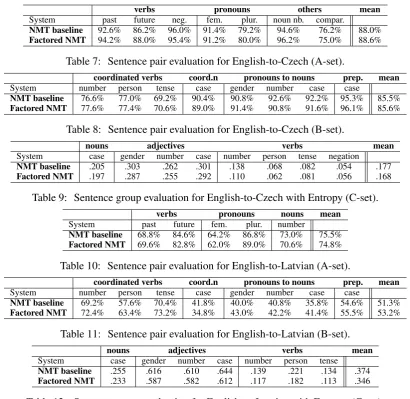
Table 7: Sentence pair evaluation for English-to-Czech (A-set).
coordinated verbs coord.n pronouns to nouns prep. mean
System number person tense case gender number case case
NMT baseline 76.6% 77.0% 69.2% 90.4% 90.8% 92.6% 92.2% 95.3% 85.5%
Factored NMT 77.6% 77.4% 70.6% 89.0% 91.4% 90.8% 91.6% 96.1% 85.6%
Table 8: Sentence pair evaluation for English-to-Czech (B-set).
nouns adjectives verbs mean
System case gender number case number person tense negation
NMT baseline .205 .303 .262 .301 .138 .068 .082 .054 .177
Factored NMT .197 .287 .255 .292 .110 .062 .081 .056 .168
Table 9: Sentence group evaluation for English-to-Czech with Entropy (C-set).
verbs pronouns nouns mean
System past future fem. plur. number
NMT baseline 68.8% 84.6% 64.2% 86.8% 73.0% 75.5%
Factored NMT 69.6% 82.8% 62.0% 89.0% 70.6% 74.8%
Table 10: Sentence pair evaluation for English-to-Latvian (A-set).
coordinated verbs coord.n pronouns to nouns prep. mean
System number person tense case gender number case case
NMT baseline 69.2% 57.6% 70.4% 41.8% 40.0% 40.8% 35.8% 54.6% 51.3%
Factored NMT 72.4% 63.4% 73.2% 34.8% 43.0% 42.2% 41.4% 55.5% 53.2%
Table 11: Sentence pair evaluation for English-to-Latvian (B-set).
nouns adjectives verbs mean
System case gender number case number person tense
NMT baseline .255 .616 .610 .644 .139 .221 .134 .374
[image:7.595.93.504.58.457.2]Factored NMT .233 .587 .582 .612 .117 .182 .113 .346
Table 12: Sentence group evaluation for English-to-Latvian with Entropy (C-set).
curacy for all morphological features is aver-aged over all sentences. (Tables7and10)
• B: We focus on various agreement
phenom-ena by checking whether a given morpholog-ical feature is present in both words that need to agree (eg. case of two nouns). Accuracy is computed here as well. (Tables8and11)
• C: We test the consistency of morphologi-cal choices over leximorphologi-cal variation (eg. syn-onyms and antsyn-onyms all having the same tense) and measure the success based on the average normalized entropy of morphologi-cal features in the set of target sentences. (Ta-bles9and12)
The A-set focuses on the morphological ade-quacy of the output towards the source sentence, which does not seem to have improved with fac-tored NMT systems. The main improvement is
re-lated to the morphological fluency of the output (B and C-sets), although the contrasts are more visi-ble for Latvian than for Czech.
7 Conclusions
This paper described LIMSI’s submissions to the News shared task at WMT2017, consisting in English-to-Czech and English-to-Latvian systems that address the issues of translating into a mor-phologically rich language. Further experiments reported the benefits obtained with an efficient pa-rameter initialization procedure, as well as data fil-tering.
Acknowledgments
References
Ondˇrej Bojar, Yvette Graham, Amir Kamran, and Miloˇs Stanojevi´c. 2016. Results of the wmt16 met-rics shared task. InProc. WMT. Berlin, Germany, pages 199–231.
Franck Burlot, Mercedes Garc´ıa-Mart´ınez, Lo¨ıc Bar-rault, Fethi Bougares, and Franc¸ois Yvon. 2017. Word Representations in Factored Neural Machine Translation. In Proceedings of the Second Con-ference on Machine Translation (WMT’17). Asso-ciation for Computational Linguistics, Copenhagen, Denmark.
Franck Burlot, Elena Knyazeva, Thomas Lavergne, and Franc¸ois Yvon. 2016. Two-step mt: Predicting tar-get morphology. InProc. IWSLT. Seattle, USA.
Franck Burlot and Franc¸ois Yvon. 2017a. Learning morphological normalization for translation from and into morphologically rich language.The Prague Bulletin of Mathematical Linguistics (Proc. EAMT) (108):49–60.
Franck Burlot and Franc¸ois Yvon. 2017b. Evaluating the morphological competence of machine transla-tion systems. In Proceedings of the Second Con-ference on Machine Translation (WMT’17). Asso-ciation for Computational Linguistics, Copenhagen, Denmark.
Ozan Caglayan, Mercedes Garc´ıa-Mart´ınez, Adrien Bardet, Walid Aransa, Fethi Bougares, and Lo¨ıc Barrault. 2017. Nmtpy: A flexible toolkit for ad-vanced neural machine translation systems. arXiv preprint arXiv:1706.00457.
Daniel D´echelotte, Gilles Adda, Alexandre Allauzen, Olivier Galibert, Jean-Luc Gauvain, H´el`ene May-nard, and Franc¸ois Yvon. 2008. LIMSI’s statistical translation systems for WMT’08. InProceedings of NAACL-HLT Statistical Machine Translation Work-shop. Columbus, Ohio.
Mercedes Garc´ıa-Mart´ınez, Lo¨ıc Barrault, and Fethi Bougares. 2016. Factored neural machine transla-tion architectures. In Proceedings of the Interna-tional Workshop on Spoken Language Translation. Seattle, USA, IWSLT’16.
Xavier Glorot and Yoshua Bengio. 2010. Understand-ing the difficulty of trainUnderstand-ing deep feedforward neu-ral networks. In Proceedings of the International Conference on Artificial Intelligence and Statistics (AISTATS’10). Society for Artificial Intelligence and Statistics.
Diederik Kingma and Jimmy Ba. 2014. Adam: A method for stochastic optimization. arXiv preprint arXiv:1412.6980.
Philipp Koehn, Hieu Hoang, Alexandra Birch, Chris Callison-Burch, Marcello Federico, Nicola Bertoldi, Brooke Cowan, Wade Shen, Christine Moran,
Richard Zens, Chris Dyer, Ondˇrej Bojar, Alexan-dra Constantin, and Evan Herbst. 2007. Moses: Open source toolkit for statistical MT. In Proc. ACL:Systems Demos. Prague, Czech Republic, pages 177–180.
Peteris Paikens, Laura Rituma, and Lauma Pretkalnina. 2013. Morphological analysis with limited re-sources: Latvian example. In Proc. NODALIDA. pages 267–277.
Anthony Rousseau. 2013. XenC: An open-source tool for data selection in natural language processing. The Prague Bulletin of Mathematical Linguistics (100):73–82.
Cicero D. Santos and Bianca Zadrozny. 2014. Learning character-level representations for part-of-speech tagging. In Tony Jebara and Eric P. Xing, editors, Proceedings of the 31st International Conference on Machine Learning (ICML-14). JMLR Workshop and Conference Proceedings, pages 1818–1826.
Rico Sennrich, Orhan Firat, Kyunghyun Cho, Alexan-dra Birch, Barry Haddow, Julian Hitschler, Marcin Junczys-Dowmunt, Samuel L¨aubli, Antonio Valerio Miceli Barone, Jozef Mokry, and Maria Nadejde. 2017. Nematus: a toolkit for neural machine transla-tion. InProceedings of the Software Demonstrations of the 15th Conference of the European Chapter of the Association for Computational Linguistics. As-sociation for Computational Linguistics, Valencia, Spain, pages 65–68.
Rico Sennrich, Barry Haddow, and Alexandra Birch. 2016a. Improving neural machine translation mod-els with monolingual data. InProc. ACL.
Rico Sennrich, Barry Haddow, and Alexandra Birch. 2016b. Neural machine translation of rare words with subword units. InProceedings of the 54th An-nual Meeting of the Association for Computational Linguistics (Volume 1: Long Papers). Association for Computational Linguistics, pages 1715–1725.
Miloˇs Stanojevi´c and Khalil Sima’an. 2014. Fit-ting sentence level translation evaluation with many dense features. In Proc. EMNLP. Doha, Qatar, pages 202–206.
Jana Strakov´a, Milan Straka, and Jan Hajiˇc. 2014. Open-Source Tools for Morphology, Lemmatiza-tion, POS Tagging and Named Entity Recognition. InProc. ACL: System Demos. Baltimore, MA, pages 13–18.
Weiyue Wang, Jan-Thorsten Peter, Hendrik Rosendahl, and Hermann Ney. 2016. CharacTer: Translation Edit Rate on Character Level. In Proc. WMT. Berlin, Germany, pages 505–510.