Original Article
Classification and differentiation between
kidney yang and yin decficiency syndromes
in TCM based on decision tree analysis method
Tieniu Zhao1, Huijun Wang1, Chunquan Yu1, Jing Wang2, Yuanwu Cui3, Xia Zheng4, Bin Wang5, Wenjuan Wang6, Jingyan Meng1
1College of Traditional Chinese Medicine, Tianjin University of Traditional Chinese Medicine, Tianjin 300193,
PR China; 2Spine Research Institute, Longhua Hospital, Shanghai University of Traditional Chinese Medicine,
Shanghai 200032, PR China; 3Center of Moxibustion, Second Affiliated Hospital of Tianjin University of Traditional
Chinese Medicine, Tianjin 300150, PR China; 4Department of Traditional Chinese Medicine, Second Affiliated
Hospital of Chengdu University of Traditional Chinese Medicine, Chengdu 610042, PR China; 5Department of
Male, Dongzhimen Hospital Affiliated to Beijing University of Traditional Chinese Medicine, Beijing 100007, PR
China; 6Department of Traditional Chinese Medicine, Capital Medical University, Beijing 100069, PR China
Received July 6, 2016; Accepted September 20, 2016; Epub November 15, 2016; Published November 30, 2016
Abstract: The classification and differentiation between kidney Yang and Yin deficiency syndromes (KDS-YANG and KDS-YIN) in traditional Chinese medicine (TCM) was performed with the approaches of decision tree as well as logistic regression analysis. A clinical epidemiology study on 44 symptoms, 5 tongue signs and 2 pulse signs (TCM diagnostic features) was conducted among 2,765 patients with KDS. Accordingly, an effective syndrome-identifying model on KDS-YANG and KDS-YIN was established. The results indicated that in terms of statistical significance (P < 0.05) of the cases with the above two different syndromes, the diagnostic indicators such as 11 symptoms, 2 tongue signs, and 1 pulse signs was found out by logistic regression analysis. The accurate rate of differentiating KDS-YANG and KDS-YIN was proved to be 88.0%. What’s more, four symptoms-aversion to cold, cold limbs, pale tongue, deep and thread pulse-were confirmed to be the most significant variables, which was beneficial for the syndrome differentiation. The decision tree analysis model was an effective approach to differentiate KDS-YANG and KDS YIN, which could be helpful to change the syndrome-diagnosing method from experience-based to data-model based.
Keywords: Syndrome differentiation, kidney deficiency syndrome, kidney yin deficiency syndrome, kidney yang deficiency syndrome, decision tree
Introduction
Traditional Chinese medicine (TCM) is a scien-tific study on disease etiology and pathogene-sis based on Yin and Yang theory as well as the five elements theory; therefore syndro- mes are regarded as the study objects. Accor- ding to TCM theory, syndrome are known as “patterns” or “zhengs (Chinese pinyin)” and serve as the key concept and theoretical abstract of the symptom profiles of the dise- ase diagnosis and treatment in China for over 2,500 years [1, 2]. Syndromes or TCM zhengs are just like a vivid picture created by the clinical manifestations that could clearly show the features, the locations and the pathology
asthenic heat due to the consumption of kid- ney yin and the nourishment insufficiency [6]. KDS-YIN, which is a general term describing the deficient condition of kidney system, is mail manifested as: lower back pain, soreness and weakness of the lumbar region and knees, dizziness, fatigue, night sweating, hot sensa-tion in the palms, soles and chest, dysphoria, insomnia, thread pulse, reddish tongue with less fur or with white fur [7]. Kidney yang deficiency syndrome (KDS-YANG) refers to the asthenia cold symptoms due to failure of Qi transformation caused by the decline of kid- ney yang and its failure to nourish the body [6]. It is primarily manifested as the symp- toms of soreness and weakness of the lum- bar regions and knees, aversion to cold, cold limbs, less libido; the secondary symptoms of low spirit and weakness, hypodynamia, impo-tence, infertility, frequent and increasing urina-tion at night, clear urine, hair loss, loose teeth, a pale tongue and a deep and thready pulse. The TCM syndromes may vary among the pa- tients suffering from the same disease be- cause of their individual difference. Thus they are managed by TCM syndrome-specific thera-pies [8]. In fact, TCM practitioners diagnosed and treated diseases based on the TCM the- ory of syndrome differentiation. So this is the reason why syndrome differentiation played an important role in the disease identification and therapeutic procession, even ultimately influenced the clinical efficacy of the disease treatment [9]. In other words, a symptom is an observable disorder indicator while a syndrome is a relatively abstract perception which can only be reflected by symptoms in TCM. How- ever, the co-relations between symptom and syndrome in TCM are not yet clearly defined, therefore it is of great difficulty to carry out the clinical diagnosis and scientific study on TCM. In addition, TCM practitioners are great- ly influenced by their subjective judgment in diagnosing TCM syndromes and therefore their identification consistency was on low le- vel [10, 11]. Moreover, because of the lack of validated and standardized instruments to assess TCM syndrome, objective assessment should be developed in TCM study [12]. To a certain extent, the above-mentioned factors affect the standardized and objective identifi-cation of TCM syndrome. Therefore, syndrome differentiation is of great importance for TCM diagnosis.
It is not only necessary but also possible to construct syndrome model based on the diag-nosis model data by combination of a variety of analysis methods. So far, a decision tree model was built and was supposed to forecast TCM syndrome accurately, which had been success-fully and widely applied to a variety of clinical diseases, including liver cirrhosis [13], coronary heart disease [14] and chronic hepatitis B [15]. In current study, according to its features the variables information in KDS will be described to analyze the complex and mutual relation- ship between symptom and syndrome. So it is of great interest to compose KDS question-naires as measurement tools, based on 5 kid-ney-related diseases: osteoporosis, male in- fertility, female inferitility, thalassemia and Al- zheimer’s disease. During this process, ex- pert’s opinion and experience as well as Del- phi method based on retrieved literature in TCM study are adopted [16]. The study pur- pose is to identify TCM syndromes: KDS-YIN and KDS-YANG based on 2,765 cases of pa- tients with symptoms and to predict the syn-drome’s type of the future cases accurately by using logistic regression analysis combined with quick unbiased efficient statistical tree (QUEST) algorithm analysis. Therefore, the data about the patients with KDS-YANG and KDS-YIN would be analyzed during which diag-nostic model were established based on a large-sample clinical survey in the study.
Material and methods
Study objects
set did not only include one certain disease, but also involved the diseases with KDS.
Data collection items included 51 attributes of TCM (that were 44 symptoms, 5 tongue signs and 2 pulse signs), which inquired TCM symp-tom variables by using all four fundamental TCM diagnostic methods. The symptom vari-ables used in the survey were elements that a TCM doctor would think over when treating patients with KDS. Each data collection team was led by a team leader who was with the title at least as attending physician. Team members have been trained beforehand to ensure the consistency in their judgment of the presence or absence of symptoms.
The average age of 2,765 patients with KDS was (Me, Qd): (36, 35) years old, including 1,054 male patients (38.1%) and 1,711 female pa- tients (61.9%). The average age of male pa- tients was (Me, Qd): (32, 13) years old, and the average age of female patients was (Me, Qd): (52, 37) years old. The syndrome differenti- ation was further confirmed by two TCM ex- perts, and the case samples were partition- ed into 2 syndrome types as follows: 1,465 cases with KDS-YIN, and 1,300 cases with KDS-YANG.
Diagnosis, inclusion, and exclusion criteria
Diagnosis criteria: Diagnostic criteria of osteo-porosis: According to the diagnostic criteria for osteoporosis recommended by World Health Organization (WHO): BMD T-score > -1.0 SD: normal bone mass, -2.5 SD ≤ T-score ≤ -1.0 SD: osteopenia, T-score < -2.5 SD: osteoporosis [17]. The patients identified as kidney deficiyy were included based on TCM syndrome differ-entiation [18, 19].
Diagnostic criteria of infertility: According to the diagnostic criteria for infertility recommended by WHO: the definition of infertility was the fail-ure of the sexually active but non-contraceptive couple to have spontaneous pregnancy within one years (WHO, 1995) [20, 21].
Diagnostic criteria of thalassemia: It referred to Chinese diagnostic criteria: diagnosis and effi-cacy standard of blood disease [22], which was combined with diagnostic criteria of the type β-thalassemia intermedia and α-thalassemia Hb-H disease. According to neonates Hb-art
content the disease diagnosis would be classi-fied: protein accounted for 1-3% was diagnosed as α1 thalassemia, that for 3-15% was as α1 thalassemia, that for 15-40% was as thalas-semia intermedia (Hb H disease) and that > 40% was as Hb-Bart hydrops syndrome.
Diagnostic criteria of Alzheimer’s disease: It was in reference to the criteria provided by the National Institute of Neurological and Com- municative Disorders and Stroke-Alzheimer’s Disease and Related Disorders Association (NINCDS-ADRDA) [23], the 4th edition of the Diagnostic and Statistical Manual of Mental Disorders (DSM-IV) [24], and the 10th revision of the International Classification of Disea- ses (ICD-10) [25]. Of these criteria sets, the NINCDS-ADRDA criteria were most widely used in dementia study.
Inclusion criteria: Patients who met the diag-nostic criteria for osteoporosis, male infertility, thalassemia, female infertility and Alzheimer’s disease were included. The patients were vol-untary to participate in the clinical study and would sign informed consent form.
The exclusion criteria were as follows: (1) Pa- tients who failed to meet western medicine and TCM diagnostic standards; (2) Those who were presented with concomitant diseases, such as cerebrovascular, gastrointestinal, kid- ney, lung, endocrine, and other serious diseas- es or mental illness; (3) Those who had abnor- mal liver and kidney function tests were shown as abnormal; (4) The women who were in pre- gnancy or breast-feeding; (5) Patients who had severe dysfunction in heart, liver or kidney.
The differentiation criteria of KDS were based on “The Guiding Principles of Clinical Research of New Chinese Medicine (trial version)” (pub-lished by China pharmaceutical technology publishing house, 2002) [18] and “Reference
Standard of TCM Deficiency Syndrome” revised by the Chinese integrated traditional and west-ern medicine deficiency syndrome and profes-sional committee of the elderly in 1986 to develop a “Reference standard TCM deficiency syndrome” [19]. Two basic syndromes of TCM were set up as follows.
soles and chest. The secondary symptoms as dizziness, tinnitus or deafness, insomnia, dreaminess, tidal fever, night sweating, dry stools, dry mouth and throat, a reddish tongue, a thread rapid pulse.
KDS-YANG is mainly manifested as the primary symptoms of soreness and weakness of the lumbar regions and knees, aversion to cold, cold limbs, less libido; secondary symptoms of spiritlessness and weakness, hypodynamia, impotence, infertility, frequent and increased urination at night, clear urine, hair loss, loose teeth, a pale tongue and a deep and thready pulse.
Data management and statistical analysis
Data management was performed by using software of Epidata 3.1. The data was arran- ged in a column wise format with each subject given a sequence identifier. Data with normal distribution was expressed as mean ± SD for continuous variable, while data with no normal distribution was expressed as (Me, Qd) for con-tinuous variable. Data was expressed as
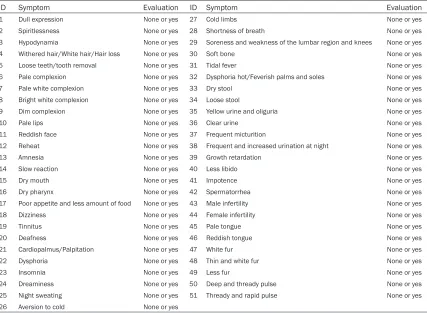
[image:4.612.94.521.84.397.2]num-bers with corresponding percentages for cate-gorical variables. Differences in proportions were assessed by using a χ2-test. Comparisons of the two groups were performed via Mann-Whitney U test. The method of logistic regres-sion analysis in combination with quick unbi-ased efficient statistical tree (QUEST) algorithm analysis was used in the study. 51 variables with multivariate were analyzed to compare the differences between YIN and KDS-YANG. These 51 variables were defined as in- dependent variables while KDS as a depen- dent variable. They were examined in a multi-variate model by using forward stepwise maxi-mum likelihood logistic regression to identify the symptoms of KDS (α=0.05). Odds ratios (ORs) were estimated by multivariate logistic regression analysis. As shown in Table 1, the 51 variables were finally collected to construct the complete clinical questionnaires of symp-tom set (feature set as below) of KDS in TCM. All reported P values were those of two-sided tests. The statistical significance was set at P < 0.01. The statistical algorithm that selected variables and quick unbiased efficient statis- tical tree (QUEST) algorithm analysis was used
Table 1. Clinical questionnaire of symptom and its value of KDS in TCM
ID Symptom Evaluation ID Symptom Evaluation
1 Dull expression None or yes 27 Cold limbs None or yes
2 Spiritlessness None or yes 28 Shortness of breath None or yes
3 Hypodynamia None or yes 29 Soreness and weakness of the lumbar region and knees None or yes
4 Withered hair/White hair/Hair loss None or yes 30 Soft bone None or yes
5 Loose teeth/tooth removal None or yes 31 Tidal fever None or yes
6 Pale complexion None or yes 32 Dysphoria hot/Feverish palms and soles None or yes
7 Pale white complexion None or yes 33 Dry stool None or yes
8 Bright white complexion None or yes 34 Loose stool None or yes
9 Dim complexion None or yes 35 Yellow urine and oliguria None or yes
10 Pale lips None or yes 36 Clear urine None or yes
11 Reddish face None or yes 37 Frequent micturition None or yes
12 Reheat None or yes 38 Frequent and increased urination at night None or yes
13 Amnesia None or yes 39 Growth retardation None or yes
14 Slow reaction None or yes 40 Less libido None or yes
15 Dry mouth None or yes 41 Impotence None or yes
16 Dry pharynx None or yes 42 Spermatorrhea None or yes
17 Poor appetite and less amount of food None or yes 43 Male infertility None or yes
18 Dizziness None or yes 44 Female infertility None or yes
19 Tinnitus None or yes 45 Pale tongue None or yes
20 Deafness None or yes 46 Reddish tongue None or yes
21 Cardiopalmus/Palpitation None or yes 47 White fur None or yes
22 Dysphoria None or yes 48 Thin and white fur None or yes
23 Insomnia None or yes 49 Less fur None or yes
24 Dreaminess None or yes 50 Deep and thready pulse None or yes
25 Night sweating None or yes 51 Thready and rapid pulse None or yes
to develop the decision tree models. QUEST decision tree was nonparametric procedure that made no assumptions of the underlying data. This algorithm determined how categori-cal independent variables best can be com-bined without bias to predict a binary outcome based on “if-then” logic and to build accurate binary trees quickly and efficiently. Data was analyzed by using the statistical software of SPSS version 20.0.
Results
Sociodemographic characteristics between KDS-YANG and KDS-YIN
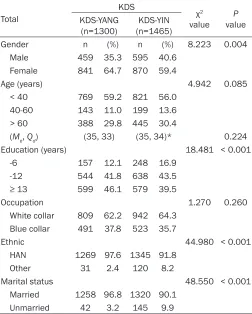
In the 2,765 cases under investigation, 1,465 cases were diagnosed as KDS-YIN while 1,300 cases as KDS-YANG by means of KDS differ- entiation criteria used by experts. As shown in Table 2, among the 1,465 cases of KDS- YIN, 595 patients (40.6%) were male and 870 (59.4%) were female, age (Me, Qd): (35, 34). Among 1,300 cases of KDS-YANG, 459 pa-
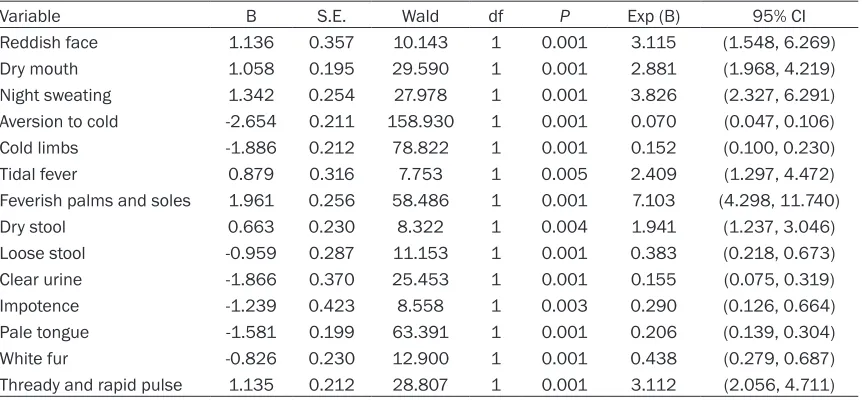
tence, pale tongue and white fur were related with KDS-YANG. The most significant symptoms of the differences between KDS-YANG and KDS-YIN were reddish face, dry mouth, night sweating, aversion to cold, cold limbs, feverish palms and soles, loose stools, clear urine, a pale tongue with white fur and a thready and rapid pulse (P < 0.01). As shown in Table 4, the results based on 2,765 cases of patients with symptoms. They were generated by the logistic regression model, which showed 2,578 cases of patients were accurately classified. The diag-nostic accuracy was 94.5%. The sensitivity was 94.7%. The specificity was 94.2%.
QUEST algorithm of decision tree analysis:
establishment of identification model on KDS
and validation
[image:5.612.92.344.97.411.2]At first, data standardization was used to ana-lyze the information of KDS in the cases from different hospitals. Next, the identification mo- dels of KDS were constructed by QUEST de- cision tree, one of algorithm of decision tree
Table 2. Comparison of sociodemographic characteristics between KDS-YANG and KDS-YIN
Total
KDS χ2
value valueP KDS-YANG
(n=1300) (n=1465)KDS-YIN
Gender n (%) n (%) 8.223 0.004
Male 459 35.3 595 40.6
Female 841 64.7 870 59.4
Age (years) 4.942 0.085
< 40 769 59.2 821 56.0
40-60 143 11.0 199 13.6
> 60 388 29.8 445 30.4
(Me, Qd) (35, 33) (35, 34)* 0.224
Education (years) 18.481 < 0.001
-6 157 12.1 248 16.9
-12 544 41.8 638 43.5
≥ 13 599 46.1 579 39.5
Occupation 1.270 0.260
White collar 809 62.2 942 64.3 Blue collar 491 37.8 523 35.7
Ethnic 44.980 < 0.001
HAN 1269 97.6 1345 91.8
Other 31 2.4 120 8.2
Marital status 48.550 < 0.001
Married 1258 96.8 1320 90.1
Unmarried 42 3.2 145 9.9
Me: Median, Qd: Quartile deviation, *U=923514.5, P=0.224.
tients (35.3%) were male and 841 (64.7%) were female, age (Me, Qd): (35, 33). Compared with KDS-YANG, lower proportions of KDS-YIN were females (59.4% versus 64.7%, P < 0.01), the proportions of KDS-YIN were younger patients (56.0% ver- sus 59.2%, P > 0.05), lower propor-tions of KDS-YIN were with higher education (39.5% versus 46.1%, P < 0.01), the proportions of KDS-YIN were white-collar employees (64.3% versus 62.2%, P=0.260), higher pro-portions of KDS-YIN were Han eth-nics (91.8% versus 97.6%, P < 0.01), higher proportions of KDS-YIN were the married (90.1% versus 96.8%, P < 0.01).
Multivariate logistic regression analy-sis of relevant symptoms for KDS
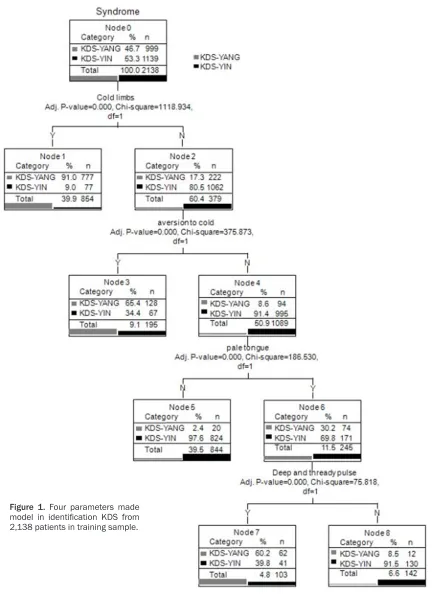
impo-analysis. KDS was considered as dependent variable whereas 14 attributes of TCM (includ-ing 11 symptoms, 2 tongue signs and 1 pulse signs) were labeled as independent variables. “Parent Node” 100 and “Child Node” 50 were set up which allowed the tree model to develop sufficiently. Split-sample validation was applied in the study to minimize the bias, which was produced by random sampling of the training sample (75%) and test sample (25%). The deci-sion tree algorithm classified the data into sub-groups with statistical significance that was exclusive and exhaustive for both sides [26]. To increase the operability of clinical use, the number of branches of the decision tree would be limited to 4. As shown in Figure 1, in this model, the tree analysis showed the 4-level QUEST decision tree with a total of 9 nodes, of which 5 were terminal nodes.
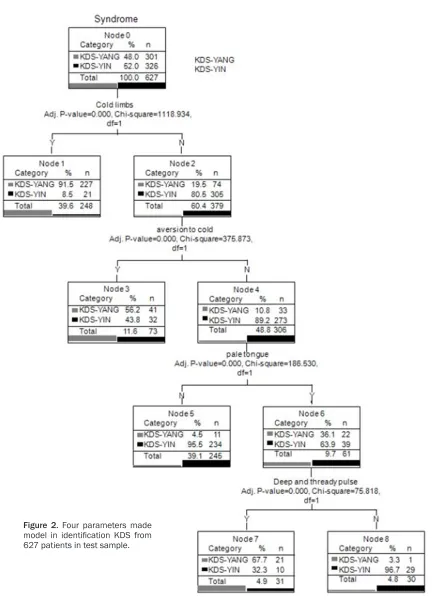
Four major predictors of symptoms which re- ached significance and were included in this model were demonstrated as aversion to cold, cold limbs, a pale tongue, and a deep and th- ready pulse. The other 42 symptoms, 4 tongue
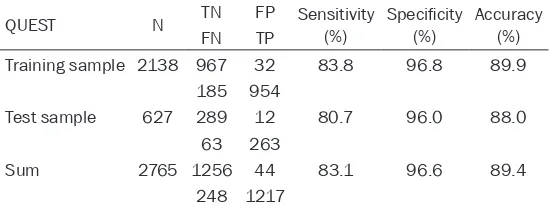
an overall accurate diagnostic rate of 88.0%, with the sensitivity at 80.7% and specificity at 96.0% respectively.
The first level of the QUEST decision tree was split into two initial branches in terms of the first level on cold limbs. The symptom of cold limbs was the best symptom to identify KDS-YANG, therefore the classification accuracy of KDS-YANG was at 91.7%. Otherwise, 82.3% patients with no cold limbs were identified as KDS-YIN.
As seen in the second level of the QUEST deci-sion tree, averdeci-sion to cold was shown to be the next best predictor variable for cases without cold limbs. The classification accuracy of KDS-YANG was 60.6% for patients with aversion to cold. Otherwise, accurate diagnostic rate of KDS-YIN for patients without aversion to cold was 90.2%.
A pale tongue was the most prominent variable on the third level of the QUEST decision tree. For those cases without pale tongue, the
accu-Table 3. Symptoms associated with use of traditional chinese medicine in KDS patients in multivari-ate logistic regression model
Variable B S.E. Wald df P Exp (B) 95% CI
Reddish face 1.136 0.357 10.143 1 0.001 3.115 (1.548, 6.269)
Dry mouth 1.058 0.195 29.590 1 0.001 2.881 (1.968, 4.219)
Night sweating 1.342 0.254 27.978 1 0.001 3.826 (2.327, 6.291)
Aversion to cold -2.654 0.211 158.930 1 0.001 0.070 (0.047, 0.106)
Cold limbs -1.886 0.212 78.822 1 0.001 0.152 (0.100, 0.230)
Tidal fever 0.879 0.316 7.753 1 0.005 2.409 (1.297, 4.472)
Feverish palms and soles 1.961 0.256 58.486 1 0.001 7.103 (4.298, 11.740)
Dry stool 0.663 0.230 8.322 1 0.004 1.941 (1.237, 3.046)
Loose stool -0.959 0.287 11.153 1 0.001 0.383 (0.218, 0.673)
Clear urine -1.866 0.370 25.453 1 0.001 0.155 (0.075, 0.319)
Impotence -1.239 0.423 8.558 1 0.003 0.290 (0.126, 0.664)
Pale tongue -1.581 0.199 63.391 1 0.001 0.206 (0.139, 0.304)
White fur -0.826 0.230 12.900 1 0.001 0.438 (0.279, 0.687)
[image:6.612.93.524.96.296.2]Thready and rapid pulse 1.135 0.212 28.807 1 0.001 3.112 (2.056, 4.711)
Table 4. Multivariate logistic regression results of classifica-tion for 2,765 cases
Multivariate logistic regression
TN FP Sensitivity
(%) Specificity (%) Accuracy (%)
FN TP
KDS 1206 74 94.7 94.2 94.5
77 1372
Note: Sensitivity = TP/(TP+FN); Specificity = TN/(TN+FP); Accuracy = (TP+TN)/(TP+FN+TN+FP).
signs and 1 pulse sign were not sig-nificant in the model. As shown in
[image:6.612.91.346.342.394.2]rate identification rate of KDS-YIN was 97.0%. While the accurate identification rate of KDS-YANG for those with pale tongue was 69.3%.
A deep and thready pulse was the most promi-nent variable on the fourth level of the QUEST decision tree. The classification accuracy of Figure 1. Four parameters made
[image:7.612.91.526.69.665.2]KDS-YANG was 56.1% for patients with deep and thready pulse. In contrast, accurate diag-nostic rate of KDS-YIN for patients without deep and thready pulse was at 91.5%.
As shown in Figures 1 and 2, the results show- ed that cold limbs were the best predictive variable quantity of KDS among the four vari-ables. However, we could not differentiate be- tween KDS-YANG and KDS-YIN only by cold limbs. We could fall back on either the second grade variable quantity: aversion to cold, or the third grade variable quantity a pale tongue, or the final-grade variable quantity a deep and thready pulse. Due to the complexity of KDS, its study was hard to find the golden index for syndrome differentiation. However, the combi-nations of different syndromes and signs might demonstrate the characteristics of different KDS. Syndrome diagnosis model was gradual- ly established on the basis of digital informa-tion of the four main fundamental TCM diag-nostic methods: observation, auscultation and olfaction, inquiry, pulse-taking and palpation, and further verified by clinical practice. It was important to promote objective study on iden- tification of TCM by improving unremittingly re- search on the diagnosis model of syndromes of TCM.
Discussion
Identification of patterns (also known as syn-drome differentiation), which is the essence of Chinese medical diagnosis, refers to the process of identifying the basic disharmony that underlies all clinical manifestations. Since there’s no simple corresponding relationship between a symptom and a pathological mecha-nism, and some symptoms that helps to
distin-basic theory of TCM, the kidneys govern re- production and store essence that serves as the source of marrow, blood and brain. Kidney plays an important role in human growth, de- velopment, strong and aging process [27]. Lots of researches confirmed many chronic diseas-es are closely related to the kidney [28, 29]. There is a saying in TCM: “A chronic disease will inevitably reach the kidneys”. The manifesta-tions of KDS can be easily found in 5 chronic kidney related diseases, including osteoporo-sis, male infertility, female infertility, thalasse- mia and Alzheimer’s disease, so they were studied as our objects. What’s more important is that using the symptoms of five diseases as the base factors to be screened can effec-tively avoid the deviation that a symptom com-mon in one specific disease being selected as a significant symptom related to KDS.
[image:8.612.90.365.98.200.2]When kidney-Yang is deficient, the fire of the gate of vitality fails to warm the body, causing the aversion to cold as well as the soreness of the back and weakness of the legs and knees. Thus results in impotence and prema-ture ejaculation for men and infertility or frigid-ity for women [30]. As for kidney Yang defi- ciency, Qi fails to transform the fluids, there- fore resulting in frequent and increased urina-tion as the fluids accumulating. The reasons of KDS-YANG include: a chronic illness after a protracted period of time, excessive sexual activity, constitutional kidney Yang deficiency and decline of the fire of the gate of vitality in the aged. The kidney Yin deficiency causes the arousal of empty-heat within the kidneys, after-ward the 5-palm heat, night sweating, red ton- gue and rapid pulse appears. Yin being defi-cient and failing to hold defensive Qi in the body at night may cause night sweating. As for
Table 5. Split-sample validation results of classification of KDS for 2765 cases
QUEST N TN FP Sensitivity (%) Specificity (%) Accuracy (%)
FN TP
Training sample 2138 967 32 83.8 96.8 89.9
185 954
Test sample 627 289 12 80.7 96.0 88.0
63 263
Sum 2765 1256 44 83.1 96.6 89.4
248 1217
Note: Sensitivity = TP/(TP+FN); Specificity = TN/(TN+FP); Accuracy = (TP+TN)/ (TP+FN+TN+FP).
guish a syndrome are not always taken as indispensable, which, making the course of identifi- cation of patterns more difficult and error-prone. So the syn-drome differentiation between kidney Yang and Yin deficiency syndromes was studied based on decision tree analysis in com-bination with logistic regression analysis.
kidney Yin deficiency, deficiency of essence brings about nocturnal emissions. thus results in the sore back and ache in the bones [31].
The reasons of kidney Yin deficiency include: a long and chronic illness usually transmits from the liver, heart or lungs; overwork over a period Figure 2. Four parameters made
[image:9.612.92.531.62.662.2]of several years and excessive sexual activity depletes kidney-essence; and it is actually said in TCM that “liver and kidney share the same root”. Accordingly loss of blood over a long peri-od of time can cause deficiency of liver bloperi-od, which, in turn, can lead to KDS-Yin.
The innovation of the research is that the two core symptoms of differentiating between KDS-YANG and KDS-YIN are obtained based on deci-sion tree analysis in combination with logistic regression. The sensitivity and specificity of the method was achieved satisfactory results so as to assist clinicians to diagnose 5 kidney related diseases. Decision tree was a decision-supporting tool that used for some box-shaped regions or model of decisions based on a logic function, which was comprised of nodes and binary splits [32]. With the development of al- gorithm of decision tree, it was successfully applied to many fields of syndrome identifica-tion in TCM, for example, researches on gastri-tis [33]. KDS is one of common syndromes in 5 chronic kidney related diseases. So it is not only necessary but also possible to construct KDS model based on combination of logistic regression analysis and QUEST algorithm ana- lysis.
Using the QUEST decision tree, an identifica- tion model between KDS-YANG and KDS-YIN was established with four significant variables: two main symptoms, one tongue sign and one pulse sign in the study. Cases with KDS-YANG and KDS-YIN were diagnosed by 8 paths. The above-mentioned four significant variables, namely, aversion to cold, cold limbs, a pale tongue, and a deep and thready pulse were sorted out by the QUEST algorithm decision tree, which were regarded as the decision tree root. The four variables with the most statistical significance would be split if the P value was less than α value which was set at 0.05; other-wise the node was not split and was then con-sidered as a terminal node. If the value of the variables such as aversion to cold, cold limbs, deep and thready pulse was set as “yes”, it would enter the branch of KDS-YANG; other-wise the node would be split and the variable would continually be used to make the two-dimensional classifications. If the value of the variables such as a pale tongue was set as “none”, it enters the branch of KDS-YIN; other-wise the node was split and the variable would
continually be used to classify the variables based on the best two dimensional classifica-tion tables. Process would be repeated until the P value was greater than α value which was set at 0.05, then the classification stopp- ed and finally the model was formed. The re- sults showed that symptoms as aversion to cold, cold limbs, a pale tongue, and a deep and thready pulse were the significant variables to differentiate between KDS-YANG and KDS-YIN.
combi-nation of identification model was formed, which played a decisive role in the diagnosis of KDS. Decision tree method showed a cer- tain advantage in the objective study on syn-drome diagnosis, so it was worth exploring in the field of KDS and the objective study on TCM. So a decision tree analysis model was an effective approach to differentiate KDS- YIN and KDS-YANG, and it could be helpful for shifting the way of syndromes diagnosis from the experience-based form to the data-model based form.
Conclusion
Decision tree model contributed a lot to the identification of KDS patients. In our study, KDS was the basic syndrome of patients related to five diseases: osteoporosis, male infertility, thalassemia, female infertility and Alzheimer’s disease. Moreover, the syndrome identification models between KDS-YIN and KDS-YANG was established based on logistic regression analysis in combination with QUEST decision tree analysis. Results showed KDS identification model included four major predic-tor symptoms: aversion to cold, cold limbs, a pale tongue and a deep and thready pulse. The accuracy of the model was 88.0%, the sensitiv-ity was 96.0% and specificsensitiv-ity was 80.7%. A decision tree model was an effective approach to differentiate between YIN and KDS-YANG, which could be beneficial for shifting the way of diagnosing syndrome from experience-based form to the data-model experience-based form. Constructions of the kidney deficiency valida-tion models would improve further reliability of the identification models.
Acknowledgements
This study was sponsored by the National Key Basic Research and Development Program (973 Program, ID: 2010CB530401).
Disclosure of conflict of interest
None.
Authors’ contribution
Tieniu Zhao drafted the manuscript, and Jing- yan Meng contributed to the design of the study and modified the manuscript. All authors contributed to the creation of the manual of
procedures and acquisition of data. All au- thors provided critical revision and approved the final manuscript.
Address correspondence to: Jingyan Meng, College of Traditional Chinese Medicine, Tianjin University of Traditional Chinese Medicine, Tianjin 300193, PR China. E-mail: [email protected]
References
[1] Wang J, Wang PQ, Xiong XJ. Current situation and perspectives of clinical study in integra-tive medicine in China. Evid Based Comple- ment Alternat Med 2012; 2012: 268542. [2] Li S, Zhang ZQ, Wu LJ, Zhang XG, Li YD,
Wang YY. Understanding ZHENG in tradition-al Chinese medicine in the context of ne-uro-endocrine-immune network. IET Syst Biol 2007; 1: 51-60.
[3] Lu A, Jiang M, Zhang C, Chan K. An integrative approach of linking traditional Chinese medi -cine pattern classification and biomedi-cine di -agnosis. J Ethnopharmacol 2012; 141: 549-556.
[4] Chen KJ, Li L. Study of traditional Chinese medicine-which is after all the right way? Chin J Integr Med 2005; 11: 241-242.
[5] Giovanni Maciocia. The Foundations of Chi-nese Medicine, British Library Cataloguing in Publication Data; 2005. pp. 417-418.
[6] Wang LF. Diagnostics of Traditional Chinese Medicine, Shanghai: Publishing House of Sh-anghai University of Traditional Chinese Medi-cine. 2002; 231-235.
[7] Yang F, Tang DZ, Cui XJ, Holz JD, Bian Q, Shi Q, Wang YJ. Classic yin and yang tonic formula for osteopenia: study protocol for a randomized controlled trial. Trials 2011; 12: 187.
[8] Wu DX, et al. Textbooks for General Tertiary Education of Chinese Medicine: Principles of Chinese Medicine, Shanghai Scientific and Technical Publishers; 2002.
[9] Xiong X, Chu F, Li H, He Q. Clinical applica-tion of the TCM classic formulae for treating chronic bronchitis. J Tradit Chinese Med 2011; 31: 69-72.
[10] Zhu WF, Fei SF, Yang MQ, et al. Textbooks for General Tertiary Education of Chinese Me-dicine: Diagnosis of Chinese Medicine. Sh-anghai: Shanghai Scientific and Technical Publishers; 1994.
[12] Davis SR, Briganti EM, Chen RQ, Dalais FS, Bailey M, Burger HG. The effects of Chinese medicinal herbs on postmenopausal vasomo-tor symptoms of Australian women. A ran -domised controlled trial. Med J Aust 2001; 174: 68-71.
[13] Wang Y, Ma LZ, Liao XW, Liu P. Decision tree method to extract syndrome differentiation rules of posthepatitic cirrhosis in traditional Chinese medicine. IEEE International Sympo- sium on IT in Medicine and Education: 12-14 December 2008; Xiamen. 2008, New York: IEEE; 2008. pp. 744-748.
[14] Shi Q, Zhao H, Chen J, Ma X, Yang Y, Zheng C, Wang W. Study on TCM Syndrome Identifica-tion Modes of Coronary Heart Disease Based on Data Mining. Evid Based Complement Al-ternat Med 2012; 2012: 697028.
[15] Chen XY, Ma LZ, Chu N, Zhou M, Hu Y. Classi-fication and Progression Based on CFS-GA and C5.0 Boost Decision Tree of TCM Zheng in Chronic Hepatitis B. Evid Based Complement Alternat Med 2013; 2013: 695937.
[16] Chen RQ, Wong CM, Lam TH. Construction of a traditional Chinese medicine syndrome- specific outcome measure: the Kidney Defici-ency Syndrome Questionnaire (KDSQ). BMC Complement Altern Med 2012; 12: 73. [17] Liu ZH, Duan YB, Ma HB, et al.
Identifica-tion and screening of osteoporosis. Chinese J Geront 1995; 15: 53-57.
[18] In: Zheng XY, editor. The Guiding Principles of Clinical Research of New Chinese Medicine (trial). Beijing: China Pharmaceutical Techno- logy Publishing House; 2002.
[19] Shen ZY, Wang WJ. Reference standard on dif -ferentiation of deficiency syndrome of tradi -tional Chinese medicine. Chinese J Integr Med 1986; 6: 598.
[20] In: Le J, editor. Obstetrics and gynecology. 7th edition. Beijing: People’s Health Press; 2008. pp. 351-352.
[21] World Health Organization (WHO). Standard Inspection Manual of Infertile Couples. Beijing: Peking Union Medical College Hospital, Na-tional Family Planning Commission, Institute of Science and Technology; 1995. pp. 44. [22] In: Zhang ZN, editor. Diagnosis and Efficacy
Standard of Blood Disease, Beijing: Science Press; 1991. pp. 48-59.
[23] McKhann G, Drachman D, Folstein M, Katzman R, Price D, Stadlan EM. Clinical diagnosis of Alzheimer’s disease: report of the NINCDS-ADRDA Work Group under the auspices of Department of Health and Human Services Task Force on Alzheimer’s Disease. Neurology 1984; 34: 939-44.
[24] Identification and Statistical Manual of Men-tal Disorders. 4th edition. Washington, DC: American Psychiatric Association; 1990. [25] International Classification of Diseases; 10th
revision. Geneva, Switzerland: World Health Organization; 1992.
[26] Kass GV. An exploratory technique for investi -gating large quantities for categorical data. App Stat 1980; 20: 119-127.
[27] Wei M, Zhao XS, Sun XM, et al. Comparative study on gene expression of kidney-Yin defi -ciency and kidney-Yang defi-ciency. J Shanxi Medl Uni 2012; 43: 652-654.
[28] Dong Y, Ding Y, Liu PZ, Song HY, Zhao YP, Li M, Shi JR. Investigation of the Material Basis Underlying the Correlation between Pre-sbycusis and Kidney Deficiency in Traditional Chinese Medicine via GC/MS Metabolomics. Evid Based Complement Alternat Med 2013; 2013: 762092.
[29] Hao YM, Hong MC, Wang WJ. Study on proteins in urine of chronic renal failure patients of different TCM syndrome types. J Integr Tradit Western Med 2012; 32: 1196-1199.
[30] Lian F, Jiang XY, Sun ZG, et al. Study on gene expression profiles in Ovarian Granulosa cells of infertility patients with Kidney-Yin or Kidney-Yang Deficiency Syndrome. J Tradit Chinese Med 2015; 56: 143-147.
[31] Li SQ, Feng EY, Zhang YY, et al. Study of the gene expression profile in the bone tissue with kidney yin deficiency syndromes in primary os -teoporosis. Chinese J Osteoporos 2013; 19: 1215-1218.
[32] Neumann A, Holstein J, Le Gall JR, Lepage E. Measuring performance in health care: case-mix adjustment by boosted decision trees. ArtifIntell Med 2004; 32: 97-113.
[33] Zhong Y, Hu XL, Lu JF. Diagnosis in traditional Chinese medicine on gastritis based on rela-tion rules and decision trees. Chinese J Inform Tradit Chinese Med 2008; 15: 97-99.