Chinese Event Coreference Resolution: An Unsupervised Probabilistic
Model Rivaling Supervised Resolvers
Chen Chen and Vincent Ng
Human Language Technology Research Institute University of Texas at Dallas
Richardson, TX 75083-0688 {yzcchen,vince}@hlt.utdallas.edu
Abstract
Recent work has successfully leveraged the semantic information extracted from lexi-cal knowledge bases such as WordNet and FrameNet to improve English event corefer-ence resolvers. The lack of comparable re-sources in other languages, however, has made the design of high-performance non-English event coreference resolvers, particularly those employing unsupervised models, very diffi-cult. We propose a generative model for the under-studied task of Chinese event corefer-ence resolution that rivals its supervised coun-terparts in performance when evaluated on the ACE 2005 corpus.
1 Introduction
Event coreference resolution is the task of deter-mining which event mentions in a text refer to the same real-world event. Compared to entity corefer-ence, event coreference is not only much less stud-ied, but it is arguably more challenging. Recall that for two event mentions to be coreferent, both their
triggers(i.e., the words realizing the occurrence of the events) and their correspondingarguments(e.g., the times, places, and people involved in them) have to be compatible. However, identifying potential ar-guments (which is typically performed by an entity extraction system), linking arguments to their event mentions (which is typically performed by an event extraction system), and determining the compatibil-ity between two event arguments (which is the job of an entity coreference resolver), are all non-trivial tasks. In other words, end-to-end event coreference
resolution is complicated in part by the fact that an event coreference resolver has to rely on the noisy outputs produced by its upstream components in the standard information extraction (IE) pipeline.
In this paper, we examine Chinese event coref-erence resolution. While English event corefcoref-erence is under-investigated, Chinese event coreference is much less studied than English event coreference. In terms of task definition, there is no difference be-tween English and Chinese event coreference. How-ever, the design of high-performance Chinese event coreference resolvers is complicated in part by the lack of large-scale lexical knowledge bases. Re-cent work by Bejan and Harabagiu (2010; 2014) has shown that the semantic information extracted from WordNet (Fellbaum, 1998) and FrameNet (Baker et al., 1998) significantly contributed to the perfor-mance of their English event coreference resolver.
While the lack of comparable lexical knowledge bases in Chinese can be mitigated in part by the use of event coreference annotated data, we focus on a challenging version of the task ---unsupervised Chi-nese event coreference resolution. Specifically, our goal is to learn an event coreference modelwithout
using data annotated with event coreference links. When evaluated on the Chinese portion of the ACE 2005 corpus, our unsupervised probabilistic model for event coreference resolution rivals its state-of-the-art supervised counterpart in performance. This, together with the fact that its underlying genera-tive process is not language-dependent and does not rely on features extracted from lexical knowledge bases, potentially enables it to be applied to lan-guages where neither annotated data nor large-scale
knowledge bases are available.
Another feature of our model that deserves men-tion is that it performs joint event coreference res-olution and anaphoricity determination. Anaphoric-ity determination, the task of determining whether a mention is anaphoric and hence needs to be re-solved, is an issue common to both entity and event coreference resolution. However, determining the anaphoricity of an event mention is arguably more difficult than determining the anaphoricity of a pro-noun. The reason is that while there exist lexical and syntactic cues that can be used to reliably identify pleonastic pronouns (Bergsma and Yarowsky, 2011), the lack of such cues in event mentions makes the identification of anaphoric event mentions challeng-ing even in a supervised manner, let alone in an un-supervised manner. Note that ignoring anaphoric-ity determination and having our model attempt to resolve every event mention is not a viable option, as only 24.4% of the Chinese event mentions in our evaluation corpus (ACE 2005) are anaphoric. Our decision to jointly model anaphoricity determination and event coreference resolution was inspired by the difficulty of designing a standalone system for deter-mining the anaphoricity of event mentions.
2 Related Work
Almost all existing approaches to event coreference are developed for English. These approaches can broadly be divided into three categories.
Within-document coreference is the most pop-ularly investigated and arguably the most important event coreference task. While early work in MUC (e.g., Humphreys et al. (1997)) is limited to sev-eral scenarios, ACE takes a further step towards pro-cessing more fine-grained events. Most ACE event coreference resolvers are supervised, training a pair-wise model to determine whether two event men-tions are coreferent (e.g., Ahn (2006)).
Improvements to this standard approach include the use offeature weightingto train a better model (McConky et al., 2012), and graph-based cluster-ing algorithmsto produce event coreference clusters (Chen and Ji, 2009; Sangeetha and Arock, 2012). Chen et al. (2011) train multiple classifiers to han-dle coreference between event mentions of different syntactic types (e.g., verb-noun coreference,
noun-noun coreference) on the OntoNotes corpus (Prad-han et al., 2007). However, OntoNotes is only par-tially annotated with event coreference links, and Chen et al. further make the simplifying assumption that event coreference chains are all and only those coreference chains that involve at least one verb.
More recently, Cybulska and Vossen (2012) and Goyal et al. (2013) have performed event corefer-ence using semantic relations (e.g., hyponymy rela-tions extracted from WordNet) and distributional se-mantic information, respectively, on the Intelligence Community (IC) corpus (Hovy et al., 2013). The IC corpus, which at the time of writing is not yet pub-licly available, is different from the MUC and ACE corpora in that it is annotated with not onlyfullevent coreference relations but alsopartialevent corefer-ence relations. Partial corefercorefer-ence is a term coined by Hovy et al. to refer to event relations that exhibit subtle deviation from the perfect identity of events (e.g., the subset relation, the membership relation). While all of the aforementioned work addresses the full event coreference task, a two-stage approach is recently proposed by Araki et al. (2014) to identify subevent relations from the IC corpus.
Cross-document coreferenceis first investigated by Bagga and Baldwin (1999), who represent an event mention as a vector of its context words and de-termine whether two event mentions are coreferent based on the cosine similarity of their vectors. Be-jan and Harabagiu (2010; 2014) and Lee et al. (2012) propose nonparametric models and a joint entity and event coreference model respectively for within- and cross-document event coreference, evaluating their models on the ECB corpus. However, ECB "is an-notated mainly for cross-document coreference" and many difficult cases of within-document coreference are not annotated (Liu et al., 2014).
Naughton (2009) and Elkhlifi and Faiz (2009) have worked onsentence-level event coreference, where the goal is to determine whether two sentences containing event mentions are coreferent. Some-what unfortunately, simplifying assumptions have to be made when a sentence containing multiple non-coreferent event mentions is encountered.
corefer-ence resolver for Chinese that achieves state-of-the-art results, employs a supervised approach where a classifier is trained to determine whether two event mentions are coreferent. We will compare our unsu-pervised model against this suunsu-pervised resolver.
3 ACE Event Coreference
In this section, we overview the ACE 2005 event coreference task, which is the version of the within-document event coreference task we focus on.
The ACE 2005 event coreference task requires that an event coreference resolver perform corefer-ence on event mentions belonging to one of the ACE event types. More specifically, an event mention is composed of a trigger (i.e., the word realizing the event's occurrence) and a set ofarguments(i.e., the event's participants). Each event trigger has atype
and asubtype. In ACE 2005, eight event types are defined, which are further subcategorized into 33 subtypes. Each event argument has a semanticrole. In ACE 2005, a set of argument roles is defined for each event type. That is, an event's type determines what roles its mentions' arguments can assume. Not surprisingly, two event mentions cannot be corefer-ent if their triggers have differcorefer-ent subtypes or they have incompatible arguments (e.g., their dates or lo-cations are different).
To better understand the ACE 2005 event corefer-ence task, consider the sentcorefer-ence in Figure 1, which is taken from the ACE 2005 corpus. This example contains three event mentions belonging to the ACE event types. Specifically, these three mentions are triggered by the words离(leaving), 暗杀 (assassi-nated) and攻击(attack). 暗杀and攻击have type Lifeand subtypeDie, whereas离has type Move-ment and subtype Transport. Note that 暗杀 and攻击refer to the same real-world event and are therefore coreferent.
4 The Generative Model
In this section, we present our generative model.
4.1 Notation
We begin by introducing the notation that we use in the rest of this paper. We denoteeto be the current event mention to be resolved (henceforth theactive
event mention). C, the set of candidate antecedents
沙米里与其子在上午交通尖峰时间[离]家时,遭到
[暗杀]。这次[攻击]再次显示叛乱分子能力。
Shameri and his son were [assassinated] during morning rush hour when [leaving] home. This [attack] once again demonstrated the insurgents' ability.
Figure 1: An excerpt from a Chinese document in the ACE 2005 corpus with the corresponding English trans-lation. The event mentions are bracketed.
ofe, contains all the event mentions precedingein the associated text as well as a dummy candidate an-tecedentd(to whichewill be resolved if it is non-anaphoric). Also, we definekto be the context sur-roundingeas well as every candidate antecedentcin
C, andkcto be the context surrounding eand can-didate antecedentc. Moreover, we define lto be a binary variable indicating whether c is the correct antecedent ofe. Finally, et andctdenoteeandc's respective trigger words.
4.2 Training
Our model estimatesP(e, k, c, l), the probability of seeing (1) the active event mentione; (2) the con-textksurroundingeand its candidate antecedents; (3) a candidate antecedentcofe; and (4)l, a binary value indicating whethercise's correct antecedent. Since we estimate this probability from a raw, unan-notated corpus, we are effectively treatinge,k, and
cas observed data andlas hidden data.
Owing to the presence of hidden data, we esti-mate the model parameters using the Expectation-Maximization (EM) algorithm (Dempster et al., 1977). Specifically, we use EM to iteratively esti-mate the model parameters from data in which each event mention is labeled with the probability that it corefers with each of its candidate antecedents, and apply the resulting model to relabel each event men-tion with the probability that it corefers with each of its candidate antecedents. Below we describe the de-tails of the E-step and the M-step.
4.2.1 E-Step
its correct antecedent, we can rewriteP(l=1|e, k, c) as follows:
P(l=1|e, k, c) = ∑ P(e, k, c, l=1) c′∈CP(e, k, c′, l=1)
(1)
As we can see from Equation (1), to compute
P(l=1|e, k, c), we need to computeP(e, k, c, l=1), which can be rewritten using Chain Rule:
P(e, k, c, l=1) =P(e|k, c, l=1)∗P(l=1|k, c) ∗P(c|k)∗P(k)
(2) Next, given l = 1(i.e.,cis the antecedent ofe), we assume that we can generate e from c without looking at the context. Using this assumption and approximatingeandcby their trigger words, we can rewriteP(e|k, c, l=1)as follows:
P(e|k, c, l=1)≈P(et|ct, l=1) (3)
Moreover, we assume that (1) giveneandc's con-text, the probability ofc being the antecedent of e is not affected by the context of the other candidate antecedents; and (2)kcis sufficient for determining whethercis the antecedent ofe. So,
P(l=1|k, c)≈P(l=1|kc, c)≈P(l=1|kc) (4)
Next, applying Bayes Rule toP(l=1|kc), we get:
P(kc|l=1)P(l=1)
P(kc|l=1)P(l=1) +P(kc|l=0)P(l=0) (5)
Representing kc as a set ofn featuresfc1, . . . fcn and assuming that eachfci is conditionally indepen-dent givenl, we can approximate Expression (5) as:
∏
iP(fci|l=1)P(l=1) ∏
iP(fci|l=1)P(l=1) +∏iP(fci|l=0)P(l=0) (6) Given Equations (2), (3), (4) and (6), we can rewriteP(l=1|e, k, c)as follows:
P(l=1|e, k, c) = ∑ P(e, k, c, l=1) c′∈CP(e, k, c′, l=1)
≈ P(et|ct, l=1)∗
∏
iP(fci|l=1)
Zc ∗P(c|k)
∑
c′∈CP(et|c′t, l=1)∗
∏
iP(fci′|l=1)
Zc′ ∗P(c
′|k)
(7)
where
Zx= ∏
i
P(fi
x|l=1)P(l=1)+ ∏
i
P(fi
x|l=0)P(l=0)
(8) As we can see from Equation (7), our model has four groups of parameters, namely P(et|ct, l=1),
P(fi
c=1|l),P(l)andP(c|k). With these four groups of parameters, we can apply Equation (7) to effi-ciently computeP(l=1|e, k, c).
Two points deserve mention before we describe our M-step. First, among the four groups of param-eters,P(et|ct, l=1)andP(fci|l)are estimated in the M-step described below;P(l)is estimated in param-eter initialization and used throughout the EM itera-tions (details on parameter initialization appear after the M-step); and P(c|k) is computed heuristically. Intuitively,P(c|k)is the prior probability of a can-didate antecedentc given context k. The simplest way to modelP(c|k)is to assume that every candi-date antecedent is equally likely given the context. In practice, however, some candidate antecedents are implausible given the context. To identify such can-didate antecedents, we employ a simple heuristic, which considers a candidate antecedent implausible if its event subtype is different from that ofe. Con-sequently, we modelP(c|k) as follows: if cis im-plausible, we setP(c|k)to 0 and distribute the prob-ability mass uniformly over all and only the plausi-ble candidate antecedents. Since this heuristic is not applicable to dummy candidates, we assume for sim-plicity that they are all plausible.
Second, by includingdas a dummy candidate an-tecedent for eache, we model anaphoricity determi-nation and event coreference in a joint fashion. If the model resolvesetod, it means that the model posits
eas non-anaphoric; on the other hand, if the model resolveseto a non-dummy candidate antecedentc, it means that the model posits e as anaphoric and
c as e's correct antecedent. This joint modeling method has proven effective in earlier work on su-pervised entity coreference resolution (e.g., Rahman and Ng (2009; 2011)).
4.2.2 M-Step
Given P(l=1|e, k, c), the goal of the M-step is to (re)estimate two of the four groups of param-eters mentioned above, namely P(et|ct, l=1) and
P(fi
Specifically, P(et|ct, l=1) is estimated as fol-lows:
P(et|ct, l=1) = CountCount((cet, ct, l=1) +θ t, l=1) +θ∗ |t| (9)
where Count(ct, l=1) is the expected number of timeschas trigger wordctwhen it is the antecedent of an event mention; and|t|is the number of possible trigger words in the training data (we treat the "trig-ger word" of a dummy candidate antecedent as an unseen word). Also,θis the Laplace smoothing pa-rameter, which we set to 1, andCount(et, ct, l=1)is the expected number of timesehasetas its trigger when its antecedentchas triggerct. Given trigger wordse′tandc′t, we computeCount(e′t, c′t, l=1)as follows:
Count(e′
t, c′t, l=1) =
∑
e,c:et=e′t,ct=c′t
P(l=1|e, k, c)
(10) The remaining group of parameters,P(fci|l), can be estimated in a similar fashion.
To start the induction process, we initialize all parameters with uniform values. Specifically,
P(et|ct, l=1) is set to |1t|, and P(l=1|kc) is set to 0.5. As noted before, P(l) is also initialized here and used throughout the EM iterations. Recall that
P(l=1)is the fraction of event pairs that are corefer-ent. Since we assumed earlier that each event men-tion has exactly one (dummy or non-dummy) an-tecedent,P(l=1)can be computed as the number of event mentions divided by the total number of event pairs. After initialization, we iteratively run the E-step and the M-E-step until convergence.
There is an important question we have not ad-dressed: what featuresfcishould we use to represent contextkc, which we need to estimateP(fci|l)? We defer the discussion of this question to Section 5.
4.3 Inference
After training, we can apply the resulting model to resolve event mentions. Given an event mentione, we determine its antecedent as follows:
ˆ
c=arg max
c∈C P(l=1|e, k, c) (11) whereC is the set of candidate antecedents ofe. In other words, we apply Equation (11) to each ofe's
candidate antecedents, and select the one that yields the largest probability. Ifcis a non-dummy candi-date antecedent, we positc as the antecedent of e; otherwise, we positeas non-anaphoric.
5 Context Features
As mentioned at the end of Section 4.2.2, to fully specify our model, we need to describe the features
fi
c used to represent kc, which is needed to com-pute P(fci|l). Recall that kc encodes the context surrounding candidate antecedentcand active event mentione. We representkcusing six features that en-code the relationship betweencande, some of which are motivated by previous work on supervised event coreference resolution (e.g., Chen and Ji (2009)). Below we describe these six features, which can be broadly divided into three categories.
5.1 Trigger-Based Features
We employ two trigger-based features (Features 1 and 2), both of which are binary-valued and are com-puted based one's andc's triggers.
Feature 1 encodes whether ct andet, the trigger words ofcande, satisfy any of the following three conditions:
1. ctandetare lexically identical;
2. ctandetcontain the same basic verb (BV) and their verb structures are compatible;
3. the similarity betweenctandetis greater than a certain threshold (which we set to 0.8 in our experiments).
Intuitively, Feature 1 is a recall-enhancing feature: it encodes a condition whose satisfaction can help discover many event coreference links. However, it is not designed to be precision-oriented, as it is com-puted based solely on the triggers and not their sur-rounding contexts. Below we explain conditions 2 and 3 in more detail.
Specifically, Li et al. (2012) observe that, with a few exceptions, a Chinese verb constructed out of a ba-sic verb bv possesses one of six main verb struc-tures: (1) bv (e.g.,逮 (arrest)); (2)bv + verb (e.g.,
送到(deliver), wherebvis送); (3) verb +bv(e.g.,
离开(leave), wherebvis开); (4)bv+ complemen-tation (e.g.,进了(enter), where bvis进); (5)bv + noun/adjective (e.g.,开枪(shoot), where bvis开); (6) noun/adjective +bv (e.g., 轻伤(slight wound), wherebv is伤). Now, assuming thatt1 andt2 are two lexically different trigger words containing the same BV (bv), we say that their verb structures (de-noted asvs1andvs2) are incompatible if one of the following conditions is satisfied: (1)bv appears in different positions in t1 and t2 (e.g., 开枪 (shoot) and离开(leave), wherebvis开); (2) bothvs1 and
vs2 havebv+ verb or verb +bv as their verb
struc-ture (e.g.,送到(deliver) and赶到(reach), wherebv is到); or (3) bothvs1 andvs2 have noun/adjective + bv orbv + noun/adjective as their verb structure (e.g.,轻伤(slight wound) and重伤(severe wound), wherebvis伤). Note that these three incompatibil-ity conditions encode our commonsense knowledge of when two Chinese verbs having the same BV can-not have the same meaning.
Next, we explain how we compute the similar-ity between two trigger words in condition 3. To capture their semantic similarity, we first apply word2vec (Mikolov et al., 2013) to the Chinese Gi-gaword corpus (Parker et al., 2009) to obtain a vec-tor representation of each word and then compute the cosine similarity between the two word vectors.
Feature 2, our second trigger-based feature, en-codes whether two nominal event mentions are in-compatible w.r.t. number. Specifically, its value is True if and only if (1)candeare both nouns, and (2) one is singular and the other is plural. Intuitively, this feature encodes a non-coreference condition.
5.2 Argument-Based Features
We employ three argument-based features (Fea-tures 3−5), all of which are binary-valued and are computed based onc's ande's arguments.
Feature 3 encodes whethercandepossess two ar-guments that have the same semantic role but dif-ferent semantic classes.1 Intuitively, Feature 3
en-1
The possible semantic classes are the ACE 2005 entity
codes a non-coreference condition: candecannot be coreferent if such arguments exist.
Feature 4 can be viewed as a generalized version of Feature 3, encoding whethercandepossess two arguments that have the same semantic role but are not coreferent.
Feature 5 encodes whether c ande possess two named entity (NE) arguments that both haveValue as their NE type but are lexically different. Such event mentions have a good chance of being not coreferent.
5.3 Distance Feature
We employ one distance feature (Feature 6) that en-codes how farcandeare apart from each other in terms of the number of event mentions. To reduce data sparseness during parameter estimation, how-ever, we quantize the distance as follows. Letdbe the distance between the first event mention and the last event mention in the document for which the tance feature will be computed. Note that the dis-tance between an arbitrary pair of event mentions in this document will be between 0 andd. We divide the interval [0,d] into four equal-sized regions, and set the value of the distance feature based on which of the four bins it falls into.
5.4 Features for Dummy Candidates
Now that we can compute the aforementioned six features for a non-dummy candidate antecedent, we next specify how we compute these features for a dummy candidate antecedentdof active event men-tione. For Feature 1, we set the feature value ofd to True, whereas for Features 2−5, we set the fea-ture value ofdto False. To understand why these values are chosen, note that for each of these fea-tures the opposite value could be a strong indicator of non-coreference, potentially causing the model to have an overly strong bias against selectingdas the antecedent ofe.
Finally, to compute Feature 6, we assume thatd is the zero-th event mention of the associated docu-ment, and then compute the distance feature in the same way as described above. By letting dbe the zero-th event mention, we make the probability of pickingdas the correct antecedent (the probability of
types, i.e.,Person,Organization,GPE,Facility, and
classifyingeas non-anaphoric) depend on e's posi-tion in the associated text. This makes sense because in general, the probability ofebeing non-anaphoric tends to be larger (smaller) when it appears earlier (later) in the document.
6 Evaluation
6.1 Experimental Setup
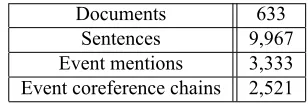
Dataset. For evaluation, we conduct five-fold cross-validation experiments on the 633 Chinese documents of the ACE 2005 training corpus. Statis-tics on the corpus are shown in Table 1.
Evaluation measures. We report results in terms of recall (R), precision (P), and F-score (F) using the commonly-used coreference evaluation measures given by the CoNLL scorer, namely the link-based MUC scorer (Vilain et al., 1995), the mention-based B3 scorer (Bagga and Baldwin, 1998), the entity-based version of the CEAF scorer (Luo, 2005), and the Rand index-based BLANC scorer (Recasens and Hovy, 2011), after singleton event mentions are re-moved from the coreference partitions produced by our resolver. We use the latest version (version 8) of the CoNLL scorer2, which fixes a bug in
pre-vious versions (Pradhan et al., 2014). In addition, we report the CoNLL score (Pradhan et al., 2011), which is the unweighted average of the MUC, B3, and CEAF F-scores.
Evaluation setting. We perform an end-to-end evaluation, as it can more accurately reflect the per-formance of an event coreference resolver when it is used in practice.
More specifically, to extract the event mentions used in our evaluation, we employ SinoCorefer-encer3, which, as mentioned before, is an end-to-end ACE-style Chinese IE system that achieves state-of-the-art event coreference results. Specifically, the event triggers needed to compute the trigger-based context features are extracted using SinoCorefer-encer's event extraction subsystem. The event sub-types needed to identify and filter out implausible candidate antecedents are also provided by its event extraction subsystem. The event arguments needed to compute the argument-based context features are
2conll.github.io/reference-coreference-scorers/
3Downloadable from http://www.hlt.utdallas.edu/
~yzcchen/coreference/
[image:7.612.348.502.59.111.2]Documents 633 Sentences 9,967 Event mentions 3,333 Event coreference chains 2,521
Table 1: Statistics on the ACE 2005 Chinese corpus.
first extracted and typed by its entity extraction sub-system, and then linked to their triggers by its event extraction subsystem. Finally, the entity coreference links and the semantic roles needed to compute Fea-ture 4 are provided by its entity coreference sub-system and its event extraction subsub-system, respec-tively.4 Details of each of these subsystems can be found in Chen and Ng (2014).
6.2 Results
We employ two supervised resolvers as baseline sys-tems. The first baseline employs rote learning, sim-ply positing two event mentions as coreferent if their corresponding triggers are annotated as coreferent in the training data. The second baseline is SinoCoref-erencer, which has produced the best Chinese event coreference results to date on the ACE corpus.
Row 1 of Table 2 shows the results of the base-line that employs rote learning. As we can see, this baseline achieves a CoNLL score of 37.9. Row 2 shows the results of SinoCoreferencer. It performs significantly better than the rote-learning baseline w.r.t. all five scoring measures5, achieving a CoNLL score of 39.2. Finally, row 3 shows the results of our model. Despite being unsupervised, it significantly outperforms the better baseline, SinoCoreferencer, w.r.t. all five scoring measures, achieving a CoNLL score of 41.5, which is 2.3 points higher than that of SinoCoreferencer. These results suggest that a gen-erative approach to unsupervised event coreference holds promise.
6.3 Ablation Experiments
Recall that in our model eight probability terms play a major role:P(et|ct),P(c|k), andP(fci|l)for each
4We employ only those semantic roles that can be reliably determined by SinoCoreferencer's event extraction subsystem, namely,Agent,Adjudicator,Defendant,Giver,
Per-son,Place,Position,Organization,Origin, and
Re-cipient. 5
MUC B3 CEAFe BLANC CoNLL
System R P F R P F R P F R P F F
Rote learning 42.6 36.4 39.3 41.4 32.3 36.3 37.0 39.7 38.3 27.4 20.0 23.1 37.9 SinoCoreferencer 42.7 38.3 40.4 41.5 34.7 37.8 39.9 39.2 39.5 28.1 23.7 25.7 39.2 Our model 43.1 42.4 42.8 41.4 39.1 40.2 40.7 42.6 41.6 27.5 26.4 26.9 41.5
Table 2: Five-fold cross-validation event coreference results on the ACE 2005 corpus.
of the six context features. To investigate the con-tribution of each probability term to overall perfor-mance, we conduct ablation experiments. Specifi-cally, in each ablation experiment, we remove ex-actly one term from the model and retrain it.
Ablation results are shown in Table 3. Each row contains the F-scores obtained via the five evaluation measures. To facilitate comparison, the scores of the model in which all eight probability terms are used is shown in row 1. As we can see, Feature 1 is the most useful feature: its removal causes the CoNLL score to drop significantly by 5.3 points. A closer exam-ination reveals that the drop in the CoNLL score is caused by a significant drop in recall w.r.t. all scor-ers. Recall that this feature encodes the conditions under which two triggers are likely to be coreferent. It is perhaps not surprising that its removal causes a significant drop in recall.
The second most useful feature isP(c|k), which places zero probability mass on candidate an-tecedents whose event subtypes are different from that of the active event mention. Its removal causes the CoNLL score to drop significantly by 1.6 points. The removal of each other feature resulted in a small, insignificant drop in the CoNLL score.
6.4 Error Analysis
It is somewhat surprising that our unsupervised event coreference model outperforms the better supervised baseline, SinoCoreferencer. To understand why, we analyze the errors made by the two resolvers.
Our analysis proceeds as follows. First, to gain in-sights into the differences between the two resolvers, we examine those candidate event mentions that are correctly handled by one model but not the other (Section 6.4.1). Specifically, we consider a candi-date event mentionecorrectly handled if (1)eis a correctly resolved anaphoric event mention; (2)eis an unresolved singleton event mention; or (3)eis an unresolved non-event mention (i.e., not a true event
System MUC B3 CEAFe BLANCCoNLL Full model 42.8 40.2 41.6 26.9 41.5
−P(et|ct) 42.9 39.8 40.9 26.9 41.2
−P(c|k) 41.2 38.6 39.8 24.9 39.9
−Feature 1 37.5 32.9 38.2 20.8 36.2
−Feature 2 42.5 39.9 41.4 26.6 41.3
−Feature 3 42.4 40.0 41.3 26.9 41.2
−Feature 4 42.5 40.1 41.7 27.0 41.4
−Feature 5 42.4 40.0 41.4 26.5 41.3
[image:8.612.83.533.60.124.2]−Feature 6 42.3 39.6 40.9 26.8 40.9
Table 3: Ablation results in terms of F-scores.
mention). Second, to understand how to improve event coreference, we identify the major sources of error made by both resolvers (Section 6.4.2).
6.4.1 Common Sources of Disagreement
There are 323 candidate event mentions that are cor-rectly handled by one model but not the other in our dataset. Among these 323 cases, 205 (50 anaphoric + 79 singletons + 76 non-event) are correctly handled by the unsupervised model, and 118 (42 anaphoric + 52 singletons + 24 non-event) are correctly handled by SinoCoreferencer.
From these numbers, we can see that the unsuper-vised model performs far better than SinoCorefer-encer in not resolving the singletons and the non-event mentions. This is perhaps not surprising given the unsupervised model's relatively stricter conditions on resolving a candidate event mention. Specifically, it is unlikely to posit two candidate event mentions as coreferent unless (1) their trig-gers have a BV match or a large word2vec similar-ity value and (2) none of the non-coreference condi-tions are satisfied. Overall, these results explain why the unsupervised model has a much higher precision than SinoCoreferencer.
in resolving the anaphoric event mentions, which ul-timately enables it to achieve a higher recall than SinoCoreferencer. In particular, it correctly resolves 50 anaphoric mentions that are incorrectly handled by SinoCoreferencer. The successful resolution of these anaphoric mentions can be attributed largely to its use of BV and word2vec, neither of which is ex-ploited by SinoCoreferencer. However, while a BV match or a high word2vec similarity value is a good indicator of event coreference, they are by no means perfect. This partly explains why there are singletons and non-event mentions that are correctly handled by SinoCoreferencer but not the unsupervised model.
Despite the fact that SinoCoreferencer slightly lags behind the unsupervised model in resolv-ing anaphoric mentions, it correctly resolves 42 anaphoric event mentions that are incorrectly han-dled by the unsupervised model. These are cases that cannot be handled simply by relying on BV match or word2vec similarity. More specifically, two of the unique features of SinoCoreferencer are primarily responsible for its successful resolution of these event mentions. First, it learns coreferent trig-ger pairs from the training data. These pairs proved to be useful for event coreference, as we saw from the competitive results provided by the rote-learning baseline. Second, unlike the unsupervised model, SinoCoreferencer can posit two event mentions as coreferentwithout considering their triggers. More specifically, SinoCoreferencer may posit two event mentions as coreferent if the corresponding argu-ments of the two event mentions (i.e., arguargu-ments having the same role) are coreferent. Neither of these two recall-enhancing features of SinoCoreferencer is a precise indicator of event coreference. In other words, employing them widens the precision gap be-tween the two resolvers.
6.4.2 Common Sources of Error
Next, we discuss the major sources of error made by both our unsupervised model and SinoCorefer-encer. Broadly, the errors can be divided into two categories, precision errors and recall errors.
Precision errors arise primarily from erroneous coreference links established between (1) one or more candidate event mentions that are not true event mentions; (2) two event mentions with incompati-ble latent attributes such asModality,Polarity,
Genericity, andTense, since these attributes are not exploited by the two resolvers; (3) two event mentions with incompatible arguments, since these arguments fail to be extracted by the argument iden-tification component; (4) two mentions representing events that occur at different times, since the event mentions are not timestamped6; and (5) two event mentions whose corresponding arguments are incor-rectly posited by the entity coreference subsystem as coreferent.
On the other hand, recall errors arise primarily from missing coreference links attributed to (1) the trigger identification component's failure to detect one or both of the triggers involved in an event coref-erence link; (2) the entity corefcoref-erence subsystem's failure to establish the link(s) between the corre-sponding arguments of two coreferent event men-tions; (3) the lack of positive evidence of event coref-erence, such as BV match, high word2vec similar-ity, and coreferent arguments; and (4) the argument identification component's failure to extract one or more arguments of an event mention.
7 Conclusions
We presented a generative model for the rela-tively under-studied task of unsupervised Chinese event coreference resolution whose parameters were learned using EM from an unannotated corpus. When evaluated on the ACE 2005 corpus, our model significantly outperforms SinoCoreferencer, a state-of-the-art Chinese event coreference resolver.
Since the performance of our resolver is limited in part by the errors made by SinoCoreferencer's sub-systems, we plan to mitigate this problem by per-forming joint inference for entity coreference, event extraction and event coreference in future work.
Acknowledgments
We thank the three anonymous reviewers for their detailed and insightful comments on an earlier draft of this paper. This work was supported in part by NSF Grants IIS-1147644 and IIS-1219142.
6Not all of these errors can be fixed by exploiting theTense attribute, asTenseis only a crude approximation of time. For instance, in the phrases首度被捕(arrested for the first time) and再度被捕(arrested again), the two occurrences of被捕
References
David Ahn. 2006. The stages of event extraction. In
Proceedings of the Workshop on Annotating and Rea-soning about Time and Events, pages 1--8.
Jun Araki, Zhengzhong Liu, Eduard Hovy, and Teruko Mitamura. 2014. Detecting subevent structure for event coreference resolution. In Proceedings of the Ninth International Conference on Language Re-sources and Evaluation, pages 4553--4558.
Amit Bagga and Breck Baldwin. 1998. Algorithms for scoring coreference chains. InProceedings of the Linguistic Coreference Workshop at the First Interna-tional Conference on Language Resources and Evalu-ation, page 563--566.
Amit Bagga and Breck Baldwin. 1999. Cross-document event coreference: Annotation, experiments, and ob-servations. In Proceedings of the ACL Workshop on Coreference and Its Applications, pages 1--9.
Collin F. Baker, Charles J. Fillmore, and John B. Lowe. 1998. The Berkeley FrameNet project. In Proceed-ings of the 36th Annual Meeting of the Association for Computational Linguistics and the 17th International Conference on Computational Linguistics, Volume 1, pages 86--90.
Cosmin Bejan and Sanda Harabagiu. 2010. Unsuper-vised event coreference resolution with rich linguistic features. InProceedings of the 48th Annual Meeting of the Association for Computational Linguistics, pages 1412--1422.
Cosmin Bejan and Sanda Harabagiu. 2014. Unsuper-vised event coreference resolution. Computational Linguistics, 40(2):311--347.
Shane Bergsma and David Yarowsky. 2011. NADA: A robust system for non-referential pronoun detection. In Proceedings of the 8th Discourse Anaphora and Anaphor Resolution Colloquium, pages 12--23. Zheng Chen and Heng Ji. 2009. Graph-based event
coreference resolution. In Proceedings of the 2009 Workshop on Graph-based Methods for Natural Lan-guage Processing (TextGraphs-4), pages 54--57. Chen Chen and Vincent Ng. 2014. SinoCoreferencer: An
end-to-end Chinese event coreference resolver. In Pro-ceedings of the Ninth International Conference on Lan-guage Resources and Evaluation, pages 4532--4538. Bin Chen, Jian Su, Sinno Jialin Pan, and Chew Lim Tan.
2011. A unified event coreference resolution by inte-grating multiple resolvers. In Proceedings of the 5th International Joint Conference on Natura Language Processing, pages 102--110.
Agata Cybulska and Piek Vossen. 2012. Using se-mantic relations to solve event coreference in text. In Proceedings of the LREC Workshop on Semantic
Relations-II Enhancing Resources and Applications (SemRel 2012), pages 60--67.
Arthur P. Dempster, Nan M. Laird, and Donald B. Ru-bin. 1977. Maximum likelihood from incomplete data via the EM algorithm. Journal of the Royal Statistical Society. Series B (Methodological), 39:1--38.
Aymen Elkhlifi and Rim Faiz. 2009. Automatic anno-tation approach of events in news articles. Interna-tional Journal of Computing and Information Sciences, 7(1):40--50.
Christiane Fellbaum. 1998.WordNet: An Electronic Lex-ical Database. MIT Press, Cambridge, MA.
Kartik Goyal, Sujay Kumar Jauhar, Huiying Li, Mrin-maya Sachan, Shashank Srivastava, and Eduard Hovy. 2013. A structured distributional semantic model for event co-reference. InProceedings of the 51st Annual Meeting of the Association for Computational Linguis-tics: Volume 2 (Short Papers), pages 467--473. Eduard Hovy, Teruko Mitamura, Felisa Verdejo, Jun
Araki, and Andrew Philpot. 2013. Events are not simple: Identity, non-identity, and quasi-identity. In
Proceedings of the NAACL-HLT Workshop on Events: Definition, Detection, Coreference, and Representa-tion, pages 21--28.
Kevin Humphreys, Robert Gaizauskas, and Saliha Az-zam. 1997. Event coreference for information ex-traction. InProceedings of the ACL/EACL Workshop on Operational Factors in Practical, Robust Anaphora Resolution for Unrestricted Texts, pages 75--81. Heeyoung Lee, Marta Recasens, Angel Chang, Mihai
Surdeanu, and Dan Jurafsky. 2012. Joint entity and event coreference resolution across documents. In
Proceedings of the 2012 Joint Conference on Empir-ical Methods in Natural Language Processing and Computational Natural Language Learning, pages 489--500.
Peifeng Li, Guodong Zhou, Qiaoming Zhu, and Libin Hou. 2012. Employing compositional semantics and discourse consistency in Chinese event extrac-tion. InProceedings of the 2012 Joint Conference on Empirical Methods in Natural Language Processing and Computational Natural Language Learning, pages 1006--1016.
Zhengzhong Liu, Jun Araki, Eduard Hovy, and Teruko Mitamura. 2014. Supervised within-document event coreference using information propagation. In Pro-ceedings of the Ninth International Conference on Lan-guage Resources and Evaluation, pages 4539--4544. Xiaoqiang Luo. 2005. On coreference resolution
Katie McConky, Rakesh Nagi, Moises Sudit, and William Hughes. 2012. Improving event co-reference by context extraction and dynamic feature weighting. InProceedings of the 2012 IEEE International Multi-Disciplinary Conference on Cognitive Methods in Sit-uation Awareness and Decision Support, pages 38--43. Tomas Mikolov, Ilya Sutskever, Kai Chen, Greg S Cor-rado, and Jeff Dean. 2013. Distributed representa-tions of words and phrases and their compositionality. InProceedings of the Advances in Neural Information Processing Systems, pages 3111--3119.
Martina Naughton. 2009. Sentence Level Event Detec-tion and Coreference ResoluDetec-tion. Ph.D. thesis, Na-tional University of Ireland, Dublin, Ireland.
Robert Parker, David Graff, Ke Chen, Junbo Kong, and Kazuaki Maeda. 2009. Chinese Gigaword fourth edi-tion. Linguistic Data Consortium, Philadelphia, PA. Sameer Pradhan, Lance Ramshaw, Ralph Weischedel,
Jessica MacBride, and Linnea Micciulla. 2007. Unre-stricted coreference: Identifying entities and events in OntoNotes. InProceedings of the International Con-ference on Semantic Computing, pages 446--453. Sameer Pradhan, Lance Ramshaw, Mitchell Marcus,
Martha Palmer, Ralph Weischedel, and Nianwen Xue. 2011. CoNLL-2011 Shared Task: Modeling unre-stricted coreference in OntoNotes. InProceedings of the Fifteenth Conference on Computational Natural Language Learning: Shared Task, pages 1--27. Sameer Pradhan, Xiaoqiang Luo, Marta Recasens,
Ed-uard Hovy, Vincent Ng, and Michael Strube. 2014. Scoring coreference partitions of predicted mentions: A reference implementation. In Proceedings of the 52nd Annual Meeting of the Association for Compu-tational Linguistics (Volume 2: Short Papers), pages 30--35.
Altaf Rahman and Vincent Ng. 2009. Supervised mod-els for coreference resolution. InProceedings of the 2009 Conference on Empirical Methods in Natural Language Processing, pages 968--977.
Altaf Rahman and Vincent Ng. 2011. Narrowing the modeling gap: A cluster-ranking approach to corefer-ence resolution. Journal of Artificial Intelligence Re-search, 40:469--521.
Marta Recasens and Eduard Hovy. 2011. BLANC: Implementing the Rand Index for coreference evalua-tion. Natural Language Engineering, 17(4):485--510. S. Sangeetha and Michael Arock. 2012. Event corefer-ence resolution using mincut based graph clustering. InProceedings of the Fourth International Workshop on Computer Networks & Communications, pages 253--260.
Marc Vilain, John Burger, John Aberdeen, Dennis Con-nolly, and Lynette Hirschman. 1995. A model-theoretic coreference scoring scheme. InProceedings