Beyond Left-to-Right: Multiple Decomposition Structures for SMT
Hui Zhang∗
USC/ISI
Los Angeles, CA 90089
Kristina Toutanova Microsoft Research Redmond, WA 98502
Chris Quirk Microsoft Research Redmond, WA 98502
Jianfeng Gao Microsoft Research Redmond, WA 98502
Abstract
Standard phrase-based translation models do not explicitly model context dependence be-tween translation units. As a result, they rely on large phrase pairs and target language mod-els to recover contextual effects in translation. In this work, we explore n-gram models over Minimal Translation Units (MTUs) to explic-itly capture contextual dependencies across phrase boundaries in the channel model. As there is no single best direction in which con-textual information should flow, we explore multiple decomposition structures as well as dynamic bidirectional decomposition. The resulting models are evaluated in an intrin-sic task of lexical selection for MT as well as a full MT system, through n-best rerank-ing. These experiments demonstrate that ad-ditional contextual modeling does indeed ben-efit a phrase-based system and that the direc-tion of condidirec-tioning is important. Integrating multiple conditioning orders provides consis-tent benefit, and the most important directions differ by language pair.
1 Introduction
The translation procedure of a classical phrase-based translation model (Koehn et al., 2003) first di-vides the input sentence into a sequence of phrases, translates each phrase, explores reorderings of these translations, and then scores the resulting candi-dates with a linear combination of models. Conven-tional models include phrase-based channel models that effectively model each phrase as a large uni-gram, reordering models, and target language mod-els. Of these models, only the target language model
∗
This research was conducted during the author’s internship at Microsoft Research
(and, to some weak extent, the lexicalized reordering model) captures some lexical dependencies that span phrase boundaries, though it is not able to model in-formation from the source side. Larger phrases cap-ture more contextual dependencies within a phrase, but individual phrases are still translated almost in-dependently.
To address this limitation, several researchers have proposed bilingual n-gram Markov models (Marino et al., 2006) to capture contextual depen-dencies between phrase pairs. Much of their work is limited by the requirement “that the source and target side of a tuple of words are synchronized, i.e. that they occur in the same order in their respective languages” (Crego and Yvon, 2010).
For language pairs with significant typological di-vergences, such as Chinese-English, it is quite dif-ficult to extract a synchronized sequence of units; in the limit, the smallest synchronized unit may be the whole sentence. Other approaches explore incor-poration into syntax-based MT systems or replacing the phrasal translation system altogether.
We investigate the addition of MTUs to a phrasal translation system to improve modeling of con-text and to provide more robust estimation of long phrases. However, in a phrase-based system there is no single synchronized traversal order; instead, we may consider the translation units in many pos-sible orders: left-to-right or right-to-left according to either the source or the target are natural choices. Alternatively we consider translating a particularly unambiguous unit in the middle of the sentence and building outwards from there. We investigate both consistent and dynamic decomposition orders in several language pairs, looking at distinct orders in isolation and combination.
2 Related work
Marino et al. (2006) proposed a translation model using a Markov model of bilingual n-grams, demon-strating state-of-the-art performance compared to conventional phrase-based models. Crego and Yvon (2010) further explored factorized n-gram ap-proaches, though both models considered rather large n-grams; this paper focuses on small units with asynchronous orders in source and target. Durrani et al. (2011) developed a joint model that captures translation of contiguous and gapped units as well as reordering. Two prior approaches explored similar models in syntax based systems. MTUs have been used in dependency translation models (Quirk and Menezes, 2006) to augment syntax directed trans-lation systems. Likewise in target language syntax systems, one can consider Markov models over min-imal rules, where the translation probability of each rule is adjusted to include context information from parent rules (Vaswani et al., 2011).
Most prior work tends to replace the existing probabilities rather than augmenting them. We be-lieve that Markov rules provide an additional sig-nal but are not a replacement. Their distributions should be more informative than the so-called “lex-ical weighting” models, and less sparse than rela-tive frequency estimates, though potentially not as effective for truly non-compositional units. There-fore, we explore the inclusion of all such informa-tion. Also, unlike prior work, we explore combina-tions of multiple decomposition orders, as well as dynamic decompositions. The most useful context for translation differs by language pair, an important finding when working with many language pairs.
We build upon a standard phrase-based approach (Koehn et al., 2003). This acts as a proposal dis-tribution for translations; the MTU Markov models provide additional signal as to which translations are correct.
3 MTU n-gram Markov models
We begin by defining Minimal Translation Units (MTUs) and describing how to identify them in word-aligned text. Next we define n-gram Markov models over MTUs, which requires us to define traversal orders over MTUs.
于
Yu
昨天
ZuoTian
举行
JuXing
held the meeting
会谈
HuiTan
yesterday null
null
M1 M2 M3 M4 M5
M1: Yu => null M2: ZuoTian => yesterday
M3: JuXing => held M4: null => the M5: HuiTan => meeting
于
Yu
昨天
ZuoTian
举行
JuXing
? ? ?
会谈
HuiTan
? ?
[image:2.612.314.540.59.224.2]null
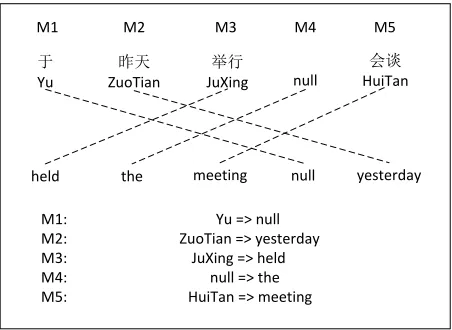
Figure 1: Word alignment and minimum translation units.
3.1 Definition of an MTU
Informally, the notion of a minimal translation unit is simple: it is a translation rule that cannot be broken down any further without violating the con-straints of the rules. We restrict ourselves to contigu-ousMTUs. They are similar to small phrase pairs, though unlike phrase pairs we allow MTUs to have either an empty source or empty target side, thereby allowing insertion and deletion phrases. Conven-tional phrase pairs may be viewed as compositions of these MTUs up to a given size limit.
Consider a word-aligned sentence pair consisting of a sequence of source words s = s1. . .sm, a
se-quence of target wordst=t1. . .tn, and a word
align-ment relation between the source and target words ∼ ⊆ {1..m} × {1..n}. A translation unit is a sequence of source wordssi..sjand a sequence of target words tk..tl (one of which may be empty) such that for all
aligned pairsi0 ∼ k0, we havei≤ i0 ≤ jif and only if k ≤ k0 ≤ l. This definition, nearly identical to that of a phrase pair (Koehn et al., 2003), relaxes the constraint that one aligned word must be present.
A set of translation units is a partition of the sen-tence pair if each source and target word is covered exactly once. Minimal translation unitsis the par-tition with the smallest average unit size, or, equiv-alently, the largest number of units. For example, Figure 1 shows a word-aligned sentence pair and its corresponding set of MTUs. We extract these min-imal translation units with an algorithm similar to that of phrase extraction.
min-imal rules for two reasons. First, the segmentation of the sentence pair is not unique under composed rules, which makes probability estimation compli-cated. Second, some phrase pairs are very large, which results in sparse data issues and compromises the model quality. Therefore, training an n-gram model over minimal translation units turns out to be a simple and clean choice: the resulting segmen-tation is unique, and the distribution is smooth. If we want to capture more context, we can simply in-crease the order of the Markov model.
Such Markov models address issues in large phrase-based translation approaches. Where stan-dard phrase-based models rely upon large unigrams to capture contextual information, n-grams of mini-mal translation units allow a robust contextual model that is less constrained by segmentation.
3.2 MTU enumeration orders
When defining a joint probability distribution over MTUs of an aligned sentence pair, it is necessary to define a decomposition, or generation order for the sentence pair. For a single sequence in lan-guage modeling or synchronized sequences in chan-nel modeling, the default enumeration order has been left-to-right.
Different decomposition orders have been used in part-of-speech tagging and named entity recog-nition (Tsuruoka and Tsujii, 2005). Intuitively, in-formation from the left or right could be more use-ful for particular disambiguation choices. Our re-search on different decomposition orders was moti-vated by this work. When applying such ideas to machine translation, there are additional challenges and opportunities. The task exhibits much more am-biguity – the number of possible MTUs is in the millions. An opportunity arises from the reordering phenomenon in machine translation: while in POS tagging the natural decomposition orders to study are only left-to-right and right-to-left, in machine translation we can further distinguish source and tar-get sentence orders.
We first define the source left-to-right and the tar-get left-to-right orders of the aligned sets of MTUs. The definition is straightforward when there are no inserted or deleted word. To place the nulls corre-sponding to such word we use the following defi-nition: the source position of the null for a target
inserted word is just after the position of the last source word aligned to the closest preceding non-null aligned target word. The target position for a null corresponding to a source deleted MTU is de-fined analogously. In Figure 1 we define the posi-tion of M4 to be right after M3 (because “the” is after “held” in left-to-right order on the target side). The complete MTU sequence in source left-to-right order is M1-M2-M3-M4-M5. The sequence in target left-to-right order is M3-M4-M5-M1-M2. This illustrates that decomposition structure may differ significantly depending on which language is used to define the enumeration order.
Once a sentence pair is represented as a sequence of MTUs, we can define the probability of the sentence pair using a conventional n-gram Markov model (MM) over MTUs. For example, the 3-gram MM probability of the sentence pair in Figure 1 under the source left-to-right order is as follows:
P(M1)·P(M2|M1)·P(M3|M1,M2)·P(M4|M2,M3)·
P(M5|M3,M4).
Different decomposition orders use different con-text for disambiguation and it is not clear apriori which would perform best. We compare all four decomposition orders (source order left-to-right and to-left, and target order left-to-right and right-to-left). Although the independence assumptions of left-to-right and right-to-left are the same, the result-ing models may be different due to smoothing.
In addition to studying these four basic decompo-sition orders, we report performance of two cyclic orders: cyclic in source or target sentence order. These models are inspired by the cyclic depen-dency network model proposed for POS tagging (Toutanova et al., 2003) and also used as a baseline in previous work on dynamic decomposition orders (Tsuruoka and Tsujii, 2005).1
The probability according to the cyclic orders is defined by conditioning each MTU on both its left and right neighbor MTUs. For example, the prob-ability of the sentence pair in Figure 1 under the source cyclic order, using a 3-gram model is defined as: P(M1|M2)· P(M2|M1,M3)· P(M3|M2,M4)·
P(M4|M3,M5)·P(M5|M4).
All n-gram Markov models over MTUs are
mated using Kneser-Ney smoothing. Each MTU is treated as an atomic unit in the vocabulary of the n-gram model. Counts of all n-grams are obtained from the parallel MT training data, using different MTU enumeration orders.
Note that if we use a target-order decomposition, the model provides a distribution over target sen-tences and the corresponding source sides of MTUs, albeit unordered. Likewise source order based mod-els provide distributions over source sentences and unordered target sides of MTUs. We attempted to introduce reordering models to predict an order over the resulting MTU sequences using approaches sim-ilar to reordering models for phrases. Although these models produced gains in some language pairs when used without translation MTU MMs, there were no additional gains over a model using mul-tiple translation MTU MMs.
4 Lexical selection
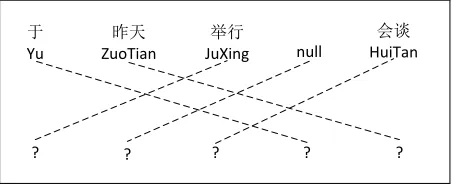
We perform an empirical evaluation of different MTU decomposition orders on a simplified machine translation task: lexical selection. In this task we assume that the source sentence segmentation into minimal translation units is given and that the or-der of the corresponding target sides of the minimal translation units is also given. The problem is to predict the target sides of the MTUs, called target MTUs for brevity (see Figure 2). The lexical selec-tion task is thus similar to sequence tagging tasks like part-of-speech tagging, though much more dif-ficult: the predicted variables are sequences of target language words with millions of possible outcomes.
于
Yu
昨天
ZuoTian
举行
JuXing
held the meeting
会谈
HuiTan
yesterday null
null
M1 M2 M3 M4 M5
M1: Yu => null M2: ZuoTian => yesterday
M3: JuXing => held M4: null => the M5: HuiTan => meeting
于
Yu
昨天
ZuoTian
举行
JuXing
? ? ?
会谈
HuiTan
? ?
[image:4.612.73.299.527.619.2]null
Figure 2: Lexical selection.
We use this constrained MT setting to evaluate the performance of models using different MTU decom-position orders and models using combinations of decomposition orders. The simplified setting allows
controlled experimentation while lessening the im-pact of complicating factors in a full machine trans-lation setting (search error, reordering limits, phrase table pruning, interaction with other models).
To perform the tagging task, we use trigram MTU models. The four basic decomposition orders for MTU Markov models we use are left-to-right in tar-get sentence order, right-to-left in tartar-get sentence or-der, left-to-right in source sentence oror-der, and right-to-left in source sentence order. We also consider cyclic orders in source and target.
Regardless of the decomposition order used, we perform decoding using a beam search decoder, sim-ilar to ones used in phrase-based machine transla-tion. The decoder builds target hypotheses in left-to-right target sentence order. At each step, it fills in the translation of the next source MTU, in the con-text of the already predicted MTUs to its left. The top scoring complete hypotheses covering the firstm
MTUs are maintained in a beam. When scoring with a target left-to-right MTU Markov model (L2RT), we can score each partial hypothesis exactly at each step. When scoring using aR2LTmodel or a source order model, we use lower-order approximations to the trigram MTU Markov model scores as future scores, since not all needed context is available for a hypothesis at the time of construction. As additional context becomes available, the exact score can be computed.2
4.1 Basic decomposition order combinations
We first introduce two methods of combining diff er-ent decomposition orders:productandsystem com-bination.
The product method arises naturally in the ma-chine translation setting, where probabilities from different models are multiplied together and further weighted to form the log-linear model for machine translation (Och and Ney, 2002). We define a similar scoring function using a set of MTU Markov models
M M1, ...,M Mkfor a hypothesishas follows:
Score(h)=λ1logPM M1(h)+...+λklogPM Mk(h)
The weightsλ of different models are trained on a development set using MER training to maximize the BLEU score of the resulting model. Note that this method of model combination was not consid-ered in any of the previous works comparing diff er-ent decompositions.
The system combination method is motivated by prior work in machine translation which com-bined left-to-right and right-to-left machine trans-lation systems (Finch and Sumita, 2009). Simi-larly, we perform sentence-level system combina-tion between systems using different MTU Markov models to come up with most likely translations. If we have k systems guessing hypotheses based on M M1, . . . ,M Mk respectively, we generate
1000-best lists from each system, resulting in a pool of up to 1000k possible distinct translations. Each of the candidate hypotheses from M Mi is scored with
its Markov model log-probability logPM Mi(h). We
compute normalized probabilities for each system’s
n-best by exponentiating and normalizing: Pi(h) ∝ PM Mi(h). If a hypothesish is not in system i’s n
-best list, we assume its probability is zero according to that system. The final scoring function for each hypothesis in the combined list of candidates is:
Score(h)=λ1P1(h)+...+λkPk(h)
The weightsλfor the combination are tuned using MERT as for the product model.
4.2 Dynamic decomposition orders
A more complex combination method chooses the best possible decomposition order for each transla-tion dynamically, using a set of constraints to de-fine the possible decomposition orders, and a set of features to score the candidate decompositions. We term this methoddynamic combination. The score of each translation is defined as its score according to the highest-scoring decomposition order for that translation.
This method is very similar to the bidirectional tagging approach of Tsuruoka and Tsujii (2005). For this approach we only explored combinations of target language orders (L2RT,CycT, andR2LT). If source language orders were included, the complex-ity of decoding would increase substantially.
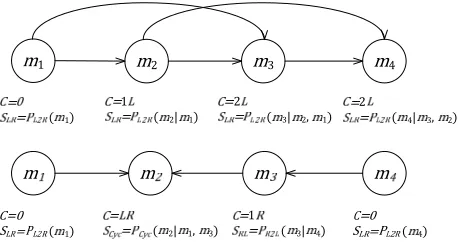
Figure 3 shows two possible decompositions for a short MTU sequence. The structures displayed are
1
1
2
1
2| 1
3
2
3| 2, 1
4
2
4| 3, 2
1 2| 1, 3
1
[image:5.612.316.545.71.193.2]3| 4 4
Figure 3: Different decompositions.
directed graphical models. They define the set of parents (context) used to predict each target MTU. The decomposition structures we consider are lim-ited to acyclic graphs where each node can have one of the following parent configurations: no parents (C = 0 in the Figure), one left parent (C = 1L), one right parent (C = 1R), one left and one right parent (C = LR), two left parents (C = 2L), and two right parents (C = 2R). If all nodes have two left parents, we recover the left-to-right decomposi-tion order, and if all nodes have two right parents, the right-to-left decomposition order. A mixture of parent configurations defines a mixed, dynamic de-composition order. The dede-composition order chosen varies from translation to translation.
A directed graphical model defines the probability of an assignment of MTUs to the variable nodes as a product of local probabilities of MTUs given their parents. Here we extend this definition to scores of assignments by using a linear model with con-figuration features and log-probability features. The configuration features are indicators of which par-ent configuration is active at a node and the settings of these features for the decompositions in Figure 3 are shown as assignments to theCvariables. The log-probability feature values are obtained by query-ing the appropriate n-gram model: L2RT,CycT, or
R2LT. For a node with one or two left parents, the log-probability is computed according to theL2RT
model. For a node with one or two right parents, the
R2LTmodel is queried. TheCycTmodel is used for nodes with one left and one right parent.
or-ders in addition to assignments to target MTUs. The final score of a translation and decomposition is a linear combination of the two types of feature values – model log-probabilities and configuration types. There is one feature weight for each parent con-figuration (six concon-figuration weights) and one fea-ture weight for each component model (three model weights). The final score of the second decomposi-tion and assignment in Figure 3 is:
Score(h)
=2∗wC0 +wCLR+wC1R
+wL2RlogPLR(m1)+wCyclogPCyc(m2|m1,m3)
+wR2LlogPRL(m3|m4)+wL2RlogPLR(m4)
There are two main differences between our ap-proach and that of Tsuruoka and Tsujii (2005): we perform beam search with hypothesis recombination instead of exact decoding (due to the larger size of the hypothesis set), and we use parameters to be able to globally weight the probabilities from dif-ferent models and to develop preferences for using certain types of decompositions. For example, the model can learn to prefer right-to-left decomposi-tions for one language pair, and left-to-right decom-positions for another. An additional difference from prior work is the definition of the possible decompo-sition orders that are searched over.
Compared to the structures allowed in (Tsuruoka and Tsujii, 2005) for a trigram baseline model, our allowed structures are a subset; in (Tsuruoka and Tsujii, 2005) there are sixteen possible parent con-figurations (up to two left and two right parents), whereas we allow only six. We train and use only three n-gram Markov models to assign probabilities:
L2RT,R2LT, andCycT, whereas the prior work used sixteen models. One could potentially see additional gains from considering a larger space of structures but the training time and runtime memory require-ments might become prohibitive for the machine translation task.
Because of the maximization over decomposition structures, the score of a translation is not a simple linear function of the features, but rather a maximum over linear functions. The score of a translation for a fixed decomposition is a linear function of the fea-tures, but the score of a translation is a maximum of linear functions (over decompositions). Therefore,
if we define hypotheses as just containing transla-tions, MERT training does not work directly for op-timizing the weights of the dynamic combination method. 3 We used a combination of approaches; we did MERT training followed by local simplex-method search starting from three starting points: the MERT solution, a weight vector that strongly prefers left-to-right decompositions, and a weight-vector that strongly prefers right-to-left decomposi-tions. In the Experiments section, we report results for the weights that achieved the best development set performance.
5 N-best reranking
To evaluate the impact of these models in a full MT system, we investigate n-best reranking. We use a phrase-based MT system to output 1000-best can-didate translations. For each cancan-didate translation, we have access to the phrase pairs it used as well as the alignments inside each phrase pair. Thus, each source sentence and its candidate translation form a word-aligned parallel sentence pair. We can extract MTU sequences from this sentence pair and com-pute its probability according to MTU Markov mod-els. These MTU MM log-probabilities are appended to the original MT features and used to rerank the 1000-best list. The weight vectors for systems using the original features along with one or more MTU Markov model log-probabilities are trained on the development set using MERT.
6 Experiments
We report experimental results on the lexical selec-tion task and the reranking task on three language pairs. The datasets used for the different languages are described in detail in Section 6.2.
6.1 Lexical selection experiments
The data used for the lexical selection experiments consists of the training portion of the datasets used for MT. These training sets are split into three sec-tions: lex-train, for training MTU Markov models
and extracting possible translations for each source
Model Chs-En Deu-En En-Bgr Dev Test Dev Test Dev Test Baseline 06.45 06.30 11.60 10.98 15.09 14.40 Oracle 69.79 70.78 72.28 75.39 85.15 84.32 L2RT 24.02 25.09 28.69 28.70 49.86 46.45 R2LT 23.79 24.91 30.14 30.14* 49.22 46.58 CycT 18.59 20.33 25.91 26.83 41.30 38.85 L2RS 25.81 27.89* 25.52 25.10 45.69 43.98
R2LS 26.48 27.96* 26.03 26.30 47.36 43.91
[image:7.612.314.548.60.151.2]CycS 21.62 23.38 22.68 23.58 39.11 36.44
Table 1: Lexical selection results for individual MTU Markov models.
MTU, lex-dev for tuning combination weights for
systems using several MTU MMs, andlex-test, for
final evaluation results. The possible translations for each source MTU are defined as the most frequent 100 translations seen inlex-train. Thelex-devsets
contain 200 sentence pairs each and thelex-testsets
contains 1000 sentence pairs each. These develop-ment and test sets consist of equally spaced sen-tences taken from the full MT training sets.
We start by reporting BLEU scores of the six in-dividual MTU MMs on the three language pairs in Table 1. The baseline predicts the most frequent tar-get MTU for each source MTU (unigram MM not using context). The oracle looks at the correct trans-lation and always chooses the correct target MTU if it is in the vocabulary of available MTUs.
We can see that there is a large difference between the baseline and oracle performance, underscoring the importance of modeling context for accurate pre-diction. The best decomposition order varies from language to language: right-to-left in source order is best for Chinese-English, right-to-left in target order is best for German-English and left-to-right or right-to-left in target order are best in English-Bulgarian. We computed statistical significance tests, testing the difference between the L2RT model (the stan-dard in prior work) and models achieving higher test set performance. The models that are significantly better at significance α < 0.01 are marked with a star in the table. We used a paired bootstrap test with 10,000 trials (Koehn, 2004).
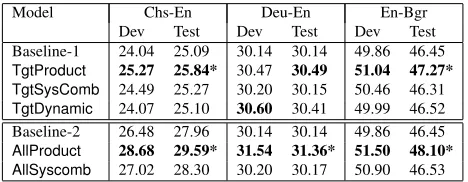
Next we evaluate the methods for combining de-composition orders introduced in Sections 4.1 and 4.2. The results are reported in Table 2. The up-per part of the table focuses on combining different
Model Chs-En Deu-En En-Bgr
Dev Test Dev Test Dev Test Baseline-1 24.04 25.09 30.14 30.14 49.86 46.45
TgtProduct 25.27 25.84* 30.47 30.49 51.04 47.27*
TgtSysComb 24.49 25.27 30.20 30.15 50.46 46.31
TgtDynamic 24.07 25.10 30.60 30.41 49.99 46.52 Baseline-2 26.48 27.96 30.14 30.14 49.86 46.45
AllProduct 28.68 29.59* 31.54 31.36* 51.50 48.10*
AllSyscomb 27.02 28.30 30.20 30.17 50.90 46.53
Table 2: Lexical selection results for combinations of MTU Markov models.
target-order decompositions. The lower part of the table looks at combining all six decomposition or-ders. The baseline for the target order combinations, Baseline-1, is the best single target MTU Markov model from Table 1. Baseline-2 in the lower part of the table is the best individual model out of all six. We can see that the product modelsTgtProduct
(a product of the three target-order MTU MMs) and
AllProduct(a product of all six MTU MMs) are con-sistently best. The dynamic decomposition models
TgtDynamicachieve slight but not significant gains over the baseline. The combination models that are statistically significantly better than corresponding baselines (α <0.01) are marked with a star.
Our takeaway from these experiments is that mul-tiple decomposition orders are good, and thus taking a product (which encourages agreement among the models) is a good choice for this task. The dynamic decomposition method shows some promise, but it does not outperform the simpler product approach. Perhaps a lager space of decompositions would achieve better results, especially given a larger pa-rameter set to trade off decompositions and better tuning for those parameters.
6.2 Datasets and reranking settings
For Chinese-English, the training corpus consists of 1 million sentence pairs from the FBIS and HongKong portions of the LDC data for the NIST MT evaluation. We used the union of the NIST 2002 and 2003 test sets as the development set and the NIST 2005 test set as our test set. The baseline phrasal system uses a 5-gram language model with modified Kneser-Ney smoothing (Kenser and Ney, 1995), trained on the Xinhua portion of the English Gigaword corpus (238M English words).
[image:7.612.75.299.61.175.2]Language Training Dev Test Chs-En 1 Mln NIST02+03 NIST05 Deu-En 751 K WMT06dev WMT06test
[image:8.612.331.524.59.161.2]En-Bgr 4 Mln 1,497 2,498
Table 3: Data sets for different language pairs.
the WMT 2006 shared task on machine translation (Koehn and Monz, 2006). The parallel training set contains approximately 751K sentences. We also used the English monolingual data of around 1 mil-lion sentences for language model training. The de-velopment set contains 2000 sentences. The final test set (the in-domain test set for the shared task) also contains 2000 sentences. Two Kneser-Ney lan-guage models were used as separate features: a 4-gram LM trained on the parallel portion of the data, and a 5-gram LM trained on the monolingual corpus.
For English-Bulgarian we used a dataset con-taining sentences from several data sources: JRC-Acquis (Steinberger et al., 2006), TAUS4, and web-scraped data. The development set consists of 1,497 sentences, the English side from WMT 2009 news test data, and the Bulgarian side a human translation thereof. The test set comes from the same mixture of sources as the training set. For this system we used a single four-gram target language model trained on the target side of the parallel corpus.
All systems used phrase tables with a maximum length of seven words on either side and lexicalized reordering models. For the Chinese-English sys-tem we used GIZA++alignments, and for the other two we used alignments by an HMM model aug-mented with word-based distortion (He, 2007). The alignments were symmetrized and then combined with the heuristics ”grow-diag-final-and”.5 We tune parameters using MERT (Och, 2003) with random restarts (Moore and Quirk, 2008) on the develop-ment set. Case-insensitive BLEU-4 is our evaluation metric (Papineni et al., 2002).
3-gram models 5-gram models
Model Dev Test Dev Test
[image:8.612.88.286.60.107.2]Baseline 32.58 31.78 32.58 31.78 L2RT 33.05 32.78* 33.16 32.88* R2LT 33.05 32.96* 33.16 32.81* L2RS 32.90 33.00* 32.98 32.98* R2LS 32.94 32.98* 33.09 32.96* 4 MMs 33.22 33.07* 33.37 33.00* 4 MMs phrs 32.58 31.78 32.58 31.78
Table 4: Reranking with 3-gram and 5-gram MTU trans-lation models on Chinese-English. Starred results on the test set indicate significantly better performance than the baseline.
6.3 MT reranking experiments
We first report detailed experiments on Chinese-English, and then verify our main conclusions on the other language pairs. Table 4 looks at the impact of individual 3-gram and 5-gram MTU Markov models and their combination. Amongst the decomposition orders tested (L2RT,R2LT,L2RS, andR2LS), each of the individual MTU MMs was able to achieve significant improvement over the baseline, around 1 BLEU point.6 The results achieved by the individ-ual models differ, and the combination of four direc-tions is better than the best individual direction, but the difference is not statistically significant.
We ran an additional experiment to test whether MTU MMs make effective use of context across phrase boundaries, or whether they simply pro-vide better smoothed estimates of phrasal transla-tion probabilities. The last row of the table reports the results achieved by a combination of MTU MMs that do not use context across the phrasal bound-aries. Since an MTU MM limited to look only inside phrases can provide improved smoothing compared to whole phrase relative frequency counts, it is con-ceivable it could provide a large improvement. How-ever, there is no improvement in practice for this lan-guage pair; the additional improvements from MTU MMs stem from modeling cross-phrase context.
4www.tausdata.org
5The combination heuristic was further refined to disallow crossing one-to-many alignments, which would result in the ex-traction of larger minimum translation units. We found that this further refinement on the combination heuristic consistently im-proved the BLEU scores by between 0.3 and 0.7.
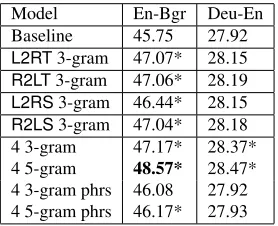
Table 5 shows the test set results of individ-ual 3-gram MTU Markov models and the com-bination of 3-gram and 5-gram models on the English-Bulgarian and German-English datasets. For English-Bulgarian all individual 3-gram Markov models achieve significant improvements of close to one point; their combination is better than the best individual model (but not significantly). The indi-vidual 5-gram models and their combination bring much larger improvement, for a total increase of 2.82 points over the baseline. We believe the 5-gram models were more effective in this setting be-cause the larger training set allowed for successful training of models of larger capacity. Also the in-creased context size helps to resolve ambiguity in the forms of morphologically-rich Bulgarian words. For German-English we see a similar pattern, with the combination of models outperforming the in-dividual ones, and the 5-gram models being better than the 3-gram. Here the individual 3-gram models are better than the baseline at significance level 0.02 and their combination is better than the baseline at our earlier defined threshold of 0.01. The within-phrase MTU MMs (results shown in the last two rows) improve upon the baseline slightly, but here again the improvements mostly stem from the use of context across phrase boundaries. Our final results on German-English are better than the best result of 27.30 from the shared task (Koehn and Monz, 2006).
Thanks to the reviewers for referring us to re-cent work by (Clark et al., 2011) that pointed out problems with significance tests for machine trans-lation, where the randomness and local optima in the MERT weight tuning method lead to a large vari-ance in development and test set performvari-ance across different runs of optimization (using a different ran-dom seed or starting point). (Clark et al., 2011) pro-posed a stratified approximate randomization statis-tical significance test, which controls for optimizer instability. Using this test, for the English-Bulgarian system, we confirmed that the combination of four 3-gram MMs and the combination of 5-gram MMs is better than the baseline (p=.0001 for both, using
five runs of parameter tuning). We have not run the test for the other language pairs.
Model En-Bgr Deu-En
Baseline 45.75 27.92 L2RT3-gram 47.07* 28.15 R2LT3-gram 47.06* 28.19 L2RS3-gram 46.44* 28.15 R2LS3-gram 47.04* 28.18 4 3-gram 47.17* 28.37* 4 5-gram 48.57* 28.47* 4 3-gram phrs 46.08 27.92 4 5-gram phrs 46.17* 27.93
Table 5: English-Bulgarian and German-English test set results: reranking with MTU translation models.
7 Conclusions
We introduced models of Minimal Translation Units for phrasal systems, and showed that they make a substantial and statistically significant improvement on three distinct language-pairs. Additionally we studied the importance of decomposition order when defining the probability of MTU sequences. In a simplified lexical selection task, we saw that there were large differences in performance among the different decompositions, with the best decomposi-tions differing by language. We investigated multi-ple methods to combine decompositions and found that a simple product approach was most effective. Results in the lexical selection task were consistent with those obtained in a full MT system, although the differences among decompositions were smaller. In future work, perhaps we would see larger gains by including additional decomposition orders (e.g., top-down in a dependency tree), and taking this idea deeper into the machine translation model, down to the word-alignment and language-modeling levels.
We were surprised to find n-best reranking so ef-fective. We are incorporating the models into first pass decoding, in hopes of even greater gains.
References
Jonathan H. Clark, Chris Dyer, Alon Lavie, and Noah A. Smith. 2011. Better hypothesis testing for statistical machine translation: Controlling for optimizer insta-bility. InProc. ACL-11.
JM Crego and F Yvon. 2010. Factored bilingual n-gram language models for statistical machine transla-tion. Machine Translation, Special Issue: Pushing the
Nadir Durrani, Helmut Schmid, and Alexander Fraser. 2011. A joint sequence translation model with inte-grated reordering. InProceedings of the 49th Annual Meeting of the Association for Computational
Linguis-tics: Human Language Technologies, pages 1045–
1054, Portland, Oregon, USA, June. Association for Computational Linguistics.
Andrew Finch and Eiichiro Sumita. 2009. Bidirectional phrase-based machine translation. InIn proceedings
of EMNLP.
Xiaodong He. 2007. Using word-dependent transition models in hmm based word alignment for statistical machine translation. InWMT workshop.
Reinhard Kenser and Hermann Ney. 1995. Improved backing-offfor m-gram language modeling. InProc.
ICASSP 1995, pages 181–184.
Philipp Koehn and Christof Monz. 2006. Manual and au-tomatic evaluation of machine translation between eu-ropean languages. InProceedings on the Workshop on
Statistical Machine Translation, pages 102–121, June.
Philipp Koehn, Franz Josef Och, and Daniel Marcu. 2003. Statistical phrase-based translation. In Proc.
HLT-NAACL 2003, pages 127–133.
Philipp Koehn. 2004. Statistical significance tests for machine translation evaluation. InIn Proceedings of
EMNLP.
JB Marino, RE Banchs, JM Crego, A de Gispert, P Lam-bert, JA Fonollosa, and MR Costa-Jussa. 2006. N-gram-based machine translation. Computational
Lin-guistics, 32(4):527–549.
Robert C. Moore and Chris Quirk. 2008. Random restarts in minimum error training for statistical ma-chine translation. InProc. Coling-08.
Franz Josef Och and Hermann Ney. 2002. Discrimina-tive training and maximum entropy models for statis-tical machine translation. InIn Proceedings of ACL, pages 295–302.
Franz Joseph Och. 2003. Minimum error training in sta-tistical machine translation. InProc. ACL-03.
Kishore Papineni, Salim Roukos, Todd Ward, and Wei-Jing Zhu. 2002. Bleu: a method for automatic
eval-uation of machine translation. In Proc. 40th Annual
Meeting of the ACL, pages 311–318.
Chris Quirk and Arul Menezes. 2006. Do we need phrases? challenging the conventional wisdom in sta-tistical machine translation. InProceedings of the Hu-man Language Technology Conference of the NAACL,
Main Conference, pages 9–16, New York City, USA,
June. Association for Computational Linguistics. Ralf Steinberger, Bruno Pouliquen, Anna Widiger,
Camelia Ignat, Toma Erjavec, Dan Tufis, and Dniel Varga. 2006. The JRC-Acquis: A multilingual aligned parallel corpus with 20+languages. InLREC, Genoa, Italy.
Kristina Toutanova, Dan Klein, Christopher D. Manning, and Yoram Singer. 2003. Feature-rich part-of-speech tagging with a cyclic dependency network. InIn
Pro-ceedings of HLT-NAACL.
Yoshimasa Tsuruoka and Jun’ichi Tsujii. 2005. Bidi-rectional inference with the easiest-first strategy for tagging sequence data. In In proceedings of
HLT/EMNLP.
Ashish Vaswani, Haitao Mi, Liang Huang, and David Chiang. 2011. Rule markov models for fast tree-to-string translation. InProceedings of the 49th Annual Meeting of the Association for Computational
Linguis-tics: Human Language Technologies, pages 856–864,