Answer Extraction as Sequence Tagging with Tree Edit Distance
Xuchen Yao and Benjamin Van Durme Johns Hopkins University
Baltimore, MD, USA
Chris Callison-Burch∗ University of Pennsylvania
Philadelphia, PA, USA
Peter Clark Vulcan Inc. Seattle, WA, USA
Abstract
Our goal is to extract answers from pre-retrieved sentences for Question Answering (QA). We construct a linear-chain Conditional Random Field based on pairs of questions and their possible answer sentences, learning the association between questions and answer types. This casts answer extraction as an an-swer sequence tagging problem for the first time, where knowledge of shared structure be-tween question and source sentence is incor-porated through features based on Tree Edit Distance (TED). Our model is free of man-ually created question and answer templates, fast to run (processing 200 QA pairs per sec-ond excluding parsing time), and yields an F1 of 63.3% on a new public dataset based on prior TREC QA evaluations. The developed system is open-source, and includes an imple-mentation of the TED model that is state of the art in the task of ranking QA pairs.
1 Introduction
The success of IBM’s Watson system for Question Answering (QA) (Ferrucci et al., 2010) has illus-trated a continued public interest in this topic. Wat-son is a sophisticated piece of software engineering consisting of many components tied together in a large parallel architecture. It took many researchers working full time for years to construct. Such sources are not available to individual academic re-searchers. If they are interested in evaluating new ideas on some aspect of QA, they must either con-struct a full system, or create a focused subtask
∗
Performed while faculty at Johns Hopkins University.
paired with a representative dataset. We follow the latter approach and focus on the task of answer ex-traction, i.e., producing the exact answer strings for a question.
We propose the use of a linear-chain Conditional Random Field (CRF) (Lafferty et al., 2001) in or-der to cast the problem as one ofsequence tagging by labeling each token in a candidate sentence as ei-ther Beginning, Inside or Outside (BIO) of an an-swer. This is to our knowledge the first time a CRF has been used to extract answers.1 We uti-lize not only traditional contextual features based on POS tagging, dependency parsing and Named Entity Recognition (NER), but most importantly, features extracted from a Tree Edit Distance (TED) model for aligning an answer sentence tree with the ques-tion tree. The linear-chain CRF, when trained to learn the associations between question and answer types, is a robust approach against error propaga-tion introduced in the NLP pipeline. For instance, given an NER tool that always (i.e., in both train-ing and test data) recognizes the pesticide DDT as an ORG, our model realizes, when a question is asked about the type of chemicals, the correct an-swer might be incorrectly but consistently recog-nized asORG by NER. This helps reduce errors in-troduced by wrong answer types, which were esti-mated as the most significant contributer (36.4%) of errors in the then state-of-the-art QA system of Moldovan et al. (2003).
The features based on TED allow us to draw the
1CRFs have been used in judging answer-bearing sentences (Shima et al., 2008; Ding et al., 2008; Wang and Manning, 2010), but not extracting exact answers from these sentences.
connection between the question and answer sen-tencesbefore answer extraction, whereas tradition-ally the exercise of answer validation(Magnini et al., 2002; Penas et al., 2008; Rodrigo et al., 2009) has been performedafteras a remedy to ensure the answer is really “about” the question.
Motivated by a desire for a fast runtime,2 we base our TED implementation on the dynamic-programming approach of Zhang and Shasha (1989), which helps our final system process 200 QA pairs per second on standard desktop hardware, when input is syntactically pre-parsed.
In the following we first provide background on the TED model, going on to evaluate our implemen-tation against prior work in the context of question answer sentence ranking (QASR), achieving state of the art in that task. We then describe how we cou-ple TED features to a linear-chain CRF for answer extraction, providing the set of features used, and fi-nally experimental results on an extraction dataset we make public (together with the software) to the community.3 Related prior work is interspersed throughout the paper.
2 Tree Edit Distance Model
Tree Edit Distance (§2.1) models have been shown effective in a variety of applications, including tex-tual entailment, paraphrase identification, answer ranking and information retrieval (Reis et al., 2004; Kouylekov and Magnini, 2005; Heilman and Smith, 2010; Augsten et al., 2010). We chose the variant proposed by Heilman and Smith (2010), inspired by its simplicity, generality, and effectiveness. Our ap-proach differs from those authors in their reliance on a greedy search routine to make use of a complex tree kernel. With speed a consideration, we opted for the dynamic-programming solution of Zhang and Shasha (1989) (§2.1). We added new lexical-semantic features§(2.2) to the model and then eval-uated our implementation on the QASR task, show-ing strong results§(2.3).
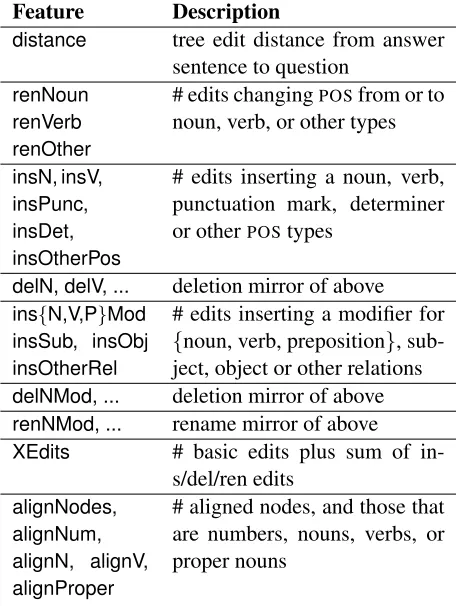
Feature Description
distance tree edit distance from answer
sentence to question
renNoun renVerb renOther
# edits changingPOSfrom or to noun, verb, or other types
insN, insV, insPunc, insDet, insOtherPos
# edits inserting a noun, verb, punctuation mark, determiner or otherPOStypes
delN, delV, ... deletion mirror of above
ins{N,V,P}Mod insSub, insObj insOtherRel
# edits inserting a modifier for
{noun, verb, preposition}, sub-ject, object or other relations
delNMod, ... deletion mirror of above
renNMod, ... rename mirror of above
XEdits # basic edits plus sum of
in-s/del/ren edits
alignNodes, alignNum, alignN, alignV, alignProper
[image:2.612.313.541.58.361.2]# aligned nodes, and those that are numbers, nouns, verbs, or proper nouns
Table 1:Features for ranking QA pairs.
2.1 Cost Design and Edit Search
Following Bille (2005), we define anedit script be-tween treesT1,T2as the edit sequence transforming
T1 toT2 according to acost function, with the total
summed cost known as thetree edit distance. Basic editoperations include:insert,deleteandrename.
WithTa dependency tree, we represent each node by three fields: lemma, POSand the type of
depen-dency relation to the node’s parent (DEP). For in-stance, Mary/nnp/sub is the proper noun Mary in subject position.
Basic edits are refined into 9 types, where the first six (INS LEAF,INS SUBTREE,INS,DEL LEAF, DEL SUBTREE, DEL) insert or delete a leaf node, a whole subtree, or a node that is neither a leaf nor part of a whole inserted subtree. The last three (REN POS, REN DEP, REN POS DEP) serve to re-name aPOStag, dependency relation, or both.
2
For instance, Watson was designed under the constraint of a 3 second response time, arising from its intended live use in the television gameshow,Jeopardy!.
prd
player nn
jennifer nn capriati
nnp
23 cd be
vbz subj
nmod nmod
tennis nn nmod
Tennis player Jennifer Capriati is 23
TreeEdit Distance
capriati nnp
jennifer nnp what
wp
sport nn
play vbz do
vbz
vmod vmod
nmod
What sport does Jennifer Capriati play
insSubTree:
ins(play/vbz/vmod) ins(do/vbz/root)
[image:3.612.174.442.65.238.2]WordNet
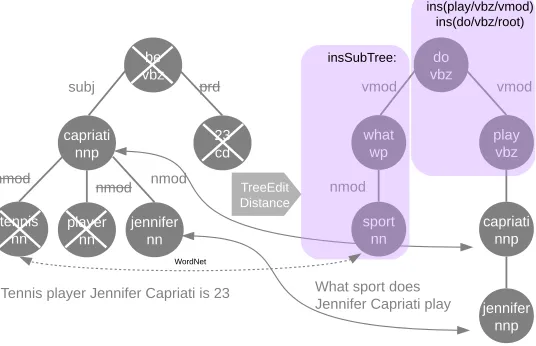
Figure 1: Edits transforming a source sentence (left) to a question (right). Each node consists of: lemma, POS tag and dependency relation, with root nodes and punctuation not shown. Shown includes deletion (×and strikethrough on the left), alignment (arrows) and insertion (shaded area). Order of operations is not displayed. The standard TED model does not capture the alignment betweentennisandsport(see Section 2.2).
We begin by uniformly assigning basic edits a cost of 1.0,4which brings the cost of a full node in-sertion or deletion to 3 (all the three fields inserted or deleted). We allow renaming ofPOSand/or relation
type iff the lemmas of source and target nodes are identical.5 When two nodes are identical and thus do not appear in the edit script, or when two nodes are renamed due to the same lemma, we say they are alignedby the tree edit model (see Figure 1).
We used Zhang and Shasha (1989)’s dynamic programming algorithm to produce an optimal edit script with the lowest tree edit distance. The ap-proach explores both trees in a bottom-up, post-order manner, running in time:
O(|T1| |T2|min(D1, L1) min(D2, L2))
where|Ti|is the number of nodes,Di is the depth, andLi is the number of leaves, with respect to tree Ti.
Additionally, we fix the cost of stopword renam-ing to 2.5, even in the case of identity, regardless of whether two stopwords have the same POS tags
or relations. Stopwords tend to have fixedPOStags and dependency relations, which often leads to less expensive alignments as compared to renaming
con-4
This applies separately to each element of the tripartite structure; e.g., deleting aPOSentry, inserting a lemma, etc.
5
This is aimed at minimizing node variations introduced by morphology differences, tagging or parsing errors.
tent terms. In practice this gave stopwords “too much say” in guiding the overall edit sequence.
The resultant system is fast in practice, processing 10,000 pre-parsed tree pairs per second on a contem-porary machine.6
2.2 TED for Sentence Ranking
The task of Question Answer Sentence Ranking (QASR) takes a question and a set of source sen-tences, returning a list sorted by the probability likelihood that each sentence contains an appropri-ate answer. Prior work in this includes that of: Punyakanok et al. (2004), based on mapping syn-tactic dependency trees; Wang et al. (2007) utiliz-ing Quasi-Synchronous Grammar (Smith and Eis-ner, 2006); Heilman and Smith (2010) using TED; and Shima et al. (2008), Ding et al. (2008) and Wang and Manning (2010), who each employed a CRF in various ways. Wang et al. (2007) made their dataset public, which we use here for system validation. To date, models based on TED have shown the best per-formance for this task.
Our implementation follows Heilman and Smith (2010), with the addition of 15 new features beyond their original 33 (see Table 1). Based on results
set source #ques. #pairs %pos. len.
TRAIN-ALL TREC8-12 1229 53417 12.0 any TRAIN TREC8-12 94 4718 7.4 ≤40
DEV TREC13 82 1148 19.3 ≤40
[image:4.612.326.528.67.154.2]TEST TREC13 89 1517 18.7 ≤40
Table 2: Distribution of data, with imbalance towards negative examples (sentences without an answer).
in DEV, we extract edits in the direction from the
source sentence to the question.
In addition to syntactic features, we incorporated the following lexical-semantic relations from Word-Net: hypernymandsynonym(nouns and verbs); en-tailmentandcausing(verbs); andmembersOf, sub-stancesOf, partsOf, haveMember, haveSubstance, havePart (nouns). Such relations have been used in prior approaches to this task (Wang et al., 2007; Wang and Manning, 2010), but not in conjunction with the model of Heilman and Smith (2010).
These were made into features in two ways:
WNsearchloosens renaming and alignment within the TED model from requiring strict lemma equal-ity to allowing lemmas that shared any of the above relations, leading to renaming operations such asREN ...(country,china) andREN ...(sport, tennis);WNfeaturecounts how many words be-tween the sentence and answer sentence have each of the above relations, separately as 10 independent features, plus an aggregate count for a total of 11 new features beyond the earlier 48.
These features were then used to train a logistic regression model using Weka (Hall et al., 2009).
2.3 QA Sentence Ranking Experiment
We trained and tested on the dataset from Wang et al. (2007), which spans QA pairs from TREC QA 8-13 (see Table 2). Per question, sentences with non-stopword overlap were first retrieved from the task collection, which were then compared against the TREC answer pattern (in the form of Perl regu-lar expressions). If a sentence matched, then it was deemed a (noisy) positive example. Finally,TRAIN,
DEV andTEST were manually corrected for errors. Those authors decided to limit candidate source
sen-System MAP MRR
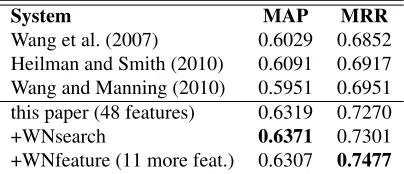
Wang et al. (2007) 0.6029 0.6852 Heilman and Smith (2010) 0.6091 0.6917 Wang and Manning (2010) 0.5951 0.6951 this paper (48 features) 0.6319 0.7270 +WNsearch 0.6371 0.7301 +WNfeature (11 more feat.) 0.6307 0.7477
Table 3:Results on the QA Sentence Ranking task.
tences to be no longer than 40 words.7 Keeping with prior work, those questions with only positive or negative examples were removed, leaving 94 of the original 100 questions for evaluation.
The data was processed by Wang et al. (2007) with the following tool chain: POS tags via MX-POST (Ratnaparkhi, 1996); parse trees via MST-Parser (McDonald et al., 2005) with 12 coarse-grained dependency relation labels; and named enti-ties via Identifinder (Bikel et al., 1999). Mean Av-erage Precision (MAP) and Mean Reciprocal Rank (MRR) are reported in Table 3. Our implementa-tion gives state of the art performance, and is fur-thered improved by our inclusion of semantic fea-tures drawn from WordNet.8
3 CRF with TED for Answer Extraction
In this section we move from ranking source sen-tences, to the next QA stage: answer extraction. Given our competitive TED-based alignment model, the most obvious solution to extraction would be to report those spans aligned from a source sentence to a question’s wh-terms. However, we show that this approach is better formulated as a (strongly in-dicative) feature of a larger set of answer extraction signals.
3.1 Sequence Model
Figure 2 illustrates the task of tagging each token in a candidate sentence with one of the following
la-7
TRAIN-ALLis not used in QASR, but later for answer ex-traction;TRAINcomes from the first 100 questions of TRAIN-ALL.
8
Tennis player Jennifer Capriati is 23
[image:5.612.74.302.57.133.2]B-ANS O O O O O
Figure 2: An example of linear-chain CRF for an-swer sequence tagging.
bels:B-ANSWER(beginning of answer),I-ANSWER
(inside of answer),O(outside of answer).
Besides local POS/NER/DEP features, at each to-ken we need to inspect the entire input to connect the answer sentence with the question sentence through tree edits, drawing features from the question and the edit script, motivating the use of a linear-chain CRF model (Lafferty et al., 2001) over HMMs. To the best of our knowledge this is the first time a CRF has been used to label answer fragments, de-spite success in other sequence tagging tasks.
3.2 Feature Design
In this subsection we describe the local and global features used by the CRF.
Chunking We use thePOS/NER/DEPtags directly just as one would in a chunking task. Specifically, supposetrepresents the current token position and pos[t]its POS tag, we extract unigram, bigram and trigram features over the local context, e.g.,pos[t−
2], pos[t−2] :pos[t−1],andpos[t−2] :pos[t−
1] :pos[t]. Similar features are extracted for named entity types (ner[t]), and dependency relation labels (dep[t]).
Our intuition is these chunking features should al-low for learning which types of words tend to be answers. For instance, we expect adverbs to be as-signed lower feature weights as they are rarely a part of answer, while prepositions may have differ-ent feature weights depending on their context. For instance,of inkind of silly has an adjective on the right, and is unlikely to be theBeginning of an an-swer to a TREC-style question, as compared toin when paired with a question on time, such as seen in an answerin 90 days, where the preposition is fol-lowed by a number then a noun.
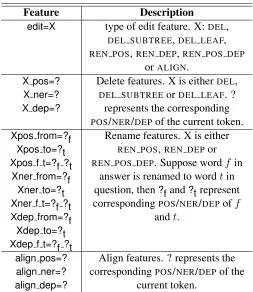
Feature Description
edit=X type of edit feature. X:DEL,
DEL SUBTREE,DEL LEAF, REN POS,REN DEP,REN POS DEP
orALIGN.
X pos=? X ner=? X dep=?
Delete features. X is eitherDEL,
DEL SUBTREEorDEL LEAF. ? represents the corresponding
POS/NER/DEPof the current token.
Xpos from=?f Xpos to=?t Xpos f t=?f ?t
Xner from=?f Xner to=?t Xner f t=?f ?t Xdep from=?f Xdep to=?t Xdep f t=?f ?t
Rename features. X is either
REN POS,REN DEPor
REN POS DEP. Suppose wordf in
answer is renamed to wordtin question, then?f and?t represent correspondingPOS/NER/DEPoff
andt.
align pos=? align ner=? align dep=?
Align features. ? represents the correspondingPOS/NER/DEPof the
current token.
Table 4: Features based on edit script for answer se-quence tagging.
Question-type Chunking features do not capture the connection between question word and
an-swer types. Thus they have to be combined
with question types. For instance, how many
questions are usually associated with numeric
an-swer types. We encode each major
question-type: who, whom, when, where, how many, how
much, how long, and then for each token, we combine the question term with its chunking tures described in (most tokens have different fea-tures because they have different POS/NER/DEP
types). One feature example of the QA pair
how much/100 dollars for the word 100would be:
qword=how much|pos[t]=CD|pos[t+1]=NNS. We ex-pect high weight for this feature since it is a good pattern for matching question type and answer type. Similar features also apply towhat, which, whyand
howquestions, even though they do not indicate an answer type as clearly ashow muchdoes.
Some extra features are designed forwhat/which
[image:5.612.312.565.65.357.2]dependency tree is analyzed and the Lexical Answer Type (LAT) is extracted. The following are some examples of LAT forwhatquestions:
• color: what is Crips’ gang color?
• animal: what kind of animal is an agouti?
The extraLAT=?feature is also used with chunking features forwhat/whichquestions.
There is significant prior work in building spe-cialized templates or classifiers for labeling question types (Hermjakob, 2001; Li and Roth, 2002; Zhang and Lee, 2003; Hacioglu and Ward, 2003; Metzler and Croft, 2005; Blunsom et al., 2006; Moschitti et al., 2007). We designed our shallow question type features based on the intuitions of these prior work, with the goal of having a relatively compact approach that still extracts useful predictive signal. One possible drawback, however, is that if an LAT is not observed during training but shows up in testing, the sequence tagger would not know which answer type to associate with the question. In this case it falls back to the more generalqword=? feature and will most likely pick the type of answers that are mostly associated withwhatquestions in training.
Edit script Our TED module produces an edit trace for each word in a candidate sentence: the word is either deleted, renamed (if there is a word of the same lemma in the question tree) or strictly aligned (if there is an identical node in the question tree). A word in the deleted edit sequence is a cue that it could be the answer. A word being aligned suggests it is less likely to be an answer. Thus for each word we extract features based on its edit type, shown in Table 4.
These features are also appended with the token’s
POS/NER/DEP information. For instance, a deleted noun usually carries higher edit feature weights than an aligned adjective.
Alignment distance We observed that a candidate answer often appears close to an aligned word (i.e., answer tokens tend to be located “nearby” portions of text that align across the pair), especially in com-pound noun constructions, restrictive clauses, prepo-sition phrases, etc. For instance, in the following pair, the answerLimp Bizkitcomes from the leading compound noun:
• What is the name of Durst ’s group?
• Limp Bizkit lead singer Fred Durst did a lot ...
Past work has designed large numbers of specific templates aimed at these constructions (Soubbotin, 2001; Ravichandran et al., 2003; Clark et al., 2003; Sneiders, 2002). Here we use a single general fea-ture that we expect to pick up much of this signal, without the significant feature engineering.
Thus we incorporated a simple feature toroughly model this phenomenon. It is defined as the distance to the nearest aligned nonstop word in the original word order. In the above example, the only aligned nonstop word isDurst. Then this nearest alignment distance feature for the wordLimpis:
nearest dist to align(Limp):5
This is the only integer-valued feature. All other features are binary-valued. Note this feature does not specify answer types: an adverb close to an aligned word can also be wrongly taken as a strong candidate. Thus we also include a version of the
POS/NER/DEPbased feature for each token:
• nearest dist pos(Limp)=NNP
• nearest dist dep(Limp)=NMOD
• nearest dist ner(Limp)=B-PERSON
3.3 Overproduce-and-vote
We make an assumption that each sentence produces a candidate answer and then vote among all answer candidates to select the most-voted as the answer to the original question. Specifically, this overproduce-and-vote strategy applies voting in two places:
1. If there are overlaps between two answer candi-dates, a partial vote is performed. For instance, for awhenquestion, if one answer candidate is
April , 1994and the other is1994, then besides the base vote of 1, both candidates have an ex-tra partial vote of#overlap/#total words= 1/4. We call thisadjusted vote.
2. If the CRF fails to find an answer, we still try to “force” an answer out of the tagged sequence,
O’s). thusforced vote. Due to its lower
D u r i n g what war d i d N i m i t z s er ve ?
O O: 0 . 9 2 1 0 6 0 Conant
O O: 0 . 9 9 1 1 6 8 had
O O: 0 . 9 9 7 3 0 7 been
O O: 0 . 9 9 8 5 7 0 a
O O: 0 . 9 9 8 6 0 8 p h o t o g r a p h e r
O O: 0 . 9 9 9 0 0 5 f o r
O O: 0 . 8 7 7 6 1 9 Adm
O O: 0 . 9 8 8 2 9 3 .
O O: 0 . 8 7 4 1 0 1 Chester
O O: 0 . 9 2 4 5 6 8 N i m i t z
O O: 0 . 9 7 0 0 4 5 d u r i n g
B−ANS O: 0 . 4 6 4 7 9 9 World
I−ANS O: 0 . 4 9 3 7 1 5 War I−ANS O: 0 . 4 4 9 0 1 7 I I
O O: 0 . 9 1 5 4 4 8 .
Figure 3: A sample sequence tagging output that fails to predict an answer. From line 2 on, the first column is the reference output and the second col-umn is the model output with the marginal probabil-ity for predicated labels. Note thatWorld War IIhas much lower probabilities as anOthan others.
The modified score for an answer candidate is thus: total vote = adjusted vote+ 0.1×forced vote. To compute forced vote, we make the following obser-vation. Sometimes the sequence tagger does not tag an answer in a candidate sentence at all, if there is not enough probability mass accumulated for B
-ANS. However, a possible answer can still be caught if it has an “outlier” marginal probability. Figure 3 shows an example. The answer candidateWorld War IIhas a much lower marginal probability as an “O” but still not low enough to be part ofB-ANS/I-ANS.
To catch such an outlier, we use Median Absolute Deviation (MAD), which is the median of the abso-lute deviation from the median of a data sequence. Given a data sequencex, MAD is defined as:
MAD(x) =median(|x−median(x)|)
Compared to mean value and standard deviation, MAD is more robust against the influence of out-liers since it does not directly depend on them. We select those words whose marginal probability is 50 times of MAD away from the median of the whole sequence as answer candidates. They contribute to the forced vote. Downweight ratio (0.1) and MAD
System Train Prec.% Rec.% F1%
CRF TRAIN 55.7 43.8 49.1
TRAIN-ALL 67.2 50.6 57.7 CRF
+WNsearch
TRAIN 58.6 46.1 51.6
TRAIN-ALL 66.7 49.4 56.8
CRF forced TRAIN 54.5 53.9 54.2
TRAIN-ALL 60.9 59.6 60.2 CRF forced
+WNsearch
TRAIN 55.2 53.9 54.5
[image:7.612.71.289.60.251.2]TRAIN-ALL 63.6 62.9 63.3
Table 5: Performance onTEST. “CRF” only takes votes from candidates tagged by the sequence tag-ger. “CRF forced” (described in§3.3) further col-lects answer candidates from sentences that CRF does not tag an answer by detecting outliers.
ratio (50) were hand-tuned onDEV.9
4 Experiments
4.1 QA Results
The dataset listed in Table 2 was not designed to include an answer for each positive answer tence, but only a binary indicator on whether a sen-tence contains an answer. We used the answer pat-tern files (in Perl regular expressions) released along with TREC8-13 to pinpoint the exact answer frag-ments. Then we manually checkedTRAIN,DEV, and TESTfor errors.TRAIN-ALLalready came as a noisy dataset so we did not manually clean it, also due to its large size.
We trained on only the positive examples of
TRAIN and TRAIN-ALL separately with CRFsuite
(Okazaki, 2007). The reason for training solely with positive examples is that they only constitute 10% of all training data and if trained on all, the CRF tagger was very biased on negative examples and reluctant to give an answer for most of the questions. The CRF tagger attempted an answer for about2/3of all
questions when training on just positive examples.
DEVwas used to help design features. A practi-cal benefit of our compact approach is that an entire round of feature extraction, training onTRAIN and testing on DEVtook less than one minute. Table 5
9
reports F1 scores on both the positive and negative examples ofTEST.
Our baseline model, which aligns the question word with some content word in the answer sen-tence,10achieves31.4%in F1. This model does not require any training. “CRF” only takes votes from those sentences with an identified answer. It has the best precision among all models. “CRF forced” also detects outliers from sentences not tagged with an answer. Large amount of training data, even noisy, is helpful. In generalTRAIN-ALLis able to boost the F1 value by7 ∼ 8%. Also, the overgenerate-and-vote strategy, used by the “forced” approach, greatly increased recall and achieved the best F1 value.
We also experimented with the two methods uti-lizing WordNet in Section 2.2 , i.e., WNsearch and
WNfeature. In general, WNsearch helps F1 and
yields the best score (63.3%) for this task. For WNfeature11we observed that the CRF model con-verged to a larger objective likelihood with these features. However, it did not make a difference in F1 after overgenerate-and-vote.
Finally, we found it difficult to do a head-to-head comparison with other QA systems on this task.12 Thus we contribute this dataset to the community, hoping to solicit direct comparisons in the future. Also, we believe our chunking and question-type features capture many intuitions most current QA systems rely on, while our novel features are based on TED. We further conduct an ablation test to com-pare traditional and new QA features.
4.2 Ablation Test
We did an ablation test for each of the four types of features. Note that the question type features are used in combination with chunking features (e.g.,
qword=how much|pos[t]=CD|pos[t+1]=NN), while the chunking feature is defined over POS/NER/DEP
10This only requires minimal modification to the original TED algorithm: the question word is aligned with a certain word in the answer tree instead of being inserted. Then the whole subtree headed by the aligned word counts as the answer. 11These are binary features indicating whether an answer candidate has a WordNet relation ( c.f. §2.2) with the LAT. For instance,tennisis a hyponym of the LAT wordsportin the what sportquestion in Figure 1.
12Reasons include: most available QA systems either retrieve sentences from the web, have different preprocessing steps, or even include templates learned from our test set.
CRF Forced CRF Forced
[image:8.612.318.539.55.117.2]All 49.1 54.2 -above 3 19.4 25.3 -POS 44.7 48.9 -EDIT 44.3 47.5 -NER 44.0 50.8 -ALIGN 47.4 51.1 -DEP 49.4 54.5 -above 2 40.5 42.0
Table 6: F1 based on feature ablation tests.
NONE CHUNKING CHUNKING+TED Features Used
0 10 20 30 40 50 60
F1(%)
31.4
40.5
49.1 42.0
54.2 F1 with Different Features Baseline
CRF CRF forced
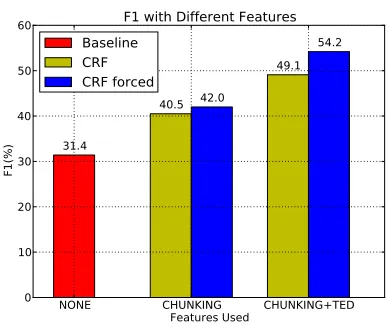
Figure 4: Impact of adding features based on chunk-ing and question-type (CHUNKING) and tree edits (TED), e.g.,EDITandALIGN.
separately. We tested theCRF model with deletion of one of the following features each time:
• POS, NERorDEP. These features are all com-bined with question types.
• The three of the above. Deletion of these fea-tures also deletes question type feature implic-itly.
• EDIT. Features extracted from edit script.
• ALIGN. Alignment distance features.
• The two of the above, based on the TED model.
Table 6 shows the F1 scores of ablation test when trained onTRAIN. NERandEDITare the two single most significant features. NERis important because
[image:8.612.325.520.147.310.2]thus taking out a single one does not decrease per-formance much. However, since TED related fea-tures do not combine question type feafea-tures, taking out all threePOS/NER/DEPfeatures decreases F1 by 30%. Without TED related features (bothEDIT and
ALIGN) F1 also drops more than 10%.
Figure 4 is a bar chart showing how much im-provement each feature brings. While having a baseline model with 31.4% in F1, traditional fea-tures based on POS/DEP/NER and question types
brings a 10% increase with a simple sequence tag-ging model (second bar labeled “CHUNKING” in the figure). Furthermore, adding TED based features to the model boosted F1 by another 10%.
5 Conclusion
Answer extraction is an essential task for any text-based question-answering system to perform. In this paper, we have cast answer extraction as a sequence tagging problem by deploying a fast and compact CRF model with simple features that capture many of the intuitions in prior “deep pipeline” approaches. We introduced novel features based on TED that boosted F1 score by 10% compared with the use of more standard features. Besides answer extraction, our modified design of the TED model is the state of the art in the task of ranking QA pairs. Finally, to improve the community’s ability to evaluate QA components without requiring increasingly imprac-tical end-to-end implementations, we have proposed answer extraction as a subtask worth evaluating in its own right, and contributed a dataset that could become a potential standard for this purpose. We believe all these developments will contribute to the continuing improvement of QA systems in the fu-ture.
Acknowledgement We thank Vulcan Inc. for funding this work. We also thank Michael Heil-man and Mengqiu Wang for helpful discussion and dataset, and the three anonymous reviewers for in-sightful comments.
References
Nikolaus Augsten, Denilson Barbosa, Michael B¨ohlen, and Themis Palpanas. 2010. TASM: Top-k Approx-imate Subtree Matching. InProceedings of the
Inter-national Conference on Data Engineering (ICDE-10), pages 353–364, Long Beach, California, USA, March. IEEE Computer Society.
D.M. Bikel, R. Schwartz, and R.M. Weischedel. 1999. An algorithm that learns what’s in a name. Machine learning, 34(1):211–231.
P. Bille. 2005. A survey on tree edit distance and related problems. Theoretical Computer Science, 337(1):217–239.
P. Blunsom, K. Kocik, and J.R. Curran. 2006. Question classification with log-linear models. InProceedings of the 29th annual international ACM SIGIR confer-ence on Research and development in information re-trieval, pages 615–616. ACM.
Peter Clark, Vinay Chaudhri, Sunil Mishra, J´erˆome Thom´er´e, Ken Barker, and Bruce Porter. 2003. En-abling domain experts to convey questions to a ma-chine: a modified, template-based approach. In
Proceedings of the 2nd international conference on Knowledge Capture, pages 13–19, New York, NY, USA. ACM.
Shilin Ding, Gao Cong, Chin yew Lin, and Xiaoyan Zhu. 2008. Using conditional random fields to extract con-texts and answers of questions from online forums. In
In Proceedings of ACL-08: HLT.
D. Ferrucci, E. Brown, J. Chu-Carroll, J. Fan, D. Gondek, A.A. Kalyanpur, A. Lally, J.W. Murdock, E. Nyberg, J. Prager, et al. 2010. Building Watson: An overview of the DeepQA project. AI Magazine, 31(3):59–79.
K. Hacioglu and W. Ward. 2003. Question classifica-tion with support vector machines and error correcting codes. InProceedings of NAACL 2003, short papers, pages 28–30.
M. Hall, E. Frank, G. Holmes, B. Pfahringer, P. Reute-mann, and I.H. Witten. 2009. The WEKA data min-ing software: an update. ACM SIGKDD Explorations Newsletter, 11(1):10–18.
Michael Heilman and Noah A. Smith. 2010. Tree edit models for recognizing textual entailments, para-phrases, and answers to questions. InProceedings of NAACL 2010, pages 1011–1019, Los Angeles, Cali-fornia.
U. Hermjakob. 2001. Parsing and question classification for question answering. InProceedings of the work-shop on Open-domain question answering-Volume 12, pages 1–6.
Milen Kouylekov and Bernardo Magnini. 2005. Recog-nizing textual entailment with tree edit distance algo-rithms. InPASCAL Challenges on RTE, pages 17–20. John D. Lafferty, Andrew McCallum, and Fernando C. N.
InProceedings of the Eighteenth International Confer-ence on Machine Learning, pages 282–289, San Fran-cisco, CA, USA. Morgan Kaufmann Publishers Inc. X. Li and D. Roth. 2002. Learning question classifiers.
InProceedings of ACL 2002, pages 1–7.
B. Magnini, M. Negri, R. Prevete, and H. Tanev. 2002. Is it the right answer?: exploiting web redundancy for answer validation. InProceedings of ACL 2002, pages 425–432.
R. McDonald, K. Crammer, and F. Pereira. 2005. On-line large-margin training of dependency parsers. In
Proceedings of ACL 2005, pages 91–98.
D. Metzler and W.B. Croft. 2005. Analysis of statistical question classification for fact-based questions. Infor-mation Retrieval, 8(3):481–504.
D. Moldovan, M. Pas¸ca, S. Harabagiu, and M. Surdeanu. 2003. Performance issues and error analysis in an open-domain question answering system. ACM Trans-actions on Information Systems (TOIS), 21(2):133– 154.
A. Moschitti, S. Quarteroni, R. Basili, and S. Manandhar. 2007. Exploiting syntactic and shallow semantic ker-nels for question answer classification. InProceedings of ACL 2007, volume 45, page 776.
Naoaki Okazaki. 2007. CRFsuite: a fast implementation of Conditional Random Fields (CRFs).
A. Penas, A. Rodrigo, V. Sama, and F. Verdejo. 2008. Testing the reasoning for question answering valida-tion. Journal of Logic and Computation, 18(3):459– 474.
Vasin Punyakanok, Dan Roth, and Wen T. Yih. 2004. Mapping Dependencies Trees: An Application to Question Answering. In Proceedings of the 8th In-ternational Symposium on Artificial Intelligence and Mathematics, Fort Lauderdale, Florida.
A. Ratnaparkhi. 1996. A maximum entropy model for part-of-speech tagging. In Proceedings of EMNLP 1996, volume 1, pages 133–142.
Deepak Ravichandran, Abraham Ittycheriah, and Salim Roukos. 2003. Automatic derivation of surface text patterns for a maximum entropy based question an-swering system. InProceedings of NAACL 2003, short papers, pages 85–87, Stroudsburg, PA, USA.
D. C. Reis, P. B. Golgher, A. S. Silva, and A. F. Laen-der. 2004. Automatic web news extraction using tree edit distance. InProceedings of the 13th international conference on World Wide Web, pages 502–511, New York, NY, USA. ACM.
´
A. Rodrigo, A. Pe˜nas, and F. Verdejo. 2009. Overview of the answer validation exercise 2008. Evaluating Sys-tems for Multilingual and Multimodal Information Ac-cess, pages 296–313.
H. Shima, N. Lao, E. Nyberg, and T. Mitamura. 2008. Complex cross-lingual question answering as sequen-tial classification and multi-document summarization task. InProceedings of NTICIR-7 Workshop, Japan. David A. Smith and Jason Eisner. 2006.
Quasi-synchronous grammars: Alignment by soft projection of syntactic dependencies. InProceedings of the HLT-NAACL Workshop on Statistical Machine Translation, pages 23–30, New York, June.
Mark D. Smucker, James Allan, and Ben Carterette. 2007. A comparison of statistical significance tests for information retrieval evaluation. In CIKM ’07: Proceedings of the sixteenth ACM conference on Con-ference on information and knowledge management, pages 623–632, New York, NY, USA. ACM.
E. Sneiders. 2002. Automated question answering: template-based approach. Ph.D. thesis, KTH. Martin M. Soubbotin. 2001. Patterns of potential answer
expressions as clues to the right answers. In Proceed-ings of the Tenth Text REtrieval Conference (TREC 2001).
Mengqiu Wang and Christopher D. Manning. 2010. Probabilistic tree-edit models with structured latent variables for textual entailment and question answer-ing. InProceedings of ACL 2010, pages 1164–1172, Stroudsburg, PA, USA.
Mengqiu Wang, Noah A. Smith, and Teruko Mita-mura. 2007. What is the Jeopardy model? a quasi-synchronous grammar for QA. InProceedings of the 2007 Joint Conference on Empirical Methods in Natu-ral Language Processing and Computational NatuNatu-ral Language Learning (EMNLP-CoNLL), pages 22–32, Prague, Czech Republic, June.
D. Zhang and W.S. Lee. 2003. Question classifica-tion using support vector machines. InProceedings of the 26th annual international ACM SIGIR conference on Research and development in informaion retrieval, pages 26–32. ACM.