Sentiment Lexicon Construction with Representation Learning Based on
Hierarchical Sentiment Supervision
Leyi Wang and Rui Xia∗
School of Computer Science & Engineering Nanjing University of Science & Technology, China
[email protected], [email protected]
Abstract
Sentiment lexicon is an important tool for identifying the sentiment polarity of word-s and textword-s. How to automatically con-struct sentiment lexicons has become a research topic in the field of sentimen-t analysis and opinion mining. Recensentimen-tly there were some attempts to employ repre-sentation learning algorithms to construct a sentiment lexicon with sentiment-aware word embedding. However, these method-s were normally trained under document-level sentiment supervision. In this paper, we develop a neural architecture to train a sentiment-aware word embedding by inte-grating the sentiment supervision at both document and word levels, to enhance the quality of word embedding as well as the sentiment lexicon. Experiments on the SemEval 2013-2016 datasets indicate that the sentiment lexicon generated by our ap-proach achieves the state-of-the-art per-formance in both supervised and unsuper-vised sentiment classification, in compari-son with several strong sentiment lexicon construction methods.
1 Introduction
Sentiment lexicon is a set of words (or phrases) each of which is assigned with a sentiment polar-ity score. Sentiment lexicon plays an important role in many practical sentiment analysis and opin-ion mining tasks. There were some manually an-notated universal sentiment lexicons such as Gen-eral Inquireer (GI) and HowNet. However, due to the ubiquitous domain diversity and absence of domain prior knowledge, the automatic construc-tion technique for domain-specific sentiment
lex-∗The corresponding author of this paper.
icons has become a challenging research topic in the field of sentiment analysis and opinion mining (Wang and Xia,2016).
The early work employed unsupervised learn-ing for sentiment lexicon construction. They nor-mally labelled a set of seed words at first, and then learned the polarity of each candidate word, based on either word conjunction relations (e.g., constel-lation and transition in texts) (Hatzivassiloglou and McKeown,1997), or the word co-occurrence information (such as pointwise mutual informa-tion, PMI) (Turney,2002), between the candidate word and the seed words. However, the unsuper-vised manner showed limited effect in sentiment prediction, and the performance greatly depends on the quality of the seed words.
To fully exploit the sentiment labeling informa-tion in texts, a series of supervised learning meth-ods was further proposed to learn the sentiment lexicons. For example, Mohammad et al.(2013) proposed to construct sentiment lexicons by cal-culating PMI between the word and the distant-ly supervised sentiment labels (such as emoticon-s) in tweets and the word’s sentiment orientation (SO). The resulting lexicons obtained the best re-sults in SemEval 2013. More advanced repre-sentation learning models were also utilized, with the aim to construct the sentiment lexicons with efficient word embeddings (Tang et al., 2014a; Hamilton et al.,2016;Vo and Zhang,2016). The traditional representation learning framework such as Word2Vec only captures the syntactic informa-tion in the texts, but ignores the sentiment rela-tions between words. Therefore, some researcher-s attempted to add researcher-sentiment researcher-superviresearcher-sion into the network structure, in order to train a sentiment-aware word embedding. For example, Tang et al. (2014a) exploited a dedicated neural architecture to integrate document-level sentiment supervision and the syntactic knowledge for representation
learning. The sentiment-aware word embedding is then used to construct a sentiment lexicon. Vo and Zhang(2016) proposed to learn a two-dimensional sentiment representation based on a simple neu-ral network. The sentiment lexicons generated by their approach obtained better performance to pre-dict the tweet sentiment labels, in comparison with the PMI-based method (Mohammad et al.,2013). Although these supervised learning method-s can to method-some extent exploit the method-sentiment la-beling information in the texts and can learn a sentiment-aware word embedding, the manner of using document-level sentiment supervision suf-fers from some complex linguistic phenomena such as negation, transition and comparative de-gree, and hence unable to capture the fine-grained sentiment information in the text. For example, in the following tweet
“Four more fake people added me. Is this why people don’t like Twitter? :( ”,
the document-level sentiment label is negative, but there is a positive word “like” in the text. In representation learning, the embeddings of word-s are word-summed up to repreword-sent the document, and the word“like”will be falsely associated with the negative sentiment label. Such linguistic phenom-ena occur frequently in review texts, and makes sentiment-aware word representation learning less effective.
To address this problem, in this paper, we pro-pose a new representation learning framework called HSSWE, to learn sentiment-aware word embeddings based on hierarchical sentiment su-pervision. In HSSWE, the learning algorithm is supervised under both document-level sentiment labels and word-level sentiment annotations (e.g., labeling “like”as a positive word). By leverag-ing the sentiment supervision at both document and word level, our approach can avoid the sen-timent learning flaws caused by coarse-grained document-level supervision by incorporating fine-grained word-level supervision, and improve the quality of sentiment-aware word embedding. Fi-nally, following Tang et al. (2014a), a simple classifier was constructed to obtain the domain-specific sentiment lexicon by using word embed-dings as inputs.
The main contributions of this work are as fol-lows:
1. To the best of our knowledge, this is the first
work that learns the sentiment-aware word representation under supervision at both doc-ument and word levels.
2. Our approach supports several kinds of word-level sentiment annotations such as 1) pre-defined sentiment lexicon; 2) PMI-SO lexi-con with hard sentiment annotation; 3) PMI-SO lexicon with soft sentiment annotation. By using PMI-SO dictionary as word-level sentiment annotation, our approach is totally corpus-based, without any external resource.
3. Our approach obtains the state-of-the-art per-formance in comparison with several strong sentiment lexicon construction methods, on the benchmark SemEval 2013-2016 datasets for twitter sentiment classification.
2 Related Work
In general, sentiment lexicons construction can be classified into two categories, dictionary-based methods and corpus-based methods.
Dictionary-based methods generally integrate predefined resources, such as WordNet, to con-struct sentiment lexicons. Hu and Liu(2004) ex-ploited WordNet for sentiment lexicon construc-tion. They first labelled two sets of seed word-s by polaritieword-s, then extended the word-setword-s by adding the synonyms for each word to the same set and antonyms to the other. For a given new word, Kim and Hovy (2004) introduced a Naive Bayes model to predict the polarities with .the synonym set obtained from WordNet as features. Kamps et al.(2004) investigated a graph-theoretic model of WordNet’s synonymy relation and measured the sentiment orientation by distance between each candidate word and the seed words with differ-ent polarities. Heerschop et al.(2011) proposed a method to propagate the sentiment of seed set words through semantic relations of WordNet.
Corpus-based approaches originate from the la-tent relation hypothesis: “Pairs of words that co-occur in similar patterns tend to have similar se-mantic and sentiment relations” (Turney,2008).
PMI were proposed afterwards, for example, pos-itive pointwise mutual information (PPMI), sec-ond order co-occurrence PMI (SOC-PMI), etc. Hamilton et al.(2016) proposed to build a senti-ment lexicon by a propagation method. The key of this method is to build a lexical graph by lating the PPMI between words. Instead of calcu-lating the PMI between words, Mohammad et al. (2013) proposed to use emoticons as distant super-vision and calculate the PMI between words and the distant class labels, and obtained sound perfor-mance for tweet sentiment classification.
The latest corpus-based approaches normally utilize the up-to-date machine learning models (e.g. neural networks) to first learn a sentiment-aware distributed representation of words, based on which the sentiment lexicon is then construct-ed. There were many word representation learn-ing methods such as NNLM (Bengio et al.,2003) and Word2Vec (Mikolov et al., 2013). Howev-er, they mainly consider the syntactic relation of words in the context but ignore the sentiment in-formation. Some work were later proposed to deal with this problem by incorporating the sentimen-t informasentimen-tion during represensentimen-tasentimen-tion learning. For example, Tang et al.(2014a) adapted a variant of skip-gram model, which can learn the sentiment information based on distant supervision. Further-more, Tang et al.(2014b) proposed a new neural network approach called SSWE to train sentiment-aware word representation. Vo and Zhang(2016) exploited a simple and fast neural network to train a 2-dimensional representation. Each dimension is explicitly associated with a sentiment polarity.
The sentiment-aware word representation in these methods was normally trained based on on-ly document-level sentiment supervision. In con-trast, the learning algorithm in our approach is supervised under both document-level and word-level sentiment supervision.
3 Our Approach
Our approach is comprised of three base mod-ules: (1) Word-level sentiment learning and an-notation; (2) Sentiment-aware word embedding learning; (3) Sentiment lexicon construction.
Our approach depends on document-level sen-timent labels. The tweet corpus provides a cheap way to get document-level sentiment annotation, owing to the distant sentiment supervision. But it should be noted that our approach is feasible
for any corpus provided with document-level sen-timent labels (not merely tweets).
The first module of our method aims to learn the pseudo sentiment distribution for each word and use it as word-level sentiment annotations to supervise word embedding learning.
In the second module, we learn the sentiment-aware embeddings for each word in corpus, based on hierarchical sentiment supervision.
In the last module, we construct a sentiment lex-icon by using the sentiment-aware word embed-dings as the basis.
3.1 Learning Word-Level Sentiment Supervision
In addition to use a pre-defined sentiment lexi-con for word-level annotations, we also propose to learn the word-level sentiment supervision, based on PMI and SO.
(1) PMI and SO
Given a corpus with document-level class label-s. We first compute the PMI score between each wordtand two class labels
P MI(t,+) = logpp(+(+)|t), (1)
P MI(t,−) = logp(−|t)
p(−) , (2) where +and− denote the positive and negative document-level class labels, respectively.
Second, we compute the SO score for each wordt:
SO(t) =P MI(t,+)−P MI(t,−). (3)
We call {t, SO(t)} as PMI-SO dictionary. The PMI-SO dictionary was widely used as a corpus-based sentiment lexicon for sentiment classifica-tion. By contrast, in our approach, it is the first step to learn the sentiment-aware word represen-tation. Our approach supports two kinds of word-level sentiment annotations: 1) PMI-SO dictionary with hard sentiment annotation; 2) PMI-SO dictio-nary with soft sentiment annotation.
The word-level sentiment annotation is repre-sented as[ˆp(−|t),pˆ(+|t)]. We employ the follow-ing two ways to obtain[ˆp(−|t),pˆ(+|t)].
Notations Description
et The embedding of wordt de The document representation ofd bt The bias of word-level softmax layer bd The bias of document-level softmax layer θt Weight of word-level softmax layer θd Weight of document-level softmax layer p(c|et) The sentiment distribution of wordt
predict-ed by our model
p(c|de) The sentiment distribution of document d predicted by our model
ˆ
p(c|t) The word-level sentiment annotation of wordtwith respect to classc
ˆ
[image:4.595.72.293.60.214.2]p(c|d) The document-level sentiment annotation of documentdwith respect to classc
Table 1: The parameters used in our neural net-work.
“Hard sentiment annotation” indicates that [ˆp(−|t),pˆ(+|t)] is a two-dimensional one-hot representation, where the annotation of words is given by the class labels:
[ˆp(−|t),pˆ(+|t)]
=
[0,1], ifSO(t)>0 [1,0], ifSO(t)<0
random{[1,0]or[0,1]}, otherwise
.
(4)
(3) PMI-SO lexicon with soft sentiment annota-tion
“Soft sentiment annotation” means that the anno-tation is given by the probability of two sentiment polarities, rather than the class label. We first use the sigmoid function to map the SO score to the range of a probability, and then define
[ˆp(−|t),pˆ(+|t)] = [1−σ(SO(t)), σ(SO(t))] (5)
as the PMI-SO soft sentiment distribution of the wordt.
3.2 Learning Sentiment-aware Word Representation under Hierarchical Sentiment Supervision
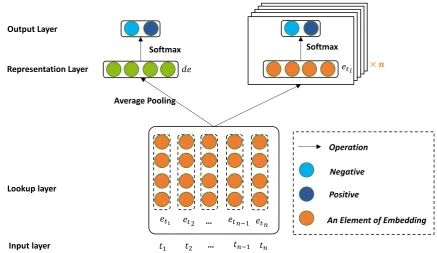
Till now we have obtained both document and word-level sentiment annotations, in the next step, we propose a neural network framework to learn the sentiment-aware word representation by inte-grating the sentiment supervision at both word and document granularities. We call it “hierarchical sentiment supervision”. The architecture of our
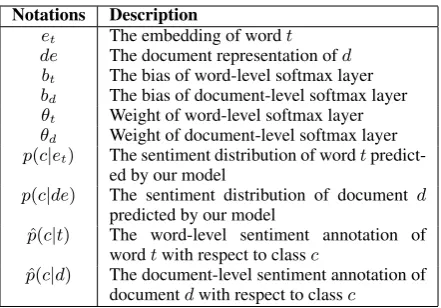
model is shown in Figure 1. We denote the corpus asD={d1, d2, ..., dN}whereN is the size of the corpus. Supposedkisk-th document inD, andti represents thei-th word in a documentd. The pa-rameters used in our neural network are described in Table 1.
We construct a embedding matrixC ∈RV×M, of which each row represents the embedding of a word in the vocabulary, whereV is the size of the vocabulary andM is the dimension of word em-bedding. We randomly initialize each element of matrixCwith a normal distribution.
(1) Word-Level Sentiment Supervision
We use the word-level sentiment annotation [ˆp(−|t),pˆ(+|t)]provided in Section 3.1 to super-vise word representation learning at the word lev-el.
For each word in document d, we map it to a continuous representation ase∈Cand feedeinto our model to predict the sentiment distribution of the input word:
p(c|e) =softmax(θt·e+bt). (6)
The cost function is defined as the average cross entropy that measures the difference between the sentiment distribution predicted in our model and the sentiment annotations at the word level:
fword= −T1 N X
k=1 X
t∈dk X
c∈{+,−} ˆ
p(c|t) logp(c|et)
(7) whereT is the number of words in corpus.
(2) Document-Level Sentiment Supervision
We use the document-level sentiment annotation-s to annotation-superviannotation-se word repreannotation-sentation learning at the document level.
In order to obtain a continuous representation of a documentd, we simply use the average embed-ding of words indasde:
de= |1d|X t∈d
et. (8)
We feeddeinto our model to predict the sentiment probability:
Average Pooling
Lookup layer Representation Layer
… Output Layer
Positive Negative
An Element of Embedding
Softmax
… Input layer
Operation
Document-Level Sentiment Supervision Word-Level Sentiment Supervision
[image:5.595.77.515.87.340.2]Softmax
Figure 1: The Architecture of our Neural Network. Given a documentd, represented as[t1, t2, . . . , tn].
ti is the i-th word in d. And eti represents the embedding of the word ti. We take de, the average embedding of[et1, et2, . . . , etn], as the representation of documentd. We get each embedding of words
indas input to predict its sentiment polarities. We also take de as input to predict the sentiment for documentdone time per epoch.
Similarly, the cost function is defined as aver-age cross entropy that measures the difference be-tween the sentiment distribution predicted in our model and the sentiment annotation at the docu-ment level:
fdoc = −N1 N X
k=1 X
c∈{+,−} ˆ
p(c|dk) logp(c|dek)
(10) wherepˆ(c|dk)is the sentiment annotation of doc-umentdk. pˆ(c|dk) = 1denotes the class label of
dkis positive, otherwisepˆ(c|dk) = 0.
(3) Word and Document-Level Joint Learning
In order to learn the sentiment-aware word repre-sentation at both word and document levels, we in-tegrate the cost function of two levels in a weight-ed combination way. The final cost function is de-fined as follows:
f =αfword+ (1−α)fdoc (11)
whereαis a tradeoff parameter(0≤α ≤1). The
weight of fword can be increased by choosing a lager value ofα.
We train our neural model with stochastic gradi-ent descgradi-ent and use AdaGrad (Duchi et al.,2011) to update the parameters.
3.3 From Sentiment Representation to Sentiment Lexicon
In this part, we follow the method proposed by Tang et al.(2014a) to build a classifier to convert the sentiment-aware word representation learned in Section 3.2 to a sentiment lexicon. The word representation is the input of the classifier and word sentiment polarity is the output.
Firstly, we utilize the embedding of 125 positive and 109 negative seed words manually labelled by Tang et al.(2014a) as training data1.
Secondly, a variant-KNN classifier is also ap-plied to extending the seed words on a web dictio-nary called Urban Dictiodictio-nary. Unlike (Tang et al.,
Dataset #pos #neg T otal SemEval2013-train 3632 1449 5081
[image:6.595.89.277.61.134.2]SemEval2013-dev 482 282 764 SemEval2013-test 1474 559 2033 SemEval2014-test 982 202 1184 SemEval2015-test 1038 365 1403 SemEval2016-test 7059 3231 10290 Table 2: Statistics of Evaluation Datasets
2014a), we did not extend the neutral words. Thirdly, a traditional logistic regression classi-fier is trained by using the embeddings of extend-ed sentiment words as the inputs. The sentiment score of a word is the difference between its posi-tive and negaposi-tive probabilities.
Finally, the sentiment lexicon can be collected by using the classifier to predict the other words’ sentiment score.
4 Experiment Study
4.1 Datasets and Settings
We utilize the public distant-supervision corpus2 (Go et al.,2009) to learn our lexicons. We setM, the dimension of embedding, as 50. The learning rate is 0.3 for stochastic gradient descent optimiz-er. We tune the hyper-parameterαin the training process.
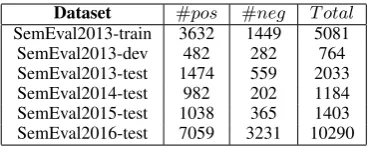
We evaluate the sentiment lexicons in both su-pervised and unsusu-pervised sentiment classification tasks, on the SemEval 2013-2016 datasets. The s-tatistics of evaluation datasets are shown in Table 2.
Supervised Sentiment Classification Evalua-tion: To evaluate the effect of the sentiment lexi-con in supervised sentiment classification, we re-port the supervised sentiment classification perfor-mance by using some pre-defined lexicon features. We follow (Mohammad et al.,2013) to extract the lexicon features as follows:
• Total count of words in the tweet score of which is greater than 0;
• Total count of words in the tweet score of which is less than 0;
• The sum of scores for all word great than 0;
2http://help.sentiment140.com/for-students
• The sum of scores for all word less than 0;
• The max score greater than 0;
• The min score less than 0;
• Non-zero score of the last positive word in the tweet;
• Non-zero score of the last negative word in the tweet.
We report the performance of SVM by using these lexicon features. The LIBSVM 3 toolkit is used with a linear kernel and the penalty parameter is set as the default value. The metric isF1score.
Unsupervised Sentiment Classification Eval-uation:For unsupervised sentiment classification, we sum up the scores of all sentiment words in the document, according to the sentiment lexicon. If the sum is greater than 0, the document will be considered as positive, otherwise negative. The unsupervised learning evaluation metric is accu-racy.
4.2 (External) Comparison with Public Lexicons
We compare our HSSWE method with four senti-ment lexicons generated by the related work pro-posed in recent years:
• Sentiment140was constructed by Moham-mad et al. (2013) on tweet corpus based on PMI between each word and the emoticons.
• HITwas constructed by Tang et al.(2014a) with a representation learning approach.
• NNwas constructed by Vo and Zhang(2016) with a neural network method.
• ETSLrefers to SemEval-2015 English Twit-ter Sentiment Lexicon4 (Rosenthal et al., 2015;Kiritchenko et al.,2014), which is done using Best-Worst Scaling.
Note that Tang et al. (2014a), Vo and Zhang (2016) used incomplete dataset of SemEval2013 in their papers. For fair comparison, we conduct
3http://www.csie.ntu.edu.tw/ cjlin/libsvm
4http://www.saifmohammad.com/WebDocs/lexiconstoreleas
Lexicon Semeval2013 Semeval2014 Semeval2015 Semeval2016 Average
Sentiment140 0.7317 0.7271 0.6917 0.6809 0.7079
HIT 0.7181 0.6947 0.6797 0.6928 0.6963
NN 0.7225 0.7115 0.6970 0.6887 0.7049
ETSL 0.7104 0.7090 0.6650 0.6862 0.6926
HSSWE 0.7550 0.7424 0.6921 0.7097 0.7248
Table 3: Supervised Evaluation for External Comparison (F1Score)
Lexicon Semeval2013 Semeval2014 Semeval2015 Semeval2016 Average
Sentiment140 0.7208 0.7416 0.6935 0.6928 0.7122
HIT 0.7566 0.7922 0.7128 0.7282 0.7474
NN 0.6903 0.7280 0.6507 0.6585 0.6819
ETSL 0.7675 0.8226 0.7505 0.7365 0.7693
[image:7.595.122.475.61.125.2]HSSWE 0.7734 0.8539 0.7669 0.7206 0.7787
Table 4: Unsupervised Evaluation for External Comparison (Accuracy)
all the comparison experiments on the complete benchmark datasets.
Supervised Sentiment Classification: We first report the supervised sentiment classification F1 score of five compared methods on the Semeval 2013-2016 datasets in Table 3. It can be seen that our HSSWE method gets the best result on all four datasets. It outperforms Sentiment140, HIT, NN and ETSL 1.7, 2.8, 1.9, and 3.2 percentages on the average of four datasets. The improvements are significant according to the pairedt-test.
Unsupervised Sentiment Classification: We then report the unsupervised sentiment classifi-cation accuracy of five methods on the Semeval 2013-2016 datasets in Table 4. In can be seen that HSSWE obtains the best performance on Semeval 2013-2015. On the Semeval 2016 dataset, it is s-lightly lower than ETSL. Across four datasets, the average accuracy of HSSWE is 6.6, 3.1, 9.6 and 0.94 higher than Sentiment140, HIT, NN and ET-SL, respectively.
4.3 (Internal) Comparison within the Model
In order to further verify the effectiveness of our method and analyze which part of our model con-tributes the most, we carried out the internal com-parison within our model. We design the follow-ing two simplified versions of our model for com-parison:
• PMI-SO denotes a PMI-SO based senti-ment lexicon with soft sentisenti-ment annotation learned in Section 3.1.
• Doc-Supdenotes the neural network system
with only document-level sentiment supervi-sion. It equals to HSSWE whenα= 0.
Actually, HSSWE can be viewed as a “combi-nation” of PMI-SO and Doc-Sup. In Tables 5 and 6, we report the comparison results on supervised and unsupervised sentiment classification respec-tively.
Supervised Sentiment Classification: As is shown in Table 5, two basic models PMI-SO and Doc-Sup show similar performance. They have distinct superiority across different datasets. But both are significantly lower than HSSWE. It shows that by combing the supervision at both document and word levels, it can indeed improve the quality of sentiment-aware word embedding and the sub-sequent sentiment lexicon.
Unsupervised Sentiment Classification:As is shown in Table 6, the conclusions are similar with that in supervised sentiment classification: HSS-WE achieves the significantly better performance.
4.4 Word-level Sentimnt Annotation: Hard vs. Soft
Lexicon Semeval2013 Semeval2014 Semeval2015 Semeval2016 Average
PMI-SO 0.7265 0.7333 0.7008 0.6858 0.7116
Doc-Sup 0.7326 0.7302 0.6814 0.6986 0.7107
HSSWE (soft) 0.7550 0.7424 0.6921 0.7097 0.7248
[image:8.595.119.483.61.115.2]HSSWE (hard) 0.7503 0.7383 0.7020 0.7061 0.7242
Table 5: Supervised Evaluation for Internal Comparison (F1 Score), where HSSWE (hard) and HSSWE (soft) utilize the PMI-SO lexicon with hard sentiment annotation and soft sentiment annotation at the word level, respectively.
Lexicon Semeval2013 Semeval2014 Semeval2015 Semeval2016 Average
Doc-Sup 0.7252 0.8294 0.7391 0.6859 0.7449
HSSWE (soft) 0.7734 0.8539 0.7669 0.7206 0.7787
[image:8.595.117.480.172.216.2]HSSWE (hard) 0.7418 0.8395 0.7633 0.7011 0.7614
Table 6: Unsupervised Evaluation for Internal Comparison (Accuracy)
0.0 0.2 0.4 0.6 0.8 1.0
alpha 0.68
0.69 0.70 0.71 0.72 0.73 0.74 0.75
Macro-F1 Score
SemEval2013 SemEval2014 SemEval2015 SemEval2016
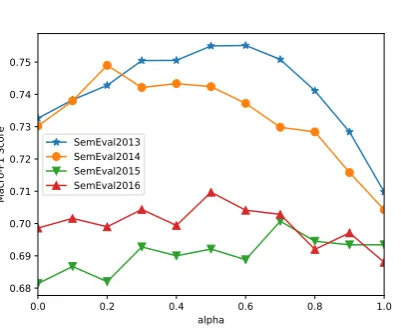
Figure 2: HSSWE (soft) with differentα
HSSWE (hard). The average improvement is 1.7 percentage.
4.5 Tuning the Parameterα
[image:8.595.306.521.254.349.2]In this section, we discuss the tradeoff between t-wo parts of supervisions by turning the tradeoff parameter α. When α is 0, HSSWE only ben-efits from the document-level sentiment supervi-sion and whenαis 1, HSSWE benefits from only word-level sentiment supervision. We observe that HSSWE performs better whenαis in the range of [0.45,0.55]. By integrating two component parts of sentiment supervision, HSSWE has significant superiority over that learned from either one.
4.6 Lexicon Analysis
In order to gain more insight of our model and observe the effectiveness of the sentiment lexi-con, in Table 7 we extract the positive
sentimen-Words HSSWE PMI-SO Doc-Sup
well 0.5740 0.5430 0.7898
better 0.5837 0.5358 (F) 0.8440
best 0.9455 0.6823 0.9639
fit 0.2894 -0.5594 (F) 0.6076 unreasonable -0.2441 -0.8421 0.5275 (F)
boreddddd -0.1137 -0.7142 0.4843 (F) sickkkk -0.3892 -0.7692 0.1323 (F) overplayed -0.1390 0.5000 (F) 0.8448 (F)
Table 7: Sentiment Lexicon Analysis, where s-core with(F) means falsely predicted polarity or strength.
t score of some representative words learned by different methods. The positive scores are sup-posed to be:best>better>well. HSSWE captures such comparative sentiment strength but PMI-SO does not. We further observe that in many cases where the results of PMI-SO and Doc-Sup are in-consistent (e.g., Doc-Sup incorrectly predicts “un-reasonable”, “boreddddd” and “sickkk” as pos-itive words, but PMI-SO predicts them correct-ly; PMI-SO incorrectly predicts“fit”but Doc-Sup predicts it correctly.), HSSWE often yield the cor-rect results. It shows the advantages of hierarchi-cal sentiment supervision. HSSWE can also cor-rect the sentiment prediction where both PMI-SO and Doc-Sup are inefficient (e.g.,“overplayed”).
5 Conclusion
[image:8.595.81.287.259.424.2]supervi-sion at both word and document levels. The word-level supervision can be provided based on either predefined sentiment lexicons or the learned PMI-SO based sentiment annotation of words. A wide range of experiments were conducted on several benchmark sentiment classification datasets. The results indicate that our method is quite effective for sentiment-aware word representation, and the sentiment lexicon generated by our approach beats the state-of-the-art sentiment lexicon construction approaches.
Acknowledgements
The work was supported by the Natural Science Foundation of China (No. 61672288), and the Natural Science Foundation of Jiangsu Province for Excellent Young Scholars (No. BK20160085).
References
Yoshua Bengio, R´ejean Ducharme, Pascal Vincent, and Christian Jauvin. 2003. A neural probabilistic lan-guage model. Journal of Machine Learning Re-search, 3(Feb):1137–1155.
John Duchi, Elad Hazan, and Yoram Singer. 2011. Adaptive subgradient methods for online learning and stochastic optimization. Journal of Machine Learning Research, 12(Jul):2121–2159.
Alec Go, Richa Bhayani, and Lei Huang. 2009. Twit-ter sentiment classification using distant supervision.
CS224N Project Report, Stanford, 1(2009):12. William L. Hamilton, Kevin Clark, Jure Leskovec, and
Dan Jurafsky. 2016. Inducing domain-specific senti-ment lexicons from unlabeled corpora. In Proceed-ings of the 2016 Conference on Empirical Methods in Natural Language Processing, pages 595–605. Vasileios Hatzivassiloglou and Kathleen R McKeown.
1997. Predicting the semantic orientation of adjec-tives. In Proceedings of the eighth conference on European chapter of the Association for Computa-tional Linguistics, pages 174–181.
Bas Heerschop, Alexander Hogenboom, and Flavius Frasincar. 2011. Sentiment lexicon creation from lexical resources. In International Conference on Business Information Systems, pages 185–196. Minqing Hu and Bing Liu. 2004. Mining and
summa-rizing customer reviews. InProceedings of the Tenth ACM SIGKDD international conference on Knowl-edge discovery and data mining, pages 168–177. Jaap Kamps, Maarten Marx, Robert J Mokken,
Maarten De Rijke, et al. 2004. Using wordnet
to measure semantic orientations of adjectives. In
Proceedings of the Fourth International Conference on Language Resources and Evaluation, volume 4, pages 1115–1118.
Soo-Min Kim and Eduard Hovy. 2004. Determin-ing the sentiment of opinions. In Proceedings of the 20th international conference on Computation-al Linguistics, page 1367.
Svetlana Kiritchenko, Xiaodan Zhu, and Saif M Mo-hammad. 2014. Sentiment analysis of short in-formal texts. Journal of Artificial Intelligence Re-search, 50:723–762.
Tomas Mikolov, Kai Chen, Greg Corrado, and Jeffrey Dean. 2013. Efficient estimation of word represen-tations in vector space. Proceedings of Workshop at 1st International Conference on Learning Represen-tations (ICLR2013).
Saif M. Mohammad, Svetlana Kiritchenko, and Xiao-dan Zhu. 2013. Nrc-canada: Building the state-of-the-art in sentiment analysis of tweets. In Proceed-ings of the seventh international workshop on Se-mantic Evaluation Exercises (SemEval-2013), pages 321–327.
Sara Rosenthal, Preslav Nakov, Svetlana Kiritchenko, Saif Mohammad, Alan Ritter, and Veselin Stoyanov. 2015. Semeval-2015 task 10: Sentiment analysis in twitter. InSemEval@ NAACL-HLT, pages 451–463. Duyu Tang, Furu Wei, Bing Qin, Ming Zhou, and T-ing Liu. 2014a. BuildT-ing large-scale twitter-specific sentiment lexicon : A representation learning ap-proach. In Proceedings of the 25th International Conference on Computational Linguistics (COLING 2014), pages 172–182.
Duyu Tang, Furu Wei, Nan Yang, Ming Zhou, Ting Liu, and Bing Qin. 2014b. Learning sentiment-specific word embedding for twitter sentiment clas-sification. InProceedings of the 52nd Annual Meet-ing of the Association for Computational LMeet-inguistic- Linguistic-s, pages 1555–1565.
Peter D Turney. 2002. Thumbs up or thumbs down?: semantic orientation applied to unsupervised classi-fication of reviews. InProceedings of the 40th an-nual meeting on association for computational lin-guistics, pages 417–424.
Peter D Turney. 2008. The latent relation mapping en-gine: Algorithm and experiments. Journal of Artifi-cial Intelligence Research, 33:615–655.
Duy Tin Vo and Yue Zhang. 2016. Dont count, pre-dict! an automatic approach to learning sentiment lexicons for short text. In Proceedings of the 54th Annual Meeting of the Association for Computation-al Linguistics, volume 2, pages 219–224.