Interactive Visualization for Linguistic Structure
Aaron Sarnat, Vidur Joshi, Cristian Petrescu-Prahova Alvaro Herrasti, Brandon Stilson, and Mark Hopkins
Allen Institute for Artificial Intelligence Seattle, WA
Abstract
We provide a visualization library and web interface for interactively exploring a parse tree or a forest of parses. The li-brary is not tied to any particular linguis-tic representation, but provides a general-purpose API for the interactive exploration of hierarchical linguistic structure. To fa-cilitate rapid understanding of a complex structure, the API offers several important features, including expand/collapse func-tionality, positional and color cues, ex-plicit visual support for sequential struc-ture, and dynamic highlighting to convey node-to-text correspondence.
1 Introduction
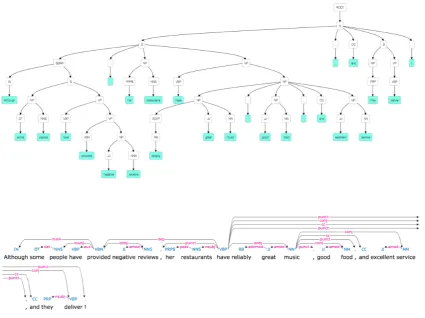
Interpreting visual representations of linguistic structure can be challenging and time-consuming. Consider the examples provided in Figure 1, which visualize syntactic parses of the sentence “Although some people have provided negative re-views, her restaurants have reliably great music, good food, and excellent service, and they de-liver!” These representations can result in cogni-tive overload, due to several concrete issues:
• The visualizations are static. If one is us-ing the visualization for debuggus-ing purposes, then typically one cares about only a part of the linguistic structure, not every last detail. Unfortunately, a static visualization must in-clude all information that could possibly be relevant.
• The visualizations are large. The screen real estate in Figure1is dominated by arrows that must be carefully tracked by the eye, in order to understand the relationships between
nodes. Visualizations of long sentences of-ten run off the side of the screen, requiring the user to scroll to discover the endpoints of these arrows.
• All node relationships look identical. Predicate-argument relationships (e.g. “restaurants” as the subject of “have”) get the same visual treatment as modifier relationships (e.g. “good” as a modifier of “food”) and sequence elements (e.g. “good food” as an element of the sequence “great music, good food, and excellent service”).
In this work, we provide a library and web in-terface for the interactive visualization of linguis-tic structure, seeking to minimize the cognitive load required to understand syntactic and seman-tic parses. Figure2shows a screenshot of our web UI for the same sentence as Figure1. It reflects several of our visualization strategies (described in more detail in Section3):
• Instead of a static visualization, we pro-vide an interactive visualization with an ex-pand/collapse functionality that allows the user to focus on what is relevant to her. For instance, the subclause “although some peo-ple have provided negative reviews” is col-lapsed in Figure 2, but can be expanded by clicking on it.
• To reduce the size of the visualization, we use a box layout, and use badging to eliminate simple leaf nodes (e.g. instead of creating a separate node for the article “her”, it is repre-sented by a badge on the node “restaurant”).
• We use positional cues to highlight predicate-argument relationships (subjects appear to the left, objects to the right, modifiers attach
Figure 1: Typical visualizations of a constituency parse (top) and a dependency parse (bottom) for the sentence “Although some people have provided negative reviews, her restaurants have reliably great music, good food, and excellent service, and they deliver!”
to the bottom) and we provide specialized vi-sualization for sequential structures (this oc-curs at two different levels in Figure2, both for the clause sequence as well as the entity sequence “reliably great music, good food, and excellent service”).
Our library is not tied to any particular linguistic formalism. In Section4, we describe the flexible and configurable API. While our primary use case has been for creating custom grammars for math-ematical language (Hopkins et al.,2017), we also provide a demonstration of how our API can be used to visualize output from the Stanford Parser (Socher et al.,2013).
2 Related Work
Most parse visualizations use the source sentence as an anchor, leaving it readable left-to-right. For constituency parses (where the words of the sen-tence are the leaves of the tree), this gives a rep-resentation like Figure 1 (top). For dependency parses (where the words of the sentences are the
nodes of the tree), this gives a representation like Figure1(bottom).
Figure 1 was generated from (Podgursky, 2015), which provides open-source code and a web interface for a static rendering of a con-stituency parse. There are a number of libraries (Stenetorp et al., 2012; Montani, 2016; Athar, 2010;Yimam et al.,2013) that provide static ren-derings of dependency parses similar to Figure1 (bottom). Among these, Brat (Stenetorp et al., 2012) provides some interactive elements (like mouseover highlighting of subtrees, and the abil-ity to add dependencies via drag-and-drop). Dis-placy (Montani, 2016) provides a general API for the static rendering of various dependency parsing schemes, e.g. Universal Dependencies (Nivre et al., 2016) and Stanford Dependencies (De Marneffe and Manning,2008).
[image:2.595.90.516.63.381.2]Figure 2: A screenshot of our parse visualization tool for the sentence “Although some people have provided negative reviews, her restaurants have reliably great music, good food, and excellent service, and they deliver!”
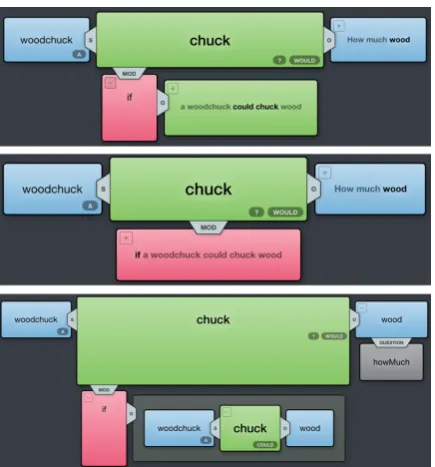
Figure 3: Three screenshots of our visual-izer for the question “How much wood would a woodchuck chuck, if a woodchuck could chuck wood?”: partially expanded (top), fully collapsed (middle), and fully expanded (bottom).
parse from this forest by repeatedly specifying constraints (calleddiscriminantsin the paper).
3 Key Features
In this section, we describe our key features for fa-cilitating a rapid understanding of linguistic struc-ture. As a companion to this section, we invite readers to use our web demonstration athttp:// hierplane.allenai.org/explain to in-teractively explore examples.1
1The user may experience some slowness when parsing certain sentences. This is due to the speed of the back-end parser, not the visualization library.
3.1 Expand/Collapse Functionality
Rather than a static rendering, our dynamic ex-pand/collapse functionality allows the user to fo-cus on relevant parts of the linguistic structure, while the rest is conveniently summarized at a coarser granularity. In Figure3, the top screenshot shows a partially expanded structure that delves into the internal structure of the if-clause. The middle and bottom screenshots respectively show the fully collapsed and expanded visualizations.
3.2 Positional Cues to Distinguish Node Relations
Linguistic relationships can often be organized into intuitive clusters. For instance, subjects and objects can be roughly viewed as required argu-ments of a verb (exactly one per verb), while mod-ifiers are optional (a verb can take any number of them, including zero). Our library allows the visual expression of these “relationship families” through positional cues. In Figure3, the subject is attached to the left of its verb, the object is at-tached to the right of its verb, and all modifiers are attached beneath. For consistency, the object of the preposition “if” is also attached to its right. At a glance, this representation allows the user to read a gloss of the main clause by simply skimming the top line of the visualization (i.e. “a woodchuck would chuck how much wood?”).
[image:3.595.73.291.248.482.2]Figure 4: Dynamic highlighting of the correspondence between the linguistic structure and the source text: “If Peter and Paula had really picked a peck of pickled peppers, how many peppers did they pick?”
3.4 Badging
Some leaf nodes of linguistic structures convey very simple information about their parent node. We allow these nodes to be represented as badges rather than separate nodes. In Figure 3, the de-terminers (“a” for “a woodchuck”) and modals (“would” for “would chuck”) are represented as badges.
3.5 Sequence Support
Sequential structure is a fundamental linguistic el-ement that is often difficult to access in a parse vi-sualization. We make sequences visually explicit as a container of linked nodes. Examples include “Peter and Paula” in Figure4 or the sequence of top-level clauses “her restaurants have...excellent service” and “they deliver” in Figure2. Contrast this to the undistinguished representations of se-quential structure found in Figure1.
3.6 Dynamic Node-to-Text Highlighting It can be difficult (particularly in semantic parses) to ascertain how the source text and the linguis-tic representation correspond. Upon mouse-over of a node, our visualizer highlights the part of the source text corresponding to the subtree rooted at that node. Parts that do not also correspond to some descendant node in the subtree are strongly highlighted. In Figure 4, upon mouse-over of the lower “pick” node, the corresponding segment “Peter and Paula had really picked a peck of pick-led peppers” is weakly highlighted. The tokens “had” and “pecked” are strongly highlighted,
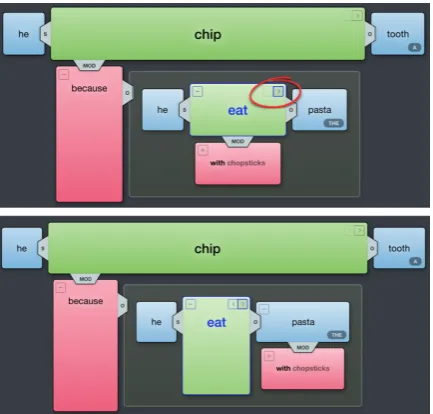
be-Figure 5: Before-and-after screenshots of forest exploration for the sentence “Because he ate the pasta with chopsticks, he chipped a tooth.”
cause they do not correspond to any of the node’s descendants.
3.7 Modular Forest Exploration
[image:4.595.309.526.310.517.2]exponential number of parses at the root).
Figure 6: System architecture for our web inter-face. Similar architectures are employed by Brat and WebAnno.
4 APIs
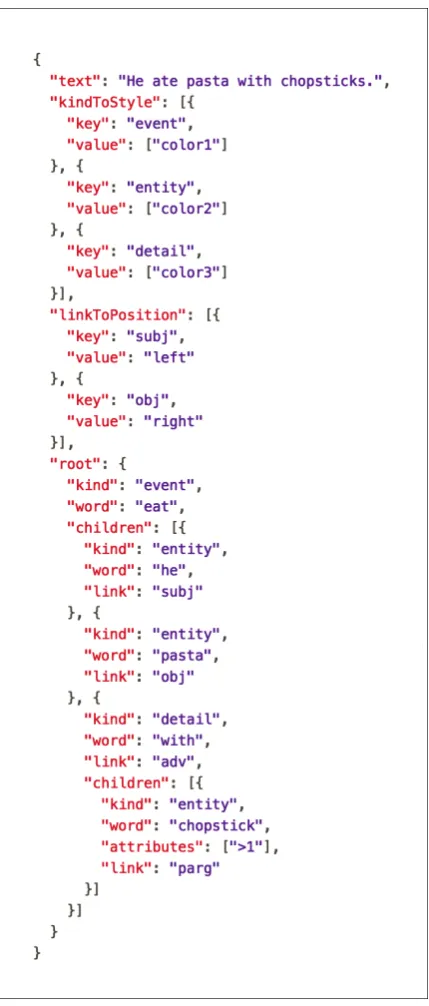
Our web interface, hosted at http: //hierplane.allenai.org/explain, has the architecture shown in Figure 6. The front-end accepts text input from the user. It forwards this text to the back-end and receives a JSON that contains an annotated tree and styling instructions. Figure 7 shows a simplified version of the JSON that renders the “He ate pasta with chopsticks” subtree in Figure 5. This JSON is passed to the visualization library, which renders it in HTML and returns this HTML to the front-end.
4.1 Basic Features
A key feature of our architecture is that the back-end is in charge of defining the node and edge types, and specifying how these should be dis-played. This allows the visualization library to be independent of any particular linguistic annotation scheme. To demonstrate this flexibility, our demo provides two alternative back-ends. By default, it uses a custom grammar that we have been devel-oping for parsing mathematical language (e.g.
http://hierplane.
allenai.org/explain/He% 20ate%20pasta%20with% 20chopsticks
utilizes the default back-end). However, we have also wrapped the Stanford Parser (Socher et al., 2013) as an alternative back-end. For any given sentence, one can try out this alternative by replac-ing the URL prefix
Figure 7: A simplified version of the JSON that describes the parse tree for “He ate pasta with chopsticks.”
http://hierplane.allenai. org/explain/
with
http://hierplane.allenai. org/explain/stanford/
For instance:
[image:5.595.310.525.59.563.2] [image:5.595.73.297.84.226.2]He%20ate%20pasta%20with% 20chopsticks
will parse “He ate pasta with chopsticks” using the Stanford parser.
In the JSON returned by the back-end, each node in the tree is annotated with its kind and la-bel (“word”), the type of edge (“link”) connecting it to its parent, and its badges (“attributes”). The linkToPositionmap allows each node to be posi-tioned according to its relation to its parent (e.g. subjects are positioned to the left of their parents, according to the example JSON). ThekindToStyle map specifies colors for the various node types. 4.2 Advanced Features
To enable interactive node-to-text highlighting, nodes in the input JSON tree can each be anno-tated with a span field that contains the indexes of the start and end characters of the substring cor-responding to the node. To enable modular for-est navigation, each node with a next or previous subtree can be annotated with codes identifying these subtrees. Navigation arrows are only ren-dered when they lead to another subtree. When a user clicks on one, the front-end sends the code identifying the desired subtree to the back-end, and expects the requested subtree as a response.
5 Conclusion
In this work, we have tried to rethink the visu-alization of hierarchical linguistic structure from the ground up, first identifying the problems that cause cognitive load (large, static visualizations with no cues to distinguish node or edge families), and then designing new tactics to counter these problems (e.g. expand/collapse functionality, po-sitional cues to distinguish node relations, explicit sequence visualization, and dynamic node-to-text highlighting). We have also created the first tool to explore parse forests using modern web design. We plan to make our visualizer freely available as an open-source library and a web interface.
References
Awais Athar. 2010. Dependensee: A dependency parse visualization tool. http://chaoticity.com/dependensee-a-dependency-parse-visualisation-tool. Accessed: 2017-04-27. Marie-Catherine De Marneffe and Christopher D
Man-ning. 2008. Stanford typed dependencies manual.
Technical report, Technical report, Stanford Univer-sity.
Mark Hopkins, Cristian Petrescu-Prahova, Roie Levin, Ronan Le Bras, Alvaro Herrasti, and Vidur Joshi. 2017. Beyond sentential semantic parsing: Tackling the math sat with a cascade of tree transducers. In
EMNLP.
Ines Montani. 2016. Displacy dependency vi-sualizer. https://demos.explosion.ai/
displacy. Accessed: 2017-04-27.
Joakim Nivre, Marie-Catherine de Marneffe, Filip Gin-ter, Yoav Goldberg, Jan Hajic, Christopher D Man-ning, Ryan McDonald, Slav Petrov, Sampo Pyysalo, Natalia Silveira, et al. 2016. Universal dependen-cies v1: A multilingual treebank collection. In Pro-ceedings of the 10th International Conference on Language Resources and Evaluation (LREC 2016), pages 1659–1666.
Stephan Oepen, Dan Flickinger, Kristina Toutanova, and Christopher D Manning. 2004. Lingo red-woods. Research on Language and Computation, 2(4):575–596.
Ben Podgursky. 2015. Nlpviz. http://nlpviz.
bpodgursky.com. Accessed: 2017-04-27.
Richard Socher, John Bauer, Christopher D Manning, and Andrew Y Ng. 2013. Parsing with composi-tional vector grammars. InACL (1), pages 455–465. Pontus Stenetorp, Sampo Pyysalo, Goran Topic, Tomoko Ohta, Sophia Ananiadou, and Jun’ichi Tsu-jii. 2012. brat: a web-based tool for nlp-assisted text annotation. InEACL.
Seid Muhie Yimam, Iryna Gurevych, Richard Eckart de Castilho, and Chris Biemann. 2013.
Webanno: A flexible, web-based and visually supported system for distributed annotations. In