Entity Linking via Joint Encoding of Types, Descriptions, and Context
Nitish Gupta∗
University of Pennsylvania Philadelphia, PA
Sameer Singh University of California
Irvine, CA
Dan Roth∗
University of Pennsylvania Philadelphia, PA
Abstract
For accurate entity linking, we need to cap-ture various information aspects of an en-tity, such as its description in a KB, con-texts in which it is mentioned, and struc-tured knowledge. Additionally, a linking system should work on texts from different domains without requiring domain-specific training data or hand-engineered features. In this work we present a neural, mod-ular entity linking system that learns a unified dense representation for each en-tity using multiple sources of information, such as its description, contexts around its mentions, and its fine-grained types. We show that the resulting entity link-ing system is effective at combinlink-ing these sources, and performs competitively, some-times out-performing current state-of-the-art systems across datasets, without requir-ing any domain-specific trainrequir-ing data or hand-engineered features. We also show that our model can effectively “embed” en-tities that are new to the KB, and is able to link its mentions accurately.
1 Introduction
Entity linking, the task of identifying the real-world entity a mention in text refers to, provides the abil-ity to ground text to existing knowledge bases, and thus supports multiple natural language understand-ing, and knowledge acquisition tasks.
A key challenge for successful entity linking is the need to capture semantic and background information at various levels of granularity. For example, to resolve the mention “India” in “India
plays a match in England today” to the correct en-tity, India cricket team, one needs to use
∗Work performed while these authors were at UIUC.
mention-level context to identify that the sentence refers to a sports team (using plays and match), use document-level context to identify the sport, and information about the entity to realize that India cricket teamis a sports team and the string “India” may refer to it. The problem has been studied extensively by employing a variety of machine learning, and inference methods, in-cluding a pipeline of deterministic modules (Ling et al., 2015), simple classifiers (Cucerzan, 2007;
Ratinov et al.,2011), graphical models (Durrett and Klein,2014), classifiers augmented with ILP infer-ence (Cheng and Roth,2013), and more recently, neural approaches (He et al.,2013;Sun et al.,2015;
Francis-Landau et al.,2016).
We present a neural approach to linking1 that learns a dense unified representation of entities by encoding the semantic and background informa-tion from multiple sources – encyclopedic entity descriptions, entity-type information, and the con-texts the entity occurs in – thus capturing differ-ent aspects of the “meaning” of an differ-entity. Hence, we overcome the shortcomings of several existing models that do not capture all these aspects. For example, methods, such as Vinculum (Ling et al.,
2015), do not make use of the local context of the mention (“plays” and “match”) while others, such as Berkeley-CNN (Francis-Landau et al.,2016), do not take entity-types into account. Our proposed model uses compositional training to ensure that the learned entity representation captures the vari-ous information sources available to it, making it quite modular. Specifically, we introduce encoders for the different sources of information about the entity, and encourage the entity embedding to be similar to all of the encoded representations.
A key requirement for information extraction systems is their ability to work across texts from
1 The source code and the datasets are available at
https://nitishgupta.github.io/neural-el
various domains. Some methods (Francis-Landau et al., 2016; Nguyen et al., 2016;Hoffart et al.,
2011) train parameters on domain-specific linked data, thus hampering their ability to generalize to new domains. By only making use of indirect su-pervision that is available in Wikipedia/Freebase, we refrain from using domain specific training data, and produce a domain-independent linking system. Our comprehensive evaluation on recent entity link-ing benchmarks reveals that the resultlink-ing entity linker compares favorably to state-of-the-art sys-tems across datasets, even those that have hand-engineered features or use dataset-specific train-ing. We hence show that our model not only lever-ages all the available information for each entity effectively, but is also robust to missing informa-tion, such as entities without links/description in Wikipedia or with incomplete entity types.
In the real-world, new entities are regularly added to the knowledge bases, thus, it is impor-tant for any entity linking system to be extendable to such entities, especially the ones that do not have any existing linked mentions. By the virtue of our model’s modular nature, it can easily incorporate new entities not present during training. Specifi-cally, we show that our model can perform accurate linking for new entities, without having to re-train the existing entity representations, only using their description and types.
2 Related Work
Existing approaches for entity linking differ in sev-eral ways, including the machine learning models, the types of training data, and the kinds of informa-tion used about the entities.
Many existing approaches use links and informa-tion from Wikipedia as the only source of supervi-sion to build the entity linking system. These ap-proaches use sparse entity and mention-context rep-resentations, such as, based on the Wikipedia cate-gories (Cucerzan,2007), weighted bag of words in the entity description and mention context ( Kulka-rni et al.,2009;Ratinov et al.,2011), hand crafted features based on partial string matches, punctua-tions in entity name (McNamee et al.,2009), etc. Heuristics (Mihalcea and Csomai,2007) or linear classifiers (Bunescu and Pasca, 2006;Cucerzan,
2007;Ratinov et al.,2011;McNamee et al.,2009) are used over these features to rank entity candi-dates for linking. Recently, neural models have been proposed as a way to support better
general-ization over the sparse features; e.g., using feed-forward networks on bag-of-words of the entity context (He et al.,2013), or using entity-class in-formation from KB (Sun et al.,2015).
Some models ignore the entity’s description on Wikipedia, but rather, only rely on the context from links to learn entity representations (Lazic et al.,
2015), or use a pipeline of existing annotators to filter entity candidates (Ling et al., 2015). Our model is similar to these approaches by only using information from Wikipedia; however, we do not use hand-crafted features, and use multiple sources of information such as local and document-level entity context, KB descriptions, and entity types, to learn explicit entity representation.
Few recent entity linking approaches (Hoffart et al.,2011;Durrett and Klein,2014;Nguyen et al.,
2016;Francis-Landau et al.,2016) use manually-annotated domain specific training data to learn the linking system. AIDA (Hoffart et al.,2011), for example, evaluate their system on test set from CoNLL-YAGO dataset but also train on the training data from the same dataset. Berkeley-CNN (Francis-Landau et al.,2016), that uses CNNs operating over different granularity of entity and mention contexts, also follows this training regime and trains separate models for each dataset. Such approaches can be prohibitive in many applications as it encourages the model to over-fit to the pecu-liarities of different datasets and domains.
Other forms of information, apart from descrip-tions, and context from linked data, are also uti-lized for linking. Many approaches perform joint inference over the linking decisions in a docu-ment (Milne and Witten,2008;Ratinov et al.,2011;
Hoffart et al.,2011;Globerson et al.,2016), idtify mentions that do not link to any existing en-tity (NIL) (Bunescu and Pasca, 2006; Ratinov et al.,2011), and clusterNIL-mentions (Wick et al.,
2013;Lazic et al.,2015) to discover new entities. Few approaches jointly model entity linking, and other related NLP tasks to improve linking, such as, coreference resolution (Hajishirzi et al.,2013), rela-tional inference (Cheng and Roth,2013), and joint coreference with typing (Durrett and Klein,2014). In our model, we use fine-grained type information of the entity as an auxiliary distant supervision to improve mention-context representation but do not use intermediate typing decisions for linking.
Mention Context
Encoder Document Context Encoder Mention Context
Encoder Document Context Encoder Local Context
Encoder Document Context Encoder
The Indian cricket team, also known as Team India, represents
India in international cricket. Description
Encoder
Entity-Type Objective Description
Objective
Context Objective
In 1932, India played their first match in England.
Nasser Hussain, Lords, Cricket Cup, ECB
Mention-Type Objective
India_cricket_team
ve
desc vm
ve
type embeddings context
embeddings description
embedding
entity embedding
Entity Type Encoder
sports_team vt Ltext
Ldesc Letype
[image:3.595.83.520.63.234.2]Lmtype
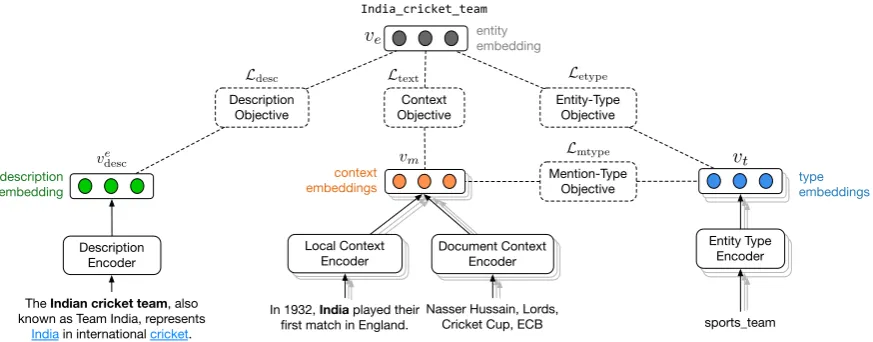
Figure 1: Overview of the Model(§3): Each entity has a Wikipedia description, linked mentions in Wikipedia (only one shown), and fine-grained types from Freebase (only one shown). We encode local and document-level mention contexts (§3.1), entity-description (§3.2), and fine-grained entity-types (§3.3&§3.4). Joint optimization (§3.5) over these provides the unified entity representations{ve}.
such as, from the structured KB for KB comple-tion (Bordes et al.,2011,2013;Yang et al.,2014;
Lin et al.,2015), or from both structured KBs, and text for relation extraction (Toutanova et al.,2016;
Verga et al.,2016a). However, since it is not trivial for these models to incorporate new entities to the KB, few recent approaches alleviate this issue by representing entities as a composition of words in their names (Socher et al.,2013), relations they par-ticipate in (Verga et al.,2016b), or their types (Das et al., 2017), but do not use multiple sources of information jointly. In our work, we use struc-tured knowledge (types) as well as unstrucstruc-tured knowledge (description and context) to learn en-tity embeddings for enen-tity linking, and show that it extends to new entities.
3 Jointly Embedding Entity Information
Knowledge bases contain different kinds of infor-mation about entities such as textual description, linked mentions (in Wikipedia), and types (in Free-base). For accurate linking, it is often necessary to combine information from these various sources. Here, we describe our model that encodes informa-tion about the set of entitiesEusing dense unified representation for linking (ve ∈ Rd,∀e ∈ E). In
particular, we use existing mentions in Wikipedia to encode the context (§3.1), textual descriptions from Wikipedia to encode background information (§ 3.2), and fine-grained types from Freebase as structured topical knowledge (§3.3). Figure1 pro-vides an overview of our model.
3.1 Encoding the Mention Context, C
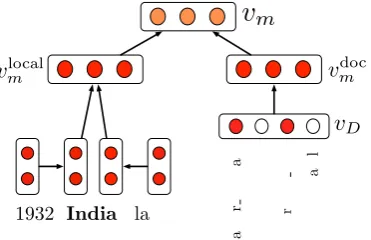
Consider the example mention in Figure1that con-tains two mentions, “India” and “England”. In order to disambiguate “India” to the correct entity, a linking system would need to utilize both the local context (played and match), and the docu-ment context (to identify the sport). However, the model needs to represent context such that the se-mantics are preserved, e.g. “England” should not be linked to a sports team even though it shares the context with “India”. In this section, we describe how we encode these two types of context, using a LSTM-based encoder to capture the lexical and syntactical local-context of a mention (vlocal
m ), and
a feed-forward network to encode the document-level topical knowledge (vdoc
m ), and combine them
in a single representation for each mention (vm).
Local-Context Encoder Given a mentionmin the sentence s = w1, . . . , m, . . . , wN, we use
LSTM encoders on the left (w1, . . . , m) and right
(m, . . . , wN) contexts of the mention separately,
and then combine it to form the local context representation of the mention (Fig. 2). More precisely, we formulate an LSTM as hi, si =
LSTM(ui, hi−1, si−1),ui ∈ Rdw is the input
em-bedding of the i-th token in the sequence, and
hi−1, si−1∈Rlis the previous output and the cell
state of the LSTM, respectively. The left-LSTM is applied to the sequence (w1, . . . , m) with the
last output−→hl
ap-vD
v
mvlocal
m
US
A
Nas
se
r
Hu
ss
ai
n
Se
at
tl
e
Cri
ck
et
Cup
vdoc
m
[image:4.595.90.276.62.182.2].. 1932,Indiaplayed ..
Figure 2: Overview of the mention context encoder
plied to the sequence (wN, . . . , m)2to produce←−hrm.
We concatenate these output [−→hl
m,←−hrm] and pass
it through a single layer feed-forward network3 to produce the local context representation of the mention (vlocal
m ), where vmlocal ∈ RDm. Note that
this encoder will produce different representations for different mentions in the same sentence.
Document-Context Encoder To represent the document context of a mentionm, we use a bag-of-mention surfaces representation,vD ∈ {0,1}|VG|,
of the document, similar toLazic et al.(2015). The vocabularyVGconsists of all mention surfaces seen
in our training data, e.g. USA, Nasser Hussain, Pearl Jam etc. Such a representation helps cap-ture the topical and entity coherence information in the document by utilizing co-occurrence between entity surface forms. This sparse vector vD of
bag-of-mention surfaces is compressed to a low-dimensional representationvdoc
m ∈ RDm using a
single layer feed-forward network.
Mention-Context Encoder We combine the lo-cal (vlocal
m ) and document (vdocm ) level context
vec-tors by concatenating them, and passing them through a single-layer feed-forward network to ob-tain the mention context embeddingvm ∈Rd. In
order to learn the entity representationvesuch that
it encodes all of its mentions’ contexts, we intro-duce an objective that encourages the context rep-resentationvmto be similar tove(where mention
mis a link to entitye), and dissimilar to other can-didates4. Precisely, we maximize the probability of predicting the correct entity from the mention-context vector asPtext(e|m) = Pexp (vm·ve)
ck∈Cmexp (vm·vck) ,
2We reverse the token sequence in the right context so that right-LSTM starts at the last token and ends at the mention.
3We use rectified linear unit (ReLU) as the non-linear activation throughout this paper.
4Details on candidate generation in Sec4
whereCmis the set of candidate entities. Given all
the mentions in Wikipedia, we jointly optimize the entity representations, and the context encoders by maximizing the following log-likelihood:
Ltext= M1 M
X
i=1
logPtext(em(i)|m(i)) (1)
wherem(i) is theith mention in the linked data,
andem(i) is the entity the mention refers to.
3.2 Encoding Entity Description, D
The textual description about entities in Wikipedia can provide a useful source of background infor-mation about the entity, and thus has been used in many existing linking systems. Given the de-scription as a sequence of words, we first embed each word to a dw-dimensional vector resulting
in a sequence of vectors w1, . . . , wn. To encode
this description as a fixed size vector, we use a Convolution Neural Network (CNN), similar to
Francis-Landau et al.(2016), with global average pooling, to obtainve
desc∈Rd.
In order for the entity representationveto encode
its description, we use a similar objective as in the previous section§3.1, i.e. we maximize the probabilityPdesc(e|vdesce ), and learn the parameters by maximizing the log-likelihoodLdesc, defined similarly as (1).
3.3 Encoding Fine-Grained Types, E
Fine-grained types provide a source of structured information that is quite readily available, often more easily than the description or linked data (e.g. Freebase contains tens of millions of entities with types but Wikipedia only contains descriptions for a few million). These types have been shown to be quite useful for linking (Ling et al.,2015), since an accurate prediction of types from the mention, and its match with the entity types can often resolve many challenging ambiguities.
Here, we focus on being able to represent the different types at the entity level, leaving mention-level type information to the next section. Each entity has multiple typesTe ⊂ T from the type set
T introduced byLing and Weld(2012). We com-pute the probabilityP(t|e)of typetbeing relevant to entityeas σ(vt·ve), whereσ is the sigmoid
function,ve∈Rdis the entity representation, and
vt∈Rdis the embedding of typetinT. We
jointly learn entity and type representations:
Letype= |E|1 X
e∈E
logY
t∈Te
P(t|e) Y
t0∈T/ e
(1−P(t0|e))
3.4 Type-Aware Context Representation, T
Apart from being able to represent the types of the entities, it is also important for our linker to be able to represent the type information at the men-tion level. In the example in Fig.1, although the mention “India” is prominently used to refer to thecountry, it is evident from the sentence that it refers to aSports Team. The context-encoder cap-tures this information in an unstructured manner, thus it will be useful for the encoder to directly utilize this supervision. This is a similar setup as
Ling et al.(2015) andShimaoka et al.(2017) that use noisy distant supervision to train a fine-grained type predictor for mentions.
In order for the context encoders, and type em-beddings to directly inform each other, we intro-duce an objectiveLmtypebetween everyvmandvt
if typetbelongs toTefor the entityethatmrefers
to. This objective is similar toLetypefrom§3.3.
3.5 Learning Unified Entity Representations
In the sections above we described different en-coder models to capture entity-context informa-tion (local- and document-level), entity-descripinforma-tion from a KB, and fine-grained types in a single entity representation vector. To learn the entity represen-tations, and parameters of the encoders, we jointly maximize the total objective:
{ve},Θ = argmax {ve},Θ
Ltext+Ldesc+Letype+Lmtype
where{ve}is the set of entity representations, and
Θis set of parameters for the different encoders. One advantage of having such a joint, modular ob-jective is that it is robust to missing information, i.e. entities with missing mentions, types, or de-scriptions will still obtain accurate representations learned using other sources of information.
4 Entity Linking
Given a document, and mentions marked in it for disambiguation, we perform a two-step procedure to link them to an entity. First, we find a set of candidate entities, and theirprior scores using a pre-computed dictionary. We then use our mention-context encoder to estimate the semantic similarity
of each mention with the vector representations of each entity candidate, and combine the results from the two sources for making linking decisions.
A typical KB contains millions of entities, which makes it prohibitively expensive to compute a sim-ilarity score between each mention and all entities in the KB. Prior work has shown that, for a given mention, aggressively pruning the set of possible entities to a small subset hurts performance only negligibly, while making the linker extremely ef-ficient. For each mentionm, we generate a set of candidate entitiesCm = {cj} ⊂ E using
Cross-Wikis (Spitkovsky and Chang,2012), a dictionary computed from a Google crawl of the web that stores the frequency with which a mention links to a particular entity. To generateCm we choose
the top−30entities for each mention string, and normalize this frequency across the chosen candi-dates to computePprior(e|m). In the literature, such a dictionary is often built from the anchor links in Wikipedia (Ratinov et al.,2011;Hoffart et al.,
2011) butLing et al.(2015) show using CrossWikis gives improved prior scores and candidate recall.
For each mention m, we use our learned mention-context encoder from§3.1to encode the mention’s context asvm, and estimate the
distribu-tion over the candidates usingPtext(e|m). We treat these two pieces of evidence; pre-computed prior probability, and the context-based probability, as independent, disjunctive sources of signal, and thus combine them to computeP(e|m)as:
P(e|m) =Pprior(e|m) +Ptext(e|m)
−(Pprior(e|m)∗Ptext(e|m)) (2)
ˆ
em = argmax
e∈Cm
P(e|m) (3)
whereˆem is the predicted entity that the mention
mshould be disambiguated to.
5 Evaluation Setup
Here we provide a detailed description of how we train our models, benchmark datasets, linking sys-tems we compare to, and the evaluation metrics.
(same as Francis-Landau et al. (2016)). To ob-tain entity types (see§3.3), we extract the types for each entity from Freebase and map them to the112fine-grained types introduced byLing and Weld(2012). For context and description encoders, we use pre-trained300-dimensional case-sensitive word embeddings byPennington et al.(2014) as the first layer that is not updated during training.
Hyper-parameters We perform coarse-grained tuning of the hyper-parameters using a fraction of the training data. The vectors for the enti-ties, types, contexts, and descriptions are of size
d = 200. The size of the local context encoder LSTM hidden layer l, local context output, and the document-context encoder outputDmis set to
100(= l =Dm). The document context
vocabu-lary contains|VG|= 1.5million strings. We use
dropout (Srivastava et al.,2014) with a probability of0.4. Additionally, we use word-dropout where we replace a random subset of tokens (mention-strings) in the local (document) context with “unk” (rate of 0.4and 0.6 for local and document con-text respectively). We use Adam (Kingma and Ba,
2014) for optimization, with learning rate 0.005 and mini-batches of size1000.
Existing Approaches We compare our ap-proach to the following five entity-linking mod-els: (1)Plato(Lazic et al.,2015), an unsupervised generative model that uses indirect-supervision from Wikipedia and an additional corpus of 50 million unlabeled webpages, (2) Wikifier ( Rati-nov et al.,2011), an unsupervised linker that uses hand-crafted features to rank candidates, (3) Vin-culum(Ling et al.,2015), a modular, unsupervised pipeline system, (4)AIDA(Hoffart et al.,2011), a supervised linker trained on CoNLL data and uses hand-crafted features, and (5)BerkCNN( Francis-Landau et al., 2016), a recent neural supervised approach that has variants that use hand-crafted features.
Evaluation Setup We evaluate our approach on the following four datasets: CoNLL-YAGO ( Hof-fart et al., 2011), ACE 2004 (NIST, 2004; Rati-nov et al.,2011), ACE 2005 (NIST, 2005; Ben-tivogli et al.,2010), and Wikipedia (Ratinov et al.,
2011). For each of these datasets, we use the stan-dard test/development splits, but do not use any information from the training splits. End-to-end entity linking systems such as Vinculum and Wik-ifier perform an NER-style F1 evaluation where
CoNLL ACE05 Wiki Test Dev
Plato (Sup) 79.7 - -
-Plato (Semi-Sup) 86.4 - -
-AIDA* 81.8 - -
-BerkCNN:Sparse* 74.9 - 83.6 81.5 BerkCNN:CNN* 81.2 86.91 84.5 75.7 BerkCNN:Full* 85.5 - 89.9 82.2
Priors 68.5 70.9 81.1 78.1
Model C 81.4 83.4 83.7 86.1
Model CD 81.0 83.2 85.8 86.1
Model CT 82.3 83.9 86.5 88.2
[image:6.595.311.521.63.225.2]Model CDT 82.5 85.6 86.8 88.0 Model CDTE 82.9 84.9 85.6 89.0
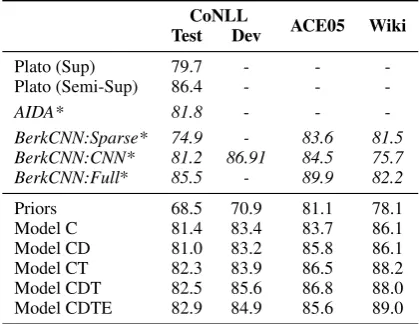
Table 1:Entity Linking Performance:Accuracy of existing systems, and variations of our model on gold mentions. The model using context informa-tion is labeled C, entity-descripinforma-tion as D, context-typing as T, and entity-type encoding as E. Existing models marked inItalics* train domain-specific linkers for each dataset. Our system performs competitively to these systems, and outperforms Plato (Sup) that uses the same indirect supervision.
a prediction is only considered correct if the sys-tem mention boundaries match the gold annota-tion, and the predicted link is correct (we compare against these by extracting mentions with Stanford-NER). On the other hand, systems like Plato, AIDA, and Berkeley-CNN assume mentions are provided, and evaluate using the linking accuracy for gold-mentions. Further, the approaches we compare here (including ours) do not predict NIL entities for the datasets evaluated on.
6 Results
F1 Accuracy
AIDA 77.8
-Wikifier 85.1
-Vinculum 88.5
[image:7.595.111.251.62.150.2]-Model C 88.9 93.1 Model CDT 89.8 93.9 Model CDTE 90.7 94.3
Table 2: Results for ACE-2004: F1 is calcu-lated for predicted mentions, and accuracy on gold-mentions. Results for Wikifier and AIDA are from (Ling et al.,2015). All systems use the same men-tion extracmen-tion protocol showing the difference in F1 is due to linking performance.
6.1 Entity Linking
In Table 1 we present linking accuracy for our models that vary in the information they use. We see that the model that only encodes the context-information, Model C (L=Ltext) consistently per-forms better than picking the entity with the high-est prior probability from CrossWikis, indicating that the model is able to utilize the context across datasets. On incorporating the description with context (Model CD) we see improvement in the performance on ACE-2005, but slight decrease in CoNLL, suggesting the entity descriptions are not extremely useful for the latter (it contains rare en-tities, many short and incomplete sentences, and specific entities as annotations for metonymic men-tions, as also observed byLing et al.(2015)). On introducing the entity type-aware loss in Model CT to the context-only model, we see significantly improved results for all datasets, demonstrating that explicitly modeling fine-grained types helps learning a better context encoder and, in turn, type-aware entity representations. Combining descrip-tions with this model (Model CDT) shows further gains in accuracy indicating that our model is able to exploit complementary information from the two sources. Finally, on introducing explicit entity-type encoding, Model CDTE performs the best on two of the four datasets. As we will see in§6.2, encod-ing entity-type information also allows our models to easily generalize to new entities.
On comparison to existing systems we see that all our variants outperform Plato’s indirectly-supervised model trained on Wikipedia, which is the same information our Model C and CD use. Their semi-supervised model, that is additionally trained on50million web-pages, performs much
Method Accuracy
[image:7.595.348.488.64.134.2]Random Guessing 16.7 Random Embeddings 34.0 Entity Description 65.1 Fine-Grained Types 73.7 Description + Types 79.5
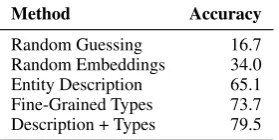
Table 3: Cold-Start Entities: Linking new enti-ties by using different information to learn their embeddings. Our model is able to jointly utilize description and type information better.
better. In comparison to AIDA and Berkeley-CNN, that train separate models on respective datasets, we perform better than AIDA and Berkeley-CNN’s sparseand neural model. On combining features from CNN to thesparsemodel, the Berkeley-CNN models for each dataset outperform our model, but are unlikely to generalize across the datasets5.
In Table2we present results for our models on ACE-2004. Our model outperforms the Wikifier and Vinculum systems that only use information from Wikipedia, and AIDA, by a significant margin, indicating its possible over-fitting to the CoNLL domain. Hence, it shows our model’s ability to perform accurate linking across different datasets without using domain-specific information.
6.2 Cold-Start Entities
In realistic situations, new entities are regularly added to the knowledge base with little or no linked data for them. Hence, it is important for any infor-mation extraction system that learns entity repre-sentations to be easily extendable for such entities without needing to be re-trained. In this section, we consider the use of our approach to this setting. In particular, for each such new entity, we need to determine their embedding using only their de-scription and/or type information. For a new entity for which only the description is available, we di-rectly set its embedding to be the output of the entity-description encoder without any need for learning. If only fine-grained types are available, we learn the new entity-embedding by optimizing the objectiveLetype. In case both description and types are available, we jointly maximize the simi-larity of the entity embedding with the output of the entity-description, and the type encoders (i.e. opti-mizeLdescandLetype). Note that we only learn the embeddings of each new entity, keeping all other
Models Acc. Macro F1 Micro F1
FIGER 47.4 69.2 65.5
SSIR-LSTM 55.6 75.1 71.7 SSIR-Full 59.6 78.9 75.3 Our Model 57.7 72.8 72.1
Table 4: Typing Prediction: Performance on the FIGER (GOLD) dataset. Our performance is com-petitive with FIGER (Ling and Weld, 2012) and neural-LSTM model of Shimaoka et al. (2017). Their SSIR-Full model that uses a biLSTM layer, an attention layer, combined with hand-crafted fea-tures is state-of-art for this task.
parameters of our model (Model CDTE) fixed. To evaluate this setting of new entities, we ran-domly select1000rare entities from Wikipedia that are not used during training. Among all mentions of these entities in Wikipedia, we only keep the mentions for which our candidate generation gen-erates more than one candidate, resulting in3791 mentions. On average, each mention had6 candi-date entities, and further, as priors are not available in this setting, we only rely on the context proba-bility for linking, making this a challenging task.
We present the results of using different types of information about the entity for this data in Table3. It is surprising that randomly initialized embed-dings for these new entities perform better than ran-dom guessing, suggesting our model is sometimes able to eliminate the wrong candidates purely based on their learned embedding, i.e. an entity with a random embedding has a higher likelihood of being the correct entity. More importantly, we see that our model variants that utilize the available entity information are able to link much more accurately (47-60% error reduction). Further, using both de-scription and types results in the best embeddings for these new entities (∼80%accuracy).
6.3 Fine-Grained Typing
Since entity embeddings are trained to be both, context and type-aware, we evaluate whether they can be used to predict fine-grained types for men-tions from context (usingvmandvt). Compared to
existing systems trained specifically for this task, embeddings from our approach (Model CDTE) per-forms competitively (see Table4). In particular, our model performs better than the neural-LSTM model ofShimaoka et al.(2017), suggesting that our multi-task linking, and typing loss facilitates effective encoding of mention contexts.
12th Asian Nations Cup finals are hosted byLebanonuntil this October 29.
Model CD:Lebanon football team Model CT:Lebanon(correct)
Model CDTE:Lebanon(correct)
Yugoslav midfielderPetrovicscored twice as PSV Eind-hoven romped to a 6-0 win.
Model CD:Zeljko Petrovic(correct) Model CT:Vladimir Petrovic
Model CDTE:Zeljko Petrovic(correct)
Incewas clambering over a wall at the Republican stadium during an under-21 clash.
Model CD:Ince Model CT:Tom Ince
Model CDTE:Paul Ince(correct)
Table 5: Example predictions by our models:
Model CT (Ex.1) and CD (Ex.2) predict correctly when correct type prediction or background knowl-edge is sufficient, respectively. Only Model CDTE (Ex.3) predicts correctly when combination of con-text, types, and background knowledge is required.
6.4 Example Predictions
In Table5we show the prediction from different variants of our model for a few example mentions. In the first example, detecting the type of the men-tion is crucial, and thus we see both Model CT and CDTE are able to predict accurately. On the other hand, predicting the type of the mention is not especially useful in Example 2, and background factual knowledge from the entity description is needed (which models CD and CDTE are able to encode). Example 3 shows a challenging example where the appropriate combination of context, type prediction, and background knowledge is needed, that our Model CDTE is able to combine.
7 Conclusion
missing linked data, and the use of entity embed-dings for related tasks such as type prediction.
There are a number of avenues for future work. Further research will include encoding more struc-tured knowledge about the entities, such as their relations to other entities, to make their representa-tions semantically richer. We will investigate how we can use unstructured resources, such as the cor-pus of unlabeled webpages used by Plato, and noisy supervision from the Wikilinks corpus (Singh et al.,
2012) in order to further improve the model. We will also evaluate our approach on substantially var-ied domains, such as discussion forums, and social media posts.
Acknowledgments
We would like to thank Mike Lewis, Xiao Ling, Ananya, Shyam Upadhyay, and the anonymous EMNLP reviewers for their valuable feedback. This work is supported in part by the US Defense Advanced Research Projects Agency (DARPA) un-der contract FA8750-13-2-0008, and in part by an Adobe Research faculty award. The views ex-pressed are those of the authors and do not reflect the official policy or position of the Dept. of De-fense, the U.S. Government, or Adobe.
References
Luisa Bentivogli, Pamela Forner, Claudio Giu-liano, Alessandro Marchetti, Emanuele Pianta, and Kateryna Tymoshenko. 2010. Extending english ace 2005 corpus annotation with ground-truth links to wikipedia. InProceedings of the International Con-ference on Machine Learning (ICML).
Antoine Bordes, Nicolas Usunier, Alberto Garcia-Duran, Jason Weston, and Oksana Yakhnenko. 2013. Translating embeddings for modeling multi-relational data. InThe Conference on Advances in Neural Information Processing Systems (NIPS).
Antoine Bordes, Jason Weston, Ronan Collobert, and Yoshua Bengio. 2011. Learning structured embed-dings of knowledge bases. InProceedings of the Na-tional Conference on Artificial Intelligence (AAAI).
Razvan Bunescu and Marius Pasca. 2006. Using en-cyclopedic knowledge for named entity disambigua-tion. InProceedings of the European Chapter of the ACL (EACL).
Xiao Cheng and Dan Roth. 2013. Relational infer-ence for wikification. InProc. of the Conference on Empirical Methods in Natural Language Processing (EMNLP).
Silviu Cucerzan. 2007. Large-scale named entity dis-ambiguation based on Wikipedia data. InProc. of the Conference on Empirical Methods in Natural Language Processing (EMNLP), pages 708–716. Rajarshi Das, Arvind Neelakantan, David Belanger,
and Andrew McCallum. 2017. Chains of reasoning over entities, relations, and text using recurrent neu-ral networks. InProceedings of the European Chap-ter of the ACL (EACL).
Greg Durrett and Dan Klein. 2014. A joint model for entity analysis: Coreference, typing, and linking. Transactions of the Association for Computational Linguistics (TACL).
Matthew Francis-Landau, Greg Durrett, and Dan Klein. 2016. Capturing semantic similarity for entity link-ing with convolutional neural networks. In Proceed-ings of the Annual Meeting of the North American Association of Computational Linguistics (NAACL). Amir Globerson, Nevena Lazic, Soumen Chakrabarti, Amarnag Subramanya, Michael Ringgaard, and Fer-nando Pereira. 2016. Collective entity resolution with multi-focal attention. InProceedings of the An-nual Meeting of the Association for Computational Linguistics (ACL).
Hannaneh Hajishirzi, Leila Zilles, Daniel S Weld, and Luke S Zettlemoyer. 2013. Joint coreference res-olution and named-entity linking with multi-pass sieves. In Proceedings of the Conference on Em-pirical Methods for Natural Language Processing (EMNLP).
Zhengyan He, Shujie Liu, Mu Li, Ming Zhou, Longkai Zhang, and Houfeng Wang. 2013. Learning entity representation for entity disambiguation. In Pro-ceedings of the Annual Meeting of the Association for Computational Linguistics (ACL).
Johannes Hoffart, Mohamed Amir Yosef, Ilaria Bor-dino, Hagen F¨urstenau, Manfred Pinkal, Marc Span-iol, Bilyana Taneva, Stefan Thater, and Gerhard Weikum. 2011.Robust disambiguation of named en-tities in text. InProceedings of the Conference on Empirical Methods for Natural Language Process-ing (EMNLP).
Diederik Kingma and Jimmy Ba. 2014. Adam: A method for stochastic optimization. arXiv preprint arXiv:1412.6980.
Sayali Kulkarni, Amit Singh, Ganesh Ramakrishnan, and Soumen Chakrabarti. 2009. Collective annota-tion of wikipedia entities in web text. In Proceed-ings of the 15th ACM SIGKDD international confer-ence on Knowledge discovery and data mining. Nevena Lazic, Amarnag Subramanya, Michael
Yankai Lin, Zhiyuan Liu, Maosong Sun, Yang Liu, and Xuan Zhu. 2015. Learning entity and relation em-beddings for knowledge graph completion. In Pro-ceedings of the National Conference on Artificial In-telligence (AAAI).
Xiao Ling, Sameer Singh, and Daniel S Weld. 2015.
Design challenges for entity linking. Transactions of the Association for Computational Linguistics (TACL).
Xiao Ling and Daniel S Weld. 2012. Fine-grained en-tity recognition. InProceedings of the National Con-ference on Artificial Intelligence (AAAI).
Paul McNamee, Mark Dredze, Adam Gerber, Nikesh Garera, Tim Finin, James Mayfield, Christine D Piatko, Delip Rao, David Yarowsky, and Markus Dreyer. 2009. Hltcoe approaches to knowledge base population at tac 2009. InTAC.
Rada Mihalcea and Andras Csomai. 2007. Wikify!: Linking documents to encyclopedic knowledge. In Proceedings of ACM Conference on Information and Knowledge Management (CIKM).
David Milne and Ian H. Witten. 2008. Learning to link with Wikipedia. In Proceedings of ACM Confer-ence on Information and Knowledge Management (CIKM), pages 509–518.
Thien Huu Nguyen, Nicolas Fauceglia, Mariano Rodriguez-Muro, Oktie Hassanzadeh, Alfio Massi-miliano Gliozzo, and Mohammad Sadoghi. 2016.
Joint learning of local and global features for en-tity linking via neural networks. InProceedings the International Conference on Computational Linguis-tics (COLING).
NIST. 2005. The ACE evaluation plan.
US NIST. 2004. The ace evaluation plan. US National Institute for Standards and Technology (NIST). Jeffrey Pennington, Richard Socher, and Christopher D
Manning. 2014.Glove: Global vectors for word rep-resentation. InProceedings of the Conference on Empirical Methods for Natural Language Process-ing (EMNLP).
L. Ratinov, D. Roth, D. Downey, and M. Anderson. 2011. Local and global algorithms for disambigua-tion to wikipedia. In Proc. of the Annual Meet-ing of the Association for Computational LMeet-inguistics (ACL).
Sonse Shimaoka, Pontus Stenetorp, Kentaro Inui, and Sebastian Riedel. 2017. Neural architectures for fine-grained entity type classification. In Proceed-ings of the European Chapter of the ACL (EACL). Sameer Singh, Amarnag Subramanya, Fernando
Pereira, and Andrew McCallum. 2012. Wikilinks: A large-scale cross-document coreference corpus la-beled via links to Wikipedia. Technical report, Uni-versity of Massachusetts, Amherst.
Richard Socher, Danqi Chen, Christopher D Manning, and Andrew Ng. 2013. Reasoning with neural ten-sor networks for knowledge base completion. InThe Conference on Advances in Neural Information Pro-cessing Systems (NIPS).
Valentin I Spitkovsky and Angel X Chang. 2012. A cross-lingual dictionary for english wikipedia con-cepts. InLREC.
Nitish Srivastava, Geoffrey E Hinton, Alex Krizhevsky, Ilya Sutskever, and Ruslan Salakhutdinov. 2014.
Dropout: a simple way to prevent neural networks from overfitting. Journal of Machine Learning Re-search.
Yaming Sun, Lei Lin, Duyu Tang, Nan Yang, Zhenzhou Ji, and Xiaolong Wang. 2015. Modeling mention, context and entity with neural networks for entity disambiguation. InProceedings of the International Joint Conference on Artificial Intelligence (IJCAI). Kristina Toutanova, Xi Victoria Lin, Wen-tau Yih,
Hoi-fung Poon, and Chris Quirk. 2016. Compositional learning of embeddings for relation paths in knowl-edge bases and text. In Proceedings of the Annual Meeting of the Association for Computational Lin-guistics (ACL).
Patrick Verga, David Belanger, Emma Strubell, Ben-jamin Roth, and Andrew McCallum. 2016a. Multi-lingual relation extraction using compositional uni-versal schema. InProceedings of the Annual Meet-ing of the North American Association of Computa-tional Linguistics (NAACL).
Patrick Verga, Arvind Neelakantan, and Andrew Mc-Callum. 2016b. Generalizing to unseen entities and entity pairs with row-less universal schema. In Proceedings of the European Chapter of the ACL (EACL).
Michael Wick, Sameer Singh, Harshal Pandya, and An-drew McCallum. 2013. A joint model for discover-ing and linkdiscover-ing entities. InProceedings of the 2013 Workshop on Automated Knowledge Base Construc-tion.