Type-Supervised Domain Adaptation for Joint Segmentation and
POS-Tagging
Meishan Zhang†, Yue Zhang‡, Wanxiang Che†, Ting Liu†∗ †Research Center for Social Computing and Information Retrieval
Harbin Institute of Technology, China
{mszhang, car, tliu}@ir.hit.edu.cn
‡Singapore University of Technology and Design
Abstract
We report an empirical investigation on type-supervised domain adaptation for joint Chinese word segmentation and POS-tagging, making use of domain-specific tag dictionaries and only un-labeled target domain data to improve target-domain accuracies, given a set of annotated source domain sentences. Pre-vious work on POS-tagging of other lan-guages showed that type-supervision can be a competitive alternative to token-supervision, while semi-supervised tech-niques such as label propagation are important to the effectiveness of type-supervision. We report similar findings using a novel approach for joint Chinese segmentation and POS-tagging, under a cross-domain setting. With the help of un-labeled sentences and a lexicon of 3,000 words, we obtain 33% error reduction in target-domain tagging. In addition, com-bined type- and token-supervision can lead to improved cost-effectiveness.
1 Introduction
With accuracies of over 97%, POS-tagging of WSJ can be treated as a solved problem (Man-ning, 2011). However, performance is still well below satisfactory for many other languages and domains (Petrov et al., 2012; Christodoulopoulos et al., 2010). There has been a line of research on using a tag-dictionary for POS-tagging (Merialdo, 1994; Toutanova and Johnson, 2007; Ravi and Knight, 2009; Garrette and Baldridge, 2012). The idea is compelling: on the one hand, a list of lex-icons is often available for special domains, such as bio-informatics; on the other hand, compiling a
∗Corresponding author.
lexicon of word-tag pairs appears to be less time-consuming than annotating full sentences.
However, success in type-supervised POS-tagging turns out to depend on several subtle fac-tors. For example, recent research has found that the quality of the tag-dictionary is crucial to the success of such methods (Banko and Moore, 2004; Goldberg et al., 2008; Garrette and Baldridge, 2012). Banko and Moore (2004) found that the accuracies can drop from 96% to 77% when a hand-crafted tag dictionary is replaced with a raw tag dictionary gleaned from data, without any hu-man intervention. These facts indicate that careful considerations need to be given for effective type-supervision. In addition, significant manual work might be required to ensure the quality of lexicons. To compare type- and token-supervised tagging, Garrette and Baldridge (2013) performed a set of experiments by conducting each type of annota-tion for two hours. They showed that for low-resource languages, a tag-dictionary can be rea-sonably effective if label propagation (Talukdar and Crammer, 2009) and model minimizations (Ravi and Knight, 2009) are applied to expand and filter the lexicons. Similar findings were reported in Garrette et al. (2013).
Do the above findings carry over to the Chi-nese language? In this paper, we perform an empirical study on the effects of tag-dictionaries for domain adaptation of Chinese POS-tagging. We aim to answer the following research ques-tions: (a) Is domain adaptation feasible with only a target-domain lexicon? (b) Can we further im-prove type-supervised domain adaptation using unlabeled target-domain sentences? (c) Is craft-ing a tag dictionary for domain adaptation more effective than manually annotating target domain sentences, given similar efforts?
Our investigations are performed under two Chinese-specific settings. First, unlike low-resource languages, large amounts of annotation
are available for Chinese. For example, the Chi-nese Treebank (CTB) (Xue et al., 2005) contains over 50,000 manually tagged news sentences. Hence rather than studying purely type-supervised POS-tagging, we make use of CTB as the source domain, and study domain adaptation to the Inter-net literature.
Second, one uniqueness of Chinese POS-tagging, in contrast to the POS-tagging of alpha-betical languages, is that word segmentation can be performed jointly to avoid error propagation (Ng and Low, 2004; Zhang and Clark, 2008; Kru-engkrai et al., 2009; Zhang and Clark, 2010). We adopt this approach for a strong baseline. Previous studies showed that unsupervised domain adap-tation can give moderate improvements (Liu and Zhang, 2012). We show that accuracies can be much more significantly improved by using target-domain knowledge in the form of lexicons.
Both token-supervised and type-supervised do-main adaptation rely on a set of source-dodo-main annotations; while the former makes additional use of a small set of target annotations, the lat-ter leverages a target-domain lexicon. We take a feature-based method, analogous to that of Daume III (2007), which tunes domain-dependent versions of features using domain-specific data. Our method tunes a set of lexicon-based features, so that domain-dependent models are derived from inserting domain-specific lexicons.
The conceptually simple method worked highly effectively on a test set of 1,394 sentences from the Internet novel “Zhuxian”. Combined with the use of unlabeled data, a tag lexicon of 3,000 words gave a 33% error reduction when com-pared with a strong baseline system trained using CTB data. We observe that joint use of type- and token-supervised domain adaptation is more cost-effective than pure type- or token-supervision. With 10 hours of annotation, the best error reduc-tion reaches 47%, with F-score increasing from 80.81% to 89.84%.
2 Baseline
We take as the baseline system a discriminative joint segmentation and tagging model, proposed by Zhang and Clark (2010), together with simple self-training (Liu and Zhang, 2012). While the baseline discriminative model gives state-of-the-art joint segmentation and tagging accuracies on CTB data, the baseline self-training makes use of
unlabeled target domain data to find improved tar-get domain accuracies over bare CTB training.
2.1 The Baseline Discriminative Chinese POS-Tagging Model
The baseline discriminative model performs segmentation and POS-tagging simultaneously. Given an input sentencec1· · ·cn(ci refers to the ith character in the sentence), it operates incre-mentally, from left to right. At each step, the cur-rent character can either be appended to the last word of the existing partial output, or seperated as the start of a new word with tagp. A beam is used to maintain the N-bestpartial results at each step during decoding. At step i (0 ≤ i < n), each item in the beam corresponds to a segmentation and POS-tagging hypothesis for the firsti−1 char-acters, with the last word being associated with a POS, but marked as incomplete. When the next character ci is processed, it is combined with all
the partial results from the beam to generate new partial results, using two types of actions: (1) Ap-pend, which appendsci to the last (partial) word
in a partial result; (2) Separate(p), which makes the last word in the partial result as completed and addscias a new partial word with a POS tagp.
Partial results in the beam are scored globally over all actions used to build them, so that the N-bestcan be put back to the agenda for the next step. For each action, features are extracted differently. We use the features from Zhang and Clark (2010). Discriminative learning with early-update (Collins and Roark, 2004; Zhang and Clark, 2011) is used to train the model with beam-search.
2.2 Baseline Unsupervised Adaptation by Self-Training
A simple unsupervised approach for POS-tagging with unlabeled data is EM. For a generative model such as HMM, EM can locally maximize the like-lihood of training data. Given a good start, EM can result in a competitive HMM tagging model (Goldberg et al., 2008).
Common
Lexicon LexiconSource CorpusSource
Training Model
Target
Sentences LexiconTarget CommonLexicon
Tagging TaggingResults
[image:3.595.75.522.58.173.2]Training Tagging
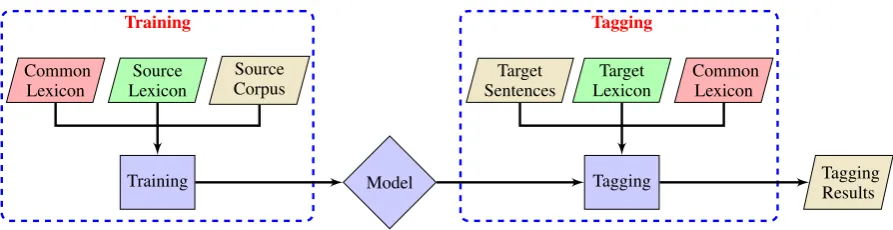
Figure 1: Architecture of our lexicon-based model for domain adaptation.
reduction on target-domain data when compared with source domain training. Their method is sim-ple to imsim-plement, and we take it as our baseline.
3 Type-Supervised Domain Adaptation
To give a formal definition of the domain adap-tation tasks, we denote by Cs a set of
anno-tated source-domain sentences,Ct a set of anno-tated target-domain sentences, and Lt an
anno-tated target-domain lexicon. The form ofLt is a
list of target-domain words, each associated with a set of POS tags.Token-superviseddomain adap-tation is the task of making use of Cs andCt to
improve target-domain performances, while type-superviseddomain adaptation is to make use ofCs
andLtinstead for the same purpose.
As described in the introduction, type-supervised domain adaptation is useful when annotated sentences are absent, but lexicons are available. In addition, it is an interesting question which type of annotation is more cost-effective when neither is available. We empirically com-pare the two approaches by proposing a novel method for type-supervised domain adaptation of a discriminate tagging model, showing that it can be a favourable choice in practical situation.
In particular, we split Chinese words into domain-independent and domain-specific cate-gories, and define unlexicalized features for domain-specific words. We train lexicalized independent and unlexicalized domain-specific features using the source domain anno-tated sentences and a source-domain lexicon, and then apply the resulting model to the target do-main by replacing the source-dodo-main lexicon with a target domain lexicon. Combined with unsu-pervised learning with unlabeled target-domain of sentences, the conceptually simple method worked highly effectively. Following Garrette and Baldridge (2013), we address practical questions
on type-supervised domain adaptation by compar-ison with token-supervised methods under similar human annotation efforts.
3.1 System Architecture
Our method is based on the intuition that domain-specific words of certain types (e.g. proper names) can behave similarly across domains. For exam-ple, consider the source-domain sentence “江 泽 民|NR (Jiang Zemin) 随后|AD (afterwards) 访
问|VV (visit) 上汽|NR (Shanghai Automobiles
Corp.)” and the target-domain sentence “碧 瑶|NR (Biyao) 随后|AD (afterwards) 来到|VV (arrive) 大竹峰|NR (the Bamboo Mountains)”. “江泽民(Jiang Zemin)” and “碧瑶 (Biyao)” are
person names in the two domains, respectively, whereas “上汽 (Shanghai Automobiles Corp.)”
and “大竹峰(the Bamboo Mountains)” are loca-tion names in the two domains, respectively. If the four words are simply treated as domain-specific nouns, the two sentences both have the pattern “hdomain-NRiAD VVhdomain-NRi”, and hence source domain training data can be useful in train-ing the distributions of the lexicon-based features for both domains.
sys-Action Lexicon Feature templates Separate in-lex(w−1),l(w−1)◦in-lex(w−1),
in-lex(w−1, t−1),l(w−1)◦in-lex(w−1, t−1)
Table 1: Dictionary features of the type-supervised model, wherew−1 andt−1 denote the
last word and POS tag of a partial result, re-spectively; l(w) denotes the length of the word
w; in-lex(w, t)denotes whether the word-tag pair (w, t)is in the lexicon.
tem is shown in Figure 1, where lexicons can be treated as “plugins” to the model for different mains, and one model trained from the source main can be applied to many different target do-mains, as long as a lexicon is available.
The method can be the most effective when there is a significant amount of domain-independent words in the data, which provide rich lexicalized contexts for estimating unlexicalized features for domain-specific words. For scientific domains (e.g. the biomedical domain) which share a significant proportion of common words with the news domain, and have most domain specific words being nouns (e.g. “糖尿病 (dia-betes)”), the method can be the most effective. We choose a comparatively difficult domain pair (e.g. modern news v.s. ancient style novel), for which the use of many word types are quite different. Results on this data can be relatively more indicative of the usefulness of the method.
3.2 Lexicon-Based Features
Table 1 shows the set of new unlexicalized fea-tures for the domain-specific lexicons. In addition to words and POS tags, length information is also encoded in the features, to capture different dis-tributions of different word sizes. For example, a one-character word in the dictionary might not be identified as confidently using the lexicon as a three-character word in the dictionary.
To acquire a domain-specific lexicon for the source domain, we use HowNet (Dong and Dong, 2006) to classify CTB words into domain-independent and domain-specific categories. Con-sisting of semantic information for nearly 100,000 common Chinese words, HowNet can serve as a resource of domain-independent Chinese words. We choose out of all words in the source domain training data those that also occur in HowNet for domain-independent words, and out of the
remain-ing words those that occur more than 3 times for words specific to the source domain. We assume that the domain-independent lexicon applies to all target domains also. For some target domains, we can obtain domain-specific terminologies eas-ily from the Internet. However, this can be a very small portion depending on the domain. Thus, it may still be necessary to obtain new lexicons by manual annotation.
3.3 Lexicon and Self-Training
The lexicon-based features can be combined with unsupervised learning to further improve target-domain accuracies. We apply self-training on top of the lexicon-based features in the following way: we train a lexicon-based model M using a lexi-conLs of the source domain, and then apply M
together with a target-domain lexiconLtto auto-matically label a set of target domain sentences. We combine the automatically labeled target sen-tences with the source-domain training data to ob-tain an extended set of training data, and train a final modelMself, using the lexiconLsandLtfor
source- and target-domain data, respectively. Different numbers of target domain sentences can be used for self-training. Liu and Zhang (2012) showed that an increased amount of tar-get sentences do not constantly lead to improved development accuracies. They use character per-plexity to order target domain sentences, taking the topK sentences for self-training. They eval-uate the optimal development accuracies using a range of differentKvalues, and select the bestK
for a final model. This method gave better results than using sentences in the internet novel in their original order (Liu and Zhang, 2012). We follow this method in ranking target domain sentences.
4 Experiments
4.1 Setting
We use annotated sentences from the CTB5 for source-domain training, splitting the corpus into training, development and test sections in the same way as previous work (Kruengkrai et al., 2009; Zhang and Clark, 2010; Sun, 2011).
Ex-CTB sentences ZX sentences
乔石会见俄罗斯议员团 天下之大,无奇不有,山川灵秀,亦多妖魔鬼怪。
(Qiaoshi meets the Russian delegates.) (The world was big. It held everything. There were fascinating 李鹏强调要加快推行公务员制度 landscapes. There were haunting ghosts.)
(Lipeng stressed on speeding the reform of official regulations.) 时间无多,我去请出诛仙古剑。
中国化学工业加快对外开放步伐 (No time left. Let me call out Zhuxian, the ancient sword.)
(Chinese chemistry industry increases the pace of opening up.) 忽听得狂笑风起,法宝异光闪动。(There came suddenly
[image:5.595.98.501.61.163.2]a gust of wind, out of which was laughters and magic flashes.)
Table 2: Example sentences from CTB and ZX to illustrate the differences between news and novel.
Data Set Chap. IDs # sents # words
CTB5
Train 1-270, 400-931, 10,086 493,930 1001-1151
Devel 301-325 350 6,821 Test 271-300 348 8,008
ZX
Train 6.6-6.10, 2,373 67,648 7.6-7.10, 19
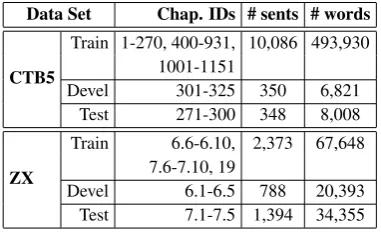
Devel 6.1-6.5 788 20,393 Test 7.1-7.5 1,394 34,355 Table 3: Corpus statistics.
ample sentences from the two corpora are shown in Table 2. Liu and Zhang (2012) manually anno-tated 385 sentences as development and test data, which we download from their website.1 These data follow the same annotation guidelines as the Chinese Treebank (Xue et al., 2000).
To gain more reliable statistics in our results, we extend their annotation work to a total 4,555 sentences, covering the sections 6, 7 and 19 of the novel. The annotation work is based on the auto-matically labeled sentences by our baseline model trained with CTB5 corpus. It took an experienced native speaker 80 hours, about one minute on av-erage to annotate one sentence. We use chapters 1-5 of section 6 as the development data, chap-ters 1-5 of section 7 as the test data, and the re-maining data for target-domain training,2 in order to compare type-supervised methods with token-supervised methods. Under permission from the author of the novel, we release our annotation for future reference. Statistics of both the source and the target domain data are shown in Table 3. The rest of the novel is treated as unlabeled sentences, used for type-annotation and self-training.
We perform the standard evaluation, using F-scores for both the segmentation accuracy and the
1http://faculty.sutd.edu.sg/˜yue zhang/emnlp12yang.zip 2We only use part of the training sentences in our experi-ments, and the remaining can be used for further research.
overall segmentation and POS tagging accuracy.
4.2 Baseline Performances
The baseline discriminative model can achieve state-of-the-art performances on the CTB5, with a 97.62% segmentation accuracy and a 93.85% on overall segmentation and tagging accuracy. Using the CTB model, the performance on ZX drops sig-nificantly, to a 87.71% segmentation accuracy and a 80.81% overall accuracy. Applying self-training, the segmentation and overall F-scores can be im-proved to 88.62% and 81.94% respectively.
4.3 Development Experiments
In this section, we study type-supervised domain adaptation by conducting a series of experiments on the development data, addressing the follow-ing questions. First, what is the influence of tag-dictionaries through lexicon-based features? Sec-ond, what is the effect of type-supervised domain adaptation in contrast to token-supervised domain adaptation under the same annotation cost? Third, what is the interaction between tag-dictionary and self-training? Finally, what is the combined effect of type- and token-supervised domain adaptation?
4.3.1 The Influence of The Tag Dictionary
We investigate the effects of two different tag dic-tionaries. The first dictionary contains names of characters (e.g. 鬼厉 (Guili)) and artifacts (e.g. swords such as斩龙(Dragonslayer)) in the novel, which are obtained from an Internet Encyclope-dia,3 and requires little human effort. We ex-tracted 159 words from this page, verified them, and put them into a tag dictionary. We associate every word in this tag dictionary with the POS “NR (proper noun)”, and name the lexicon byNR. The second dictionary was constructed man-ually, by first employing our baseline tagger to tag the unlabeled ZX sentences automatically,
[image:5.595.86.277.209.325.2]Model Target-Domain Cost Supervised +Self-Training
Resources SEG POS SEG POS ER
Baseline — 0 89.77 82.92 90.35 83.95 6.03
Type-Supervision NR(T)3K(T) 5h0 89.8491.93 83.9186.53 91.1892.86 85.2287.67 8.148.46 ORACLE(T) ∞ 93.10 88.87 94.00 89.91 9.34
[image:6.595.113.481.61.205.2]Token-Supervision 300(S)600(S) 10h5h 92.5993.19 86.8688.13 93.3393.81 87.8589.01 7.537.41 900(S) 15h 93.53 88.53 94.15 89.33 6.97 Combined 3K(T) + 300(S) 10h 93.49 88.54 94.00 89.21 5.85 Type- and Token-Supervision 3K(T) + 600(S) 15h 93.98 89.27 94.61 89.87 5.59
Table 4: Development test results, whereCostdenotes the cost of type- or token-annotation measured by person hours, ERdenotes the error reductions of overall performances brought by self-training,T
denotes type-annotation andSdenotes token-annotation.
and then randomly selecting the words that are not domain-independent for an experienced native speaker to annotate. To facilitate comparison with token-supervision, we spent about 5 person hours in annotating 3,000 word-tag pairs, at about the same cost as annotating 300 sentences. Finally we conjoined the 3,000 word-tag pairs with the NR
lexicon, and name the resulting lexicon by3K. For the target domain, we mark the words from bothNRand3K as thedomain-specificlexicons. In all experiments, we use the same domain-independent lexicon, which is extracted from the source domain training data by HowNet matching. The accuracies are shown in Table 4, where the NR lexicon improved the overall F-score slightly over the baseline, and the larger lexicon
3Kbrought more significant improvements. These experiments agree with the intuition that the size and the coverage of the tag dictionary is impor-tant to the accuracies. To understand the extent to which a lexicon can improve the accuracies, we perform an oracle test, in which lexicons in the gold-standard test outputs are included in the dic-tionary. The accuracy is 88.87%.
4.3.2 Comparing Type-Supervised and Token-Supervised Domain Adaptation
Table 4 shows that the accuracy improvement by 3,000 annotated word-tag pairs (86.53%) is close to that by 300 annotated sentences (86.86%). This suggest that using our method, type-supervised domain adaptation can be a competitive choice to the token-supervised methods.
The fact that the token-supervised model gives slightly better results than our type-annotation method under similar efforts can probably be
ex-0.6 0.7 0.8 0.9 1 0.6
0.7 0.8 0.9 1
Token-Supervision with 300(S)
Type-Super
vision
with
3K(T)
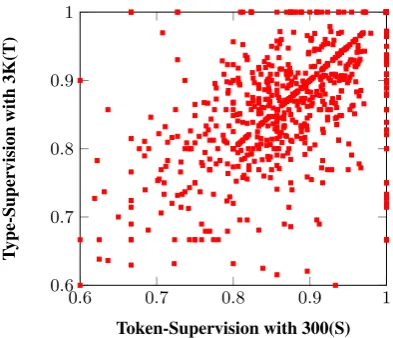
Figure 2: Sentence accuracy comparisons for type- and token-supervision with equal cost.
plained by the nature of domain differences. Texts in the Internet novel are different with CTB news in not only the vocabulary, but also POS n-gram distributions. The latter cannot be transferred from the source-domain training data directly. Texts from domains such as modern-style novels and scientific articles might have more similar POS distributions to the CTB data, and can potentially benefit more from pure lexicons. We leave the ver-ification of this intuition to future work.
4.3.3 Making Use of Unlabeled Sentences
[image:6.595.309.506.280.449.2]Interestingly, the effects of the two methods on self-training are slightly different. The er-ror reduction by self-training improves from 6.0% (baseline) to averaged 7.3% and 8.6% for token-and type-supervised adaptation, respectively. The better effect for the type-supervised method may result from comparatively more uniform cover-age of the lexicon on sentences, since the target-domain lexicon is annotated by selecting words from much more than 300 sentences.
4.3.4 Combined Model of Type- and Token-Supervision
Figure 2 shows the F-scores of each development test sentence by type- and token-supervised do-main adaptation with 5 person hours, respectively. It indicates that the two methods make different types of errors, and can potentially be used jointly for better improvements. We conduct a set of ex-periments as shown in Table 4, finding that the combined type- and token-supervised model with lexicon 3K and 300 labeled sentences achieves an overall accuracy of 88.54%, exceeding the ac-curacies of both the type-supervised model with lexicon 3K and the token-supervised model with 300 labeled sentences. Similar observation can be found for the combined model with lexicon3K
and 600 labeled sentences. If combined with self-training, the same fact can be observed.
More interestingly, the combined model also exceeds pure type- and token-supervised mod-els with the same annotation cost. For exam-ple, the combined model with 3K and 300 la-beled sentences gives a better accuracy than the token-supervised model with 600 sentences, with or without self-training. Similar observations hold between the combined model with3Kand 600 la-beled sentences and the token-supervised model with 900 sentences. The results suggest that the most cost-effective approach for domain adapta-tion can be combined type- and token-supervision: after annotating a set of raw sentences, one could stop to annotate some words, rather than continu-ing sentence annotation.
4.4 Final Results
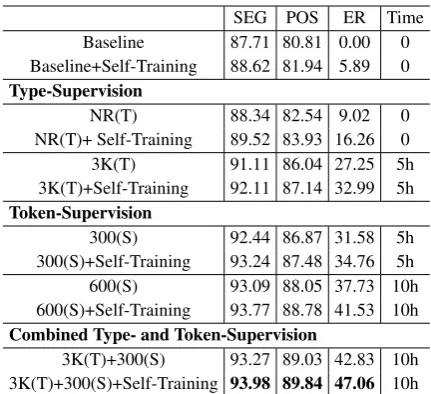
Table 5 shows the final results on test corpus within ten person hours’ annotation. With five per-son hours (lexicon3K), the type-supervised model gave an error reduction of 32.99% compared with the baseline. The best result was obtained by the combined type- and token-supervised model, with
SEG POS ER Time Baseline 87.71 80.81 0.00 0 Baseline+Self-Training 88.62 81.94 5.89 0 Type-Supervision
NR(T) 88.34 82.54 9.02 0
NR(T)+ Self-Training 89.52 83.93 16.26 0 3K(T) 91.11 86.04 27.25 5h 3K(T)+Self-Training 92.11 87.14 32.99 5h Token-Supervision
300(S) 92.44 86.87 31.58 5h 300(S)+Self-Training 93.24 87.48 34.76 5h 600(S) 93.09 88.05 37.73 10h 600(S)+Self-Training 93.77 88.78 41.53 10h Combined Type- and Token-Supervision
[image:7.595.308.524.60.257.2]3K(T)+300(S) 93.27 89.03 42.83 10h 3K(T)+300(S)+Self-Training 93.98 89.84 47.06 10h Table 5: Final results on test set within ten per-son hours’ annotation, whereERdenotes the over-all error reductions compared with the baseline model, Time denotes the cost of type- or token-annotation measured by person hours, Tdenotes type-annotation andSdenotes token-annotation.
an error reduction of 47.06%, higher than that the token-supervised model with the same cost under the same setting (the model of 600 labeled sen-tences with an error reduction of 41.53%). The results confirm that the type-supervised model is a competitive alternative for joint segmenta-tion and POS-tagging under the cross-domain set-ting. Combined type- and token-supervised model yields better results than single models.
5 Related Work
with Garrette et al. (2013), we also find that the type-supervised method is a competitive choice to token-supervised adaptation.
There has been a line of work on using graph-based label propagation to expand tag-lexicons for POS-tagging (Subramanya et al., 2010; Das and Petrov, 2011). Similar methods have been ap-plied to character-level Chinese tagging (Zeng et al., 2013). We found that label propagation from neither the source domain nor auto-labeled target domain sentences can improve domain adaptation. The main reason could be significant domain dif-ferences. Due to space limitations, we omit this negative result in our experiments.
With respect to domain adaptation, existing methods can be classified into three categories. The first category does not explicitly model dif-ferences between the source and target domains, but use standard semi-supervised learning meth-ods with labeled source domain data and unla-beled target domain data (Dai et al., 2007; Raina et al., 2007). The baseline self-training ap-proach (Liu and Zhang, 2012) belongs to this cat-egory. The second considers the differences in the two domains in terms of features (Blitzer et al., 2006; Daume III, 2007), classifying features into domain-independent source domain and target do-main groups and training these types consistently. The third considers differences between the dis-tributions of instances in the two domains, treat-ing them differently (Jiang and Zhai, 2007). Our type-supervised method is closer to the second cat-egory. However, rather than splitting features into domain-independent and domain-specific types, we use domain-specific dictionaries to capture do-main differences, and train a model on the source domain only. Our method can be treated as an ap-proach specific to the POS-tagging task.
With respect to Chinese lexical analysis, lit-tle previous work has been reported on using a tag dictionary to improve joint segmentation and POS-tagging. There has been work on using a lexicon in improving segmentation in a Chinese analysis pipeline. Peng et al. (2004) used fea-tures from a set of Chinese words and characters to improve CRF-based segmentation; Low et al. (2005) extracted features based on a Chinese lex-icon from Peking University to help a maximum segmentor; Sun (2011) collected 12,992 idioms from Chinese dictionaries, and used them for rule-based pre-segmentation; Hatori et al. (2012)
col-lected Chinese words from HowNet and the Chi-nese Wikipedia to enhance segmentation accura-cies of their joint dependency parsing systems. In comparison with their work, our lexicon contain additional POS information, and are used for word segmentation and POS-tagging simultaneously. In addition, we separate domain-dependent lexicons for the source and target lexicons, and use a novel framework to perform domain adaptation.
Wang et al. (2011) collect word-tag statistics from automatically labeled texts, and use them as features to improve POS-tagging. Their word-tag statistics can be treated as a type of lexicon. How-ever, their efforts differ from ours in several as-pects: (1) they focus on in-domain POS-tagging, while our concern is cross-domain tagging; (2) they study POS-tagging on segmented sentences, while we investigate joint segmentation and POS-tagging for Chinese; (3) their tag-dictionaries are not tag-dictionaries literally, but statistics of word-tag associations.
6 Conclusions
We performed an empirical study on the use of tag-dictionaries for the domain adaptation of joint Chinese segmentation and POS-tagging, showing that type-supervised methods can be a compet-itive alternative to token-supervised methods in cost-effectiveness. In addition, combination of the two methods gives the best cost-effect. Finally, we release our annotation of over 4,000 sentences in the Internet literature domain
on-line at http://faculty.sutd.edu.sg/
˜yue_zhang/eacl14meishan.zip as a
free resource for Chinese POS-tagging.
Acknowledgments
References
Michele Banko and Robert C. Moore. 2004. Part-of-speech tagging in context. InCOLING.
John Blitzer, Ryan McDonald, and Fernando Pereira. 2006. Domain adaptation with structural correspon-dence learning. In Proceedings of the 2006 Con-ference on Empirical Methods in Natural Language Processing, pages 120–128, Sydney, Australia, July. Association for Computational Linguistics.
Christos Christodoulopoulos, Sharon Goldwater, and Mark Steedman. 2010. Two decades of unsu-pervised POS induction: How far have we come? In Proceedings of the 2010 Conference on Empiri-cal Methods in Natural Language Processing, pages 575–584, Cambridge, MA, October. Association for Computational Linguistics.
Michael Collins and Brian Roark. 2004. Incremen-tal parsing with the perceptron algorithm. In Pro-ceedings of the 42nd Meeting of the Association for Computational Linguistics (ACL’04), Main Volume, pages 111–118, Barcelona, Spain, July.
Wenyuan Dai, Gui-Rong Xue, Qiang Yang, and Yong Yu. 2007. Transferring Naive Bayes Classifiers for Text Classification. InAAAI, pages 540–545.
Dipanjan Das and Slav Petrov. 2011. Unsuper-vised part-of-speech tagging with bilingual graph-based projections. In Proceedings of the 49th An-nual Meeting of the Association for Computational Linguistics: Human Language Technologies, pages 600–609, Portland, Oregon, USA, June. Association for Computational Linguistics.
Hal Daume III. 2007. Frustratingly easy domain adap-tation. InProceedings of the 45th Annual Meeting of the Association of Computational Linguistics, pages 256–263, Prague, Czech Republic, June. Associa-tion for ComputaAssocia-tional Linguistics.
Zhendong Dong and Qiang Dong. 2006. Hownet And the Computation of Meaning. World Scientific Pub-lishing Co., Inc., River Edge, NJ, USA.
Dan Garrette and Jason Baldridge. 2012. Type-supervised hidden markov models for part-of-speech tagging with incomplete tag dictionaries. In EMNLP-CoNLL, pages 821–831.
Dan Garrette and Jason Baldridge. 2013. Learning a part-of-speech tagger from two hours of annotation. InProceedings of the 2013 Conference of the North American Chapter of the Association for Computa-tional Linguistics: Human Language Technologies, pages 138–147, Atlanta, Georgia, June. Association for Computational Linguistics.
Dan Garrette, Jason Mielens, and Jason Baldridge. 2013. Real-world semi-supervised learning of pos-taggers for low-resource languages. In Proceed-ings of the 51st Annual Meeting of the Association
for Computational Linguistics (Volume 1: Long Pa-pers), pages 583–592, Sofia, Bulgaria, August. As-sociation for Computational Linguistics.
Yoav Goldberg, Meni Adler, and Michael Elhadad. 2008. EM can find pretty good HMM POS-taggers (when given a good start). InProceedings of ACL-08: HLT, pages 746–754, Columbus, Ohio, June. Association for Computational Linguistics.
Sharon Goldwater and Tom Griffiths. 2007. A fully bayesian approach to unsupervised part-of-speech tagging. In Proceedings of the 45th Annual Meet-ing of the Association of Computational LMeet-inguistics, pages 744–751, Prague, Czech Republic, June. As-sociation for Computational Linguistics.
Jun Hatori, Takuya Matsuzaki, Yusuke Miyao, and Jun’ichi Tsujii. 2012. Incremental joint approach to word segmentation, pos tagging, and dependency parsing in chinese. InProceedings of the 50th An-nual Meeting of the Association for Computational Linguistics (Volume 1: Long Papers), pages 1045– 1053, Jeju Island, Korea, July. Association for Com-putational Linguistics.
Canasai Kruengkrai, Kiyotaka Uchimoto, Jun’ichi Kazama, Yiou Wang, Kentaro Torisawa, and Hitoshi Isahara. 2009. An error-driven word-character hy-brid model for joint chinese word segmentation and pos tagging. In Proceedings of the Joint Confer-ence of the 47th Annual Meeting of the ACL and the 4th International Joint Conference on Natural Lan-guage Processing of the AFNLP, pages 513–521, Suntec, Singapore, August. Association for Compu-tational Linguistics.
Yang Liu and Yue Zhang. 2012. Unsupervised domain adaptation for joint segmentation and POS-tagging. In Proceedings of COLING 2012: Posters, pages 745–754, Mumbai, India, December. The COLING 2012 Organizing Committee.
Jin Kiat Low, Hwee Tou Ng, and Wenyuan Guo. 2005. A maximum entropy approach to chinese word seg-mentation. In Proceedings of the Fourth SIGHAN Workshop on Chinese Language Processing, pages 161–164.
Christopher D. Manning. 2011. Part-of-speech tag-ging from 97% to 100%: is it time for some linguis-tics? InProceeding of CICLing’11.
Bernard Merialdo. 1994. Tagging english text with a probabilistic model. Computational Linguistics, 20(2).
Fuchun Peng, Fangfang Feng, and Andrew McCallum. 2004. Chinese segmentation and new word detec-tion using condidetec-tional random fields. InProceedings of Coling 2004, pages 562–568, Geneva, Switzer-land, Aug 23–Aug 27. COLING.
Slav Petrov, Dipanjan Das, and Ryan McDonald. 2012. A universal part-of-speech tagset. InProceedings of LREC, May.
Rajat Raina, Alexis Battle, Honglak Lee, Benjamin Packer, and Andrew Y. Ng. 2007. Self-taught learn-ing: transfer learning from unlabeled data. InICML, pages 759–766.
Sujith Ravi and Kevin Knight. 2009. Minimized models for unsupervised part-of-speech tagging. In ACL/IJCNLP, pages 504–512.
Amarnag Subramanya, Slav Petrov, and Fernando Pereira. 2010. Efficient graph-based semi-supervised learning of structured tagging models. In Proceedings of the 2010 Conference on Empiri-cal Methods in Natural Language Processing, pages 167–176, Cambridge, MA, October. Association for Computational Linguistics.
Weiwei Sun. 2011. A stacked sub-word model for joint chinese word segmentation and part-of-speech tagging. In Proceedings of the 49th Annual Meet-ing of the Association for Computational LMeet-inguis- Linguis-tics: Human Language Technologies, pages 1385– 1394, Portland, Oregon, USA, June. Association for Computational Linguistics.
Oscar T¨ackstr¨om, Dipanjan Das, Slav Petrov, McDon-ald Ryan, and Joakim Nivre. 2013. Token and type constraints for cross-lingual part-of-speech tagging. InTransactions of the ACL. Association for Compu-tational Linguistics, March.
Partha Pratim Talukdar and Koby Crammer. 2009. New regularized algorithms for transductive learn-ing. InECML/PKDD (2), pages 442–457.
Kristina Toutanova and Mark Johnson. 2007. A bayesian lda-based model for semi-supervised part-of-speech tagging. InNIPS.
Yiou Wang, Jun’ichi Kazama, Yoshimasa Tsuruoka, Wenliang Chen, Yujie Zhang, and Kentaro Tori-sawa. 2011. Improving chinese word segmentation and pos tagging with semi-supervised methods using large auto-analyzed data. InProceedings of 5th In-ternational Joint Conference on Natural Language Processing, pages 309–317, Chiang Mai, Thailand, November. Asian Federation of Natural Language Processing.
Nianwen Xue, Fei Xia, Shizhe Huang, and Tony Kroch. 2000. The bracketing guidelines for the chinese treebank. Technical report, University of Pennsyl-vania.
Nianwen Xue, Fei Xia, Fu-Dong Chiou, and Martha Palmer. 2005. The penn chinese treebank: Phrase structure annotation of a large corpus. Natural Lan-guage Engineering, 11(2):207–238.
Xiaodong Zeng, Derek F. Wong, Lidia S. Chao, and Is-abel Trancoso. 2013. Graph-based semi-supervised model for joint chinese word segmentation and part-of-speech tagging. In Proceedings of the 51st An-nual Meeting of the Association for Computational Linguistics (Volume 1: Long Papers), pages 770– 779, Sofia, Bulgaria, August. Association for Com-putational Linguistics.
Yue Zhang and Stephen Clark. 2008. Joint word seg-mentation and POS tagging using a single percep-tron. InProceedings of ACL-08: HLT, pages 888– 896, Columbus, Ohio, June. Association for Com-putational Linguistics.
Yue Zhang and Stephen Clark. 2010. A fast decoder for joint word segmentation and POS-tagging using a single discriminative model. InProceedings of the 2010 Conference on Empirical Methods in Natural Language Processing, pages 843–852, Cambridge, MA, October. Association for Computational Lin-guistics.