Regularized Structured Perceptron:
A Case Study on Chinese Word Segmentation, POS Tagging and Parsing
Kaixu Zhang Xiamen University
Fujian, P.R. China
Jinsong Su Xiamen University
Fujian, P.R. China
Changle Zhou Xiamen University
Fujian, P.R. China
Abstract
Structured perceptron becomes popular for various NLP tasks such as tagging and parsing. Practical studies on NLP did not pay much attention to its regularization. In this paper, we study three simple but effec-tive task-independent regularization meth-ods: (1) one is to average weights of dif-ferent trained models to reduce the bias caused by the specific order of the train-ing examples; (2) one is to add penalty term to the loss function; (3) and one is to randomly corrupt the data flow during training which is called dropout in the neu-ral network. Experiments are conducted on three NLP tasks, namely Chinese word segmentation, part-of-speech tagging and dependency parsing. Applying proper reg-ularization methods or their combinations, the error reductions with respect to the av-eraged perceptron for some of these tasks can be up to 10%.
1 Introduction
Structured perceptron is a linear classification al-gorithm. It is used for word segmentation (Zhang and Clark, 2011), POS (part-of-speech) tagging (Collins, 2002), syntactical parsing (Collins and Roark, 2004), semantical parsing (Zettlemoyer and Collins, 2009) and other NLP tasks.
The averaged perceptron or the voted percep-tron (Collins, 2002) is proposed for better gener-alization. Early update (Collins and Roark, 2004; Huang et al., 2012) is used for inexact decod-ing algorithms such as the beam search. Dis-tributed training (McDonald et al., 2010) and the minibatch and parallelization method (Zhao and
Huang, 2013) are recently proposed. Some other related work focuses on the task-specified feature engineering.
Regularization is to improve the ability of generalization and avoid over-fitting for machine learning algorithms including online learning al-gorithms (Do et al., 2009; Xiao, 2010). But prac-tical studies on NLP did not pay much attention to the regularization of the structured perceptron. As a result, for some tasks the model learned using perceptron algorithm is not as good as the model learned using regularized condition random field.
In this paper, we treat the perceptron algorithm as a special case of the stochastic gradient de-scent (SGD) algorithm and study three kinds of simple but effective task-independent regulariza-tion methods that can be applied. Theaveraging
method is to average the weight vectors of differ-ent models. We propose a “shuffle-and-average” method to reduce the bias caused by the specific order of the training examples. The traditional
penaltymethod is to add penalty term to the loss function. Thedropoutmethod is to randomly cor-rupt the data flow during training. We show that this dropout method originally used in neural net-work also helps the structured perceptron.
In Section 2, we describe the perceptron algo-rithm as a special case of the stochastic gradient descent algorithm. Then we discuss three kinds of regularization methods for structured perceptron in Section3, 4and 5, respectively. Experiments conducted in Section6 shows that these regular-ization methods and their combinations improve performances of NLP tasks such as Chinese word segmentation, POS tagging and dependency pars-ing. Applying proper regularization methods, the error reductions of these NLP tasks can be up to 10%. We finally conclude this work in Section7.
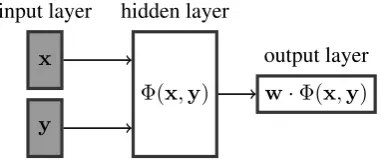
w·Φ(x,y)
output layer
Φ(x,y)
x
input layer
y
[image:2.595.89.280.65.146.2]hidden layer
Figure 1: A structured perceptron can be seen as a multi-layer feed-forward neural network.
2 Structured Perceptron
We treat the structured perceptron architecture as a multi-layer feed-forward neural network as in Figure 1 and treat the perceptron algorithm as a special case of the stochastic gradient descent al-gorithm in order to describe all the regularization methods.
The network of the structured perceptron has three layers. The input vectorxand output vector
yof the structured classification task are concate-nated as the input layer. The hidden layer is the feature vectorΦ(x,y). The connections between the input layer and the hidden layer are usually hand-crafted and fixed during training and predict-ing. And the output layer of the network is a scalar
w·Φ(x,y)which is used to evaluate the matching of the vectorxandy.
Besides the common process to calculate the output layer given the input layer, there is a pro-cess called decoding, which is to find a vectorzto maximum the activation of the output layer:
zi= arg max
z w·Φ(xi,z) (1) By carefully designing the feature vector, the de-coding can be efficiently performed using dynamic programming. Beam search is also commonly used for the decoding of syntactical parsing tasks. In the predicting precess, the vector z is the structured output corresponding tox. In the train-ing precess, what we expect is that for every input
xi, the vectorzi that maximums the activation of the output layer is exactly the gold standard output
yi.
We define the loss function as the sum of the margins of the whole training data:
L(w) =X
i
{w·Φ(xi,zi)−w·Φ(xi,yi)}
=wX
i ·∆Φi
(2)
where
∆Φi= Φ(xi,zi)−Φ(xi,yi) (3) The unconstrained optimization problem of the training process is
arg min
w L(w) (4) The loss function is not convex but calculating the derivative is easy. One of the algorithms to solve this optimization problem is SGD. Here we use the minibatch with size of 1, which means in every iteration we use only one training example to approximate the loss function and the gradient to update the weight vector:
w(t+1) ←w(t)−η ∂L
∂w
w(t) ≈w
(t)−η∆Φ(t)
(5) where w(t) is the weight vector after t updates.
Note that in this case, the learning rateηcan be set to an arbitrary positive real number. In the percep-tron algorithm commonly used in NLP (Collins, 2002) ,η is not changed respect tot. We fixη to be1in this paper without loss of generality. 3 Averaging
3.1 Averaged Perceptron
Averaging the weight vectors in the learning pro-cess is one of the most popular regularization techniques of the structured perceptron (Collins, 2002). And it is also the only used regulariza-tion technique for many practical studies on NLP (Jiang et al., 2009; Huang and Sagae, 2010).
Suppose the learning algorithm stopped afterT updates. The final weight vector is calculated as:
w= T1 XT
t=1
w(t) (6)
The intuition might be that the learned weight vector is dependent on the order of the training ex-amples. The final vector w(T) may be more
ap-propriate for the last few training examples than the previous ones. The averaging method is used to avoid such tendency. Similar treatment is used in other sequential algorithm such as the Markov chain Monte Carlo sampling method.
3.2 Shuffle and Average
As we has mentioned that the learned weight vec-tor is strongly dependent on the order of the train-ing examples, randomly shuffltrain-ing the traintrain-ing ex-amples results in different weight vectors. Based on such observation, we training different weight vectors using the same training examples with dif-ferent orders, and average them to get the final weight vector. We use this method to further min-imize the side effect caused by this online algo-rithm.
Suppose we shuffle and trainndifferent weight vectorsw[1], . . . ,w[n], thej-th component of the
final vector can be simply calculated as
wj = Pn
i=1w[ji]
n (7)
Note that generally these models do not share the same feature set. Features may be used in one model but not in another one. Whenwj[i] = 0, it does not imply that this feature has no effect on this problem. It only implies that this feature does not have chances to be tested. We propose a modi-fied equation to only average the non-zero compo-nents:
wj =
Pn i=1w[ji]
{i|w[ji]= 06 , i= 1,· · · , n} (8)
This equation makes the low-frequency features more important in the final model.
4 Penalty
Adding penalty term to the loss function is a com-mon and traditional regularization method to avoid over-fitting. It is widely used for the optimization problems of logistic regression, support vector machine, conditional random field and other mod-els. Penalty terms for probabilistic models can be interpreted as a prior over the weights (Chen and Rosenfeld, 1999). It is also called “weight decay” in artificial neural network (Moody et al., 1995). The use of the penalty term is to prevent the com-ponents of the weight vector to become too large.
In Section2we have modeled the perceptron al-gorithm as an SGD alal-gorithm with an explicit loss function, the additional penalty term is therefore easy to be employed.
4.1 L2-norm penalty
We can add a square of the L2-norm of the weight vector as the penalty term to the loss function as
L=w·X i
∆Φi+λ22kwk22 (9)
where λ2 is a hyper-parameter to determine the
strength of the penalty.
In the SGD algorithm, the update method of the weight vector is thus
w(t+1)←(1−ηλ2)w(t)−η∆Φ(t) (10)
The term(1−ηλ2)is used to decay the weight in
every updates. This forces the weights to be close to zero.
4.2 L1-norm penalty
Another commonly used penalty term is the L1-norm of the weight vector. This kinds of terms usually results in sparse weight vector. Since the averaged perceptron is used, the final averaged weight vector will not be sparse.
The loss function using the L1-nrom penalty is
L=w·X i
∆Φi+λ1kwk1 (11)
whereλ1 is the hyper-parameter to determine the
strength of the penalty.
The derivative of the penalty term is discontin-uous. We update the weights as
w(it+1)← max{0,|wi(t)| −ηλ1}
|w(it)| w
(t)
i −η∆φ(it) (12) This ensures that the weight decay will not change the sign of the weight.
An modified version of the L1 penalty for the online learning is the cumulative L1 penalty (Tsu-ruoka et al., 2009), which is used to make the stochastic gradient of the penalty term more close to the true gradient. The update is divided into two steps. In the first step, the weight vector is updated according to the loss function without the penalty term
w(t+12)
i ←w(it)−η∆φ(it) (13) And the cumulative penalty is calculated sepa-rately
c(t+12)
In the second step, |wi|andci are compared and at most one of them is non-zero before the next update
m ←min{|w(t+12) i |, c(t+
1 2)
i } (15)
w(it+1) ← max{0,|w(it+ 12 )|−m}
|w(it+ 12 )| w
(t+1 2) i (16)
c(it+1) ←c(t+12)
i −m (17)
5 Dropout
Dropout (Hinton et al., 2012) is originally a regu-larization method used for the artificial neural net-work. It corrupts one or more layers of a feed-forward network during training, by randomly omitting some of the neurons. If the input layer is corrupted during the training of an autoencoder, the model is called denoising autoencoder (Vin-cent et al., 2008).
The reason why such treatment can regularize the parameters are explained in different ways. Hinton et al. (2012) argued that the final model is an average of a large number of models and the dropout forces the model to learn good features which are less co-adapted. Vincent et al. (2008) argued that by using dropout of the input layer, the model can learn how to deal with examples out-side the low-dimensional manifold that the train-ing data concentrate.
Models not so deep such as the structured per-ceptron may also benefit from this idea. Follow-ing the dropout method used in neural network, we give the similar method for structured perceptron.
5.1 Input Layer
We can perform dropout for structured perceptron by corrupting the input layer in Figure 1. Since we concern that whatyexactly is, we only corrupt
x. The components of the corrupted vector x˜ is calculated as
˜
xi =xini (18)
whereni ∼Bern(p)obey a Binomial distribution with the hyper-parameterp.
During training, the decoding processing with the corrupted input is
z= arg max
z w·Φ(˜x,z) (19)
Thexin the loss function is also substituted with the corrupted versionx˜.
Note that the corruption decreases the number of non-zero components of the feature vectorΦ, which makes the decoding algorithm harder to find the gold standardy.
For NLP tasks, the input vector x could be a sequence of tokens (words, POS tags, etc.). The corruption substitutes some of the tokens with a special tokennull. Any features contain such to-ken will be omitted (This is also the case for the out-of-vocabulary words during predicting). So the dropout of x in NLP during training can be explained as to randomly mask some of the input tokens. The decoder algorithm needs to find out the correct answer even if some parts of the input are unseen. This harder situation could force the learning algorithm to learn better models.
5.2 Hidden Layer
The dropout can also be performed at the hidden layer. Likewise, the components of the corrupted feature vector ˜Φis calculated as
˜
φi =φimi (20)
wheremi ∼Bern(q)obey a Binomial distribution with the hyper-parameterq.
TheΦin the decoding processing during train-ing and the loss function is substituted with ˜Φ. 6 Experiments
In this section, we first introduce three NLP tasks using structured perceptron namely Chinese word segmentation, POS tagging and dependency pars-ing. Then we investigate the effects of regular-ization methods for structured perceptron mainly on the development set of character-based Chinese word segmentation. Finally, we compare the final performances on the test sets of these three tasks using regularization methods with related work. 6.1 Tasks
6.1.1 Chinese Word Segmentation
A Chinese word consists of one or more Chinese characters. But there is no spaces in the sentences to indicating words. Chinese word segmentation is the task to segment words in the sentence.
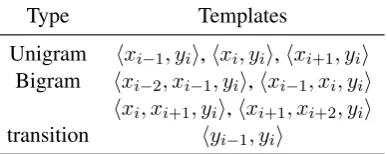
Type Templates
Unigram hxi−1, yii,hxi, yii,hxi+1, yii Bigram hxi−2, xi−1, yii,hxi−1, xi, yii
hxi, xi+1, yii,hxi+1, xi+2, yii transition hyi−1, yii
Table 1: Feature templates for the character-based Chinese word segmentation model and the joint Chinese word segmentation and POS tagging model.
tagS indicates that the character forms a single-character words; tagB/Eindicates that the char-acter is at the beginning / end of a multi-charchar-acter words; tagMindicates that the character is in the middle of a multi-character words.
For example, if the tag sequence for the input
x=菊次郎的夏天 (21)
is
y= BMESBE, (22) the corresponding segmentation result is
菊次郎 的 夏天. (23)
Table 1 shows the set of the feature templates which is a subset of some related work (Ng and Low, 2004; Jiang et al., 2009) .
Following Sun (2011), we split the Chinese treebank 5 into training set, development set and test set. F-measure (Emerson, 2005) is used as the measurement of the performance.
6.1.2 Part-of-Speech Tagging
The second task is joint Chinese word segmenta-tion and POS tagging. This can also be modeled as a character-based sequence labeling task.
The tag set is a Cartesian product of the tag set for Chinese word segmentation and the set of POS tags. For example, the tag B-NN indicates the character is the first character of a multi-character noun. The tag sequence
y= B-NR M-NR E-NR S-DEG B-NN E-NN, (24) for the input sentence in Equation (21) results in
菊次郎 NR 的 DEG 夏天 NN. (25)
The same feature templates shown in Table 1
are used for joint Chinese word segmentation and POS tagging.
Also, we use the same training set, development set and test set based on CTB5 corpus as the Chi-nese word segmentation task. F-measure for joint Chinese word segmentation and POS tagging is used as the measurement of the performance. 6.1.3 Dependency Parsing
The syntactical parsing tasks are different with previously introduced tagging tasks. To investi-gate the effects of regularization methods on the parsing tasks, we fully re-implement the linear-time incremental shift-reduce dependency parser by Huang and Sagae (2010). The structure per-ceptron is used to train such model. The model totally employs 28 feature templates proposed by Huang and Sagae (2010).
Since the search space for parsing tasks is quite larger than the search space for tagging tasks, Ex-act search algorithms such as dynamic program-ming can not be used. Besides, beam search with state merging is used for decoding. The early up-date strategy (Collins and Roark, 2004) is also em-ployed.
In order to compare to the related work, un-like the Chinese word segmentation and the POS tagging task, we split the CTB5 corpus follow-ing Zhang et al.(2008). Two types of accuracies are used to measure the performances, namely word and complete match (excluding punctua-tions) (Huang and Sagae, 2010).
6.2 Averaging
First, we investigate the effect of averaging tech-niques for regularization. Figure2 shows the in-fluence of the number of the averaged models by using the “shuffle-and-average” method described in section3.2. The performances of the Chinese word segmentation, POS tagging and parsing tasks are all increased by averaging models trained with the same training data with different orders. The “shuffle-and-average” method is effective to re-duce the bias caused by the specific order of the training examples.
For the Chinese word segmentation task which is a relatively simple task, averaging about five dif-ferent models can achieve the best effect; whereas for POS tagging and parsing, averaging more models will continually increase the performance even when the number of models approaches 10.
[image:5.595.86.280.65.142.2](a) Chinese word segmentation (b) POS tagging (c) Dependency parsing Figure 2: The influence of the number of the averaged models using the “shuffle-and-average” method for (a) Chinese word segmentation, (b) POS tagging and (c) dependency parsing. “Shuffle” means to only average the non-zero weights (Equation (8)), while “Shuffle (average all)” means to average all weights (Equation (7)).
using Equation (8) for model averaging. Accord-ing to these three different tasks, Equation (8) al-ways performs better than Equation (7). We will use Equation (8) denoted as “Shuffle” for the rest of the experiments.
6.3 Penalty
Here we investigate the penalty techniques for reg-ularization only using the character-based Chinese word segmentation task.
Figure 3 shows the effect of adding L1-norm and L2-norm penalty terms to the loss function.
With appropriate hyper-parameters, the perfor-mances are increased. According to the per-formances, adding L2 penalty is slightly better than adding L1 penalty or adding cumulative L1 penalty.
We then combine the “shuffle-and-average” method with the penalty methods. The perfor-mances (solid lines in Figure 3) are further im-proved and are better than those of models that only use one regularization method.
6.4 Dropout
We also investigate the dropout method for regu-larization using the character-based Chinese word segmentation task.
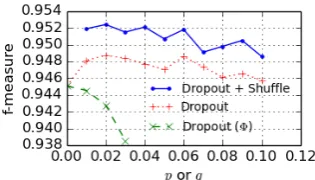
Figure4shows the effect of the dropout method (“dropout” for the input layer and “dropout (Φ)” for the hidden layer) and the combination of the dropout and “shuffle-and-average” method (solid line). We observed that the dropout for the hid-den layer is not effective for structured perceptron. This may caused by that the connections between the input layer and the hidden layer are fixed dur-ing traindur-ing. Neurons in the hidden layer can not
Figure 4: Influences of the hyper-parameterp(for the input layer, denoted as “dropout”) or q (for the hidden layer, denoted as “dropout (Φ)”) for the dropout method.
changes the weights to learn different representa-tions for the input layer. On the other hand, the dropout for the input layer improves the perfor-mance. Combining the dropout and the “shuffle-and-average” method, the performance is further improved.
Figure5shows the effect of the combination of the three regularization methods. We see that no matter what other regularization methods are al-ready used, adding “shuffle-and-average” method can always improve the performance. The effects of the penalty method and the dropout method have some overlap, since combining these two method does not result in a significant improve-ment of the performance.
6.5 Final Results
6.5.1 Chinese Word Segmentation
Table 2 shows the final results of the character-based Chinese word segmentation task on the test set of the CTB5 corpus.
[image:6.595.337.495.276.366.2](a) L2-norm penalty (b) L1-norm penalty
Figure 3: influence of the hyper-parameterλ2in the L2-norm penalty term andλ1in the L1-norm penalty
[image:7.595.341.499.71.159.2]term (“l1-c” indicates the cumulative L1 penalty) for the character-based Chinese word segmentation task.
Figure 5: The combination of these three regular-ization methods.
Table1is used. We use the “shuffle-and-average” (5 models), the L2 penalty method (λ2 = 10−4),
the dropout method (p = 3%) and their combina-tions to regularize the structured perceptron.
To compare with the perceptron algorithm, we use the conditional random field model (CRF) with the same feature templates in Table1to train the model parameters. The toolkit CRF++1 with the L2-norm penalty is used to train the weights. The hyper-parameter C = 20is tuned using the development set.
Jiang et al. (2009) proposed a character-based model employing similar feature templates using averaged perceptron. The feature templates are following Ng and Low (2004). Zhang and Clark (2011) proposed a word-based model employing both character-based features and more sophis-ticated word-based features using also averaged perceptron. There are other related results (Jiang et al., 2012) of open test including the final result of Jiang et al. (2009). Since their models used extra resources, they are not comparable with the
1http://crfpp.googlecode.com/svn/trunk/doc/index.html
sf (Jiang et al., 2009) 0.9735 (Zhang and Clark, 2011) 0.9750† CRF++ (C= 20) 0.9742 Averaged Percetron 0.9734
+ Shuffle 0.9755
+ L2 0.9736
+ L2 + Shuffle 0.9772
+ Dropout 0.9741
[image:7.595.326.506.254.421.2]+ Dropout+ Shuffle 0.9765 + L2 + Dropout 0.9749 + L2 + Dropout+ Shuffle 0.9771 Table 2: Final results of the character-based Chi-nese word segmentation task on CTB5. †This re-sult is read from a figure in that paper.
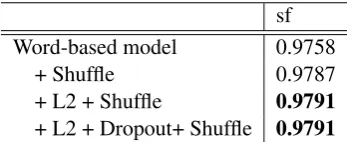
sf Word-based model 0.9758
+ Shuffle 0.9787
+ L2 + Shuffle 0.9791 + L2 + Dropout+ Shuffle 0.9791 Table 3: Final results of the word-based Chinese word segmentation task on CTB5.
results in this paper.
The results in Table 2 shows that with proper regularization methods, the models trained using perceptron algorithm can outperform CRF models with the same feature templates and other models with more sophisticated features trained using the averaged perceptron without other regularization methods.
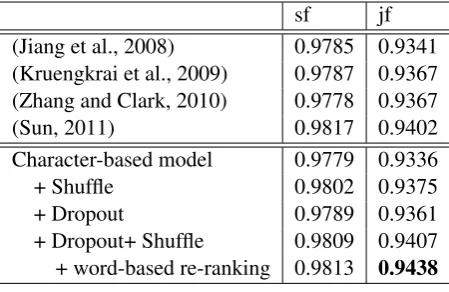
[image:7.595.101.258.260.376.2] [image:7.595.329.503.484.555.2]sf jf (Jiang et al., 2008) 0.9785 0.9341 (Kruengkrai et al., 2009) 0.9787 0.9367 (Zhang and Clark, 2010) 0.9778 0.9367
(Sun, 2011) 0.9817 0.9402
Character-based model 0.9779 0.9336
+ Shuffle 0.9802 0.9375
+ Dropout 0.9789 0.9361
[image:8.595.72.297.62.208.2]+ Dropout+ Shuffle 0.9809 0.9407 + word-based re-ranking 0.9813 0.9438 Table 4: Final results of the POS tagging task on CTB5.
word compl. (Huang and Sagae, 2010) 85.20 33.72 our re-implementation 85.22 34.15
+ Shuffle 85.65 34.52
+ Dropout 85.32 34.04
+ Dropout+ Shuffle 85.71 34.57 Table 5: Final results of the dependency parsing task on CTB5.
is similar with the model proposed by Zhang and Clark (2011). Beam search with early-update is used for decoding instead of dynamic program-ming. The results with different regularization methods are shown in Figure3. These regulariza-tion methods show similar characteristics for the word-based model.
6.5.2 POS Tagging
The results of the POS tagging models on the CTB5 corpus are shown in Table4. Structure per-ceptron with feature templates in Table1is used. The F-measures for word segmentation (sf) and for joint word segmentation and POS tagging (jf) are listed.
We use the “shuffle-and-average” (10 models), the dropout method (p = 5%) and their combina-tion to regularize the structured perceptron.
Jiang et al. (2008) used a character-based model using perceptron for POS tagging and a log-linear model for re-ranking. Kruengkrai et al. (2009) proposed a hybrid model including character-based and word-based features. Zhang and Clark (2010) proposed a word-based model using perceptron. Sun (2011) proposed a frame-work based on stacked learning consisting of four sub-models. For the closed test, this model has the best performance on the CTB5 corpus to our
knowledge. Other results (Wang et al., 2011; Sun and Wan, 2012) for the open test are not listed since they are not comparable with the results in this paper.
If we define the error rate as1−jf, the error re-duction by applying regularization methods for the character-based model is more than10%. Com-paring to the related work, the character-based model that we used is quite simple. But using the regularization methods discussed in this paper, it provides a comparable performance to the best model in the literature.
6.5.3 Dependency Parsing
Table5shows the final results of the dependency parsing task on the CTB5 corpus. We use the “shuffle-and-average” (10 models), the dropout method (p = 5% only for the words in the input) and their combination to regularize the structured perceptron based on Huang and Sagae’s (2010).
The performance of the parsing model is also improved by using more regularization methods, although the improvement is not as remarkable as those for tagging tasks. For the parsing tasks, there are many other factors that impact the per-formance.
7 Conclusion
The “shuffle-and-average” method can effectively reduce the bias caused by the specific order of the training examples. It can improve the performance even if some other regularization methods are ap-plied.
When we treat the perceptron algorithm as a special case of the SGD algorithm, the traditional penalty methods can be applied. And our observa-tion is that L2 penalty is better than L1 penalty.
The dropout method is derived from the neural network. Corrupting the input during training im-proves the ability of generalization. The effects of the penalty method and the dropout method have some overlap.
Acknowledgments
The authors want to thanks all the reviews for many pertinent comments which have improved the quality of this paper. The authors are supported by NSFC (No. 61273338 and No. 61303082), the Doctoral Program of Higher Education of China (No. 20120121120046) and China Postdoctoral Science Foundation (No. 2013M541861).
References
Stanley F Chen and Ronald Rosenfeld. 1999. A gaus-sian prior for smoothing maximum entropy models. Technical report, DTIC Document.
Michael Collins and Brian Roark. 2004. Incremental parsing with the perceptron algorithm. In Proceed-ings of the 42nd Meeting of the Association for Com-putational Linguistics (ACL’04), Main Volume, page 111118, Barcelona, Spain, July.
Michael Collins. 2002. Discriminative training meth-ods for hidden markov models: theory and experi-ments with perceptron algorithms. pages 1–8. Chuong B Do, Quoc V Le, and Chuan-Sheng Foo.
2009. Proximal regularization for online and batch learning. InProceedings of the 26th Annual
Interna-tional Conference on Machine Learning, pages 257–
264. ACM.
Thomas Emerson. 2005. The second international chi-nese word segmentation bakeoff. InProceedings of the Fourth SIGHAN Workshop on Chinese Language Processing, pages 123–133. Jeju Island, Korea. Geoffrey E. Hinton, Nitish Srivastava, Alex
Krizhevsky, Ilya Sutskever, and Ruslan R. Salakhut-dinov. 2012. Improving neural networks by preventing co-adaptation of feature detectors. arXiv preprint arXiv:1207.0580.
Liang Huang and Kenji Sagae. 2010. Dynamic pro-gramming for linear-time incremental parsing. In
Proceedings of the 48th Annual Meeting of the Asso-ciation for Computational Linguistics, pages 1077– 1086, Uppsala, Sweden, July. Association for Com-putational Linguistics.
Liang Huang, Suphan Fayong, and Yang Guo. 2012. Structured perceptron with inexact search. In Pro-ceedings of the 2012 Conference of the North Amer-ican Chapter of the Association for Computational
Linguistics: Human Language Technologies, pages
142–151. Association for Computational Linguis-tics.
Wenbin Jiang, Liang Huang, Qun Liu, and Yajuan Lü. 2008. A cascaded linear model for joint chi-nese word segmentation and part-of-speech tagging.
In Proceedings of ACL-08: HLT, pages 897–904,
Columbus, Ohio, June. Association for Computa-tional Linguistics.
Wenbin Jiang, Liang Huang, and Qun Liu. 2009. Au-tomatic adaptation of annotation standards: Chinese word segmentation and POS tagging - a case study.
In Proceedings of the 47th ACL, pages 522–530,
Suntec, Singapore, August. Association for Compu-tational Linguistics.
Wenbin Jiang, Fandong Meng, Qun Liu, and Yajuan Lü. 2012. Iterative annotation transformation with predict-self reestimation for chinese word segmen-tation. In Proceedings of the 2012 Joint Confer-ence on Empirical Methods in Natural Language Processing and Computational Natural Language Learning, pages 412–420, Jeju Island, Korea, July. Association for Computational Linguistics.
Canasai Kruengkrai, Kiyotaka Uchimoto, Jun’ichi Kazama, Yiou Wang, Kentaro Torisawa, and Hitoshi Isahara. 2009. An error-driven word-character hy-brid model for joint chinese word segmentation and POS tagging. InProc. of ACL-IJCNLP 2009, pages 513–521, Suntec, Singapore. Association for Com-putational Linguistics.
Ryan McDonald, Keith Hall, and Gideon Mann. 2010. Distributed training strategies for the structured per-ceptron. In Human Language Technologies: The 2010 Annual Conference of the North American Chapter of the Association for Computational
Lin-guistics, pages 456–464. Association for
Computa-tional Linguistics.
JE Moody, SJ Hanson, Anders Krogh, and John A Hertz. 1995. A simple weight decay can improve generalization. Advances in neural information pro-cessing systems, 4:950–957.
Hwee Tou Ng and Jin Kiat Low. 2004. Chinese part-of-speech tagging: One-at-a-time or all-at-once? word-based or character-based? In Dekang Lin and Dekai Wu, editors, Proceedings of EMNLP 2004, pages 277–284, Barcelona, Spain, July. Association for Computational Linguistics.
Weiwei Sun and Xiaojun Wan. 2012. Reducing ap-proximation and estimation errors for chinese lexi-cal processing with heterogeneous annotations. In
Proceedings of the 50th Annual Meeting of the As-sociation for Computational Linguistics (Volume 1:
Long Papers), pages 232–241, Jeju Island, Korea,
July. Association for Computational Linguistics. Weiwei Sun. 2011. A stacked sub-word model for
joint chinese word segmentation and part-of-speech tagging. In Proceedings of the 49th Annual Meet-ing of the Association for Computational LMeet-inguis-
Linguis-tics: Human Language Technologies, pages 1385–
1394, Portland, Oregon, USA, June. Association for Computational Linguistics.
4th International Joint Conference on Natural Lan-guage Processing of the AFNLP: Volume 1-Volume 1, pages 477–485. Association for Computational Linguistics.
Pascal Vincent, Hugo Larochelle, Yoshua Bengio, and Pierre-Antoine Manzagol. 2008. Extracting and composing robust features with denoising autoen-coders. In Proceedings of the 25th international
conference on Machine learning, page 10961103.
Yiou Wang, Jun’ichi Kazama, Yoshimasa Tsuruoka, Wenliang Chen, Yujie Zhang, and Kentaro Torisawa. 2011. Improving chinese word segmentation and POS tagging with semi-supervised methods using large auto-analyzed data. InProceedings of 5th In-ternational Joint Conference on Natural Language
Processing, pages 309–317, Chiang Mai, Thailand,
November. Asian Federation of Natural Language Processing.
Lin Xiao. 2010. Dual averaging methods for reg-ularized stochastic learning and online optimiza-tion. The Journal of Machine Learning Research, 9999:2543–2596.
Luke S Zettlemoyer and Michael Collins. 2009. Learning context-dependent mappings from sen-tences to logical form. InProceedings of the Joint Conference of the 47th Annual Meeting of the ACL and the 4th International Joint Conference on Natu-ral Language Processing of the AFNLP: Volume
2-Volume 2, pages 976–984. Association for
Compu-tational Linguistics.
Yue Zhang and Stephen Clark. 2008. A tale of two parsers: Investigating and combining graph-based and transition-based dependency parsing. In Pro-ceedings of the 2008 Conference on Empirical
Meth-ods in Natural Language Processing, page 562571,
Honolulu, Hawaii, October. Association for Compu-tational Linguistics.
Yue Zhang and Stephen Clark. 2010. A fast decoder for joint word segmentation and POS-Tagging using a single discriminative model. InProceedings of the 2010 Conference on Empirical Methods in Natural
Language Processing, pages 843–852, Cambridge,
MA, October. Association for Computational Lin-guistics.
Y. Zhang and S. Clark. 2011. Syntactic processing using the generalized perceptron and beam search.
Computational Linguistics, (Early Access):1–47. Kaixu Zhang, Maosong Sun, and Changle Zhou. 2012.
Word segmentation on chinese mirco-blog data with a linear-time incremental model. InProceedings of the Second CIPS-SIGHAN Joint Conference on
Chi-nese Language Processing, pages 41–46, Tianjin,
China, December. Association for Computational Linguistics.