Instance-Driven Attachment of Semantic Annotations
over Conceptual Hierarchies
Janara Christensen∗
University of Washington Seattle, Washington 98195
Marius Pas¸ca
Google Inc.
Mountain View, California 94043
Abstract
Whether automatically extracted or human generated, open-domain factual knowledge is often available in the form of semantic annotations (e.g., composed-by) that take one or more specific instances (e.g., rhap-sody in blue,george gershwin) as their ar-guments. This paper introduces a method for converting flat sets of instance-level annotations into hierarchically organized, concept-level annotations, which capture not only the broad semantics of the desired arguments (e.g., ‘People’ rather than ‘Loca-tions’), but also the correct level of general-ity (e.g., ‘Composers’ rather than ‘People’, or ‘Jazz Composers’). The method refrains from encoding features specific to a partic-ular domain or annotation, to ensure imme-diate applicability to new, previously un-seen annotations. Over a gold standard of semantic annotations and concepts that best capture their arguments, the method sub-stantially outperforms three baselines, on average, computing concepts that are less than one step in the hierarchy away from the corresponding gold standard concepts.
1 Introduction
Background: Knowledge about the world can
be thought of as semantic assertions or anno-tations, at two levels of granularity: instance level (e.g., rhapsody in blue, tristan und isolde,
george gershwin, richard wagner) and concept level (e.g., ‘Musical Compositions’, ‘Works of Art’, ‘Composers’). Instance-level annotations correspond to factual knowledge that can be found in repositories extracted automatically from text (Banko et al., 2007; Wu and Weld, 2010)
∗
Contributions made during an internship at Google.
or manually created within encyclopedic re-sources (Remy, 2002). Such facts could state, for instance, that rhapsody in blue was composed-by george gershwin, or that tristan und isolde
was composed-by richard wagner. In compar-ison, concept-level annotations more concisely and effectively capture the underlying semantics of the annotations by identifying the concepts cor-responding to the arguments, e.g., ‘Musical Com-positions’ arecomposed-by‘Composers’.
The frequent occurrence of instances, relative to more abstract concepts, in Web documents and popular Web search queries (Barr et al., 2008; Li, 2010), is both an asset and a liability from the point of view of knowledge acquisition. On one hand, it makes instance-level annotations rel-atively easy to find, either from manually created resources (Remy, 2002; Bollacker et al., 2008), or extracted automatically from text (Banko et al., 2007). On the other hand, it makes concept-level annotations more difficult to acquire di-rectly. While “Rhapsody in Blue was composed by George Gershwin [..]” may occur in some form within Web documents, the more abstract
“Musical compositions are composed by musi-cians [..]” is unlikely to occur. A more practical approach to collecting concept-level annotations is to indirectly derive them from already plenti-ful instance-level annotations, effectively distill-ing factual knowledge into more abstract, concise and generalizable knowledge.
Contributions: This paper introduces a method
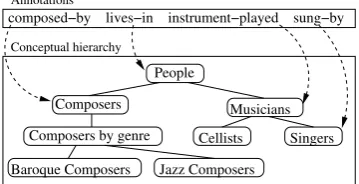
for converting flat sets of specific, instance-level annotations into hierarchically organized, concept-level annotations. As illustrated in Fig-ure 1, the resulting annotations must captFig-ure not just the broad semantics of the desired arguments (e.g., ‘People’ rather than ‘Locations’ or
People
Composers Musicians
Composers by genre Cellists Singers
Baroque Composers Jazz Composers Annotations
Conceptual hierarchy
[image:2.595.89.269.72.164.2]composed−by lives−in instrument−played sung−by
Figure 1: Hierarchical Semantic Annotations: The attachment of semantic annotations (e.g., composed-by) into a conceptual hierarchy, a portion of which is shown in the diagram, requires the identification of the correct concept at the correct level of generality (e.g., ‘Composers’ rather than ‘Jazz Composers’ or ‘Peo-ple’, for the right argument ofcomposed-by).
ucts’, as the right argument of the annotation
composed-by), but actually identify the concepts at the correct level of generality/specificity (e.g., ‘Composers’ rather than ‘Artists’ or ‘Jazz Com-posers’) in the underlying conceptual hierarchy.
To ensure portability to new, previously unseen annotations, the proposed method avoids encod-ing features specific to a particular domain or an-notation. In particular, the use of annotations’ la-bels (composed-by) as lexical features might be tempting, but would anchor the annotation model to that particular annotation. Instead, the method relies only on features that generalize across an-notations. Over a gold standard of semantic anno-tations and concepts that best capture their argu-ments, the method substantially outperforms three baseline methods. On average, the method com-putes concepts that are less than one step in the hierarchy away from the corresponding gold stan-dard concepts of the various annotations.
2 Hierarchical Semantic Annotations
2.1 Task Description
Data Sources: The computation of hierarchical
semantic annotations relies on the following data sources:
•a target annotationr(e.g.,acted-in) that takes
M arguments;
• N annotations I={<i1j, . . . , iM j>}Nj=1 of
r at instance level, e.g., {<leonardo dicaprio,
inception>,<milla jovovich, fifth element>}(in this example,M=2);
• mappings {i→c} from instances to con-cepts to which they belong, e.g., milla jovovich
→ ‘American Actors’,milla jovovich→‘People from Kiev’,milla jovovich→‘Models’;
•mappings{cs→cg}from more specific con-cepts to more general concon-cepts, as encoded in a hierarchyH, e.g., ‘American Actors’→‘Actors’, ‘People from Kiev’→‘People from Ukraine’, ‘Actors’→‘Entertainers’.
Thus, the main inputs are the conceptual hi-erarchyH, and the instance-level annotations I. The hierarchy contains instance-to-concept pings, as well as specific-to-general concept map-pings. Via transitivity, instances (milla jovovich) and concepts (‘American Actors’) may be im-mediate children of more general concepts (‘Ac-tors’), or transitive descendants of more general concepts (‘Entertainers’). The hierarchy is not re-quired to be a tree; in particular, a concept may have multiple parent concepts. The instance-level annotations may be created collaboratively by hu-man contributors, or extracted automatically from Web documents or some other data source.
Goal: Given the data sources, the goal is to de-termine to which conceptcin the hierarchyHthe arguments of the target concept-level annotation
r should be attached. While the left argument of
acted-incould attach to ‘American Actors’, ‘Peo-ple from Kiev’, ‘Entertainers’ or ‘Peo‘Peo-ple’, it is best attached to the concept ‘Actors’. The goal is to select the conceptcthat most appropriately generalizes across the instances. Over the setI
of instance-level annotations, selecting a method for this goal can be thought of as a minimization problem. The metric to be minimized is the sum of the distances between each predicted conceptc
and the correct conceptcgold, where the distance is the number of edges betweencandcgoldinH.
Intuitions and Challenges: Given instances such
asmilla jovovich that instantiate an argument of an annotation likeacted-in, the conceptual hierar-chy can be used to propagate the annotation up-wards, from instances to their concepts, then in turn further upwards to more general concepts. The best concept would be one of the many can-didate concepts reached during propagation. In-tuitively, when compared to other candidate con-cepts, a higher proportion of the descendant in-stances of the best concept should instantiate (or match) the annotation. At the same time, rela-tive to other candidate concepts, the best concept should have more descendant instances.
Conceptual hierarchy
Entities
Locations People
Singers Actors
American Actors English Actors
Instance-level annotations acted-in(leonardo dicaprio,inception)
acted-in(milla jovovich,fifth element)
acted-in(judy dench,casino royale)
acted-in(colin firth,the king’s speech)
Instance to concept mappings leonardo dicaprio: American Actors
milla jovovich: American Actors
judy dench: English Actors
colin firth: English Actors
Candidate concepts
Entities People Actors American Actors English Actors
Raw statistics
Entities, 4, 0.01 . . . People, 3, 0.1 . . . Actors, 2, 0.7 . . . American Actors, 1, 0.9 . . . English Actors, 1, 0.8 . . .
FeaturesDepth, Instance Percent . . .
Query logs
fifth element actors fifth element costumes inception quotes out of africa actors the king’s speech oscars
Classified data
0, People-Actors, 3/2, 0.1/0.7 . . . 1, Actors-People, 2/3, 0.7/0.1 . . . 1, Actors-American Actors, 2/1, 0.7/0.9 . . . 0, American Actors-Actors, 1/2, 0.9/0.7 . . . .
. .
Training/testing data
People-Actors, 3/2, 0.1/0.7 . . . Actors-People, 2/3, 0.7/0.1 . . . Actors-American Actors, 2/1, 0.7/0.9 . . . American Actors-Actors, 1/2, 0.9/0.7 . . . .
. .
Ranked data (for Concept-level annotations)
4, Actors 3, People 2, American Actors 1, English Actors 0, Entities
[image:3.595.90.507.69.295.2]Concept-level annotations acted-in(Actors, ?)
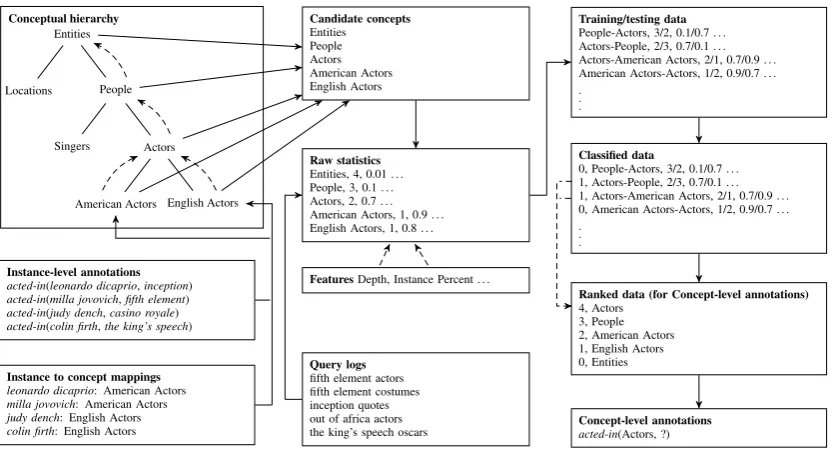
Figure 2:Method Overview: Inferring concept-level annotations from instance-level annotations.
instance-level annotations, which may artificially skew the distribution of matching instances to-wards a less than optimal region in the hierarchy. If the input annotations foracted-inare available almost exhaustively for all descendant instances of ‘American Actors’, and are available for only a few of the descendant instances of ‘Belgian Ac-tors’, ‘Italian Actors’ etc., then the distribution over the hierarchy may incorrectly suggest that the left argument ofacted-inis ‘American Actors’ rather than the more general ‘Actors’. In another example, if virtually all instances that instantiate the left argument of the annotationwon-awardare mapped to the concept ‘Award Winning Actors’, then it would be difficult to distinguish ‘Award Winning Actors’ from the more general ‘Actors’ or ‘People’, as best concept to be computed for the annotation. Another type of noise is missing or erroneous edges in the hierarchy, which could artificially direct propagation towards irrelevant regions of the hierarchy, or prevent propagation from even reaching relevant regions of the hier-archy. For example, if the hierarchy incorrectly maps ‘Actors’ to ‘Entertainment’, then ‘Entertain-ment’ and its ancestor concepts incorrectly be-come candidate concepts during propagation for the left argument ofacted-in. Conversely, if miss-ing edges caused ‘Actors’ to not have any children in the hierarchy, then ‘Actors’ would not even be reached and considered as a candidate concept during propagation.
Second, to apply evidence collected from some annotations to a new annotation, the evidence must generalize across annotations. However, collected evidence or statistics may vary widely across annotations. Observing that 90% of all de-scendant instances of the concept ‘Actors’ match an annotationacted-inconstitutes strong evidence that ‘Actors’ is a good concept for acted-in. In contrast, observing that only 0.09% of all descen-dant instances of the concept ‘Football Teams’ match won-super-bowl should not be as strong negative evidence as the percentage suggests.
2.2 Inferring Concept-Level Annotations
Determining Candidate Concepts: As
illus-trated in the left part of Figure 2, the first step to-wards inferring concept-level from instance-level annotations is to propagate the instances that in-stantiate a particular argument of the annota-tion, upwards in the hierarchy. Starting from the left arguments of the annotationacted-in, namely
leonardo dicaprio, milla jovovichetc., the prop-agation reaches their parent concepts ‘American Actors’, ‘English Actors’, then their parent and ancestor concepts ‘Actors’, ‘People’, ‘Entities’ etc. The concepts reached during upward prop-agation become candidate concepts. In subse-quent steps, the candidates are modeled, scored and ranked such that ideally the best concept is ranked at the top.
identifica-tion of a ranking funcidentifica-tion is cast as a semi-supervised learning problem. Given the cor-rect (gold) concept of an annotation, it would be tempting to employ binary classification directly, by marking the correct concept as a positive ex-ample, and all other candidate concepts as nega-tive examples. Unfortunately, this would produce a highly imbalanced training set, with thousands of negative examples and, more importantly, with only one positive example. Another disadvan-tage of using binary classification directly is that it is difficult to capture the preference for concepts closer in the hierarchy to the correct concept, over concepts many edges away. Finally, the absolute values of the features that might be employed may be comparable within an annotation, but incompa-rable across annotations, which reduces the porta-bility of the resulting model to new annotations.
To address the above issues, the ranking func-tion proposed does not construct training exam-ples from raw features collected for each indi-vidual candidate concept. Instead, it constructs training examples from pairwise comparisons of a candidate concept with another candidate con-cept. Concretely, a pairwise comparison is la-beled as a positive example if the first concept is closer to the correct concept than the second, or as negative otherwise. The pairwise formulation has three immediate advantages. First, it accomodates the preference for concepts closer to the gold con-cept. Second, the pairwise formulation produces a larger, more balanced training set. Third, deci-sions of whether the first concept being compared is more relevant than the second are more likely to generalize across annotations, than absolute deci-sions of whether (and how much) a particular con-cept is relevant for a given annotation.
Compiling Ranking Features: The features are
grouped into four categories: (A) annotation co-occurrence features, (B) concept features, (C) ar-gument co-occurrence features, and (D) combina-tion features, as described below.
(A) Annotation Co-occurrence Features: The annotation co-occurrence features emphasize how well an annotation applies to a concept. These features include (1) MATCHED INSTANCES the
number of descendant instances of the concept that appear with the annotation, (2) INSTANCE
PERCENTthe percentage of matched instances in
the concept, (3) MORE THANTHREEMATCHING
INSTANCESand (4) MORE THAN TEN MATCH
-INGINSTANCES, which indicate when the
match-ing descendant instances might be noise.
Also in this category are features that relay in-formation about the candidate concept’s children concepts. These features include (1) MATCHED
CHILDREN the number of child concepts con-taining at least one matching instance, (2) CHIL
-DRENPERCENTthe percentage of child concepts with at least one matching instance, (3) AVGIN
-STANCE PERCENT CHILDREN the average per-centage of matching descendant instances of the child concepts, and (4) INSTANCE PERCENT TO
INSTANCE PERCENT CHILDREN the ratio be-tween INSTANCE PERCENT and AVERAGE IN
-STANCE PERCENT OF CHILDREN. The last fea-ture is meant to capfea-ture dramatic changes in per-centages when moving in the hierarchy from child concepts to the candidate concept in question.
(B) Concept Features: Concept features ap-proximate the generality of the concepts: (1) NUM INSTANCES the number of descendant in-stances of the concept, (2) NUM CHILDREN the number of child concepts, and (3) DEPTHthe dis-tance to the concept’s farthest descendant.
(C)Argument Co-occurrence Features: The ar-gument co-occurrence features model the likeli-hood that an annotation applies to a concept by looking at co-occurrences with another argument of the same annotation. Intuitively, if a con-cept representing one argument has a high co-occurrence with an instance that is some other ar-gument, a relationship more likely exists between members of the concept and the instance. For ex-ample, givenacted-in, ‘Actors’ is likely to have a higher co-occurrence withcasablancathan ‘Peo-ple’ is. These features are generated from a set of Web queries. Therefore, the collected values are likely to be affected by different noise than that present in the original dataset. For every concept and instance pair from the arguments of a given annotation, they feature the number of times each of the tokens in the concept appears in the same query with each of the tokens in the instance, normalizing to the respective number of tokens. The procedure generates, for each candidate con-cept, an average co-occurrence score (AVG CO
-OCCURRENCE) and a total co-occurrence score (TOTALCO-OCCURRENCE) over all instances the
concept is paired with.
Concept Distance Match Total Match Total AvgInst Depth Avg Total ToCorrect Inst Inst Child Child PercOfChild Cooccur Cooccur
People 4 36512 879423 22 29 4% 14 0.67 33506
Actors 0 29101 54420 6 10 32% 6 2.08 99971
English Actors 2 3091 5922 3 4 37% 3 2.75 28378
Labeled Concept Pair Annotation Co-occurrence Concept Arg Co-occurrence Combination
Features Features Features Features
[image:5.595.73.519.67.251.2]Concept Label Match Inst Match Child AvgInst Num Num Depth Avg Total Depth DepthInst Pair Inst Perc Child Perc PercChild Inst Child Cooccur Cooccur InstPerc PercChild People-Actors 0 1.25 0.08 3.67 1.26 0.13 1.25 3.67 2.33 0.32 0.34 0.18 0.66 Actors-People 1 0.8 12.88 0.27 0.79 7.65 0.8 0.27 0.43 3.11 2.98 5.52 1.51 Actors-English Actors 1 9.41 1.02 2.0 0.8 0.87 9.41 2.0 2.0 0.76 3.52 2.05 4.1 English Actors-Actors 0 0.11 0.98 0.5 1.25 1.15 0.11 0.5 0.5 1.32 0.28 0.49 0.24 English Actors-People 1 0.08 12.57 0.14 0.99 8.82 0.08 0.14 0.21 4.12 0.85 2.69 0.37 People-English Actors 0 11.81 0.08 7.33 1.01 0.11 11.81 7.33 4.67 0.24 1.18 0.37 2.72
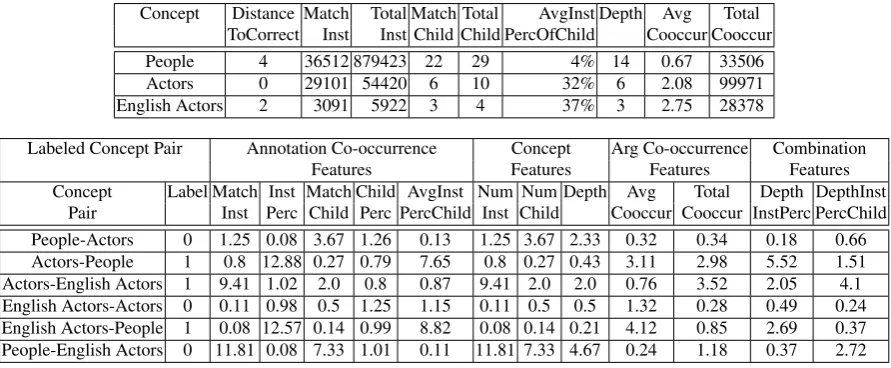
Table 1:Training/Testing Examples: The top table shows examples of raw statistics gathered for three candidate concepts for the left argument of the annotationacted-in. The second table shows the training/testing examples generated from these concepts and statistics. Each example represents a pair of concepts which is labeled positive if the first concept is closer to the correct concept than the second concept. Features shown here are the ratio between a statistic for the first concept and a statistic for the second (e.g. DEPTHfor Actors-English Actors is 2 as ‘Actors’ has depth of 6 and ‘English Actors’ has depth of 3). Some features omitted due to space constraints.
(2) DEPTH, INSTANCE PERCENT, CHILDREN, which is the DEPTHmultipled by the INSTANCE
PERCENT multiplied by MATCHED CHILDREN. Both these features seek to balance the perceived relevance of an annotation to a candidate concept, with the generality of the candidate concept.
Generating Learning Examples: For a given
annotation, the ranking features described so far are computed for each candidate concept (e.g., ‘Movie Actors’, ‘Models’, ‘Actors’). However, the actual training and testing examples are gener-ated for pairs of candidate concepts (e.g.,<‘Film Actors’, ‘Models’>,<‘Film Actors’, ‘Actors’>,
<‘Models, ‘Actors’>). A training example rep-resents a comparison between two candidate con-cepts, and specifies which of the two is more rele-vant. To create training and testing examples, the values of the features of the first concept in the pair are respectively combined with the values of the features of the second concept in the pair to produce values corresponding to the entire pair.
Following classification of testing examples, concepts are ranked according to the number of other concepts which they are classified as more relevant than. Table 1 shows examples of train-ing/testing data.
3 Experimental Setting
3.1 Data Sources
Conceptual Hierarchy: The experiments
com-pute concept-level annotations relative to a
con-ceptual hierarchy derived automatically from the Wikipedia (Remy, 2002) category network, as de-scribed in (Ponzetto and Navigli, 2009). The hi-erarchy filters out edges (e.g., from ‘British Film Actors’ to ‘Cinema of the United Kingdom’) from the Wikipedia category network that do not corre-spond to IsA relations. A concept in the hierarchy is a Wikipedia category (e.g., ‘English Film Ac-tors’) that has zero or more Wikipedia categories as child concepts, and zero or more Wikipedia categories (e.g., ‘English People by Occupation’, ‘British Film Actors’) as parent concepts. Each concept in the hierarchy has zero or more in-stances, which are the Wikipedia articles listed (in Wikipedia) under the respective categories (e.g.,
colin firthis an instance of ‘English Actors’).
Instance-Level Annotations: The experiments
Web Search Queries: The argument co-occurrence features described above are com-puted over a set of around 100 million anonymized Web search queries from 2010.
3.2 Experimental Runs
The experimental runs exploit ranking features described in the previous section, employing:
•one of three learning algorithms: naive Bayes (NAIVEBAYES), maximum entropy (MAXENT), or perceptron (PERCEPTRON) (Mitchell, 1997), chosen for their scalability to larger datasets via distributed implementations.
• one of three ways of combining the values of features collected for individual candidate con-cepts into values of features for pairs of candidate concepts: the raw ratio of the values of the re-spective features of the two concepts (0 when the denominator is 0); the ratio scaled to the interval [0, 1]; or a binary value indicating which of the values is larger.
For completeness, the experiments include three additional, baseline runs. Each baseline computes scores for all candidate concepts based on the respective metric; then candidate concepts are ranked in decreasing order of their scores. The baselines metrics are:
• INSTPERCENT ranks candidate concepts by the percentage of matched instances that are de-scendants of the concept. It emphasizes concepts which are “proven” to belong to the annotation;
• ENTROPY ranks candidate concepts by the entropy (Shannon, 1948) of the proportion of matched descendant instances of the concept;
• AVGDEPTH ranks candidate concepts by their distances to half of the maximum hierarchy height, emphasizing a balance of generality and specificity.
3.3 Evaluation Procedure
Gold Standard of Concept-Level Annotations:
A random, weighted sample of 200 annotation la-bels (e.g., corresponding to composed-by, play-instrument) is selected, out of the set of labels of all instance-level annotations collected from Freebase. During sampling, the weights are the counts of distinct instance-level annotations (e.g.,
<rhapsody in blue, george gershwin>) avail-able for the label. The arguments of the anno-tation labels are then manually annotated with a gold concept, which is the category from the Wikipedia hierarchy that best captures their
se-mantics. The manual annotation is carried out independently by two human judges, who then verify each other’s work and discard inconsisten-cies. For example, the gold concept of the left argument ofcomposed-by is annotated to be the Wikipedia category ‘Musical Compositions’. In the process, some annotation labels are discarded, when (a) it is not clear what concept captures an argument (e.g., for the right argument of function-of-building), or (b) more than 5000 candidate con-cepts are available via propagation for one of the arguments, which would cause too many train-ing or testtrain-ing examples to be generated via con-cept pairs, and slow down the experiments. The retained 139 annotation labels, whose arguments have been labeled with their respective gold con-cepts, form the gold standard for the experiments. More precisely, an entry in the resulting gold stan-dard consists of an annotation label, one of its arguments being considered (left or right), and a gold concept that best captures that argument. The set of annotation labels from the gold stan-dard is quite diverse and covers many domains of potential interest, e.g.,has-company(‘Industries’, ‘Companies’), written-by(‘Films’, ‘Screenwrit-ers’),member-of(‘Politicians’,‘Political Parties’), orpart-of-movement(‘Artists’, ‘Art Movements’).
Evaluation Metric: Following previous work
on selectional preferences (Kozareva and Hovy, 2010; Ritter et al., 2010), each entry in the gold standard, (i.e., each argument for a given annota-tion) is evaluated separately. Experimental runs compute a ranked list of candidate concepts for each entry in the gold standard. In theory, a com-puted candidate concept is better if it is closer semantically to the gold concept. In practice, the accuracy of a ranked list of candidate con-cepts, relative to the gold concept of the anno-tation label, is measured by two scoring metrics that correspond to the mean reciprocal rank score (MRR) (Voorhees and Tice, 2000) and a modifi-cation of it (DRR) (Pas¸ca and Alfonseca, 2009):
M RR= 1 N
N
X
i=1
max
rank
1 ranki
N is the number of annotations andranki is the rank of the gold concept in the returned list for MRR. An annotation ai receives no credit for MRR if the gold concept does not appear in the corresponding ranked list.
DRR= 1 N
N
X
i=1
max
rank
1
ranki×(1 +Len)
Annotation (Number of Candidate Concepts) Examples of Instances Top Ranked Concepts
ComposerscomposeMusical Compositions (3038) aaron copland; black sabbath Music by Nationality; Composers; Classical Composers
Musical Compositionscomposed-byComposers (1734) we are the champions; yor-ckscher marsch
Musical Compositions; Compositions by Composer; Classical Music
FoodscontainNutrients (1112) acca sellowiana; lasagna Foods; Edible Plants; Food Ingredients Organizationshas-boardmemberPeople (3401) conocophillips; spence school Companies by Stock Exchange; Companies
Listed on the NYSE; Companies Educational Organizationshas-graduateAlumni (4072) air force institute of technology;
deering high school
Education by Country; Schools by Country; Universities and Colleges by Country Television Actorsguest-roleFictional Characters (4823) melanie griffith; patti laBelle Television Actors by Nationality; Actors;
American Actors
Musical Groupshas-memberMusicians (2287) steroid maximus; u2 Musical Groups; Musical Groups by Genre; Musical Groups by Nationality
Record LabelsrepresentMusician (920) columbia records; vandit Record Labels; Record Labels by Country; Record Labels by Genre
Awardsawarded-toPeople (458) academy award for best original song; erasmus prize
Film Awards; Awards; Grammy Awards
FoodscontainNutrients(177) lycopene; glutamic acid Carboxylic Acids ; Acids; Essential Nutrients ArchitectsdesignBuildings and Structures(4811) 20 times square; berkeley
build-ing
Buildings and Structures; Buildings and Struc-tures by Architect; Houses by Country Peopledied-fromCauses of Death(577) malaria; skiing Diseases; Infectious Diseases; Causes of
Death
Art DirectorsdirectFilms(1265) batman begins; the lion king Films; Films by Director; Film
Episodesguest-starTelevision Actors(1067) amy poehler; david caruso Television Actors by Nationality; Actors; American Actors
Television Networkhas-tv-showTelevision Series(2492) george of the jungle; great expec-tations
Television Series by Network; Television Se-ries; Television Series by Genre
MusiciansplayMusical Instruments(423) accordion; tubular bell Musical Instruments; Musical Instruments by Nationality; Percussion Instruments Politiciansmember-ofPolitical Parties(938) independent moralizing front;
national coalition party
[image:7.595.71.522.65.374.2]Political Parties; Political Parties by Country; Political Parties by Ideology
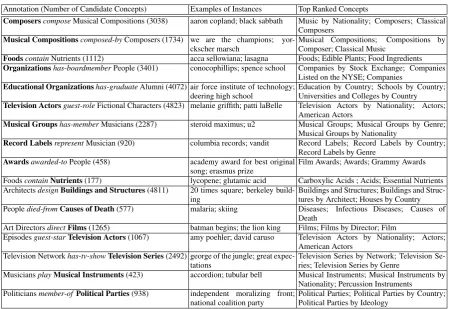
Table 2:Concepts Computed for Gold-Standard Annotations: Examples of entries from the gold standard and counts of candidate concepts (Wikipedia categories) reached from upward propagation of instances (Wikipedia instances). The target gold concept is shown in bold. Also shown are examples of Wikipedia instances, and the top concepts computed by the best-performing learning algorithm for the respective gold concepts.
the minimum path in the hierarchy between the concept and the gold concept. Lenis minimum (0) if the candidate concept is the same as the gold standard concept. A given annotationaireceives no credit for DRR if no path is found between the returned concepts and the gold concept.
As an illustration, for a single annotation, the right argument of composed-by, the ranked list of concepts returned by an experimental may be [‘Symphonies by Anton Bruckner’, ‘Sym-phonies by Joseph Haydn’, ‘Sym‘Sym-phonies by Gus-tav Mahler’, ‘Musical Compositions’, ..], with the gold concept being ‘Musical Compositions’. The length of the path between ‘Symphonies by An-ton Bruckner’ etc. and ‘Musical Compositions’ is 2 (via ‘Symphonies’). Therefore, the MRR score would be 0.25 (given by the fourth element of the ranked list), whereas the DRR score would be 0.33 (given by the first element of the ranked list). MRR and DRR are computed in five-fold cross validation. Concretely, the gold standard is split into five folds such that the sets of annotation la-bels in each fold are disjoint. Thus, none of
the annotation labels in testing appears in train-ing. This restriction makes the evaluation more rigurous and conservative as it actually assesses the extent the models learned are applicable to new, previously unseen annotation labels. If this restriction were relaxed, the baselines would preform equivalently as they do not depend on the training data, but the learned methods would likely do better.
4 Evaluation Results
4.1 Quantitative Results
Conceptual Hierarchy: The conceptual
hierar-chy contains 108,810 Wikipedia categories, and its maximum depth, measured as the distance from a concept to its farthest descendant, is 16.
Candidate Concepts: On average, for the gold
Experimental Run Accuracy
N=1 N=20
MRR DRR MRR DRR
→With raw-ratio features:
NAIVEBAYES 0.021 0.180 0.054 0.222 MAXENT 0.029 0.168 0.045 0.208 PERCEPTRON 0.029 0.176 0.045 0.216 →With scaled-ratio features:
NAIVEBAYES 0.050 0.170 0.112 0.243 MAXENT 0.245 0.456 0.430 0.513
PERCEPTRON 0.245 0.391 0.367 0.461 →With binary features:
NAIVEBAYES 0.115 0.297 0.224 0.361 MAXENT 0.165 0.390 0.293 0.441 PERCEPTRON 0.180 0.332 0.330 0.429 →For baselines:
[image:8.595.76.288.67.286.2]INSTPERCENT 0.029 0.173 0.045 0.224 ENTROPY 0.000 0.110 0.007 0.136 AVGDEPTH 0.007 0.018 0.028 0.045
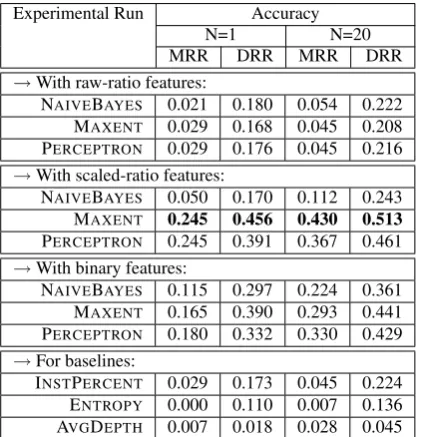
Table 3: Precision Results: Accuracy of ranked lists of concepts (Wikipedia categories) computed by var-ious runs, as an average over the gold standard of concept-level annotations, considering the top N can-didate concepts computed for each gold standard entry.
4.2 Qualitative Results
Precision: Table 3 compares the precision of the
ranked lists of candidate concepts produced by the experimental runs. The MRR and DRR scores in the table consider either at most 20 of the concepts in the ranked list computed by a given experimen-tal run, or only the first, top ranked computed con-cept. Note that, in the latter case, the MRR and DRR scores are equivalent to precision@1 scores. Several conclusions can be drawn from the re-sults. First, as expected by definition of the scoring metrics, DRR scores are higher than the stricter MRR scores, as they give partial credit to concepts that, while not identical to the gold concepts, are still close approximations. This is particularly noticeable for the runs MAXENTand PERCEPTRON with raw-ratio features (4.6 and
4.8 times higher respectively). Second, among the baselines, INSTPERCENT is the most accu-rate, with the computed concepts identifying the gold concept strictly at rank 22 on average (for an MRR score 0.045), and loosely at an aver-age of 4 steps away from the gold concept (for a DRR score of 0.224). Third, the accuracy of the learning algorithms varies with how the pair-wise feature values are combined. Overall, raw-ratio feature values perform the worst, and scaled-ratio the best, with binary in-between. Fourth, the scores of the best experimental run, MAXENT
with scaled-ratio features, are 0.430 (MRR) and
0.513 (DRR) over the top 20 computed concepts, and 0.245 (MRR) and 0.456 (DRR) when consid-ering only the first concept. These scores corre-spond to the ranked list being less than one step away in the hierarchy. The very first computed concept exactly matches the gold concept in about one in four cases, and is slightly more than one step away from it. In comparison, the very first concept computed by the best baseline matches the gold concept in about one in 35 cases (0.029 MRR), and is about 6 steps away (0.173 DRR). The accuracies of the various learning algorithms (not shown) were also measured and correlated roughly with the MRR and DRR scores.
Discussion: The baseline runs INSTPERCENT
and ENTROPY produce categories that are far too specific. For the gold annotation composed-by(‘Composers’, ‘Musical Compositions’), INST
-PERCENTproduces ‘Scottish Flautists’ for the left argument and ‘Operas by Ernest Reyer’ for the right. AVGDEPTH does not suffer from over-specification, but often produces concepts that have been reached via propagation, yet are not close to the gold concept. For composed-by, AVGDEPTHproduces ‘Film’ for the left argument
and ‘History by Region’ for the right.
4.3 Error Analysis
The right part of Table 2 provides a more de-tailed view into the best performing experimental run, showing actual ranked lists of concepts pro-duced for a sample of the gold standard entries by MAXENTwith scaled-ratio. A separate analy-sis of the results indicates that the most common cause of errors is noise in the conceptual hier-archy, in the form of unbalanced instance-level annotations and missing hierarchy edges. Un-balanced annotations are annotations where cer-tain subtrees of the hierarchy are artificially more populated than other subtrees. For the left argu-ment of the annotationhas-profession, 0.05% of ‘New York Politicians’ are matched but 70% of ‘Bushrangers’ are matched. Such imbalances may be inherent to how annotations are added to Free-base: different human contributors may add new annotations to particular portions of Freebase, but miss other relevant portions.
‘Members of the Parliament of Northern Ireland’, all of which should have parents in the hierarchy. If a few edges are missing in a particular region of the hierarchy, the method can recover, but if so many edges are missing that a gold concept has very few descendants, then propagation can be substantially affected. In the worst case, the gold concept becomes disconnected, and thus will be missing from the set of candidate concepts com-piled during propagation. For example, for the annotation team-color(‘Sports Clubs’, ‘Colors’), the only descendant concept of ‘Colors’ in the hi-erarchy is ‘Horse Coat Colors’, meaning that the gold concept ‘Colors’ is not reached during prop-agation from instances upwards in the hierarchy.
5 Related Work
Similar to the task of attaching a semantic anno-tation to the concept in a hierarchy that has the best level of generality is the task of finding se-lectional preferences for relations. Most relevant to this paper is work that seeks to find the appro-priate concept in a hierarchy for an argument of a specific relation (Ribas, 1995; McCarthy, 1997; Li and Abe, 1998). Li and Abe (1998) address this problem by attempting to identify the best tree cut in a hierarchy for an argument of a given verb. They use the minimum description length princi-ple to select a set of concepts from a hierarchy to represent the selectional preferences. This work makes several limiting assumptions including that the hierarchy is a tree, and every instance belongs to just one concept. Clark and Weir (2002) inves-tigate the task of generalizing a single relation-concept pair. A relation is propagated up a hier-archy until a chi-square test determines the differ-ence between the probability of the child and par-ent concepts to be significant where the probabili-ties are relation-concept frequencies. This method has no direct translation to the task discussed here; it is unclear how to choose the correct concept if instances generalize to different concepts.
In other research on selectional preferences, Pantel et al. (2007), Kozareva and Hovy (2010) and Ritter et al. (2010) focus on generating ad-missible arguments for relations, and Erk (2007) and Bergsma et al. (2008) investigate classifying a relation-instance pair as plausible or not.
Important to this paper is the Wikipedia cate-gory network (Remy, 2002) and work on refin-ing it. Ponzetto and Navigli (2009) disambiguate Wikipedia categories by using WordNet synsets
and use this semantic information to construct a taxonomy. The resulting taxonomy is the concep-tual hierarchy used in the evaluation.
Another related area of work is the discovery of relations between concepts. Nastase and Strube (2008) use Wikipedia category names and cate-gory structure to generate a set of relations be-tween concepts. Yan et al. (2009) discover re-lations between Wikipedia concepts via deep lin-guistic information and Web frequency informa-tion. Mohamed et al. (2011) generate candi-date relations by coclustering text contexts for ev-ery pair of concepts in a hierarchy. In a sense, this area of research is complementary to that dis-cussed in this paper. These methods induce new relations, and the proposed method can be used to find appropriate levels of generalization for the arguments of any given relation.
6 Conclusions
This paper introduces a method to convert flat sets of instance-level annotations to hierarchically or-ganized, concept-level annotations. The method determines the appropriate concept for a given se-mantic annotation in three stages. First, it propa-gates annotations upwards in the hierarchy, form-ing a set of candidate concepts. Second, it classi-fies each candidate concept as more or less appro-priate than each other candidate concept within an annotation. Third, it ranks candidate concepts by the number of other concepts relative to which it is classified as more appropriate. Because the fea-tures are comparisons between concepts within a single semantic annotation, rather than consider-ations of individual concepts, the method is able to generalize across annotations, and can thus be applied to new, previously unseen annotations. Experiments demonstrate that, on average, the method is able to identify the concept of a given annotation’s argument within one hierarchy edge of the gold concept.
References
Michele Banko, Michael Cafarella, Stephen Soder-land, Matt Broadhead, and Oren Etzioni. 2007. Open information extraction from the Web. In Pro-ceedings of the 20th International Joint Conference on Artificial Intelligence (IJCAI-07), pages 2670– 2676, Hyderabad, India.
Cory Barr, Rosie Jones, and Moira Regelson. 2008. The linguistic structure of English Web-search queries. In Proceedings of the 2008 Conference on Empirical Methods in Natural Language
Pro-cessing (EMNLP-08), pages 1021–1030, Honolulu,
Hawaii.
Shane Bergsma, Dekang Lin, and Randy Goebel. 2008. Discriminative learning of selectional pref-erence from unlabeled text. InProceedings of the 2008 Conference on Empirical Methods in Natural
Language Processing (EMNLP-08), pages 59–68,
Honolulu, Hawaii.
Kurt Bollacker, Colin Evans, Praveen Paritosh, Tim Sturge, and Jamie Taylor. 2008. Freebase: A collaboratively created graph database for struc-turing human knowledge. In Proceedings of the 2008 International Conference on Management of
Data (SIGMOD-08), pages 1247–1250, Vancouver,
Canada.
Stephen Clark and David Weir. 2002. Class-based probability estimation using a semantic hierarchy.
Computational Linguistics, 28(2):187–206.
Mark Dredze, Paul McNamee, Delip Rao, Adam Ger-ber, and Tim Finin. 2010. Entity disambiguation for knowledge base population. In Proceedings of the 23rd International Conference on
Compu-tational Linguistics (COLING-10), pages 277–285,
Beijing, China.
Katrin Erk. 2007. A simple, similarity-based model for selectional preferences. InProceedings of the 45th Annual Meeting of the Association for
Com-putational Linguistics (ACL-07), pages 216–223,
Prague, Czech Republic.
Zornitsa Kozareva and Eduard Hovy. 2010. Learning arguments and supertypes of semantic relations us-ing recursive patterns. InProceedings of the 48th Annual Meeting of the Association for Computa-tional Linguistics (ACL-10), pages 1482–1491, Up-psala, Sweden.
Hang Li and Naoki Abe. 1998. Generalizing case frames using a thesaurus and the mdl principle. In
Proceedings of the ECAI-2000 Workshop on
Ontol-ogy Learning, pages 217–244, Berlin, Germany.
Xiao Li. 2010. Understanding the semantic struc-ture of noun phrase queries. InProceedings of the 48th Annual Meeting of the Association for Com-putational Linguistics (ACL-10), pages 1337–1345, Uppsala, Sweden.
Diana McCarthy. 1997. Word sense disambiguation for acquisition of selectional preferences. In Pro-ceedings of the ACL/EACL Workshop on Automatic Information Extraction and Building of Lexical
Se-mantic Resources for NLP Applications, pages 52–
60, Madrid, Spain.
Tom Mitchell. 1997.Machine Learing. McGraw Hill. Thahir Mohamed, Estevam Hruschka, and Tom Mitchell. 2011. Discovering relations between noun categories. InProceedings of the 2011 Con-ference on Empirical Methods in Natural Language
Processing (EMNLP-11), pages 1447–1455,
Edin-burgh, United Kingdom.
Vivi Nastase and Michael Strube. 2008. Decoding Wikipedia categories for knowledge acquisition. In
Proceedings of the 23rd National Conference on Artificial Intelligence (AAAI-08), pages 1219–1224, Chicago, Illinois.
M. Pas¸ca and E. Alfonseca. 2009. Web-derived resources for Web Information Retrieval: From conceptual hierarchies to attribute hierarchies. In
Proceedings of the 32nd International Conference on Research and Development in Information
Re-trieval (SIGIR-09), pages 596–603, Boston,
Mas-sachusetts.
Patrick Pantel, Rahul Bhagat, Timothy Chklovski, and Eduard Hovy. 2007. ISP: Learning inferential se-lectional preferences. InProceedings of the Annual Meeting of the North American Chapter of the Asso-ciation for Computational Linguistics (NAACL-07), pages 564–571, Rochester, New York.
Simone Paolo Ponzetto and Roberto Navigli. 2009. Large-scale taxonomy mapping for restructuring and integrating Wikipedia. In Proceedings of the 21st International Joint Conference on Ar-tifical Intelligence (IJCAI-09), pages 2083–2088, Barcelona, Spain.
Melanie Remy. 2002. Wikipedia: The free encyclope-dia. Online Information Review, 26(6):434. Francesc Ribas. 1995. On learning more appropriate
selectional restrictions. InProceedings of the 7th Conference of the European Chapter of the
Asso-ciation for Computational Linguistics (EACL-97),
pages 112–118, Madrid, Spain.
Alan Ritter, Mausam, and Oren Etzioni. 2010. A la-tent dirichlet allocation method for selectional pref-erences. InProceedings of the 48th Annual Meet-ing of the Association for Computational LMeet-inguis-
Linguis-tics (ACL-10), pages 424–434, Uppsala, Sweden.
Claude Shannon. 1948. A mathematical theory of communication. Bell System Technical Journal, 27:379–423,623–656.
Fei Wu and Daniel S. Weld. 2010. Open information extraction using wikipedia. InProceedings of the 48th Annual Meeting of the Association for Compu-tational Linguistics (ACL-10), pages 118–127, Up-psala, Sweden.
Yulan Yan, Naoaki Okazaki, Yutaka Matsuo, Zhenglu Yang, and Mitsuru Ishizuka. 2009. Unsupervised relation extraction by mining Wikipedia texts using information from the Web. InProceedings of the Joint Conference of the 47th Annual Meeting of the ACL and the 4th International Joint Conference on Natural Language Processing of the AFNLP