Dependency Tree Abstraction for Long-Distance Reordering in
Statistical Machine Translation
Chenchen Ding
Department of Computer Science University of Tsukuba
1-1-1 Tennodai, Tsukuba, Ibaraki , Japan
Yuki Arase
Microsoft Research No. 5 Danling St., Haidian Dist.
Beijing, P.R. China
Abstract
Word reordering is a crucial technique in statistical machine translation in which syntactic information plays an important role. Synchronous context-free gram-mar has typically been used for this pur-pose with various modifications for adding flexibilities to its synchronized tree gen-eration. We permit further flexibilities in the synchronous context-free grammar in order to translate between languages with drastically different word order. Our method pre-processes a parallel corpus by abstracting source-side dependency trees, and performs long-distance reordering on top of an off-the-shelf phrase-based sys-tem. Experimental results show that our method significantly outperforms previous phrase-based and syntax-based models for translation between English and Japanese.
1 Introduction
Since the inception of statistical machine trans-lation (SMT), long-distance word reordering has been a notable challenge, particularly when trans-lating between languages with drastically different word orders, such as subject-verb-object (SVO) and subject-object-verb (SOV) languages like En-glish and Japanese, respectively. Phrase-based models (Koehn et al., 2003; Och and Ney, 2004; Xiong et al., 2006) have been strong in local translation and reordering. However, phrase-based models cannot effectively conduct long-distance reordering because they are based purely on statis-tics of syntax-independent phrases. As a comple-mentary approach to phrase-based models, some researchers have incorporated syntactic informa-tion into an SMT framework (Wu, 1997; Yamada and Knight, 2001; Liu et al., 2006) using syn-chronous context-free grammar(SCFG) (Aho and
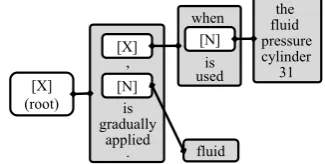
when the fluid pressure cylinder 31 is used, fluid is gradually applied. ,
is gradually
applied
. fluid when
is used
[N]
the fluid pressure cylinder
31 [N]
[X]
[image:1.595.323.486.211.293.2][X] (root)
Figure 1:English abstraction tree example Ullman, 1972). The original SCFG assumes that the syntactic trees of the source and target lan-guages can be derived synchronously. However, this assumption is too strict for handling paral-lel sentences that are often comparable rather than parallel. For alleviating this assumption, some re-searchers have added flexibilities in synchronized tree generation (Wu, 1997; Burkett et al., 2010). In addition, in the SMT framework, there is an approach that alleviates the assumption by only generating the source-side syntactic tree and pro-jecting it to the target-side sentence (Yamada and Knight, 2001; Liu et al., 2006).
In practice, these existing methods are not flex-ible enough to handle parallel sentence pairs, es-pecially those of SVO and SOV languages. There-fore, we permit further flexibility in SCFG aiming to effectively conduct long-distance reordering. We design our method as a pre-processing proce-dure so that we can use a well-developed phrase-based system without adding heavy computational complexity to the system. Specifically, we propose an abstraction tree that is a shallow and nested representation,i.e., abstraction of the dependency tree as Fig. 1 depicts. Our method pre-processes a parallel corpus by generating source-side abstrac-tion trees and projecting the trees onto the target-side sentences. It then decomposes the corpus by collecting corresponding node pairs as a new corpus, and finally trains the phrase-based model. In this manner, the source-side grammar is deter-mined on the fly for each sentence based on a
pendency parse of the source sentence. The target side of each production in the grammar is deter-mined by running the phrase-based decoder.
We empirically show effectiveness of our method for English-to-Japanese and Japanese-to-English translations by comparing it to phrase-based and syntax-phrase-based models. Experimental re-sults show that our method significantly outper-forms the previous methods with respect to the BLEU (Papineni et al., 2002) metric.
2 Related Work
For adding flexibilities to SCFG under an SMT scenario, previous studies generate only a source-side syntactic tree and project it to the target-source-side sentence regardless of the true target-side syntactic structure. Liu et al. (2006) propose a tree-to-string model using a source-side constituency tree to ex-tract correspondences between the source-side tree and the target-side sentence. Quirk et al. (2005) and Xie et al. (2011) use a dependency tree for the same purpose. Since these methods project a fine-grained source-side syntax tree, an accurate pro-jection is possible only when the target-side sen-tence has a syntactic structure that is similar to the source-side. Zhu and Xiao (2011) and Huang and Pendus (2013) generalize rules obtained by the tree-to-string model to increase the chance of rule matching at decoding. Despite their merits, none of these methods resolves the problem of tree projection to the target-side.
The hierarchical phrase-based model (HIERO) proposed by Chiang (2007) is independent of any syntactic information and generates SCFG rules only from parallel sentence pairs. Li et al. (2012) and Feng et al. (2012) incorporate syntactic infor-mation into HIERO as soft constraints. Since these methods are bound by the original HIERO rules that are independent of syntactic information, their rules cannot represent the global syntactic struc-ture of a sentence.
There are also pre-reordering methods for long-distance reordering in SVO-to-SOV translations using heuristics designed based on source-side syntactic structures (Xu et al., 2009; Isozaki et al., 2010; Isozaki et al., 2012). They are fine-tuned to handle only specific reordering problems in a pre-determined language pair. Another approach is to statistically learn pre-reordering rules from a cor-pus; however, this requires a highly parallel train-ing corpus consisttrain-ing of literal translations to learn
Algorithm 1CKY-style decoding
Input: Input sentenceuand its dependency treeru, transla-tion modelT M, block-LMbLM, sentence-LMsLM, size ofm-bestm
1: τu←generate abstraction tree ofuusingru 2: NodeT rans[][]← ∅
3: for allnodeinτudo
4: m-best←Decode(node, T M, bLM, m)
5: (start, end)←start and end indices ofnodeinu
6: NodeT rans[start][end]←m-best
7: end for
8: forstart:= 1to|u|do 9: forspan:= 0to|u| −1do 10: end←start+span
11: ChildT rans[]← ∅
12: for all(i, j)such thatstart≤i≤j≤enddo 13: ifNodeT rans[i][j]6=∅then
14: addNodeT rans[i][j]toChildT rans
15: end if 16: end for
17: CubeP runing(NodeT rans[start][end], ChildT rans, sLM, m)
18: end for 19: end for
effective rules (Neubig et al., 2012; Navratil et al., 2012). Such a training dataset is not widely avail-able in many languages.
3 Overview of the Proposed Method
Our method pre-processes sentences in a paral-lel corpus based on source-side abstraction trees. It first generates an abstraction treeτsof a source-side sentencesby abstracting its dependency tree rs: (s, rs) → τs. It then projects the tree to the target-side sentence tfor generating a target-side abstraction treeτtthat has exactly the same struc-ture to τs, i.e., (τs, t) → τt. The abstraction-tree generation process can be adapted to translat-ing languages by specifytranslat-ing source-side part-of-speeches (POSs) as input. Abstraction tree struc-tures also depend on the dependency grammar that a parser uses. In this study, we assume commonly used Stanford typed dependency (de Marneffe et al., 2006) for English and the chunk-based depen-dency with ipadic (Asahara and Matsumoto, 2003) for Japanese. Investigation of effects of different dependency grammars is our future work.
a highpressurehot watercylinder isused Figure 2:[N] node detection example
original corpus (referred to as sentence-LM), re-spectively. Thus the sentence-LM can be trained using a larger-scale monolingual corpus. Com-pared to previous methods that also decompose sentence pairs (Xu et al., 2005; Sudoh et al., 2010), our method is more syntax-oriented.
In decoding, we adopt the parsing algorithm with cube-pruning (Huang and Chiang, 2005) into a phrase-based decoder to translate the abstrac-tion tree of an input sentence efficiently. As Algorithm 1 shows, our decoder first generates the abstraction tree of the input sentence (line
1), and independently translates each node us-ing the block-LM that models orderus-ing among non-terminals and lexical words (line 3–7). It then combines the m-best translation hypotheses of each node to construct a sentence-level trans-lation (line 8–19). Specifically, we insert sets of the m-best translation hypotheses of child nodes into the m-best hypotheses of their parent node by replacing the corresponding non-terminals us-ing the cube-prunus-ing (line 17). The ordering of these child nodes has been determined in their parent node by the phrase-based model that re-gards non-terminals only as single words. By doing so, long-distance reordering is solved sidering the global syntactic structure and con-texts (lexical strings) preserved in the node. In cube-pruning, we use the sentence-LM to com-pose fluent sentence-level translation. The block-LM and sentence-block-LM scores are treated as inde-pendent features.
The computational complexity of our decoder (line3–19) isO(|N |C), where|N |is the number of nodes in the abstraction-tree and C is a con-stant representing the complexity of phrase-based decoder and cube-pruning. Since combinations of hypotheses in cube-pruning are determined by the abstraction-tree in our method, the computational cost is significantly smaller than HIERO’s case. 4 Abstraction Tree Generation
In this section, we provide the formal definition of an abstraction tree and the generation method.
4.1 Definition of Abstraction Tree
We define an abstraction tree as τ = {N,E}, where N is a set of nodes and E is a set of
when [N] isused, [N] is graduallyapplied. Figure 3: [X] and [P] node detection. Since the word “used” is a head, it and its governing span are detached from the root “applied” as a child node.
edges. For conducting abstraction based on syn-tactic structures, we merge a span governed by a dependency head as a node and represent it by a non-terminal in a parent node. As a result, thei-th nodeNiconsists of a sequence of lexical wordsw and non-terminals Lthat replace spans governed by heads in the corresponding child nodes:
Ni={Ψ|ψ1, . . . , ψ|Ni|}, ψk∈ {w, L}.
The edge Eij between a parent node Ni and its child node Nj corresponds to a governor-dependent relationship from the head inNi to its dependentwxinNj. wxis another head and gov-erns other words inNj. The span covered byNj is replaced by a non-terminal inNi.
We use three kinds of labels to representLfor explicitly using syntactic information that is use-ful for long-distance reordering; [N], [P], and [X] according to the head in the corresponding node. We label a child node [N] when its head word is a noun and forms a base noun phrase, [P] when its head word is an adposition1, and [X] for others like verb phrases, conjunctive phrases, and rela-tive phrases. These nodes play different roles in a sentence. An [N] node, i.e., a base noun phrase, adds context to a sentence. A [P] node depends on other phrases and generally appears relatively freely in a sentence. Thus, we assume that the [P] node requires special reordering.
The abstraction tree depicted in Fig. 1 has a par-ent [X] node “when [N] is used” and its child [N] node “the fluid pressure cylinder 31.” The word “used” governs “cylinder” in the [N] node, and the [N] node folds the context in the [X] node.
4.2 Tree Construction
We begin with detecting [N] nodes, then pro-ceed to [P] and [X] nodes. These processes require to specify source-side POSs as input for adapting to translating languages. We finally flatten frag-mented nodes.
For detecting [N] nodes, we take a POS of noun as input and identify each noun and its governing span,i.e., a string of all governed words, using the source-side dependency tree as Fig. 2 shows. We
Algorithm 2[P] and [X] node detection
Input: Source-side sentences and its dependency treers, POS list of adpositionsP P os, [N] node listN-Nodes Output: [P] and [X] nodesP-Nodes,X-Nodes
1: P-Nodes[]← ∅,X-Nodes[]← ∅ 2: HeadList[]←root ofrs
3: repeat
4: head←pop node fromHeadList
5: ChildList[]←all dependents ofhead
6: for allchildinChildListdo
7: ifchild /∈ N-Nodesandchildhas dependents then
8: addchildtoHeadList
9: removechildfromChildList
10: end if 11: end for
12: start←smallest start index of nodes inChildList
13: end←largest end index of nodes inChildList
14: ifPOS ofhead∈P P osthen
15: add span[start, end]ofstoP-Nodes
16: else
17: add span[start, end]ofstoX-Nodes
18: end if
19: removeheadfromHeadList
20: untilHeadList=∅
regard descendant dependents as being governed by the noun for detecting a noun phrase of a com-plete form. We extract the span as a node and re-place it by an [N] label in the sentence.
Next, we identify [P] and [X] nodes given a list of source-side POSs of adpositions as input. As Algorithm 2 shows, after [N] node detection, we trace the dependency tree from its root to leaves (line3–20). We find all the dependents to the root, then check if each dependent is a head. If a de-pendent of the root is a head and governs other words, we detach the dependent to process later (line6–11). We then find the smallest start index and largest end index of dependent words and set the corresponding span as a node (if a dependent is in an [N] node, we use the start and end indices of the [N] node). Each node is labeled accord-ing to the POS of its head as [P] or [X] (line14–
18). We then take the detached dependent as a new root and repeat the process until no more detach-ment is possible. The computational complexity isO(|s|2). Through this process, a span with di-rect dependencies is extracted as a node, and other spans with descendant dependencies become de-scendant nodes, replaced by non-terminals in their parent node as shown in Fig. 3.
4.3 Handling Complex Noun Phrase
As described in Sec. 4.2, we detect a noun phrase as an [N] node. However, an [N] node be-comes more complex than a base noun phrase when the head governs a clause, such as a relative
thecylinder thatis
uses
machine …
…
[N] [X]
[image:4.595.339.493.56.105.2]original [N]
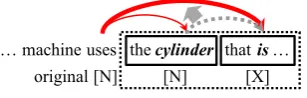
Figure 4:Handling a complex noun phrase clause. Such a complex node may require long-distance reordering of an inside clause when trans-lating. Therefore, we separate the noun phrase and clause. We take a POS list whose word can be a head of [P] and [X] nodes (preposition, verb,to, Wh-determiner/pronoun/adverb, and coordinating conjunction for English) as input. If the POS of a noun’s dependent is in the list, we detach the de-pendency arc, and then re-attach the dede-pendency arc to the head of the noun. As a result, the base noun phrase becomes an [N] node and its clause becomes a [P] or [X] node that is transformed to a sibling of the [N] node.
In Fig. 4, the word “cylinder” in the original [N] node has a relative clause and governs “is.” We de-tach the dependency arc and re-atde-tach it to “uses” (the head of “cylinder”), so that the noun phrase and the clause become sibling [N] and [X] nodes.
4.4 Flattening Fragmented Nodes
The above processes are independent of the size of each node, meaning they produce fragmented nodes of only a few words. Such fragmented nodes make the tree projection to the target-side difficult. To solve this problem, we flatten the ab-straction tree as shown in Algorithm 3. We pro-cess an internal node inτsfrom bottom to top. If the covering span of an internal node is less than a thresholdγ ∈N, its child nodes are merged (line3
and4, Algorithm 3). Specifically, we reinsert the child nodes by replacing the corresponding non-terminals with lexical strings that the child nodes have been covered by. The computational cost is
O(|N |). We investigate the effect ofγ in the fol-lowing evaluation section (Table 2).
5 Abstraction Tree Projection
In this section, we describe a method for project-ing the obtained source-side abstraction tree onto the target-side sentence.
5.1 Tree Structure Projection
Algorithm 3Tree flattening
Input: Abstraction treeτs, thresholdγ Output: Flattened treeτ0
s
1: for allinternalnodeinτs, from bottom to topdo 2: (start, end)←start and end indices ofnode
3: ifend−start+ 1< γthen 4: τ0
s←MergeChildNodes(node, τs) 5: end if
6: end for
To avoid this problem, we first omit alignment links of function words whose alignment quality tends to be lower than that of the content words. We then complement the quality of word align-ment by adapting thesyntactic cohesion assump-tion (Yamada and Knight, 2001) that assumes a word string covered by a sub-tree of the source-side syntactic tree corresponds to a string of con-tiguouswords in the target-side sentence. Follow-ing the assumption, we project the k-th node of the source-side abstraction treeNk(s)to a string of contiguous words in the target-side:
Nk(s)7→ti, . . . , tj, s.t.1≤i≤j ≤ |t|, wheretiis thei-th word in the target-side sentence and|t|is the number of words in the sentence.
For each node of the source-side abstraction tree, we first obtain its covering span. We then define a vectorc∈ {0,1}nwhose elements repre-sent word alignment links in a binary manner. If and only if thei-th target word is aligned to a word in the span, thei-th element ofcbecomes1, oth-erwise it is 0. Since the original word alignment represented by the vectorcmay be noisy, we find a vectorc∗ ∈ {0,1}n that maximizes the syntac-tic cohesion assumption. Inc∗, only consecutive elements between two indices iand j are1, and others are0. We derive suchc∗as follows:
Cmin(c) = {c0|argmin
c0 kc
0−ck}, (1)
s.t.∃i, j, 1≤i≤j≤nand c0k=
1 i≤k≤j,
0 otherwise, c∗ = argmax
c0∈Cmin(c)kc
0k. (2)
The operatork · k computes the Euclidean norm of a vector and c0
kis thek-th element of a vector c0. Finally, c∗ represents the best possible word links that maximize the syntactic cohesion as-sumption,i.e., the longest contiguous word string in the target-side, and that are closest to the orig-inal word alignment. Specifically, Eq. (1) deter-mines vectors that have the smallest distance to
Algorithm 4Tree projection
Input: Source-side abstraction treeτs, target-side sentence t, word alignmentAwbetweensandt
Output: Target-side abstraction treeτt 1: τt[]← ∅
2: remove links of function words inAw 3: forspan:=|s| −1to0do
4: forstart:= 1to|s|do 5: end←start+span
6: ifspan[start, end]∈τsthen
7: c←GenerateV ector([start, end],Aw) 8: c∗←Solve(c)Eq. (1) and Eq. (2) 9: (i, j)←start and end indices ofc∗ 10: add span[i, j]oftas a node intoτt 11: Aw←UpdateW ordAlignment(c,c∗) 12: end if
13: end for 14: end for
the original vectorcwhile satisfying the hard con-straint, and Eq. (2) selects the one whose norm is largest, i.e., a vector that has longest contiguous word links to the target-side. For computational efficiency, we use the greedy-search so that the computational cost is O(|t|). When Eq. (2) has multiple solutions, word links in these solutions are equally likely, and thus we merge them into a unique solution. Specifically, we take the union of the solutions and find the smallest indexil and largest indexirwhose elements are1. We then set all elements betweenilandirto1.
As Algorithm 4 shows, we conduct this pro-cess in a top-down manner throughout the abstrac-tion tree (line3–14). When processing each node, word alignment links are updated by overwriting links incwith the ones inc∗ (line 11). The com-putational cost isO(|N(s)||t|), where|N(s)|is the number of nodes inτs. Figure 5 shows a projection example of a node. A node of “when [N] is used” covers a span of “when the fluid pressure cylin-der31is used.” The words in the span are aligned to the 1st, 2nd, and 5th target words (chunks)2; however, the link to the 5th target word (chunk) is a mis-alignment. With the alignment vector c of[1,1,0,0,1,0,0], we can remove this misalign-ment and derivec∗of[1,1,0,0,0,0,0].
5.2 Fixed-Expression Recovery
The abstraction tree generation and projection are based on a dependency tree, and thus may over-segment a fixed-expression, such as idioms and multi-word expressions. Since a fixed-expression composes a complete meaning using a contiguous word string, splitting it into different nodes results
Node:
Target sentence:
Span: when the fluid pressure cylinder 31 isused
流体 圧 シリンダ 31 の 場合 は 液体 が 徐々 に 排出 さ れる こと と なる 。
used is
when [N]
[image:6.595.306.524.62.171.2]𝒄 = 1, 1, 0, 0, 1, 0, 0
Figure 5:Abstraction tree projection
in poor translation. To avoid this issue, we gener-ate a list of fixed-expressions using conventional methods (Evert, 2008) and force them to remain in one node. On both the source and target abstrac-tion trees, we recursively reinsert nodes to their parent node when such a fixed-expression is over-segmented and spread over multiple nodes.
5.3 Block-Corpus Construction
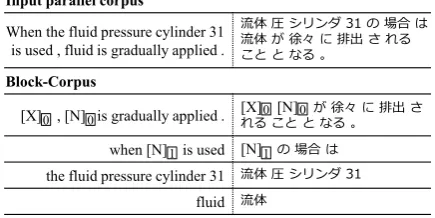
After tree structure projection, we extract cor-responding node pairs as a block-corpus. Each node pair has a formhΨs,Ψt,ALi, whereΨs ∈
{Ωs, L}n represents the source-side node of length n. It consists of a sequence of lexical words in the source-side vocabularyΩs and non-terminalsL. Ψt∈ {Ωt, L}m similarly represents the target-side node of length m. AL preserves correspondences between the non-terminals in the source and target nodes.
Specifically, we extract a pair of leaf nodes as a pair of lexical strings. As for internal nodes, we use the same non-terminal labels appearing in the source-side node at the target-side node. Namely, the span covered by child nodes are re-placed by corresponding non-terminal labels in the source-side node. At the same time, we record the correspondence between the non-terminals. Fig-ure 6 shows an example of the block-corpus, in which the boxed indices indicate correspondences of non-terminals in the source and target nodes. 6 Evaluation
We evaluate our method in English-to-Japanese (EJ) and Japanese-to-English (JE) translation tasks, since long-distance reordering is a serious problem in this language pair.
6.1 Experiment Corpus
We use NTCIR-7 PATMT (Fujii et al., 2008), a publicly available standard evaluation dataset, for EJ and JE machine translation. The dataset is con-structed using English and Japanese patents and consists of1.8million parallel sentence pairs for training,915sentence pairs for development, and
1,381sentence pairs for testing. The development
Input parallel corpus
When the fluid pressure cylinder 31 is used , fluid is gradually applied .
流体 圧 シリンダ 31 の 場合 は 流体 が 徐々 に 排出 さ れる こと と なる 。
Block-Corpus
[X] , [N] is gradually applied . [X] [N] れる こと と なる 。が 徐々 に 排出 さ
when [N] is used [N] の 場合 は
the fluid pressure cylinder 31 流体 圧 シリンダ 31
fluid 流体 0
0 0 0
1 1
Figure 6: Block-corpus example. Boxed indices link non-terminals in the source and target exemplars.
and test sets have one reference per sentence. This dataset is bidirectional and can be used for both EJ and JE translation evaluation.
6.2 Implementation of Proposed Method
We implement our method for EJ and JE translation tasks. In both cases, we use an in-house implementation of English POS tag-ger (Collins, 2002) and a Japanese morpholog-ical analyzer (Kudo et al., 2004) for tokeniza-tion and POS tagging. As for EJ translatokeniza-tion, we use the Stanford parser (de Marneffe et al., 2006) to obtain English abstraction trees. We also use an in-house implementation of a Japanese chunker (Kudo and Matsumoto, 2002) to obtain chunks in Japanese sentences. We apply the chun-ker just before tree projection for using a chunk as a projection unit, since a chunk is the basic unit in Japanese. As for JE translation, we use a popular Japanese dependency parser (Kudo and Matsumoto, 2002) to obtain Japanese abstraction trees. We convert Japanese chunk-level depen-dency tree to a word-level using a simple heuris-tic. We use GIZA++ (Och and Ney, 2003) with the grow-diag-final-and heuristic for word alignment. We use an in-house implementation of the bracketing transduction grammar (BTG) model (Xiong et al., 2006) as the phrase-based model that our method relies on for translation. Non-terminals in our block-corpus are regarded as a single word, and their alignmentsAL deter-mined in the block-corpus are exclusively used to align them. We set the maximum phrase length to
5 when training the translation model, since we find that the performance is stable even setting larger values as in (Koehn et al., 2003). We then train the sentence-LM and block-LM using the original corpus and the obtained block-corpus, respectively. We ignore a sentence-end tag (</s>) in the block-LM. With each corpus, we train a
6.3 Comparison Method
Since our method pre-processes the parallel cor-pus based on SCFG with increased flexibility and trains a BTG model using the processed corpus, we compare our method to another BTG model trained only with the original corpus (simply re-ferred to as the BTG model). We also com-pare to the tree-to-string model and HIERO using state-of-the-art implementations available in the Moses system (Koehn et al., 2007), since they are based on SCFG. The tree-to-string model requires source-side constituency trees. For EJ transla-tion, we use a state-of-the-art English constituency parser (Miyao and Tsujii, 2005; Miyao and Tsujii, 2008). For JE translation, we transform a Japanese dependency tree into a constituency tree using a simple heuristic because there is no publicly avail-able constituency parser. During the translation model training, we use the same setting as our method. In addition, we set the maximum span of rule extraction to infinity for the tree-to-string model and 10 for HIERO following Moses’ de-fault. We use the sentence-LM in these models as they assume.
In addition, we compare our method to Head-Finalization (Isozaki et al., 2010; Isozaki et al., 2012) because it has achieved the best BLEU score in EJ translation by handling long-distance re-ordering. It is a specialized method to EJ trans-lation, where a syntactic head in an English sen-tence is reordered behind its constituents for com-plying with the head-final nature of the Japanese language. We pre-process the parallel corpus us-ing the Head-Finalization and train a BTG model using the same setting with our method to observe the effect of different pre-processing methods.
During decoding, we set the translation table size to 10 for each source string, and the stack and beam sizes in the cube pruning to100for our method (i.e., m-best = 100) and all other mod-els. The maximum reordering span in the tree-to-string model and HIERO is the same as the rule extraction setting (infinity and 10, respectively). We set the word reordering limit to infinity for our method and the BTG model, while we set it to3
for Head-Finalization as their papers report. We tune feature weights by the minimum error rate training (Och, 2003) to maximize the BLEU score using the development set. As an evaluation metric, we compute the BLEU score using the test set, and all the scores discussed in Sec. 6.4 are the
Method EJ JE
Proposed method (γ= 10) 31.78 28.55
BTG 28.82∗∗ 26.98∗∗
HIERO 29.27∗∗ 27.96∗
Tree-to-string 30.97∗∗ 26.28∗∗
[image:7.595.318.513.59.126.2]Head-Finalization 29.52∗∗ NA
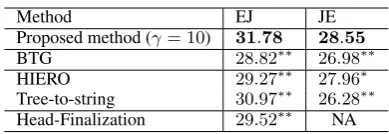
Table 1: Test-set BLEU scores. The symbol∗∗represents
a significant difference at thep < .01level and∗indicates a
significant difference at thep < .05level against our method. test-set BLEU scores. Significance tests are con-ducted using bootstrap sampling (Koehn, 2004).
6.4 Result and Discussion
In this section, we present experimental results and discuss them in detail.
Overall Performance Table 1 shows the BLEU scores, in which our method significantly outper-forms all other models for both EJ and JE transla-tion tasks. These results indicate that our method effectively incorporates syntactic information into the phrase-based model and improves the transla-tion quality.
For EJ translation, our method outperforms the BTG model by 2.96, the HIERO by 2.51, the tree-to-string model by 0.81, and the Head-Finalization3 by 2.26 in terms of BLEU score. When we compare our method to the Head-Finalization, both of them improve the BTG model by pre-processing the parallel corpus. Moreover, our method outperforms the Head-Finalization us-ing richer syntactic information.
For JE translation, our method outperforms the BTG model by1.57, the HIERO by0.59, and the tree-to-string model by 2.27 in terms of BLEU score. Our method and the tree-to-string model, which depend on syntactic information, largely outperform the BTG model and HIERO in EJ translation. While the BTG model and HIERO, which are independent of syntactic information, outperform the tree-to-string model in JE trans-lation. One reason for this phenomenon is that English is a strongly configurational language that has rigid word order while Japanese is an agglu-tinative language that has relatively free word or-der. A rigid syntactic structure provides solid clues for word reordering when translated into a flexible language, while a flexible structure provides weak clues for fitting it to a rigid structure.
γ EJ JE BLEU height BLEU height
0 31.15 4.1(1.5) 28.41 4.2(1.4)
3 30.88 3.8(1.7) 28.34 3.9(1.6)
5 31.21 3.7(1.5) 28.39 3.8(1.5)
8 31.61 3.4(1.4) 28.52 3.4(1.4)
10 31.78 3.1(1.3) 28.55 3.2(1.3)
12 31.76 2.9(1.3) 28.54 3.0(1.3)
[image:8.595.87.275.53.171.2]15 31.25 2.6(1.2) 28.21 2.7(1.2) ∞ 28.82 1.0(–) 26.98 1.0(–)
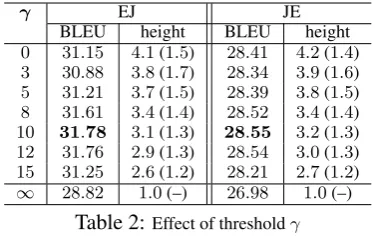
Table 2:Effect of thresholdγ
Effect of Flattening Threshold Table 2 shows BLEU scores when changing the flattening thresh-old γ in our method, and averages and standard deviations of the abstraction tree heights (γ =∞
is equal to the BTG model). The performance im-proves as we increase the threshold,i.e., increas-ing the level of abstraction. Our method achieves the best BLEU score whenγ = 10for both EJ and JE translation, with the performance degrading as we further increase the threshold.
This trend shows the trade-off between phrase-based and syntax-phrase-based approaches. When the threshold is too small, an abstraction tree be-comes closer to the dependency tree and the tree-projection becomes difficult. In addition, text information becomes unavailable when con-ducting long-distance reordering with a deep tree. On the other hand, when setting the threshold too large, the abstraction tree becomes too abstracted and syntactic structures useful for long-distance word reordering are lost. We need to balance these effects by setting an appropriate threshold.
Effect of Non-Terminals and Fixed-Expressions
We change the kinds of non-terminal labels in an abstraction tree to investigate their effect on the translation quality. When we merge the [P] label to the [X] label,i.e., use only [N] and [X] labels, the BLEU score drops0.40in EJ translation while the score is unaffected in JE translation. This is because flexible Japanese syntax does not differ-entiate postpositional phrases with others, while English syntax prohibits such a flexibility.
When we merge all labels and only use the [X] label, the BLEU score drops 0.57 in EJ transla-tion and 0.43 in JE translation. This result sup-ports our design of the abstraction tree that distin-guishes non-terminals according to their different functionalities in a sentence.
We also evaluate the effect of fixed-expressions as described in Sec. 5.2. Results show a significant change when over-splitting fixed-expressions; the BLEU score drops 1.13 for EJ and 0.36 for JE translation without reinserting fixed-expressions.
Method acceptable↑ global↓ local↓
Proposed 52 30 4
BTG 34 38 7
[image:8.595.314.515.53.96.2]Tree-to-string 47 32 7
Table 3:Error distribution in100samples of EJ translation Error Analysis We randomly sample100 trans-lation outputs per our method (γ = 10), BTG, and tree-to-string models for each EJ and JE transla-tion tasks, and manually categorize errors based on (Vilar et al., 2006). We focus primarily on reordering errors and exclusively categorize the samples into acceptable translations, translations with only global or local reordering errors, as well as others that are complicated combinations of var-ious errors. An acceptable translation correctly conveys the information in a source sentence even if it contains minor grammatical errors.
Table 3 shows the distribution of acceptable translations and those with global/local reordering errors in the EJ task (results of JE task are omitted due to the severe space limitation, but their trend is similar). It confirms that our method reduces re-ordering errors, not only for long-distance but for local reordering, and increases the ratio of accept-able translations compared to the BTG and tree-to-string models. We also find that long-distance reordering was attempted in85, 66, and 70 sen-tences by our method, BTG, and tree-to-string, re-spectively, among these translations. The results show that our method performs long-distance re-ordering more frequently than others.
When we compare translations performed by our method to those performed by the tree-to-string model, we observe that their effectiveness depends on a range of reordering. Our method is effective in long-distance reordering like those of clauses, while the tree-to-string model performs middle-range reordering well. This is due to the trade-off regarding the level of abstraction as dis-cussed in the flattening threshold experiment.
7 Conclusion and Future Work
We have proposed an abstraction tree for effec-tively conducting long-distance reordering using an off-the-shelf phrase-based model. Evaluation results show that our method outperforms conven-tional phrase-based and syntax-based models.
References
Alfred V. Aho and Jeffrey D. Ullman. 1972. The the-ory of parsing, translation, and compiling. Prentice-Hall Inc.
Masayuki Asahara and Yuji Matsumoto. 2003. ipadic version 2.7.0 user’s manual. http: //sourceforge.jp/projects/ipadic/ docs/ipadic-2.7.0-manual-en.pdf. David Burkett, John Blitzer, and Dan Klein. 2010.
Joint parsing and alignment with weakly synchro-nized grammars. In Proceedings of Conference of the North American Chapter of the Association for Computational Linguistics on Human Language Technology (NAACL-HLT 2010), pages 127–135. David Chiang. 2007. Hierarchical phrase-based
trans-lation. Computational Linguistics, 33(2):201–228. Michael Collins. 2002. Discriminative training
meth-ods for hidden Markov models: Theory and ex-periments with perceptron algorithms. In Proceed-ings of Conference on Empirical Methods in Natural Language Processing (EMNLP 2002), pages 1–8. Marie-Catherine de Marneffe, Bill MacCartney, and
Christopher D. Manning. 2006. Generating typed dependency parses from phrase structure parses. In
Proceedings of International Conference on Lan-guage Resources and Evaluation (LREC 2006), pages 449–454.
Stefan Evert. 2008. Corpora and collocations. In Anke L¨udeling and Merja Kyt¨o, editors,Corpus Linguis-tics. An International Handbook, volume 2, chap-ter 58. Mouton de Gruychap-ter.
Yang Feng, Dongdong Zhang, Mu Li, Ming Zhou, and Qun Liu. 2012. Hierarchical chunk-to-string translation. In Proceedings of Annual Meeting of the Association for Computational Linguistics (ACL 2012), pages 950–958.
Atsushi Fujii, Masao Utiyama, Mikio Yamamoto, and Takehito Utsuro. 2008. Overview of the patent translation task at the NTCIR-7 workshop. In Pro-ceedings of NTCIR-7 Workshop Meeting (NTCIR), pages 389–400.
Liang Huang and David Chiang. 2005. Better k-best parsing. InProceedings of International Workshop on Parsing Technology (IWPT 2005), pages 53–64. Fei Huang and Cezar Pendus. 2013. Generalized
re-ordering rules for improved SMT. InProceedings of Annual Meeting of the Association for Computa-tional Linguistics (ACL 2013), pages 387–392. Hideki Isozaki, Katsuhito Sudoh, Hajime Tsukada, and
Kevin Duh. 2010. Head Finalization: A simple re-ordering rule for SOV languages. In Proceedings of Joint Workshop on Statistical Machine Transla-tion and Metrics MATR (WMT-MetricsMATR 2010), pages 244–251.
Hideki Isozaki, Katsuhito Sudoh, Hajime Tsukada, and Kevin Duh. 2012. HPSG-based preprocessing for English-to-Japanese translation. ACM Trans-actions on Asian Language Information Processing (TALIP), 11(3):8:1–8:16.
Philipp Koehn, Franz J. Och, and Daniel Marcu. 2003. Statistical phrase-based translation. InProceedings of Conference of the North American Chapter of the Association for Computational Linguistics on Human Language Technology (NAACL-HLT 2003), pages 48–54.
Philipp Koehn, Hieu Hoang, Alexandra Birch, Chris Callison-Burch, Marcello Federico, Nicola Bertoldi, Brooke Cowan, Wade Shen, Christine Moran, Richard Zens, Chris Dyer, Ondrej Bojar, Alexan-dra Constantin, and Evan Herbst. 2007. Moses: Open source toolkit for statistical machine transla-tion. InProceedings of Annual Meeting of the Asso-ciation for Computational Linguistics (ACL 2007), pages 177–180.
Philipp Koehn. 2004. Statistical significance tests for machine translation evaluation. In Proceedings of Conference on Empirical Methods in Natural Lan-guage Processing (EMNLP 2004), pages 388–395. Taku Kudo and Yuji Matsumoto. 2002. Japanese
de-pendency analysis using cascaded chunking. In Pro-ceedings of Conference on Natural Language Learn-ing (CoNLL 2002), pages 1–7.
Taku Kudo, Kaoru Yamamoto, and Yuji Matsumoto. 2004. Applying conditional random fields to Japanese morphological analysis. InProceedings of Conference on Empirical Methods in Natural Lan-guage Processing (EMNLP 2004), pages 230–237. Junhui Li, Zhaopeng Tu, Guodong Zhou, and Josef van
Genabith. 2012. Head-driven hierarchical phrase-based translation. InProceedings of Annual Meet-ing of the Association for Computational LMeet-inguistics (ACL 2012), pages 33–37.
Yang Liu, Qun Liu, and Shouxun Lin. 2006. Tree-to-string alignment template for statistical machine translation. In Proceedings of International Con-ference on Computational Linguistics and Annual Meeting of the Association for Computational Lin-guistics (COLING-ACL 2006), pages 609–616. Yusuke Miyao and Jun’ichi Tsujii. 2005.
Probabilis-tic disambiguation models for wide-coverage HPSG parsing. InProceedings of Annual Meeting on Asso-ciation for Computational Linguistics (ACL 2005), pages 83–90.
Yusuke Miyao and Jun’ichi Tsujii. 2008. Feature for-est models for probabilistic HPSG parsing. Compu-tational Linguistics, 34(1):35–80.
translation. InProceedings of International Confer-ence on Computational Linguistics (COLING 2012), pages 2043–2058.
Graham Neubig, Taro Watanabe, Eiichiro Sumita, Shinsuke Mori, and Tatsuya Kawahara. 2011. An unsupervised model for joint phrase alignment and extraction. In Proceedings of Annual Meeting of the Association for Computational Linguistics: Human Language Technologies (ACL-HLT 2011), pages 632–641.
Graham Neubig, Taro Watanabe, and Shinsuke Mori. 2012. Inducing a discriminative parser to optimize machine translation reordering. In Proceedings of Joint Conference on Empirical Methods in Natural Language Processing and Computational Natural Language Learning (EMNLP-CoNLL 2012), pages 843–853.
Franz J. Och and Hermann Ney. 2003. A systematic comparison of various statistical alignment models.
Computational Linguistics, 29(1):19–51.
Franz J. Och and Hermann Ney. 2004. The alignment template approach to statistical machine translation.
Computational Linguistics, 30(4):417–449.
Franz J. Och. 2003. Minimum error rate training in statistical machine translation. In Proceedings of Annual Meeting on Association for Computational Linguistics (ACL 2003), pages 160–167.
Kishore Papineni, Salim Roukos, Todd Ward, and Wei-Jing Zhu. 2002. BLEU: a method for automatic evaluation of machine translation. InProceedings of Annual Meeting on Association for Computational Linguistics (ACL 2002), pages 311–318.
Chris Quirk, Arul Menezes, and Colin Cherry. 2005. Dependency treelet translation: Syntactically in-formed phrasal SMT. In Proceedings of Annual Meeting on Association for Computational Linguis-tics (ACL 2005), pages 271–279.
Andreas Stolcke. 2002. SRILM - An extensible lan-guage modeling toolkit. InProceedings of Interna-tional Conference on Spoken Language Processing (ICSLP 2002), pages 901–904.
Katsuhito Sudoh, Kevin Duh, Hajime Tsukada, Tsu-tomu Hirao, and Masaaki Nagata. 2010. Divide and translate: Improving long distance reordering in statistical machine translation. In Proceedings of Joint Workshop on Statistical Machine Transla-tion and Metrics MATR (WMT-MetricsMATR 2010), pages 418–427.
David Vilar, Jia Xu, Luis Fernando d’Haro, and Her-mann Ney. 2006. Error analysis of statistical ma-chine translation output. InProceedings of Interna-tional Conference on Language Resources and Eval-uation (LREC 2006), pages 697–702.
Dekai Wu. 1997. Stochastic inversion transduction grammars and bilingual parsing of parallel corpora.
Computational Linguistics, 23(3):377–403.
Jun Xie, Haitao Mi, and Qun Liu. 2011. A novel dependency-to-string model for statistical machine translation. In Proceedings of Conference on Em-pirical Methods in Natural Language Processing (EMNLP 2011), pages 216–226.
Deyi Xiong, Qun Liu, and Shouxun Lin. 2006. Maxi-mum entropy based phrase reordering model for sta-tistical machine translation. InProceedings of In-ternational Conference on Computational Linguis-tics and Annual Meeting on Association for Com-putational Linguistics (COLING-ACL 2006), pages 521–528.
Jia Xu, Richard Zens, and Hermann Ney. 2005. Sentence segmentation using IBM word alignment model 1. In Proceedings of Annual Conference of the European Association for Machine Translation (EAMT 2005), pages 280–287.
Peng Xu, Jaeho Kang, Michael Ringgaard, and Franz J. Och. 2009. Using a dependency parser to improve SMT for subject-object-verb languages. In Proceed-ings of Conference of the North American Chapter of the Association for Computational Linguistics on Human Language Technology (NAACL-HLT 2009), pages 245–253.
Kenji Yamada and Kevin Knight. 2001. A syntax-based statistical translation model. InProceedings of Annual Meeting on Association for Computa-tional Linguistics (ACL 2001), pages 523–530. Jingbo Zhu and Tong Xiao. 2011. Improving decoding
![Figure 2: [N] node detection example](https://thumb-us.123doks.com/thumbv2/123dok_us/1319478.662367/3.595.95.266.56.95/figure-n-node-detection-example.webp)