Original Article
The functional TERT MNS16A polymorphic tandem
repeat minisatellite contributes to gliomas development
Jie Liu*, Qiaowei He*, Hongtao Zhang, Peng Zou
Department of Neurosurgery, Yuhuangding Hospital of Yantai, 20 Yuhuangding East Road, Yantai 264000, Shan-dong, China. *Equal contributors and co-first authors.
Received February 13, 2017; Accepted July 2, 2018; Epub August 15, 2018; Published August 30, 2018
Abstract: Background: MNS16A, located on chromosome 5p15.33 downstream of the human telomerase reverse transcriptase (hTERT) gene, was demonstrated to have some promoter activity and involved in tumorigenesis. The association between MNS16A polymorphism and the susceptibility of cancers was inconsistent in previous studies. Methods: Pooled odds ratio (OR) and 95% confidence interval (95% CI) were calculated using fixed- or random-effect model. Results: We assessed published studies of the association between MNS16A polymorphism and cancer risk from 13 studies with 5920 cases and 8268 controls. In the overall analysis, no significant associations were found between MNS16a polymorphism and cancer risk. However, significant associations between MNS16a polymorphisms and glioma risk were observed in the comparison of homozygote (SS versus LL: OR = 1.51, 95% CI: 1.17-1.95; Pheterogeneity = 0.248; I2= 25.2%), dominant model (OR = 1.24, 95% CI: 1.05-1.46; P
heterogeneity = 0.412; I2= 0%), and recessive model (OR = 1.39, 95% CI: 1.09-1.77; Pheterogeneity = 0.325; I2= 0%). Conclusion: Taken together,
our results indicate that the MNS16A polymorphism is associated with gliomas susceptibility. Additional larger stud-ies were warranted to validate our findings.
Keywords: Cancer, meta-analysis, polymorphism, MNS16A
Introduction
Telomeres, the physical ends of eukaryotic lin-ear chromosomes composed of characteristic TTAGGG repeats, function to prevent chromo-some from degradation and maintain genome stability [1, 2]. Telomerase is a cellular ribonu-cleoprotein with a rate-limiting determinant of the reverse transcriptase activity which main- tenance of telomeric repeats at the end of ch- romosomes [3-5]. Human telomerase reverse transcriptase (hTERT) encodes the catalytic subunit of telomerase holoenzyme and pro-tects chromosomes from degradation [6, 7]. It has been shown that telomere-driven genome instability is a widespread cause of genome instability in cancer. On the other hand, en- hanced telomerase expression is intimately linked to the development of the malignancy [8, 9]. Recent discoveries have shown that telom-erase is inactivated in primary normal tissues but present in > 90% of cancer cells underlining the importance of telomerase in cell immortal-ization and tumorigenesis [10-12]. TERT siRNA
effectively suppressed the formation of dicen-tric chromosomes and susceptibility to
onco-genic transformation. Together, these findings
demonstrated that reactivated TERT contrib-utes to cellular proliferation and abnormal telo-mere maintenance in cancer cells.
In light of the already abundant evidence linking telomerase activity to the development of many tumor types, many efforts have been made to test the hypothesis that TERT gene polymor-phism might affect individual cancer predispo-sition. Recently, variable tandem repeat of MN-
S16A has been identified in the downstream
TERT mRNA. Recently, the TERT MNS16A has been studied in several malignancies, but the results remain controversial [13-25]. Therefore, we conduct a meta-analysis to evaluate the association between the MNS16a polymor-phisms and cancer susceptibility.
Materials and methods
Publication search
We conducted a comprehensive search through the PubMed, Embase databases and Chinese National Knowledge Infrastructure (CNKI) da- tabases for relevant articles in English and Chinese before Jan 20, 2017. The following key-words were used in isolation and combination with one another: “MNS16A” and “polymor-phism or variant or mutation” and “cancer or carcinoma”. There was no sample size limita-tion. The search was limited to human popula-tions and articles were written in English or Chinese. We also included additional studies by a hand search of references of original or review
articles on this topic to find other potentially eli -gible publications not indexed in common data-bases. All studies matching the eligible criteria were included in our meta-analysis.
Inclusion criteria
Eligible studies included in the current meta-analysis had to meet all the following criteria: (1) articles that evaluated the association between the MNS16A and cancer risk; (2) designed in case-control study; (3) providing
sufficient information to calculate odds ratios (ORs) with their 95% confidence interval (CI).
Data extraction and quality assessment
Relevant data were independently extracted according to the inclusion criteria listed above by two reviewers and disagreement was re- solved by discussion. From each of the eligible studies the following information was
extract-ed: the name of first author, year of
publica-tion, ethnicity (Caucasian or Asian), cancer type, published language, genotyping methods, source of controls (population- or hospital-based controls), total number of cases and controls and numbers of cases and controls with MNS16A polymorphism genotypes, res- pectively.
The quality of the included studies was eva- luated through a checklist originated from Strengthening the Reporting of Genetic As- sociation (STREGA) recommendations for re- ports on genetic association studies [26].
Statistical methods
All statistical analyses were performed with the software Stata (version 11; Stata Corporation, College Station, Texas), and all tests were two
sided. We classified the allele 213 bp, 240 bp,
243 bp, 271 bp, 272 bp, 274 bp as the S-allele, and 299 bp, 302 bp, 331 bp, 333 bp, 364 bp as the L-allele on the basis of their functional relevance. HWE among controls for each study
was examined by goodness-of-fit chi-square
test [27]. The crude odds ratios (ORs) and 95%
confidence intervals (95% CIs) for genotypes
were employed to assess the strength of the risk of cancer associated with the MNS16A
polymorphism. The statistical significance of
the summary OR was determined by Z test (P <
0.05 was considered statistically significant).
The pooled ORs were calculated for a homozy-gote comparison model (SS versus LL), a het-erozygote comparison model (SL versus LL), a dominant model (SS+SL versus LL), a recessive model (SS versus SL+LL), respectively. We
per-formed stratification analyses on ethnicity,
source of control and cancer types (if one can-cer type contained less than two individual studies, they were combined into the ‘other’ group). Between-study heterogeneity was esti-mated using the chi-square-based Q-test [28]. If obvious heterogeneity existed among those included studies (P < 0.05), the pooled ORs were analyzed using the random effects model. Otherwise, If the Q-test revealed a P value of
more than 0.05, the fixed-effects model was selected [29]. We also quantified the effect of
heterogeneity by I2 test to quantify the propor-tion of the total variapropor-tion due to heterogeneity (I2 = 100% × (Q-df)/Q), with I2 < 25%, 25-75% and > 75% to represent low, moderate and high degrees of inconsistency, respectively [30]. To assess the effects of individual studies on the overall risk of cancer, sensitivity analy-ses were performed by omitting each study. Finally, publication bias of literatures was esti-mated using the Begg’s funnel plot and the degree of asymmetry was tested by Egger’s
test (P < 0.05 was considered a significant
Table 1. Main characteristics of all studies included in the meta-analysis
First author Year Ethnicity Cancer type HWE Genotyping methods Source of controls Cases Controls LL CaseLS SS LL ControlLS SS
Wang 2003 Caucasians Lung cancer 0.38 PCR HB 53 72 30 17 6 33 29 10
Carpentier 2007 Caucasian Glioma 0.21 PCR PB 352 305 126 174 52 133 144 28
Wang 2008 Asian Breast cancer 0.55 PCR PB 1006 1095 860 141 5 984 107 4
Andersson 2009 Caucasian Glioma 0.09 PCR PB 648 1359 282 277 89 650 560 149
Jin 2011 Asian Lung cancer 0.57 PCR PB 937 943 820 110 7 840 101 2
Hofer 2011 Caucasian Colorectal cancer 0.50 PCR PB 88 1712 36 44 8 770 747 195
Zhang 2011 Asian Nasopharyngeal carcinoma 0.20 PCR PB 798 1019 725 71 2 891 121 7
Chang 2011 Asian Lung cancer 0.59 PCR PB 205 219 181 24 0 197 21 1
Zagouri 2012 Caucasian Breast cancer 0.00 PCR HB 113 124 50 36 27 63 29 32
Hofer 2013 Caucasian Prostate cancer 0.81 PCR HB 1137 650 501 499 137 308 277 65
Hashemi 2014 Asian Breast cancer 0.00 PCR PB 266 224 115 136 15 66 153 5
Wysoczanska 2015 Caucasian Lymphoma 0.40 PCR PB 75 126 28 37 10 53 54 19
Martino 2015 Caucasian Renal cell cancer 0.84 PCR PB 242 420 116 106 20 148 201 71
Results
Literature search and study selection
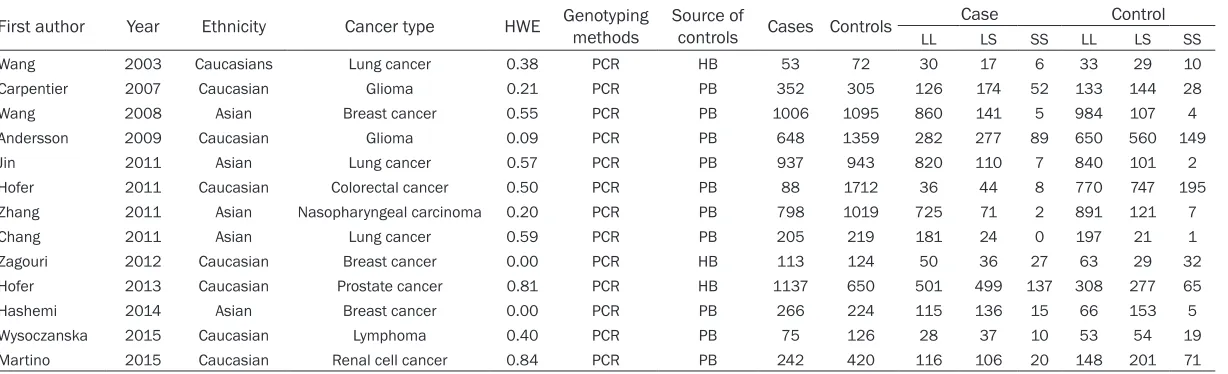
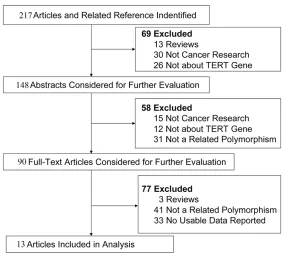
Table 1 listed the main characteristics of eligi-ble studies included in this meta-analysis. We
identified a total of 13 relevant publications
after initial screening (shown in Figure 1). Our
final data consisted of 13 case-control studies
[13-25], including 5920 cases and 8268 con-trols met the selection criteria. Among the 13 studies, 8 studies are of Caucasians and 5 studies are of Asians. There are 3 studies of hospital-based controls and the rest are popu-lation-based controls. Four cancer types were addressed: 2 studies on glioma, 3 studies on breast cancer, 3 studies on lung cancer and 5 on other cancers. The quality assessment of these included studies was provided in Table 2.
Quantitative synthesis
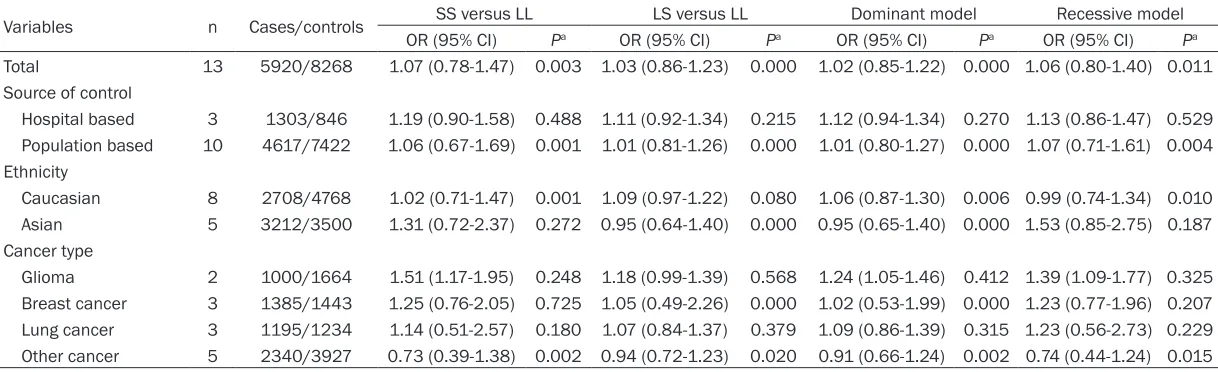
The results of meta-analysis based on 13 inde-pendent population samples with 5920 cases and 8268 controls for the MNS16A polymor-phism and cancer risk are shown in Table 3. In
the overall analysis, no significant associations
were found between MNS16a polymorphism and cancer risk (SS versus LL: OR = 1.07, 95% CI: 0.78-1.47; P = 0.003; SL versus LL:
16a polymorphisms and gliomas risk were observed in the comparison of homozygote (SS versus LL: OR = 1.51, 95% CI: 1.17-1.95;
Pheterogeneity = 0.248; I2= 25.2%), dominant mo-
del (OR = 1.24, 95% CI: 1.05-1.46; Pheterogeneity = 0.412; I2 = 0%), and recessive model (OR =
1.39, 95% CI: 1.09-1.77; Pheterogeneity = 0.325; I2
= 0%). No significant associations were found
for the other cancers.
Stratification based on the source of controls showed no significant associations between
the polymorphism and risk of cancer in the population-based subgroup and hospital-bas- ed subgroup.
Test of heterogeneity
In this meta-analysis, substantial heterogene-ities were observed in overall comparison in all genetic models (SS versus LL: Pheterogeneity = 0.003, SL versus LL: Pheterogeneity = 0.000; domi-nant model: Pheterogeneity = 0.000; recessive model: Pheterogeneity = 0.011). When stratified by
[image:4.612.89.374.70.323.2]ethnicity, cancer type and source of control, the heterogeneity was partly decreased in Caucasians (SL versus LL: Pheterogeneity = 0.080), Asians (SS versus LL: Pheterogeneity = 0.272; re- cessive model: Pheterogeneity = 0.187), gliomas (SS versus LL: P = 0.248; SL versus LL: Figure 1. Flow chart showing study selection procedure.
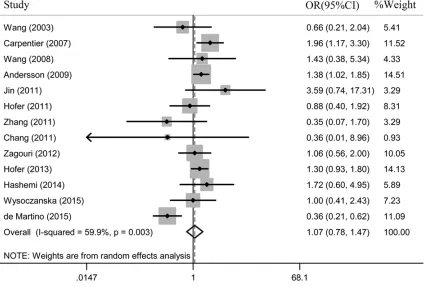
OR = 1.03, 95% CI: 0.86-1.23;
Pheterogeneity = 0.000; dominant model: OR = 1.02, 95% CI: 0.85-1.22; Pheterogeneity = 0.000; recessive model: OR = 1.06, 95% CI: 0.80-1.40; Pheterogeneity
= 0.011) (Figure 2).
Subgroup analyses
In addition, a subgroup
analy-sis stratified by study charac -teristics was performed for a better understanding of the relationship between the MN- S16A polymorphism and can-cer risk.
In Caucasian and Asian popu-lation, MNS16a polymorphism was not associated with an increased risk in all genetic models.
As for cancer type, significant
Table 2. Table Quality assessment of included studies
Last name of
first author Year
Clear description of background, objectives
and study design
Clear eligibility
criteria
Clear
Definition of
variables
Credible genotyping
methods
Hardy-Weinberg equilibrium
as-sessment
Clear Description of statistical
methods
Summary of characteristics of participants
Publicly avail-able genotype
data
Comprehensive discussion
Wang 2003 + + + + + + + + +
Carpentier 2007 + + + + + + + + +
Wang 2008 + + + + - + + + +
Andersson 2009 + + + + - + + + +
Jin 2011 + + + + - + + + +
Hofer 2011 + + + + + + + + +
Zhang 2011 + + + + + + + + +
Chang 2011 + + + + - + + + +
Zagouri 2012 + + + + + + + + +
Hofer 2013 + + + + + + + + +
Hashemi 2014 + + + + + + + + +
Wysoczanska 2015 + + + + - + + + +
Martino 2015 + + + + - + + + +
“+”: detailed description; “±”: incomplete description; “-”: no description.
Table 3. Stratified analyses of the MNS16A polymorphism on cancer risk
Variables n Cases/controls SS versus LL LS versus LL Dominant model Recessive model
OR (95% CI) Pa OR (95% CI) Pa OR (95% CI) Pa OR (95% CI) Pa Total 13 5920/8268 1.07 (0.78-1.47) 0.003 1.03 (0.86-1.23) 0.000 1.02 (0.85-1.22) 0.000 1.06 (0.80-1.40) 0.011 Source of control
Hospital based 3 1303/846 1.19 (0.90-1.58) 0.488 1.11 (0.92-1.34) 0.215 1.12 (0.94-1.34) 0.270 1.13 (0.86-1.47) 0.529 Population based 10 4617/7422 1.06 (0.67-1.69) 0.001 1.01 (0.81-1.26) 0.000 1.01 (0.80-1.27) 0.000 1.07 (0.71-1.61) 0.004 Ethnicity
Caucasian 8 2708/4768 1.02 (0.71-1.47) 0.001 1.09 (0.97-1.22) 0.080 1.06 (0.87-1.30) 0.006 0.99 (0.74-1.34) 0.010 Asian 5 3212/3500 1.31 (0.72-2.37) 0.272 0.95 (0.64-1.40) 0.000 0.95 (0.65-1.40) 0.000 1.53 (0.85-2.75) 0.187 Cancer type
Glioma 2 1000/1664 1.51 (1.17-1.95) 0.248 1.18 (0.99-1.39) 0.568 1.24 (1.05-1.46) 0.412 1.39 (1.09-1.77) 0.325 Breast cancer 3 1385/1443 1.25 (0.76-2.05) 0.725 1.05 (0.49-2.26) 0.000 1.02 (0.53-1.99) 0.000 1.23 (0.77-1.96) 0.207 Lung cancer 3 1195/1234 1.14 (0.51-2.57) 0.180 1.07 (0.84-1.37) 0.379 1.09 (0.86-1.39) 0.315 1.23 (0.56-2.73) 0.229 Other cancer 5 2340/3927 0.73 (0.39-1.38) 0.002 0.94 (0.72-1.23) 0.020 0.91 (0.66-1.24) 0.002 0.74 (0.44-1.24) 0.015
[image:5.792.91.700.324.510.2]Pheterogeneity = 0.568; dominant model: Pheterogeneity
= 0.412; recessive model: Pheterogeneity = 0.325), lung cancers (SS versus LL: Pheterogeneity = 0.180; SL versus LL: Pheterogeneity = 0.379; dominant model: Pheterogeneity = 0.315; recessive model:
Pheterogeneity = 0.229), breast cancers (SS versus
Then the leave-one-out sensitivity analysis was performed by excluding each study
indi-vidually to evaluate the influence of the individ -ual data set to pooled ORs. The statistical
[image:6.612.96.521.77.364.2]sig-nificance of the results was not impacted by single study, confirming the stability of the
Figure 2. Meta-analysis of the association between MNS16A polymorphism and susceptibility to cancer (SS versus LL).
Figure 3. Begg’s funnel plot for publication bias test (SS versus LL).
Pheterogeneity = 0.207) and hospi-tal-based populations (SL ver-sus LL: Pheterogeneity = 0.215; dominant model: Pheterogeneity = 0.270).
Although there 2 studies [20, 22] that deviated from HWE for the MNS16a polymorph- ism, respectively, the corre-sponding pooled ORs were not materially altered by not including these studies (SS versus LL: OR = 1.03, 95% CI: 0.71-1.49; Pheterogeneity = 0.001; I2= 65.9%).
[image:6.612.92.374.413.601.2]Assessment of bias
Begg’s funnel plot and Egger’s test were per-formed to assess the publication bias. The shape of the funnel plot did not reveal any evi-dence of obvious asymmetry (Figure 3). The results did not suggest any evidence of publica-tion bias (P = 0.433 for SS versus LL), and the
95% confidence interval (95% CI: -2.49, 1.14)
included zero, indicating no publication bias. Discussion
Telomerase regulation and telomere mainte-nance have been the subject of intense re- search focus in the past decade. In this study, we conducted a comprehensive literature search in different databases and assessed the associations of the functional TERT gene MNS16A polymorphism with the risk of cancer. Compared with the previous study, our meta-analysis included 3 additional studies on the polymorphism [22-24]. Therefore, this update meta-analysis has more statistical power than the 2 previous studies [33, 34]. Overall, we observed positive association between the MNS16A polymorphism and the glioma risk in the homozygote comparison model, dominant model and the recessive model.
The TERT gene encodes the catalytic subunit of
telomerase complex and plays a critical role in protecting the ends of the chromosome which are truncated during cell division [35]. The
cancer-specific expression of TERT contributes
to malignant transformation and progression
[36]. Recent findings indicate that 90% of
human tumors possess telomerase activity, irrespective of tumor type [37-39]. Telomerase activation in most cancer cells suggests that enhanced telomerase expression is critical for cellular immortality and carcinogenesis. The role of telomerase activation has been
identi-fied for human carcinogenesis, but the activa -tion mechanism remains unclear. Recent
dis-coveries have suggested that the modification
of TERT and alternate TERT mRNA splicing play a critical role in the regulation of telomerase activity [40]. Wang et al. suggested a novel
TERT gene regulating mechanism based on
the finding of a variable tandem repeat poly -morphism MNS16A by in situ hybridization. MNS16A, located in the downstream region of
the TERT gene locus, is identified in the puta -tive promoter region of this antisense RNA
tran-script with the ability to regulate the expression of antisense hTERT messenger RNA level as well as telomerase activity. The VNTR-302 allele, which contains two 23 bp repeats and
three 26 bp repeats, has a significantly lower
promoter activity and antisense TERT mRNA expression when compared with the VNTR-243 allele, which contains one 23 bp repeat and two 26 bp repeats. Luciferase reporter assay have shown that shorter VNTRs had higher pro-moter activity in cell lines of colorectal, lung
and prostate cancer. These findings support
the role of TERT MNS16A polymorphism in malignant progression.
In present work, we observed that the MNS- 16A polymorphism might modulate the glio- mas risk. One possible reason is thatcancer of different sites has variant tumor microenvi-
ronment that regulates or influences the gene expression profiles. The same polymorphism
may exert different effects in variant cancers. Heterogeneity is a potential problem when interpreting the results of all meta-analysis. In this meta-analysis, heterogeneity was found in
all genetic models. When stratified by ethnicity,
cancer type and source of control, heterogene-ity was partly decreased in Caucasians, Asians, gliomas, lung cancers, breast cancers and hospital-based populations. Then sensitivity analyses were conducted by successively ex- cluding one study. The estimated pooled odd ratio changed quite little, strengthening the results from this meta-analysis. No publication bias was shown suggesting this possible true result.
Although meta-analysis is robust, there are sev-eral limitations in the current study need to be addressed in interpreting the results. First, original data shortage limited our further evalu-ation of potential gene-environment
interac-tions. Second, lacking sufficient eligible studi-es limited our further stratified analysis, partic -ularly for subgroup analysis by cancer type. Third, this meta-analysis was based on unad-justed ORs, while a more precise estimation should take into account the effect of multiple confounders such as smoking and drinking sta-tus. Fourth, most studies in the meta-analysis were retrospective design which could suffer more risk of bias owing to the methodologi-
cal deficiency of retrospective studies. Despite
has some advantages. First, it contains the lat-est data about association between MNS16A polymorphism and cancer risk. Second, we conducted four types of genotype analysis and subgroup analysis by cancer site, ethnicity and source of controls. Third, publication bias was not found in our meta-analysis.
In conclusion, this comprehensive meta-analy-sis of high-quality studies provides substantial evidence that the MNS16A polymorphism is
associated with gliomas susceptibility. Our find -ings need to be validated by further functional studies as well as well-designed larger studies. Acknowledgements
This work is supported by Shandong Province Natural Science Foundation (ZR2014HL070). Disclosure of conflict of interest
None.
Address correspondence to: Hongtao Zhang and Peng Zou, Department of Neurosurgery, Yuhuangd- ing Hospital of Yantai, No.20, Yuhuangding East Road, Zhifu District, Yantai 264000, Shandong, China. Tel: + 86 5356691999; Fax: + 86 535- 6691999; E-mail: [email protected] (HTZ); [email protected] (PZ)
References
[1] Basu N, Skinner HG, Litzelman K, Vanderboom R, Baichoo E and Boardman LA. Telomeres and telomere dynamics: relevance to cancers of the GI tract. Expert Rev Gastroenterol Hepa-tol 2013; 7: 733-748.
[2] Mason PJ and Perdigones N. Telomere biology and translational research. Transl Res 2013; 162: 333-342.
[3] Qian Y, Yang L and Cao S. Telomeres and telomerase in T cells of tumor immunity. Cell Immunol 2014; 289: 63-69.
[4] Gomez DE, Armando RG, Farina HG, Menna PL, Cerrudo CS, Ghiringhelli PD and Alonso DF. Telomere structure and telomerase in health and disease (review). Int J Oncol 2012; 41: 1561-1569.
[5] Blasco MA. Telomeres and human disease: ageing, cancer and beyond. Nat Rev Genet 2005; 6: 611-622.
[6] Blackburn EH. Switching and signaling at the telomere. Cell 2001; 106: 661-673.
[7] Wick M, Zubov D and Hagen G. Genomic
orga-gene encoding the human telomerase reverse transcriptase (hTERT). Gene 1999; 232: 97-106.
[8] Zhan WH, Ma JP, Peng JS, Gao JS, Cai SR, Wang JP, Zheng ZQ and Wang L. Telomerase activity in gastric cancer and its clinical impli-cations. World J Gastroenterol 1999; 5: 316-319.
[9] Deng Y and Chang S. Role of telomeres and telomerase in genomic instability, senescence and cancer. Lab Invest 2007; 87: 1071-1076. [10] Osterhage JL and Friedman KL. Chromosome
end maintenance by telomerase. J Biol Chem 2009; 284: 16061-16065.
[11] Bodnar AG, Ouellette M, Frolkis M, Holt SE, Chiu CP, Morin GB, Harley CB, Shay JW, Lich-tsteiner S and Wright WE. Extension of life-span by introduction of telomerase into normal human cells. Science 1998; 279: 349-352. [12] Zhang Y, Chen L, Yang S and Fang D. E2F1: a
potential negative regulator of hTERT tran-scription in normal cells upon activation of on-cogenic c-Myc. Med Sci Monit 2012; 18: RA12-15.
[13] Wang L, Soria JC, Chang YS, Lee HY, Wei Q and Mao L. Association of a functional tandem re-peats in the downstream of human telomerase gene and lung cancer. Oncogene 2003; 22: 7123-7129.
[14] Carpentier C, Lejeune J, Gros F, Everhard S, Marie Y, Kaloshi G, Laigle-Donadey F, Hoang-Xuan K, Delattre JY and Sanson M. Association of telomerase gene hTERT polymorphism and malignant gliomas. J Neurooncol 2007; 84: 249-253.
[15] Wang Y, Hu Z, Liang J, Wang Z, Tang J, Wang S, Wang X, Qin J and Shen H. A tandem repeat of human telomerase reverse transcriptase (hTERT) and risk of breast cancer development and metastasis in Chinese women. Carcino-genesis 2008; 29: 1197-1201.
[16] Andersson U, Osterman P, Sjostrom S, Johan-sen C, Henriksson R, Brannstrom T, Broholm H, Christensen HC, Ahlbom A, Auvinen A, Feycht-ing M, Lonn S, Kiuru A, Swerdlow A, Schoemak-er M, Roos G and MalmSchoemak-er B. MNS16A minisat-ellite genotypes in relation to risk of glioma and meningioma and to glioblastoma out-come. Int J Cancer 2009; 125: 968-972. [17] Hofer P, Baierl A, Feik E, Fuhrlinger G, Leeb G,
Mach K, Holzmann K, Micksche M and Gsur A. MNS16A tandem repeats minisatellite of hu-man telomerase gene: a risk factor for colorec-tal cancer. Carcinogenesis 2011; 32: 866-871. [18] Jin G, Yoo SS, Cho S, Jeon HS, Lee WK, Kang
[19] Zhang Y, Zhang H, Zhai Y, Wang Z, Ma F, Wang H, Li P, Yu L, Cui Y, He F and Zhou G. A func-tional tandem-repeats polymorphism in the downstream of TERT is associated with the risk of nasopharyngeal carcinoma in Chinese pop-ulation. BMC Med 2011; 9: 106.
[20] Zagouri F, Sergentanis TN, Gazouli M, Tsiggi-nou A, Dimitrakakis C, Eleutherakis-Papaiako-vou E, Papaspyrou I, Chrysikos D, Theodoro-poulos G, Zografos GC, Antsaklis A, DimoTheodoro-poulos AM and Papadimitriou CA. HTERT MNS16A polymorphism in breast cancer: a case-control study. Mol Biol Rep 2012; 39: 10859-10863. [21] Hashemi M, Amininia S, Ebrahimi M, Hashemi
SM, Taheri M and Ghavami S. Association be-tween hTERT polymorphisms and the risk of breast cancer in a sample of Southeast Iranian population. BMC Res Notes 2014; 7: 895. [22] Wysoczanska B, Wrobel T, Dobrzynska O,
Ma-zur G and Bogunia-Kubik K. Role of the func-tional MNS16A VNTR-243 variant of the hu-man telomerase reverse transcriptase gene in progression and response to therapy of pa-tients with non-Hodgkin’s B-cell lymphomas. Int J Immunogenet 2015; 42: 100-105. [23] de Martino M, Taus C, Lucca I, Hofbauer SL,
Haitel A, Shariat SF and Klatte T. Association of human telomerase reverse transcriptase gene polymorphisms, serum levels, and telomere length with renal cell carcinoma risk and pa-thology. Mol Carcinog 2016; 55: 1458-1466. [24] Hofer P, Zerelles J, Baierl A, Madersbacher S,
Schatzl G, Maj-Hes A, Sutterluty-Fall H and Gsur A. MNS16A tandem repeat minisatellite of human telomerase gene and prostate can-cer susceptibility. Mutagenesis 2013; 28: 301-306.
[25] Chang CC, Yu MC, Bai KJ, Chang JH, Lee CN, Fang CL and Liu HE. The analysis between functional human telomerase reverse tran-scriptase MNS16A polymorphisms and the risk of developing non-small cell lung cancer in the Taiwanese population. Journal of Experi-mental and Clinical Medicine 2011; 3: 293-295.
[26] Little J, Higgins JP, Ioannidis JP, Moher D, Ga-gnon F, von Elm E, Khoury MJ, Cohen B, Davey-Smith G, Grimshaw J, Scheet P, Gwinn M, Wil-liamson RE, Zou GY, Hutchings K, Johnson CY, Tait V, Wiens M, Golding J, van Duijn C, McLaughlin J, Paterson A, Wells G, Fortier I, Freedman M, Zecevic M, King R, Infante-Rivard C, Stewart A and Birkett N. STrengthening the REporting of genetic association studies (STREGA): an extension of the STROBE state-ment. PLoS Med 2009; 6: e22.
[27] Wigginton JE, Cutler DJ and Abecasis GR. A note on exact tests of hardy-weinberg equilib-rium. Am J Hum Genet 2005; 76: 887-893. [28] Lau J, Ioannidis JP and Schmid CH.
Quantita-tive synthesis in systematic reviews. Ann Intern Med 1997; 127: 820-826.
[29] Higgins JP and Thompson SG. Quantifying het-erogeneity in a meta-analysis. Stat Med 2002; 21: 1539-1558.
[30] Mantel N and Haenszel W. Statistical aspects of the analysis of data from retrospective stud-ies of disease. J Natl Cancer Inst 1959; 22: 719-748.
[31] Begg CB and Mazumdar M. Operating charac-teristics of a rank correlation test for publica-tion bias. Biometrics 1994; 50: 1088-1101. [32] Egger M, Davey Smith G, Schneider M and
Minder C. Bias in meta-analysis detected by a simple, graphical test. BMJ 1997; 315: 629-634.
[33] Xia X, Rui R, Quan S, Zhong R, Zou L, Lou J, Lu X, Ke J, Zhang T, Zhang Y, Liu L, Yan J and Miao X. MNS16A tandem repeats minisatellite of hu-man telomerase gene and cancer risk: a meta-analysis. PLoS One 2013; 8: e73367.
[34] Chen P, Zou P, Yan Q, Xu H, Zhao P and Gu A. The TERT MNS16A polymorphism contributes to cancer susceptibility: meta-analysis of the current studies. Gene 2013; 519: 266-270. [35] Kolquist KA, Ellisen LW, Counter CM, Meyerson
M, Tan LK, Weinberg RA, Haber DA and Gerald WL. Expression of TERT in early premalignant lesions and a subset of cells in normal tissues. Nat Genet 1998; 19: 182-186.
[36] Daniel M, Peek GW and Tollefsbol TO. Regula-tion of the human catalytic subunit of telomer-ase (hTERT). Gene 2012; 498: 135-146. [37] Cong YS, Wright WE and Shay JW. Human
telomerase and its regulation. Microbiol Mol Biol Rev 2002; 66: 407-425, table of contents. [38] Kyo S, Takakura M, Fujiwara T and Inoue M.
Understanding and exploiting hTERT promoter regulation for diagnosis and treatment of hu-man cancers. Cancer Sci 2008; 99: 1528-1538.
[39] Shay JW and Wright WE. Role of telomeres and telomerase in cancer. Semin Cancer Biol 2011; 21: 349-353.