Proceedings of the 2019 EMNLP and the 9th IJCNLP (System Demonstrations), pages 25–30 25
Automatic Taxonomy Induction and Expansion
Nicolas Rodolfo Fauceglia, Alfio Gliozzo, Sarthak Dash, Md Faisal Mahbub Chowdhury and Nandana Mihindukulasooriya
IBM Research AI, Yorktown Heights, NY, USA
{nicolas.fauceglia, nandana.m} @ibm.com {gliozzo, sdash, mchowdh} @us.ibm.com
Abstract
The Knowledge Graph Induction Service (KGIS)is an end-to-end knowl-edge induction system. One of its main capabilities is to automatically induce tax-onomies1 from input documents using a hybrid approach that takes advantage of linguistic patterns, semantic web and neural networks. KGIS allows the user to semi-automatically curate and expand the induced taxonomy through a component calledsmart spreadsheet by exploiting distributional semantics. In this paper, we describe these taxonomy induction and expansion features of KGIS. A screencast video demonstrating the system is available inhttps://ibm.box. com/v/emnlp-2019-demo.
1 Introduction
Knowledge Graph Induction Service (KGIS)is an end-to-end knowledge graph (KG) induction system. Among other capabilities, it enables automatic taxonomy induction and
human-in-the-loop curation. The output taxon-omy representation can be used by downstream applications such as dialog systems and search engines.
The taxonomy is induced directly from the in-put documents by a combination of different ap-proaches: one based on linguistic-patterns, an-other that leverages the semantic-web, and finally a novel neural network for cleaning and expand-ing taxonomies. The induced taxonomies are ac-cessible through another component of the KGIS called Smart Spreadsheet (SSS), which consists of an editable interactive tabular grid where the first row contains induced types (aka hypernyms), and each corresponding column con-tains its instances (aka hyponyms), henceforth, simplytypesandinstances.
1Ataxonomyis a classification of things or concepts.
Using the SSS, the user can refine the au-tomatically induced taxonomy, both by remov-ing wrongtypes orinstances, and by further ex-panding the instances of a particular type. This is accomplished by leveraging its main features:
auto-complete 2, type-suggestion, and automatic population fromsemantic webanddistant super-vision using external Knowledge Graphs (KG). KGIS also allows taxonomies to be exported in RDF/OWL representation with the terms linked to Wikidata3entities (Vrandeˇci´c,2012).
We describe the use case in question in Section 2, followed by the system description for taxon-omy induction component in Section3. Then, in Section4, we illustrate how the features of the SSS can be used for taxonomy curation and expansion. Finally, in Section 5 we conclude by discussing example outputs of the system.
2 Use Case Scenario
A typical KGIS user has a collection of documents that contain knowledge about a specific domain. The size of the collection makes human analysis or annotation impractical (slow and expensive). Therefore, the user ingests its collection into the KGIS, and fires aKG Induction job. Depending on the size of the collection, in minutes or a few hours the system provides the following artifacts: an annotated corpus, a terminology, a type embed-ding model, and different types of taxonomies that can be further refined.
2
The option of completing terms by selecting from a sug-gested list of terms on the basis of the letters that has been already typed by the user.
Figure 1: KGIS home
3 System Description
3.1 Input processing and annotation
The input of the system is a collection of doc-uments. The corpus creation process transforms different formats of inputs (txt, json, pdf, word, etc) into a standard document format. This is done through theDocument Conversion Service API in IBM CloudTM 4.
After corpus creation, the system annotates terms (analyzing all noun phrases). This is done through the usage of IBM WatsonR
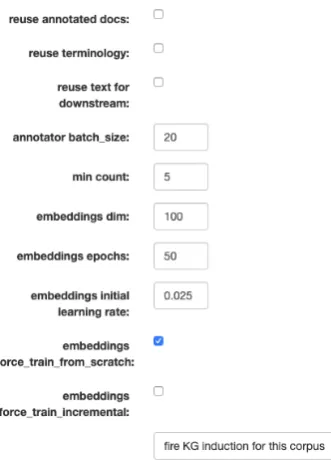
NLU API5. Next, all terms that have a frequency greater than a threshold (specified by the user during KG In-duction, see figure 3) are combined to form the terminology.
3.2 Type Models
As part of the pipeline, the system builds a type
model, which capturestypesimilarity between two given domain terms (e.g. SVM and Logistic Re-gressionare both of type supervised learning al-gorithm). To do so, the system trains a Word2Vec model (Mikolov et al.(2013)) using Gensim6with a CBOW configuration of window size 2. The reason for this choice is that type similarity is captured by analyzing the local context around the terms. In addition, other input parameters for this model (e.g., embedding dimensions, min-frequency, learning rate, etc.), can be provided by the user while firing theKG Induction.
3.3 Taxonomy Induction
The Taxonomy Induction module takes the anno-tated corpus (see Section 3.1) and identifies is-a
relations between pairs of terms. KGIS uses three
4https://cloud.ibm.com/docs/cli 5
https://cloud.ibm.com/apidocs/ natural-language-understanding
6https://radimrehurek.com/gensim/
different approaches for inducing shallow (i.e., not hierarchical) taxonomies, as described in the fol-lowing sections. The results of each approach are presented as an SSS where the users can manually validate the generated taxonomies and further cu-rate them (see Section4.
3.3.1 Pattern-Based Approach
For extractingtype-instancerelationships, i.e.is-a
pairs, the system makes use of 24 lexico-syntactic patterns (e.g., “NPy is a NPx”), aka Hearst-like
patterns (Hearst(1992)). Once the is-apairs are extracted, the system applies the following pre-processing steps. First, the list of is-a pairs are represented as a graph by considering each pair as anedge, and the corresponding terms as nodes. The weight of each edge is the count of how often a pair has been extracted by pattern-matching.
The system excludes any cycle inside the graph; e.g. if(x, y),(y, z)and(z, x)are present in the list of extracted is-a pairs, then all of them are dis-carded. KGIS also discards all edges that have a value lower than a frequency threshold f, which is specified by the user. KGIS checks all types
and tries to identify potential proper nouns among them, using the following heuristic – a term x1 would be considered as a proper noun if all the following three conditions hold:(i)it is not a sub-string of atypex2 and vice-versa,(ii)x2 is atype ofx1, and (iii)x2 belongs to a list oftypes7 that are known to have massive amount of proper noun
instances. If atypeis identified as a proper noun, KGIS discards all edges that link the term astype
with any other term.
The next step of the pre-processing is to expand the list of pairs in the graph with likely (but not yet extracted) pairs of nested termtypesand super
7To be specific, “person”, “place”, “organization”, and
Figure 2: Taxonomy induction and expansion/curation workflow.
Figure 3: KG induction
terminstances. A nested term is a term that is part of a larger term (called super term).8 Often there aretypesthat are nested terms in one or many of their instances. For example, the type “bank” is a nested term ininstances“Capital One BankTM”, “Chase BankTM” and “Bank of AmericaTM”.
KGIS builds a nested term search index
8For example, the terms “IBM” and “Corporation” are
nested terms in their super term “IBM Corporation”.
(Chowdhury and Farrell,2019) using the list of re-mainingis-a pairs. For every single wordtype9, the system identifies corresponding super terms from the index which are not already identified by the Hearst-like patterns as potentialinstances. If thetypeis the syntactic head word of one of these super terms, then KGIS adds that super term as a
typein the list ofis-apairs.
The final list of pairs after all these steps is the output of the Pattern-Based approach.
3.3.2 Semantic Web Based Approach
Wikidata is a comprehensive cross-domain source of knowledge semantically represented using RDF and OWL. It contains a large amount of taxo-nomic information with relations such asrdf:type
orrdfs:subClassOf. The semantic web based ap-proach for candidate generation in KGIS con-sists on linking the terms identified in terminol-ogy extraction to Wikidata entities and discover-ing is-a relations between them using the back-ground knowledge. Linking is done by approxi-mate matching of the surface from of the term with the label and the aliases of the Wikidata candidate entity.
Once the initial list ofis-apairs is extracted, fur-ther filtering is performed to eliminate terms that might be erroneously linked. This is done by com-paring the type-instance similarity and pairwise
9We avoid multi-word
[image:3.595.87.253.357.588.2]instance-instancesimilarity (using the Type model mentioned in Section3.2) against a threshold that is provided as a parameter.
3.3.3 Neural Network Based Approach Is-a relations are reflexive and transitive but not symmetric (Miller et al.,1990;Hearst,1992). Us-ing ideas fromorder theory, we can model these relations asstrict partial orderrelations, i.e. a bi-nary relation that is transitive, asymmetric and ir-reflexive.
We developed STRICTPARTIAL ORDER NET-WORKS (SPON), a novel neural network archi-tecture comprising ofnon-negativeactivations and
residual connections designed to enforce strict partial order as a soft constraint. We use SPON as a component within the KGIS platform to model
is-arelationships among pairs that have been gen-erated from the approaches described in the previ-ous Sections3.3.1and3.3.2.
SPON works in three stages. In the first stage, it models theis-arelationships extracted in the pre-vious steps and aims to provide a score to each individual is-a pair. In the second stage, it uses the same learned model in order to generate a top-k ranked list of types for every term present in theterminology. Finally, it ranks the accumulated
is-arelationships generated in the previous steps according to certain user-specified criterion, and presents it back to the user.
Stage One. The purpose of this step is to score existingis-arelationshipsT. This stage assumes that a trueis-arelationshipt is more likely to be inferred correctly, as opposed to a false relation-shipf when evaluated against a SPON model that has been trained using otheris-arelationships i.e.
T \ {t, f}.
Following the assumption, the list of existing is-a relationships obtained via either Pattern based approaches or Semantic Web based approaches, are divided into k-folds. k independent SPON processes are then run in parallel, each process then trains upon k-2 folds, performs early stop-ping based on evaluations on the (k-1)th fold and finally generates scores for thekth fold. The re-sults for each fold are then concatenated together to generate the outputO1 of Stage One.
Stage Two. The purpose of this step is to gener-ate a ranked list oftypesfor all the terms extracted in the Terminology extraction step (Section3.1), but was not included in the list ofis-arelationships
extracted using either Pattern based or Semantic Web based approaches.
Following similar approach as of Stage One, the list of existingis-arelationships are divided into
k-folds. k independent SPON processes are then run in parallel, wherein each process trains upon k-1 folds, performs early stopping based on eval-uations on the (k-1)th fold and finally generates a ranked list oftypesfor all the terms in the Termi-nology.
Once all the SPON processes are over, we ob-tainkdifferent ranked lists of typesfor each term in the Terminology. These ranked lists are then averaged to obtain a single ranked list oftypesper term. This generated output O2 then behaves as output for Stage Two.
Stage Three. Concatenating the resultsO1 and
O∈ from previous stages, we obtain anextended
list of rankedinstancesfor eachtype.
This stage, then works in two steps, in the first step all theinstancesfor a giventypewhose score is less than a thresholdθare removed. In the sec-ond step, thetypesare then ranked by an average score of itstop m instances.
Note that the parametersθandmare entered by the user. The output of this step provides the final result for SPON component in KGIS.
4 Knowledge Curation using the Smart Spreadsheet (SSS)
The KGIS framework features a novel way of in-teracting with the induced knowledge called Smart Spreadsheet (SSS). The cells in an SSS correspond to the nodes in a KG 10. In addition, within an SSS, the first row is reserved for induced types, and other cells in each column containinstances
of the corresponding type (i.e. the term in the 1st row of the column). Functionality wise, SSS provides: auto-complete of term names, for eas-ily identifying terms matching an input text; type-suggestion, to help the user assign atypeto a set of
instances, and alsosuggestion of similar or related termsgiven existing ones.
Each time a new taxonomy is created (Section 3.3), it is also saved as an SSS so that the user can modify it to match their business needs. In the description that follows, the example snap-shots following the functionality descriptions are taken from an automatically induced taxonomy,
10cells whose content does not match the
Term Predicted types
dicoumarol drug, carbohydrate, acid, person, service , ... Planck person, particle, physics, elementary particle, service, ...
Belt Line main road,infrastructure,transport infrastructure, expressway, way, ... relief service, assistance, resource, support, aid, ...
[image:5.595.95.502.60.193.2]honesty virtue, ideal, moral philosophy, philosophy, chastity, ... shoe footwear, shoe,footgear, overshoe, sandal, ... ethanol alcohol, fuel, person,fluid, resource, ... ruby language, precious stone, person, resource,stone, ...
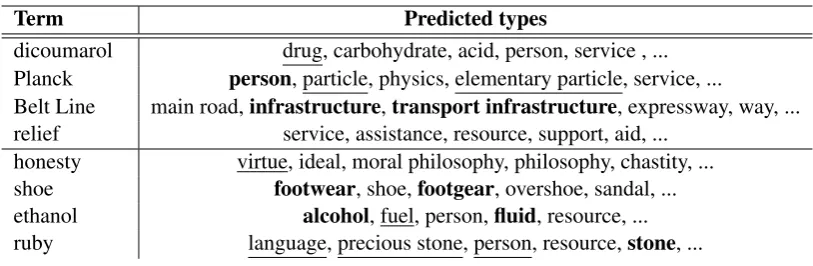
Table 1: Examples of ranked predictions (from left-to-right) made by our system on a set of eightrandomlyselected test queries from SemEval 2018 English dataset. Typespredicted by SPON that match the gold annotations are highlighted inbold, while we use underline for predictions that we judge to be correct but are missing in the gold standard expectedtypes.
obtained by running the steps described in Sec-tion 3.3on a corpus of scientific papers from the NeurIPS conference.
Firstly, given a list of few terms by the user sup-posedly belonging to a type, SSS has the ability to generate additional terms belonging to the same
typeusing the following three options,
• Populate from seeds. The embeddings for the user-entered terms are averaged together to create a centroid vector; and a nearest neighbor algorithm is run across all the terms in the terminology to obtain additional terms belonging to the sametype.
• Populate from KG Type.This option is only available when the user has found a match-ingtypefrom the Semantic Web (usingtype
suggestion). It allows the user to get the in-stancesin the target KG are of this column’s
typeand are also present in the corpus’ termi-nology.
• Populate from KG, Distant Supervision. This option also requires a selected KGtype, and it is a combination of the previous two techniques: it retrieves moreinstancesof the given type from the KG, then it combines them with the ones already in the column (seeds) and applies the same ‘populate from seeds‘ technique.
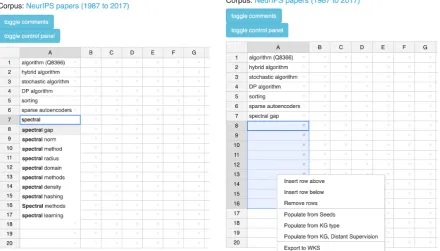
Figure 4b shows a snapshot of the KGIS sys-tem that demonstrates thePopulate from fea-ture. In this example, the user enters the name of a few algorithm names asinstances, setsalgorithm
as thetype, then selects a few cells and right-clicks to invoke the window containing thePopulate fromfeature.
In addition, SSS provides an auto-complete fea-ture, i.e. the option of completing terms wherein the list of displayed terms conform to the Termi-nology extraction step as discussed in Section3.1. For example, in figure4aas soon as the user types the term spectral, the system suggests mean-ingful possible terms to auto-complete based on the input corpus.
5 Conclusion and Future Work
Table1shows the result of applying our KGIS sys-tem on the English Domain corpus of theSemEval 2018 Hypernym Detection shared task. Two sets of four query terms (from test set input) are chosen at random. The first four terms have correspond-ingis-a pairs in the gold annotation provided by the task organizers, whereas the final four terms do not. The right hand column presents a ranked list oftypesfor each query term.
Note that the correcttypesin the gold label test set are set in bold, whereas underlined terms are the types which we believe to be correct. This qualitative example, together with the academic benchmark results (not reported in this demo pa-per) together demonstrate that our system is the state of the art in discoveringis-apairs from text.
In conclusion, we have introduced the
Knowledge Graph Induction Service (KGIS), an end-to-end knowledge induction system, which provides numerous functionalities, most notably automatic taxonomy induction. The
(a) AutoComplete feature in Smart Spreadsheet. (b) Smart Spreadsheet Feature: Allowing automatic population.
Figure 4: Features for Smart Spreadsheet.
taxonomies), but at the same time allows for a
human-in-the-loop to interact with it, thereby ensuring that the user has always the final say in all the system outputs.
In the future, we plan on developing customer-centric downstream applications for using this framework. In addition, we also plan on working upon additional knowledge centric problems, such asUnsupervised Relation Inductionto provide ad-ditional facets to our proposed framework.
References
Md. Faisal Mahbub Chowdhury and Robert Farrell. 2019. An efficient approach for super and nested term indexing and retrieval.CoRR, abs/1905.09761.
Marti A. Hearst. 1992. Automatic acquisition of hy-ponyms from large text corpora. InCOLING 1992 Volume 2: The 15th International Conference on Computational Linguistics.
Tomas Mikolov, Ilya Sutskever, Kai Chen, Greg S Cor-rado, and Jeff Dean. 2013. Distributed representa-tions of words and phrases and their compositional-ity. InAdvances in neural information processing systems, pages 3111–3119.
G. A. Miller, R. Beckwith, C. Fellbaum, D. Gross, and K. J. Miller. 1990. Introduction to WordNet: an on-line lexical database. International Journal of Lexi-cography, 3(4):235–244.