Annotating Derivations: A New Evaluation Strategy and Dataset for
Algebra Word Problems
Shyam Upadhyay1and Ming-Wei Chang2 1University of Illinois at Urbana-Champaign, IL, USA
2Microsoft Research, Redmond, WA, USA [email protected] [email protected]
Abstract
We propose a new evaluation for auto-matic solvers for algebra word problems, which can identify mistakes that existing evaluations overlook. Our proposal is to evaluate such solvers using derivations, which reflect how an equation system was constructed from the word problem. To accomplish this, we develop an algorithm for checking the equivalence between two derivations, and show how derivation an-notations can be semi-automatically added to existing datasets. To make our exper-iments more comprehensive, we include the derivation annotation for DRAW-1K, a new dataset containing 1000 general alge-bra word problems. In our experiments, we found that the annotated derivations enable a more accurate evaluation of au-tomatic solvers than previously used met-rics. We release derivation annotations for over 2300 algebra word problems for fu-ture evaluations.
1 Introduction
Automatically solving math reasoning problems is a long-pursued goal of AI (Newell et al., 1959; Bobrow, 1964). Recent work (Kushman et al., 2014; Shi et al., 2015; Koncel-Kedziorski et al., 2015) has focused on developing solvers for alge-bra word problems, such as the one shown in Fig-ure 1. Developing a solver for word problems can open several new avenues, especially for online education and intelligent tutoring systems (Kang et al., 2016). In addition, as solving word prob-lems requires the ability to understand and ana-lyze natural language, it serves as a good test-bed for evaluating progress towards goals of artificial intelligence (Clark and Etzioni, 2016).
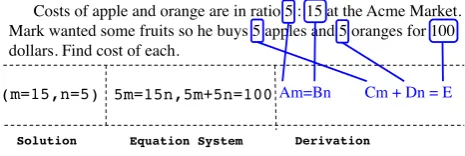
Am=Bn Cm + Dn = E Costs of apple and orange are in ratio 5 : 15 at the Acme Market. Mark wanted some fruits so he buys 5 apples and 5 oranges for 100 dollars. Find cost of each.
5m=15n,5m+5n=100 (m=15,n=5)
[image:1.595.306.539.224.302.2]Solution Equation System Derivation
Figure 1: An algebra word problem with itssolution, equa-tion systemandderivation. Evaluating solvers on derivation is more reliable than evaluating on solution or equation sys-tem, as it reveals errors that other metric overlook.
An automatic solver finds the solution of a given word problem by constructing a deriva-tion, consisting of an un-grounded equation system1 ({Am=Bn,Cm+Dn=E} in Figure 1) and alignments of numbers in the text to its coefficients (blue edges). The deriva-tion identifies a grounded equaderiva-tion system
{5m=15n,5m+5n=100}, whose solutioncan then be generated to answer the problem. A derivation precisely describes how the grounded equation system was constructed from the word problem by the automatic solver. On the other hand, the grounded equation systems and the so-lutions are less informative, as they do not explain which span of text aligns to the coefficients in the equations.
While the derivation is clearly the most in-formative structure, surprisingly, no prior work evaluates automatic solvers using derivations di-rectly. To the best of our knowledge, none of the current datasets contain human-annotated deriva-tions, possibly due to the belief that the current evaluation metrics are sufficient and the benefit of evaluating on derivations is minor. Currently, the most popular evaluation strategy is to use so-lution accuracy(Kushman et al., 2014; Hosseini et al., 2014; Shi et al., 2015; Koncel-Kedziorski et
1Also referred to as atemplate. We use these two terms interchangeably.
al., 2015; Zhou et al., 2015; Huang et al., 2016), which computes whether the solution was correct or not, as this is an easy-to-implement metric. An-other evaluation strategy was proposed in (Kush-man et al., 2014), which finds an approximate derivation from the gold equation system and uses it to compare against a predicted derivation. We follow (Kushman et al., 2014) and call this evalu-ation strategy theequation accuracy.2
In this work, we argue that evaluating solvers against human labeled derivation is important. Ex-isting evaluation metrics, like solution accuracy are often quite generous — for example, an incor-rect equation system, such as,
{m+ 5 =n+ 15, m+n= 15 + 5}, (1)
can generate the correct solution of the word prob-lem in Figure 1. While equation accuracy appears to be a stricter metric than solution accuracy, our experiments show that the approximation can mis-lead evaluation, by assigning higher scores to an inferior solver. Indeed, a correct equation system, (5m= 15n,5m+5n= 100), can be generated by using a wrong template,Am=Bn,Am+An=C, and aligning numbers in the text to coefficients in-correctly. We show that without knowing the cor-rect derivation at evaluation time, a solver can be awarded for the wrong reasons.
The lack of annotated derivations for word problems and no clear definition for comparing derivations present technical difficulties in using derivation for evaluation. In this paper, we address these difficulties and for the first time propose to evaluate the solvers usingderivation accuracy. To summarize, the contributions of this paper are:
• We point out that evaluating using derivations is more precise compared to existing metrics. Moreover, contrary to popular belief, there is a meaningful gap between the derivation ac-curacy and existing metrics, as it can discover crucial errors not captured previously.
• We formally define when two derivations are equivalent, and develop an algorithm that can determine the same. The algorithm is simple 2Note that an approximation of the derivation is neces-sary, as there is no annotated derivation. From the brief de-scription in their paper and the code released by Kushman et al. (2014), we found that their implementation assumes that the first derivation that matches the equations and generates the correct solution is the correct reference derivation against which predicted derivations are then evaluated.
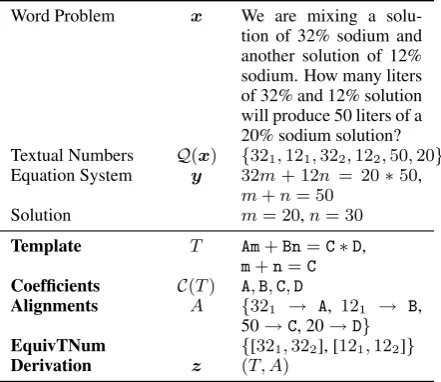
Word Problem x We are mixing a
solu-tion of 32% sodium and another solution of 12% sodium. How many liters of 32% and 12% solution will produce 50 liters of a 20% sodium solution? Textual Numbers Q(x) {321,121,322,122,50,20}
Equation System y 32m+ 12n = 20∗50, m+n= 50
Solution m= 20,n= 30
Template T Am+Bn=C∗D, m+n=C Coefficients C(T) A,B,C,D
Alignments A {321 → A, 121 → B,
50→C, 20→D} EquivTNum {[321,322], [121,122]}
[image:2.595.308.529.63.254.2]Derivation z (T, A)
Table 1: The symbols we used in the paper. Our proposed annotations are shown inbold. Equivalent textual numbers, described in EquivTNum, are distinguished with subscripts.
to implement, and can accurately detect the equivalence even if two derivations have very different syntactic forms.
• We annotated over 2300 word algebra prob-lems3 with detailed derivation annotations, providing high quality labeled semantic parses for evaluating word problems.
2 Evaluating Derivations
We describe our notation and revisit the notion of derivation introduced in (Kushman et al., 2014). We then formalize the notion of derivation equiv-alence and provide an algorithm to determine it.
Structure of Derivation The word problem in Table 1 shows our notation, where our proposed annotations are shown inbold. We denote a word problem byxand anequation systembyy.
An un-grounded equation system (or template) T is a family of equation systems parameter-ized by a set of coefficients C(T) = {ci}ki=1,
where each coefficientci aligns to atextual num-ber (e.g., four) in the word problem. We also refer to the coefficients as slots of the template. We use(A,B,C, . . .)to represents coefficients and
(m,n, . . .) to represent the unknown variables in the templates.
LetQ(x)be the set of all the textual numbers in the problemx, and C(T)be the coefficients to be determined in the template T. Analignment is a set of tuplesA={(q, c)|q ∈ Q(x), c∈ C(T)∪ {}}aligning textual numbers to coefficient slots,
where a tuple(q, )indicates that the numberqis not relevant to the final equation system.
Note that there may be multiple semantically equivalent textual numbers. e.g., in Figure 1, ei-ther of the 32 can be aligned to coefficient slotA
in the template. These equivalent textual numbers are marked in the EquivTNum field in the annota-tion. If two textual numbersq, q0 ∈EquivTNum,
then we can align a coefficient slot to either q or q0, and generate a equivalent alignment.
An alignmentAand a templateTtogether iden-tify a derivation z = (T, A) of an equation sys-tem. Note that there may be multiple valid deriva-tions, using one of the equivalent alignments. We assume there exists a routineSolve(y) that find the solution of an equation system. We use a Gaus-sian elimination solver for ourSolveroutine. We use hand-written rules and the quantity normalizer in Stanford CoreNLP (Manning et al., 2014) to identify textual numbers.
Derivation Equivalence We define two deriva-tions (T1, A1) and (T2, A2) to be equivalentiffthe
corresponding templates T1, T2 and alignments
A1, A2are equivalent.
Intuitively, two templatesT1, T2 are equivalent
if they can generate the same space of equation systems – i.e., for every assignment of values to slots ofT1, there exists an assignment of values to
slots ofT2such that they generate the same
equa-tion systems. For instance, template (2) and (3) below are equivalent
m=A+Bn m=C−n (2)
m+n=A m−Cn=B. (3) because after renaming (A,B,C) to (B,C,A) re-spectively in template (2), and algebraic manip-ulations, it is identical to template (3). We can see that any assignment of values to correspond-ingslots will result in the same equation system.
Similarly, two alignmentsA1andA2are
equiv-alent if corresponding slots from each template align to the same textual number. For the above example, the alignment{1 → A,3 → B,4 → C}
in template (2), and alignment {1 → B,3 →
C,4 → A} in template (3) are equivalent. Note that the alignment{1→A,3→B,4→C}for (2) is not equivalent to{1 → A,3 → B,4 → C} in (3), because it does not respect variable renaming. Our definition also allows two alignments to be
Algorithm 1Evaluating Derivation
Input: Predicted(Tp, Ap)and gold(Tg, Ag)derivation
Output: 1 if predicted derivation is correct, 0 otherwise 1: if|C(Tp)| 6=|C(Tg)|then .different # of coeff. slots
2: return 0 3: end if
4: Γ←TEMPLEQUIV(Tp,Tg)
5: ifΓ =∅then .not equivalent templates 6: return 0
7: end if
8: ifALIGNEQUIV(Γ, Ap, Ag)then .Check alignments
9: return 1 10: end if 11: return 0 12:
13: procedureTEMPLEQUIV(T1, T2)
14: .Note that here|C(T1)|=|C(T2)|holds
15: Γ← ∅
16: foreach 1-to-1 mappingγ:C(T1)→ C(T2)do
17: match←True
18: fort= 1· · ·Rdo . R: Rounds 19: Generate random vectorv
20: A1← {(vi→ci)},A2← {(vi→γ(ci))}
21: ifSolve(T1, A1)6=Solve(T2, A2)then
22: match←False;break 23: end if
24: end for
25: ifmatchthenΓ←Γ∪ {γ} 26: end for
27: returnΓ .Γ6=∅iff the templates are equivalent 28: end procedure
29:
30: procedureALIGNEQUIV(Γ, A1, A2)
31: formappingγ∈Γdo 32: iffollowing holds true,
(q, c)∈A1 ⇐⇒ {(q, γ(c))or(q0, γ(c))} ∈A2
33: where(q0, q)∈EquivTNum
34: thenreturn 1 35: end if 36: end for 37: return 0 38: end procedure
equivalent, if they use textual numbers in equiva-lent positions for corresponding slots (as described by EquivTNum field).
In the following, we carefully explain how tem-plate and alignment equivalence are determined algorithmically. Algorithm 1 shows the complete algorithm for comparing two derivations.
Template Equivalence We propose an approx-imate procedure TEMPLEQUIV (line 13) that de-tects equivalence between two templates. The pro-cedure relies on the fact that under appropriate re-naming of coefficients, two equivalent templates will generate equations which have the same solu-tions, for all possible coefficient assignments.
For two templates T1 and T2, with the same
number of coefficients|C(T1)|=|C(T2)|, we
1-to-1 mapping from C(T1) to C(T2). The two
templates are equivalent if there exists a γ such that solutions of the equations identified by T1
and T2 are same, for all possible coefficient
as-signments. The TEMPLEQUIVprocedure exhaus-tively tries all possible renaming of coefficients (line 16), checking if the solutions of the equa-tion systems generated from a random assignment (line 19) match exactly. It declares equivalence if for a renamingγ, the solutions match forR = 10
such random assignments.4The procedure returns all renamingsΓof coefficients between two tem-plates under which they are equivalent (line 27). We discuss its effectiveness in§3.
Alignment Equivalence The TEMPLEQUIV procedure returns every mapping γ in Γ under which the templates were equivalent (line 4). Recall that γ identifies corresponding slots, c andγ(c), inT1 andT2 respectively. We describe
alignment equivalence using these mappings. Two alignmentsA1andA2are equivalent if
cor-responding slots (according toγ) align to the same textual number. More formally, if we find a map-pingγsuch that for each tuple (q, c) inA1there is
(q, γ(c)) inA2, then the alignments are equivalent
(line 33). We allow for equivalent textual numbers (as identified by EquivTNum field) to match when comparing tuples in alignments.
The proof of correctness of Algorithm 1 is sketched in the appendix. Using Algorithm 1, we can define derivation accuracy, to be 1 if the predicted derivation (Tp, Ap) and the reference
derivation (Tg, Ag) are equivalent, and 0
other-wise.
Properties of Derivation Accuracy By com-paring derivations, we can ensure that the follow-ing errors are detected by the evaluation.
Firstly, correct solutions found using incorrect equations will be penalized, as the template used will not be equivalent to reference template. Sec-ondly, correct equation system obtained by an in-correct template will also be penalized for the same reason. Lastly, if the solver uses the correct template to get the correct equation system, but aligns the wrong number to a slot, the alignment will not be equivalent to the reference alignment, and the solver will be penalized too.
4Note that this procedure is a Monte-Carlo algorithm, and can be made more precise by increasingR. We found mak-ingRlarger than 10 did not have an impact on the empirical results.
We will see some illustrative examples of above errors in§5.3. Note that the currently popular eval-uation metric of solution accuracy will not detect
anyof these error types.
3 Annotating Derivations
As none of the existing benchmarks contain derivation annotations, we decided to augment ex-isting datasets with these annotations. We also an-notated DRAW-1K, a new dataset of 1000 general algebra word problems to make our study more comprehensive. Below, we describe how we re-duced annotation effort by semi-automatic gener-ated some annotations.
Annotating gold derivations from scratch for all problems is time consuming. However, not all word problems require manual annotation – some-times all numbers appearing in the equation sys-tem can be uniquely aligned to a textual number without ambiguity. For such problems, the an-notations are generated automatically.5 We iden-tify word problems which have at least one align-ment ambiguity – multiple textual numbers with the same value, which appears in the equation sys-tem. A example of such a problem is shown in Figure 1, where there are three textual numbers with value 5, which appears in the equation sys-tem. Statistics for the number of word problems with such ambiguity is shown in Table 2.
We only ask annotators to resolve such align-ment ambiguities, instead of annotating the entire derivation. If more than one alignments are gen-uinely correct (as in word problem of Table 1), we ask the annotators to mark both (using the Equiv-TNumfield). This ensures our derivation annota-tions are exhaustive – all correct derivations are marked. With the correct alignment annotations, templates for all problems can be easily induced.
Dataset DRAW-1K ALG-514 DOLPHIN-L
# problems 1000 514 832
w/ ambiguity 21% 23% 35%
vocab. 2.21k 1.83k 0.33k
Number of Templates
before 329 30 273
after 224 24 203
% reduction 32% 20% 25%
Table 2: Statistics of the datasets. At least 20% of problems in each dataset had alignment ambiguities that required hu-man annotations. The number of templates before and after annotation is also shown (reduction>20%).
per word problem. We attained a inter-annotator agreement of 92% (raw percentage agreement), with most disagreements arising on EquivTNum field.6
Reconciling Equivalent Templates The num-ber of templates has been used as a measure of dataset diversity (Shi et al., 2015; Huang et al., 2016), however prior work did not reconcile the equivalent templates in the dataset. Indeed, if two templates are equivalent, we can replace one with the other and still generate the correct equa-tions. Therefore, after getting human judgements on alignments, we reconcile all the templates us-ing TEMPLEQUIVas the final step of annotation.
TEMPLEQUIVis quite effective (despite being approximate), reducing the number of templates by at least 20% for all datasets (Table 2). We did not find any false positives generated by the TEMPLEQUIVin our manual examination. The re-duction in Table 2 clearly indicates that equivalent templates are quite common in all datasets, and number of templates (and hence, dataset diversity) can be significantly overestimated without proper reconciliation.
4 Experimental Setup
We describe the three datasets used in our experi-ments. Statistics comparing the datasets is shown in Table 2. In total, our experiments involve over 2300 word problems.
Alg-514 The dataset ALG-514 was introduced in (Kushman et al., 2014). It consists of 514 gen-eral algebra word problems ranging over a vari-ety of narrative scenarios (distance-speed, object counting, simple interest, etc.).
6These were adjudicated on by the first author.
Dolphin-L DOLPHIN-L is the linear-T2 subset of the DOLPHINdataset (Shi et al., 2015), which focuses onnumber word problems– algebra word problems which describe mathematical relation-ships directly in the text. All word problems in the linear-T2 subset of the DOLPHIN dataset can be solved using linear equations.
DRAW-1K Diverse Algebra Word (DRAW-1K), consists of 1000 word problems crawled from
algebra.com. Details on the dataset creation can be found in the appendix. As ALG-514 was also crawled from algebra.com, we ensured that there is little overlap between the datasets.
We randomly split DRAW-1Kinto train, devel-opment and test splits with 600, 200, 200 prob-lems respectively. We use 5-fold cross validation splits provided by the authors for DOLPHIN-L and ALG-514.
4.1 Evaluation
We compare derivation accuracy against the fol-lowing evaluation metrics.
Solution Accuracy We compute solution accu-racy by checking if each number in the reference solution appears in the generated solution (disre-garding order), following previous work (Kush-man et al., 2014; Shi et al., 2015).
Equation Accuracy An approximation of derivation accuracy that is similar to the one used in Kushman et al. (2014). We approximate the reference derivation z˜ by randomly chosen from the (several possible) derivations which lead to the goldy from x. Derivation accuracy is com-puted against this (possibly incorrect) reference derivation. Note that in equation accuracy, the approximation is used instead of annotated deriva-tion. We include the metric of equation accuracy in our evaluations to show that human annotated derivation is necessary, as approximation made by equation accuracy might be problematic.
4.2 Our Solver
We train a solver using a simple modeling ap-proach inspired by Kushman et al. (2014) and Zhou et al. (2015). The solver operates as fol-lows. Given a word problem, the solver ranks all templates seen during training,Γtrain, and
se-lects the set of the top-k (we use k = 10) tem-platesΠ ⊂ Γtrain. Next, all possible derivations
Setting Soln. Acc. Eqn. Acc. Deriv. Acc. ALG-514
TE 76.2 72.7 75.5
TD 78.4 73.9 77.8
TD - TE 2.2 1.2 2.3
DRAW-1K
TE 52.0 48.0 48.0
TD 55.0 48.0 53.0
TD - TE 3.0 0 5.0
DOLPHIN
TE 55.1 50.1 44.2
TD 57.5 36.8 54.9
TD - TE 2.4 -13.3 10.7
Table 3: TE and TD compared using different evaluation met-rics. Note that while TD is clearly superior to TE due to extra supervision using the annotations, only derivation accuracy is able to correctly reflect the differences.
and scored. The equation systemyˆ identified by highest scoring derivationzˆ is output as the pre-diction. Following (Zhou et al., 2015), we do not model the alignment of nouns phrases to variables, allowing for tractable inference when scoring the generated derivations. The solver is trained using a structured perceptron (Collins, 2002). We extract the following features for a(x,z)pair,
Template Features. Unigrams and bigrams of lemmas and POS tags from the word problem x, conjoined with|Q(x)|and|C(T)|.
Alignment Tuple Features. For two alignment tuples, (q1, c1),(q2, c2), we add features
indicat-ing whetherc1andc2belong to the same equation
in the template or share the same variable. If they belong to the same sentence, we also add lemmas of the nouns and verbs betweenq1andq2inx. Solution Features. Features indicating if the so-lution of the system identified by the derivation are integer, negative, non-negative or fractional.
5 Experiments
Are solution and equation accuracy equally ca-pable as derivation accuracy at distinguishing be-tween good and bad models? To answer this ques-tion, we train the solver under two settings such that one of the settings has clear advantage over the other, and see if the evaluation metrics reflect this advantage. The two settings are,
Setting Soln. Acc. Eqn. Acc. Deriv. Acc. DRAW-1K+ Alg-514
TE 32.5 31.5 29.5
TE∗ 60.5 56.0 54.0
TD 62.0 53.0 59.5
TD - TE∗ 1.5 -3.0 5.5
DRAW-1K+ Dolphin
TE 41.0 37.5 37.5
TE∗ 58.5 55.5 51.5
TD 60.0 53.0 58.0
TD - TE∗ 1.5 -2.5 6.5
Table 4: When combining two datasets, it is essential to rec-oncile templates across datasets. Here TE∗denotes training
on equations after reconciling the templates, while TE simply combines datasets naively. As TE∗represents a more
appro-priate setting, we compare TE∗and TD in this experiment.
TE (TRAIN ON EQUATION) Only the (x,y) pairs are provided as supervision. Similar to (Kushman et al., 2014; Zhou et al., 2015), the solver finds a derivation which agrees with the equation system and the solution, and trains on it. Note that the derivation found by the solver may be incorrect.
TD (TRAIN ON DERIVATION) (x,z)pairs ob-tained by the derivation annotation are used as su-pervision. This setting trains the solver on human-labeled derivations. Clearly, the TD setting is a more informative supervision strategy than the TE setting. TD provides the correct template and cor-rect alignment (i.e. labeled derivation) as super-vision and is expected to perform better than TE, which only provides the question-equation pair.
We first present the main results comparing dif-ferent evaluation metrics on solvers trained using the two settings.
5.1 Main Results
We compare the evaluation metrics in Table 3. We want to determine to what degree each evaluation metric reflects the superiority of TD over TE.
by 10.7 points. We found that the large gap on Dolphin-L was due to several alignment errors in the predicted derivations, which were detected by derivation accuracy. Recall that over 35% of the problems in Dolphin-L have alignment ambigui-ties (Table 2). In the TD setting, many of these errors made by our solver were corrected as the gold alignment was part of supervision.
Equation accuracy too has several limitations. For DRAW-1K, it cannot determine which solver is better and assigns them the same score. Fur-thermore, it often (incorrectly) considers TD to be a worse setting than TE, as evident from de-crease in the scores (for instance, on DOLPHIN -L). Recall that equation accuracy attempts to ap-proximate derivation accuracy by choosing a ran-dom derivation agreeing with the equations, which might be incorrect.
Study with Combining Datasets With several ongoing annotation efforts, it is a natural ques-tion to ask is whether we can leverage multiple datasets in training to generalize better. In Ta-ble 4, we combine DRAW-1K’s train split with other datasets, and test on DRAW-1K’s test split. DRAW-1K’s test split was chosen as it is the largest test split with general algebra problems (recall Dolphin-L contains only number word problems). We found that in this setting, it was important to reconcile the templatesacrossdatasets. Indeed, when we simply combine the two datasets in the TE setting, we notice a sharp drop in performance (compared to Table 3). However, if we reconciled all templates and then used the new equations for training (called TE∗ setting in Table 4), we were
able to see improvements from training on more data. We suspect difference in annotation style led to several equivalent templates in the combined dataset, which got resolved in TE∗. Therefore, in
Table 4, we compare TE∗and TD settings.7 In Table 4, a trend similar to Table 3 can be observed – solution accuracy assigns a small im-provement to TD over TE∗. Derivation accuracy
clearly reflects the fact that TD is superior to TE∗,
with a larger improvement compared to solution accuracy (eg., 5.5 vs 1.5). Equation accuracy, as before, considers TD to be worse than TE∗.
Note that this experiment also shows that dif-ferences in annotation styles across different alge-bra problem datasets can lead to poor performance 7In TE∗, the model still trains only using equations,
with-out access to derivations. So TD is still better than TE∗.
Dataset Ours KAZB Best Result ALG-514 76.2 68.7 79.7(ZDC) DOLPHIN-L 55.1 37.5 46.3‡(SWLLR) DRAW-1K 52.0 43.2 –
Table 5: Comparison of our solver and other state-of-the-art systems, when trained under TE setting. All numbers are solution accuracy. See footnote for details on the comparison to SWLLR.
when combining these datasets naively. Our find-ings suggest that derivation annotation and tem-plate reconciliation are crucial for such multi-data supervision scenarios.
5.2 Comparing Solvers
To ensure that the results in the previous sec-tion were not an artifact of any limitasec-tions of our solver, we show here that our solver is competi-tive to other state-of-the-art solvers, and therefore it is reasonable to assume that similar results can be obtained with other automatic solvers.
In Table 5, we compare our solver to KAZB, the system of Kushman et al. (2014), when trained under the existing supervision paradigm, TE (i.e., training on equations) and evaluated using solu-tion accuracy. We also report the best scores on each dataset, using ZDCand SWLLRto denote the systems of Zhou et al. (2015) and Shi et al. (2015) respectively. Note that our system and KAZBare the only systems that can process all three datasets without significant modification, with our solver being clearly superior to KAZB.
5.3 Case Study
We discuss some interesting examples from the datasets, to show the limitations of existing met-rics, which derivation accuracy overcomes.
Correct Solution, Incorrect Equation In the following example from the DOLPHIN-L dataset, by choosing the correct template and the wrong alignments, the solver arrived at the correct solu-tions, and gets rewarded by solution accuracy.
The sum of 2(q1) numbers is 25(q2). 12(q3)
less than 4(q4) times one(q5) of the numbers is
16(q6) more than twice(q7) the other number.
Find the numbers.
‡SWLLRalso had a solver which achieves 68.0, using over
Note that there are seven textual numbers (q1, . . . , q7) in the word problem. We can arrive at
the correct equations ({m+n= 25,4m−2n= 16 + 12}), by the correct derivation,
m+n=q2 q4m−q7n=q6+q3.
However, the solver found the following deriva-tion, which produces the incorrect equations ({m+n= 25,2m−n= 2 + 12}),
m+n=q2 q1m−q5n=q7+q3.
Both the equations have the same solutions (m = 13, n = 12), but the second derivation is clearly using incorrect reasoning.
Correct Equation, Incorrect Alignment In such cases, the solver gets the right equation sys-tem, but derived it using wrong alignment. Solu-tion accuracy still rewards the solver. Consider the problem from the DOLPHIN-L dataset,
The larger of two(q1) numbers is 2(q2) more
than 4(q3) times the smaller. Their sum is 67(q4).
Find the numbers.
The correct derivation for this problem is,
m−q3n=q2 m+n=q4.
However, our system generated the following derivation, which although results in the exact same equation system (and thus same solutions), is clearly incorrect due incorrect choice of ”two”,
m−q3n=q1 m+n=q4.
Note that derivation accuracy will penalize the solver, as the alignment is not equivalent to the ref-erence alignment (q1 andq2 are not semantically
equivalent textual numbers).
Bad Approx. in Equation Accuracy The fol-lowing word problem is from the ALG-514 dataset:
Mrs. Martin bought 3(q1) cups of coffee
and 2(q2) bagels and spent 12.75(q3) dollars.
Mr. Martin bought 2(q4) cups of coffee and
5(q5) bagels and spent 14.00(q6) dollars. Find
the cost of one(q7) cup of coffee and that of
one(q8) bagel.
The correct derivation is,
q1m+q2n=q3 q4m+q5n=q6.
However, we found that equation accuracy used the following incorrect derivation for evaluation,
q1m+q2n=q3 q2m+q5n=q6.
Note while this derivation does generate the cor-rect equation system and solutions, the derivation utilizes the wrong numbers and misunderstood the word problem. This example demonstrates the needs to evaluate the quality of the word problem solvers using the annotated derivations.
6 Related Work
We discuss several aspects of previous work in the literature, and how it relates to our study.
Existing Solvers Current solvers for this task can be divided into two broad categories based on their inference approach – template-first and
bottom-up. Template-first approaches like (Kush-man et al., 2014; Zhou et al., 2015) infer the derivationz= (T, A)sequentially. They first pre-dict the template T and then predict alignments A from textual numbers to coefficients. In con-trast, bottom-up approaches (Hosseini et al., 2014; Shi et al., 2015; Koncel-Kedziorski et al., 2015)
jointlyinfer the derivationz = (T, A). Inference proceeds by identifying parts of the template (eg.
Am+Bn) and aligning numbers to it ({2 → A, 3 → B}). At any intermediate state during in-ference, we have a partial derivation, describing a fragment of the final equation system (2m+3n). While our experiments used a solver employing the template-first approach, it is evident that per-forming inference in all such solvers requires con-structing a derivationz = (T, A). Therefore, an-notated derivations will be useful for evaluatingall
Labeling Semantic Parses Similar to our work, efforts have been made to annotate semantic parses for other tasks, although primarily for pro-viding supervision. Prior to the works of Liang et al. (2009) and Clarke et al. (2010), seman-tic parsers were trained using annotated logical forms (Zelle and Mooney, 1996; Zettlemoyer and Collins, 2005; Wong and Mooney, 2007, inter alia), which were expensive to annotate. Re-cently, Yih et al. (2016) showed that labeled se-mantic parses for the knowledge based question answering task can be obtained at a cost compa-rable to obtaining answers. They showed signifi-cant improvements in performance of a question-answering system using the labeled parses instead of answers for training. More recently, by treating word problems as a semantic parsing task, Upad-hyay et al. (2016) found that joint learning us-ing both explicit (derivation as labeled semantic parses) and implicit supervision signals (solution as responses) can significantly outperform models trained using only one type of supervision signal.
Other Semantic Parsing Tasks We demon-strated that response-based evaluation, which is quite popular for most semantic parsing prob-lems (Zelle and Mooney, 1996; Berant et al., 2013; Liang et al., 2011, inter alia) can overlook rea-soning errors for algebra problems. A reason for this is that in algebra word problems there can be several semantic parses (i.e., derivations, both cor-rect and incorcor-rect) that can lead to the corcor-rect so-lution using the input (i.e., textual number in word problem). This is not the case for semantic pars-ing problems like knowledge based question an-swering, as correct semantic parse can often be identified given the question and the answer. For instance, paths in the knowledge base (KB), that connect the answer and the entities in the question can be interpreted as legitimate semantic parses. The KB therefore acts as a constraint which helps prune out possible semantic parses, given only the problem and the answer. However, such KB-based constraints are unavailable for algebra word prob-lems.
7 Conclusion and Discussion
We proposed an algorithm for evaluating deriva-tions for word problems. We also showed how derivation annotations can be easily obtained by only involving annotators for ambiguous cases. We augmented several existing benchmarks with
derivation annotations to facilitate future compar-isons. Our experiments with multiple datasets also provided insights into the right approach to combine datasets – a natural step in future work. Our main finding indicates that derivation accu-racy leads to a more accurate assessment of al-gebra word problem solvers, finding errors which other metrics overlook. While we should strive to build such solvers using as little supervision as possible for training, having high quality anno-tated data is essential for correct evaluation.
The value of such annotations for evaluation be-comes more immediate for online education sce-narios, where such word solvers are likely to be used. Indeed, in these cases, merely arriving at the correct solution, by using incorrect reasoning may prove detrimental for teaching purposes. We be-lieve derivation based evaluation closely mirrors how humans are evaluated in schools (by forcing solvers to show “their work”).
Our datasets with the derivation annotations have applications beyond accurate evaluation. For instance, certain solvers, like the one in (Roy and Roth, 2015), train arelevance classifierto identify which textual numbers are relevant to solving the word problem. As we only annotate relevant num-bers in our annotations, our datasets can provide high quality supervision for such classifiers. The datasets can also be used in evaluation test-beds, like the one proposed in (Koncel-Kedziorski et al., 2016).
We hope our datasets will open new possibili-ties for the community to simulate new ideas and applications for automatic problem solvers.
Acknowledgments
The first author was supported on a grant sponsored by DARPA under agreement num-ber FA8750-13-2-0008. We would also like to thank Subhro Roy, Stephen Mayhew and Chris-tos Christodoulopoulos for useful discussions and comments on earlier versions of the paper.
References
Daniel G. Bobrow. 1964. A question-answering sys-tem for high school algebra word problems. In Pro-ceedings of the October 27-29, 1964, fall joint com-puter conference, part I, pages 591–614. ACM. Peter Clark and Oren Etzioni. 2016. My computer is
an honor student but how intelligent is it? standard-ized tests as a measure of ai. AI Magazine, 37(1):5– 12.
James Clarke, Dan Goldwasser, Ming-Wei Chang, and Dan Roth. 2010. Driving semantic parsing from the world’s response. InProceedings of the Four-teenth Conference on Computational Natural Lan-guage Learning, pages 18–27, Uppsala, Sweden, July. Association for Computational Linguistics. Michael Collins. 2002. Discriminative training
meth-ods for hidden markov models: Theory and experi-ments with perceptron algorithms. InProceedings of the 2002 Conference on Empirical Methods in Natural Language Processing, pages 1–8. Associ-ation for ComputAssoci-ational Linguistics, July.
Mohammad Javad Hosseini, Hannaneh Hajishirzi, Oren Etzioni, and Nate Kushman. 2014. Learning to solve arithmetic word problems with verb catego-rization. InProceedings of the 2014 Conference on Empirical Methods in Natural Language Process-ing (EMNLP), pages 523–533, Doha, Qatar, Octo-ber. Association for Computational Linguistics. Danqing Huang, Shuming Shi, Chin-Yew Lin, Jian Yin,
and Wei-Ying Ma. 2016. How well do comput-ers solve math word problems? large-scale dataset construction and evaluation. In Proceedings of the 54th Annual Meeting of the Association for Compu-tational Linguistics (Volume 1: Long Papers), pages 887–896, Berlin, Germany, August. Association for Computational Linguistics.
Bo Kang, Arun Kulshreshth, and Joseph J. LaViola Jr. 2016. Analyticalink: An interactive learning envi-ronment for math word problem solving. In Pro-ceedings of the 21st International Conference on In-telligent User Interfaces, pages 419–430. ACM. Rik Koncel-Kedziorski, Hannaneh Hajishirzi, Ashish
Sabharwal, Oren Etzioni, and Siena Ang. 2015. Parsing algebraic word problems into equations. Transactions of the Association for Computational Linguistics, 3:585–597.
Rik Koncel-Kedziorski, Subhro Roy, Aida Amini, Nate Kushman, and Hannaneh Hajishirzi. 2016. Mawps: A math word problem repository. InProceedings of the 2016 Conference of the North American Chap-ter of the Association for Computational Linguistics: Human Language Technologies, pages 1152–1157, San Diego, California, June. Association for Com-putational Linguistics.
Nate Kushman, Yoav Artzi, Luke Zettlemoyer, and Regina Barzilay. 2014. Learning to automatically solve algebra word problems. InProceedings of the
52nd Annual Meeting of the Association for Compu-tational Linguistics (Volume 1: Long Papers), pages 271–281, Baltimore, Maryland, June. Association for Computational Linguistics.
Percy Liang, Michael Jordan, and Dan Klein. 2009. Learning semantic correspondences with less super-vision. In Proceedings of the Joint Conference of the 47th Annual Meeting of the ACL and the 4th In-ternational Joint Conference on Natural Language Processing of the AFNLP, pages 91–99, Suntec, Sin-gapore, August. Association for Computational Lin-guistics.
Percy Liang, Michael Jordan, and Dan Klein. 2011. Learning dependency-based compositional seman-tics. InProceedings of the 49th Annual Meeting of the Association for Computational Linguistics: Hu-man Language Technologies, pages 590–599, Port-land, Oregon, USA, June. Association for Computa-tional Linguistics.
Christopher D. Manning, Mihai Surdeanu, John Bauer, Jenny Finkel, Steven J. Bethard, and David Mc-Closky. 2014. The Stanford CoreNLP natural lan-guage processing toolkit. In Proc. of 52nd Annual Meeting of the Association for Computational Lin-guistics: System Demonstrations.
Allen Newell, John C. Shaw, and Herbert A. Simon. 1959. Report on a general problem-solving pro-gram. InIFIP Congress, volume 256, page 64. Subhro Roy and Dan Roth. 2015. Solving general
arithmetic word problems. In Proceedings of the 2015 Conference on Empirical Methods in Natu-ral Language Processing, pages 1743–1752, Lisbon, Portugal, September. Association for Computational Linguistics.
Shuming Shi, Yuehui Wang, Chin-Yew Lin, Xiaojiang Liu, and Yong Rui. 2015. Automatically solving number word problems by semantic parsing and rea-soning. InProceedings of the 2015 Conference on Empirical Methods in Natural Language Process-ing, pages 1132–1142, Lisbon, Portugal, September. Association for Computational Linguistics.
Shyam Upadhyay, Ming-Wei Chang, Kai-Wei Chang, and Wen-tau Yih. 2016. Learning from Explicit and Implicit Supervision Jointly For Algebra Word Problems. InProceedings of EMNLP, pages 297– 306.
Yuk Wah Wong and Raymond Mooney. 2007. Learn-ing synchronous grammars for semantic parsLearn-ing with lambda calculus. In Proceedings of the 45th Annual Meeting of the Association of Computational Linguistics, pages 960–967, Prague, Czech Repub-lic, June. Association for Computational Linguis-tics.
Meeting of the Association for Computational Lin-guistics (Volume 2: Short Papers), pages 201–206, Berlin, Germany, August. Association for Computa-tional Linguistics.
J. M. Zelle and R. J. Mooney. 1996. Learning to Parse Database Queries using Inductive Logic Pro-ramming. InAAAI.
Luke S. Zettlemoyer and Michael Collins. 2005. Learning to map sentences to logical form: Struc-tured classification with probabilistic categorial grammars. InUAI ’05, Proceedings of the 21st Con-ference in Uncertainty in Artificial Intelligence, Ed-inburgh, Scotland, July 26-29, 2005, pages 658–666. Lipu Zhou, Shuaixiang Dai, and Liwei Chen. 2015. Learn to solve algebra word problems using quadratic programming. InProceedings of the 2015 Conference on Empirical Methods in Natural Lan-guage Processing, pages 817–822, Lisbon, Portugal, September. Association for Computational Linguis-tics.
A Creating DRAW-1K
We crawl over 100k problems from http://
algebra.com. The 100k word problems
in-clude some problems which require solving non-linear equations (e.g. finding roots of quadratic equations). We filter out these problems using keyword matching. We also filter problems whose explanation do not contain a variable named “x”. This leaves us with 12k word problems.
Extracting Equations A word problem on
algebra.comis accompanied by a detailed ex-planation provided by instructors. In our crawler, we use simple pattern matching rules to extract all the equations in the explanation. The problems often have sentences which are irrelevant to solv-ing the word problem (e.g. “Please help me, I am stuck.”). During cleaning, the annotator removes such sentences from the final word problem and performs some minor editing if necessary.8
1000 problems were randomly chosen from these pool of 12k problems, which were then shown to annotators as described earlier to get the derivation annotations.
B Proof of Correctness (Sketch)
For simplicity, we will assume that EquivTNum is empty. The proof can easily be extended to handle the more general situation.
8In some cases, some of the numbers in the text are rephrased (“10ml” to “10 ml”) in order to allow NLP pipeline work properly.
Lemma 1. The procedure TEMPLEQUIVreturns
Γ6=∅iff templatesT1,T2are equivalent (w.h.p.). Proof First we prove that with high probability we are correct in claiming that aγ found by the algorithm leads to equivalence. Let probability of getting the same solution even when the template are not equivalent be(T1, T2, γ)<1. The
proba-bility that solution is same for R rounds forT1, T2
which are not equivalent is ≤ R, which can be
made arbitrarily small by choosing large R. There-fore, with a large enough R, obtainingΓ6=∅from TEMPLEQUIV implies there is a γ under which templates generate equations with the same solu-tion, and by definisolu-tion, are equivalent.
Conversely, if templates are equivalent, it im-plies∃γ∗such that under that mapping for any
as-signment, the generated equations have the same solution. As we iterate over all possible 1-1 map-pings γ between the two templates, we will find γ∗eventually.
Proposition Algorithm 1 returning 1 implies derivations(Tp, Ap)and(Tg, Ag)are equivalent. Proof Algorithm returns 1 only if TEMPLEQUIV found aΓ6=∅, and∃γ ∈Γ, following holds
(q, c)∈Ag ⇐⇒ (q, γ(c))∈Ap
i.e., the corresponding slots aligned to the same textual number. TEMPLEQUIVfound aΓ6=∅ im-plies templates are equivalent (w.h.p). Therefore,